O
riginal
a
r
ticle
RESUMO
Estudo descriivo, transversal, correlacional, que objeivou veriicar a associação entre a presença de ansiedade e depressão após a alta hospitalar em pacientes submeidos à intervenção coronária percutânea (ICP), se -gundo o sexo. Foram avaliados 59 pacientes submeidos à ICP e em acompanhamento ambulatorial nos primeiros sete meses após a alta hospitalar. Para avaliação de sintomas de ansiedade e de depressão foi uilizada a Escala Hospitalar de Ansiedade e Depressão (HADS). Para testar as possíveis associações entre as variáveis ansiedade, depressão e sexo foi uilizado o teste de qui-quadrado, com nível de signiicância de 5%. Os resul -tados indicaram maior número de mulheres com depressão, sendo que a associação en -tre as variáveis sexo e depressão mostrou-se estaisicamente signiicaiva. Em relação à ansiedade, os casos foram mais frequentes no sexo masculino e a associação entre as variáveis sexo e ansiedade não foi estais -icamente signiicaiva.
DESCRITORES
Doenças cardiovasculares Intervenção coronária percutânea Ansiedade
Depressão
ABSTRACT
A descripive, cross-secional, correlaional study aimed to invesigate the associaion of sex and the presence of anxiety and depression ater hospital discharge in pa -ients who underwent percutaneous coro -nary intervenion (PCI). Fity-nine paients undergoing PCI and receiving outpaient treatment in the irst seven months ater hospital discharge were evaluated. To as -sess the symptoms of anxiety and depres -sion the Hospital Anxiety and Depres-sion Scale (HADS) was used. To test the possible associaions between the variables anxiety, depression and sex the Chi-square test was used with a signiicance level of 5%. The results indicated a greater number of women with depression and the associa -ion between the variables sex and depres -sion was staisically signiicant. In relaion to anxiety, cases were more frequent in males and the associaion between the variables sex and anxiety was not staisi -cally signiicant.
DESCRIPTORS
Cardiovascular diseases
Percutaneous coronary intervenion Anxiety
Depression
RESUMEn
La inalidad de este estudio fue veriicar la asociación entre la presencia de ansiedad y depresión tras el alta hospitalaria en pa -cientes someidos a intervención coronaria percutánea (ICP) según el sexo. Éste corres -ponde a un estudio descripivo, transversal, correlacional con 59 pacientes someidos a ICP y con seguimiento ambulatorio durante los primeros siete meses tras el alta. Para evaluar los síntomas de ansiedad y de de -presión se uilizó la Escala Hospitalaria de Ansiedad y Depresión (HADS). Para testar las posibles asociaciones entre las variables ansiedad, depresión y sexo, se uilizó el test ji-cuadrado con nivel de signiicancia del 5%. Los resultados indicaron un mayor número de mujeres con depresión, siendo la aso -ciación entre las variables sexo y depresión estadísicamente signiicaiva. Respecto a la ansiedad, los casos fueron más frecuentes en las personas de sexo masculino y la asocia -ción entre las variables sexo y ansiedad no fue estadísicamente signiicaiva.
DESCRIPTORES
Enfermedades cardiovasculares Intervención coronaria percutánea Ansiedad
Depresión
Anxiety and depression among men and
women who underwent percutaneous
coronary intervention
ANSIEDADE E DEPRESSÃO ENTRE HOMENS E MULHERES SUBMETIDOS À INTERVENÇÃO CORONÁRIA PERCUTÂNEA
ANSIEDAD Y DEPRESIÓN ENTRE HOMBRES Y MUJERES SOMETIDOS A INTERVENCIÓN CORONARIA PERCUTÁNEA
Rejane Kiyomi Furuya1, Eliana de Cássia Arantes Costa2, Mariana Coelho3, Vitor César Richter4, Carina Aparecida Marosti Dessotte5, André Schmidt6, Rosana Aparecida Spadoti Dantas7, Lídia Aparecida Rossi8
1 Nurse. PhD Candidate, Interunit Doctoral Program, School of Nursing, Ribeirão Preto College of Nursing, University of São Paulo, Ribeirão Preto, SP, Brazil.
[email protected] 2 Occupational Therapist. Specialist in Public Health, University of Franca, SP, Brazil. [email protected] 3 Undergraduate
Student of Nursing, Ribeirão Preto College of Nursing, University of São Paulo, Ribeirão Preto, SP, Brazil. [email protected] 4 Undergraduate
Student of Nursing, Ribeirão Preto College of Nursing, University of São Paulo, Ribeirão Preto, SP, Brazil. [email protected] 5 Nurse. PhD in
Nursing, Ribeirão Preto College of Nursing, University of São Paulo, Ribeirão Preto, SP, Brazil. [email protected] 6 Doctor. Associate Professor,
Ribeirão Preto Scholl of Medicine, University of São Paulo, Ribeirão Preto, SP, Brazil. [email protected] 7 Nurse. Associate Professor, Ribeirão Preto
1333
Rev Esc Enferm USP2013; 47(6):1332-6 www.ee.usp.br/reeusp/
Anxiety and depression among men and women who underwent percutaneous coronary intervention
Furuya RK, Costa ECA, Coelho M, Richter VC, Dessotte CAM, Schmidt A, Dantas RAS, Rossi LA
InTRODUCTIOn
Cardiovascular diseases are the leading cause of death worldwide. If the current trends are maintained, it is esi -mated that the worldwide mortality from cardiovascular diseases will increase from 16.7 million in 2002 to 23.3 mil -lion in 2030(1). Among cardiovascular diseases, the coronary artery disease (CAD) stands out due to its high morbidity and mortality. In Brazil there were over 335,000 deaths from diseases in the circulatory system in 2011, accouning for 28.6% of total deaths in the country(2). Among these deaths 103,486 were due to CAD, accouning for 8.8% of deaths in Brazil that year (2). In the United States, between 2007 and 2010 over 15 million people had CAD, a prevalence of 6.4% in the American populaion(3). In addiion, in 2009, the CAD caused approximately one in six deaths in the United States(3).
The percutaneous coronary intervenions (PCI), included in the set of available technologies for treaing CAD, include balloon angioplasty (percutaneous transluminal coronary angioplasty), implantation of intracoronary stents and other intervenions with the use of catheters for treaing coronary atherosclerosis(4).
Psychological factors such as depression and anxiety are related to the develop -ment, manifestation and progression of CAD. The prevalence of major depression in paients with CAD is approximately three imes higher than in the general popula -ion(5). Furthermore, depression is related to pathophysiological mechanisms of CAD, including unhealthy lifestyle and lower treat -ment adherence(6). In a meta-analysis on the relaionship between depression and CAD, an associaion of these variables with eiological factors and prognosis was observed(7).
Currently, there is growing evidence linking anxiety dis -orders to the development of cardiac events in the general populaion(5). Individuals with anxiety disorders are prone to unhealthy lifestyles, which is an important risk factor for pa -ients with CAD(5). Anxiety and depression also increase the risk of major adverse cardiac events in paients with CAD, including death from cardiac events and myocardial infarcion(8).
Studies indicate that symptoms of anxiety and depres -sion are more severe in women with CAD compared with men(9-10). The results, however, are inconclusive. Further -more, studies of paients undergoing PCI are scarce.
Given these consideraions, the aim of this study was to invesigate the associaion between sex and the presence of anxiety and depression ater hospital discharge in paients who underwent PCI.
METHOD
A descripive, cross-secional, correlaional study con -ducted in a teaching hospital in the state of São Paulo, with 59
paients who underwent PCI and were receiving outpaient treatment in the irst seven months ater hospital discharge. This was a convenience sample in which the inclusion criteria were: being over 18 years old, outpaients with follow-up visits within two to seven months ater PCI, with ability for verbal and writen communicaion and of understanding the free and informed consent form (IC) as well as the quesion -naire. The exclusion criterion was the presence of motor impairment (e.g., use of wheelchairs), due to its inluence on issues related to physical acivity. The chosen period of two to seven months is jusiied by the expectaion that within this period the paients would have already returned to their previous rouine and employment aciviies(11).
The research project was approved by the Research Ethics Commitee of the Hospital das Clínicas da Faculdade
de Medicina de Ribeirão Preto (Project ID number HCRP
7333/2010). The paricipants signed two copies of the IC. One copy was iled by the researcher and the other given to the paricipant, in accordance with Resoluion 466/2012 of the Naional Health Council(12).
Data collecion occurred from July 2011 to January 2012 during the return of outpaients for follow-up visits, through individual interviews and analysis of medical records, with an average duraion of one hour. Paricipants responded to the instruments of sociodemographic and clinical characteriza -ion with the following items: hospital registra -ion number, date of birth (for subsequent cal -culaion of the age in years), date of interview, date of PCI, sex, marital status, employment status, years of educaion, number of sites of PCI, PCI type, prior treatment of heart disease, comorbidiies (hypertension, diabetes, dys -lipidemia and obesity) and physical acivity. Paients were also asked to respond how they considered their lives in relaion to stress.
The symptoms of anxiety and depression were mea -sured via the validated and adapted version for Portuguese of the Hospital Anxiety and Depression Scale (HADS)(13). It contains 14 muliple-choice quesions, divided into two subscales: anxiety and depression. In the Portuguese valida -ion, the Cronbach’s alpha obtained for the two subscales was 0.68 and 0.77, respecively(13). Each consists of seven items and each item has a score ranging from zero to three. The overall range in each subscale varies from zero to 21 and higher values indicate more symptoms of anxiety and depression. In both, paricipants were grouped into two categories: non-case (0-7) and case (8-21)(14).
Data were entered and analyzed using the Staisical Package for Social Science (SPSS) version 17.0. For categori -cal variables it was done a descripive analysis of frequency. For numerical variables it was done an analysis of measures of central tendency (mean) and variability (standard devia -ion). To test the possible associaions between the vari -ables anxiety, depression and sex was used the Chi-square test, with a signiicance level of 5%.
Psychological factors such as depression and anxiety are related
to the development, manifestation and
progression of coronary artery
RESULTS
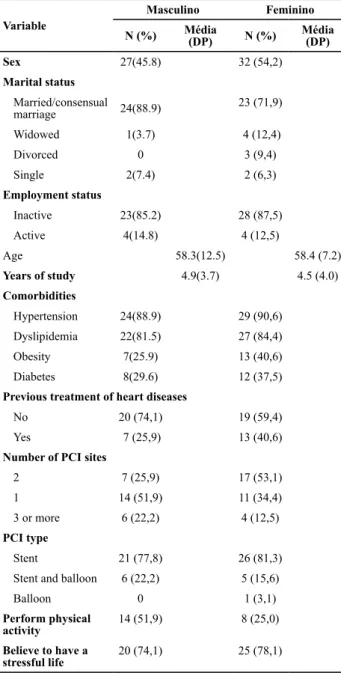
The majority of study paricipants were female (54.2%). In the comparison of sociodemographic variables according to sex, in both groups there was predominance of individu -als married or in consensual marriage (88.9% for males and 71.9% for females) and more than 10% of women were widows. The percentage of acive men was slightly higher than that of women (14.8% and 12.5%, respecively) and the median family income was also higher for the group of men (R$ 1,500.00 and 1,000.00 respecively). There was no difer -ence between the groups regarding mean age and years of study. In Table 1 the values are displayed in descending order according to the predominant group in each of the variables.
Women had more diagnosed comorbidiies than men, including hypertension, diabetes, dyslipidemia and obe -sity. They have also reported previous treatment for heart disease (myocardial infarcion, angina, arrhythmia, conges -ive heart failure and dyspnea) more frequently than men (40.6% and 25.9%, respecively). In 51.9% of men, the PCI was performed in a single place, whereas in women the procedure was more frequent in two locaions (53.1%), with predominance of use of stent in both groups (Table 1).
Eighteen men (66.7%) and 18 women (56.3%) had anxiety symptoms, and the diference between groups was not signiicant. There was a greater number of women with depression (43.7%) compared to men (14.8%) and the dif -ference between groups was signiicant (p=0.01).
Table 1 – Descriptive analysis of sociodemographic and clinical characteristics of participants according to sex – Ribeirão Preto, SP, Brazil, 2012.
Variable
Masculino Feminino
N (%) Média (DP) N (%) Média (DP)
Sex 27(45.8) 32 (54,2)
Marital status
Married/consensual
marriage 24(88.9)
23 (71,9)
Widowed 1(3.7) 4 (12,4)
Divorced 0 3 (9,4)
Single 2(7.4) 2 (6,3)
Employment status
Inactive 23(85.2) 28 (87,5)
Active 4(14.8) 4 (12,5)
Age 58.3(12.5) 58.4 (7.2)
Years of study 4.9(3.7) 4.5 (4.0)
Comorbidities
Hypertension 24(88.9) 29 (90,6)
Dyslipidemia 22(81.5) 27 (84,4)
Obesity 7(25.9) 13 (40,6)
Diabetes 8(29.6) 12 (37,5)
Previous treatment of heart diseases
No 20 (74,1) 19 (59,4)
Yes 7 (25,9) 13 (40,6)
Number of PCI sites
2 7 (25,9) 17 (53,1)
1 14 (51,9) 11 (34,4)
3 or more 6 (22,2) 4 (12,5)
PCI type
Stent 21 (77,8) 26 (81,3)
Stent and balloon 6 (22,2) 5 (15,6)
Balloon 0 1 (3,1)
Perform physical
activity 14 (51,9) 8 (25,0)
Believe to have a stressful life
20 (74,1) 25 (78,1)
Table 2 – Descriptive analysis of cases of anxiety and depression
of participants according to sex and values of probability (p)
asso-ciated with the Chi-square test – Ribeirão Preto, SP, Brazil, 2012.
Variable Male Female p-value
N % N %
Anxiety
Case 18 66.7 18 56.3
Non-case 9 33.3 14 43.7 0.41
Depression
Case 4 14.8 14 43.7
Non-case 23 85.2 18 56.3 0.01
DISCUSSIOn
The characterization of study participants regarding marital status and age resembles other studies of people with CAD(15-16), as well as in relaion to a higher family income for the group of men(16). However, in this study there was a great -er numb-er of women, and in oth-er studies that addressed individuals with CAD the number of men was greater(15-16).
The largest number of depression cases in women with CAD compared to men corroborates literature data(17-19). In a study that included paients with CAD a year ater diagnosis, there was a higher frequency of depressive symptoms in women, compared to men. When assessing depression via the Center for Epidemiological Studies Depression Scale (CESD), the mean found for women was 5.7 and for men it was 4.5 (p<0.001)(17).
1335
Rev Esc Enferm USP2013; 47(6):1332-6 www.ee.usp.br/reeusp/
Anxiety and depression among men and women who underwent percutaneous coronary intervention
Furuya RK, Costa ECA, Coelho M, Richter VC, Dessotte CAM, Schmidt A, Dantas RAS, Rossi LA
In a study that aimed to understand and describe the stories of life of women with depression by the qualitaive method and the methodological referenial of Oral History, the authors observed that women experience depression from a historical perspective, remembering important facts that accumulated and may have triggered the depres -sion(20). These facts may be related to the higher frequency of stressful life events and lower percepion of social sup -port, described as factors related to the higher frequency of depression in women.
In relaion to anxiety, in this study the number of cases was slightly higher in males comparing to females. How -ever, literature data show a higher prevalence of anxiety in women with CAD. In a study with CAD paients parici -paing of a cardiac rehabilitaion program, the assessment of anxiety was done using the Anxiety Disorders Interview Schedule-IV (ADIS-IV), which assesses both the current episodes of anxiety as those throughout life.
There was a greater percentage of women with at least one current anxiety disorder, compared to men (58.3% and 25.5%, respecively, p<0.001). Women were also more likely to experience any anxiety disorder at some point in their lives compared to men (70.8% and 33.3%, respecively, p<0.001)(21).
Studies including the comparison of mental health of men and women with CAD assessed by the HADS are scarce. Authors compared the means of the subscales of anxiety and depression and found a higher score of anxiety among women than among men: 5.3 and 3.3, respecively (p=0.03). In relaion to depression, the mean scores of women were also higher (3.8 for females and 2.5 for males, p = 0.07)(22).
In another study of paients with CAD, the HADS was used to assess anxiety and depression, considering three subscales: negaive afect, autonomic anxiety and depres -sion. The evaluaions were performed during hospitaliza -ion, six, 12 and 24 months ater discharge. In relaion to
sex, signiicant efects were found in the subscale of nega -ive afect and women had higher scores than men in all evaluaions (p<0.001). Women also had higher scores than men in the subscales of autonomic anxiety (p<0.001) and depression (p=0.002) considering all the evaluaions (in hospitalizaion and six, 12 and 24 months)(23). Women also praciced less physical exercise than men (p<0.001) and there were staisically signiicant relaionships between the variable physical exercise and the variables negaive afect, autonomic anxiety and depression(23).
The frequency of cases and non-cases of anxiety and depression was also analyzed considering three categories in each subscale: non case (0-7), possible cases (8-10) and probable cases (11-21). In all assessments, the percentage of women with probable and possible cases of anxiety and depression was higher than men(23). However no staisical analysis was performed to compare the percentage in each category according to sex.
The limitaion of this study is the small sample size. Future studies are needed to explore the reasons related to the greater frequency of depression in females. It is important to evaluate variables that may be related to de -pression, including social support, physical acivity pracice, the perceived health status and physical aspects. Qualitaive studies can also be carried out to explore aspects related to the understanding of the construct of depression in the view of women with CAD.
COnCLUSIOn
The group with depression showed a higher percent -age of women, with staisically signiicant associaion between the variables sex and depression, results that corroborate literature data. In relaion to anxiety, cases were more frequent in males, however discreetly, and the associaion between the variables sex and anxiety was not staisically signiicant.
1. Mathers CD, Loncar D. Projecions of global mortality and burden of diseases from 2002 to 2030 [images]. PLoS Med. 2006;3(11):e442.
2. Brasil. Ministério da Saúde. DATASUS. Sistema de Informação sobre Mortalidade -SIM [Internet]. Brasília; 2013 [citado 2013 jun. 23]. Disponível em: htp://tabnet.datasus.gov.br/cgi/ tabcgi.exe?sim/cnv/obt10uf.def
3. Go AS, Mozafarian D, Roger VL, Benjamin EJ, Berry JD, Borden WB, et al. Heart disease and stroke staisics - - 2013 update: a report from the American Heart Associaion. Circulaion. 2013;127(1):e6-e245.
4. Smith SC Jr, Feldman TE, Hirshfeld JW Jr, Jacobs AK, Kern MJ, King SB 3rd, et al. ACC/AHA/SCAI 2005 Guideline Update for Percutaneous Coronary Intervenion: a report of the American College of Cardiology/American Heart Associaion Task Force on Pracice Guidelines (ACC/AHA/SCAI Wriing Commitee to Update the 2001 Guidelines for Percutaneous Coronary Intervenion). Circulaion. 2006;113(7):e166-286.
5. Rozanski A, Blumenthal JA, Kaplan J. Impact of psychological factors on the pathogenesis of cardiovascular disease and implicaions for therapy. Circulaion. 1999;99(16):2192-217. 6. Khawaja IS, Westermeyer JJ, Gajwani P, Feinstein RE.
Depression and coronary artery disease: the associaion, mechanisms, and therapeutic implications. Psychiatry (Edgmont). 2009;6(1):38-51.
7. Nicholson A, Kuper H, Hemingway H. Depression as an aeiologic and prognosic factor in coronary heart disease: a meta-analysis of 6362 events among 146 538 paricipants in 54 observaional studies. Eur Heart J. 2006;27(23):2763-74. 8. Frasure-Smith N, Lespérance F. Depression and anxiety as
predictors of 2-year cardiac events in paients with stable coronary artery disease. Arch Gen Psychiatry. 2008;65(1):62-71. 9. Kazemi-Saleh D, Pishgoo B, Farrokhi F, Fotros A, Assari S. Sexual
funcion and psychological status among males and females with ischemic heart disease. J Sex Med. 2008;5(10):2330-7. 10. Möller-Leimkühler AM. Women with coronary artery disease
and depression: a neglected risk group. World J Biol Psychiatry. 2008;9(2):92-101.
11. Matos LA, Lemos Neto PA, Rassi Jr A, Marin-Neto JA, Sousa AGMR, Devito FS, et al. Diretrizes da Sociedade Brasileira de Cardiologia – Intervenção Coronária Percutânea e Métodos Adjuntos Diagnósicos em Cardiologia Intervencionista (II Edição – 2008). Arq Bras Cardiol. 2008;91(6 Supl 1):1-58. 12. Brasil. Ministério da Saúde; Conselho Nacional de Saúde. Resolução
n. 466, de 12 de dezembro de 2012. Dispõe sobre as diretrizes e normas regulamentadoras de pesquisas envolvendo seres humanos [Internet]. Brasília; 2012 [citado 2013 jan. 30]. Disponível em: htp://conselho.saude.gov.br/resolucoes/2012/Reso466.pdf 13. Botega NJ, Bio MR, Zomignani MA, Garcia Jr C, Pereira WA.
Transtornos do humor em enfermaria de clínica médica e validação de escala de medida (HAD) de ansiedade e depressão. Rev Saúde Pública. 1995;29(5):355-63.
14. Botega NJ, Pondé MP, Medeiros P, Lima MG, Guerreiro CAM. Validação da escala hospitalar de ansiedade e depressão (HAD) em pacientes epiléicos ambulatoriais. J Bras Psiq. 1998;47(6): 285-9. 15. Dessote CAM, Dantas RAS, Schmidt A. Paients’ symptoms
before a irst hospitalizaion due to acute coronary syndrome. Rev Esc Enferm USP [Internet]. 2011 [cited 2012 Aug 17];45(5):1097-104. Available from: htp://www.scielo.br/ pdf/reeusp/v45n5/en_v45n5a10.pdf
16. Silverio CD, Dantas RAS, Carvalho ARS. Gender-speciic evaluaion of coronary disease paients’self-esteem and social support. Rev Esc Enferm USP [Internet]. 2009 [cited 2012 Aug 17];43(2):407-14. Available from: htp://www.scielo.br/pdf/ reeusp/v43n2/en_a21v43n2.pdf
17. Norris CM, Spertus JA, Jensen L, Johnson J, Hegadoren KM, Ghali WA. Sex and gender discrepancies in health-related quality of life outcomes among paients with established coronary artery disease. Circ Cardiovasc Qual Outcomes. 2008;1(2):123-30.
18. Bouin-Foster C, Charlson ME. Do recent life events and social support explain gender diferences in depressive symptoms in paients who had percutaneous transluminal coronary angioplasty? J Womens Health (Larchmt). 2007;16(1):114-23.
19. Perez GH, Nicolau JC, Romano BW, Laranjeira R. Depression and acute coronary syndromes: gender-related diferences. Arq Bras Cardiol. 2005;85(5):319-26.
20. Gonçales CAV, Machado AL. Vivendo com a depressão: histórias de vida de mulheres. Rev. Esc. Enferm. USP. 2008;42(3):461-6.
21. Todaro JF, Shen BJ, Raffa SD, Tilkemeier PL, Niaura R. Prevalence of anxiety disorders in men and women with established coronary heart disease. J Cardiopulm Rehabil Prev. 2007;27(2):86-91.
22. Norris CM, Ljubsa A, Hegadoren KM. Gender as a determinant of responses to a self-screening quesionnaire on anxiety and depression by paients with coronary artery disease. Gend Med. 2009;6(3):479-87.
23. Hunt-Shanks T, Blanchard C, Reid RD. Gender diferences in cardiac paients: a longitudinal invesigaion of exercise, autonomic anxiety, negaive afect and depression. Psychol Health Med. 2009;14(3):375-85.
Acknowledgements