Clinical and prehospital survival
indicators in blunt trauma: a
multivariate analysis
*INDICADORES CLÍNICOS E PRÉ-HOSPITALARES DE SOBREVIVÊNCIA NO TRAUMA FECHADO: UMA ANÁLISE MULTIVARIADA
INDICADORES CLÍNICOS Y PREHOSPITALARIOS DE SUPERVIVENCIA AL TRAUMA CERRADO: UN ANÁLISIS MULTIVARIADO
* Extracted from the dissertation “Predetermining factors of survival in transportation accident victims submitted to advanced emergency life support”, School of Nursing at University of São Paulo, 2005. 1 Ph.D. in Nursing from School of Nursing at University of São Paulo. Nurse from Development and Research Division of advanced emergency life support SAMU 192 - São Paulo. São Paulo, SP, Brazil. [email protected] 2 Faculty, Free Lecturer at
Medical-O
RIGINAL
A
R
TICLE
RESUMO
O objetivo do estudo foi identificar os indi-cadores clínicos e pré-hospitalares associa-dos à sobrevivência de vítimas de trauma fechado. Foram utilizadas a análise de so-brevivência de Kaplan Meier, e de Riscos Proporcionais de Cox, para analisar a asso-ciação de 33 variáveis ao óbito precoce e tardio, propondo modelos multivariados. Os modelos finais até 48h pós-trauma evi-denciaram altos coeficientes de risco pro-movidos pelas lesões abdominais, Injury Severity Score >25, procedimentos respira-tórios avançados e compressões torácicas pré-hospitalares. No modelo até 7 dias, a pressão arterial sistólica na cena do aciden-te, se menor de 75mmHg, foi associada a maior risco de óbito e se ausente, foi asso-ciada ao mais elevado risco de óbito após 7 dias. A reposição de volume pré-hospitalar apresentou efeito protetor em todos os períodos. Os resultados sugerem que a magnitude da hipoxemia e da instabilida-de hemodinâmica diante da hemorragia, influenciaram de forma significante o óbi-to precoce e tardio desse grupo de vítimas.
DESCRITORES
Traumatismo múltiplo. Sobrevivência.
Modelos de riscos proporcionais. Acidentes de trânsito.
Marisa Aparecida Amaro Malvestio1, Regina Marcia Cardoso de Sousa2
ABSTRACT
The aim of the study was to identify the clinical and prehospital indicators associ-ated to the survival of blunt trauma victims. The Kaplan Meier survival analysis and the Cox proportional hazards model were used to analyze the association of 33 variables to early and late death, proposing multivari-ate models. The final models until 48 hours post-trauma showed high rates of risk pro-moted by abdominal injuries, Injury Sever-ity Score > 25, advanced respiratory proce-dures and prehospital chest compressions. In the model up to 7 days, a systolic blood pressure in accident site lower than 75mmHg was associated with increased risk of death, and if absent it was associated with higher risk of death after 7 days. The prehospital volume replacement showed a protective effect in all periods. Results sug-gest that the magnitude of hypoxemia and hemodynamic instability due to bleeding had a significant influence on early and late death in this group of victims.
KEY WORDS
Multiple trauma. Survival.
Proportional hazards models. Accidents, traffic.
RESUMEN
El objetivo del estudio fue identificar los indicadores clínicos y prehospitalarios aso-ciados a la supervivencia de víctimas de trau-ma cerrado. Fueron utilizados el Análisis de Supervivencia de Kaplan-Meier y de Riesgos Proporcionales de Cox para examinar la aso-ciación de 33 variables respecto de la muerte temprana y tardía, proponiéndose modelos multivariados. Los modelos finales hasta 48 horas post trauma mostraron altos coeficien-tes de riesgo promovidos por las lesiones ab-dominales, Injury Severity Score > 25, proce-sos respiratorias avanzados y compresiones torácicas prehospitalarias. En el modelo has-ta 7 días, la presión arterial sistólica en la es-cena del accidente, cuando resultó inferior a 75mmHg, se asoció con mayor riesgo de muerte y, en caso de ausencia, se asoció con el mayor riesgo de muerte posterior a 7 días. La reposición de volumen prehospitalario mostró un efecto protector en todos los pe-ríodos. Los resultados sugieren que la magni-tud de la hipoxemia y la inestabilidad hemodinámica debida a la hemorragia influ-yeron de manera significativa en la muerte temprana y tardía en este grupo de víctimas.
DESCRIPTORES
Traumatismo múltiple. Supervivencia.
INTRODUCTION
Countless variables interfere in the survival result of blunt trauma patients. These involve the severity of the trauma event, the victims’ clinical conditions and injuries suffered, in addition to the emergency and intra-hospital care models of the received care(1-3).
This multiplicity of factors makes it difficult to statisti-cally demonstrate the association between the result and one or more variables and, therefore, to determine prog-nostic indicators of blunt traumas, mainly indicators of the emergency phase, which relate to a very short care period(2).
In the attempt to determine this association, the use of mortality analysis as a statistical method is common(4-5), al-though this type of analysis privileges the dichotomous result living or dying and does not permit observing the variables’ impact over time, until the result.
The use of survival analysis can permit this observation, as the dependent variable becomes the time until death, while independent variables are the different factors that can interfere in the occurrence of this event over time(6-9). Through this approach, the prognostic
indica-tors related to early or late death can be evi-denced according to certain time periods, de-pending on scientific interest.
In trauma research, this type of analysis has been used to assess the results of patients with head and brain traumas(6-7) and severely traumatized patients(8). In these studies, though, except for intubation at the accident
scene, interventions or variables related to the victim’s as-sessment in the prehospital care period were not taken into account.
This research aims to identify the factors that influenced the survival of a group of blunt trauma victims attended within the same prehospital and intra-hospital care model, using the statistical technique of survival analysis, with a view to favoring evidence about the impact of clinical and emergency care variables over time after the trauma, pro-posing a multivariate model that explains these victims’ survival and reveals the mortality risk.
METHOD
Retrospective and longitudinal research, using data from the prehospital and intra-hospital care phases related to 175 transportation accident victims in São Paulo City/Bra-zil, between April 1999 and March 2003 and authorized under process 274/2002/CEP/EEUSP and letter 015/2003/ CEP by the São Paulo Municipal Health Office. All victims were between 12 and 65 years old, with a Revised Trauma Score for screening (RTSt) <11 at the accident scene, and were attended and transported by an advanced life
sup-port team (ALS) from the municipal prehospital care ser-vice (PHC) to a tertiary hospital.
Data were collected from ALS records, from the victims’ hospital files and, when necessary, from autopsy reports. Criteria to include the victims in this research were estab-lished to compose a study group with a similar trauma mechanism, physiological alteration detected as early as the prehospital care phase and who, because they needed more medical and technological care resources, received ALS care and were forwarded to tertiary hospitals.
The variables analyzed in terms of the victims’ survival time were:
a) Clinical variables: gender, age, trauma mechanisms (victim’s vehicle, victim’s position in the vehicle and type of impact), physiological repercussion at the accident scene and trauma severity.
b) Prehospitalcare variables: time consumed in differ-ent ALS phases (response time, scene time and total time) and procedures performed. The following ALS procedures were considered:
• Basic respiratory support: oxygen therapy,
Guedel airway and aspiration;• Immobilizations: cervical collar, long
board and limbs immobilization;• Basic circulatory support:
cardiorespira-tory reanimation (CPR) and dressings;•
Advanced respiratory support: oro-tracheal intubation (OTI), percutaneous tran-stracheal ventilation (PTV), thoracic puncture and/or drainage;• Advanced circulatory support: venous access,
crystal-line solution infusion for volume replacement (> or < than 1000 ml) and drugs administered.Time intervals were analyzed considering cut-off points at 10 minutes of response or scene time and intervals of 30 and 60 minutes of total time.
The physiological repercussion of the trauma at the acci-dent scene was assessed through the total (ranging from 0 to 12 points, with zero as the worst result and scores <10 as critical) an partial RTSt, (systolic blood pressure, respiratory frequency and Glasgow Come Scale) and through the fluc-tuation in these parameters until the hospital unit (subtract-ing the score upon arrival at the scene from the score upon arrival at the hospital). Positive fluctuations were considered a sign of improvement in the victim’s physiological condition during the ALS phase. If negative, the fluctuation appointed worsening in the initial condition. The absence of fluctua-tion was considered as maintenance of the condifluctua-tion.
To determine the patients’ global severity, the Injury Se-verity Score (ISS)(10) and the Maximum Abbreviated Injury
This research aims to identify the factors that
influenced the survival of a group of blunt
Scale (MAIS)(11) were used. The ISS was categorized as 1 to <16 (mild trauma), 16 to <25 (moderate trauma) and >25 (severe trauma). The MAIS(11) according to body region (face, head, neck, thorax, abdomen, spine, upper limbs, lower limbs and external surface) was used to express the inju-ries’ global severity per body region. Any injury of MAIS>3 was considered severe; injuries of MAIS=2 were moderate and MAIS=1 mild.
The dependent variable was survival time after the ac-cident, analyzed according to the intervals of interest: within 6 hours, up to 12 hours, up to 24 hours, up to 48 hours, up to 7 days and until hospital discharge if superior to 7 days. Deaths occurred after discharge from hospital were not taken into account.
Kaplan Meier’s Survival Analysis (KMSA) was used to determine the variables associated with survival in each interval (Log rank test, p<0.05). Event was considered as death by trauma and censored data were related to pa-tients who were alive or discharged until each of the inter-vals under analysis(9).
The variables selected by KMSA were submitted to mul-tivariate analysis using Cox’ Proportional Hazards Regres-sion Model(9) (CPHRM), (Wald test, p<0.05), which estimates the effect of an independent variable on survival after be-ing adjusted by the estimated effect of other variables, so as to estimate the mortality risk of a group of people when different prognostic variables are present(9).
Forward selection was used as a modeling process, start-ing with procedure and RTS-related variables, followed by modeling with trauma severity-related variables. The vari-ables were removed from the model when they did not reach a statistically significant association. The final model presented the best statistical significance and clinical clar-ity. SPSS 10.0 was used for statistical analysis.
The retrospective analysis used in this research imposes some limitations, such as wrong or inexistent notes, which cannot be minimized, mainly in the emergency care phase, when the scene is inhospitable and leads to difficulties to make notes, as well as loss of patients who, even after three system-atic searches, were not located in any of the study phases.
RESULTS
The total group comprised 175 patients, 86.9% of whom were male, mostly between 20 and 39 years of age
(61.1%), with a mean age of 31.9 years (sd 11.3; med 30); 45.1% of victims were pedestrians, 30.9% motorcycle driv-ers and 18.9% were in vehicles. Among patients who were in some kind of vehicle, 36.4% received a frontal impact and 27.1% a lateral impact; other types of impacts were less frequent.
On the average, ALS response time was 8.6 min (sd 6.3min), scene time 20.2 min (sd 11.7 min) and total time 41.0 min (sd 17.7 min), with 84.6% of the victims reaching the destination hospital within less than 60 minutes after the trauma.
Among Basic Life Support procedures, immobilizations were the most frequent (98.9%). Oxygen therapy was needed in 96.0% of the victims. Thoracic compression ma-neuvers were executed in 16 victims (9.2%). Peripheral venous punctures for volume replacement or medication were the most frequent Advanced Life Support procedures (92.0%), and isotonic crystalloid solutions with volumes of less than 1000ml were the most frequent option for vol-ume replacement, 70.7% (Ringer’s lactate 57.9%). Medica-tion use was described in only 33.1% of the victims, with psychoactive drugs and sedatives as the most common medicines (16.0%). Advanced airway procedures were per-formed in 38.2% of the victims, with OTI as the most fre-quent intervention.
The mean RTSt at the scene was 8.8 (sd 3.2; med 10). Victims with RTSt<10 corresponded to 57.1%. RTSt fluctua-tions were observed in 54.3% of the victims (39.4% with positive fluctuation). The Glasgow Coma Scale (m 9.2; sd 4.2; med 9) showed the largest number of victims with posi-tive (19.4%) and negaposi-tive (12.0%) fluctuations.
As for the ISS, (µ 19.4, sd 14.1; med 17; min 1; max 57),
victims with ISS <16 corresponded to 39.4% and severe trauma victims (>25), 37.2%.
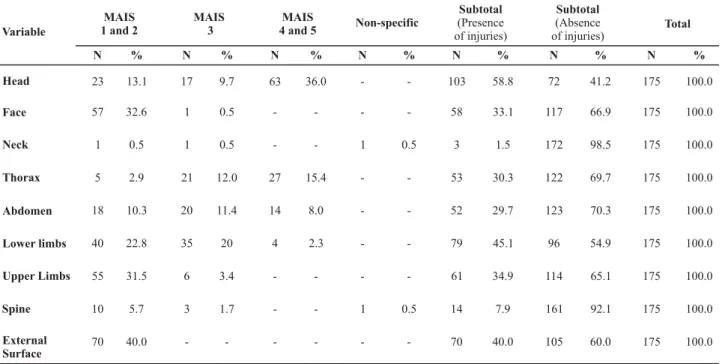
The most frequently affected body segments were the head, lower limb and external surface (Table 1). MAIS scores 4 and 5 were observed in victims with head, thorax and abdominal injuries and lower limb.
Table 1 - Distribution (No. and %) of victims according to presence of injuries and MAIS, considering the body segments included in the AIS - São Paulo - 1999/2003
Variable
MAIS 1 and 2
MAIS 3
MAIS
4 and 5 Non-specific
Subtotal (Presence of injuries) Subtotal (Absence of injuries) Total Head Face Neck Thorax Abdomen Lower limbs Upper Limbs Spine External Surface N 23 57 1 5 18 40 55 10 70 % 13.1 32.6 0.5 2.9 10.3 22.8 31.5 5.7 40.0 N 17 1 1 21 20 35 6 3 -% 9.7 0.5 0.5 12.0 11.4 20 3.4 1.7 -N 63 -27 14 4 -% 36.0 -15.4 8.0 2.3 -N -1 -1 -% -0.5 -0.5 -N 103 58 3 53 52 79 61 14 70 % 58.8 33.1 1.5 30.3 29.7 45.1 34.9 7.9 40.0 N 72 117 172 122 123 96 114 161 105 % 41.2 66.9 98.5 69.7 70.3 54.9 65.1 92.1 60.0 N 175 175 175 175 175 175 175 175 175 % 100.0 100.0 100.0 100.0 100.0 100.0 100.0 100.0 100.0
Table 2 - Distribution of victims (No. and %), according to exit condition and time until death after the trauma event São Paulo -1999/2003
Table 2 shows that, of all victims in the sample, 63 (36.0%) died, 32 deaths (50.8%) during the first 6h and 13 (20.6%) more than 7 days after the accident. Seven deaths (11.1%) occurred up to the first hour after the accident.
In the KMSA applied to the 33 variables described (Table 3), 11 emergency and 5 clinical variables showed a statisti-cally significant association with survival at all intervals under analysis; 3 variables were associated with specific intervals and 14 were not statistically associated with sur-vival. Statistically associated variables were selected for modeling, using the CPHRM technique.
Table 4 shows that the final models involved 3 emer-gency care and 3 other clinical variables.
Exit condition N %
Death within 6h 32 18.3
Death between 6h and <12h 5 2.9
Death between 12h and <24h 4 2.3
Death between 24h and <48h 3 1.7
Death between 48h and <7 days 6 3.4
Death within more than 7 days 13 7.4
Subtotal – Deaths 63 36.0
Hospital discharge 108 61.7
No Information* 4 2.3
Total 175 100
Table 3 - Distribution of variables according to KMSA result - São Paulo - 1999/2003
Associated with survival in all time intervals*
Associated with survival in
specific time intervals* Not associated with survival
? ? ? ? ? ? ? ? ? ?
Basic circulatory procedures Advanced respiratory procedures Replaced volume
Drugs
RF, SBP and initial GCS Total RTS
Fluctuation in total RTS Fluctuation in RF and GCS ISS
MAIS thorax, abdomen, lower limbs and External surface
?
?
?
Basic respiratory procedures (at intervals between 6 and 12h)
Advanced circulatory procedures (at all intervals up to 7 days)
MAIS head (at interval after 7 days)
? ? ? ? ? ? ? Gender Age
Accident mechanisms (vehicle and victim's position, type of impact)
Response time, scene and total Fluctuation in SBP
Table 4 - Cox’ proportional hazard regression coefficients according to variable and predetermining category, selected for the model and according to studied interval - São Paulo - 1999/2003
5.2 p<0.001 1 -0.1 p=0.002 0.1 p=0.005 1 2.6 p=0.019 3.9 p=0.002 3.6 p=0.016 1 1 3.7 p<0.001 6.5 p<0.001 2.2 p=0.108 1.7 p=0.128 10.1 p<0.001 10.9 p<0.001 1 1 3.2 p=0.034 -0.9 p=0.999 -1 0.04 p<0.001 0.1 p<0.001 0.05 p<0.001 0.1 p=0.001 1 1 4.8 p=0.002 3.6 p=0.006 11.2 p<0.001 8.0 p<0.001 16.7 p<0.001 6.2 p=0.002 1 1 1 1 3.0 p=0.008 3.3 p=0.004 - 6.7 p<0.001 - 3.1 p=0.041 - 2.1 p=0.086 8.8 p<0.001 9.2 p<0.001 1 1 6.6 p=0.003 4.1 p=0.014 1.5 p=0.398 1.0 p=0.851 1 1 0.1 p=0.002 0.04 p< 0.001 0.1 p=0.005 0.05 p<0.001 1 1 3.1 p=0.073 4.8 p=0.004 11.0 p<0.001 10.3 p<0.001 9.1 p<0.001 13 p<0.001 1 1 1 1 4.0 p=0.008 4.5 p=0 .002 - -- --
-Variable and category Within
6 hours Up to 12 hours Up to 24 hours Up to 48 hours Up to 7 days Until hospital discharge
Advanced respiratory procedures
Performed 8.8
p<0.001
Not performed* 1
Basic Circulatory Procedures
Thoracic pressure with or without compressive dressing
6.7
p=0.004
Compressive dressing 1.0
p=0.928
Not performed* 1
Replaced volume Crystalloid Sol. <1000ml 0.1 p=0.003 Crystalloid Sol. >1000ml 0.1 p=0.013
Not performed* 1
MAIS Abdomen
1 and 2 4.2
p=0.033
3 9.7
p<0.001
4 and 5 7.4
p=0.001
No injuries* 1
ISS
1 to <25 * 1
>25 4.2
p=0.014
Initial SBP in Emergency Life Support
0=Absent
-1 and 2= -1 to 75mmHg
-3=76 to 89mmHg
-4= > 89mmHg * - - - - 1 1
(a) Descriptive significance level according to Wald test (*) Baseline category (-) Not selected for the interval model.
The final models for intervals of up to 48h comprised the same prognostic variables and evidenced the growing importance of the abdominal segment during this period through the highest death risk coefficients. In this phase, high death risk levels also stood out for victims who needed advanced respiratory procedures or thoracic compressions in the ALS phase, as well as the importance of global trauma severity and the protective effect of volume replacement.
In the interval of up to 7 days, thoracic compressions lost significance in the adjusted model and another
circu-latory component was included: the SBP at the accident scene. If lower than 75mmHg, this was associated with greater mortality risk in this interval and, if absent, this was associated with higher death risk after 7 days. Volume re-placement maintained its protective effect in all periods.
up to the first week after the accident, when it was 10.9 times higher.
In the final models for the period up to 48h, victims with abdominal injuries of MAIS>3 showed a growth trend of the regression coefficients. Victims with MAIS 1 and 2 presented significant coefficients only as from intervals of up to 24h.
The adjusted death risk coefficients of the ISS variable presented significance during the entire analysis period. The maximum coefficient was reached in the interval of up to 24h (p=0.002).
DISCUSSION
As presented in this study, since 1983, the Trimodal Trauma Mortality Distribution(12) already appoints the im-portance of considering the time between the trauma and death when determining the factors associated with this result.
To describe the Trimodal distribution, the author(12) pre-sented the results for a sample of trauma victims of differ-ent etiologies with fatal results, submitted to mortality analysis, concluding that deaths were distributed in three time intervals. The first peak referred to deaths occurred during the first minutes, while still at the accident scene, due to severe brain, heart, thorax or aorta injuries (45%). Deaths occurred within 60 minutes after the trauma con-stituted the second peak with 34% and were associated with the occurrence of hemopneumothorax, pelvic and abdominal organ injuries, extra and subdural hematoma or long bone fractures. Deaths after several days or weeks due to infections or multiple organ failure represented the third peak, with about 20% of all deaths(12).
Despite the similarity in the proposal and involvement of abdominal and thoracic injuries, though, in this research, the association between head injuries and deaths was found in the late post-trauma phase (7 days) only and, even when considering that the head was the most affected segment in percentage terms, with the common occurrence of MAIS 4 and 5 injuries in this segment (36%), this did not affect the variable’s inclusion in the final model in any interval.
Head and brain injuries’ later involvement with deaths and thorax, abdominal, lower limb and external surface injuries’ involvement with deaths since the earliest phase until late post-trauma periods were already demonstrated in other studies that used the statistical strategy of survival analysis(6,8), alerting about the probable association be-tween hemorrhagic causes and negative results until late phases. Researchers(1) affirm that patients with head and brain injuries can benefit from stabilization at the accident scene, particularly from procedures to optimize oxygenation and circulation, which help to prevent secondary injuries due to hypoxia or cerebral edema, delaying death.
Time is a critical factor in care delivery to trauma vic-tims(1-2,4), but the time consumed in the emergency care phase was not associated with survival in Kaplan Meier’s univariate analysis in any of the intervals (Table 3), even when considering internationally accepted cut-off points like the Platinum ten minutes at the scene(1) or the thirty(1) and sixty-minute intervals of total time, called the golden hour(13). The more homogeneous composition of the group, already justified in the methods section, may have contrib-uted to this result, favoring the statistical association of other variables of greater clinical interest.
In general, the multivariate models presented in this research reflect the synergistic relation between the occur-rence of hypoxemia, hemodynamic instability and hemor-rhage and deaths, confirming that these factors and their repercussions constitutes trauma victims’ main enemies(14).
In the final models, the advanced respiratory procedures
and basic circulatory procedures, i.e. OTI and external tho-racic compression maneuvers in the emergency care phase, resulted in high death risk coefficients.
Other studies(1-2,4) already demonstrated low survival rates among victims submitted to OTI, but did not justify the abandonment of this procedure. Early OTI permits cor-rect lung expansion and avoids intra-pulmonary shunt, de-laying the adverse effects of hypoxia(3). The clinical inter-pretation of this variable in the model is that the victim needed the procedure due to the repercussion of the trauma and it is this need that entails risk, instead of the accomplishment of the procedure. OTI should be acknowl-edged as a prognostic factor that indicates high risk of death, given its indication in already complex situations, ratifying that hypoxia and hypoperfusion provoked by severe trauma represent high death risks, even in cases of intervention.
Nevertheless, it needs to be taken into account that the high mortality rates after OTI can also be related with intu-bation difficulties at the accident scene, delays to perform the procedure or even badly accomplished and/or aggres-sive ventilation post-OTI, with hyperventilation(3) and, there-fore, against international care parameters(13). The analysis of OTI procedure difficulties and decision making to per-form the procedure, as well as the ventilation technique after OTI and its implications, represent an interesting per-spective for further research.
on scene CPR procedures into their protocols, attempting to maximize the survival of blunt trauma victims.
The practical value of ISS or MAIS to guide therapy is limited. The use of these scales, however, permitted knowl-edge about the body segments related to survival and this recognition can change protocols to treat these patients.
Considering the analysis of clinical variables with the multivariate technique, in this sample, the commitment of the abdominal region seems to have been preponderant for negative results, as well as ISS with a cut-off point >25, producing good adjustment of the models. This combina-tion of clinical variables seems to have better expressed the severity of the clinical situation, to the detriment of the physiological repercussion expressed by the RTSt and injuries to other specific body segments like the head.
In transportation accidents, abdominal injuries result from rapid speed changes, which can lead to vein and organ ruptures and bleedings of different intensities(13). In multiple trauma victims, the discrete signs of physiological alteration this bleeding provokes can impair, delay or sublimate the diagnosis of abdominal injuries until late periods(13). There-fore, for care delivery to abdominal trauma victims, it is key to maintain high levels of suspicion of this type of injury(13).
Although deaths due to abdominal traumas are consid-ered avoidable(13,16), the noteworthy involvement of the abdominal segment in the present models may be related exactly to the lack of recognition that injuries exist, the pres-ence of hemorrhage and the abspres-ence of appropriate inter-ventions for the diagnosis, treatment and control of its com-plications. Among complications, shock and abdominal compartment syndrome stand out, very common in the very aggressive volume replacements that happen in the initial phase of care and affect survival results in the late phase(17).
The use of crystalloid solution in volume replacement is strongly emphasized in the early treatment of trauma victims as a form of combating shock, although this resource does not correct the systemic inflammatory event provoked by hypoperfusion(13,18) .
The final regression models demonstrated that both vol-ume categories replaced in the emergency care phase were related to lower mortality risks in all intervals. This protec-tive and linear effect indicates that the benefit this proce-dure generates can influence the results for longer periods.
The approach of the relation between the volume re-placed in the ALS phase and trauma patients’ survival is not very clear yet(13) although nowadays, for blunt trauma victims, there is an international trend to support the use of smaller volumes for emergency volume replacement until surgical treatment is possible, with a view to preventing new bleedings and hemodilution, which are clinical condi-tions that favor shock(1-2,5,13,16).
The inclusion of the initial SBP variable (at the accident scene) in models for the last two intervals ratifies the hy-pothesis that hemodynamic instability as early as at the accident scene can commit the long-term evolution of the situation, constituting an important severity indicator.
Researchers(19) have already demonstrated that mortal-ity associated with hemodynamic instabilmortal-ity detected early is related with multiple organ failure due to the production of a great variety of chemical mediators that result in a state that favors coagulation and influences mortality among multiple trauma patients. Like in this research, the authors demonstrated that mortality caused by this instability can appear in a bi-modal distribution, with a first peak during the first three days and a second peak between the fifth and seventh day, justifying the variable’s inclusion in the model after 48h and its permanence until later periods.
Nowadays, international researchers(17-19) have defended more aggressive protocols to treat shock in blunt trauma victims, in the emergency care phase as well as upon ar-rival to the emergency care unit, so as to avoid hypoper-fusion and its devastating and acknowledged determining effects for survival.
The incorporation of minimally invasive shock monitor-ing technologies, reserved for ICUs today, has been stimu-lated at emergency care units, with a view to the early de-tection o hypoperfusion(17-19).These technologies involve the serial measurement of hemodynamic parameters to assess the progress of the systemic dysfunction, including arterial gasometry; measurement of hemoglobin and arterial lac-tate, prothrombin and thromboplastin time, central venous pressure, urinary debit and arterial and venous saturation.
This diagnostic monitoring, associated with surgical and interventionist radiology techniques, has improved survival results in developed countries and its early implementa-tion can represent an important change in the shock ap-proach strategy and a technical and political challenge for developing countries(16-18).
CONCLUSION
REFERENCES
1. Hodgetts TJ, Smith J. Essential role of prehospital care in the optimal outcome from major trauma. Emerg Med. 2000;12(1): 103-11.
2. Macfarlane C, Benn CA. Evaluation of emergency medical systems: a classification to assist in determination of indicators. Emerg Med J. 2003;20(2):188-91.
3. Pepe PE. Controversies in prehospital management of major trauma. Emerg Med. 2000; 12(1):180-9.
4. Spaite DW, Criss EA,Valenzuela TD, Meislin HW. Pre-hospital advanced life support for major trauma: critical need for clinical trials. Ann Emerg Med. 1998;32(4):480-9.
5. Regel G, Stalp M, Lehmann U, Seekamp A. Pre-hospital care, importance of early intervention on outcome. Acta Anaesthesiol Scand. 1997;110 Suppl:71-6.
6. Combes P, Fauvage B, Colonna M, Pasgia JG, Chirossel JP, Jacquot C. Severe head injuries: an outcome prediction and survival analysis. Intensive Care Med. 1996; 22(12):1391-5.
7. Bulger EM, Nathens AB, Rivara FP, Moore M, Mackenzie EJ, Jurkovich MD. Management os severe head injury: institutional variations in care and effect on outcome. Crit Care Med. 2002;30(8):1870-5.
8. Oakley PA,Mackenzie G,Templeton J,Cook AL,Kirby RM. Longi-tudinal trends in trauma mortality and survival in Stoke-on-Trent 1992-1998. Injury. 2004;35(4):379-85.
9. Bustamante-Teixeira MT, Faerstein E, Latorre MR. Técnicas de análise de sobrevida. Cad Saúde Pública. 2002;18(3):579-94.
10. Baker SP, O’Neill B, Haddon W Jr, Long WB. The Injury Severity Score: a method for describing patients with multiple injuries and evaluating emergency care. J Trauma. 1974; 14(3):187-96.
11. Association for the Advancement of Automotive Medicine (AAAM). The Abbreviated Injury Scale (AIS):1990 Revision. Update 98. Illinois: Des Plaines; 1998.
12. Trunkey DD. Trauma. Sci Am. 1983;249(2):28-35.
13. National Association of Emergency Medical Technicians (NAEMT). Comitê do PHTLS em cooperação com o Comitê de Trauma do Colégio Americano de Cirurgiões. Atendimento pré-hospitalar ao traumatizado: básico e avançado. Rio de Janeiro; 2004.
14. Novo FCF. Choque em trauma. In: Poggetti R, Fontes B, Birolini D. Cirurgia no trauma. São Paulo: Rocca; 2006. p. 61-7.
15. Pickens JJ, Copass MK, Bulger EM. Trauma patients receiving CPR: predictors of survival. J Trauma. 2005;58(5):951-8.
16. Cabrales RA, Castaño J, Garcia F. Trauma abdominal: factores predictivos de complicatción y muerte. Rev Colomb Cir. 1994;9(3):137-41.
17. Britt RC, Gannon T, Collins JN, Cole FJ, Weireter LJ, Britt LD. Secondary abdominal compartimental sundrome:risk factors an outcomes. Am Surg. 2005;71(11):982-5.
18. Moore FA, Mckinley BA, Moore EE. The next generation in shock resuscitation. Lancet. 2004;363(9425):1988-96.