REVISTA DE
ODONTOLOGIA
DA UNESP
Rev Odontol UNESP. 2013 Sept-Oct; 42(5): 389-392 © 2013 - ISSN 1807-2577
CLINICAL REPORT
Conservative surgical-orthodontic treatment of a
young patient with a dentigerous cyst
Tratamento cirúrgico conservador e ortodôntico em paciente jovem com cisto dentígero
Marina Lara DE CARLI
a, Fernanda Rafaelly de Oliveira PEDREIRA
a, Eduardo Pereira GUIMARÃES
a,
Nayara Nery de Oliveira DIAS
a, Alessandro Antônio Costa PEREIRA
a, João Adolfo Costa HANEMANN
aaFaculdade de Odontologia, UNIFAL – Universidade Federal de Alfenas, Alfenas, MG, Brasil
Resumo
Introdução: Cisto dentígero é um cisto odontogênico de desenvolvimento cuja abordagem terapêutica depende do tamanho da lesão. A proposta desse relato foi descrever o tratamento realizado em um paciente do gênero masculino de 14 anos de idade portador de cisto dentígero envolvendo o segundo molar permanente inferior esquerdo. Relato de caso: Foi realizada a exodontia do primeiro molar permanente inferior esquerdo e a lesão foi descomprimida e marsupializada através de um dreno de acrílico suturado na mucosa. O espécime retirado durante o ato cirúrgico conirmou o diagnóstico de cisto dentígero. Após 90 dias, houve diminuição signiicativa da lesão. Em seguida, iniciou-se o tratamento ortodôntico, que incluiu o tracionamento do dente impactado e a abertura de um espaço adequado com um aparelho ixo, proporcionando alinhamento e nivelamento favoráveis. Conclusão: A marsupialização e o tracionamento ortodôntico devem ser considerados quando se planeja o tratamento de cisto dentígero, principalmente em pacientes jovens com lesões extensas, a im de preservar estruturas nobres adjacentes à lesão.
Descritores: Cisto dentígero; descompressão cirúrgica; ortodontia corretiva.
Abstract
Introduction: he dentigerous cyst is a developmental odontogenic cyst, whose therapeutic approach depends on the size of the lesion. his paper describes the treatment performed on a 14-year-old male patient who presented with a large dentigerous cyst on the permanent mandibular let second molar. Case report: he permanent mandibular let irst molar was extracted, and the lesion was decompressed and marsupialized by excision of the overlying mucosa, opening a window into the cystic cavity and suturing an acrylic resin drain to the oral mucosa. he specimen removed during surgery conirmed the diagnosis of a dentigerous cyst. Within ninety days of surgery, there was a signiicant reduction in lesion size. Orthodontic treatment was then started, and included traction of the impacted tooth and opening of adequate space with a ixed appliance, providing favorable tooth alignment and leveling.
Conclusion: Marsupialization and orthodontic traction should be considered when planning the treatment of a dentigerous cyst, mainly in young patients with large lesions, to avoid damage to the surrounding structures.
Descriptors: Dentigerous cyst; decompression surgical; orthodontics corrective.
INTRODUCTION
he dentigerous cyst is the second most common type of developmental odontogenic cyst, accounting for approximately 20% of all true cysts of the jaws1. It develops in two ways: by
accumulating luid between the reduced enamel epithelium (REE) and the crown of an embedded tooth, or by accumulating luid between layers of the REE2,3. Dentigerous cysts are
asymptomatic, except if secondarily infected, and are generally discovered through a panoramic radiographic examination2,4.
Dentigerous cysts can reach a considerable size ater some time4,
and can cause expansion of the cortical bone followed by facial asymmetry, pain, tooth displacement and root resorption5.
he diagnosis of the dentigerous cyst includes clinical, radiographic, and histopathological aspects. Radiographically,
the lesion presents as a radiolucent, unilocular area with well-deined borders, and is associated with an embedded tooth6. A
normal follicular space measures 3 to 4 mm; when a follicular space measuring more than 5 mm is observed, a dentigerous cyst is suspected7. he histopathological criteria include the presence
of a ibrous capsule with minimal inlammatory cells and covered by stratiied squamous nonkeratinized epithelium with 4 to 6 layers of cells6.
he treatment proposed for dentigerous cysts depends on the extension of the lesion. Small lesions can be surgically removed in order to prevent harm to the succeeding permanent tooth8,
390 De Carli, Pedreira, Guimarães et al. Rev Odontol UNESP. 2013; 42(5): 389-392
favoring both lesion reduction7,9 and eruption of the impacted
tooth. When spontaneous eruption does not occur, orthodontic traction is indicated7,10.
his article reports a case of a dentigerous cyst associated with an impacted tooth in a teenage patient, where a multidisciplinary approach was taken, including conservative surgery and orthodontic traction.
CASE REPORT
A 14-year-old male patient of mixed African-European descent was seen at the Stomatology Clinic of the School of Dentistry, Federal University of Alfenas, Alfenas, MG, Brazil, showing an asymptomatic lesion on the right side of the mandible. he lesion was discovered on a panoramic radiographic exam, which was requested to investigate into the non-eruption of the permanent mandibular second molars. he patient denied any trauma or infection in this area. His medical history was unremarkable. No signiicant changes were noted during the intraoral examination. he panoramic radiographic exam showed a radiolucent, unilocular lesion associated to the crown of the unerupted mandibular let second molar, surrounded by a slightly opaque halo extending from the mesial aspect of the mandibular let second premolar to the vicinity of the unerupted mandibular let third molar. he lower limit of the lesion was close to the basilar portion of the mandible (Figure 1).
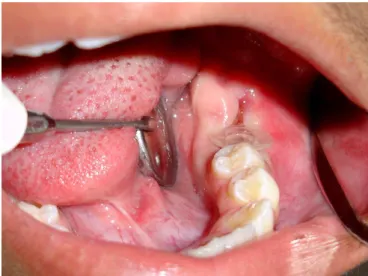
he diagnostic hypotheses were dentigerous cyst and inlammatory follicular cyst. he proposed treatment was extraction of the permanent mandibular let irst molar, owing to extensive root resorption, cystic decompression and placement of an acrylic resin drain (Figure 2).
An incisional biopsy was performed and the microscopic analysis of the specimen revealed a cystic cavity lined by a cuboidal, nonkeratinized, thin, stratiied, squamous epithelium and a capsule of dense ibrous connective tissue. A lat epithelial-connective tissue interface was observed (Figure 3).
Based on the observation of radiographic and microscopic aspects, the diagnosis was made of a dentigerous cyst. he acrylic resin drain was kept in place for 90 days, ater which a marked decrease in lesion size and eruption of the mandibular let third molar were observed (Figure 4).
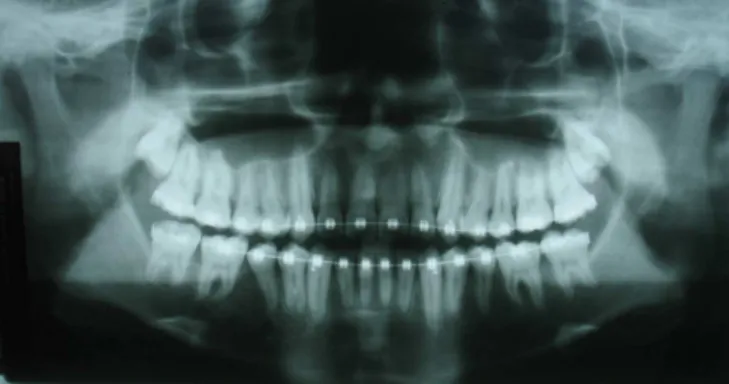
Extraction of the permanent mandibular right irst molar was performed at this time. hree months later, orthodontic treatment was initiated, consisting of the placement of ixed inferior and superior appliances, according to the Edgewise prescription (Edgewise Slim, Morelli, Sorocaba, SP, Brazil). Cementation of orthodontic bands was performed on the mandibular let and right third molars. A stainless steel open coil spring and a .014-in NiTi archwire were used both to make space for the permanent mandibular second molars and to verticalize the mandibular third molars. Traction of the mandibular permanent let second molar was initiated by bonding an orthodontic button to its occlusal surface. he button was then fastened to a 0.30 mm wire ligature, which, in turn, was tied to the archwire. Six months ater placing the ixed appliance, the button was removed, and leveling and alignment of the permanent mandibular second molars were completed. Sixteen months ater traction was initiated, a panoramic radiograph showed the permanent mandibular second molars and mandibular third molars aligned, leveled and correctly positioned on the arch, exhibiting parallel roots and no apical resorption. he patient is still under follow-up, and, three years ater the beginning of treatment, shows no signs of lesion recurrence. he orthodontic treatment was considered successful (Figure 5).
Figure 1. Panoramic radiograph showing a radiolucent area related
to a permanent mandibular let second molar.
Figure 2. Placement of an acrylic resin drain for decompression.
Figure 3. Cystic wall composed of ibrous tissue lined by a thin,
Rev Odontol UNESP. 2013; 42(5): 389-392 Conservative surgical-orthodontic treatment... 391
DISCUSSION
Dentigerous cysts represent 30% of all odontogenic jaw cysts9.
he majority of these cysts occur in males of European descent6,11,
although Avelar et al.12 (2009) have found a predominance among
subjects of African descent, as in the present case. hey occur most commonly in the second and third decades of life, and their frequency declines with age11. Dentigerous cysts seldom occur in
the irst decade of life, but there are reports in patients with ages ranging from 14 to 99 years11. hey may occur in the maxilla or in
the mandible, and are more frequently associated to mandibular third molars and upper anterior teeth. he present case shows a dentigerous cyst associated to the permanent mandibular second molar. Shariian, Khalili13 (2011) report that only 10.4% of the
odontogenic cysts associated to permanent irst and second molars were dentigerous cysts.
he exact histogenesis of the dentigerous cyst is still unknown. It is believed that the cyst develops around the impacted tooth crown by accumulation of luid either between the reduced enamel epithelium and the enamel, or between the layers of the enamel organ2,3. his luid accumulation occurs as
a result of pressure exerted by a potentially erupting tooth on an impacted follicle that obstructs the venous outlow, thereby inducing rapid transudation of serum across the capillary walls2.
he accumulation of luid associated with the degradation of the follicle cells causes an increase in osmotic pressure and cystic formation. his osmotic pressure increase also causes the lesion
to enlarge. An additional factor potentially stimulating lesion growth is the presence of the parathyroid hormone-related protein receptor (PTHrP) in the epithelial cells and in the ibrous capsule of the dentigerous cyst. his protein is a potential inducer of osteoclastogenesis, and is correlated to an increase in bone resorption14.
he treatment for dentigerous cysts depends on its size and location. Moreover, one should also consider the patient’s age, the teeth involved, and the involvement of other anatomic structures as basic criteria for choosing the appropriate treatment modality4.
In children, marsupialization or decompression is generally preferred as a more conservative intervention, compared to complete enucleation of the cystic lesion, aimed at preventing any damage to the crowns of the developing permanent teeth15.
Decompression may serve as a primary treatment of odontogenic cysts, leading to a signiicant reduction in lesion size. he aim of marsupialization or decompression is to relieve intracystic pressure through an accessory cavity, and to reduce the size of both the lesion and the bone defect. Nevertheless, secondary and deinitive surgery following decompression is recommended in aggressive cystic lesions8,9. It is also believed that a shorter
decompression period is needed for young patients9.
he beneits of marsupialization and decompression include a gradual decrease in the cystic cavity, preservation of oral tissues, maintenance of the vitality of the dental pulp, prevention of tooth extraction, prevention of damage to the adjacent anatomic structures (inferior alveolar nerve, maxillary sinus, nasal cavity), prevention of mandible fracture and a decrease in the risk of recurrence16,17. It should be stressed that proper cleaning of the
cystic area is essential to induce a more favorable tissue response and to prevent infection9.
Orthodontic traction of the impacted tooth has oten been performed ater marsupialization as a means of preserving the tooth associated with the cyst and facilitate its eruption. It is a technique that does not cause signiicant discomfort to the patient18. A device oten used for this purpose, with favorable
results, is a metallic orthodontic button19. Its reduced size, round
contour, ease of bonding, and ease of adaptation to the archwire, contribute to its performance. Resin coverage ater bonding is recommended to reduce friction against gingival tissues, and to lessen irritation to the adjacent tissues during the traction process20. In addition to traction, orthodontic treatment of an
impacted tooth usually includes the opening of adequate space with a ixed appliance to provide more favorable alignment and leveling10. his was the approach adopted in the present case.
Marsupialization should be considered when planning the treatment of a dentigerous cyst to avoid damage to the surrounding structures, mainly in young patients with large lesions. Dentists play an important role in the early diagnosis and treatment of dentigerous cysts. Furthermore, a multidisciplinary approach is required, as illustrated in our case, involving several specialists, such as a stomatologist, an oral and maxillofacial surgeon, an oral pathologist, and an orthodontist.
Figure 5. Panoramic radiograph showing no signs of lesion
recurrence three years ater the beginning of treatment. he teeth are aligned, leveled, and correctly positioned on the arch, showing parallel roots and no apical resorption.
Figure 4. Panoramic radiograph showing a signiicant decrease in
392 De Carli, Pedreira, Guimarães et al. Rev Odontol UNESP. 2013; 42(5): 389-392
REFERENCES
1. Neville BW, Damm DD, Allen C, Bouquot JE. Oral and maxillofacial pathology. 3rd ed. St. Louis: Saunders Elsevier; 2008.
2. Benn A, Altini M. Dentigerous cysts of inlammatory origin. A clinicopathologic study. Oral Surg Oral Med Oral Pathol Oral Radiol Endod. 1996;81:203-9. http://dx.doi.org/10.1016/S1079-2104(96)80416-1
3. Kramer IRH, Pindborg JJ, Shear M. Histological typing of odontogenic tumours. International histological classiication of tumours,
World Health Organization. 2nd ed. Berlin: Springer-Verlag; 1992. http://dx.doi.org/10.1007/978-3-662-02858-2
4. Suresh R, Janardhanan M, Joseph AP, Vinodkumar RB, Peter S. A rare case of dentigerous cyst in a one year old child: the earliest known reported occurrence. Head and Neck Pathol. 2011;5:171–4. PMid:21221867 PMCid:PMC3098338. http://dx.doi.org/10.1007/s12105-010-0238-7
5. Struthers P, Shear M. Root resorption by ameloblastomas and cysts of the jaws. Int J Oral Surg. 1976;5:128-32. http://dx.doi.org/10.1016/ S0300-9785(76)80061-0
6. Bataineh AB, Rawashdeh MA, AI Qudah MA. he prevalence of inlammatory and developmental odontogenic cysts in a Jordanian population: a clinicopathologic study. Quintessence Int. 2004;35:815-9. PMid:15553292.
7. Padmanabhan S, Chitharanjan AB. Dentigerous cyst: an orthodontic perspective. Int J Dent Clin. 2011;3:109-10.
8. Bharath KP, Revathy V, Poornima S, Subba Reddy VV. Dentigerous cyst in an uncommon site: a rare entity. J Indian Soc Pedod Prev
Dent. 2011;29(6 Suppl):S99-103. PMid:22169849. http://dx.doi.org/10.4103/0970-4388.90756
9. Anavi Y, Gal G, Miron H, Calderon S, Allon DM. Decompression of odontogenic cystic lesions: clinical long-term study of 73 cases. Oral Surg Oral Med Oral Pathol Oral Radiol Endod. 2011;112:164-9. PMid:21194990. http://dx.doi.org/10.1016/j.tripleo.2010.09.069
10. Ishihara Y, Kamioka H, Takano-Yamamoto T, Yamashiro T. Patient with nonsyndromic bilateral and multiple impacted teeth and dentigerous cysts. Am J Orthod Dentofacial Orthop. 2012;141:228-41. PMid:22284291. http://dx.doi.org/10.1016/j.ajodo.2010.02.043 11. Zhang LL, Yang R, Zhang L, Li W, MacDonald-Jankowski D, Poh CF. Dentigerous cyst: a retrospective clinicopathological analysis of 2082
dentigerous cysts in British Columbia, Canada. Int J Oral Maxillofac Surg. 2010;39:878–82. PMid:20605411. http://dx.doi.org/10.1016/j.
ijom.2010.04.048
12. Avelar RL, Antunes AA, Carvalho RWF, Bezerra PGCF, Oliveira Neto PJ, Andrade ESS. Odontogenic cysts: a clinicopathological study
of 507 cases. J Oral Sci. 2009;51:581-6. PMid:20032611. http://dx.doi.org/10.2334/josnusd.51.581
13. Shariian MJ, Khalili M. Odontogenic cysts: a retrospective study of 1227 cases in an Iranian population from 1987 to 2007. J Oral
Sci. 2011;53:361-7. http://dx.doi.org/10.2334/josnusd.53.361
14. Lima AC, Fregnani ER, Silva-Sousa YTC, da Cruz Perez DE. Parathyroid hormone/parathyroid hormone-related peptide receptor 1 expression in odontogenic cystic lesions. Int Endod J. 2012;45:209–14. PMid:21985249. http://dx.doi.org/10.1111/j.1365-2591.2011.01961.x 15. Hayasaki H, Ishibashi M, Nakamura S, Fukumoto S, Nonaka K. Dentigerous cyst in primary dentition: case report of a 4-year-old girl.
Pediatr Dent. 2009;31:294-7. PMid:19722437.
16. Archer WH, editor. Textbook of oral surgery. 4th ed. Philadelphia: Saunders; 1968.
17. homa KH, editor. Oral surgery. 3rd ed. St. Louis: Mosby; 1958.
18. Crescini A, Nieri M, Buti J, Baccetti T, Prato GPP. Orthodontic and periodontal outcomes of treated impacted maxillary canines. Angle
Orthod. 2007;77(4):571-7. PMid:17605500. http://dx.doi.org/10.2319/080406-318.1
19. Caminiti MF, Sandor GKB, Giambattistini C, Tompson B. Outcomes of the surgical exposure, bonding and eruption of 82 impacted
maxillary canines. J Can Dent Assoc. 1998;64:572-4, 576-9. PMid:9785687.
20. Kokich VG, Mathews DP. Surgical and orthodontic management of impacted teeth. Dent Clin North Am. 1993;37:181-204. PMid:8477864.
CONFLICTS OF INTERESTS
he authors declare no conlicts of interest.
CORRESPONDING AUTHOR
João Adolfo Costa Hanemann
Departamento de Clínica e Cirurgia, UNIFAL – Universidade Federal de Alfenas, Rua Gabriel Monteiro da Silva, 700, Centro, 37130-000 Alfenas - MG, Brasil
e-mail: [email protected]