1 5 3
Revista da Sociedade Br asileir a de Medicina Tr opical 3 8 ( 2 ) :1 5 3 -1 5 6 , mar-abr, 2 0 0 5
ARTIGO/ARTICLE
1 . Labo rató rio de Viro lo gia do Instituto de Pato lo gia Tro pic al e Saúde Públic a da Universidade Federal de Go iás, Go iânia, Go iás. Financ ial suppo rt ( FUNAPE/UFG) .
En de r e ço par a cor r e spon dê n ci a: Dra. Divina das Do res de Paula Cardo so . Rua Delenda Rezende de Melo esquina c o m 1a avenida s/n, Seto r Universitário , 7 4 6 0 5 -0 5 0 Go iânia, GO, B rasil.
Tel: 5 5 6 2 2 0 9 -6 1 2 2 , Fax: 5 5 6 2 5 2 1 -1 8 3 9 . e-mail: divina@ netgo .c o m.br
Rec ebido em 3 /2 /2 0 0 4 Ac eito em 1 6 /1 1 /2 0 0 4
Seroprevalence of hepatitis B virus infection and seroconvertion
to anti-HBsAg in laboratory staff in Goiânia, Goiás
Soroprevalência da infecção pelo vírus da hepatite B e soroconversão para
anti-HBsAg em profissionais de laboratório em Goiânia, Goiás
Paula Andréia Silva
1, Fabíola Souza Fiaccadori
1, Ana Maria Tavares Borges
1,
Simone Almeida Silva
1, Roberto Ruhman Daher
1, Regina Maria
Bringel Martins
1and Divina das Dores de Paula Cardoso
1ABSTRACT
We re a n a lyze d 6 4 8 se ru m sa m p le s f ro m la b o ra to ry sta f f i n Go i â n i a , Go i á s a i m i n g d e te c ti o n o f th re e se ro lo gi c a l m a rk e rs o f HBV: HBsAg, a n ti - HBsAg a n d a n ti - HBc Ag. Th e HBsAg a n d a n ti - HBc Ag p o si ti ve sa m p le s we re a lso a n a lyze d f o r HBe Ag, a n ti - HBe Ag a n d a n ti - HBc AgIgM m a rk e rs. HBV i n f e c ti o n ra te o f 2 4 .1 % wa s o b se rve d a n d , f ro m th e m , 0 .7 % we re p o si ti ve f o r HBsAg. Vi ra l DNA wa s d e te c te d b y PCR i n two HBsAg p o si ti ve sa m p le s. A va c c i n a ti o n i n d e x o f 7 4 .5 % a n d a glo b a l i n d e x o f 8 9 .9 % o f se ro lo gi c a l re sp o n se to va c c i n a ti o n we re o b se rve d . Th e d i re c t wo rk wi th b i o lo gi c a l f lu i d s a s we ll a s c le a n i n g wo rk e rs re p re se n te d si gn i f i c a n t ri sk s f o r a c q u i si ti o n o f HBV i n f e c ti o n . Th e d a ta f ro m th e p re se n t stu d y sh o we d a n i n c re a se o f th e va c c i n a ti o n i n d e x a m o n g la b o ra to ry sta f f b u t th e ra te s o f HBV i n f e c ti o n d i d n o t c h a n ge th ro u gh th e ye a rs i n th e re gi o n .
Ke y-words: He p a ti ti s B. Se ro p re va le n c e . Va c c i n a ti o n . La b o ra to ry sta f f .
RESUMO
Ne ste e stu d o , f o ra m a n a li sa d a s 6 4 8 a m o stra s d e so ro , p ro ve n i e n te s d e p ro f i ssi o n a i s d e la b o ra tó ri o d e Go i â n i a - Go i á s, vi sa n d o a d e te c ç ã o d e trê s m a rc a d o re s so ro ló gi c o s d o VHB: HBsAg, a n ti HBsAg e a n ti HBc Ag. As a m o stra s HBsAg e a n ti -HBc Ag p o si ti va s f o ra m ta m b é m a n a li sa d a s p a ra o s m a rc a d o re s HBe Ag, a n ti - HBe Ag e a n ti - -HBc AgIgM. Fo i o b se rva d o u m p e rc e n tu a l d e so ro p o si ti vi d a d e p a ra i n f e c ç ã o p e lo VHB d e 2 4 ,1 % se n d o q u e 0 ,7 % d e ste s f o ra m p o si ti vo s p a ra o HBsAg. O DNA vi ra l f o i d e te c ta d o p o r PCR n a s d u a s a m o stra s HBsAg p o si ti va s. Do s 6 4 8 p ro f i ssi o n a i s, 7 4 ,5 % re la ta ra m va c i n a ç ã o p a ra o VHB e , d e ste s, 8 9 ,9 % a p re se n ta ra m so ro c o n ve rsã o . Tra b a lh o d i re to c o m f lu i d o s b i o ló gi c o s b e m c o m o tra b a lh o e m se rvi ç o s ge ra i s re p re se n ta ra m ri sc o si gn i f i c a ti vo p a ra a q u i si ç ã o d a i n f e c ç ã o p e lo VHB. Os re su lta d o s d o e stu d o m o stra m q u e e m b o ra te n ha ha vi do u m a u m e n to n o í n di c e de va c i n a ç ã o e n tre o s tra b a lha do re s de la b o ra tó ri o , o í n di c e de i n f e c ç ã o p e lo VHB m a n te ve - se i n a lte ra d o e m re la ç ã o a o te m p o n a re gi ã o .
Pal avr as-chave s: He p a ti te B. So ro p re va lê n c i a . Va c i n a ç ã o . Pro f i ssi o n a i s d e la b o ra tó ri o .
Hepatitis B virus ( HBV) is one of agents of human liver diseases, including acute and chronic hepatitis, cirrhosis and hepatocelular carcinoma3. The disease is a great health problem worldwide, with
an estimate of 350 million people chronically infected6.
Health-care workers ( HCW) are at risk for occupational exposure to blood-borne pathogens, including HBV. The annual number of occupational infections has decreased since hepatitis B vaccine became available in 1982. Nevertheless, in the United States,
approximately 800 health-care workers become infected with HBV each year following occupational exposure4. In Goiânia, Goiás, a
vaccination program directed at immunization of people at high risk for acquiring HBV, such as HCW, was introduced in 1992.
1 5 4
Silva PA e t al
I n o ur r e gio n , Go iâ n ia , Go iá s , s tudie s a b o ut HB V seroprevalenc e in different populations have been developed, inc luding hospital and hemodialysis staff2 1 1. However, there
are no studies regarding the seroprevalenc e of infec tion and status of vac c ination for HB V in laboratory staff. In this way, this study presents the index of serologic al markers for HB V, the detec tion of viral DNA, as well as the index of professionals vac c inated against HB V and the response to vac c ine.
MATERIAL AND METHODS
Population studied. In 2 0 0 0 , the number of laboratory professionals in Goiânia was estimated at 3000 people ( Ministério do Trabalho e Emprego, Brazil) . In this way, 6 0 0 professionals would be enough to detect a seroprevalence rate of infection of 2 2 % with an accuracy of 3 %. Also, in the period under study there were 1 5 0 private and 2 0 public laboratories in Goiânia ( Conselho Regional de B iomedic ina, Conselho Regional de Farmácia, Sociedade Brasileira de Análises Clínicas e Vigilância Epidemiológica do Município de Goiânia) , which 3 0 private and 1 0 public laboratories were chosen at random to participate in the study. All staff involved in the study agreed with the procedure ( written c onsent) and filled out a questionnaire requesting personal data, information about risk factors associated with hepatitis transmission, as well as vaccination against HBV. The collection of blood samples was performed between November, 2 0 0 0 and June, 2 0 0 1 . A second blood sample was collected for follow-up from individuals who tested positive for HBsAg. This study was approved by the Ethic s Committee of the Federal University of Goiás ( nº 2 2 0 0 0 0 0 1 6 7 ) .
Detection of HBV ser ological mar ker s. The blood samples were analyzed for HBsAg, anti-HBsAg and anti-HBcAg. Samples which tested positive for HBsAg or only for anti-HBcAg were also te ste d fo r anti-HB c AgIgM, HB e Ag and anti-HB e Ag. The se procedures were performed by enzyme-linked immunosorbent assay ( ELISA) using a c o mmerc ial kit ( Organo n Teknika-Hepanostika, Boxtel, The Netherlands and Bio-Rad, France) . The samples were considered positive or negative when optic density was respectively 10% above or below of the cut off value, calculated as recommended by the manufacturer.
Calc ulatio n o f the HB V se r o pr e vale nc e infe c tio n r ate inc luded professionals who were not vac c inated, as well as tho se who wer e vac c inated but pr esented o ther infec tio n markers besides anti-HB sAg.
Vir al DNA detection. The positive samples for HBsAg and/ or anti-HBc Ag were analyzed to detec t viral DNA using PCR methodology. The viral DNA was extrac ted from serum and am plifie d in ac c o r ding to the de sc r iptio n1 3. I n the fir st
amplification, 5 pairs of primers designed from conserved regions of the viral genome ( PS1 PS2 , X1 X2 , C1 C2 , C1 PS2 and PS1 -S2 ) , were used. The negative samples were submitted to a second amplification ( semi-nested PCR) , using primers PS1 -PS2 and PS4 -S29 1 3. The PCR procedure utilized is able to detect 1 0 0 copies
per genome ( Gomes, S.A.- personal communication) .
Ser opositivity to vaccine. For this analysis, vaccinated staff who did not present any serological markers for viral infection
were considered. Only individuals that tested positive for only anti-HBsAg were considered seropositive to the vaccine.
Statistical analysis. Data were analyzed using the EPINFO 6 .0 4 ( Centers for Disease Control and Prevention, Atlanta, GA, EUA, 1 9 9 7 ) statistical software package. A square test, chi-squarefor trend tests and Fisher´s exact test with 9 5 % confidence intervals were utilized when necessary. Odds ratio ( OR) also was utilized for evaluation of HBV risk factors.
RESULTS
Po pula tio n cha r a cte r istics. From 6 4 8 staff members, 4 9 6 were female and 1 5 2 male, the ranging in age was from 1 8 to 6 0 years and 3 8 .1 % were between 2 6 and 3 5 years. Of these, 3 8 9 were from private laboratories.
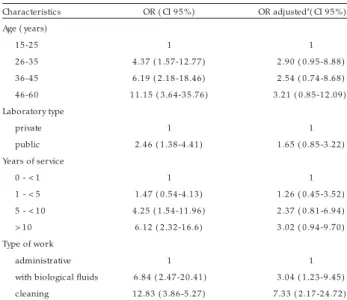
Se r o pr e va le nce r a te s fo r HBV. From 2 9 5 individuals analyzed, 7 1 ( 2 4 .1 % ) presented serologic al markers for HB V: Two were positive for HB sAg/anti-HB c Ag, six for anti-HB c Ag alone and sixty-three for anti-HB c Ag /anti-HB sAg ( Table 1 ) . It was observed that of two individuals who tested positive fo r HB sAg, o ne te ste d po sitive fo r the sam e se r o lo gic al markers ( HB sAg/total anti-HB c Ag) in both blood samples and the other only for HB sAg in the first sample and for HB sAg/ a nti- HB c Ag in the se c o nd o ne . Te n sta ff m e m b e r s who reported no vac c ination tested positive for anti-HB sAg alone. Multivariate analysis for HBV infection in relation to risk fac tors showed statistic al signific anc e for professionals that worked directly with biological fluids and in cleaning ( Table 2 ) .
Table 1 - Seroprevalen ce of HBV in fection in 295 laboratory workers in Goiân ia, Goiás, con siderin g serological markers.
Serological markers Positive CIa 95%
nº %
HBsAg / antiHBcAg total 2 0.7 0.11 - 2.7
Anti-HBcAg total 6 2.0 0.8 - 4.5
Anti-HBcAg total/anti-HBsAg 63 21.4 16.8 - 26.5
Total 71 24.1 19.3 - 29.4
aCI= Confidence Interval ; Ten staff members reported no vaccination but tested positive
for anti-HBs only were not included in this analysis.
Table 2 - Mu ltivariate an alyses for risk factors of HBV in fection in laboratory workers in Goiân ia, Goiás.
Characteristics OR ( CI 95%) OR adjusteda( CI 95%)
Age ( years)
15-25 1 1
26-35 4.37 ( 1.57-12.77) 2.90 ( 0.95-8.88)
36-45 6.19 ( 2.18-18.46) 2.54 ( 0.74-8.68)
46-60 11.15 ( 3.64-35.76) 3.21 ( 0.85-12.09)
Laboratory type
private 1 1
public 2.46 ( 1.38-4.41) 1.65 ( 0.85-3.22)
Years of service
0 - < 1 1 1
1 - < 5 1.47 ( 0.54-4.13) 1.26 ( 0.45-3.52)
5 - < 10 4.25 ( 1.54-11.96) 2.37 ( 0.81-6.94)
> 10 6.12 ( 2.32-16.6) 3.02 ( 0.94-9.70)
Type of work
administrative 1 1
with biological fluids 6.84 ( 2.47-20.41) 3.04 ( 1.23-9.45)
cleaning 12.83 ( 3.86-5.27) 7.33 ( 2.17-24.72)
1 5 5
Revista da Sociedade Br asileir a de Medicina Tr opical 3 8 ( 2 ) :1 5 3 -1 5 6 , mar-abr, 2 0 0 5
De te c tio n o f vir a l DNA. Po sitivity fo r HB V-DNA was observed in the two HB sAg positive samples.
Vaccination r ates. 6 2 3 of 6 4 8 staff provided information about vaccination and of them 4 6 4 ( 7 4 .5 %) had been vaccinated. A smaller vaccination rate was observed among individuals with low educational levels, public laboratory workers, administrative and cleaning workers, as well as workers less than one year on the job ( p< 0 ,0 5 ) .
Se r o po sitivity to va ccine. A seropositivity rate of 8 9 .9 % to the vac c ine for individuals that rec eived three doses of HB V vac c ine was observed. The male individuals and those of 4 6 -6 0 years of age or who had low educ ational levels had lower seropositivity to the vac c ine ( Table 3 and 4 ) .
DISCUSSION
In this study, the r ate o f ser o pr evalenc e fo r infec tio n observed for HB V among laboratory staff is in agreement with other studies2 5 8 1 5. Direc t c ontac t with biologic al fluids as
well as laboratory c leaning c onstituted risk fac tors for HB V infec tion. This result reinforc es data from other studies and the c o nc ept that b lo o d and b io lo gic al fluids ar e r elevant fac tors for ac quisition of infec tion for this type of population1 9.
The follow up of two staff tested positive for HBsAg, showed that one had HB sAg for more than one year and was thus considered a chronic carrier. For the other staff member the antiHBcAg was present only in the second sample and in whole these data reaffirm the circulation of the virus in this population.
In the present study, no positivity was observed for viral DNA in positive samples for anti-HBcAg only, which is in agreement with a study performing by Largura et al1 0. However, study shows
that even in intermittent viremia the viral DNA can be detected when ultrasensitive nucleic acid amplification testing ( 3.8 IU/mL) is utilized7. On the other hand, in Goiânia, Goiás, 3.6% of positive
rate for viral DNA in this type of sample was observed utilizing the same procedure1 4. This difference may be the result of the type of
population studied since in this study the participants were patients with clinic suspect of hepatitis. Positive samples for viral DNA were also positive for HBsAg and were from the second blood samples. This data suggest that more than one sample of clinical specimens may be necessary before considering the results for HBV-DNA.
The percentage of staff who had received HBV vaccine was 74.5% and is higher than the percentage reported in other studies of health-care workers in 1989 and 1998 in the region, in which vaccination rates of 3% and 59.2%, respectively were reported2 11.
Seropositive rate of 8 9 .9 % for anti-HBs only was found for staff that received three doses of vaccine, which is in agreement with other studies1 1 6 1 8. Males, as well as, staff members over 4 6
years of age showed a smaller seropositive rate to the vaccine. These data agree with those of other studies, which consider that these characteristics are responsible for a failure in the immunological response to the vaccine1 1 2 1 7. A lower seropositive
rate to the vaccine was also observed in individuals that had little education. Of this group only 5 0 % received the three doses of vaccine ( data not shown) and in this way this fact could be related to the lower positive rate to the vaccine.
This study showed that HBV vaccination rate in Goiânia, GO has increased over time but the seroprevalence of HBV infection remains unchanged. This reinforces the necessity of taking preventive measures, including vaccination, in order to control of the virus.
ACKNOWLODGEMENTS
To FUNAPE/UFG for providing financ ial support.
REFERENCES
1 . Assad S, Franc is A. Over a dec ade o f experienc e with a yeast rec o mbinant hepatitis B vac c ine. Vac c ine1 8 : 5 7 -6 7 , 2 0 0 0 .
Table 3 - Percen tage distribu tion of seropositivity to the HBV vaccin e in 415 laboratory workers in Goiân ia, Goiás.
Characteristics Seropositivity to vaccine
positive vaccinated
no % p
Gender
F 276/323 85.4 p< 0.05
M 67/92 72.8
Agea ( years)
15-25 86/103 83.5 p< 0.05
26-35 148/168 88.1
36-45 74/96 77.1
46-60 32/44 72.1
Level of educationb
university 173/198 87.4 p< 0.05
secondary 137/176 77.8
none/Elementary 32/40 80.0
Laboratory type
private 192/238 80.7 p> 0.05
public 151/177 85.3
Positive/vaccinated = number of individuals with positive samples for anti-HBsAg/total vaccinat individual. a 4 individuals without information about age; b 1 individual without information about level educational.
Table 4 - Percen tage distribu tion of seropositivity to the HBV vaccin e in 415 laboratory workers in Goiân ia, Goiás.
Characteristics Seropositivity to vaccine
positive vaccinated
no % p
Years of servicea
0 - < 1 45/55 81.8 p> 0.05
1 - < 5 127/153 83.0
5 - < 10 87/98 88.8
> 10 73/94 77.6
Type of work
administrative 39/53 73.6 p> 0.05
with biological fluids 271/324 83.6
cleaning 33/38 86.8
Number of vaccine doses
1 14/34 41.2 p< 0.001
2 57/76 75.0
3 231/257 89.9
NIb 41/47 87.2
1 5 6
2 . Aze ve do MSP, Car do so DDP, Mar tins RMB , Dahe r RR, Cam ar o ta SCT, B arbo sa AJ. Rastreamento so ro ló gic o para hepatite B em pro fissio nais de saúde na c idade de Go iânia-Go iás. Revista da So c iedade B r asileir a de Medic ina Tro pic al 2 3 : 1 5 7 -1 6 2 , 1 9 9 4 .
3 . B irrer RB , B irrer D, Klavins JV. Hepato c ellular c arc ino ma and hepatitis virus. Annals o f Clinic al and Labo rato ry Sc ienc e 3 3 : 3 9 -5 4 , 2 0 0 3 .
4 . Center Fo r Diseases Co ntro l And Preventio n. Viral Hepatitis. Expo sure to blo o d. What health-c are wo rkers need to kno w. Dispo nível em: < http:// www.c dc .go v/nc ido d/diseases/hepatitis. Ac esso em: 0 5 mar, 2 0 0 2 .
5 . Co e lho HSM, Ar te m e nk o SMT, Ma r tins CN, Ca r va lho DM, Va le nte J , Ro drigues EC, Alves LS, Martins MLM.Prevalênc ia da infec ç ão para o vírus da hepatite B na c o munidade ho spitalar. Revista da So c iedade B rasileira de Medic ina Tro pic al 2 3 : 7 1 -7 6 , 1 9 9 0 .
6 . Davis GL. Update o n the management o f c hro nic hepatitis B . Reviews in Gastro entero lo gic al Diso rders 2 : 1 0 6 -1 1 5 , 2 0 0 2 .
7 . Dreier J, Krö ger M, Diekmann J, Gö tting C, Kleesiek K. Lo w-level viraemia o f hepatitis B virus in an anti-HB c - and anti-HB s-po sitive blo o d do no r. Transfusio n Medic ine 1 4 : 9 7 -1 0 3 , 2 0 0 4 .
8 . Fernandes JV, B raz RFS, Neto FVA, Silva MAD, Co sta NFD, Ferreira AM. Prevalência de marcadores sorológicos do vírus da hepatite B em trabalhadores do serviço hospitalar. Revista de Saúde Pública 3 3 : 1 2 2 -1 2 8 , 1 9 9 9 .
9 . Gomes AS, Yoshida CFT, Niel C. Detec tion of hepatitis B virus DNA in hepatitis B surfac e antigen-negative serum by polimerase c hain reac tion: evaluation of different primer pairs and c onditions. Ac ta Virologic a 4 0 : 1 3 3 -3 8 , 1 9 9 6 .
1 0 . Largura MA, Pac hec o M, Largura A. Ausênc ia do HB V-DNA po r PCR em So ro s de Do ado res de Sangue c o m HB sAg Negativo e Anti-HB c Po sitivo em Região de Alta Prevalênc ia de Hepatite B . Laes & Haes1 2 5 : 1 0 6 -1 2 6 , 2 0 0 0 .
1 1 . Lo pes CLR, Martins RMB , Teles AS, Silva SA, Maggi PS, Yo shida CFTY. Perfil so ro epidemio ló gic o da infec ç ão pelo vírus da hepatite B em pro fissio nais
das unidades de hemo diálise de Go iânia-Go iás, B rasil Central. Revista da So c iedade B rasileira de Medic ina Tro pic al 3 4 : 5 4 3 -5 4 8 , 2 0 0 1 .
1 2 . Martínez NT, B urillo JMT, B ermúdez B P, Álvarez JB S.Fac to res aso c iado s a una respuesta inadec uada a la vac unac ión c ontra la hepatitis B em personal sanitario . Revista Espano la de Salud Public a 7 2 : 5 0 9 -5 1 5 , 1 9 9 8 .
1 3 . Niel C, Moraes MTB , Gaspar AMC, Yoshida CFT, Gomes SA. Genetic diversity o f hepatitis B virus strains iso lated in Rio de Janeiro , B razil. Jo urnal o f Medic al Viro lo gy 4 4 : 1 8 0 -1 8 6 , 1 9 9 4 .
1 4 . Silva CO, Azevedo MSP, So ares CMA, Martins RMB , Ramo s CH, Daher RR, Cardo so DDP. Sero prevalenc e o f hepatitis B virus infec tio n in individuals with c linic al evidenc e o f hepatitis in Go iânia, Go iás. Detec tio n o f viral DNA and de te r minatio n o f sub type s. Re vista do Instituto de Me dic ina Tro pic al de São Paulo 4 4 : 3 3 1 -3 3 4 , 2 0 0 2 .
1 5 . Zanalda B C, Mantero la AC, Lestrem MD, Frider B , Zo c c hi GA, Fainbo im H, Clua GI, Amo r E. Prevalenc ia del antic uerpo c o ntra el antígeno c entral del virus de la hepatitis B ( anti HB c ) em perso nal ho spitalario de B ueno s Aires.B o letim Sanitário Panameric ano 1 0 8 : 1 6 -2 4 , 1 9 9 0 .
1 6 . Zanetti AR. Update o n hepatitis B vac c inatio n in Italy 1 0 years after its implementatio n. Vac c ine 1 9 : 2 3 8 0 -2 3 8 3 , 2 0 0 1 .
1 7 . Zuc kerman JN. No nrespo nse to hepatitis B vac c ines and the kinetic s o f anti-HB S pro duc tio n. Jo urnal o f Medic al Viro lo gy 5 0 : 2 8 3 -2 8 8 , 1 9 9 6 .
1 8 . Williams JL, Christensen CJ, Mc Maho n B J, B ulko w LR, Cagle HH, Mayers JS, Zanis CL, Parkinso n AJ, Margo lis HS.Evaluatio n o f the respo nse to a bo o ster do se o f hepatitis B vac c ine in previo usly immunized healthc are wo rkers. Vac c ine 1 9 : 4 0 8 1 -8 5 , 2 0 0 1 .
1 9 . Wo lff M. Oc c upatio nal ac c ide nts with e xpo sur e to b io lo gic al fluids. Re c o m m e ndatio ns fo r the m anage m e nt o f e xpo se d wo r k e r s. Re vista Me dic a de Chile 1 2 5 : 6 0 5 -6 1 3 , 1 9 9 7 .