Lia SeligI,II
Afranio Lineu KritskiIII Angela Maria CascãoIV José Ueleres BragaV,VI Anete TrajmanVII
Regina Maria Guedes de CarvalhoVIII
I Gerência de Pneumologia Sanitária. Superintendência de Vigilância
Epidemiológica e Ambiental. Secretaria de Estado de Saúde e Defesa Civil do Rio de Janeiro (Sesdec-RJ). Rio de Janeiro, RJ, Brasil II Curso de Graduação em Medicina. Centro
Universitário Serra dos Órgãos. Fundação Educacional Serra dos Órgãos. Teresópolis, RJ, Brasil
III Programa Acadêmico de Tuberculose. Faculdade de Medicina. Universidade Federal do Rio de Janeiro. RJ, Brasil IV Coordenação de Dados Vitais. Centro de
Apoio à Gestão e Vigilância em Saúde. Sesdec-RJ. Rio de Janeiro, RJ, Brasil V Departamento de Epidemiologia. Instituto
de Medicina Social. Universidade do Estado do Rio de Janeiro. Rio de Janeiro, RJ, Brasil VI Centro de Referência Professor Hélio
Fraga. Escola Nacional de Saúde Pública. Fundação Oswaldo Cruz. Rio de Janeiro, RJ, Brasil
VII Departamento de Clínica Médica. Faculdade de Medicina. Universidade Gama Filho. Rio de Janeiro, RJ, Brasil VIII Gerência de Pneumologia Sanitária.
Superintendência de Vigilância
Epidemiológica e Ambiental. Sesdec-RJ. Rio de Janeiro, RJ, Brasil
Correspondence: Lia Selig
Coordenação da Medicina R. Alberto Torres 111 – Alto 25964-004 Teresópolis, RJ, Brasil E-mail: [email protected] Received: 11/23/2009 Approved: 4/15/2010
Artigo disponível em português e inglês em: www.scielo.br/rsp
Proposal for tuberculosis death
surveillance in information
systems
ABSTRACT
OBJECTIVE: To propose a tuberculosis-related death surveillance strategy based on the Brazilian Mortality Information System.
METHODS: Data on 55 tuberculosis-related deaths, which occurred in two large hospitals in Rio de Janeiro, Southeastern Brazil, between September 2005 and August 2006, were obtained from the SIM. These cases were searched and compared with cases in the National Notifi cation System (Sinan). The increment in the number of notifi cations and completeness of data were evaluated, as well as entry type and outcome in Sinan.
RESULTS: Of the 55 deaths, 28 were registered in Sinan. Comparison between systems allowed for the following corrections: 27 new cases were notifi ed, 14 new notifi cations performed by the hospitals where death occurred and ten outcomes corrected. This represented an increment of 41/144 (28%) notifi cations by these two hospitals in 2006. Nine cases, previously classifi ed as unconfi rmed tuberculosis were reclassifi ed as bacteriologically confi rmed, and another fi ve cases were reclassifi ed from tuberculosis to AIDS as the primary cause of death.
CONCLUSIONS: The proposed surveillance system for tuberculosis-related death was useful to increase data completeness, decrease under-notifi cation and cases with unknown outcome, to evaluate epidemiological surveillance and death certifi cate quality and to trace previously unidentifi ed contacts. DESCRIPTORS: Tuberculosis, mortality. Disease Notifi cation. Hospital Mortality. Mortality Registries. Information Systems. Epidemiologic Surveillance.
INTRODUCTION
Epidemiological surveillance, as defi ned by the Ministry of Health, is a combi-nation of actions that increase knowledge about individual and collective health in order to inform the adoption of prevention and control measures for diseases or illnesses. Mortality data is included among the important data for developing “information for action”. Since death from tuberculosis (TB) is avoidable, it is considered a sentinel event, indicating failings of the social network and health system and providing an opportunity to discover other problems in families or the community. Despite its importance, deaths from TB have not been the object of surveillance in Brazil.1,4,16
comparing national incidence with the estimated new cases from the World Health Organization (WHO). In Brazil, in 2007, 72,000 cases were reported out of an estimated 92,000, which corresponds to a detection rate of 78%.a The difference can be explained by the
non-detection of cases or by under-registration in Sinan.
Recently, Selig et al17 described the results of TB-related
death surveillance actions, based on the registries of two large hospitals in the municipality of Rio de Janeiro, Southeastern Brazil, in 2005/2006. In considering TB as the primary or associated cause of death, the rese-arch identifi ed problems, such as: disease transmission opportunities, errors in clinical performance, high work loads of professionals doing epidemiological surveillance at hospitals, inadequate physical infras-tructure and incomplete or inadequate records.
Therefore, due to the lack of human resources to perform death surveillance from records, this study utilized an alternative strategy based on the identifi ca-tion of death through the Mortality Informaca-tion System (SIM) and previous case detection in Sinan.
The present study aimed to propose a surveillance strategy for TB-related deaths based on the SIM.
METHODS
This descriptive study was based on deaths between September of 2005 and August of 2006, in two large hospitals. The two hospitals, located in the municipality of Rio de Janeiro, were selected for convenience and attend up to 800 patients per day, with open emergency rooms. Death surveillance was performed by the iden-tifi cation of death reports in the SIM of Rio de Janeiro state and subsequent search of the case notifi cation in the state Sinan.
The selected deaths were registered in the SIM and had TB as the primary or associated cause of death.
Death certifi cates (DCs) that listed TB on a line in fi eld 49 were printed, and the respective cases were sought in Sinan. The notifi cations were printed to compare information on DCs to data on the identification and confi rmation of pulmonary TB, AIDS and other comorbidities. Variable that could be completed of modifi ed were identifi ed. Notifi cations were considered as related to death, if they occurred within one year or less before death.
Characteristics of the notifi cations for patients that died were evaluated and described: notifying unit, type of entry and outcomes.
a Ministério da Saúde. Secretaria da Vigilância em Saúde. Programa Nacional de Controle da Tuberculose. Situação da Tuberculose no Brasil e no mundo. [s.d.] [cited 2009 Oct 22]. Available from: http://portal.saude.gov.br/portal/arquivos/pdf/apresentacao_tb_2009.pdf
b World Health Organization. International Statistical Classifi cation of Diseases and Related Health Problems. 10.ed. 2007 [cited 2009 Oct 23]. Available from: http://www.who.int/classifi cations/apps/icd/icd10online/
After the comparison of databases, the deaths were eventually reclassified based on the International Classifi cation of Diseasesb (ICD-10). The DCs
identi-fying unconfi rmed pulmonary TB as a primary cause (A16.2) were reclassifi ed as confi rmed TB diagnosis (A15.0) based on notifi cation of bacteriologic positive TB. Information contained on positive serology or AIDS permitted the reclassifi cation of deaths that had TB as a primary cause (A15-A19), to death from AIDS (B20-B24).
The study was approved by the Ethics Committee of the Health Department of Rio de Janeiro Municipality, process 11A/05, on March 14, 2005. The directo-rate of the involved hospitals authorized the study implementation.
RESULTS
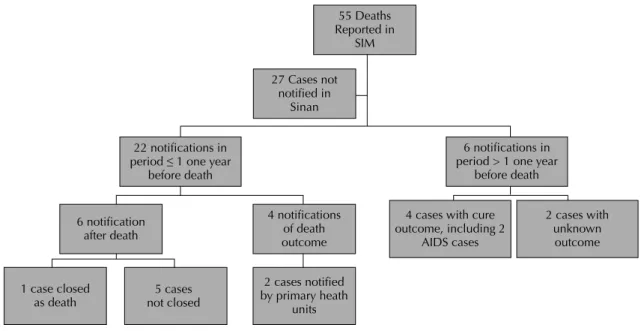
There were 55 TB-related deaths identifi ed in the two hospitals through SIM. Of these, the 28 cases were found in Sinan, and 22 had a period between notifi ca-tion and death of less than or equal to one year (Figure 1), with a median of 41 days (1-308). These 28 cases generated 43 non-duplicative notifi cations, because notifi cations were done by different units or during the distinct treatments. Although these cases were duly notifi ed, failings in the fi lling of notifi cations negatively impacted their analysis.
The comparison of SIM with Sinan permitted the following corrections: 27 (49%) new cases notifi ed, 14 new notifi cations performed by the unit where death occurred (notifi cations previously done only by primary health units where patients began treatment) and outcome for ten notifi cations. In regards to
noti-fi cations by the two hospitals in 2006, there was an increase of 41/144 (28%).
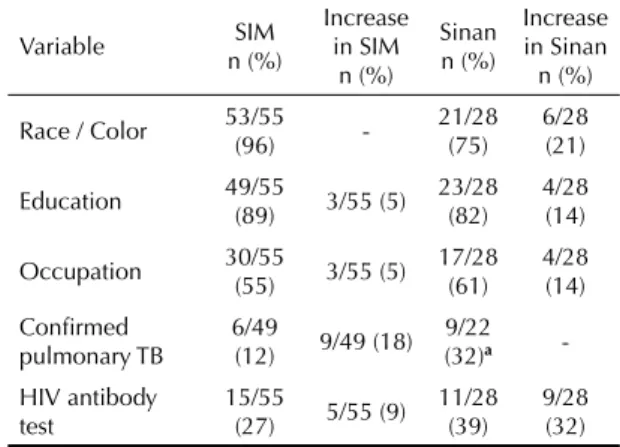
In Sinan, it was also observed that 25 of the 43 notifi -cations (58%) were performed by hospitals. Among the new notifi cations identifi ed, the type of entry was read-mission after abandonment in three cases and relapse in two cases, which totals 5/28 (18%) inconsistencies for entry type. The identifi cation of TB-related deaths in SIM allowed completion of fi elds with common varia-bles in the two information systems. The completeness and resulting changes from the strategy are described in Table 2.
c World Health Organization. Global Tuberculosis Control Surveillance, Planning, Financing. Geneva; 2009 [cited 2009 Oct 20]. Available from: http://www.who.int/tb/publications/global_report/en/
confi rmed by sputum microscopy (A15.0). Additionally, the information on AIDS in Sinan allowed reclassifi ca-tion of the primary cause of death from TB to AIDS in
fi ve cases. In seven cases, the patients presented chronic comorbidities reported in Sinan and not mentioned in the DC. There was concordance in only one case, with the mention of diabetes mellitus in Sinan and SIM.
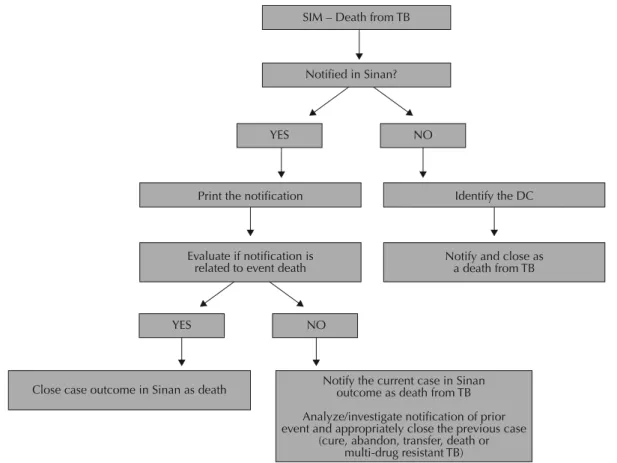
The systemization of procedures allowed for develo-ping a proposal for TB-related death surveillance based on the SIM (Figure 2). According to this proposal, every TB case with an outcome of death should be notifi ed by the unit in which death occurred, independent of prior notifi cation. If the case was previously reported, the notifi cations should be linked. The notifi cation referring to the preceding event (cure, abandonment, transfer, death or multidrug-resistant TB) should be adequately closed after investigation and analysis.
DISCUSSION
Death surveillance using the SIM produced a substan-tial increase in notifi cations performed by hospitals and modest increase in data completeness for both information systems, as well as the reclassifi cation of SIM registrations. With the procedures utilized, we formulated a proposed algorithm for surveillance of TB-related deaths. The effi cacy obtained for data
retrieval was inferior to the surveillance of TB deaths from hospital death records,17 which we perceived
empirically as impractical for the majority of hospitals due to the high work load of professionals and the time necessary for case investigations.
In 2003, the WHO classifi ed the Brazilian SIM as medium quality,12,c with sensitivity between 70% and
90%. An evaluation of the SIM by indirect demogra-phic methods suggests that the coverage is satisfactory, principally in the South and Southeast regions, where it is 90% for men and 87.4% for women.6 According
to the Ministry of Health, SIM has greater coverage than Sinan.c This indicates that the death of a patient
with TB may not be reported.d Therefore, we decided to
recommend death surveillance through the SIM.
The under-notifi cation of TB-cases with the outcome of death is not a new fi nding. In a recent publication, the WHO recommends the creation of strategies based on a mortality information system that allows the recovery of unreported cases.d In the state of Rio de Janeiro,
an under-notifi cation of 58% in 1998 was reported.16
In other Brazilian states, the same phenomenon was reported: in the municipality of São Paulo, Southeastern Brazil, under-notifi cation was 50% in the East Zone in 2001,13 49% in 200210 and 44% during the period of
2002–2004;e in Fortaleza, Northeastern, it was 67%
during the period 1999–2003.5 In 2008, the
comple-teness of essential fi elds in the municipality of Rio de Janeiro was 91% for race/color, 100% for education and 77% for occupation, which was not observed in the sample of deaths studied here.f It is possible that
the low completeness in studied cases is related to an
Table 1. Notifi cations of deaths in hospitals. Rio de Janeiro municipality, Southeastern Brazil, 2005-2006.
Notifi cation n/N (%)
Death 28/55 (51)
Notifi cations by hospitals (more than one
notifi cation per patient) 25/43 (58) New cases 19/28 (68) Type of entry – relapse or abandonment, 1st
notifi cation in Sinan 5/28 (18) Type of entry – not known 4/28 (14) Notifi cation related to death (< one year
before death) 22/28 (79) Notifi cation by the unit where death
occurred 14/28 (50) Cases with death as fi nal outcome 4/28 (14) Previous notifi cations with outcome as
abandoned 2/43 (5)
Notifi cations with unknown outcome 29/43 (67) Prior notifi cations with outcome as curea 7/43 (16)
Source: National Notifi cation System (Sinan)
a One case with two TB epidsodes with the outcome as
cure.
n = number verifi ed N = total number considered
Table 2. Proportion of notifi cations with fi elds fi lled in the information systems and resulting increase from linkage. Rio de Janeiro municipality, Southeastern Brazil, 2005-2006.
Variable n (%)SIM
Increase in SIM
n (%)
Sinan n (%)
Increase in Sinan
n (%)
Race / Color 53/55 (96) - 21/28 (75) 6/28 (21)
Education 49/55 (89) 3/55 (5) 23/28 (82) 4/28 (14)
Occupation 30/55 (55) 3/55 (5) 17/28 (61) 4/28 (14)
Confi rmed
pulmonary TB 6/49 (12) 9/49 (18) (32)9/22 a
-HIV antibody test
15/55
(27) 5/55 (9) 11/28
(39)
9/28 (32) SIM: Mortality Information System; Sinan: National Notifi cation System
a Excluded the six cases in which death occurred in a period
increased frequency of individuals living in a homeless situation among those that die from TB.17
The proposal for death surveillance based on the SIM involves cooperation between epidemiological surveillance and the vital statistics sector on TB control programs, which has already been routinely occurring in the Woman, Child and Adolescent Health Program.g
A similar strategy to link information systems was proposed by Maia-Elkhoury et al,11 in 2007, with
the goal of decreasing under-notifi cation of visceral leishmaniasis.
Besides data quality improvement, the proposed death surveillance allowed epidemiologic and operational refl ection. The high number of notifi cations performed by hospitals indicates the importance of hospital care for a disease that should be mostly managed in primary care, which also occurs in the municipality of São Paulo.7 The amount of new cases followed by
death indicates their gravity and highlights the delay in diagnosis as previously described7 and the potential
diffi culty in access to the health system.It is expected that when TB control improves, the number of notifi -cations by hospitals and the number of new cases with the outcome of death will decrease.
Evaluation of the identifi ed mistakes, such as “relapse” as a type of entry in a fi rst notifi cation in Sinan, should be a warning of database quality and the collection of information in hospital units. In the majority of deaths notifi ed by hospitals, the case outcome was not reported, which is an indicator of operational failings in
the hospital epidemiological surveillance.2 The number
of cases with unknown outcome complicates the evalu-ation of disease control actions.8 The decentralization
of the Sinan to hospitals could contribute to improve the utilization of data about patients registered in the system, avoiding under-notifi cations and improving connections between patients and the team of health professionals in the notifying units of the information system. The number of individuals that died from TB after a cure event generates questions about the criteria for cure and the importance of a post-treatment surveillance system.14
In addition, database linkage allows for the
reclassi-fi cation of some cases. Deaths attributed to TB and notifi ed in Sinan, with serology confi rmed human immunodeficiency virus (HIV) could be correctly classifi ed as a death from AIDS (primary cause), with TB as an associated cause. Another shortcoming to potentially correct through linkage is the number of TB deaths without bacteriological or histological confirmation (ICD A16.2). According to Laurenti (2006), death investigations can change the analysis of mortality profi le.d Santos (2006) highlights the lower
average number of causes mentioned in Rio de Janeiro state in comparison to São Paulo, in the DCs with TB as a primary cause,15 which weakens the evaluation of
TB-related comorbidities in Rio de Janeiro.
For our algorithm, we began from the Ministry of Health’s premise notifi cation of case death should be performed by the unit where the death occurred, through a notification even if a prior notification had been
55 Deaths Reported in
SIM
27 Cases not notified in
Sinan
22 notifications in period ≤ 1 one year
before death
6 notification after death
1 case closed
as death not closed5 cases
2 cases notified by primary heath
units
4 cases with cure outcome, including 2
AIDS cases
2 cases with unknown outcome 4 notifications
of death outcome
6 notifications in period > 1 one year
before death
Figure 1. Temporal relationship among notifi cations in the information systems of deaths associated with tuberculosis that occurred in hospitals. Rio de Janeiro municipality, Southeasten Brazil, 2005-2006.
performed in another health unit. In the present study, of the notifi cations closed by death, two cases were closed by prior notifi cation by a primary health unit, more than 30 days before death. It is possible, for example, that the case had been reported, initiated and later abandoned treatment, and, some time later, the death was reported to the primary health unit. In such cases, we recommend that the TB control program contact the health unit to understand the outcome in the notifi cation, which was incorrectly reported as death. The described hypothesis could generate a false reduction in the rate of abandon-ment, in addition to the non-reporting of the case by the unit where death occurred. This is an example of proce-dures that, besides correcting the database and improving analysis, facilitate the supervision of the work process in the epidemiological surveillance of the health unit and hospital. In our study, where case investigation at the health unit was not a possibility, the cut-off point for the linkage of notifi cations was a period of one year. This point was arbitrary, based on the maximum treatment time for a TB case susceptible to fi rst line drugs, and deserves further consideration and validation.
One of the main goals of epidemiological surveillance in cases of direct disease transmission is the interruption
of transmission. The notifi cations register the path traveled by the patient, which can allow for the disco-very of opportunities to interrupt transmission. A patient that progressed to death without prior notifi cation was undetected by the TB control program, and therefore, we assume that their contacts have not been evaluated.9
In this situation, the health units should be actuated for a domestic visit, considering the risk of illness among contacts is at least 15 times greater than among the general population.3,i A function of epidemiological
surveillance is to provide feedback with data to the health units and their professionals, which can encou-rage the professionals to perform notifi cations. The current study has limitations, since it evaluated a small sample of cases from only two hospitals. It is necessary to validate this algorithm in the munici-pality of Rio de Janeiro and others. Nonetheless, we conclude that death surveillance of TB can be useful to increase the completeness of information systems, increase the proportion of cases with known outcome, correct the Sinan and SIM, decrease under-notifi cation, evaluate the quality of DCs, supervise epidemiological surveillance by hospitals and health units and search for contacts unevaluated by health teams.
SIM – Death from TB
Notified in Sinan?
Print the notification Identify the DC
Evaluate if notification is related to event death
Close case outcome in Sinan as death
Notify and close as a death from TB
Notify the current case in Sinan outcome as death from TB
Analyze/investigate notification of prior event and appropriately close the previous case
(cure, abandon, transfer, death or multi-drug resistant TB)
YES NO
YES NO
1. II Consenso Brasileiro de Tuberculose. Diretrizes Brasileiras para Tuberculose 2004. J Bras Pneumol. 2004;30(Suppl 1):S1-86. DOI:10.1590/S1806-37132004000700002
2. Braga JU. Vigilância Epidemiológica e o sistema de informação da tuberculose no Brasil, 2001-2003. Rev Saude Publica. 2007;41(Suppl 1):77-87. DOI:10.1590/ S0034-89102007000800011
3. Cailleaux-Cezar M, de Melo DA, Xavier GM, de Salles CL, de Mello FC, Ruffi no-Netto A, et al. Tuberculosis incidence among contacts of active pulmonary tuberculosis. Int J Tuberc Lung Dis. 2009;13(2):190-5. 4. Dye C, Bassili A, Bierrenbach AL, Broekmans JF,
Chadha VK, Glaziou P, et al. Measuring tuberculosis burden, trends, and impact of control programmes.
Lancet Infect Dis. 2008;8(4):233-43. DOI:10.1016/ S1473-3099(07)70291-8
5. Façanha MC. Tuberculose: subnotifi cação de casos que evoluíram para o óbito em Fortaleza-CE. Rev Bras Epidemiol. 2005;8(1):25-30. DOI:10.1590/S1415-790X2005000100004
6. França E, de Abreu DX, Rao C, Lopez AD. Evaluation of cause-of-death statistics for Brazil, 2002-2004. Int J Epidemiol. 2008;37(4):891-901.
7. Galesi VMN, Almeida MMMB. Indicadores de morbimortalidade hospitalar de tuberculose no Município de São Paulo. Rev Bras Epidemiol. 2007;10(1):48-55. DOI:10.1590/S1415-790X2007000100006
8. Gonçalves MJF, Penna MLF. Morbidade por tuberculose e desempenho do programa de controle de tuberculose em municípios brasileiros, 2001-2003. Rev Saude Publica. 2007;41(Suppl 1):95-102. DOI:10.1590/S0034-89102007000800013 9. Korenromp EL, Bierrenbach AL, Williams BG, Dye
C. The measurement and estimation of tuberculosis mortality. Int J Tuberc Lung Dis. 2009;13(3):283-303
10. Lindoso AAB, Waldman EA, Komatsu NK, Figueiredo SM, Taniguchi M, Rodrigues LC. Perfi l de pacientes que evoluem para óbito por tuberculose no município de São Paulo, 2002. Rev Saude Publica. 2008;42(5):805-12. DOI:1590/S0034-89102008000500004 11. Maia-Elkhoury ANS, Carmo EH, Sousa-Gomes ML,
Mota E. Análise dos registros de leismaniose visceral pelo método de captura-recaptura. Rev Saude Publica. 2007;41(6):931-7. DOI:10.1590/S0034-89102007000600007
12. Mathers CD, Fat DM, Inoue MI, Chalapati R, Lopez AD. Counting the dead and what they died from: an assessment of the global status of cause of death data.
Bull World Health Organ. 2005;83(3):171-7. DOI:10.5 901500429686200500300009
13. Pelaquin MHH, Souza e Silva R, Ribeiro SA. Fatores associados ao óbito por tuberculose na zona leste da cidade de São Paulo, 2001. J Bras Pneumol. 2007;33(3). DOI:10.1590/S1806-37132007000300013
14. Picon PD, Bassanesi SL, Caramori MLA, Ferreira RLT, Jarczewski CA, Vieira PRB. Fatores de risco para recidiva de tuberculose J Bras Pneumol. 2007;33(5):572-8. DOI:10.1590/S1806-37132007000500013
15. Santo AH. Causas múltiplas de morte relacionadas à tuberculose no Estado do Rio de Janeiro entre 1999 e 2001. J Bras Pneumol. 2006;32(6):544-52. DOI:10.1590/S1806-37132006000600012
16. Selig L, Belo M, Cunha AJLA, Teixeira EG, Brito R, Luna AL, et al. Óbitos atribuídos à tuberculose no Estado do Rio de Janeiro. J Bras Pneumol. 2004;30(4):335-42. DOI:10.1590/S1806-37132004000400006
17. Selig L, Guedes R, Kritski A, Spector N, Lapa e Silva JR, Braga JU, et al. Uses of Tuberculosis mortality surveillance to identify programme errors and improve database reporting. Int J Tuberc Lung Dis. 2009;13(8):982-8.
REFERENCES