Clóvis Arlindo de SousaI Chester Luiz Galvão CésarII Marilisa Berti de Azevedo BarrosIII
Luana CarandinaIV Moisés GoldbaumV
Júlio Cesar Rodrigues PereiraII
I Programa de Pós-Graduação em Saúde
Pública. Departamento de Epidemiologia. Faculdade de Saúde Pública (FSP). Universidade de São Paulo (USP). São Paulo, SP, Brasil
II Departamento de Epidemiologia. FSP-USP.
São Paulo, SP, Brasil
III Departamento de Medicina Preventiva e
Social. Faculdade de Ciências Médicas. Universidade Estadual de Campinas. Campinas, SP, Brasil
IV Departamento de Saúde Pública. Faculdade
de Medicina. Universidade Estadual Paulista. Botucatu, SP, Brasil
V Departamento de Medicina Preventiva.
Faculdade de Medicina. USP. São Paulo, SP, Brasil
Correspondence: Clóvis Arlindo de Sousa Departamento de Epidemiologia Universidade de São Paulo
Av. Dr. Arnaldo, 715 – Cerqueira Cesar 01246-904 São Paulo, SP, Brasil E-mail: [email protected] Received: 9/15/2010 Approved: 8/9/2011
Article available from: www.scielo.br/rsp
Respiratory diseases and
associated factors:
population-based study in São Paulo,
2008-2009
ABSTRACT
OBJECTIVE: To assess the prevalence of acute bronchitis, rhinitis, and sinusitis among children and adolescents and identify associated factors.
METHODS: This is a population-based, cross-sectional study. A household survey was conducted with 1,185 children and adolescents from the city of São Paulo (Southeastern Brazil), from 2008 to 2009. The participants were selected by means of probability sampling, stratifi ed by sex and age, and by two-stage cluster sampling. For the adjusted analysis, multiple Poisson regression was used.
RESULTS: Of the respondents, 7.3% reported acute bronchitis, 22.6% rhinitis and15.3% sinusitis. After the adjusted analysis, the following characteristics were associated with self;reported acute bronchitis: age 0 to 4 years (PR=17.86; 95%CI: 3.65;90.91), 5 to 9 years (PR=37.04; 95%CI: 8.13;166.67), 10 to 14 years (PR=20,83; 95%CI: 4.93;90.91), allergy (PR=3.12; 95%CI: 1.70;5.73), black and mixed-ethnicity (black and white) skin color (PR=2.29; 95%CI: 1.21;4.35), and living in a household with 1 to 3 rooms (PR=1.85; 95%CI: 1.17;2.94). As to self-reported rhinitis, the following characteristics were associated: age 10 to 14 years (PR=2.77; 95%CI: 1.60;4.78), 15 to 19 years (PR=2.58; 95%CI: 1.52;4.39), allergy (PR=4.32; 95%CI: 2.79;6.70), asthma (PR=2.30; 95%CI: 1.30;4.10) and living in fl ats (PR=1.70; 95%CI: 1.06;2.73). Concerning self-reported sinusitis, the following characteristics were associated: age 5 to 9 years (PR=2.44; 95%CI: 1.09;5.43), 10 to 14 years (PR=2.99; 95%CI: 1.36;6.58), 15 to 19 years (PR=3.62; 95%CI: 1.68;7.81), allergy (PR=2.23 (95%CI: 1.41;3.52) and obesity (PR=4.42; 95%CI: 1.56;12.50).
CONCLUSIONS: Respiratory diseases were more prevalent in population groups with defi ned characteristics, such as age group, self-reported diseases, type of household and obesity.
DESCRIPTORS: Child. Adolescent. Respiratory Tract Diseases, epidemiology. Risk Factors. Socioeconomic Factors. Cross-Sectional Studies.
INTRODUCTION
an important pressure on the health services and are responsible for frequent school absenteeism.a
These respiratory diseases also have a prominent position in Brazil. The recent increase in the cases of hospitalizations of children and adolescents possibly occurs due to bronchial irritation from infectious and noninfectious causes, like atmospheric pollutants, cigarette smoke and other allergens.11
The prevalence of episodes of acute bronchitis is 5% per year in the United States. It is one of the most common infections in children younger than fi ve years and it is responsible for numerous hospitalization cases.12
According to the last Brazilian consensus,b rhinitis is
described in the literature as one of the most frequent chronic diseases in childhood. Although little impor-tance is given to it, it produces great discomfort and can be associated with serious problems like sleep apnea, asthma and repeated respiratory infections. The mean prevalence of symptoms related to allergic rhinitis in Brazil was 29.6% among adolescents (13-14 years) and 25.7% among schoolchildren (six-seven years) between 2002 and 2003. Brazil is in the group of countries with the highest prevalence of allergic rhinitis in the world.18
Rhinitis and sinusitis are quite common in clinical practice and are conditions which are frequently associ-ated. It is estimated that sinusitis affects approximately 31 million people annually in the United States, one of the most prevalent affections of the upper airways, with high fi nancial cost to society.10
Both sinusitis and rhinitis may mean decrease in the quality of life and aggravation of comorbidities; it addition, they may demand signifi cant expenditures on health. They may also create indirect costs to society, as the lost school days can reduce school learning. Although rhinitis and sinusitis frequently occur in the population, little is known about the epidemiology of these diseases. The same can be said about acute bronchitis. The absence of a standardized method to identify them in epidemiological studies is an important limitation to obtain these data.c
Although respiratory diseases in childhood and adoles-cence are common, information about the frequency and distribution of respiratory diseases in children and adolescents is scarce in Brazil. Regarding the
a Schappert SM, Burt CW. Ambulatory care visits to physician offi ces, hospital outpatient departments, and emergency departments: United
States, 2001-02. National Center for Health Statistics. Vital Health Stat 13. 2006 [cited 2011 Sep 15];(159):1-67. Available from: http://www. cdc.gov/nchs/data/series/sr_13/sr13_159.pdf
b II Consenso Brasileiro sobre Rinites. Rev Bras Alerg Imunopatol. 2006 [cited 2011 Sep 19];29(1):29-58. Available from: http://www.asbai.org.
br/revistas/Vol291/consenso.pdf
c Diretrizes Brasileiras de Rinossinusites. Rev Bras Otorrinolaringol. [on line]. 2008 [cited 2011 Sep 19];74(2 Supl):6-59. Available from: http://
www.scielo.br/pdf/rboto/v74n2s0/a02.pdf
d Alves MCGP, Escuder MML. Plano de amostragem do ISA - Capital 2008. São Paulo; 2009 [cited 2010 Sep 2]. Available from: http://www.
fsp.usp.br/isa-sp/pdf/planoamostral2008.pdf
e Universidade de São Paulo, Faculdade de Saúde Pública. Inquérito de Saúde no Município de São Paulo - ISA Capital 2008: questionário
completo. São Paulo; 2008 [cited 2010 Sep 2]. Available from: http://www.fsp.usp.br/isa-sp/pdf/questionarioisa2008.pdf
municipality of São Paulo (Southeastern Brazil), there are few population-based studies about estimation of the prevalence of these respiratory diseases and associ-ated factors for these age groups.5 Population health
surveys play an important role in the knowledge of current aspects about the population’s morbidity situ-ation. Health information subsidizes actions supported by objective data backed by scientific evidence. Population health surveys carried out periodically are important to generate information that is not obtained in continuous national records, and are fundamental to plan and evaluate the policies of prevention and control of health problems and of health promotion in the municipal or regional level.2
The aim of this study was to estimate the prevalence of acute bronchitis, rhinitis and sinusitis in children and adolescents and to identify associated factors.
METHODS
Cross-sectional, population-based study with data from the 2008 Inquérito de Saúde no Município de São Paulo
(ISA - Capital 2008 - Health Survey in the Municipality of São Paulo), from 2008 to 2009. The sample of ISA – Capital was of 3,271 people, and for this study, children and adolescents were selected, totaling 1,185 individuals aged between zero and 19 years.
The participants were selected by probability sampling, stratifi ed by sex and age, and by two-stage cluster sampling: census tracts and households. Seventy sectors were drawn from Pesquisa Nacional por Amostra de
Domicílio (PNAD-2002 – National Household Sample
Survey), which sampled 267 urban census tracts in the municipality.d
A questionnaire structured in 21 thematic blocks whose majority of questions was closed was administered to the drawn person or to the mother/guardian, for children younger than 12 years.e The interviews were conducted
f Centers for Disease Control and Prevention. National Center for Chronic Disease Prevention and Health Promotion. Division of Nutrition,
Physical Activity, and Obesity. Healthy Weight - Assessing Your Weight: About BMI for Children and Teens. USA: 2011 [cited 2011 Sep 13]. Available from: http://www.cdc.gov/healthyweight/assessing/bmi/childrens_BMI/about_childrens_BMI.html
The dependent variables were self-reported acute bron-chitis, rhinitis and sinusitis (yes; no). The independent variables were: sex, age, skin color, level of schooling of the head of the family, income of the head of the family, characterization of the household, type of household, number of rooms, sewage disposal, presence of dogs in the household, of cats, presence of allergy, of asthma, body mass index (BMI,f calculated according to reported
weight and height), hospitalization in the 12 months before the interview, and nights of hospitalization. For the BMI classifi cation, the criterion proposed by Centers for Disease Control and Prevention was adopted, by means of the BMI curve according to age and sex. Low weight was considered BMI below percentile 5; normal weight, BMI between percentile 5 and below 85; overweight, BMI between percentile 85 and below 95; and obesity, BMI higher than or equal to percentile 95. The association between the independent and depen-dent variables was estimated in the bivariate analysis by the chi-square test, with level of signifi cance of 5%. Prevalence ratios were used, as well as 95% confi dence intervals, and multiple Poisson regression was performed for the adjusted analysis. The variables which had p < 0.20 in the bivariate analysis were considered and those with p < 0.05 remained in the multiple model. Interactions between the variables of the fi nal model were examined. The effect of sample design was considered for the analysis of surveys based on complex outlines in the analyses. The program SPSS 16.0 was utilized. It allows incorporating the distinct weights of the observations.
The participants signed a consent document in which the aims of the research and the information that would be requested were explained and the secrecy of the information was guaranteed. The research protocol was approved by the Research Ethics Committee of the School of Public Health of Universidade de São Paulo (Process no. 381/2001).
RESULTS
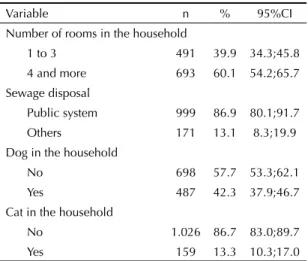
Of the 1,185 interviewees aged between zero and 19 years, 50.1% were women and 61.9% had white skin color. In addition, 94% lived in households character-ized as houses, 56.1% owned the place where they lived and 60.1% lived in homes with four rooms or more. Dogs were present in 42.3% of the households and cats, in 13.3%. The prevalence of asthma was 9.1% (95%CI: 7.0;11.7) and of allergy, 21.1% (95%CI: 17.9;24.7) (Table 1).
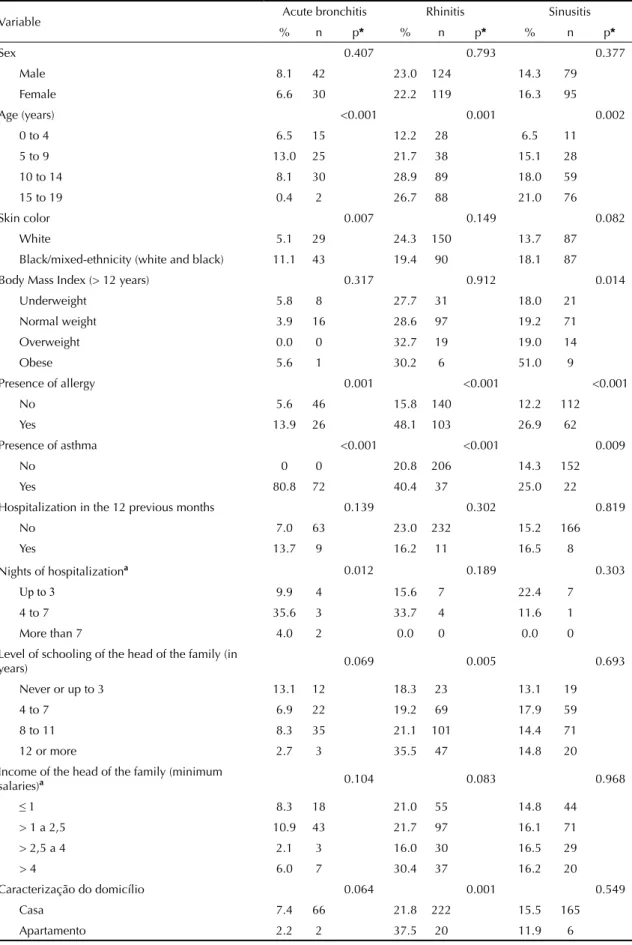
Self-reported prevalence of acute bronchitis was 7.3% (95% CI: 5.5;9.8), of rhinitis, 22.6% (95%CI: 19.3;26.2), and of sinusitis, 15.3% (95%CI: 12.6;18.5).
Acute bronchitis was signifi cantly associated with age (p < 0.001), skin color (p = 0,007), presence of allergy (p = 0.001), of asthma (p < 0.001), number of nights of hospitalization (four to seven nights, p = 0.012), and with number of rooms in the household (p = 0.004). Rhinitis was associated with age (p = 0.001), with pres-ence of allergy (p < 0.001), of asthma (p < 0.001), level of schooling of the head of the family (p = 0.005), and with the characterization of the household (p = 0.001). Sinusitis was associated with age (p = 0.002), with BMIf (p = 0.014), presence of allergy (p < 0.001), and
presence of asthma (p = 0.009) (Table 2).
In the multiple Poisson regression model, the following variables were associated with self-reported acute bron-chitis: ages from zero to four years (PR = 17.86; 95%CI: 3.65;90.91), from fi ve to nine years (PR = 37.04; 95%CI: 8.13;166.67), from ten to 14 years (PR = 20.83; 95%CI: 4.93;90.91), presence of allergy (PR = 3.12; 95%CI: 1.70;5.73), black and mixed-ethnicity (black and white) skin color (PR = 2.29; 95%CI: 1.21;4.35), and one to three rooms in the household (PR = 1.85; 95%CI: 1.17;2.94) (Table 3). The interaction test was not signifi cant among the independent variables. Age and skin color did not modify the association for pres-ence of allergy (p = 0.998 and p = 0.528, respectively), and number of rooms in the household did not modify the association for skin color (p = 0.187).
The following variables were associated with self-reported rhinitis: ages ten to 14 years (PR = 2.77; 95%CI: 1.60;4.78), 15 to 19 years (PR = 2.58; 95%CI: 1.52;4.39), reporting to have allergy (PR = 4.32; 95%CI: 2.79;6.70), reporting to have asthma (PR = 2.30; 95%CI: 1.30;4.10) and living in a fl at (PR = 1.70; 95%CI: 1.06;2.73). There was no interaction between presence of asthma and allergy (p = 0.196), and age did not modify the association for presence of asthma (p = 0.840) and of allergy (p = 0.687) (Table 3).
Self-reported sinusitis was associated with: age fi ve to nine years (PR = 2.44; 95%CI: 1.09;5.43), ten to 14 years (PR = 2.99; 95%CI: 1.36;6.58), 15 to 19 years (PR = 3.62; 95%CI: 1.68;7.81), reporting to have allergy (PR = 2.23; 95%CI: 1.41;3.52), and being obese (PR = 4.42; 95%CI: 1.56;12.50) (Table 3). There was no interaction between presence of allergy and body mass index (p = 0.457).
DISCUSSION
fi ve, and it is responsible for the majority of the causes of hospitalization.12 The United States performed
more than 5 million consultations for acute bronchitis between 2001 and 2002, and classifi ed it among the most frequent diseases in the outpatient health services.a
In Germany, the prevalence of self-reported bronchitis in children aged fi ve to seven years was 21.3% in Munich, 33% in Dresden and 31.8% in Leipzig between 1995 and 1996. The prevalence of bronchitis was 24.4% in Munich and 36.8% in Dresden for children between nine and 11 years.23 The prevalence of acute bronchitis
for children between fi ve and nine years old was lower in the present study: 13%.
Age was associated with acute bronchitis, mainly in the
fi rst years of life. Presence of allergy was associated with acute bronchitis. This disease frequently refers to an infectious process propagated by the upper airways and is a complication of rhinitis or pharyngitis, more common in atopic (allergic) individuals.12 Black or
mixed-ethnicity skin color and living in households with lower number of rooms were also associated with acute bronchitis. Although skin color relations are not defi ned by a social group, ethnic differences are asso-ciated with social inequalities and condition the way of living of groups of individuals. Thus, blacks are considered more susceptible to respiratory infectious diseases. Agglomeration and low socioeconomic level are important factors for acute lower respiratory tract infections, as well as allergies and associated comor-bidities, like asthma.17
The mean prevalence of clinically diagnosed rhinitis in Europe was 22.7% (95%CI: 21.1;24.2) in 2001, similar to the present study in São Paulo. The European countries that were evaluated were: Belgium (28.5%;
Table 1. Distribution of the studied population according to investigated variables. São Paulo, Southeastern Brazil,
2008-2009. (n = 1,185)a
Variable n % 95%CI
Sex
Male 596 49.9 46.5;53.3 Female 589 50.1 46.7;53.5 Age (years)
0 to 4 316 22.5 19.4;26.0 5 to 9 189 28.2 24.8;32.0 10 to 14 318 25.9 22.8;29.3 15 to 19 362 23.3 19.7;27.4 Skin color
White 691 61.9 56.8;66.7 Black/Mixed-ethnicity
(white and black) 483 38.1 33.3;43.2 Body Mass Index (> 12 years)
Underweight 116 21.0 17.2;25.2 Normal weight 366 65.0 60.1;69.6 Overweight 63 10.7 8.3;13.8
Obese 19 3.3 1.9;5.6
Presence of allergy
No 954 78.9 75.3;82.1
Yes 230 21.1 17.9;24.7
Presence of asthma
No 1.093 90.9 88.3;93.3
Yes 92 9.1 7.0;11.7
Hospitalization in the 12 previous months
No 1.110 94.9 93.3;96.1
Yes 75 5.1 3.9;6.7
Nights of hospitalization (hospitalized in the 12 previous months)
Up to 3 39 63.8 50.4;75.4 4 to 7 19 18.8 11.7;28.8 More than 7 17 17.4 8.5;32.1 Level of schooling of the head of the family (in years)
Never or up to 3 140 10.2 7.9;13.0 4 to 7 358 24.5 20.5;28.9 8 to 11 506 48.5 44.1;53.0 12 or more 156 16.8 12.9;21.7 Income of the head of the family (minimum salaries)b
Less than or equal to 1 296 25.0 21.3;29.2 > 1 to 2.5 469 40.8 36.2;45.5 > 2.5 to 4 161 16.5 13.5;20.0 > 4 148 17.7 13.6;22.8 Characterization of the household
House 1.109 93.7 89.5;96.3
Flat 58 6.3 3.7;10.5
Type of household
Ceded 162 15.2 11.4;20.0 Rented 328 28.7 24.0;33.9 Private 653 56.1 50.2;61.8
To be continued
Table 1 continuation
Variable n % 95%CI
Number of rooms in the household
1 to 3 491 39.9 34.3;45.8
4 and more 693 60.1 54.2;65.7
Sewage disposal
Public system 999 86.9 80.1;91.7
Others 171 13.1 8.3;19.9
Dog in the household
No 698 57.7 53.3;62.1
Yes 487 42.3 37.9;46.7
Cat in the household
No 1.026 86.7 83.0;89.7
Yes 159 13.3 10.3;17.0
a Variable that presented the highest number of losses obtained
n = 1,074.
b Income of the head of the family in minimum salaries (1
Table 2. Prevalence of self-reported acute bronchitis, rhinitis and sinusitis in children and adolescents and its associations with the independent variables. São Paulo, Southeastern Brazil, 2008-2009.
Variable Acute bronchitis Rhinitis Sinusitis
% n p* % n p* % n p*
Sex 0.407 0.793 0.377
Male 8.1 42 23.0 124 14.3 79
Female 6.6 30 22.2 119 16.3 95
Age (years) <0.001 0.001 0.002
0 to 4 6.5 15 12.2 28 6.5 11
5 to 9 13.0 25 21.7 38 15.1 28
10 to 14 8.1 30 28.9 89 18.0 59
15 to 19 0.4 2 26.7 88 21.0 76
Skin color 0.007 0.149 0.082
White 5.1 29 24.3 150 13.7 87
Black/mixed-ethnicity (white and black) 11.1 43 19.4 90 18.1 87
Body Mass Index (> 12 years) 0.317 0.912 0.014
Underweight 5.8 8 27.7 31 18.0 21
Normal weight 3.9 16 28.6 97 19.2 71
Overweight 0.0 0 32.7 19 19.0 14
Obese 5.6 1 30.2 6 51.0 9
Presence of allergy 0.001 <0.001 <0.001
No 5.6 46 15.8 140 12.2 112
Yes 13.9 26 48.1 103 26.9 62
Presence of asthma <0.001 <0.001 0.009
No 0 0 20.8 206 14.3 152
Yes 80.8 72 40.4 37 25.0 22
Hospitalization in the 12 previous months 0.139 0.302 0.819
No 7.0 63 23.0 232 15.2 166
Yes 13.7 9 16.2 11 16.5 8
Nights of hospitalizationa 0.012 0.189 0.303
Up to 3 9.9 4 15.6 7 22.4 7
4 to 7 35.6 3 33.7 4 11.6 1
More than 7 4.0 2 0.0 0 0.0 0
Level of schooling of the head of the family (in
years) 0.069 0.005 0.693
Never or up to 3 13.1 12 18.3 23 13.1 19
4 to 7 6.9 22 19.2 69 17.9 59
8 to 11 8.3 35 21.1 101 14.4 71
12 or more 2.7 3 35.5 47 14.8 20
Income of the head of the family (minimum
salaries)a 0.104 0.083 0.968
≤ 1 8.3 18 21.0 55 14.8 44
> 1 a 2,5 10.9 43 21.7 97 16.1 71
> 2,5 a 4 2.1 3 16.0 30 16.5 29
> 4 6.0 7 30.4 37 16.2 20
Caracterização do domicílio 0.064 0.001 0.549
Casa 7.4 66 21.8 222 15.5 165
Apartamento 2.2 2 37.5 20 11.9 6
95%CI: 24.5;32.5), France (24.5%; 95%CI: 21.0;28.0), Germany (20.6%; 95%CI: 16.5;24.6), Italy (16.9%; 95%CI: 12.9;20.9), Spain (21.5%; 95%CI: 18.5;24.4) and England (26.0%; 95%CI: 20.3;31.7%).4 Rhinitis
presents important variations in the prevalence indexes of its symptoms. According to studies carried out in hundreds of cities in Africa, North and South America, Asia, Australia and Europe, with 463,801 children aged 13 to 14 years, and in dozens of cities in the same regions, except for Africa, with 257,800 children aged six to seven years, the prevalence of rhinitis symptoms varied from 3.2% to 66.6% and from 1.5% to 41.8%, respectively.20
The mean prevalence of rhinitis in 20 Brazilian cities for children aged six to seven years and for adolescents aged 13 to 14 years was 25.7% and 29.6%, respectively. For the present study, the estimated prevalence of rhinitis for the age group between fi ve and nine years was 22%, and between ten and 14 years, 29%, similar to the Brazilian mean. In São Paulo, the International Study of Asthma and Allergies in Childhood (ISAAC) – Phase 3 – pointed prevalence of symptoms of rhinitis (sneezing, coryza or nasal stuffi ness present in the absence of a cold) for children and adolescents of around 29% from 2002 to 2003. The prevalence of rhinitis by medical diagnosis was 19.3% for children and 21.4% for adolescents, values that are similar to the ones found in the present study.18
The presences of asthma and allergy were associated with rhinitis. Batlles-Garrido et al3 (2010) found odds
ratio 2.2 (95%CI: 1.22;4.02) times higher for rhinitis in asthmatics when compared to non-asthmatic indi-viduals, and for the presence of atopy, the odds ratio was of 2.5 (95%CI: 1.93;3.42). Epidemiological studies show that, many times, asthma and rhinitis coexist in the same person. At least 60% of the asthmatics have rhinitis and approximately 20% to 30% of the people with rhinitis have asthma.7
Law et al15 (2003) stated that consultations in
emer-gency services are responsible for 1% of the direct costs with rhinitis, but account for 62% of the expenditures on asthma in the United States. Rhinitis, intimately associated with asthma, is a public health problem in many countries, which leads to the need of monitoring its tendencies continuously. Clinical observation and data from the literature show that the adequate approach to infl ammation in the upper airways is indispensable to the satisfactory handling of the asthmatic. People with rhinitis frequently present a reduction in the quality of life, caused by sleep disorders, fatigue, irritability, daytime sleepiness, and memory defi cits. In addition, the fi nancial impact becomes higher when the related comorbidities are considered, like asthma, sinusitis and allergies.7,16
Due to the coexistence between allergic rhinitis and asthma, the importance of the upper airways infections as an intensifi cation factor for asthma and the impor-tance of the presence of rhinitis as a risk factor for sinus-itis have been widely discussed. Rhinsinus-itis is associated
Table 2 continuation
Variable Acute bronchitis Rhinitis Sinusitis
% n p* % n p* % n p*
Type of household 0.186 0.138 0.075
Ceded 11.2 14 26.6 41 14.1 26
Rented 7.5 22 17.6 53 10.7 36
Private 6.1 33 23.9 140 17.5 103
Number of rooms in the household 0.004 0.116 0.079
1 to 3 10.5 43 19.8 91 12.2 61
4 and more 5.4 29 24.5 152 17.4 113
Sewage disposal 0.980 0.090 0.087
Public system 7.2 60 23.5 547 14.0 140
Others 7.1 10 16.8 45 18.8 32
Dog in the household 0.453 0.787 0.182
No 7.9 47 23.0 140 14.9 104
Yes 6.5 25 21.1 103 14.4 70
Cat in the household 0.096 0.646 0.507
No 8.0 67 22.3 209 14.0 143
Yes 3.0 5 24.9 34 19.5 31
* Chi-square test.
a Only for those who were hospitalized in the 12 previous months.
Table 3. Multiple Poisson regression model for self-reported respiratory diseases in children and adolescents. São Paulo, Southeastern Brazil, 2008-2009.
Variable PR (95%CI) Standard-error p Design effect
Acute bronchitis
Age (years)
15 to 19 1
10 to 14 20.83 (4.9;90.9) 0.73
<0.001
0.58
5 to 9 37.04 (8.1;166.7) 0.81 0.65
0 to 4 17.86 (3.6;90.9) 0.76 0.70
Presence of allergy
No 1
Yes 3.12 (1.70;5.73) 0.31 <0.001 1.64
Skin color
White 1
Black/mixed-ethnicity (white
and black) 2.29 (1.21;4.35) 0.33 0.011 1.96
Number of rooms in the household
4 and more 1
1 to 3 1.85 (1.17;2.94) 0.23 0.008 1.00
Rhinitis
Age (years)
0 to 4 1
5 to 9 1.77 (0.98;3.18) 0.22
0.001
1.70
10 to 14 2.77 (1.60;4.78) 0.27 1.40
15 to 19 2.58 (1.52;4.39) 0.26 1.23
Presence of allergy
No 1
Yes 4.32 (2.79;6.70) 0.22 <0.001 1.82
Presence of asthma
No 1
Yes 2.30 (1.30;4.10) 0.29 0.004 1.24
Characterization of the household
House 1
Flat 1.70 (1.06;2.73) 0.24 0.027 0.81
Sinusitis
Age (years)
0 to 4 1
5 to 9 2.44 (1.09;5.43) 0.23
0.010
1.94
10 to 14 2.99 (1.36;6.58) 0.27 1.86
15 to 19 3.62 (1.68;7.81) 0.39 1.78
Presence of allergy
No 1
Yes 2.23 (1.41;3.52) 0.24 <0.001 1.91
Body Mass Index
Underweight 1
Normal weight 1.01 (0.58;1.73) 0.45 0.91
Overweight 0.99 (0.44;2.44) 0.52
0.012 1.19
with worse control of asthma. This is interpreted as the expression of one disease that affects simultaneously the upper and lower respiratory tracts, probably due to common risk factors and pathogenesis.7,16
Living in fl ats was associated with rhinitis, supporting the hygiene hypothesis, which interprets the variation in the risks for allergic diseases as a refl ex of the reduction in the exposure to microbial agents in the early phase of life. According to this hypothesis, the change to the modern lifestyle would be responsible or co-responsible for the signifi cant increase in allergic diseases in the last decades. Strachan (1989)21 considers it as the only
coherent and biologically plausible explanation for the variations in allergy observed among more or less numerous families, modern lifestyle (fl ats) or in farms and fi elds (houses). However, the following aspects seem to contradict this hypothesis: high rates of respi-ratory disease among the poor urban population in the USA and in other industrialized countries, the lungs of many atopic children are abnormal before the occur-rence of any infection, and there is no evidence that the incidence or type of viral respiratory infections have decreased during the period of thirty years in which the prevalence of the allergic diseases increased.24
As for sinusitis, it is estimated that it affects one out of every six adults in the United States and its diagnosis is considered one of the most common in clinical practice. These statistics possibly underestimate the real prevalence in the country, because approximately 20% of the affected people do not look for medical assistance. Sinusitis by medical diagnosis presented prevalence around 10% in Europe, Japan and in the United States in 2001.19 The prevalence of self-reported
sinusitis was higher in the present study. A large part of the studies about the prevalence of this disease refers to the North American and European realities; few studies present information on Latin America.c
Sinusitis generates a direct and indirect impact on the global economy due to its high prevalence; also, it brings signifi cant repercussions on the quality of life of the affected children and their parents. Cunningham et al9 (2000) showed that parents of children with sinusitis
attributed to them greater physical limitation compared to children with asthma.
Allergy and obesity were associated with sinusitis in the present study, and age presented dose-response effect depending on the increase in the age group. Hoover et al13 (1997) observed odds ratio 4.3 (95%CI:
1.5;12.8) times higher for sinusitis in allergic individ-uals when compared to non-allergic ones. According to consensus recommendations, the term sinusitis has been replaced by rhinosinusitis due to the numerous anatomic, histological and physiopathological rela-tions between the nose and the paranasal sinuses. There is no genetic predisposition to sinusitis; however, there is family predisposition to allergies, which are
considered the main predisposing factors to sinusitis. The symptoms overlap and sinusitis rarely occurs without other allergies. Evidences show that asthma, rhinitis (and other allergies) and sinusitis would represent parts of one single infl ammatory syndrome, the “united airways disease”. The risk factors that are most implicated in sinusitis are the allergies and viral infections of the airways.1,7,13,16
No studies that showed or explained consistently the association identifi ed between obesity and sinusitis were found. One of the possible interpretations refers to the association between gastro-oesophageal refl ux disease and respiratory symptoms in children, a disease that is also related to presence of overweight and obesity,25 although there are controversies.14 On the
other hand, the increased presence of proinfl ammatory cytokines in obese individuals and these substances would be related to the local and systemic infl amma-tory responses of the airways.6 Obese people present
higher risks for asthma and other associated diseases, like sinusitis and allergies, due to the relation between these respiratory diseases and circulating levels of these cytokines, which are higher in obese people. Nevertheless, little is known about the physiological, mechanic, immunologic, genetic and environmental mechanisms that participate in the relation.8
Concerning the study’s limitations, self-reported morbidity may underestimate the prevalence of respi-ratory disease due to memory bias and/or absence of diagnosis. To epidemiology, estimating the prevalence of self-reported respiratory diseases in the population is a simple and direct way of obtaining information about health and presents good levels of agreement, repro-ducibility and cost-benefi t when the results of clinical evaluations are obtained, which can indirectly refl ect the real prevalence of the disease in the population.22
Table 4 synthesizes the final outcomes that are common, similar and specifi c to acute bronchitis, rhinitis and sinusitis. Presence of allergy was associ-ated with the three diseases. Atopic individuals are more susceptible to the associated comorbidities, and
Table 4. Final outcomes that are common, similar and specifi c to self-reported acute bronchitis, rhinitis and sinusitis in children and adolescents. São Paulo, Southeastern Brazil, 2008-2009.
Outcomes Acute bronchitis Rhinitis Sinusitis
Common
Age (zero to 14 years)
Age (10 to 19 years)
Age (5 to 19 years)
Allergy Allergy Allergy
Similar Household (1 to 3
rooms)
Household
(fl at)
-Specifi c
Skin color (black/ mixed-ethnicity (white and black)
they frequently have more than one sensitized shock organ: bronchial mucosa (asthma), nasal mucosa (rhinitis), conjunctiva (allergic conjunctivitis) and skin (atopic dermatitis).1,16,c Sinusitis and rhinitis
exist without other associated allergies with lower frequency, and acute bronchitis affects a higher number of atopic individuals. The age group ten to 14 years was common among the three respiratory diseases. Household aspects were similar between acute bronchitis and rhinitis. The hygiene hypothesis can explain part of the high prevalence of rhinitis in those who live in fl ats, unlike the relation between low number of rooms (one to three) in the household and acute bronchitis, which can be related to low socioeco-nomic level, agglomeration and low standard of living, which in turn can increase the risk of lung infection by virus or bacteria, mainly among children.17 Black and
mixed-ethnicity skin color was specifi cally associated with acute bronchitis. Admitting that the individuals’ skin color determines their socioeconomic conditions, or that ethnic differences are associated with social inequalities and condition the way of living of groups of people, blacks can be more susceptible to infectious
respiratory diseases. Another specifi c outcome was the presence of asthma in people with rhinitis. The current literature considers asthma and rhinitis as expressions of the same disease, which affects, concomitantly, the upper and lower airways.
1. Annesi-Maesano I. Epidemiological evidence of the occurrence of rhinitis and sinusitis in
asthmatics. Allergy. 1999;54 Suppl 57:7-13.
DOI:10.1111/j.1398-9995.1999.tb04401.x
2. Barros MBA. Inquéritos domiciliares de saúde:
potencialidades e desafi os. Rev Bras Epidemiol. 2008;11
Supl 1:6-19. DOI:10.1590/S1415-790X2008000500002
3. Batlles-Garrido J, Torres-Borrego J, Rubí-Ruiz T, Bonillo-Perales A, González-Jiménez Y, Momblán-De Cabo J, et al. Prevalence and factors linked to allergic rhinitis in 10 and 11-year-old children in Almería.
Isaac Phase II, Spain. Allergol Immunopathol (Madr).
2010;38(3):135-41. DOI:10.1016/j.aller.2009.07.
4. Bauchau V, Durham SR. Prevalence and rate of
diagnosis of allergic rhinitis in Europe. Eur Respir J.
2004;24(5):758-64. DOI:10.1183/09031936.04.0001 3904
5. Benício MHD, Cardoso MRA, Gouveia NC, Monteiro CA. Tendência secular da doença respiratória na
infância na cidade de São Paulo (1984-1996). Rev
Saude Publica. 2000;34(6 Supl):91-101. DOI:10.1590/ S0034-89102000000700012
6. Beuther DA, Weiss ST, Sutherland ER. Obesity and
asthma. Am J Respir Crit Care Med.
2006;174(2):112-9. DOI:10.1164/rccm.200602-231PP
7. Bousquet J, Van-Cauwenberge P, Khaltaev N; Aria Workshop Group; World Health Organization. Allergic
rhinitis and its impact on asthma (ARIA). J Allergy Clin
Immunol. 2001;108(5 Suppl):S147-334. DOI:10.1067/ mai.2001.118891
8. Camilo DF, Ribeiro JD, Toro AD, Baracat EC, Barros Filho AA. Obesity and asthma: chronic recurrent
rinosinusitis in children. J Pediatr (Rio J).
2010;86(1):6-14. DOI:10.2223/JPED.1963
9. Cunningham JM, Chiu EJ, Landgraf JM, Gliklich RE. The health impacto of chronic recurrent rhinosinusitis
in children. Arch Otolaryngol Head Neck Surg.
2000;126(11):1363-8.
10. Dykewicz MS, Hamilos DL. Rhinitis and sinusitis. J
Allergy Clin Immunol. 2010;125(2 Suppl 2):S103-15. DOI:10.1016/j.jaci.2009.12.989
11. Freitas C, Bremner SA, Gouveia N, Pereira LAA, Saldiva PHN. Internações e óbitos e sua relação com a poluição atmosférica em São Paulo, 1993 a 1997.
Rev Saude Publica. 2004;38(6):751-7. DOI:10.1590/ S0034-89102004000600001
12. Gonzales R, Bartlett JG, Besser RE, Cooper RJ, Hickner JM, Hoffman JR, et al. Principles of appropriate antibiotic use for treatment of uncomplicated
acute bronchitis: background. Ann Intern Med.
2001;134(6):521-9.
13. Hoover GE, Newman LJ, Platts-Mills TA, Phillips CD, Gross CW, Wheatley LM. Chronic sinusitis: risk
factors for extensive disease. J Allergy Clin Immunol.
1997;100(2):185-91.
14. Lagergren J, Bergström R, Nyrén O. No relation between body mass and gastro-oesophageal refl ux
symptoms in a Swedish population based study. Gut.
2000;47(1):26-9. DOI:10.1136/gut.47.1.26
15. Law AW, Reed SD, Sundy JS, Schulman KA. Direct costs of allergic rhinitis in the United States: estimates from the 1996 Medical Expenditure Panel Survey.
J Allergy Clin Immunol. 2003;111(2):296-300. DOI:10.1067/mai.2003.68
16. Passalacqua G, Ciprandi G, Canonica WC. The nose-lung interaction in allergic rhinitis and asthma: united
airways disease. Curr Opin Allergy Clin Immunol.
2001;1(1):7-13.
17. Prietsch SOM, Fischer GB, César JA, Lempek BS, Barbosa Jr. LV, Zogbi L, et al. Acute lower respiratory illness in under-fi ve children in Rio Grande, Rio Grande do Sul State, Brazil: prevalence and risk
factors. Cad Saude Publica. 2008;24(6):1429-38.
DOI:10.1590/S0102-311X2008000600023
18. Solé D, Wandalsen GF, Camelo-Nunes IC, Naspitz CK; ISAAC - Grupo Brasileiro. Prevalence of symptoms of asthma, rhinitis, and atopic eczema among Brazilian children and adolescents identifi ed by the International Study of Asthma and Allergies in Childhood (ISAAC)
– Phase 3. J Pediatr (Rio J). 2006;82(5):341-6.
DOI:10.1590/S0021-75572006000600006
19. Stewart M, Ferguson BJ, Fromer L. Epidemiology and
burden of nasal congestion. Int J Gen Med.
2010;3:37-45.
20. Strachan D, Sibbald B, Weiland S, Ait-Khaled N, Anabwani G, Anderson HR, et al. Worldwide variations in prevalence of symptoms of allergic rhinoconjunctivitis in children: the International Study of Asthma and Allergies in Childhood (ISAAC).
Pediatr Allergy Immunol. 1997;8(4):161-76. DOI:10.1111/j.1399-3038.1997.tb00156.x
21. Strachan DP. Family size, infection and atopy: the fi rst
decade of the “hygiene hypothesis”. Thorax. 2000;55
Suppl 1:S2-10. DOI:10.1136/thorax.55.suppl_1.S2
22. Viacava F. Informações em saúde: a importância
dos inquéritos populacionais. Cienc Saude
Coletiva. 2002;7(4):607-21. DOI:10.1590/S1413-81232002000400002
23. Weiland SK, von Mutius E, Hirsch T, Duhme H, Fritzsch C, Werner B, et al. Prevalence of respiratory and atopic disorders among children in the East and
West of Germany fi ve years after unifi cation. Eur
Respir J. 1999;14(4):862-70. DOI:10.1034/j.1399-3003.1999.14d23.x
24. Weiss ST. Asthma in early life: is the hygiene
hypothesis correct? J Pediatr (Rio J). 2008;84(6):475-6.
DOI:10.2223/JPED.1857
25. Wong IW, Rees G, Greiff L, Myers JC, Jamieson GG, Wormald PJ. Gastroesophageal refl ux disease and chronic sinusitis: in search of an
esophageal-nasal refl ex. Am J Rhinol Allergy. 2010;24(4):255-9.
DOI:10.2500/ajra.2010.24.3490
REFERENCES
Paper based on the doctoral dissertation authored by Sousa CA, submitted to the Postgraduate Program in Public Health of the Faculdade de Saúde Pública at Universidade de São Paulo, in 2011.