Longitudinal assessment of mercury exposure
in schoolchildren in an urban area of the
Brazilian Amazon
Avaliação longitudinal da exposição ao mercúrio
em crianças de uma área urbana na
Amazônia brasileira
1 Instituto de Estudos em Saúde Coletiva, Universidade Federal do Rio de Janeiro, Rio de Janeiro, Brasil.
2 Instituto Evandro Chagas, Ananindeua, Brasil. 3 Faculdade de Medicina, Universidade Federal do Rio de Janeiro, Rio de Janeiro, Brasil.
Correspondence M. D. S. Dutra Instituto de Estudos em Saúde Coletiva, Universidade Federal do Rio de Janeiro. Rua Marino da Costa 143, apto. 304, Rio de Janeiro, RJ 21940-210, Brasil. [email protected]
Marilene Danieli Simões Dutra 1 Iracina Maura de Jesus 2
Elisabeth C. de Oliveira Santos 2 Marcelo de Oliveira Lima 2
Renato Lopes Fernandes de Medeiros 2 Marcia Cavadas 3
Ronir Raggio Luiz 1
Volney de Magalhães Câmara 1
Abstract
This study was a longitudinal assessment of mer-cury exposure in schoolchildren in an urban area of the Brazilian Amazon. The study population consisted of 90 children whose exposure levels were assessed by testing mercury levels in the um-bilical cord blood and mothers’ blood samples in 2000-2001, and in the children’s hair and blood samples. The study also used a questionnaire on demographic and socioeconomic data, fish consumption, and self-reported disease history. Mean mercury level in hair in 2010 was approxi-mately 1µg/g, ranging up to 8.22µg/g, similar to 2004 and 2006. These figures can be explained by low fish consumption. Mean blood mercury lev-els at birth exceeded 10µg/L, ranging up to nearly 60µg/L, which indicates mercury transfer across the placenta. There was a significant increase in blood mercury from 2004 to 2006 (p < 0.001), sug-gesting exposure through air pollution. The main exposure to mercury was during pregnancy.
Mercury; Poisoning; Environmental Exposure; Child
Introduction
Epidemiological studies in the Brazilian Amazon should consider that both working and non-working individuals may be exposed to metal-lic mercury (Hg) emissions caused by mining operations that use mercury as an amalgam in gold extraction, during the resmelting of gold for sale in shops usually located in urban areas, and from emissions resulting from the burning and destruction of forests 1.
Another more toxic form of exposure involves the absorption of methylmercury (MeHg) pres-ent in fish, a staple in the diet of riverine and indigenous communities, making these popula-tion groups more vulnerable 1,2. Depending on
specific environmental conditions like the pres-ence of certain aquatic microorganisms, metallic mercury accumulated in the environment can be transformed into MeHg and biomagnify in fish along the biological chain 3.
Children can be subject to mercury exposure through: prenatal transfer across the placenta; breastfeeding, by ingesting breast milk contain-ing mercury; and a diet rich in fish 1,3,4,5. Recent
studies have also raised the possibility of mer-cury exposure through vaccines 6. According to
a study by the U.S. Agency for Toxic Substances and Disease Registry 7, as compared to adults,
growth and development; higher levels of gastro-intestinal, transdermal, and respiratory absorp-tion based on body weight for the same concen-trations of toxic substances; the incomplete de-velopment of their detoxifying mechanisms; and their immature blood-brain barrier 8,9.
Mercury can have systemic effects, reaching nearly all of the body’s organs and systems. The effects are predominantly on the nervous system, causing, among others, alterations in the child’s development; decreased motor coordination; al-terations in hearing, speech, gait, and balance; tremors; decreased visual field; and blindness. Mercury can also have mutagenic and teratogen-ic effects 9,10,11,12.
Children’s exposure to methylmercury has been proven by various studies, generally cross-sectional, conducted in small riverine communi-ties in the Amazon 1,2. As a contribution to future
research on this theme, the aim of the current study was to conduct a longitudinal evaluation of mercury exposure in schoolchildren in an urban area of the Amazon, specifically Itaituba, a mu-nicipality (county) in the State of Pará which is the largest gold producer in Brazil, and whose so-cioeconomic and nutritional profile differs from that of the rural riverine communities 2,13.
Methods
The gold-mining boom in the Brazilian Amazon lasted until the early 1990s, but the city of Itai-tuba, situated in the southwest region of the State of Pará, is still the main gold marketing center in Brazil 13. According to estimates by Souza et al. 13,
based on data from the Central Bank of Brazil, from the 1990s to 2004, 3,585kg of mercury used in gold production in Itaituba were launched into the atmosphere.
The study population included children from the urban area of the municipality of Itaituba with prior information on mercury levels at birth (cord blood samples from 2000 and 2001) and analysis of mercury levels in hair samples taken later from the same children at 8 to 10 years of age in 2010. Hair and blood mercury levels were also analyzed in these children in 2004 (n = 90) and 2006 (n = 47) in samples stored at the Evandro Chagas Institute, thus providing a study with repeated measurements over time. No mercury results are available for 43 children in 2006, since they were not visited that year due to changes of address or because they were not present when the field research team visited.
The sample (n = 90) was based on the exis-tence of a study 2 at the Evandro Chagas Institute
(Instituto Evandro Chagas) with 1,510 children
born in 2000 and 2001 at the maternity hospitals in Itaituba. Of these, a group of 239 children from the urban and rural areas were monitored from birth until 4 and 6 years of age. Losses to follow-up from birth to 6 years can be explained by the fact that the municipality of Itaituba has the larg-est infrastructure in the Tapajós Basin, offering better birthing conditions for women as com-pared to other municipalities in the region, so that the mothers return to their home towns and villages after childbirth (in addition to changes of address). Later, based on this list of 239 children that were followed and which included those re-siding in urban and rural areas, the study selected only those that studied and lived in the city lim-its of Itaituba, leading to the identification of the 90 children that participated in this study with the help of the Itaituba Municipal Department of Education (Secretaria Municipal de Educação de Itaituba) for children not located in 2006.
In 2010, the procedures included the use of a questionnaire on demographic and socioeco-nomic data, fish consumption, and self-reported disease history, similar to that used by the institu-tion since 2000. Blood and hair samples were tak-en by the team from the Evandro Chagas Institute according to international procedures. Determi-nation of total mercury in blood and hair samples used a cold vapor atomic absorption spectrome-ter (CV-AAS), model Automatic Mercury Analyzer HG-201 (Sanso Seisakusho Corp., Tokyo, Japan) and quality control used analysis of certified hair samples (IAEA-086), with analytical recovery of 99.65% (n = 27), and blood samples (Whole Blood II), with analytical recovery of 98.14% (n = 9).
In the exploratory data analysis, descriptive statistics were calculated for mercury levels and the appropriate graphs and tables were con-structed. The Wilcoxon test was used to check variation in mercury levels from birth to 4 years and from 4 to 6 years. The McNemar chi-square test was used to test the proportions of elevated mercury in the blood of newborns, children, and mothers, using the cutoff for blood mercury rec-ommended by the World Health Organization (≥
8µg/L) for unexposed individuals 9. For mercury
levels in hair, the study used the reference value of 2.0µg/g for unexposed individuals, also rec-ommended by the WHO 9.
In compliance with the ethical procedures of the Declaration of Helsinki and Ruling 196/96
pro-cedures, and the parents or guardians signed a free and informed consent form before the study began.
Results
The study sample of 90 children showed an even sex distribution, with 48 boys and 42 girls. As for age, the majority were 8 years old (69%), and on-ly one child was 10. All lived in Itaituba, and 65 (70%) of the families had residential or mobile telephones.
According to the disease history reported in 2010, 67 (74.4%) of the children had a lifetime history of one to three diseases, the most com-mon being chicken pox (17), dengue (14), intesti-nal infections (13), and pneumonia (12). A sepa-rate question on illnesses in the previous month showed that 48 (53.3%) had experienced one or more disease events, mainly influenza (20), fever (13), and headache (6).
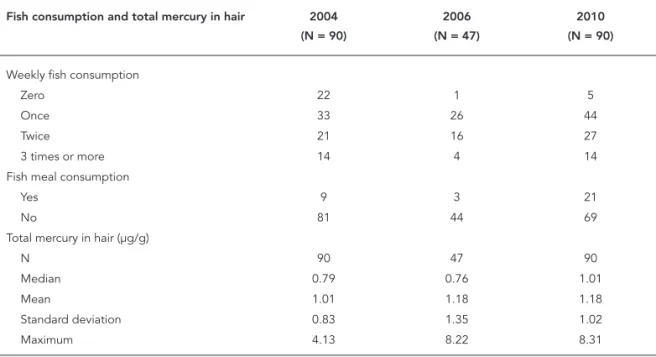
Table 1 shows figures on the children’s fish consumption. Only 5 children showed zero fish consumption in the previous year, while con-sumption once a week was reported by 44 chil-dren and twice a week by an additional 27. In 2004 and 2006, the majority of the children consumed fish a maximum of twice a week. Consumption of fish meal was reported for 21 children in 2010, but only two children consumed fish meal more
than once a month. This dietary pattern was sim-ilar for both years (2004 and 2006).
Mean mercury level in hair in 2010 was close to 1µg/g, ranging up to 8.22µg/g, similar to previ-ous years (Table 1).
The highest blood mercury level was at birth (Table 2), using cord blood and exceeding 8µg/L for both the mean and median, ranging up to nearly 60µg/L. There was a significant decrease in 2004 (p < 0.001, Wilcoxon test) and a subsequent increase, also significant, in 2006 (p < 0.001, Wil-coxon test). At birth, a significant correlation was observed (Spearman correlation coefficient = 0.315; p = 0.002) between cord blood and mater-nal venous blood levels.
As shown in Figure 1, more than 50% of the children (median line) were “positive” for blood mercury levels above the WHO limit for unex-posed individuals 9 (≥ 8µg/L), decreasing to fewer
than 25% in 2006. Table 3 compares the propor-tion of mercury levels greater than or equal to 8µg/L in the blood of mothers and their new-borns at birth. The proportion of levels above the cutoff in mothers was 31.1%, statistically lower (p < 0.001, McNemar chi-square) than the propor-tion in the newborns (63.3%). Importantly, of the 28 positive results in mothers, nearly all (25) were also positive in the children, and of the 62 nega-tive results in mothers, 32 converted to posinega-tive in the children.
Table 1
Fish consumption and descriptive measures of total mercury levels in hair samples from 90 schoolchildren in the urban area of Itaituba, Pará State, Brazil, according to year of sample collection.
Fish consumption and total mercury in hair 2004 (N = 90)
2006 (N = 47)
2010 (N = 90)
Weekly fish consumption
Zero 22 1 5
Once 33 26 44
Twice 21 16 27
3 times or more 14 4 14
Fish meal consumption
Yes 9 3 21
No 81 44 69
Total mercury in hair (µg/g)
N 90 47 90
Median 0.79 0.76 1.01
Mean 1.01 1.18 1.18
Standard deviation 0.83 1.35 1.02
Table 2
Descriptive statistics of blood mercury levels (µg/L) and variations according to year of sample collection, urban area of Itaituba, Pará State, Brazil.
Statistics Blood sample collection Variations
Birth (cord blood) 2004 2006 Birth to 2004 2004 to 2006
N 90 90 47 90 47
Mean 14.0 5.4 10.5 8.6 -5.2
Standard deviation 12.2 4.7 7.4 12.8 7.6
Minimum 0.0 0.0 0.0 -15.5 -24.1
Median 10.0 4.0 8.0 6.4 -4.1
Maximum 57.7 22.9 29.1 53.0 18.5
p-value, Wilcoxon test < 0.001 < 0.001
Figure 1
Blood mercury levels in children according to age. Itaituba, Pará State, Brazil.
Total blood Hg (µg/L)
64
56
48
40
32
24
16
8
0
Birth (cord blood) 2004 2006
Discussion
This was an urban population sample, thus dis-playing different socioeconomic conditions from the riverine communities in the same municipal-ity. Factors emphasizing this difference included the fact that 70% of the children’s families had telephones in 2010, in contrast to the riverine communities, which usually lack even basic
electricity 2,14. Using the criteria suggested by
Mahaffey 15, another striking difference with the
or species of fish consumed, and approximate amount in grams.
The unexpected result of mercury level in hair, below the WHO reference of 2.0µg/g for un-exposed individuals 7 , may be a consequence of
the low fish consumption, showing that exposure to methylmercury after birth was negligible. In exposed communities and even in populations not directly impacted by gold-mining areas in the State of Pará, Santos et al. 14 found mercury
levels in hair that exceeded what are considered safe limits for unexposed populations, such as 8.58µg/g in 203 individuals from Caxiuanã, a na-tional conservation area.
The high mercury levels in cord blood sam-ples indicate that the most significant exposure to mercury occurred during pregnancy. Accord-ing to some authors, cord blood mercury lev-els reflect exposure during the first trimester of pregnancy and can decrease tenfold by the end of pregnancy and after birth 16,17. In this sense, a
decrease in these indicators would be expected during the first year of life, especially after the conclusion of breastfeeding.
In an analysis of total mercury levels in cord blood and maternal blood samples in 28 interna-tional studies, Murata et al. 18 cited levels ranging
from 0.96µg/L in 1,109 individuals in Canada in a study by Rhainds et al. 19 to 22.35µg/L reported
by Grandjean et al. 20 in 996 subjects in the Faroe
Islands. Taking the previously cited values as the reference, or 8.0µg/L for total blood mercury in unexposed individuals or up to 5.8µg/L as sug-gested by Mahaffey et al. 21 , the cord blood levels
detected in the current study were high.
Although the mercury levels in the children’s venous blood were close to the reference values used in the international literature (8.0µg/L and 5.8µg/L), the increase in the blood mercury lev-els from 2004 to 2006, along with the marginally
significant results for hair mercury, suggest the possibility of exposure to metallic mercury in the city of Itaituba. A plausible explanation would be mercury emissions from gold shops.
According to a study by the National Depart-ment of Mine Production in the State of Pará (Departamento Nacional de Produção Mineral do Estado do Pará) and the Foundation of the Federal University in Rondônia (Fundação Uni-versidade Federal de Rondônia), from 2002 to 2006 22, gold resmelting in 17 shops caused
in-door and outin-door air pollution with mercury. Among others, mercury levels were analyzed in 30 soil samples and 68 dust samples collected from the streets around the gold shops. In 2002, these shops produced an average of 18.7kg of gold per month. Mercury levels varied from 71 to 1,067µg. kg-1 in the soil samples and from 59 to 21,943µg.
kg-1 in the dust samples. The authors
conclud-ed that there was air pollution from mercury, especially in areas close to these gold shops 22.
The pollution increased over time, and in 2006 the mercury levels in the soil varied from 40 to 1,390µg.kg-1, while the dust samples ranged from
25 to 60,778µg.kg-122. The authors also identified
an increase in gold production, and showed that the areas with the highest mercury levels were lo-cated close to the gold shops, decreasing in pro-portion to the distance from these sources.
A similar result, corroborating the possibility of exposure from the gold shops, was obtained in Poconé, Mato Grosso State, in a study 23 of
mer-cury concentrations in dust samples from houses up to 200 meters from gold shops, showing levels up to 21.29ppm, while 10% of the 158 individu-als without occupational exposure living in these homes showed urine mercury levels above the WHO references, reaching 102.40µg/L 23. Table 3
Comparisons of the proportions of mercury greater than or equal to 8µg/L in maternal blood and cord blood. Itaituba, Pará State, Brazil.
Cord blood mercury Maternal blood mercury Total p-value *
Negative (< 8µg/L)
Positive (≥ 8µg /L)
n % n % n %
Negative (< 8µg/L) 30 33.3 3 3.3 33 36.7 < 0.001
Positive (≥ 8µg/L) 32 35.6 25 27.8 57 63.3
Total 62 68.9 28 31.1 90 100.0
Conclusion
This longitudinal evaluation of mercury expo-sure in children in the urban area of Itaituba from 2000 to 2010 indicates that the main exposure to the metal was prenatal. Mercury levels in the hair of these children did not exceed the reference values for unexposed individuals, while there was an increase in exposure to metallic mercury, probably from emissions by local gold shops. Health teams from the Brazilian Unified National
Health System (SUS) should thus conduct joint interventions with the appropriate environmen-tal agencies, besides special measures for more exposed individuals, particularly children and childbearing-age women.
These results also demonstrate the useful-ness of assessing mercury in different types of biological samples in order to elucidate human exposure. Epidemiological studies should pri-oritize blood samples in urban areas with gold shops, as in Itaituba.
Resumo
O objetivo deste estudo foi realizar avaliação longitu-dinal da exposição de crianças de uma área urbana da Amazônia brasileira ao mercúrio (Hg). A população foi composta por 90 crianças, cuja exposição foi avaliada desde o nascimento por meio das análises dos teores de Hg no sangue do cordão umbilical e no sangue das mães em 2000/2001, e em amostras de cabelo e sangue das crianças. Os procedimentos incluíram também um questionário com informações demográficas, so-cioeconômicas, sobre consumo de peixes e morbidade referida. A média dos teores de Hg no cabelo em 2010 foi próxima a 1µg/g e sua amplitude 8,22µg/g, seme-lhantes aos anos 2004 e 2006, podendo ser explicada pela baixa ingestão de peixes. A média dos teores de Hg no sangue das crianças ao nascer ultrapassou 10µg/L e sua amplitude atingiu quase 60µg/L, indicando trans-ferência do Hg através da barreira placentária. Ocor-reu aumento significativo dos teores de Hg no sangue entre 2004 e 2006 (p < 0,001), sugerindo a possibilida-de possibilida-de exposição atmosférica ao Hg. O principal perío-do de exposição ao Hg ocorreu durante a gestação.
Mercúrio; Envenenamento; Exposição Ambiental; Criança
Contributors
M. D. S. Dutra, I. M. Jesus, E. C. O. Santos, M. O. Lima, R. L. F. Medeiros, M. Cavadas, R. R. Luiz, and V. M. Câmara collaborated in all stages of the study.
Acknowledgments
References
1. Passos CJS, Mergler D. Human mercury exposure and adverse health effects in the Amazon: a review. Cad Saúde Pública 2008; 24 Suppl 4:S503-20. 2. Santos EO, Jesus IM, Câmara VM, Brabo ES,
Je-sus MI, Fayal KF, et al. Correlation between blood mercury levels in mothers and newborns in Itai-tuba, Pará State, Brazil. Cad Saúde Pública 2007; 23 Suppl 4:S622-9.
3. Kehrig HA, Seixas TG, Baêta AP, Malm O, Moreira I. Inorganic and methylmercury. Do they transfer along a tropical coastal food web? Mar Pollut Bull 2010; 60:2350-6.
4. Malm O, Dórea JG, Barbosa AC, Pinto FN, Weihe P. Sequential hair mercury in mothers and chil-dren from a traditional riverine population of the Rio Tapajós. Bull Environ Contam Toxicol 2010; 85:463-6.
5. Jedrychowski W, Perera F, Rauh V, Flak E, Mróz E, Pac A, et al. Fish intake during pregnancy and mer-cury level in cord and maternal blood at delivery: an environmental study en Poland. Int J Occup Med Environ Health 2007; 20:31-7.
6. Dórea JG, Marques RC, Brandão KG. Neonate ex-posure to thimerosal-Hg from hepatitis B vaccines. Am J Perinatol 2009; 26:523-7.
7. Agency for Toxic Substances and Disease Registry. Technical support document for a methylmercury reference dose as a basis for fish consumption screening values (FCSVs). Atlanta: Agency for Toxic Substances and Disease Registry; 2009.
8. Asmus CF, Ruzany MH. Riscos ocupacionais na in-fância e adolescência. Uma revisão. J Pediatr (Rio J.) 1996; 72:203-8.
9. International Programme on Chemical Safety. Methylmercury. Geneva: World Health Organiza-tion; 1990. (Environmental Health Criteria, 101). 10. Davidson PW, Myers GJ, Weiss B, Shamlaye CF, Cox
C. Prenatal methyl mercury exposure from fish consumption and child development: a review of evidence and perspectives from the Seychelles Child Development Study. Neurotoxicology 2006; 27:1106-9.
11. van Wijngaarden E, Beck C, Shamlaye CF, Cerni-chiari E, Davidson PW, Myers GJ, et al. Benchmark concentrations for methyl mercury obtained from the 9-year follow-up of the Seychelles Child Devel-opment Study. Neurotoxicology 2006; 27:702-9. 12. Yorifuji T, Tsuda T, Inoue S, Takao S, Harada M.
Long-term exposure to methylmercury and psy-chiatric symptoms in residents of Minamata, Ja-pan. Environ Int 2011; 37:907-13.
13. Souza TMC, Anjos JR, Barros FC, Bastos WR, Silva GS, Oliveira RC. Atmospheric pollution caused by mercury from gold trade shops in Itaituba, Ama-zon, Brazil In: XIII International Conference on Heavy Metals in the Environment. Rio de Janeiro: Center for Mineral Technology; 2005. p. 13. 14. Santos ECO, Câmara VM, Jesus IM, Brabo ES,
Lou-reiro ECB, Mascarenhas AFS, et al. A contribution for the establishment of references values for total mercury levels in hair and fishes in Amazonia. En-viron Res 2002; 90:6-11.
15. Mahaffey KR. Mercury exposure: medical and public health issues. Trans Am Clin Climatol Assoc 2005; 116:127-53.
16. Sakamoto M, Kubota M, Liu XJ, Murata K, Nakai K, Satoh H. Correlations between mercury con-centrations in umbilical cord tissue and other biomarkers of fetal exposure to methylmercury in the Japanese population. Environ Res 2007; 103: 106-11.
17. Huan SP, Sakamoto M, Oliveira XJL, Kakita A, Fu-tatsuka M. Changes in methylmercury accumula-tion in the brain of rat offspring throughout ges-tation and during sucking. Toxicol Environ Chem 2004; 86:161-8.
18. Murata K, Dakeishi M, Shimada M, Satoh H. As-sessment of intrauterine methylmercury exposure affecting child development: messages from the newborn. Tohoku J Exp Med 2007; 213:187-202. 19. Rhainds M, Levallois P, Dewailly F, Ayotte P. Lead,
mercury and organochlorine compounds levels in cord blood in Quebec, Canada. Arch Environ Health 1999; 54:40-7.
20. Grandjean P, Budtz-Jorgensen E, Jorgensen PJ, Wheile P. Umbilical cord mercury concentration as biomaker of prenatal exposure to methylmercury. Environ Health Perspect 2005; 113:905-8.
21. Mahaffey KR, Clickner RP, Jeffries RA. Adult wom-en’s blood mercury concentrations vary regionally in the United States: association with patterns of fish consumption (NHANES 1999–2004). Environ Health Perspect 2009; 117:47–53.
22. Souza TMC, Anjos JR, Barros FC, Bastos WR. Moni-toramento da poluição por mercúrio na cidade de Itaituba, Pará. In: 44o Congresso Brasileiro de Ge-ologia. Curitiba: Sociedade Brasileira de Geologia; 2008. p. 906.
23. Câmara VM, Tavares LMB, Filhote MIF, Malm O, Perez MA. A program for the control of indoor pollution by metallic mercury. Environ Res 2000; 83:110-6.
Submitted on 16/May/2011