Proceedings IGLC-18, July 2010, Technion, Haifa, Israel
ANALYSIS OF STRATEGIC ASPECTS IN LEAN
CONSTRUCTION IMPLEMENTATION
Mario José Azevedo1, Fernando R. Melo Nunes2, José de Paula Barros Neto3
ABSTRACT
This paper proposes improvements on the strategic aspects of the lean construction system implementation in contractor companies of Fortaleza/Brazil. It is an exploratory-descriptive study based on qualitative research supported by interviews and observations ―in loco‖. The hypothesis are: 1) the enterprise and production strategies have influence on the results of the application of lean construction principles on the productivity increase, cost, losses and labor force reduction; 2) the success of the lean construction system implementation depends upon the labors‘ formal education and participation in planning elaboration. Determinant factors are the high management support and the involvement of human capital with adequate formal education. Resultant contributions are competition power and productivity increase, stability in production processes, labor force requirements delays in activities execution, costs and losses reduction, better organization of working layout area, increase in the labor force and final clients satisfaction level. As a suggestion of improvement, the contractors should negotiate business deals with strategic suppliers, previously mapped by the value chain. This could leverage gains in the productive chain. It is suggested for future papers, the development of a systematic procedure capable of interfering in the alignment level between strategy and lean production.
KEY-WORDS
Strategy, Production, Lean Construction.
INTRODUCTION
The Brazilian civil construction industry is characterized as a raising market, with high competition, having a lot of new incomers. Contributing to this scenery a lot of contractors are financing themselves in the share market They need large volumes of capital to apply in contracts all over the country, in two governmental programs, Program of Development Acceleration and Program My House My Life, besides all contracts tied to 2014 World Cup, which will be in Brazil. To develop and apply strategies in a fast and precise way can make a difference between the success and the failure of an enterprise.
This paper has academic relevance since it offers better decision alternatives focusing costs and losses reduction, and process acceleration. It is also important
1
M.Sc. Student, Administration Post-Graduation Program, Federal University of Ceará, e-mail: [email protected].
2 Dr. Professor, Administration Post-Graduation Program, Federal University of Ceará,
e-mail:[email protected].
3
because it allows a discussion of the strategic aspects of the concepts of lean construction implementation in countries that are part of emerging economies.
The hypothesis are: 1) enterprise and production strategies influence the results of the application of lean construction principles to increase productivity, and reduce costs, losses and labor force; 2) the success on the implementation of lean construction principles depends upon the formal education and participation of the labor force in the plans formulation. The main objective is to propose improvements to the process of implementation of the lean concepts in civil construction companies, under a strategic point of view.
THEORETICAL SUPPORT
The strategy definition is not unique (Whittington 2006). The trial to reach a unique definition could be a trap, since it is possible and useful to have different perspectives and alternatives about what is strategy (Slack et al., 2002). Many authors have contributed to the debut of different strategic thinking schools focusing the business world, generically grouped in descriptive and prescriptive schools.
Researching a large chunk of known literature, Mintzberg et al. (2000) present 10 different schools of strategic thinking (design, planning, positioning, entrepreneur, cognitive, learning, power, cultural, ambient and configuration), applying to different stages of administrative development.
Strategy can be defined in five different ways: (1) as a plan, or something equivalent (pretended strategy); (2) as a consistent comportment standard along time (realized strategy); (3) as a position, the place of the company‘s products in its markets; (4) as perspective, which means the fundamental way the company has to realize its mission; and (5) as a magic, which means a way to trap the competition (Mintzberg et al. 2000).
Between the planning of a strategy and its realization, there is a period of analysis where it can be aborted, becoming non realized strategy, or accepted, receiving the influence of emergent strategies to get the final format, becoming the realized strategy after its implementation.
LEAN CONSTRUCTION
The base of Toyota Production System (TPS) is the absolute elimination of losses, having as pillar of support: 1) just in time, a flux process where the parts only reach the production line at the moment and on the quantity needed; (2) self automation, signifying the automation with human participation (Ohno, 1997).
The basic difference between the traditional managerial philosophy and lean production is mainly conceptual, while traditionally production was done by steps, each one done in one ring of the chain, lean production is seen as a flux of products, from raw materials to finished goods, analyzing each activity in a way to reduce or eliminate those that do not aggregate value, such as moving, waiting and inspecting (Isatto et al., 2000).
Proceedings IGLC-18, July 2010, Technion, Haifa, Israel
Lean construction has a set of interdependent principles that must be applied in an integrated form: (1) reduction of all activities that do not aggregate value; (2) increase the final value of the product by the systematic adoption of clients‘ requirements; (3) reduction of the variability; (4) reduction of cycle time; (5) simplification and minimization of steps and parts; (6) increase flexibility to make products; (7) increase transparency; (8) focus control on the totality of processes; (9) establish continuous improvement in processes; (10) balance flux improvements with conversion improvements; and (11) do benchmarking (Koskela, 1992)
As says Barros Neto (2007), the strategic view contributes to a larger coherence in lean construction process implementation, provided that long term objectives are compatible with market and company needs. This process implementation should take into account internal peculiarities and the mapping of long term external context. About lean construction process, there are many questions: What is the main sequence to implement lean construction, considering competitive priorities (cost, quality, flexibility and delivery)? Are there different results when you use lean construction principles with different competitive priorities?
METHODOLOGY
This study is classified as exploratory-descriptive, since it deals with the detailing and description of a subject poorly explored because there is not a great amount of researches discussing strategic choices before lean construction implementation process. It is a multi case study supported by a bibliographic and a field research, working with qualitative data. The use of a multi case study is justified since it deals with a contemporary phenomenon inserted in a real context, being deeply analyzed (Triviños, 1987; Gil, 1996; Yin, 2001).
There were two companies, with different focus in the civil construction industry, participating in the study: (1) company ―A‖ belongs to an entrepreneurial group; it was established to attend the construction demands of its group, developing to a position today as a contractor of industrial facilities and private home buildings; (2) company ―B‖ builds high standard homes, vacation homes, hotels and resorts, and also acts as third part contractor to other companies, mainly new entrants from the southeast region of Brazil. Within the Fortaleza/Brazil universe of builders, these two companies were selected because they are in an advanced stage in the implementation of lean construction concepts. The data from these cases provide experiences that lead to theoretical generalizations.
A semi structured interview having a questionnaire with open questions was used on both companies to talk with the directors, managers, engineers and technicians, as a way to understand the dynamic of the operation of these organizations. During the interviews many other questions were added, according to the facts presented. Observations in loco were done during many visits made to the headquarters and the construction sites of these companies, registering with photos the different things found, and participating in the analysis of their productivity indexes.
DATA ANALYSIS
MARKET AND COMPETITION
Table 1 presents information about clients and the differentiation strategies adopted by contractors.
Table 1: Information on market and contractors‘ strategy (Source: interview)
COMPANY “A” COMPANY “B”
What is more valorized by your client? Group: speed; Industrial segment: reaction
capacity; Residential segment: price, lead time, quality, reliability, and customization.
Construction and finishing with quality for the best price.
What has your company done to be different of competitors? Adopt an innovative positioning; Uses
equipment, materials and managerial processes with high aggregate technology; Open mind; Labor force developed in company; Decentralized decisions making; Managerial system based in the concepts of lean construction ; Quality system having focus on process standardization; Exhaustive planning; Non acceptance of market and technology standards; Aggregates value to clients; Promotes technological interchanges.
Posture of innovation, leadership, information and adhesion to lean construction concepts.
Company ―A‖ has three groups of different clients – the group of enterprises to which it belongs, the industrial and the residential sections. This last one requires price, lead time, quality, reliability and customization, requirements of difficult simultaneous realization, requiring trade-offs among them. To be different of competitors, they adopt lean concepts directed to technology, processes and management. They form and instruct internally their personnel, trying to open their mind. They have as must items the planning, the decentralization of decisions and the standardization of processes. All their actions lead to aggregate value to clients, and do win-win technological interchanges.
Clients of company ―B‖ valorize the quality of materials and finishing, as well as price. To offer this, company B promotes better utilization of production assets, demonstrated by the cost and production rhythm control. It differentiates from competitors by the adoption of an innovation posture, benchmarking leader companies in Brazilian bigger cities. They consider themselves ahead of competitors because of their time of adhesion to lean construction concepts.
The analysis of the collected data presents both companies having experience with the implementation of lean construction principles. In company ―A‖ lean concepts were absorbed by the management system, being used not only as a tool, but as a philosophy, the way thought by Ohno (1997) when referring to the TPS.
STRUCTURAL ORGANIZATION AND THE PROCESS OF PLANNING
Table 2 shows a comparison between the two companies researched, referring to structural organization and the formalization of the strategic planning
Proceedings IGLC-18, July 2010, Technion, Haifa, Israel
The strategic planning at company ―B‖ is still intuitive, even though they recognize the necessity of change. Some goals are established for each of the cities where the company acts. They are business and income goals, but they are not properly followed up, only by the time of the balance sheet presentation. Every six months the production manager has a meeting with contract managers and on duty engineers to communicate their goals for the period.
Table 2: Organizational structure, strategic planning and goals setting (Source: Interviews)
COMPANY “A” COMPANY “B”
How is your company structurally organized? 1 Vice President, 1 Director, 4 Managers and a
Staff to support the Director, where is located the Coordination of lean processes.
There is a structural organization composed by directors, one of them dedicated to planning and to do strategy formulation.
Does the company have a formal definition of its strategy, goals and a strategic planning? It adopts an annual strategic planning, revised
every six months, having the participation of the director, the managers, coordinators and the vice president. In this planning they establish the goals and analyze the commercial, technological and production strategies. The follow up is done by the lean coordination.
The process is still intuitive, even though the company feels the necessity to do it formally. They use to establish goals in all areas where the company acts. Those are volume of business and income goals, missing a proper follow up, which is done only at the time of the balance sheet
presentation.
Are the goals spread in the company or are they exclusive for high management?
They are spread from first level managers up, each management level having knowledge of his goals; middle managers and coordinators have knowledge of all goals.
Every six months there is a meeting with the production manager, who is in charge to
communicate the goals to each contract manager. The communication of the strategic directions is also made through regular operational meetings and an internal newspaper. They want to be transparent to all.
Using regular operational meetings and an internal newspaper, the company tries to communicate their strategic directions. They recognize that this communication system should be more effective to reach all employees.
Analyzing strategic planning and goals establishment, while company ―A‖ is far advanced in terms of strategic planning, company ―B‖ is still in the intuition phase. Both companies establish goals, but while company ―A‖ communicates until first level managers, company ―B‖ tries to reach all employees, searching the highest degree of transparency.
TECHNOLOGY AND PRODUCTION
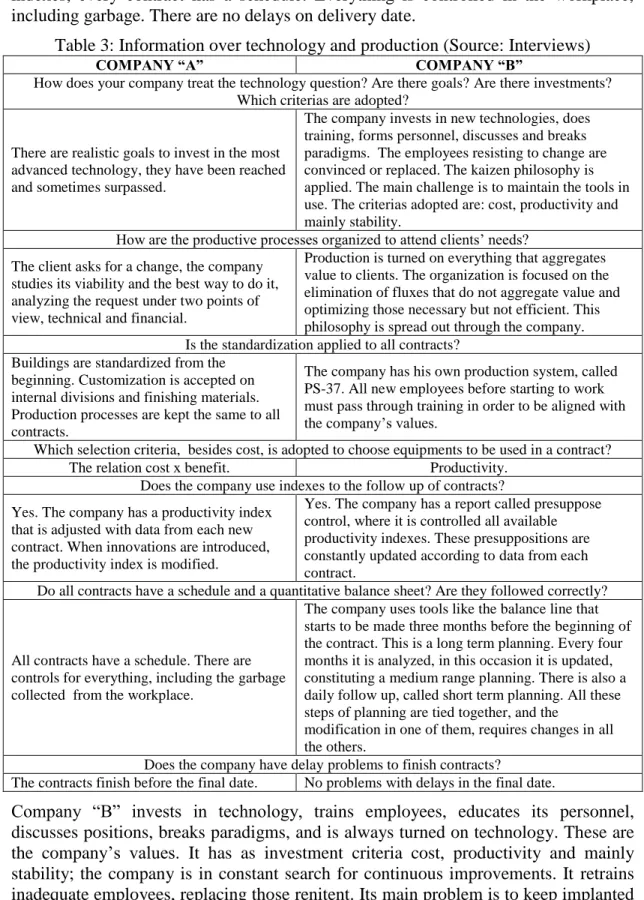
Table 3 there shows a comparison of data related to technology and production systems adopted by the two companies.
indexes, every contract has a schedule. Everything is controlled in the workplace, including garbage. There are no delays on delivery date.
Table 3: Information over technology and production (Source: Interviews)
COMPANY “A” COMPANY “B”
How does your company treat the technology question? Are there goals? Are there investments? Which criterias are adopted?
There are realistic goals to invest in the most advanced technology, they have been reached and sometimes surpassed.
The company invests in new technologies, does training, forms personnel, discusses and breaks paradigms. The employees resisting to change are convinced or replaced. The kaizen philosophy is applied. The main challenge is to maintain the tools in use. The criterias adopted are: cost, productivity and mainly stability.
How are the productive processes organized to attend clients‘ needs?
The client asks for a change, the company studies its viability and the best way to do it, analyzing the request under two points of view, technical and financial.
Production is turned on everything that aggregates value to clients. The organization is focused on the elimination of fluxes that do not aggregate value and optimizing those necessary but not efficient. This philosophy is spread out through the company. Is the standardization applied to all contracts?
Buildings are standardized from the beginning. Customization is accepted on internal divisions and finishing materials. Production processes are kept the same to all contracts.
The company has his own production system, called PS-37. All new employees before starting to work must pass through training in order to be aligned with the company‘s values.
Which selection criteria, besides cost, is adopted to choose equipments to be used in a contract? The relation cost x benefit. Productivity.
Does the company use indexes to the follow up of contracts?
Yes. The company has a productivity index that is adjusted with data from each new contract. When innovations are introduced, the productivity index is modified.
Yes. The company has a report called presuppose control, where it is controlled all available productivity indexes. These presuppositions are constantly updated according to data from each contract.
Do all contracts have a schedule and a quantitative balance sheet? Are they followed correctly?
All contracts have a schedule. There are controls for everything, including the garbage collected from the workplace.
The company uses tools like the balance line that starts to be made three months before the beginning of the contract. This is a long term planning. Every four months it is analyzed, in this occasion it is updated, constituting a medium range planning. There is also a daily follow up, called short term planning. All these steps of planning are tied together, and the
modification in one of them, requires changes in all the others.
Does the company have delay problems to finish contracts?
The contracts finish before the final date. No problems with delays in the final date.
Proceedings IGLC-18, July 2010, Technion, Haifa, Israel
incentives. Every four months there is a meeting to realign contracts to the values and strategic objectives of the company. This system has large transparency, giving to all employees the notion that the relationship management x workplace is good for both; a demonstration of this was the elimination of the first line supervisor. There is no notice of relationship problems among employees. During the selection and hiring period the new employee is presented to the principles and values of the company. There is a video showing the expected working way of the company. Productivity is the second criteria to select the equipments to each contract. There are indexes to follow up the progress of each contract, which is summarized in a sheet of presupposes, constantly updated according to the historic of each contract. To make the schedule it is used a tool called balance line that starts to be prepared three months before the beginning of the contract. There are no delays on delivery date.
Both companies have the conscience to attend client‘s needs in the project and in customizations, these submitted to an analysis of possible modifications under finance and technology aspects. Equipment selection is based on analysis cost x benefit. They both use indexes to follow up productivity. There are no records of delays on delivery date for contracts in both companies.
RELATIONSHIP WITH SUPPLIERS AND THIRD PART CONTRACTORS
Table 4 compares information about relationship with suppliers and third part contractors.
Table 4: Information about suppliers and third part contractors (Source: Interviews)
COMPANY “A” COMPANY “B”
Does your company work with third part contractors? How is the relationship with these partners? We bet and qualify our suppliers, which are kept
on all contracts, even though this is the biggest bottleneck we have.
Yes. The Technical Director is in charge of selecting third part contractors. The activities contracted are those of high labor rotation.
Are there cases of non attendance to the modernization and adherence to the company‘s concepts?
Yes. That is why the company intends to return with some jobs we had stopped doing.
Yes. However, at contract signature the company teaches all its methodology in use.
Is there standardization referring to materials receiving? Yes. Lean philosophy helps this process referring
to signs and minimum stock level.
Yes. The company maps the value flux. Lean concepts are directly tied to this.
Company ―A‖ bets in the third part contractors to the point of qualifying them, and in two cases financing their certification ISO 9001. This relationship, however, is one of their biggest problems, coming to the point that the company considers returning to execute some jobs it had stopped to do. Referring to standardization on the materials receiving, as everything else in the company it is formalized. The majority of what is done in this area is responsibility of the job shop that counts with the guidance of lean concepts referring to signalization and minimum stock. Workers assimilate this easily and the return is very good.
It should be noted that both companies hire third part contractors and also have problems related to non attendance to the requirements of modernization and adoption of the company‘s concepts. To company ―A‖ this is one of its biggest bottlenecks, making them think about returning to execute activities they have stopped to do. Company ―B‖ tries to solve this problem through training on its work methodology, done by occasion of contract signature.
ADHESION TO THE CONCEPTS OF LEAN CONSTRUCTION
Table 5 compares data about the implementation of lean philosophy and its results along time.
Table 5: Information about adhesion to lean construction concepts (Source: Interviews)
COMPANY “A” COMPANY “B”
How happened the adhesion process to lean concepts? Which were the problems? It started after CONENX 2004 (Congress of Lean
Construction). As a second step the company started to participate in 2005 on the INOVACON program (Program of Construction Innovation). The biggest troubles were to convince internal client to do training to third part contractors and
material‘s suppliers.
The decision was taken in CONENX 2004. Due to the fact that the process was very well conducted by the personnel in charge of the implementation, the problems were irrelevant.
What was the contribution of lean thinking to create a competitive differential? Reduction of costs and losses, increase of
productivity and the relationship with clients. Cost control.
What is the vision of the company related to the implementation of lean concepts? Never stop the use of lean concepts. The company
is implanting the lean office.
The company intends to work forever with lean concepts.
Which were the main innovations and improvements resultant from lean construction adoption? Hierarchy on production plans; long term,
medium term and short term planning; wage gains; social gains; regular training; increase in productivity, better life quality for blue collar workers; change in the way of thinking and facing production processes; job shop organization; and transparency of actions.
\Priority to planning and managing contracts, pointing the easiness to use the system and the level of maturity on decisions.
How the implementation of lean concepts does help to satisfy clients needs?
The company becomes more competitive, faster,
more transparent, able to customize client‘s needs
and aggregate value without noticeable cost increases.
Clients are surprised with the organization of the job shop. They can follow the planning; the schedule and they can feel a high attention on the materials flux. At the occasion to receive the product, they are surprised with the quality of finishing; they affirm that it is something unexpected; they never saw something like this. Does the company do benchmarking?
The tool is essential to the company‘s evolution.
It is done with companies from São Paulo, Rio de Janeiro, Ceará and soon from other countries.
The company does with competitors from São Paulo, Aracajú and Belém, with excellent results.
Proceedings IGLC-18, July 2010, Technion, Haifa, Israel
since they bought immediately the idea, in opposition to medium management and supervisors. Presently the company realizes monthly seminars to employees and third part contractors. As a result, many of the third part contractors adopted the use of the balance line, reduction of losses program and packages of production.
The biggest contributions given by lean concepts to the capacity of competition were cost and losses reduction, increase in productivity and client‘s attendance; this was obtained through direct relationship, customization, more transparence in contracts and scheduled visits. They did not present data to prove these declarations. One of the biggest challenges of the company is to give conscience to all employees that the changes are definitive, and the order is never stop, improve always. Presently company ―A‖ is implanting lean office. Referring to innovations and improvements resultant of lean concepts, they list the hierarchic production planning, starting with a long term plan, focusing the vectors time and money in the balance line for the medium and short terms. That was something they did not have before.
Company ―A‖ notes a reduction of 30% of its labor force, salary increases of 45% compared to data before lean construction adoption. Social advances are also pointed: vaccination in the job shop, selection of the best worker of the month and the best worker of the contract, dental assistance, continuous training, labor gymnastics, and films presentation in the job shop showing a new way to see production processes. This is in accordance to the literature, when affirms that lean production brings a new way to understand productive processes (Koskela, 1992; Womack et al., 2004).
Referring to client‘s needs attendance after lean philosophy adoption, company ―A‖ feels it is more competitive and transparent, what allows it to aggregate value and increase selling price. Customization became easier to do, conducting to the achievement of client‘s objectives. The benchmarking is a tool the company understands as essential to its evolution. São Paulo, Rio de Janeiro and Fortaleza are points of reference to this practice, and in the future cities in other more developed countries.
Company ―B‖ after CONENX 2004 decided to implant lean construction concepts. Due to the fact that the implementation job was very well done, the problems were irrelevant. The main competitive differential brought by lean thinking was cost control. The company assures they will keep on lean philosophy use. Referring to innovations and improvements obtained by lean thinking they list more effort to plan and manage the contracts. The easiness of operation of the new system and the maturity of decisions is a starlight point. The transparence of the system makes the controls easy to visualize. This surprises the clients that find a job shop clean and organized, and find a constant care with the material‘s flux. The planning and the schedule are main points to follow up. The final product is a surprise for clients due to the quality of finishing, totally different of what they find in contracts of competitors. Organization, flux and signalization create a different ambience, easily seen by clients. The company does benchmarking with competitors from other regions.
Both companies declare their decision to have lean construction concepts as a permanent philosophy, due to results obtained.
FINAL COMMENTS
discussion about the process of implementation of lean concepts, when related to strategic aspects involved; the effort has been done over the application of the principles and the tools used.
It can be pointed here as factors determinants of the successful implementation of lean concepts: The strategic decision to use it; the support of the high administration; the involvement of workers of different levels with the processes in transformation; the personnel training necessary to implant the new concepts.
Hypothesis 1 is demonstrated by the different results between the two companies using different enterprise and production strategies, as shown in the five tables presenting data collected in interviews. Hypothesis 2 is also demonstrated by the better results obtained by company A, that invested in formal education for all employees, in opposition to company B, that invested only in training on his production system PS-37.
In face of what was presented it is considered justified the importance of this research, the hypothesis placed were validated and the main objective reached. As suggestion for future papers, it is pointed the development of a system capable to infer the degree of alignment between the strategy and the lean construction system implanted.
REFERENCES
Barros Neto, J. P. (2007) Study on strategic aspects related to lean philosophy implantation in the civil construction.
Barros Neto et al. (2007). Strategic aspects of lean construction. In: Annals of
SIBRAGEC 5. Campinas - Brazil.
Gil, A. C. (1996). How to do a research project. 3. ed. São Paulo, Brazil: Atlas. Isatto, E. L. et al. (2000). Lean construction: directions and tools to control losses in
civil construction. SEBRAE/RS, Porto Alegre, Brazil.
Koskela, L. (1992). Application of the new production philosophy to civil construction. Stanford University, CIFE Technical Report #72.
Mintzberg et al. (2000). Strategy safari: a guided tour through the wilds of strategic management. Bookman, Porto Alegre, Brazil.
Ohno, T. (1997). Toyota production syste: besides large scale production. Bookman, Porto Alegre, Brazil.
Slack, N. et al. (2002). P roduction management. São Paulo: Atlas, 2002.
Triviños, A. N. S. (1987) Introduction to research in social sciences: a qualitative research in education. Atlas, São Paulo, Brasil.
Whittington, R. (2006). What is strategy?. Thomson: São Paulo, Brazil.
Womack, J. P. et al., (2004). The machine that changed the world. Elsevier: Rio de Janeiro, Brazil.