www.nat-hazards-earth-syst-sci.net/8/1009/2008/ © Author(s) 2008. This work is distributed under the Creative Commons Attribution 3.0 License.
and Earth
System Sciences
Ionospheric conductivity effects on electrostatic field penetration
into the ionosphere
V. V. Denisenko1,2, M. Y. Boudjada3, M. Horn4, E. V. Pomozov1, H. K. Biernat3,5, K. Schwingenschuh3, H. Lammer3, G. Prattes6, and E. Cristea3
1Institute of Computational Modeling, Russian Academy of Sciences, Siberian Branch, Krasnoyarsk, Russia 2Siberian Federal University, Krasnoyarsk, Russia
3Space Research Institute, Austrian Academy of Science, Graz, Austria
4Institute of Physics, Department of Geophysics, Astrophysics and Meteorology, Karl-Franzens-University Graz, Austria 5Institute of Physics, Department of Theoretical Physics, Karl-Franzens-University Graz, Austria
6Communication Networks and Satellite Communications Institute, Technical University Graz, Austria Received: 7 May 2008 – Revised: 18 July 2008 – Accepted: 22 July 2008 – Published: 17 September 2008
Abstract. The classic approach to calculate the electro-static field penetration, from the Earth’s surface into the iono-sphere, is to consider the following equation∇· ˆσ·∇8=0 whereσˆ and8are the electric conductivity and the potential of the electric field, respectively. The penetration character-istics strongly depend on the conductivities of atmosphere and ionosphere. To estimate the electrostatic field penetra-tion up to the orbital height of DEMETER satellite (about 700 km) the role of the ionosphere must be analyzed. It is done with help of a special upper boundary condition for the atmospheric electric field. In this paper, we investigate the influence of the ionospheric conductivity on the electrostatic field penetration from the Earth’s surface into the ionosphere. We show that the magnitude of the ionospheric electric field penetrated from the ground is inverse proportional to the value of the ionospheric Pedersen conductance. So its typical value in day-time is about hundred times less than in night-time.
1 Introduction
First unusual disturbances of the vertical componentEz of
the electrostatic field were observed prior to earthquakes in the epicentral zones on the Earth’s surface by Kondo (1968). Electrostatic potential fluctuations were measured onboard a satellite at an altitude of 400 km (Kelley and Mozer, 1972). A systematic research started to develop in 80th (Gokhberg
Correspondence to:M. Y. Boudjada ([email protected])
et al., 1983). Response of the atmosphere and the ionosphere to intense earthquakes were reported by several studies (Kel-ley et al., 1985; Kings(Kel-ley, 1989; Pogorel’tsev, 1989; Depuev and Zelenova, 1996; Ruzhin and Depueva, 1996). Also dis-turbances related to nuclear accidents were observed (Ruzhin et al., 1995; Martynenko et al., 1996) and associated to the propagation of acoustic-gravity waves (Row, 1967). More details about these investigations and others are reviewed by Parrot (1995).
1.1 Models of seismic precursory phenomena
All these effects or changes in the electromagnetic envi-ronment of the near Earth atmosphere due to chemical mech-anisms may lead to the rise of electromagnetic fields on the Earth’s surface (Gershenzon and Bambakidis, 2001). Several models have been proposed to summarize the main physi-cal mechanisms and the corresponding effects starting from the ground up to the ionosphere/magnetosphere (Gokhberg et al., 1985; Pulinets et al., 2000, 2002; Sorokin et al., 2001; Molchanov et al., 2004). Characteristic variations in the crit-ical frequency foF2 (Silina et al., 2001), the total electron content (Liu et al., 2004), the ion temperature (Sharma et al., 2006) or the local ion and electron density (Parrot et al., 2006) were found.
1.2 Electric field penetration in the ionosphere
In the frame of ionospheric precursors, it is important to know what kind of effect could be observable to maintain proper satellite missions. In this connection it is essential to understand how electrostatic fields from lithospheric origin penetrate into higher altitudes of the atmosphere. Theoret-ical investigations are generally based on the work of Park and Dejnakarintra (1973). This approach was mainly ap-plied to study the penetration of thundercloud electric field into the ionosphere and the magnetosphere. First this model has been used and developed towards a better description of physical phenomena occurring during lightning (Roble and Hays, 1979; Nisbet, 1983; Makino and Ogawa, 1984; Tsur and Roble, 1985; Baginski et al., 1988; Khegay et al., 1990; Ma et al., 1998; Velinov and Tonov, 1995; Rodger et al., 1998). The conductivity of the atmosphere is found to be a key physical parameters in the processes which occurred be-tween the ground and the other layers, in particular the iono-sphere (James, 1985; Kim and Khegay, 1985; Kamra and Ravichandran, 1993). A second application of the model of Park and Dejnakarintra (1973) is discussed and investigated in the frame of the studies of the seismic precursor emis-sions. In this case the electric field of seismic origin is an-alyzed in the way to estimate the effect of such field within the ionosphere (Gokhberg et al., 1984; Kim et al., 1994; Pu-linets et al., 1998). One has also to report models based on enhancement of radioastivity and charged aerosols in the at-mosphere before earthquakes (Pierce, 1976; Boyarchuk et al., 1998; Sorokin et al., 2000, 2005). The general conclu-sion is that electric fields can effectively penetrate into the ionosphere and disturb the ionospheric plasma under certain circumstances.
The field penetration is more effectively at night and the field intensity value critically depends on the characteristic source dimension, which could be described by the earth-quake preparation area (Dobrovolsky et al., 1979). Pulinets et al. (2003) concluded that the electrostatic field effectively penetrates into the ionosphere when the source area is greater than 100 to 200 km. This corresponds to a magnitude greater than 4.6 to 5.3, which is some kind of threshold value for the
ionospheric sensibility. Grimalsky et al. (2003) estimated a critical value for the ground electrostatic field of the order of 1 to 3 kV/m. These values were also discussed in the frame of in-situ measurements (Mikhailov et al., 2007).
The effect of a near Earth precursory sign on the iono-sphere can be determined by the projection along geomag-netic field lines. In a simplified approach, the inclination of the geomagnetic field lines is taken to beI=90◦ (which is nearly the case at the geomagnetic poles) and the atmo-spheric conductivity is assumed to be isotropic. The at-mospheric (and ionospheric) conductivity has the most im-portant influence on the penetration of an electrostatic field through the atmosphere. In altitude regions above 80 km the conductivity can no longer be taken as isotropic, since the influence of the rotation of the ionized particles around mag-netic field lines becomes more important. The Ohm’s law that relates electric fieldEand the current densityj, involves the conductivity tensorσˆ. Let us split the vectorEinto field-aligned componentEkparallel to the magnetic field and the
normal componentsE⊥,
jk=σkEk, (1)
j⊥=σPE⊥−σH[E⊥×B]/B, (2)
where quantitiesσP, σH, σkare the Pedersen, Hall, and
field-aligned conductivities (Hargreaves, 1979).
In the atmosphere below 80 km the conductivity tensor is isotropic one, so thatσH=0,σP=σk=σ. Values of the near
Earth atmospheric conductivityσ are in the range 10−14S/m to 10−13S/m (Molchanov and Hayakawa, 1994). Huge vari-ations are possible due to solar and geochemical influences (Pr¨olss, 2003). Grimalsky et al. (2002) concluded that an increase of the near-Earth atmospheric conductivity leads to a modification of the electric environment of the ionosphere due to changed conditions for the electrostatic field penetra-tion.
In this paper we are interested to study the possible in-fluences of conductivity variations on the penetration of an electrostatic field through the atmosphere. Obviously, it is complicated to calculate regions where the conductivity is anisotropic. Thus it is necessary to obtain a proper upper boundary condition, which makes possible to estimate elec-trostatic fields at higher altitudes. In the section below, a model was obtained, where the atmospheric conductivity has the most important influence on the electrostatic field pene-tration.
2 Basic equations
Since we are interested in the steady state case the basic equations for the atmospheric electric field are the Faraday law, the charge conservation law and the Ohm’s law
∇·j =0 (4)
j = ˆσE, (5)
where the Ohm’s law (Eqs. 1 and 2) is written in the short form. Because of (Eq. 3) the electric potential8can be in-troduced so that
E=−∇8. (6)
Then the system of the equations (Eqs. 3–5) is reduced to the equation
−∇· ˆσ·∇8=0, (7)
that would be the Laplace equation if the conductivity tensor
ˆ
σis isotropic and constant.
3 Conductivity
Clearly one can see from Eq. (7) that the conductivity tensor
ˆ
σ takes a major part in our investigations. The conductiv-ity is approximately isotropic in the atmosphere. It is re-garded here as altitude range 0≤z≤zup, wherezup=80 km is the upper altitude range. The height distributions of the at-mospheric conductivity can be approximated with an expo-nential function
σ (z)= ¯σexp(z/ h), (8)
where the conductivity only depends on an initial valueσ¯
and on the conductivity scale-heighth.
In accordance with (Handbook of Geophysics, 1960) the typical values areσ¯=10−13S/m,h=6 km for the main part of the atmosphere andσ¯=3·10−14S/m,h=3 km for the region near the ground. We mainly use the first set of the parame-ters and describe possible differences in the results due to this choice. Of course more detailed approximation than Eq. (8) can be used to present real conductivity distribution. How-ever numerical solution of differential equations is necessary in such a model with no principal results in comparison with this simplified model, that permits to get the solutions ana-lytically.
4 Model geometry
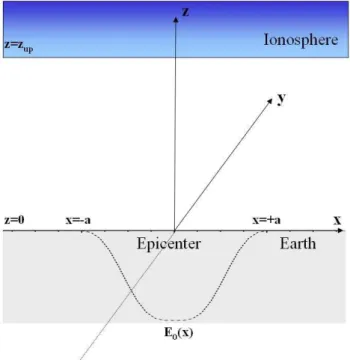
The geometry of the model is shown in Fig. 1. The origin of the coordinate system is exactly at the epicenter, the y-axis is directed along the fault and the x-axis is directed perpen-dicular to the fault. The z-axis is directed upward, from the ground to the ionosphere. The distribution only depends on the distance perpendicular to the tectonic faultx, but along the faulty the field is considered to be not variable. This simple approach is consistent with earlier work (Pulinets et al., 1998). As a tectonic fault is elongated, and some hun-dreds of kilometers long, one can also assume an elongated electrostatic field distribution on the Earth’s surface. So we
analyze the two-dimensional model in which no parameter depends ony. In such a model the equation (Eq. 7) has the form
− ∂
∂x
σ (z) ∂
∂x8(x, z)
−∂
∂z
σ (z) ∂
∂z8(x, z)
=0. (9)
In our model the atmosphere is considered to be a horizon-tal layer between ground and some heightzup.
The general solution of this equation in such a domain can be obtained by separation of variables, i.e. superposition of exponential functions. To solve the differential equation, we need a lower and upper boundary conditions.
4.1 Lower boundary condition
As the lower boundary condition, the vertical component of the electric field on the Earth’s surface is given
−∂
∂z8(x, z)|z=0=E0(x). (10)
The model distribution for the vertical electrostatic field can be written as (see Fig. 1):
E0(x)=− ¯E0(1+cos(xπ/a))/2, |x|<a. (11) whereaindicates the size of the affected area on the Earth’s surface, so that E0(x)=0 outsides, and E¯0 is the maximal value of the electrostatic field at z=0 km. Quantity a can be interpreted as the earthquake preparation area. Nega-tive vertical electrostatic fields on the ground means an in-crease of the fair weather electric field of the atmosphere. These values are in agreement with estimations of the elec-trostatic source in connection with an earthquake prepara-tion process (Mikhailov et al., 2007; Pulinets and Boyarchuk, 2004). In our modelE¯0=100 V/m anda=200 km were cho-sen. This value ofa makes the function (Eq. 11) close to
− ¯E0/cosh(2x/c), that was used in the mentioned models withc=150 km. We opt for the function (Eq. 11) because it is equal to zero outside the domain of interest and stays smooth.
4.2 Upper boundary condition
The most significant results concerning the penetration of an electrostatic field into the ionosphere are related to the upper boundary condition (Grimalsky et al., 2003).
In our model the ionosphere is considered to be a hori-zontally stratified in the height more than some zup above ground. It could be shown that because of the high field-aligned conductivity in the ionosphere our model of the iono-spheric electric field is not sensitive to the value ofzup. We choosezup=80 km. Our test calculations show no significant change ifzupis chosen in the range 80–90 km.
Fig. 1. Geometry of the model where the origin of the coordinate system is at the epicenter, and the x- and y-axis are perpendicular and along the fault, respectively.
The boundaryz=zup separates the region below it with isotropic finite conductivity, from the region above it with nearly infinite field-aligned conductivity. Below zup, the value of the conductivity increases by many orders of mag-nitude with increasing altitude. Abovezup, the conductivity along geomagnetic field is considered to be huge (practically infinite). It means that the magnetic field lines are equipoten-tial andE⊥is independent of the height forz>zup. Therefore
the Ohm’s law (Eq. 2) can be integrated overz J=
Z ∞
zup
j⊥dz=
6P −6H
6H 6P
Ex
Ey
, (12)
where
6P=Rz∞
upσPdz, 6H=
R∞
zupσHdz,
which are referred to as Pedersen – 6P – and Hall
conductances – 6H – (Hargreaves, 1979). Since jz from
the atmosphere at z=zup is closed with this J, the charge conservation law means
∇J=jz
z=zup
. (13)
Using the Ohm’s law in the atmosphere with scalar con-ductivityσ this equation can be written as the upper bound-ary condition for the equation (Eq. 9)
− ∂
∂x(6P ∂8
∂x)+σ (zup) ∂8
∂z
z=zup
=0, (14)
where the derivatives overyare omitted because no function depends ony. Moreover we use only constant6P since the
horizontal scale of interest is much less than the horizontal scale of the ionosphere.
5 Model calculation
To study the influence of ionospheric conductivity variations on the electrostatic field propagation through the atmosphere we use typical values of the ground value of the conductivity
¯
σ and the parameterh, and consider different values of6P.
The integrated conductivity6P is assumed to be6P=10 S in
day-time (and in auroral zone) and6P=0.1 S in night-time.
The boundary value problem (Eqs. 9, 10 and 14) aught to be solved in the two-dimensional domain 0<z<zup, that is infinite in x direction. We can simplify the problem by addition some sources at large distances b≫a in such a manner that the solution of the original problem is not disturbed in the domain of interest, |x|<2a for example. Namely we add
¯
E0(1+cos((x−b)π/a))/2,|x−b|<a,
and continue this function to the whole x-axis with pe-riod 2b. The large parameter b≫a is chosen by test calculations so that such a modification of Eq. (11) has no influence on the results in the domain of interest|x|<2a.
After that we have the boundary value problem (Eqs. 9, 10 and 14) with additional condition of periodicity
8(x+2b, z)=8(x, z). (15)
It is much more simple to deal with periodical functions since such a function can be presented with the Fourier Se-ries, while the Fourier Integral is necessary (Korn and Korn, 1968) to present a function that is defined at the infinite axe and equals zero outside of some finite domain, that is|x|<a
for the original functionE0(x)(Eq. 11).
Such a modification of the problem can be described by other words in the manner that is usual for numerical meth-ods. The boundary value problem (Eqs. 9, 10 and 14) has a particular solution8(x, z)=αx+β with arbitrary constants
α, β. It can be used as the asymptotic atx→∞and it means that8(x, z)is constant at vertical lines, whenx→∞. To avoid infinite domain it is possible to chose some large parameterband approximately use this condition atx=b/2:
8(b/2, z)=0. (16)
The zero value is of no matter since any constant can be added to the potential. Because the solution is a symmetrical one with respect tox=0 line and Eq. (16) we also have
8(−b/2, z)=0. (17)
10−1 60
10−2 10−3 80
20
0 70
100 z, km
50
40
10 30
Ez(0,z), V/m
101 102
Fig. 2.The height distribution of the vertical electric fieldEz(0, z)
above the pointx=0.
Its solution is close to the solution of the original prob-lem when b→∞. The conditions (Eqs. 16 and 17) per-mit to continue the function 8(x, z) antisymmetrically
8(b−x, z)=−8(x, z)and to get a periodical function with 2bperiod as in the previous formula (Eq. 15).
The new functionE1(x)equals toE0(x)(Eq. 11) in the interval|x|<b−a and in contrast withE0(x)it can be pre-sented as
E1(x)=
∞
X
n=0
fncos(knx), (18)
where
kn=(2n−1)π/b. (19)
The terms with even values 2nas well as all terms with sin(kx)are absent because the functionE1(x)is antisym-metrical in respect ofx=b/2 and symmetrical in respect of
x=0.
The Fourier coefficients are equal
fn=1bR02bE1(x)cos(knx)dx.
Because ofE1(x)symmetry and Eq. (16)
fn=4bR0b/2E1(x)cos(knx)dx.
The interval of integration may be decreased to 0<x<a
sinceE1(x)=0 ata<x<b/2. Because of thatE1(x)=E0(x) at 0<x<athe formula (Eq. 11) can be used and the integral
can be calculated analytically
fn=
2
b Z a
0
(1+cos(xπ/a))cos(knx)dx
= 2 sin(kna)
bkn((kna/π )2−1)
¯
E0. (20)
If kna=π, that means 2n0−1=b/a, the denominator equals zero, but the numerator also equals zero and this
fn=a/b. It can not occur if b/a is not integer. The
coef-ficientsfn are large for nclose to thisn0=(b/a+1)/2 and decrease as 1/n3forn→∞.
The general solution of equation (Eq. 9) can be found due to separation of variables and is a superposition of exponen-tial functions, depending onxandzseparately
8(x, z)=
∞
X
0
cos(knx) Aneλnz+Bne3nz, (21)
where
λn= −
1 2h+
s
1 2h
2
+k2,
3n= −
1 2h−
s
1 2h
2
+k2. (22)
The coefficientsAnandBncan be derived from the
bound-ary conditions given in Eqs. (10) and (14).
We use the presentation (Eq.15) for E0(x) since
E1(x)=E0(x) for |x|<b−a and the parameter b is large enough and it does not disturb the solution.
With the constitutive relation,
αn=
6Pk2+ ¯σexp[zup/ h]λn
6Pk2+ ¯σexp[zup/ h]3n
e(λn−3n)zup, (23)
the coefficients are
An=fn(λn−3nα)−1,
Bn= −αAn. (24)
The components of the electric field in the atmosphere can be deduced from Eq. (6)
Ex(x, z)=−
∂
∂x8(x, z) (25)
Ez(x, z)=−
∂
∂z8(x, z), (26)
where the potential 8(x, z) is calculated by the formula (Eq. 21). The third componentEy(x, z)=0 since there is no
0
−50
300
−10
200 0
−100
−40
−70
−90 −200
−300 400
−20
−60
−100 −400
x, km
−30
100
−80
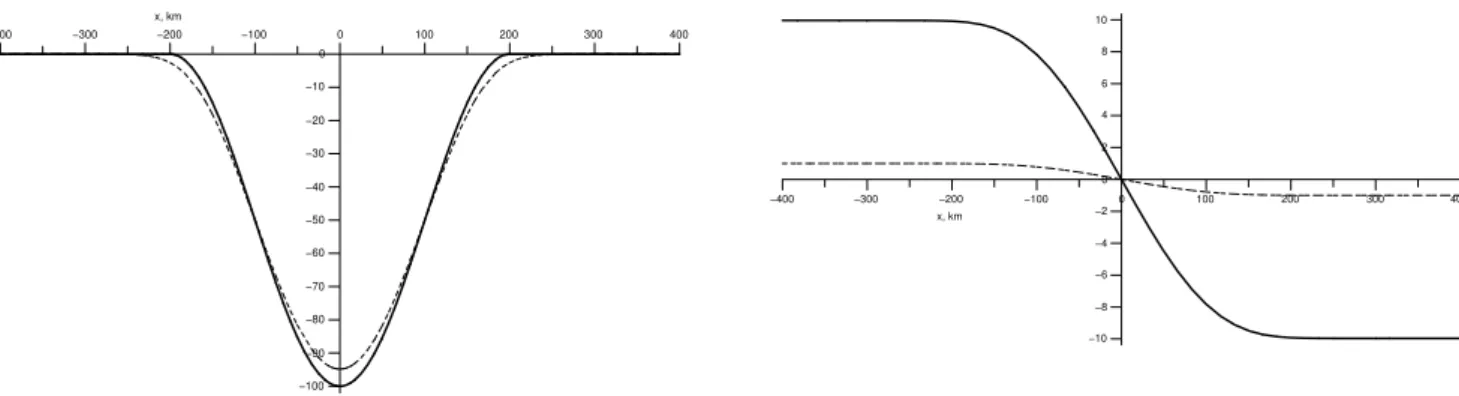
Fig. 3.Electric field at the groundEz(x,0)- solid line, and at the
bottom of the ionosphereEz(x, zup)- dashed line. The maximal values are 100 V/m and 9µV/m, respectively.
6 Summary of the main results
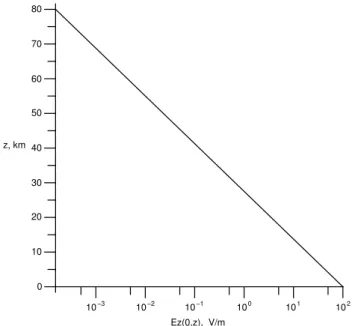
The results of the electric field calculations are presented in Fig. 2. It presents the height distribution of the vertical com-ponent of the electric field at the line x=0. This graph is hardly distinguished from the line
Ez(0, z)=Ez(0,0)σ (0)/σ (z), (27)
which corresponds to the fact that the vertical electric current density does not vary with height.
The shape of horizontal cross-section ofEz(x, z)is almost
independent of the height as it can be seen in Fig. 3. The
Ez(x, z)distributions at the ground and at the upper
bound-ary of the atmosphere are plotted in such scales that these two lines would be identical if Eq. (24) is exactly valid. For this purpose the dashed line presents the vertical electric field in the ionosphereEz(x, zup)multiplied by exp(zup/ h). So the maximal values are 100 V/m and 9µV/m, respectively.
Figures 2 and 3 show that the vertical component of the current density almost does not vary with height. The domain|x|<aof nonzerojzat the ground slightly increases
up to the ionosphere. The total current per1y=1 m
Jz=R−2a2ajzdx
does not depend on z in view of the charge conserva-tion law. Here we regard 2aas a large distance, but less than
b/2 to exclude the influence of the added periodically current sources at the ground. So this current can be calculated using the Ohm’s law and given values of conductivityσ¯ at the ground andEz(x,0)(Eq. 11)
Jz =
Z a
−a
jzdx=
Z a
−a
σ (0)Ez(x,0)dx
= − ¯σE¯0a=−2µA/m.
with values of the parametersE¯0=100 V/m,a=200 km and
¯
σ=10−13S/m, which are chosen in Sects. 3 and 4.1,
respec-8
−4
300 4
2
−6 0
−100 100
x, km
400 6
−2
−10 −400
10
200 0
−8 −200
−300
Fig. 4. Horizontal electric field SEx(x, zup),µV/m in the night-time ionosphere with6P=0.1 S - solid line, and in the ionosphere
with6P=1 S - dashed line.
tively. This currentJzgoes to the ground through atmosphere
from the ionosphere. In accordance with charge conservation law the same current must go along the ionosphere from its far regions,Jz/2 from both infinities because of the
symme-try. Horizontal electric field is necessary for such currents
Ex= ±
1
2Jz/6P= ±
¯
σE¯0a 26P
. (28)
It is equal to∓1µV/m forx≫a andx<<−aif6P=1 S.
The typical values of6P vary from 0.1 S in the night-time
ionosphere till 10 S in the day-time ionosphere and in the auroral zone.
These limit values, i.e.∓10µV/m, in the night-time iono-sphere are shown in Fig. 4 for|x|>200 km. The calculated
Ex(x)presented in this figure for the upper boundary of the
atmosphere stays the same in the ionosphere in the frame of our model because of the large field-aligned conductivity in the ionosphere.
The electric field in the ionosphere is not more than 10µV/m, since other values of6P give decrease ofEx. It
can be seen in Fig. 4 whereEx(x)for6P=1 S is shown by
dashed line. The day-timeEx(x)distribution has almost the
same shape, but it is invisible in this scale because its maxi-mum equals 0.1µV/m.
The electric fields of these magnitudes can not be observed in the ionosphere because much larger fields, definitely more than 1µV/m are always present there.
Figure 5 gives general view of the electric potential in the atmosphere. Because of the simple properties of the electric field described above, it is possible to obtain analytical solu-tion with a rather good precision.
As the results of Eqs. (6), (8) and (24),
8(x, z)= −
Z zup
z
|E0(x)|exp(−z/ h)dz
−400
−300
−200 0
0 −100
10 40
0 20
x, km 80
30 100
40 120
z, km 50 200
160
60 300
70 200
400 80 240
280
Fig. 5.Electric potential in atmosphere8(x, z)kV.
if we approximately consider8=0 in the ionosphere. Since the second term is small far from the ground, approximately
8(x, z)=|E0(x)|hexp(−z/ h).
The maximal value equals E0(x)h=600 kV. This value must be decreased if we take into account specific σ (z)
behavior near the ground where h=3 km gives better ap-proximation (Handbook of Geophysics, 1960). Then the maximal potential difference between ground and iono-sphere becomes about 300 kV. Such an electric potential distribution is presented in Fig. 5. It almost does not depend onσ (z)distribution abovez=5 km.
The described simple properties ofE and8space distri-butions are mainly due to large horizontal scalea≫h. If the region of the electric field generator near the analyzed earth-quake becomes less, the ionospheric electric field is propor-tionally decreased in our model in accordance with the esti-mations (Eq. 25). So 10µV/m can be regarded as the upper limit of possible electric field penetrated into the ionosphere. 7 Discussion and conclusion
The details ofEx(x, z)distribution are defined by the
solu-tion for the boundary value problem (Eqs. 9, 10 and 14), but the scale of the penetrating field can be calculated by the for-mula (Eq. 25) in a wide range of parameters which
charac-terize the atmospheric and ionospheric conductivities while the horizontal scale of the processais large enough.
This conclusion and estimations by the formula (Eq. 25) contradict the former calculations (Pulinets et al., 1998), where the maximum of the horizontal electrostatic field pen-etration is in the mV/m range.
The electric field at the ground can not be much larger than 100 V/m, that is used both here and in former models, since it gives a few hundreds kV potential difference between ionosphere and ground. So, the only way to get large pene-trated electric field may be due to atmospheric conductivity near the ground hundred times increased in comparison with usual conditions.
Because the conductivity along geomagnetic field lines is much greater than the conductivities perpendicular to the field lines, and because of the assumption, that geomagnetic field lines are parallel in the ionosphere, the electric field in-tensity will not change significantly in higher altitudes. This is taken into account in the effective upper boundary con-dition (Eq. 14). Thus, the electrostatic field at the altitude
zup=80 km can be used to calculate effects in higher regions. The assumption of vertical geomagnetic field lines (I=90◦) is almost fulfilled in polar regions. In the frame of satellite missions, data generally is recorded at latitudes below a specific region. In the case of DEMETER, observa-tions are performed at latitudes less than 65◦on both hemi-spheres. This means, the model calculation obtained here must be expanded to oblique geomagnetic field lines to im-prove the results.
The designed model suppose vertical magnetic field, that is not valid in middle and low latitudes. It is of matter only for the value of the conductance of the ionosphere, since the atmospheric conductivity is a scalar that is independent of magnetic field. If we take the inclination into account, the conductance tensor with parameters6P,6H (Eq. 12) must
be changed with tensor with coefficients6xx,6xy=−6yx,
6yy (Hargreaves, 1979). Since these parameters are
inde-pendent ofx, ythe terms with6xy=−6yxdo not appear in
the upper condition (Eq. 14) after such a modification as well as6H is not present in (Eq. 14):
−∂
∂x(6xx ∂8
∂x)+σ (zup) ∂8
∂z
z=zup
=0. (29)
If we exclude for simplicity a narrow region near the ge-omagnetic equator, then6xx=6P/cos 2χ,6yy=6P, where
χis the angle between vertical and magnetic field, that is in x, z plane (Hargreaves, 1979). Of cause6xx=6P if
mag-netic field is inclined in y, z plane and some average value would be in general case.
Anyway, the conductance6xxcan only be increased in
com-parison with6P. Hence the magnitude of the electric field
in the ionosphere is smaller if we take the inclination into account.
conductivity near the ground and inverse proportional to the integral ionospheric Pedersen conductivity. Also this penetrated electric field is a hundred times larger during night-time in comparison with day-time one, and its penetra-tion of electrostatic fields depends on various characteristics of the conductivity distributions. However our estimations show that the field penetration is damped and no seismic pre-cursor may be seen in the ionosphere.
Future investigation, the height distribution and the dy-namic behavior of the atmospheric conductivity must be more better known, especially its increase near the ground during seismic events.
Acknowledgements. This work is supported by grant 07-05-00135 from the Russian Foundation for Basic Research and by the Programs 16.3 and 2.16 of the Russian Academy of Sciences. Further support is due to the Austrian “Fonds zur F¨orderung der wissenschaftlichen Forschung” under project P20145-N16. We acknowledge support by the Austrian Academy of Sciences, “Verwaltungstelle f¨ur Auslandsbeziehungen”, and the Russian Academy of Sciences. Part of this research was done during academic visits of V. V.‘Denisenko to the Space Research Institute of the Austrian Academy of Sciences in Graz as well as during an academic visit of H. K. Biernat to the Institute of Computational Modelling of the Russian Academy of Sciences in Krasnoyarsk.
Edited by: M. Contadakis
Reviewed by: J.-J. Berthelier and another anonymous referee
References
Baginski, M. E., Hale, L. C., and Olivero, J. J.: Lightning-related fields in the ionosphere, Geophys. Res. Lett., 15, 764–767, 1988. Boyarchuk, K. A., Lomonosov, A. M., Pulinets, S. A., and Hegai, V. V.: Variability of Earth’s atmospheric electric field and ion-aerosols kinetics in the troposphere, Stud. Geophys. Geod., 42, 197–210, 1998.
Depuev, V. and Zelenova, T.: Electron density profile changes in a pre-earthquake period, Adv. Space Res., 18(6), 115–118, 1996. Dobrovolsky, I. P., Zubkov, S. I., and Miachkin, V. I: Estimation of
the size of earthquake preparation zones, Pure Appl. Geophys., 117, 1025–1044, 1979.
Gershenzon, N. and Bambakidis, G.: Modeling of seismo-electromagnetic phenomena, Russian Journal of Earth Science, 3, 247–275, 2001.
Gershenzon, N. I., Gokhberg, M. B., and Yunga, S. L.: On the elec-tromagnetic field of an earthquake focus, Phys. Earth Planet. In., 77, 13, 1993.
Gokhberg, M. B., Gershenzon, N. I., Gufel’d, I. L., Kustov, A. V., Liperovskiy, V. A., and Khusameddimov, S. S.: Possible effects of the action of electric fields of seismic origin on the ionosphere, Geomagn. Aeronomy+, 24, 183, 1984.
Gokhberg, M. B., Gufel’d, I. L., Gershenzon, N. I., and Pilipenko, V. A.: Electromagnetic effects during rupture of the Earth’s crust, Izvestiya Russian Academy of Sciences, Physics of the Solid Earth, 21, 52, 1985.
Gokhberg, M. B., Pilipenko, V. A., and Pokhotelov, O. A.: Seis-mic precursors in the ionosphere, Izvestiya Russian Academy of Sciences, Physics of the Solid Earth, 19(10), 762–765, 1983. Grimalsky, V. V., Hayakawa, M., Ivchenko, V. N., Rapoport, Y.
G., and Zadorozhnii, V. I.: Penetration of an electrostatic field from the lithosphere into the ionosphere and its effect on the D-region before earthquakes, J. Atmos. Sol.-Terr. Phys., 65, 391– 407, 2003.
Grimalsky, V. V., Koshevaya, S., Perez-Enriquez, R., and Kot-sarenko, A.: Electrostatic field variations in the lower ionosphere due to the change of near–earth atmosphere conductivity – 3D modeling, 27th General Assembly of the International Union of Radio Science, Maastricht, Netherlands, 17–24 August 2002. Handbook of Geophysics, The Macmillan Company, New York,
1960.
Hargreaves, J. K.: The upper atmosphere and Solar-Terrestrial rela-tions, Van Nostrand Reinold Co. Ltd, NY, 1979.
James, H. G.: The ELF Spectrum of Artificially Modulated D/E – Region Conductivity, J. Atmos. Terr. Phys., 47, 1129–1142, 1985.
Kamra, A. K. and Ravichandran, M.: On the assumption of the Earth’s surface as a perfect conductor in atmospheric electricity, J. Geophys. Res., 98, 22 875–22 885, 1993.
Kelley, M. C. and Mozer, F. S.: A satellite survey of vector elec-tric fields in the ionosphere at frequencies of 10 to 500 Hertz, 3. Low-frequency equatorial emissions and their relationship to ionospheric turbulence, J. Geophys. Res., 77, 4183, 1972. Kelley, M. C., Livingston, R., and McCready, M.: Large amplitude
thermospheric oscillations induced by an earthquake, Geophys. Res. Lett., 12, 577, 1985.
Khegay, V. V., Kim, V. P., and Illich-Svitych, P. V.: The formation of a cavity in the night–time midlatitude ionospheric E-region above a thundercloud, Planet. Space Sci., 38, 703–707, 1990. Kim, V. P., Hegaj, V. V., and Illich-Switych, P. V.: On the possibility
of a metallic ion layer forming in the E-region of the night mid-latitude ionosphere before great earthquakes, Geomagn. Aeron-omy+, 33, 658–662, 1994.
Kim, V. P. and Khegay, V. V.: The effect of an electric field on the nightside E region of the midlatitude ionosphere, Geomagn. Aeronomy+, 25, 717–718, 1985.
Kingsley, S. P.: On the possibilities for detecting radio emissions from earthquakes, Il Nuovo Cimento, 12, 117, 1989.
Kondo, G.: The variation of the atmospheric electric field at the time of earthquake, Memoirs of the Kakioka Magnetic Observatory, 13, 11–23, 1968.
Korn, G. A. and Korn, T. M.: Mathematical handbook, McGraw-Hill Book Company, New York, 1968.
Liu, J. Y., Chuo, Y. J., Shan, S. J., Tsai, Y. B., Chen, Y. I., Pulinets, S. A., and Yu, S. B.: Pre-earthquake ionospheric anomalies reg-istered by continuous GPS TEC measurements, Ann. Geophys., 22, 1585–1593, 2004,
http://www.ann-geophys.net/22/1585/2004/.
Ma, Z., Croskey, C. L., and Hale, L. C.: The electrodynamic re-sponses of the atmosphere and ionosphere to the lightning dis-charge, J. Atmos. Terr. Phys., 60, 845–861, 1998.
Martynenko, S. I., Fuks, I. M., and Shubova, R. S.: Ionospheric electric-field influence on the parameters of VLF signals con-nected with nuclear accidents and earthquakes, J. Atmos. Electr., 16, 259–269, 1996.
Mastov, S. R. and Lasukov, V. V.: A theoretical model of generation of an electromagnetic signal in brittle failure, Izvestiya Russian Academy of Sciences, Physics of the Solid Earth, 25, 478, 1989. Mikhailov, Y. M., Mokhailova, G. A., Kapustina, O. V., Buzevich, A. V., and Smirnov, S. E.: Atmospheric noise extremes in quasi-static electric field variation in the near ground atmosphere of Kamchatka, in Proceedings of the IV International Conference on Solar-Terrestrial Relations and Precursors of Earthquakes, Kamchatka, Russia, 14–17 August 2007.
Molchanov, O. A.: Transmission of electromagnetic fields from seismic sources to the upper ionosphere, Geomagn. Aeron.+, 31, 80–85, 1991.
Molchanov, O. A. and Hayakawa, M.: On the generation mech-anism of ULF seismogenic electromagnetic emissions, Phys. Earth Planet. In., 105, 201–210, 1998.
Molchanov, O. A. and Hayakawa, M.: Generation of ULF electro-magnetic emissions by microfracturing, Geophys. Res. Lett., 22, 3091–3094, 1995.
Molchanov, O.A:, Hayakawa, M.: Generation of ULF seismogenic electromagnetic emission: A natural consequence of microfrac-turing process, in: Electromagnetic phenomena related to earth-quake prediction, edited by: Hayakawa, M. and Fujinawa, Y., Terra Scientific Publishing Company, Tokyo, 537–563, 1994. Molchanov, O., Fedorov, E., Schekotov, A., Gordeev, E., Chebrov,
V., Surkov, V., Rozhnoi, A., Andreevsky, S., Iudin, D., Yunga, S., Lutikov, A., Hayakawa, M., and Biagi, P. F.: Lithosphere-atmosphere-ionosphere coupling as governing mechanism for preseismic short-term events in atmosphere and ionosphere, Nat. Hazards Earth Syst. Sci., 4, 757–767, 2004,
http://www.nat-hazards-earth-syst-sci.net/4/757/2004/.
Molchanov, O. A., Hayakawa, M., and Rafalsky, V. A.: Penetra-tion characteristics of electromagnetic emissions from an un-derground seismic source into the atmosphere, ionosphere, and magnetosphere, J. Geophys. Res., 100, 1691–1712, 1995. Nisbet, J. S.: A dynamic model of thundercloud electric field, J.
Atmos. Terr. Phys., 40, 2855–2873, 1983.
Park, C. G. and Dejnakarintra, M.: Penetration of thundercloud electric fields into the ionosphere and magnetosphere, 1. Middle and auroral latitudes, J. Geophys. Res., 84, 960–964, 1973. Parrot, M., Berthelier, J. J., Lebreton, J. P., Sauvaud, J. A.,
Santo-lik, O., and Blecki, J.: Examples of unusual ionospheric obser-vations made by the DEMETER satellite over seismic regions, Phys. Chem. Earth, 31, 486–495, 2006.
Parrot, M.: Use of satellites to detect seismo-electromagnetic ef-fects, Adv. Space Res., 15(11), 27–35, 1995.
Pierce, E. T.: Atmospheric electricity and earthquake prediction, Geophys. Res. Lett., 3, 185–188, 1976.
Pogorel’tsev, A. I.: Disturbances of electric and magnetic fields in-duced by the interaction of atmospheric waves with the iono-spheric plasma, Geomagn. Aeronomy+, 29, 286–292, 1989 (in Russian).
Pr¨olss, G.W.: Physik des erdnahen Weltraums, Eine Einf¨uhrung, Berlin, Heidelberg, New, York, Springer, 2003.
Pulinets, S. A. and Boyarchuk, K.: Ionospheric precursors of earth-quakes, Berlin, Heidelberg, New York, Springer, 2004.
Pulinets, S. A., Legen’ka, A. D., Gaivoronskaya, T. V., and Depuev, V. K.: Main phenomenological features of ionospheric precur-sors of strong earthquakes, J. Atmos. Sol.-Terr. Phy., 65, 1337– 1347, 2003.
Pulinets, S. A., Boyarchuk, K. A., Hegai, V. V., and Karelin, A. V.: Conception and model of seismo-ionosphere-magnetosphere coupling, in SeismoElectromagnetics Lithosphere-Atmosphere-Ionosphere coupling, edited by: Hayakawa, M. and Molchanov, O. A., Terrapub, Tokyo, 353–361, 2002.
Pulinets, S. A., Boyarchuk, K. A., Hegai, V. V., Kim, V. P., and Lomonosov, A. M.: Quasielectrostatic model of atmosphere-thermosphere-ionosphere coupling, Adv. Space Res., 26, 1209– 1218, 2000.
Pulinets, S. A., Hegai, V. V., Kim, V. P., and Depuev, V. K.: Unusual longitude modification of the night-time mid-latitude F2 region ionosphere in July 1980 over the array of tectonic faults in the Andes area: observations and interpretation, Geophys. Res. Lett., 25, 4133–4136, 1998.
Roble, R. G. and Hays, P. B.: A quasi-static model of global atmo-spheric electricity. II – Electrical coupling between the upper and the lower atmosphere, J. Geophys. Res., 84, 7247–7256, 1979. Rodger, C. J., Thomson, N. R., and Dowden, R. L.: Testing the
formulation of Park and Dejnakarintra to calculate thunderstorms dc electric fields, J. Geophys. Res., 103, 2171–2178, 1998. Row, R. V.: Acoustic-gravity waves in the upper atmosphere due
to a nuclear detonation and an earthquake, J. Geophys. Res., 72, 1599–1610, 1967.
Ruzhin, Y. Y., Depueva, A. K., and Gorduk, V. P.: Signature of atomic station at lower ionosphere as plasma anomalies of Es layer, Adv. Space Res., 15(11), 157–159, 1995.
Ruzhin, Y. Y. and Depueva, A. K.: Seismoprecursors in space as plasma and wave anomalies, J. Atmos. Electr., 16, 271–288, 1996.
Sharma, D. K., Rai, J., Chand, R., and Israil, M.: Effect of seismic activities on ion temperature in the F2 region of the ionosphere, Atm´osfera, 19, 1–7, 2006.
Silina, A. S., Liperovskaya, E. V., Liperovsky, V. A., and Meister, C.-V.: Ionospheric phenomena before strong earthquakes, Nat. Hazards Earth Syst. Sci., 1, 113–118, 2001,
http://www.nat-hazards-earth-syst-sci.net/1/113/2001/.
Sorokin, V. M., Yaschenko, A. K., Chmyrev, V. M., and Hayakawa, M.: DC electric field amplification in the mid-latitude ionosphere over seismically active faults, Nat. Hazards Earth Syst. Sci., 5, 661–666, 2005,
http://www.nat-hazards-earth-syst-sci.net/5/661/2005/.
Sorokin, V. M., Chmyrev, V. M., and Yaschenko, A. K.: Electro-dynamic model of the lower atmosphere and the ionosphere cou-pling, J. Atmos. Sol-Terr. Phy., 63, 1681–1691, 2001.
Sorokin, V. and Yaschenko, A.: Electric field disturbance in the Earth-ionosphere layer, Adv. Space Res., 26, 1219-1223, 2000. Trakhtengerts, V. Y.: The generation of electric fields by aerosol
particle flow in the middle atmosphere, J. Atmos. Terr. Phys., 56, 337–342, 1994.
Tzur, I. and Roble, R. G., The interaction of a dipolar thunder-storm with its global electrical environment, J. Geophys. Res., 90, 5989–5999, 1985.