Development of a Computer Assisted Gantry System for Gaining
Rapid and Accurate Calyceal Access during Percutaneous
Nephrolithotomy
A. D. Zarrabi, J. P. Conradie, C. F. Heyns, C. Scheffer, K. Schreve
Department of Urology (ADZ, CFH), University of Stellenbosch and Tygerberg Hospital,
Tyger-berg, South Africa and Department of Mechanical and Mechatronic Engineering (JPC, CS, KS),
University of Stellenbosch, Stellenbosch, South Africa
ABSTRACT
Purpose: To design a simple, cost-effective system for gaining rapid and accurate calyceal access during percutaneous nephrolithotomy (PCNL).
Materials and Methods: The design consists of a low-cost, light-weight, portable mechanical gantry with a needle guid-ing device. Usguid-ing C-arm luoroscopy, two images of the contrast-illed renal collectguid-ing system are obtained: at 0-degrees (perpendicular to the kidney) and 20-degrees. These images are relayed to a laptop computer containing the software and graphic user interface for selecting the targeted calyx. The software provides numerical settings for the 3 axes of the gantry, which are used to position the needle guiding device. The needle is advanced through the guide to the depth calculated by the software, thus puncturing the targeted calyx. Testing of the system was performed on 2 target types: 1) radiolucent plastic tubes the approximate size of a renal calyx (5 or 10 mm in diameter, 30 mm in length); and 2) foam-occluded, contrast-illed porcine kidneys.
Results: Tests using target type 1 with 10 mm diameter (n = 14) and 5 mm diameter (n = 7) tubes resulted in a 100% tar -geting success rate, with a mean procedure duration of 10 minutes. Tests using target type 2 (n = 2) were both successful, with accurate puncturing of the selected renal calyx, and a mean procedure duration of 15 minutes.
Conclusions: The mechanical gantry system described in this paper is low-cost, portable, light-weight, and simple to set up and operate. C-arm luoroscopy is limited to two images, thus reducing radiation exposure signiicantly. Testing of the system showed an extremely high degree of accuracy in gaining precise access to a targeted renal calyx.
Key words: nephrolithotomy; percutaneous; access; computers; endourology; urolithiasis Int Braz J Urol. 2010; 36: 738-48
INTRODUCTION
Since the irst description of percutaneous
nephrolithotomy (PCNL) by Fernström and
Johans-son more than 30 years ago, major technological advances have improved the eficacy and safety of this procedure, conirming its superiority compared to open surgery for renal calculi (1).
doi: 10.1590/S1677-55382010000600013
Obtaining precise access to a predetermined renal calyx is the most critical part of PCNL (2). Cur-rently available techniques for obtaining percutaneous (PC) access to the renal collecting system include the
following:
the tract and performs the PCNL. A recent report
indicates that the minority of urologists (11%) gain
their own access for PCNL (3).
Retrograde percutaneous access: This in -volves retrograde placement of a ureteric catheter, fol-lowed by passage of a sharp wire through the catheter
and via the selected calyx to the skin (4). Despite the
feasibility of this method, it offers no advantage over antegrade percutaneous access and is not commonly utilized.
Fluoroscopic X-ray guided techniques: The
two techniques best described are “eye of the needle” and “triangulation”. Both consist of several steps
where C-arm luoroscopy is rotated into different
positions relative to the needle and the target
(con-trast-illed calyx) (2). The needle is advanced until
the calyx is punctured in a controlled and predictable fashion. These are the access techniques most com-monly used by urologists. However, gaining access to
a pre-identiied calyx is usually the most dificult part
of PCNL. It often requires multiple needle punctures and prolonged radiological screening, and sub-op-timal access leads to increased operative times and decreased stone-free rates.
Robotic assisted access: The irst robotic
system to access the renal collecting system for PCNL
was described by Potamianos et al. in 1995 and con -sisted of a manually positioned robotic arm mounted
on the operating table, guided by C-arm luoroscopy
(5,6). Cadeddu et al. designed a fully automated robot
that managed all aspects of PC access: planning the needle trajectory, needle positioning and advance -ment and real-time needle tracking using biplanar
luoroscopy (7). Stoianovici et al. developed a metal
arm with 6 degrees of freedom movement that was manipulated mechanically by the urologist. It was attached to the side rail of the operating table, and incorporated a radiolucent needle grasping disc at the distal end of the arm (8). The PAKY (percutaneous access to the kidney) system and later PAKY-RCM (remote center of motion) system were improvements
on the original design: the passive robotic arm was
improved by adding an electronic needle insertion device and the ability to position the needle by remote
control (9,10).
In all the abovementioned designs, except the fully automated robot, the “robotic arms” mainly serve
to stabilize and in some cases advance the needle, and reduce radiation exposure. However, the urologist still
needs to calculate and plan the needle trajectory to the
desired renal calyx.
Therefore, the challenge is to develop a sys-tem that is cost-effective and simple to use, yet faster and more accurate than is possible for the average gen-eral urologist. Prototypes of a fully automated robot managing all aspects of access for PCNL have been built, but their size and complexity have prevented
application in routine clinical practice (7).
The aim of this study was to design a simple and cost-effective system for use by urologists to gain rapid and accurate percutaneous access for performing PCNL. Although an automated system provides rapid needle alignment and insertion, active components
increase system costs. Furthermore, bi-planar luo -roscopy is not as commonly used in operating rooms as mobile C-arm systems. This paper describes the development of a computer directed gantry system
using C-arm luoroscopy to gain rapid and accurate
renal access during PCNL.
MATERIALS AND METHODS
This access system is based on the principle of triangulation - the process of localizing a point in 3 di-mensions by using 2 intersecting lines. In the setting of
PCNL, the luoroscopic images of the contrast-illed
renal calyceal system obtained intra-operatively are used. One image of the collecting system is obtained
with the C-arm in the 0-degrees position (directly
perpendicular to the kidney) and the other with the
C-arm tilted 20-degrees. The images are taken at the
same time in the respiratory cycle during controlled mechanical ventilation.
These images are relayed to a laptop com-puter containing the software and graphic user inter-face. The ideal setup would be a system where the C-arm has an output connected to the laptop so that
the images can be transferred there directly. Due to
limitations of our C-arm unit, this was unfortunately
not possible and images had to be saved on a “lash
drive” and manually imported to the graphic user in-terface on the laptop. On these images, the urologist
for puncturing by clicking with the computer mouse
on the luoroscopic images. The software calculates the needle trajectory and subsequently provides
the numerical settings for the 3 axes of the gantry, which is attached to the operating table. The needle positioning device on the gantry is set into position by the urologist according to the values provided by the software. The needle is now placed through the needle guide and inserted to the depth calculated by the software, which should result in puncturing of the targeted calyx.
Hardware
Needle Positioning Device
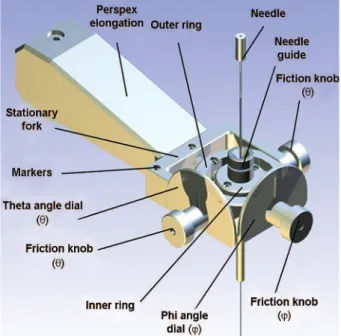
The central feature of this design is a needle alignment device and portable, light-weight mechani-cal gantry that is attached to the edge of the operating
table (Figure-1). The gantry contains no motorized
parts or electronic components. The system is
manu-ally adjusted by the urologist and consists of 3 or -thogonal axes and a gyro-like end-effector resulting in a 6 degrees of freedom system.
The vertical axis of the system carries the combined weight of the other axes and end-effector,
and is attached to the existing rails on the theatre table. High precision guide shafts with closed linear
bush-ings ensure accuracy. An adjustment resolution of 2
mm per knob rotation is achieved. A vertical
transla-tion range of 400 mm is possible, which is more than
adequate to accommodate patients with varying body habitus.
A rack and pinion option provides lexibility to the design and simpliies placement of ixing knobs
for the horizontal axes. Bending and torsion forces are addressed by a web and a counter balance, which pre-vents twisting of the rack. A guide-block, housing the
pinions, adjustment- and ixing knobs, ensures high
precision linear movement of the 2 rack and pinion
conigurations. The horizontal axes cover a 450 mm x 450 mm area at the height of the vertical axis.
The gyro mechanism or needle-alignment mechanism (end-effector) orientates the needle
around a ixed point (Figure-2). Aligning a needle with a speciied vector requires 2 rotational degrees
of freedom. As the needle-alignment mechanism will be positioned over the kidney, a radiolucent acrylic (Perspex) was used in the manufacturing of the mechanism. It consists of 3 main components for
the 2 axes of rotation: a ixed base, an outside ring
for rotation around the y-axis and an inside ring for rotation around the x-axis. The rings are locked in
position by friction locks. Engraved dials display the
angle of needle rotation, which ranges ± 40-degrees
around both axes, resulting in the needle rotation range shown in Figure-3.
Two groups of 2 mm diameter stainless steel navigation markers, required for coordinate
iden-tiication and needle manipulation, are located on
the radiolucent needle-alignment mechanism. These are called the gantry and needle marker groups. The needle is gripped by a friction mechanism, which
al-lows the urologist to adjust the friction by which the
needle is held during insertion.
Software
Software was designed using Python® (which can be obtained via free internet download) and was run on a standard laptop computer.
User interface - The control center of the positioning system is the urologist-operated user interface, aiding in the calibration and the targeting procedure.
Calibration screen - The user is required to select and import the calibration images. The calibra-tion algorithm is performed automatically and takes
approximately 15 seconds to complete.
Point selection screen - All points on the speciied calyx required for targeting are identiied and selected
by the urologist - this provides the calyx markers.
Targeting screen - This shows the inal translation and
rotation (i.e. numerical settings of the 3 axes of the gantry) required for targeting.
• Insertion routines - Two insertion routines can be
utilized with the information gained (Figure-4).
Figure 3 – Movement volume of needle in the gyro mechanism (the gyro point is the targeted point used for translational cal-culations).
• Insertion routine 1 uses the deined calyx vector
and needle tip coordinate and attempts to orientate
the needle in this vector at a pre-speciied distance from the calyx tip (Figure-4). Routine 1 resembles
the “triangulation” technique.
• Insertion routine 2 uses the needle tip coordinate and calyx center coordinate to provide a new vector
to which the needle is adjusted (Figure-4). Routine 2
resembles the “eye of the needle” technique.
As the targeted gyro-center coordinates for the two respective insertion routines are known, the required translation from the initial gyro-center coordinate to any of the targeted markers can be computed. The operator can select either one of the two insertion routines. The required translation in the gantry x-, y-, z directions for the respective routines is calculated as the difference between the transformed coordinates of the target and initial gyro mechanism
center coordinates:
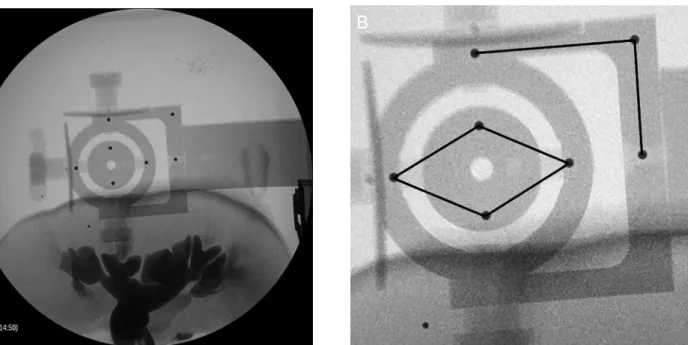
Marker Selection - Three groups of naviga-tion markers require selecnaviga-tion (Figure-5). They are called the gantry, needle and access marker groups, respectively. The needle markers are visible as a
dia-mond shaped coniguration. The gantry markers on their outside are in the shape of a lipped capital letter
“L”. The access marker shows as a small individual
artifact which is easily recognized (Figure-5B). The
needle markers serve a dual function: they deine
the needle orientation and the center of rotation of
the gyro mechanism. The gantry markers deine the
Figure – 5 A) Fluoroscopic image of needle positioner and contrast-illed porcine kidney. B) Enlargement of A, showing needle markers
(diamond shape), gantry markers (L-shape) and access marker (dot at bottom left).
Figure 6 – Enlarged view of the 0-degrees image (as seen by the operator on the user interface) in which the 4-point method has been used – 4 points on the edges of the desired calyx have been selected.
movement directions of the x, y and z translations of the needle positioning system. The access marker
deines the needle access point.
Determining point correspondences of the
kidney calyx in the stereo image pair is problematic,
as deinite corresponding structures or points are not
easily discerned. A four or two-point selection method can be implemented (Figure-6). In the four-point method, 2 points are selected at either end of one edge of the calyx, and another 2 on the opposite edge of the calyx. The calyx vector is determined by triangulation and subtraction of the coordinates halfway between the 2 selected calyx-end coordinates (Figure-6). With the two-point method, a point is selected centrally at the one end of the calyx and another on the opposite end in the estimated center of the calyx.
It was found that the four-point method reduced the point selection error in cases where calyx image edges
were unclear (due to limitations of the luoroscopy sys
-tem). In cases where a distinct edge could be identiied,
the two-point method was adequate.
Experimental Setup for Testing
Laboratory Testing
The operating room environment was
simu-lated using digital cameras in a coniguration resem
-bling that of the C-arm luoroscopy system (Figure-7). This allowed thorough testing of the system in
a controlled environment to determine mechanical design accuracy and repeatability. This setup also
allowed a basis for algorithm testing during system development stages.
Operating Room Testing
Testing of the system using C-arm luoro -scopic imaging was performed on 2 target types in an operating room (Figure-8).
Target type 1 consisted of radiolucent acrylic plastic tubes, 5 and 10 mm in diameter (approximate calyceal diameter) and 30 mm in length, with two 1
mm diameter stainless steel spheres attached on op-posite sides of each tube.
Target type 2 consisted of a foam-occluded,
contrast-illed porcine kidney - resembling a model described by De Sa Earp for teaching PCNL access (11). An occlusion balloon catheter was inserted into
the ureter and blue-colored radiological contrast medium introduced into the collecting system under gravitational force.
Apart from the imaging system and target differences, the same steps used during the laboratory setup were followed. The operating room experimen-tal setup is shown in Figure-8.
RESULTS
The cost of manufacturing the gantry and needle positioning mechanism was approximately
US$ 1,500. All other equipment (operating table,
C-Figure 7 – Laboratory experimental testing setup.
arm luoroscopy, access needle) were standard as for
routine PCNL.
Fourteen tests were performed in the
operat-ing room usoperat-ing the 10 mm diameter target type-1. Targeting done within 50 mm above and 50 mm below the calibrated volume resulted in a 100% targeting success rate. Due to the large distortion in the X-ray
images, reconstruction of points too far outside the calibrated volume resulted in large targeting errors.
Seven tests completed with the 5 mm
diam-eter target type-1 resulted in the same success rate. The targeting procedure took approximately 10 minutes to complete for each of the respective type-1 targets.
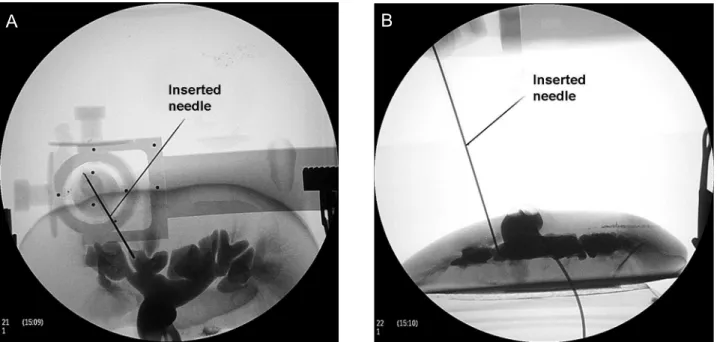
Two target type-2 procedures were performed. Successful needle insertion was achieved in both cases and validated by aspiration of blue contrast medium
through the needle as well as luoroscopic screening (Figure-9). The targeting procedure for the type-2 targets took approximately 15 minutes to complete,
excluding the calibration process.
COMMENTS
PCNL is the most dificult stone surgery tech
-nique for the trainee urologist to learn (12). PC access
Figure 9 – A) Fluoroscopic image at 0-degrees indicating needle alignment with the targeted calyx, and B) at 90-degrees showing
needle insertion depth.
performed by a radiologist is a practical option, often employed. However, PC access related complications are fewer and stone-free rates are higher with
urolo-gist-acquired access (3,13).
Training on animals is dificult to organize, expensive and not suficiently close to human reality. Häcker et al. described teaching ultrasound- or luo -roscopy guided PC renal access with a porcine kidney
“hidden” in a chicken carcass (14). Various virtual
reality and inanimate simulators for endourological
training have been developed, but none speciically for PC renal access (15).
Heyns and Van Gelderen (1990) were the irst to propose computed tomography imaging of
the pelviocalyceal system with 3-dimensional re-construction as an aid in selecting the appropriate
calyx for PCNL (16). Mozer et al. superimposed ultrasound images onto luoroscopic images to help plan PC renal puncture (17). “Pelviocalyceal biomod
-eling” (18) and “rapid prototyping” (19) have been
described to create a replica of individual patients’ stone-containing renal collecting systems, on which PCNL and PC access can be planned and practiced prior to the actual surgery.
The robots and robotic arms discussed earlier are certainly accurate in obtaining access.
Unfortunately, they are still too large and/or
expen-sive. Furthermore, the majority of these systems still rely on the urologist to calculate the trajectory of the
needle to the desired calyx. Robots for PCNL have been used in experimental settings only. Obtaining remote PC renal access using an automated telesurgi-cal robotic system has been successfully performed
(20). With this system, an experienced endourologist
is only a phone call away. This holds promise for the future.
CONCLUSIONS
The mechanical gantry system described in this paper is low-cost, portable, light-weight, sturdy
and resilient. C-arm luoroscopy is limited to two im
-ages, thus reducing radiation exposure signiicantly.
As there are no electronic switches or dials involved in positioning the gantry and needle alignment mecha-nism, it is simple to set up and operate. Testing of the system, both in the laboratory and in the operating
room with the use of contrast illed porcine kidneys,
showed an extremely high degree of accuracy in gain-ing precise access to a targeted renal calyx. Further study is required to validate its use during PCNL in humans.
Further study is also required to improve some engineering and design features. As C-arm imaging systems were not designed to produce ste-reoscopic images for point triangulation, errors due to movement during the acquisition of targeting im-ages are expected. A method to accurately monitor and control C-arm positioning is necessary. Another problem in image-guided systems requiring
calibra-tion prior to targeting is the fact that only a speciied
volume is calibrated. Point reconstruction outside this volume introduces large errors. Factors such as needle
delection due to tissue resistance and obstruction by adjacent structures were not addressed at this stage
of development.
ACKNOWLEDGEMENTS
Research funding for this project was provid -ed by the Urological Association of South Africa.
The authors would like to thank Malcolm
April, Elsabé du Toit and Dr Willem Groenewald from the Department of Medical Imaging and Clinical
Oncology at Tygerberg Hospital for their assistance
and the use of the BV Pulsera luoroscopy system.
The University of Stellenbosch, on behalf of the authors, is the intellectual property owner of the design, manufacture and patent rights of the equip-ment described in this paper.
CONFLICT OF INTEREST
None declared.
REFERENCES
1. Fernström I, Johansson B: Percutaneous pyeloli -thotomy. A new extraction technique. Scand J Urol Nephrol. 1976; 10: 257-9.
2. Miller NL, Matlaga BR, Lingeman JE: Techniques for luoroscopic percutaneous renal access. J Urol. 2007; 178: 15-23.
3. Watterson JD, Soon S, Jana K: Access related compli -cations during percutaneous nephrolithotomy: urology versus radiology at a single academic institution. J Urol. 2006; 176: 142-5.
4. Lawson RK, Murphy JB, Taylor AJ, Jacobs SC: Ret -rograde method for percutaneous access to kidney. Urology. 1983; 22: 580-2.
5. Potamianos P, Davies BL, Hibberd RD: Intra-operative imaging guidance for keyhole surgery: methodology and calibration. Proceedings of the First International Symposium on Medical Robotics and Computer As-sisted Surgery, Pittsburgh, Pennsylvania. 1994; pp. 98-104.
6. Potamianos P, Davies BL, Hibberd RD: Intra-opera -tive registration for percutaneous surgery. Proceedings of the Second International Symposium on Medical Robotics and Computer Assisted Surgery, Baltimore, Maryland. 1995; pp. 156-64.
7. Cadeddu JA, Bzostek A, Schreiner S, Barnes AC, Roberts WW, Anderson JH, et al.: A robotic system for percutaneous renal access. J Urol. 1997; 158: 1589-93.
CRVMed II & MRCAS III, Grenoble, France. 1997; pp. 295-8.
9. Cadeddu JA, Stoianovici D, Chen RN, Moore RG, Kavoussi LR: Stereotactic mechanical percutaneous renal access. J Endourol. 1998; 12: 121-5.
10. Su LM, Stoianovici D, Jarrett TW, Patriciu A, Roberts WW, Cadeddu JA, et al.: Robotic percutaneous access to the kidney: comparison with standard manual ac -cess. J Endourol. 2002; 16: 471-5.
11. Earp PP: Percutaneous renal surgery--new model for learning and training. Int Braz J Urol. 2003; 29: 151-4.
12. Tanriverdi O, Boylu U, Kendirci M, Kadihasanoglu M, Horasanli K, Miroglu C: The learning curve in the training of percutaneous nephrolithotomy. Eur Urol. 2007; 52: 206-11.
13. Osman M, Wendt-Nordahl G, Heger K, Michel MS, Alken P, Knoll T: Percutaneous nephrolithotomy with ultrasonography-guided renal access: experience from over 300 cases. BJU Int. 2005; 96: 875-8.
14. Häcker A, Wendt-Nordahl G, Honeck P, Michel MS, Alken P, Knoll T: A biological model to teach percu -taneous nephrolithotomy technique with ultrasound-
and luoroscopy-guided access. J Endourol. 2007; 21: 545-50.
15. Laguna MP, Hatzinger M, Rassweiler J: Simulators and endourological training. Curr Opin Urol. 2002; 12: 209-15.
16. Heyns CF, van Gelderen WF: 3-dimensional imaging of the pelviocaliceal system by computerized tomo-graphic reconstruction. J Urol. 1990; 144: 1335-8. 17. Mozer P, Conort P, Leroy A, Baumann M, Payan Y,
Troccaz J, et al.: Aid to percutaneous renal access by virtual projection of the ultrasound puncture tract onto luoroscopic images. J Endourol. 2007; 21: 460-5. 18. Radecka E, Brehmer M, Holmgren K, Palm G, Mag
-nusson P, Mag-nusson A: Pelvicaliceal biomodeling as an aid to achieving optimal access in percutaneous nephrolithotripsy. J Endourol. 2006; 20: 92-101. 19. Bruyère F, Leroux C, Brunereau L, Lermusiaux P:
Rapid prototyping model for percutaneous nephroli-thotomy training. J Endourol. 2008; 22: 91-6. 20. Bauer J, Lee BR, Stoianovici D, Bishoff JT, Micali
S, Micali F, et al.: Remote percutaneous renal access using a new automated telesurgical robotic system. Telemed J E Health. 2001; 7: 341-6.
Accepted after revision: May 7, 2010
Correspondence address:
Dr. A. D. Zarrabi Department of Urology
University of Stellenbosch and Tygerberg Hospital
PO Box 19063, Tygerberg, 7505, South Africa Fax: + 27 21 933-8010
E-mail: [email protected]
EDITORIAL COMMENT
This article proposes an interesting method for gaining the calyx in a percutaneous surgery and offers some important aspects like a welcoming less exposure to irradiation, and requires less expertise of the surgeon for accessing the urinary tract.
be-EDITORIAL COMMENT
Undoubtedly, percutaneous surgery for kid-ney stones is the most demanding procedure for a young endourologist to learn. As a matter of fact, it is also cumbersome for the expert endourologist to pass onto the apprentice the techniques of the pro-cedure in a stepwise and clear manner. Having said that, any effort to unfold the tricks of this treatment modality is worth trying.
Simulators, animal models, “ex vivo” and “in vivo” training models are being built and tested worldwide, but to date there has not been a single one that has proven capable of reproducing the “real life” challenges of the percutaneous nephrolithoto-my. The present study creates a ixed computerized geometrical concept of the procedure, where
land-marks are delimitated and loaded onto a computer that generates angles and aligns the tip of the needle towards the target (chosen calyx). The idea is very interesting and minimizes the mistakes of the human made puncture, but it needs further testing in “in vivo” animal models.
However, understanding the mechanism on which this study was based is the irst and most im -portant step for performing a safe calyx puncture. Basically, the triangulation technique has been re-produced by the authors, and once one (reader) un-derstands this concept, the puncture becomes less enigmatical.
Dr. Renato Nardi Pedro &
Dr. Nelson Rodrigues Netto Junior
Division of Urology, UNICAMP
Sao Paulo, SP, Brazil
E-mail: [email protected]
EDITORIAL COMMENT
Nephrolithiasis is a worldwide problem that accounts for signiicant morbidity and expense. Indications for an active treatment of renal calculi go mainly according to the stone size as well as the
clinical symptoms. The goal of Nephrolithiasis treat-ment is the complete removal of all stones from the pelviocalyceal system with the lowest possible mor-bidity. Extracorporeal shockwave lithotripsy, percu-comes necessary in a more complex surgery, the
sur-geon without any other assistance can perform the procedure.
However, in several services the urinary tract approach continues to be done by invasive radiolo-gists. For novice urologists and for those who are
ra-diologist dependent, the equipment and the software may be useful since it could be really cost-effective, commercially available and clinically tested. It is an additional way to give autonomy to urologists in percutaneous surgery.
Dr. Anuar I. Mitre
Division of Urology University of Sao Paulo, USPSao Paulo, SP, Brazil
EDITORIAL COMMENT
The authors are to be congratulated on their innovative work aimed at developing a reliable and simple technology to aid with accurate calyceal ac-cess during PCNL. Many urologists in the United States rely on radiologist to gain initial kidney ac-cess at the time of surgery. I hope that continued de-velopment of this technology or something similar that is inexpensive may help urologists gain their
own precise access. Any excitement for this innova-tion must be tempered, however, by the lack of in vivo testing where muscle and fascial deformation as well as kidney movement may diminish calyceal puncture success. We await further animal and clini-cal reliability evaluations.
Dr. Jeffrey Anthony Cadeddu
Department of Urology UT Southwestern Medical Center Dallas, Texas, USA E-mail: [email protected]taneous nephrolitholapaxy and lexible ureteroreno -scopy are the main options for treatment.
Percutaneous nephrolithotomy has under-gone an evolution in technique and in equipment since its introduction in the late 1970s. This evolu -tion continues today and is evidenced by the numer-ous publications about the technique.
Although ureteroscopy and shock wave lithotripsy predominate in the treatment of urolithia-sis, percutaneous nephrolithotomy continues to be an important part of the urologist’s armamentarium. Percutaneous nephrolithotomy is a minimally inva-sive surgery that causes minimal renal injury and maximizes stone clearance, especially in patients with complex stone disease.
The authors in this paper design a simple, cost-effective system for gaining rapid and accurate caly-ceal access during percutaneous nephrolithotomy.
They showed that with the system described, we can have a new project with low-cost ($1500), portable, light-weight, that can help any other urolo-gist around the world.
It is very important that the C-arm luoros -copy is limited to two images, thus reducing the risk of all Urologists who live with radiation exposure.
As the authors concluded, “Further study is required to validate its use during PCNL in the hu-man” and improve the system. We will be expecting the human results.
Dr. Mauricio Rubinstein
Section of Urology Federal University of Rio de Janeiro StateRio de Janeiro, RJ, Brazil