ABSTRACT
Purpose: To determine the prevalence of different approaches to the dificult urethral catheterization (DUC) among urol -ogy residents (UR) in the United States (US).
Materials and Methods: An email invitation to participate in an online survey regarding DUC was sent to 267 UR and to
22 urology program coordinators for them to forward to their residents. 142 UR completed the survey.
Results: After the initial unsuccessful attempt by a nurse, 92% of UR attempted a catheter prior to resorting to other mo -dalities. The most common choice of the irst catheter was a Coude (76%) size 18F (51%). For situations where multiple sizes and types of catheters (12 - 20F) were used without success, 3 scenarios were proposed: 1) Catheter passed the bulbomembranous urethra (BMU) and patient had previous history of transurethral resection of the prostate or radical retropubic prostatectomy, 2) Catheter passed the BMU and no urologic history, 3) Catheter did not pass the BMU and no urologic history. Flexible cystoscopy was used in 74%, 62% and 63%; blind passage of a glidewire was second with 15%, 23% and 20%; and blind use of iliforms and followers was chosen in 7%, 9% and 9% of the scenarios respectively.
Conclusions: The most common approach to the DUC among UR in the US involves using an 18F Coude catheter irst.
After trying one or more urethral catheters, UR most commonly resort to lexible cystoscopy as opposed to the blind placement of glide wires or iliforms/followers.
Key words: urethra; male; catheterization; dificult; stenosis Int Braz J Urol. 2010; 36: 710-7
INTRODUCTION
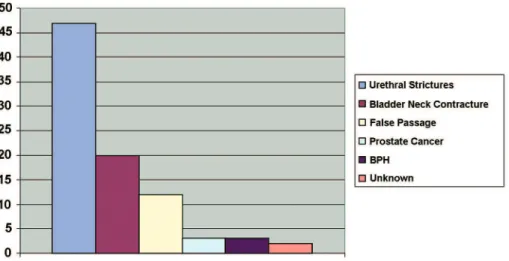
The dificult urethral catheterization (DUC) is one of the most common consultations for the gen -eral urologist. There are many causes of DUC among which urethral strictures and bladder neck contrac -tures are probably the most commonly reported in the literature (Figure-1). Other less common causes include benign prostatic hyperplasia (BPH), incorrect technique, tightening of the external sphincter (in an anxious patient), false passages, phimosis, meatal stenosis, prostate cancer, etc.
There are multiple approaches to the DUC and an extensive review of the literature regarding these was recently reported (1). Common approaches include trying different sizes/types of catheters, the Liss maneuver (2), catheter guides using lidocaine jelly, iliforms/followers, blind passage of a glide -wire (3), lexible cystoscopy to place a glide-wire (4), suprapubic catheter, etc.
urologists to assist with the DUC. The introduction of the lexible cystoscope and glidewires came to revolutionize the approach to the DUC. The teach -ing of the use of iliforms and followers is dificult, since a “feeling” has to be developed by the trainee and there is no way for the teacher to know what the trainee is feeling. Teaching lexible cystoscopy is easy in the sense that the instructor knows what is hap -pening. This is analogous to the teaching of the use of forceps in obstetrics: any obstetrician would agree that it is easier to teach how to do a C-Section. Just as there has been a trend in obstetrics to abandon the use of forceps, there has also been a trend in urology to abandon the use of iliforms and followers. The prevalence of the various different approaches for the DUC among urologists is not known. In this study, our objective was elucidating which approaches are used by UR in the US for the DUC.
MATERIALS AND METHODS
Approval from the Institutional Review Board was granted. An email invitation was sent to 267 UR and to 22 urology residency program coordinators
to forward to their residents. These residents and program coordinators were the ones we could obtain their email addresses. The email invitation contained a link for an online survey which was performed us -ing www.surveymonkey.com. The front page of the online survey contained an informed consent.
The survey was designed to simulate common scenarios encountered during DUC. Demographic data comprised the irst section: Post-graduate year (PGY) of training, state of the residency program, and the incidence of DUC encountered by the residents.
In the irst case scenario, the residents were asked if they would attempt to catheterize a patient after a nurse had tried using Coude type catheters and lidocaine jelly. If they chose to try a catheter they were asked about the type and sizes.
In the second case they were asked about a scenario where during the initial attempt at catheter -ization with a 16F Coude they felt the catheter met resistance after passing the bulbomembranous urethra (BMU). The third scenario was similar except that the catheter met resistance before the BMU. In each of these scenarios they were given the option to try one or more catheters or to proceed with cystoscopy, glidewires, iliforms or other alternatives.
Figure 1 –Most common causes of dificult urethral catheterization*.
the option of initially using iliforms/followers, lex -ible cystoscopy, pass a glidewire blindly, suprapubic tube placement, or other.
The survey was piloted with 4 UR for ease of understanding and completion with modiications made to it accordingly. Cognitive testing was per -formed by having 2 residents think aloud while they were answering the questionnaire.
An internet calculator (www.surveysystem. com/sscalc.htm) was used to calculate a conidence interval (CI) based on a 95% conidence level.
RESULTS
There are probably 900 UR in the US. Our survey was completed by about 14% of all the UR if we do not count the UR doing preliminary surgery. To calculate a CI we used 900 as the population size, 127 as the sample size, 95% as the conidence level, and the worst case percentage (50%). The CI was 8.
The post-graduate year (PGY) distribution is depicted in Figure-2. Residents that responded to the survey were training in 27 different states. Figure-3 shows the frequency which with residents dealt with DUC in a week.
In the irst scenario where a nurse had un -successfully tried using Coude type catheters and lidocaine jelly, 131 (92%) of residents attempted to place the catheter themselves irst, instead of having the nurse try an alternative approach or going directly to more advanced techniques. In this scenario, out of the 92% electing to try the catheter, the choice of the irst catheter type was a Coude (76%) with a size distribution of 18F (51%), 16F (27%) or 20F (14%) . A
90 residents who chose to try another catheter, 87% chose a Coude, and the majority chose a larger size: 18F (47%), 20F (22%) and 22F (10%).
In the next (similar) scenario, they were asked about what to do when the initial attempt to pass a 16F Coude was unsuccessful and they felt the cath -eter did not pass the BMU. Only 32% elected to try a different catheter, 39% would go directly to lexible cystoscopy, 18% would try a glidewire blindly and 8% would use iliforms and followers. Among the 45 residents that elected to try another catheter, Coude was only chosen by 40% and the majority chose a smaller catheter: 14F (33%) and 12F (31%).
For situations where multiple sizes and types of catheters (12 - 20F) were used without success, 3 scenarios were proposed: 1) Catheter passed the BMU and patient had previous history of transure -thral resection of the prostate or radical retropubic prostatectomy, 2) Catheter passed the BMU and no urologic history, 3) Catheter did not pass the BMU and no urologic history.
Flexible cystoscopy was used in 74%, 62% and 63%; blind passage of a glidewire was second with 15%, 23% and 20%; and blind use of iliforms and followers was chosen in 7%, 9% and 9% of the scenarios respectively. Suprapubic catheter and “other” accounted for the rest of the responses. A suprapubic catheter was used in 2.1, 0.7 and 3.5 % of the scenarios respectively.
COMMENTS
concomitant preference for lexible cystoscopy by UR in the US to approach the DUC. Most university hospitals nowadays have easy access to “urology carts” equipped with a lexible cystoscope. Flexible cystoscopy facilitates the diagnosis of the problem and assists maneuvering false passages and the passage of glidewires though pinpoint urethral strictures. By vir -tue of using a monitor, junior residents can be guided through the procedure facilitating its teaching.
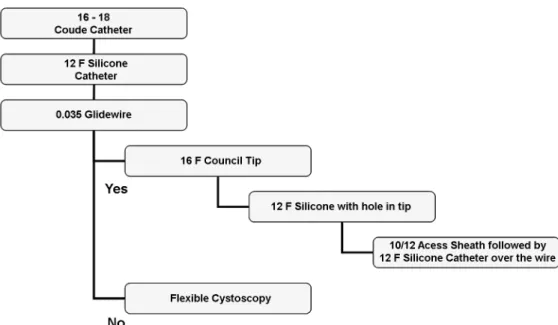
Despite all the benefits of using flexible cystoscopy as the main approach to the DUC, it has not been proven that is necessary in the major -ity of cases. The authors have implemented a DUC algorithm (Figure-4) for all DUC cases over the past
almost 3 years (report accepted for publication). This algorithm was applied to 41 patients in a University setting and 24 in the private settings successfully and without breaks. Flexible cystoscopy was required in 5% of the university patients and 13% of the private patients. No patients suffered any complications. Most urologists would agree that lexible cystoscopy is the safest approach and we agree. However, our contention is that by using algorithms like the one we reported, lexible cystoscopy could be used more selectively without harming the patient with possible (but unproven) economic and time savings.
Another prevalent approach to the DUC that the study documented among UR, was the blind pas
-Figure 2 – Post-graduate yearof residents that completed the survey.
sage of a glidewire. The hydrophilic nature and loppy tips of glidewires allow them to be easily advanced into the bladder with minimal trauma. When the glidewire encounters a false passage it usually relects out the urethral meatus instead of digging deeper into the false passage (unless a rigid shaft glidewire was used). Multiple reports have documented the safety of this approach for the DUC(3,5-7).
It is dificult to know with this survey the true incidence of the use of suprapubic catheters in the DUC. Although just a small percentage of UR chose to use a suprapubic catheter in the questionnaire, we believe that others would have also chosen it, after evaluating the situation with the lexible cystoscope. Unfortunately this was not assessed.
Although this study assesses just the initial approach to the DUC, we believe that what happens next is of paramount importance. What do residents do once a glidewire is in the bladder, whether it was passed blindly or using a lexible cystoscope, can result in severe urethral damage. In certain instances, Heyman dilators have been passed over a glidewire perforating the urethra and violating the rectum. Once a glidewire is the bladder, there are multitude choices for the next step. One can pass a small catheter without
dilating or a large catheter after dilating. One can use Heyman dilators, ureteral dilators (8), ureteral access sheaths (9), urethral balloon dilators etc. It would be interesting to determine the prevalence of these dif -ferent approaches among urologists.
The main weakness of the study is in the elaboration of the questionnaire. Despite the fact that our questionnaire underwent pilot testing for ease of understanding and completion as well as cognitive testing a formal validation was not performed.
Our study conirms indings analogous to those in the ield of obstetrics with forceps deliver -ies, UR are probably not being exposed adequately to the use of the traditional iliforms and followers and will probably lack the skills to use them safely once in practice. This is compounded by the lack of studies related to the use of iliforms and followers in the DUC, with only one report briely describing their use (10). More studies have now been published regarding the lexible cystoscopy (4,11) or blind pas -sage of glidewire approaches. A similar survey applied to practicing urologists would help assess the trend of iliforms and followers use and probably predict the future demise of one of the staple urologic instru -ments.
CONCLUSION
The most common approach to the DUC among UR in the US involves using an 18F Coude catheter irst. When UR attempt catheterization un -successfully with a 16F Coude but felt the catheter was past the BMU, they chose another larger Coude catheter. When the resistance was felt before the BMU, only about a third of residents attempted an -other catheter, usually smaller (12 - 14F). After one or more urethral catheters, UR most commonly resort to lexible cystoscopy.
CONFLICT OF INTEREST
None declared.
REFERENCES
1. Villanueva C, Hemstreet GP 3rd: Dificult male ure -thral catheterization: a review of different approaches. Int Braz J Urol. 2008; 34: 401-11; discussion 412. 2. Liss MA, Leifer S, Sakakine G, Esparza M, Clayman
RV: The Liss maneuver: a nonendoscopic technique for dificult Foley catheterization. J Endourol. 2009; 23: 1227-30.
3. Zammit PA, German K: The dificult urethral cath -eterization: use of a hydrophilic guidewire. BJU Int. 2004; 93: 883-4.
4. Beaghler M, Grasso M 3rd, Loisides P: Inability to pass a urethral catheter: the bedside role of the lexible cystoscope. Urology. 1994; 44: 268-70.
5. Lachat ML, Moehrlen U, Bruetsch HP, Vogt PR: The Seldinger technique for dificult transurethral catheter -ization: a gentle alternative to suprapubic puncture. Br J Surg. 2000; 87: 1729-30.
6. Freid RM, Smith AD: The Glidewire technique for overcoming urethral obstruction. J Urol. 1996; 156: 164-5.
7. Chiou RK, Aggarwal H, Chen W: No title available. Can Urol Assoc J. 2009; 3: 189-192.
8. Chelladurai AJ, Srirangam SJ, Blades RA: A novel technique to aid urethral catheterisation in patients presenting with acute urinary retention due to urethral stricture disease. Ann R Coll Surg Engl. 2008; 90: 77-8.
9. Athanasopoulos A, Liatsikos EN: The use of a ureteral access sheath for the urethral dilatation and catheteriza -tion of dificult urethral strictures. Urol Int. 2009; 83: 359-61.
10. Jordan GH, Winslow BH, Devine CJ Jr: Intraoperative consultation for the urethra. Urol Clin North Am. 1985; 12: 447-52.
11. Krikler SJ: Flexible urethroscopy: use in dificult male catheterisation. Ann R Coll Surg Engl. 1989; 71: 3. 12. Mistry S, Goldfarb D, Roth DR: Use of
hydrophilic-coated urethral catheters in management of acute urinary retention. Urology. 2007; 70: 25-7.
Accepted after revision: June 6, 2010
Correspondence adrress: Dr. Carlos Villanueva 855 N 82nd, Plaza Apt. 40 Omaha, NE, 68114, USA Fax: + 1 402 559-6529
rary practice and propose an algorithm. The authors claim that the algorithm has been successfully uti -lized in 65 consecutive patients with DUC without any failures. One arm of the algorithm proposes the passage of a hydrophilic glidewire with a catheter or access sheath passed over the wire. The alternative arm employs the use of a lexible cystoscopy. The cost of up to three catheters and an access sheath is not insigniicant and may not stack up favorably against that of a multiple use lexible cystoscope. This needs to be further investigated.
Common conditions predisposing to DUC include bladder neck contractures, occlusive pros -tates, and urethral strictures. It is entirely appropri -ate for an experienced urological resident or urolo -gist to attempt a catheterization after a failed initial attempt by a nurse. The level of obstruction, though a rather subjective entity, may suggest a particular etiology. A catheter not passing the bulbomembra -nous urethra in a young male with no previous uro -logical intervention is highly suggestive of urethral stricture and multiple attempts at catheterization are to be avoided.
The use of traditional iliforms and follow -ers is diminishing, especially in developed coun -tries, due to a combination of lack of exposure to such techniques and the easy availability of alterna -tive equipment such as lexible cystoscopes. Clini -cians therefore not trained in these techniques may not have the ‘feel’ for these and are liable to cause further urethral trauma.
The use of a hydrophilic glidewire is the step suggested by the authors after two failed catheteriza -tions. It is safer with regards to urethral trauma with the glidewire’s tendency to turn back on itself rather
and SPC does not feature at all in the proposed algo -rithm. SPC has inherent advantages in the manage -ment of DUC. It avoids further urethral trauma, is associated with fewer infections and urethral stric -tures, is more comfortable, easier to manage and more cost effective, and avoids the need for re-cath -eterization in the event of subsequent failure to void (2).
Note also that catheterizing a patient with a DUC will result in rapid resolution of painful reten -tion, but does not complete the management of the patient. More often than not the patient will require a subsequent cystoscopy (lexible or rigid) to conirm urethral patency and correction of the underlying problem. This is another argument in favor of us -ing the lexible cystoscopy to assist initial catheter -ization as the cause of the obstruction can be easily identiied, safely negotiated and the appropriate de -initive treatment can be planned.
Ultimately it is dificult to draw robust con -clusions from a hypothetical survey prone to bias, but the proposed algorithm represents a logical ap -proach to the management of DUC. In reality, local practice will be dictated by a large number of vari -ables including local expertise, availability of equip -ment (e.g. dilators, lexible cystoscopes), conidence to perform SPC, and patient co-morbidity. Each case must be managed on merit.
REFERENCES
2. Horgan AF, Prasad B, Waldron DJ, O’Sullivan DC:
Acute urinary retention. Comparison of suprapubic and urethral catheterisation. Br J Urol. 1992; 70: 149-51.
Dr. Shalom J. Srirangam
Department of Urology East Lancashire Teaching Hospitals NHS Trust Preston Royal Inirmary Preston, United Kingdom E-mail: [email protected]REPLY BY THE AUTHORS
We appreciate the kind comments. With re -gards to the algorithm that we have used in 65 con -secutive patients, an access sheath was only used in 3 and cystoscopy was only necessary in 5 patients. Twenty-nine patients were catheterized readily with an 18F code, and another 10 patients with the 12F silicone catheter. If we had resorted to lexible cys -toscopy in all of these patients, the costs would cer -tainly have been higher. We do agree that lexible cystoscopy could have provided some useful infor -mation in the patients with pathology. Nevertheless, in our series a signiicant proportion of patients did not have any consequential pathology, based on the fact that the 18F Coude was successful in 29 of the 65 patients.
In our experience, we have almost always been able to place a catheter after a glidewire is se -cured in the bladder. In the case of a dense stricture,
using a 15F ureteral balloon dilator followed by a 12F silicone catheter over the glidewire usually is effective. We do agree that SPC is underutilized and that it has all the mentioned advantages. As to why it is underutilized, we think It may be attributed to the setting, with most cases of DUC being per -formed on awake patients under no sedation many of them on anticoagulation. Also, residents most likely would have to check with their faculty when a SPC is planned whereas they will not probably do so for performing lexible cystoscopy at the bedside. This is, of course, all hypothetical and it would be inter -esting to study the factors that contribute to the low incidence of SPC in the setting of the DUC.