Stages in the evolution of the Hardy-Weinberg law
Alan E. Stark
Balgowlah NSW, Australia
Abstract
The Hardy-Weinberg law has been used widely for about one hundred years with little question as to the foundations laid down by its originators. The basic assumption of random mating, that is choice of mates by a process akin to that of a lottery, was shown to produce genotypic proportions following the “binomial-square” rule, the so-called Hardy-Weinberg proportions (HWP). It has been assumed by many that random mating was the only way of pairing genes capable of producing HWP. However it has been shown that HWP can be obtained and maintained by non-random mating. The steps along the way to this revelation and some implications are reviewed.
Key words:Hardy-Weinberg law, non-random mating. Received: May 24, 2006; Accepted: August 16, 2006.
It is a strange fact that the most basic law of popula-tion genetics, which is attributed to Hardy (1908) and Weinberg (1908), is poorly understood by many scientists who use it routinely. Support for this apparently extrava-gant statement can be found in numerous textbooks and web sites. It is unfair to take Hancock (2004), which ap-pears to be an excellent monograph on its topic - plant evo-lution - to illustrate the point. But, because it is such an admirable book, it does provide a good example. In the sec-tion entitled “Random Mating and Hardy-Weinberg Equi-librium” on page 24 is the following statement: “What these two men [Hardy and Weinberg] discovered mathe-matically is that genotype frequencies will reach an equilib-rium in one generation of random mating in the absence of any other evolutionary force. The frequencies of different genotypes will then depend only upon the allele frequen-cies of the previous generation. If gene frequenfrequen-cies do not accurately predict genotype frequencies, then plants are crossing in a non-random fashion or some other evolution-ary force is operating”. While some of the quoted text is valid, the overall impression that random mating and Hardy-Weinberg proportions (HWP) are inextricably linked is not correct. Stark (2006, in press) shows that, pro-vided the population has discrete and non-overlapping gen-erations, HWP can be attained in one round of non-random mating and that random mating is a single point in a contin-uum of such possibilities. Furthermore Li (1988) and Stark (2005) give mating schemes which show that HWP can be maintained by non-random mating.
To illustrate the problem further, Hancock (p. 35) writes “While the Hardy-Weinberg formula is very useful in describing the completely randomized situation, it is a rare natural population that is in fact in Hardy-Weinberg equilibrium. More commonly, mating is not random and the populations are subjected to other evolutionary forces, such as migration. genetic drift and natural selection”. As noted above, HWP are consistent with (some) non-random mating.
The object of this paper is to trace some of the history of basic population genetics to see how this misunderstand-ing has arisen and to point out some of the misconceptions. In the proceedings of the Mendel Centennial Symposium sponsored by the Genetics Society of America, which was held in 1965, Wright (1967) wrote: “It is not surprising that the first attempt to formulate the statistical properties of Mendelian populations and to reconcile the views of Galton with those of Mendel was made by a biometrician, Yule (1902). He showed that the unselected, randomly bred de-scendants of a cross would maintain indefinitely the 1:2:1 ratio of F2. Castle (1903), in the course of a criticism based
on a misunderstanding of Yule’s postulates, worked out for the first time the effect of selection in a Mendelian popula-tion He also showed that if selecpopula-tion ceases, the composi-tion of the randomly bred descendants remains constant thereafter, with genotypic frequencies according to the now familiar binomial-square rule. Unfortunately, he did not stress this as a basic principle of population genetics, and it did not attract attention. It is now known as the Hardy-Weinberg law because of independent restatements by Hardy and by Weinberg in 1908”. We see here not only mention of the fore-runners of Hardy and Weinberg but www.sbg.org.br
Send correspondence to Alan E. Stark. 3/20 Seaview Street, 2093 Balgowlah, NSW, Australia. E-mail: [email protected].
also the emphasis on random mating as recently as the cen-tenary of Mendel’s work.
Cotterman (1940) wrote: “the fact first noted by Hardy (1908), that random mating produces an equilibrium in the distribution of the three genotypes, AA, Aa, aa, the frequencies of which are then proportional to the terms of the squared binomial of the gametic proportions of the two genes. The derivation also reveals the additional fact, later noted by Wentworth and Remick (1916), that such an equi-librium is reached in a single generation of random mat-ing”. This quotation appears on page 198 of the reproduc-tion of Cotterman’s thesis in Ballonoff (1974). That Hardy-Weinberg proportions were reached in one genera-tion of random mating was first made explicit in 1916, ac-cording to Cotterman. As noted above, this is possible with non-random mating also.
Dobzhansky (1998) contributed to the workshops on the “Evolutionary Synthesis” held in 1974. His submission, along with those of other attendants was published in 1980 and again in 1998. In his paper, which dealt with scientists from the Soviet Union, he wrote: “The personal back-grounds and the scientific traditions of this Anglo-Ame-rican trinity [Fisher, Wright, and Haldane] were quite different from Chetverikov’s, as well as from each other. It is well known that Mendelism and genetics in general were, by a singular miscomprehension, regarded as contradictory to Darwin’s theory of natural selection in the early decades of the twentieth century. The short but important theoretical paper by Hardy in 1908 should have dispelled this miscom-prehension, and in fact it served as a point of departure for Chetverikov as well as for the other founding fathers (the parallel work of Weinberg was not then considered)”. This quotation illustrates the significance of the H-W law and also the fact that Weinberg’s independent contribution was not recognized until Stern (1943) drew attention to it. Even then it was not universally known for Schmalhausen (1986, p. 98) cites Hardy (1908) as the originator of the formula. Schmalhausen’s (1986) text was translated with minor changes from the original Russian manuscript available around 1947. Also Malécot (1948) refers to “loi de Hardy”.
Hardy’s (1908) paper contains some questionable statements. For example he wrote “suppose that the num-bers are fairly large, so that the mating may be regarded as random”. There is no necessary relation between popula-tion size and randomness of mating. Presumably Hardy wished to exclude genetic drift as a mechanism capable of changing the status of the population.The genesis of the fal-lacy that random mating was a necessary requirement for the production and maintenance of Hardy-Weinberg pro-portions may be due to Hardy himself, for he wrote “I have, of course, considered only the very simplest hypotheses possible. Hypotheses other than that of purely random mat-ing will give different results”. As will be seen, this state-ment is not generally true.
Weinberg (1908) invoked random mating in his study of the inheritance of twinning in humans. The translated version of his paper includes the following: “I have there-fore tried to construct a formula for the frequency of domi-nant and recessive traits among the mothers, daughters, and sibs of persons affected with such traits of the same charac-ter, under the assumption that absolute panmixis is pres-ent”. As will be shown later, the kind of inference that can be made validly, using the data which Weinberg collated, depends critically on what assumption is made as to the mating system which generates HWP.
Li (1988) made a valuable contribution when he showed that Hardy-Weinberg (H-W) frequencies can be maintained in large populations with non-random mating. Crow (1988) made the following comment on Li’s article: “we are still learning things about the Hardy-Weinberg re-lationship. C.C. Li shows that random mating is a suffi-cient, not a necessary condition for H-W ratios”. This fact was noted by Stark (1977a) and is implicit in Stark (1977b). However, to add weight to his model, Li attributed additive genotypic values to male and female parents from which he calculated that the coefficient of correlation between mat-ing pairs is zero. In this paper it is shown that this arbitrary assignment of values is questionable.
The origin of the confounding of random mating and HWP can be traced to the (correct) principle enunciated by Mendel that, in the formation of gametes, the genetic mate-rial is halved and then restored to its full complement in the production of offspring. It is not immediately obvious that, in this sequence of events, the pair of uniting gametes may be independent in a probabilistic sense while the genotypes of its parents not be independent. There are numerous ex-amples in the genetics literature where random union of gametes and random pairing of parents are taken to be equivalent. As will be seen, this is not necessarily so.
The next section contains a description of Li’s model. That is followed by an analysis of dependence and inde-pendence, as mentioned in the previous paragraph. Then Li’s model is expressed in a canonical form which allows an analysis of the assignment of genotypic values. The final section reviews Weinberg’s (1908) study of twinning.
Li’s parametrization of non-random mating
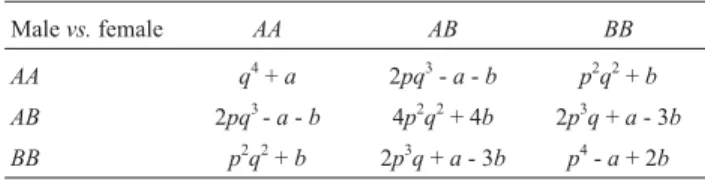
Consider a population with respect to a single locus having allelesAandBwith respective frequenciesqandp, the same in males and females. Denote frequencies of geno-typesAA,AB andBB byf0,f1 andf2. Table 1 gives Li’s3 x 3 matrix of cell frequencies will be denoted by [fij],i= 0,
1, 2;j= 0, 1, 2.
Both row totals and column totals give Hardy-Wein-berg proportions:f0=q2,f1= 2pq,f2=p2. Thus the parental
population is in H-W form and it is simple to show that the distribution of genotypes among offspring is the same. Note thatf11= 4f02.
Parametersa andb are constrained by the require-ment that the elerequire-ments of [fij] be non-negative. Thus, for
ex-ample,acannot be less than -q4. It is convenient to replace the symbolbbyk, defined ask=b/a, in the section in which Li’s model is analysed. The introduction ofkentailsa 0. However, this is not a practical constraint since |a| can be made arbitrarily small.
Randomness and independence
There exist many examples where the derivation of the H-W distribution appeals to a random union of egg and sperm. In fact, this is correct but, as Li has shown, not nec-essarily because of random pairing of mates. This may be the basic cause of the invalid claim that random pairing of mates is a necessary condition for the existence of H-W fre-quencies. Suppose that a given zygote was derived from an egg of typeA, a meaningful question is: what is the proba-bility that this egg was fertilised by a sperm of type A? Using the mating matrix [fij] of Table 1, by application of
the probability calculus, the required probability is found to be equal toq. The probability that an egg is of typeAisq, so the joint probability isq2, thus deriving the H-W frequency of offspring of typeAA. Corresponding calculations pro-duce the remaining H-W zygotic frequencies.
The preceding paragraph may be summarized in an-other way. But first it is necessary to recall the definitions of conditional probability and independence. Two events X and Y are said to be independent if the joint probability of X and Y, denoted Pr(XY), is equal to the products of the prob-abilities of the separate events, that is Pr(XY) = Pr(X). Pr(Y). This property of independence can be described in another way through the conditional probability of X, given Y, denoted Pr(X|Y). By definition, Pr(XY) = Pr(Y). Pr(X|Y), so that independence of X and Y requires the iden-tity Pr(X|Y) = Pr(X). Relating this to the derivation of the probability of genotypeAAin the previous paragraph, it can be said that the union of egg and sperm is the joint occur-rence of independent events. In other terms, egg and sperm are said to pair `randomly’.
However, pairing of mates in the scheme given by Ta-ble 1 is not random. As can be seen by looking along the rows of the matrix, the conditional probabilities relating to male type, given the type of female, are not identical to the unconditional probabilities relating to male types, that is the types of female and male mates are not independent.
The canonical form of Li’s model
It is instructive to examine [fij] through its canonical
form
fij=fifj(1 +rxixj+syiyj), (i= 0, 1, 2;j= 0, 1, 2) (1)
Formula (1) is a particular example of the representa-tion of a discrete bivariate probability distriburepresenta-tion which Lancaster (1969, p. 90) refers to as “Fisher’s Identity”. Some important properties of this representation are given below. An example of its use in classifying mating systems is Stark (1980).
Without loss of generality take q in the interval 0 <q 1/2. Puttingk=b/a, some simplification is achieved by introducing the following symbols:
n= 1 +p
d= 1 +p(p-q) - 2q2k
r=Ö(p2+q2- 4q2k+ 2q(1 +q)k2).
Then the terms in (1) are obtained from:
=a(p-q+ 2qk-r)/(2p2q2)
=a(p-q+ 2qk+r)/(2p2q2)
x2=Ö(1/2q(n+d/r))/p
y2=Ö(1/2q(n-d/r))/p
x0= -pÖ(1/2q(n+d/r))/(qn) -IkÖ(p(n-d/r))/(qn)
x1= -pÖ(1/2q(n+d/r))/(qn) +IkÖ(p(n-d/r))/(2pn)
y0= -pÖ(1/2q(n-d/r))/(qn) +IkÖ(p(n+d/r))/(qn)
y1= -pÖ(1/2q(n-d/r))/(qn) -IkÖ(p(n+d/r))/(2pn).
Ikis an indicator function defined as:
Ik= 1,k> 0;Ik= -1,k 0.
The vector of values {x0,x1,x2} will be denoted byx
and {y0,y1,y2} byy.
The connection between Li’s formulation and the ca-nonical form is complicated. Therefore there is some value in considering some special cases in order to illustrate in a simpler way the connection and to reveal key properties of the canonical form. Ifk= -p/(1 +q), then
r= -2a/(p2q(1 +q)),s=a/(pq2(1 +q)),
x0= 0,x1= -1/Ö(2q(1 +q)), x2=p-1Ö(2q/(1 +q)).
Table 1- Li’s symmetric non-random mating model.
Malevs.female AA AB BB
AA q4+a 2pq3-a-b p2q2+b
AB 2pq3-a-b 4p2q2+ 4b 2p3q+a- 3b
y0= -q-1Ö(p(1 +q)), y1=y2= -y0-1.
For this case,r/s = -2q/p. Calculation shows that, with respect to the H-W distribution, the mean ofxand the mean ofyare each zero and the standard deviation of each is one. Furthermore, with respect to the mating matrix [fij],
the correlation ofxin females andxin males isrand the correlation ofyin females andyin males iss. The correla-tion ofxin females andyin males is zero. These are proper-ties of the general form of Fisher’s Identity.
Narrowing this example further, when q = 1/3,
a= 2pq3andk= -p/(1 +q),
r= -1/2, s= 1/2,
x0= 0, x1= -3Ö2/4, x2= 3Ö2/4,
y0= -2Ö2, y1=Ö2/4, y2=Ö2/4.
This case illustrates readily another property of Fisher’s Identity, namely that the regression ofxvalues in females on that of males is linear with coefficient equal tor
and the regression ofyvalues in females on that of males is linear with coefficients. This property was the condition taken by Hirschfeld (1935) as the starting point for investi-gating a two-way contingency table of frequencies. He reached essentially the same representation as Fisher’s Identity.
As has been noted already, the case of Fisher’s Iden-tity used here is special in that it is being applied to a sym-metric matrix, the roles of males and females being ex-changeable without altering the properties. In an example used by Fisher (1940) and later by Maung (1942), where Fisher’s formula is given, the object was to study the con-nection between eye colour and hair colour in Scottish chil-dren. They calculated sets of numerical values to stand for the grades of hair colour and eye colour, one set for each. That is they were dealing with two different but supposedly related characters. Here, given a symmetric mating table, two sets of values,xandy, are calculated for each sex, but the same for each sex. Thus there is a difference from the analysis of Li who assumed one set ofadditivevalues for each sex.
A natural question to ask is “What is gained by intro-ducing Fisher’s Identity?”. On the face of it, Li’s model is very simple and shows very easily and generally how H-W proportions can be maintained with non-random mating. But Li went further and stated that the correlation between mates is zero. He did this by assigningadditive values to genotypes, that is essentially 0 to typeAA, 1 to typeAB, and 2 to typeBB. This is intuitively plausible and was used fre-quently by Sewall Wright. However, there is no compelling reason to assign additive values. The important point is that, using Fisher’s Identity, the pair of conditionsr= 0 and xbe a vector ofadditivevalues is true if and only ifb=a (k= 1). Then (1) reduces to:
fij=fifj(1 +syiyj), (i= 0, 1, 2;j= 0, 1, 2), (2)
wheres=a/(p2q2), andy= {p/q, -1,q/p}. Taking q 1/2,s
can take values in the interval (-q2/p2,q/p), the correspond-ing interval forabeing (-q4,pq3), as noted by Stark (2005).
Li’s assignment of additive values is purely arbitrary, except in the sense that they are the count of genes of typeB in the respective genotypes, whereasxandyare intrinsic to the structure of (1).
Weinberg’s analysis of twin data
Crow (1999) discussed the reasons for the relative ne-glect of Weinberg’s work, notinginter aliathat Weinberg (1908) concluded that dizygotic twinning was inherited. I show here that Weinberg’s analysis, though ingenious, can be questioned on the ground that HWP can be maintained with non-random mating. As will be seen, the relative pro-portions of a particular phenotype among different catego-ries of relatives may be confounded with non-random mating parameters.
Weinberg selected a single locus model with either dominant or recessive propensity to produce twins at a higher than normal rate, which for convenience is referred to here as a high propensity phenotype, denoted byA. He calculated the proportions of high propensity versus normal groups (B) among three types of relatives of high propen-sity women: parents, children and sibs. Following Wein-berg’s reasoning, but using Li’s mating model rather than random mating frequencies as the basic mating system, the probabilities relating to high propensity trait being domi-nant are as follows:
among parents and children (ofAmothers):
(q(1 +pq) - 1/2(a-b))/(q(1 +p)); (3)
among sibs:
(4q(1 +pq) +p2q2- (2a- 3b))/(4q(1 +p)). (4)
The probabilities relating to high propensity trait be-ing recessive are as follows:
among parents and children:
(q3+ 1/2(a-b))/q2; (5)
among sibs:
(q2(1 +q)2+ 2a-b)/(4q2). (6)
Each of formulae (3) - (6) gives the conditional prob-ability that the particular relative has higher propensity to have twins, given that the index mother has higher propen-sity (A).
this with admittedly extreme choices ofaandb, the differ-ence in hypothetical rates can even be zero.
Bulmer (1970) reviewed data relating to the inheri-tance of twinning in humans. It is impossible, in a few sen-tences, to do justice to the thorough treatment of this question given by Bulmer. He compiled tables of twinning rates per thousand maternities among mothers of twins and first degree relatives of such mothers and in the general population. He found, for example, that the repeat dizygotic twinning rate of high propensity mothers is nearly four times the dizygotic twinning rate in the general population.
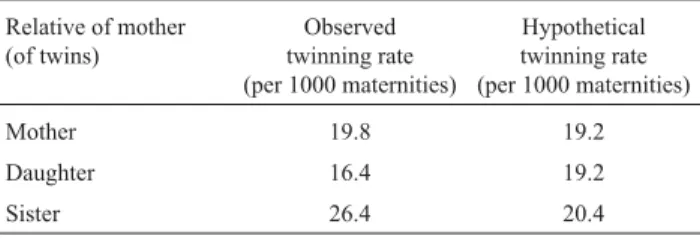
Bulmer used data from various sources including his own collection and tables published by Weinberg in 1901 and 1909 from family registers in Stuttgart relating to Württemberg. However he did not refer to Weinberg (1908) which gives twinning rates in various categories. Some of these are given in Table 2 where they have been converted to rates per thousand maternities. The hypotheti-cal rates are for the model of recessive inheritance preferred by Weinberg and can be obtained from formulae (5) and (6) by settinga= 0 andb= 0 and inserting estimated values ofq and twinning rates from observed twinning rates. Weinberg inferredq= 1/2. Twinning fractions of 1/32.5 for high pensity mothers and 1/130 for the remaining mothers pro-duce hypothetical rates close to Weinberg’s values which are given in the third column of Table 2.
The final paragraphs of the translation of Weinberg’s (1908) paper are:
“The situation found in the inheritance of twinning best finds its explanation in the assumption that the trait for twinning is inherited according to the Mendelian rule and is recessive.
This investigation (a more thorough presentation based on a new collection of material that I have in the meantime obtained from another source will follow) may show that one can gain an insight into the nature of human inheritance by suitable changes in the investigative meth-ods”.
Weinberg’s analysis of twinning rates depended on the assumption of random mating used to construct the mat-ing matrix. Li’s model shows that HWP can be found in the general population with non-random mating. Formulae (3) - (6) show that the values of parametersaandbare required to calculate hypothetical twinning rates, for comparison with observed rates. Weinberg’s analysis exploited the fact
that sibs may have zero, one or two genes at a locus identi-cal by descent whereas parent and child have one. However the mating system has bearing on the probabilities of the re-spective events. This needs to be taken into account when making inferences about the mode of inheritance of a trait.
References
Bulmer MG (1970) The Biology of Twinning in Man. Clarendon Press, Oxford, 205 pp.
Castle WE (1903) The laws of Galton and Mendel and some laws governing race improvement by selection. Proc Amer Acad Arts Sci 39:233-242.
Cotterman CW (1940) A calculus for statistico-genetics. PhD Thesis, Graduate School of The Ohio State University. In: Ballonoff PA (ed) Genetics and Social Structure: Mathemat-ical Structuralism in Population Genetics and Social Theory. Dowden, Hutchinson & Ross, Inc., Stroudsburg, pp 157-271.
Crow JF (1988) Eighty years ago: The beginnings of population genetics. Genetics 119:473-476.
Crow JF (1999) Hardy, Weinberg and language impediments. Ge-netics 152:821-825.
Dobzhansky T (1998) The birth of the genetic theory of evolution in the Soviet Union in the 1920’s. In: Mayr E and Provine WB (eds) The Evolutionary Synthesis: Perspectives on the Unification of Biology. Harvard University Press, Cam-bridge, Massachusetts and London pp 229-242.
Fisher RA (1940) The precision of discriminant functions. Ann Eugen Lond 10:422-429.
Hancock JF (2004) Plant Evolution and the Origin of Crop Spe-cies. 2nd edition. CABI Publishing, Wallingford, Oxford-shire and Cambridge, MA, 313 pp.
Hardy GH (1908) Mendelian proportions in a mixed population. Science 28:49-50.
Hirschfeld HO (1935) A connection between correlation and con-tingency. Proc Camb Phil Soc 31:520-524.
Lancaster HO (1969) The Chi-Squared Distribution. John Wiley & Sons, Inc., New York, 356 pp.
Li CC (1988) Pseudo-random mating populations. In celebration of the 80thanniversary of the Hardy-Weinberg law. Genetics 119:731-737.
Malécot G (1948) Les Mathématiques de l’Hérédité. Masson et Cie, Paris, 60 pp.
Maung K (1942) Measurement of association in a contingency ta-ble with special reference to the pigmentation of hair and eye colours of Scottish school children. Ann Eugen Lond 11:189-223.
Schmalhausen II (1986) Factors of Evolution: The Theory of Sta-bilizing Selection. The University of Chicago Press, Chi-cago and London, 327 pp.
Stark AE (1977a) Models of correlation between mates and rela-tives and some applications. Unpublished Ph.D. Thesis, School of Community Medicine, The University of New South Wales.
Stark AE (1977b) Dwa uogólnienia prawa Hardy’ego-Weinberga w genetyce populacji (The Hardy-Weinberg Law of Popula-tion Genetics and two GeneralizaPopula-tions). Matematyka Stosowana IX:123-137.
Stark AE (1980) Inbreeding systems: Classification by a canoni-cal form. J Math Biol 10:305.
Table 2- Weinberg’s observed and hypothetical twinning rates.
Relative of mother (of twins)
Observed twinning rate (per 1000 maternities)
Hypothetical twinning rate (per 1000 maternities)
Mother 19.8 19.2
Daughter 16.4 19.2
Stark AE (2005) The Hardy-Weinberg principle. Genet Mol Biol 28:485-485.
Stark AE (2006) A clarification of the Hardy-Weinberg law. Ge-netics, in press.
Stern C (1943) The Hardy-Weinberg law. Science 97:137-138. Weinberg W (1908) Über den Nachweis der Vererbung beim
Menschen. Jahresh Verein f vaterl Naturk Württem 64:368-382. English version: On the demonstration of heredity in Man. In: Boyer SH (ed) Papers on Human Genetics, Prentice-Hall, Englewood Cliffs, pp 4-15.
Wentworth EN and Remick BL (1916) Some breeding properties of the generalized Mendelian population. Genetics 1:608-616.
Wright S (1967) The foundations of population genetics. In: Brink RA and Styles ED (eds) Heritage from Mendel. The University of Wisconsin Press, Madison and London, pp 245-263.
Yule GU (1902) Mendel’s laws and their probable relation to intraracial heredity. New Phytol 1:193-207, 222-238.