GROWTH AND YIELD PREDICTION USING THE MODIFIED BUCKMAN
MODEL¹
Antonilmar Lopes da Silva2, João Carlos Chagas Campos3, Helio Garcia Leite3, Agostinho Lopes de Souza3 e Pablo Falco Lopes4
ABSTRACT – A model to manage even-aged stands was developed using a modification of the Buckman model. Data from Eucalyptus urophylla and Eucalyptus cloeziana stands located in the Northern region of Minas Gerais State, Brazil were used in the formulation of the system. The proposed model generated precise and unbiased estimates in non-thinned stands.
Keywords: Buckman model, growth and yield, basal area growth.
PREDIÇÃO DE CRESCIMENTO E PRODUÇÃO USANDO O MODELO
BUCKMAN MODIFICADO
RESUMO – Desenvolveu-se um modelo para o manejo de florestas equiâneas usando-se uma modificação do modelo de Buckman. Foram utilizados na formulação do sistema dados provenientes de povoamentos de Eucalyptus urophylla e Eucalyptus cloeziana localizados na região Norte do Estado de Minas Gerais, Brasil. O modelo proposto gerou estimativas precisas e não tendenciosas para povoamentos não desbastados.
Palavras chaves: modelo Buckman, crescimento e produção, crescimento de área basal.
1 Recebido em 13.07.2005 e aceito para publicação em 05.04.2006.
2 Veracel Celulose e Papel, Eunápolis, Bahia State, Brazil.
3 Departamento de Engenharia Florestal da Universidade Federal de Viçosa, Viçosa, Minas Gerais State, Brazil. E-mail:<[email protected]>. 4 Forest engineering graduate student, Universidade Federal de Viçosa. Viçosa, Minas Gerais State, Brazil.E-mail: <[email protected]>.
1. INTRODUCTION
One of the three essential elements of forest management is prognosis, that is, growth and yield prediction. Forests cannot be managed without proper information on the future availability of wood and/ or sub-products. Such information is obtained by growth and yield models.
Buckman (1962) and Clutter (1963) were the first researchers to explain the mathematical relationships between growth and yield. Clutter derived compatible models for growth and yield in cubic volume of Pinus taeda, ensuring that the algebraic form of the yield
model could be derived by the mathematical integration of the growth model. Later, Sullivan and Clutter (1972) perfected this model, resulting simultaneously in yield
and accumulated growth estimates, as a function of an initial age, projected age, site index and basal area. A model to estimate the yield, using age, site index, Reineke index and a competition index as independent variables was fitted to natural Pinus taeda plantations
by MacKinney and Chaiken (1939). According to Avery and Burkhart (1994) many researchers have since used multiple regression techniques to predict growth and yield for total plantations or for some commercial portion of the plantation.
Buckman (1962) worked with periodic growth data from Pinus and used the following regression model
to estimate the basal area growth rate in function of age, basal area and the site index: dV=β0+ β1B+β2B2+ β3I+ β4I2+ β
of the basal area, B = basal area, I = age and, and S = site index.
The author then substituted the basal area growth estimated by the equation derived from the previous model, and the height growth, in a differential form from a plantation volume equation, represented by
V = f(k,B,Hd) where V is the volume, k a constant
representing the mean form of the trees in the plantation, and Hd is the dominant height in the plantation. Summing
the results, the author obtained estimates of net accumulated yield for several combinations of independent variables.
Later, Clutter (1963) formalized the relationships necessary between growth and yield observed in the Buckman model and developed equations to express net volume and growth rate of the basal area as function of age, from the site index and the plantation density, by differentiation of the yield function. Sullivan and Clutter (1972) refined this technique, estimating the cumulative yield and the growth as a function of the initial age of the plantation, the initial basal area of the site index and future age.
Several studies were carried out after 1972, including those by Beck and Della-Bianca (1972), Burkhart and Sprinz (1984), Trevizol Jr. (1985), Resende (1991) Campos et al. (1996) among many others, showing the flexibility of the Buckman model. In spite of this, the model has not been used in Brazil. In this country, the growth and yield modeling have always been conducted using the Clutter model (CAMPOS e LEITE, 2002).
This study was carried out with the objective of proving the efficiency of this model in predicting growth and yield in eucalyptus plantations in Brazil. For greater efficiency, a modification of the model is presented and fitted to Eucalyptus urophylla and Eucalyptus cloeziana plantations located in the northern region
of Minas Gerais State, Brazil.
2. MATERIAL AND METHODS
2.1. Data used in the growth and yield study.
The data used in this study were provided from
Eucalyptus urophylla and Eucalyptus cloeziana
plantation located in the northern region of Minas Gerais State. Two data sets were used from a research project implemented in 1988 by the Forest Research Society - SIF (Sociedade de Investigações Florestais) of the
Federal University of Viçosa, Minas Gerais, Brazil. Each set consists of two groups of 30 permanent 500 m2 plots measured at ages ranging from 28 to 96 months. When the project was established, the variations in site quality were considered and the initial spacing was 3.0 x 1.5 m. On each occasion the following parameters were measured: the diameter at 1.30 m (dbh) of all the
trees, the total height of the trees of the first row of each plot and the total height of ten dominant trees. Data from 225 sample trees (130 Eucalyptus urophylla and 95 Eucalyptus cloeziana trees) were
used to fit the volumetric model. These trees were felled and cubed using the Smalian formula, with 1.0 m long sections and included diameters between 4 and 18 cm and total heights between 5 and 24 m.
2.2. Site quality, height and volume per tree
The site quality was determined using the guide-curve method (CAMPOS e LEITE, 2006) and Chapman-Richards model, employing the following expression:
where Hd = heights of dominant trees, m, A = age in
months and β0, β1, β2 = parameters, Ai = index age
= 66 months.
The following models were fitted to estimate the total heights per tree:
where Ht = total height, S= site index, and βI, dbh, A and ε as previously defined.
The volumetric model proposed by Leite et al. (1995) was fitted to quantify the volume per tree. The coefficient of determination and the graphic analyses of the residues were the statistics used to assess the estimates generated by all the equations fitted in this study.
2.3. Growth and Yield model
After obtaining the totalized plots, the model
was fitted, where dB = net periodic increase of the
basal area, m2ha-1, B
1= basal area at initial age, m 2ha-1,
A ,S, Ln and βi as previously defined.
of the Schumacher model. Here the variable was included in the model based on results from some preliminary adjustments.
The yield in basal area (B) was obtained by the
sum of the successive increases, that is, for an interval of ages A1 and A2,
, where B = basal area,
m2ha-1, A
1 and A2 = age 1 and age 2, in months,
C=β0+β2S+β4Lnβ1.
After obtaining the estimates of basal area increase and the height and yield capacity, the model suggested by Schumacher (1939) was used to predict the volume
obtained where
V = volume, in m3ha-1, β0, β1, β2, β3 = parameters to
be estimated, and A, B and S as previously defined.
3. RESULTS AND DISCUSSION
The site quality was classified using the independent equations for the two species, using an age index (Ai)
equal to 66 months, and the following equations were obtained, respectively, for Eucalyptus cloeziana and Eucalyptus urophylla:
with , Y = Hd,
with
The model fitted to estimate the total height, resulted in the following equations:
with R2 = 0.944 and SYX = 0.95 m, for Eucalyptus cloeziana, and
with R2 = 0.910 and S
YX = 0.97 m, for Eucalyptus urophylla.
These equations do not ensure meeting of the biological phenomenon involved, but they were efficient quantitatively for the height estimates and are useful when the mechanistic models do not apply.
The multiple volume equations obtained from the two species did not reveal bias in the estimates, proving their efficiency:
Eucalyptus cloeziana and dbh ≤ 10 cm:
, dbh ≤ 10 cm,
Eucalyptus cloeziana and dbh > 10 cm:
, dbh > 10 cm,
Eucalyptus urophyllaanddbh ≤ 12 cm:
,dbh ≤ 12 cm,
Eucalyptus urophyllaanddbh > 12 cm:
,dbh > 12 cm,
where V = volume in m3, dbh = diameter outside bark in cm measured at 1.30 m, k = dummy variable, where k = 0 volume outside bark and k = 1 volume inside
bark, and du = commercial superior diameter, outside
bark, in cm.
to the mean point of the measurement interval of one year. For this purpose the following equations were generated:
(1), withR2= 0.450, for Eucalyptus urophylla, and
(2), with R2 = 0.710, for Eucalyptus cloeziana.
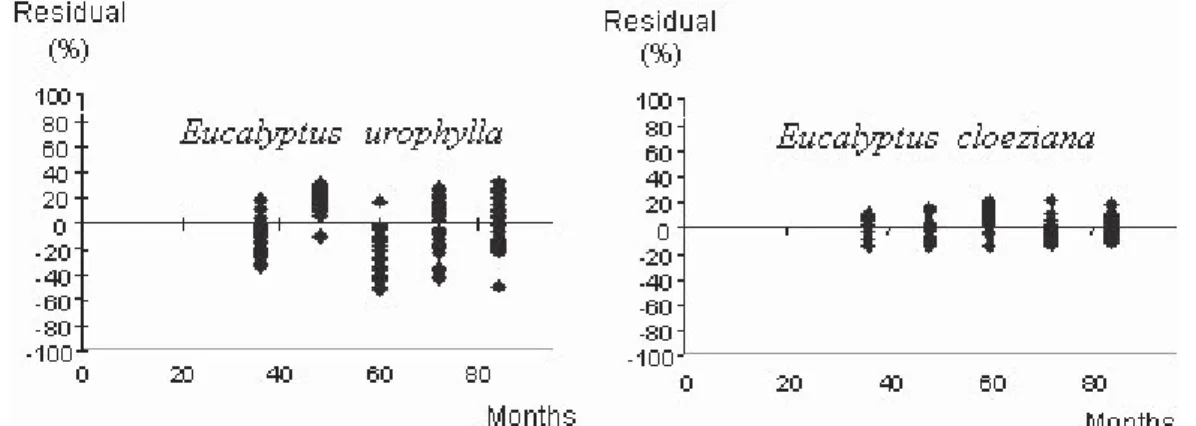
This model fitted best the basal area increase data. All the independent variables were significant at 1% probability. The inclusion of the age variable twice in the model eliminated an undesirable tendency ascertained when using the model in its original form, and despite a “low” R2, the distribution of the percentage residues can be considered acceptable (Figure 1).
The basal area yield can be obtained from the sum of the basal area increases by differential equations, or by approximations of a table of basal area growth, or by repeated solution of the basal area growth function. It can be written that (3)
and (4) for, respectively,
Eucalyptus urophylla and Eucalyptus cloeziana, where dB is the basal area growth, B the yield in basal area, dB/dA the change in the basal area with age, and C
a constant that contains the terms S (site index), LnB1
(logarithm of the initial basal area) and the β0 value (intercept). Integration of the growth equations generates the yield function.
If a function f(x) is continuous in an interval [a,b]
its primitive F(x) can be known, corresponding to the integral defined of this function, in this interval. Thus:
(5) In the case of this study, the primitive value of F(x) is not known or easily obtained. Thus, to calculate the value of the defined f(x) integral, a numerical method
had to be used. The Newton-Cortes formulas were used that employed f(x) values, where the x values
were equally spaced (monthly values). Specifically among the Newton-Cortes formulas the compound formula of the 1st Simpson rule was used (BARROSO et al., 1982). This rule is obtained by approximating the function f(x) by a 2nd degree interpoled polynomial.
Thus and
Developing this integral, we obtain
(6), which is the 1st Simpson rule. To obtain the compound formula, the integration interval [a,b] should be divided into n equal subintervals of h amplitude and the 1st
Simpson rule should be applied to each pair of subintervals. Thus, it follows that
, xi; i = 0, 1, 2,...,n,
(7)
Figure 1 – Distribution of percent residues of the basal area increase estimates.
Applying the Simpson rule to the growth function in Eucalyptus urophylla basal area,
was obtained and B is
the yield in basal area (m2ha-1) in the interval [a,b], and C is the constant that contains β0+β2S+β4LnB1.
For example, when considering the interval a = 30 months and b = 42 months, a site index of 13 and an initial basal area (at 30 months) of 4.52331, we have
The first subinterval y0 for age 30 months is
The second subinterval y1 for 31 months is
The last subinterval yn for age 42 months is
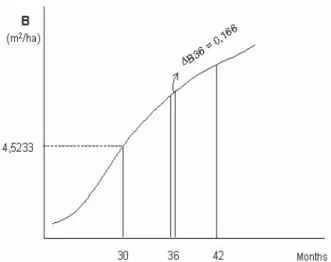
Applying the subinterval values (12 months) in equation 7, we obtain (α1), which is a yield in basal area at the interval 30 to 42 months. The possibility of integrating the growth functions allows proof of the compatibility between growth and yield. The sum of the basal area increases obtained at various subintervals of the interval [a,b] is equal to the integral of the growth function at this same interval. The second method of sum of the basal area increases results in the growth of the mean point of a determined interval (Figure 2).
The yield in basal area at the interval [30,42] is obtained by multiplying the number of subintervals (12 months) by the growth obtained from the growth curve (equation 1) for example, for site index S = 13
and initial basal area B1 = 4.5233 at the mean point
of the interval. The growth in basal area at 36 months is dB=0.166 and the yield in basal area in the period
[30, 42] is 1.99 m2ha-1 (α 2).
The third method to obtain yield in basal area consists of repeated solutions of the growth in basal area function. This method involves the solution of the growth equation for a determined site index, age and plantation density. The growth is then added to the initial density of the
plantation, one month is added to the age and the equation is solved again. For example, for the same site index, 13, considering equation 1 of basal area growth of 4.5233 and age ranging from 30 to 42 months, yield is obtained by repeated solutions. In this case, the yield in basal area in the 12 month period is 6.4640 – 4.5233 – 1.94 m2ha-1 (α
3).
The comparison of the results of the three methods, for the site index 13 and initial basal area of 4.5233 m2ha-1 (α
1, α2 and α3) shows that the difference among them was small. Although not presented, the difference was even less for higher ages, within the interval studied. Therefore, any one of these methods can be used to estimate the basal area growth.
After obtaining the yield in basal area, the yield and growth in volume with bark can be estimated to build the yield table. The equations of plantation volume fitted with yield data as a function of the site index (S) age (I) and basal area (B) for Eucalyptus urophylla
and Eucalyptus cloeziana were, respectively
(8) (9) With determination coefficients 0.998 and 0.998.
Figure 2 – Growth in basal area at the mean point of the
30 to 42 month interval (dB36) for Eucalyptus urophylla, site index 13 and initial basal area of 4.5233m2ha-1.
The increase in volume is obtained by deriving equation 8, for age, that is
(10)
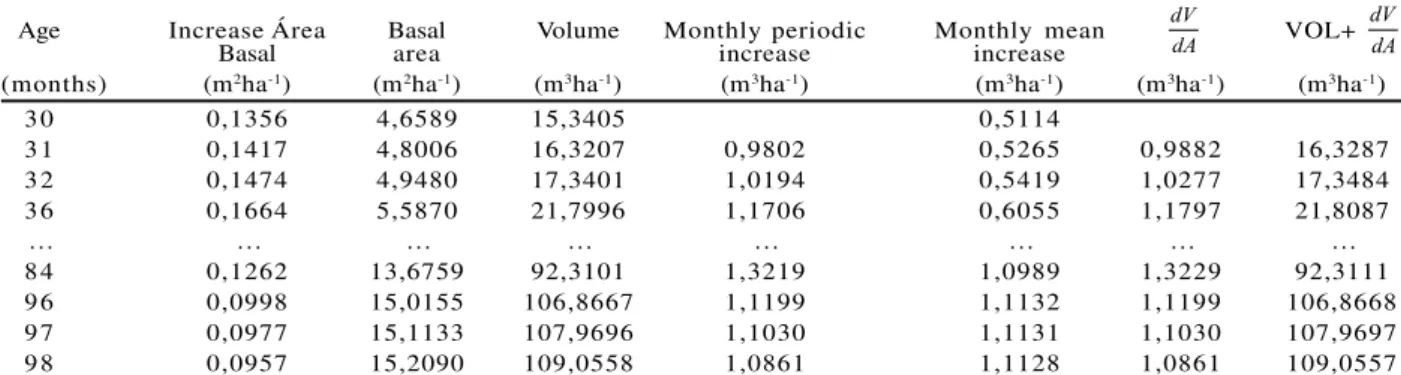
(11) The yield tables or curves are obtained by the calculation of the increase and yield in basal area and the growth and yield in volume, as shown in Table 1, for some ages. In this table, the increase in basal area obtained from equation 1 is shown in column 2. The method of obtaining yield in basal area by repeated
solutions results in the total basal area (column 3). Replacing the total basal area in equation 8, yield in volume is obtained (column 4). The felling age, from the point of view of mean yield, occurs when the mean monthly increase (column 6) is maximum and equal to the monthly periodic increase (column 5) in the example, 96 months. Finally increase in volume can be obtained, using equation 11 (column 7) and summing the increases in volume, the yield in volume is obtained (column 8). No type of tendentiousness was observed in the growth and yield estimates and they can be considered precise (Figure 3).
Age Increase Área Basal Volume Monthly periodic Monthly mean VOL+
Basal area increase increase
(months) (m2ha-1) (m2ha-1) (m3ha-1) (m3ha-1) (m3ha-1) (m3ha-1) (m3ha-1)
3 0 0,1356 4,6589 15,3405 0,5114
3 1 0,1417 4,8006 16,3207 0,9802 0,5265 0,9882 16,3287
3 2 0,1474 4,9480 17,3401 1,0194 0,5419 1,0277 17,3484
3 6 0,1664 5,5870 21,7996 1,1706 0,6055 1,1797 21,8087
… … … …
8 4 0,1262 13,6759 92,3101 1,3219 1,0989 1,3229 92,3111
9 6 0,0998 15,0155 106,8667 1,1199 1,1132 1,1199 106,8668
9 7 0,0977 15,1133 107,9696 1,1030 1,1131 1,1030 107,9697
9 8 0,0957 15,2090 109,0558 1,0861 1,1128 1,0861 109,0557
Table 1 – Table of variable density yield for Eucalyptus urophylla in the Northern Region of Minas Gerais State, Brazil, with initial basal area of 4.5233 m2ha-1 and site index 13
Tabela 1 – Tabela de produção de densidade variável de Eucalyptus urophylla, na região de Montes Claros, Minas Gerais, com área basal inicial de 4,523 m2ha-1 e índice de local 13
Figure 3 – Distribution of observed and estimated volume residues for Eucalyptus urophylla and Eucalyptus cloeziana projected by the growth and yield model.
4. CONCLUSIONS
The Buckman model, modified in this study, results in unbiased estimates and is indicated to estimate the present and future growth and yield of eucalypt plantations. Three alternatives for estimating the growth in basal area are presented, all of which are efficient.
5. REFERENCES
AVERY, T.E.; BURKHART, H.E. Forest
measurements. 4.ed. New York: McGraw-Hill
Book Co, 1994. 408 p.
BARROSO, L.C. et al. Cálculo numérico. 2.ed. Belo Horizonte: Harbra, 1982. 180 p.
BECK, D.E.; DELLA-BIANCA, L. Growth and yield of thinned yellow-poplar. Asheville: USFS,1972. 20 p. (Res.Paper SE-101).
BUCKMAN, R.E. Growth and yield of red pine in Minnesota. Washington: U.S. Department Agriculture, 1962. 50 p. (Technical Bulletin, 1272).
BURKHART, H.E.; SPRINZ, P.T. Compatible cubic volume and basal area projection equations for thinned old-field loblolly pine plantations.
Forest Science, v. 30, n. 1, p. 86-93, 1984.
CAMPOS, J.C.C.; LEITE, H.G. Mensuração florestal: perguntas e respostas. Viçosa, MG: Editora UFV, 2006. 470 p.
CAMPOS, J.C.C.; ROSAS, M.P.; LEITE, H.G. Comparação de alternativas de determinação da idade técnica de corte em plantações de eucalipto.
Revista Árvore, v. 20, n. 1, p. 37-49, 1996.
CLUTTER, J.L. Compatible growth and yield models for loblolly pine. Forest Science, v. 9, n. 4, p. 354-371, 1963.
LEITE, H.G.; GUIMARÃES, D.P.; CAMPOS, J.C.C. Descrição e emprego de um modelo para estimar múltiplos volumes de árvores. Revista
Árvore, v. 19, n. 1, p. 65-79, 1995.
MACKINNEY, A.L.; CHAIKEN, L.E. Volume, yield and growth of loblolly pine in
the mid-atlantic coastal region.
Washington: USDA Forest Service, 1939. 30p. (Technology Note,33).
RESENDE, R.R. Emprego de um modelo de crescimento e produção para determinação da rotação em
povoamento de eucalipto. 1991. 81 f.
Dissertação (Mestrado em Ciência Florestal) – Universidade Federal de Viçosa, Viçosa, MG.
SCHUMACHER, F.X. A new grouth curve and its application to timber – yield. Journal Forestry, v. 37, p. 817-820, 1939.
SULLIVAN, A.D.; CLUTTER, J.L. A simultaneaous growth and yield model for loblolly pine. Forest Science, v. 18, p. 76-86, 1972.
TREVIZOL Jr, T.L. Análise de um modelo compatível de crescimento e produção em plantações de Eucalyptus grandis
(W. Hill ex Maiden). 1985. 74 f. Dissertação