Effe ct o f die tary lino le ic acid o n the
pro gre ssio n o f chro nic re nal failure
in rats
1Divisão de Nefrologia, Universidade Estadual do Rio de Janeiro,
Rio de Janeiro, RJ, Brasil
2Divisão de Patologia, Universidade Federal Fluminense, Niterói,
RJ, Brasil S.M.P. Gregório2,
C.C.S. Lemos1,
M.L. Caldas2 and
R. Bregman1
Abstract
The role of linoleic acid in chronic renal failure (CRF) is controversial. In the present study 21 male Wistar rats submitted to 5/6 renal mass reduction (R) and 16 normal controls (C) were fed a supplement (S) or normal (N) linoleic acid diet for 60 days starting 10 days after CRF. As expected, serum creatinine, cholesterol and triglycerides (mean ± SEM) were higher in the CRF groups compared to the C groups (P<0.05). The RS group presented lower cholesterol (84 ± 4 vs 126 ±
13 mg%) and triglyceride (88 ± 9 vs 132 ± 19 mg%) levels compared
to the RN group. Proteinuria and kidney weight did not differ between CRF groups. Glomerular area increased 78% in RS and 100% in RN compared to control rats. Glomerular sclerosis index tended to be lower in RS (27%) compared to RN (38%), tubulointerstitial damage was similar between CRF groups (RS = 1.91 ± 0.2 and RN = 2.14 ± 0.3), and mesangial fractional volume increased to the same extent in both CRF groups. The data suggest that a linoleic acid-enriched diet did not protect against the progression of CRF after 60 days.
Co rre spo nde nce
R. Bregman
Rua Soares Cabral, 71/401 22240-070 Rio de Janeiro, RJ Brasil
Fax: + 55-21-587-6250 E-mail: bregmanr@ uol.com.br
Received August 27, 2001 Accepted March 6, 2002
Ke y wo rds
·Chronic kidney failure ·Diet
·Glomeruli ·Linoleic acid
Intro ductio n
In the 1980's, the diet started to be consid-ered the factor that would solve almost all problems related to the progression of chronic renal failure (CRF) (1). The protein diet has been extensively studied, together with some other dietary components. Lipids and pre-cursors of some autacoids like prostaglan-dins and leukotrienes have also been impli-cated in the progression of CRF (2-4). Di-etary prostaglandin precursors are different in different parts of the world. Linoleic acid, common in the western diet, and eicosapen-tanoic acid, common in the diet of inhabit-ants of the far north, are examples of this
difference. Many studies have compared these two sources of prostaglandins (those from dienoic series with those of trienoic series) but with inconclusive results (5-7). Studies using different experimental models such as a 5/6 reduction of renal mass, lupus nephritis, and immunologic glomerulonephri-tis have suggested that increases in vasodila-tory prostaglandins could retard the progres-sion of CRF (8-10).
and thromboxanes are cyclic derivatives of polyunsaturated fatty acids (PUFAs) (15-17). Linoleic acid is an essential fatty acid ingested at the rate of approximately 10 g per day, and is the most abundant fatty acid in western diets. It is present in many vegetable oils and is the precursor of arachidonic acid. Some beneficial effects of PUFAs, espe-cially linoleic acid, are related to the reduc-tion of blood pressure (18,19), platelet aggregability and blood viscosity (2,5). Subtotally nephrectomized rats fed a low linoleic acid diet had progressive deteriora-tion of renal funcdeteriora-tion. By contrast, those fed the high linoleic acid diet had better preser-vation of renal function with less proteinuria and glomerular sclerosis (20,21), and also an increase in the renal content of arachidonic acid (22). Other investigators have shown that rats with CRF fed a linoleic acid-en-riched diet had an increase in proteinuria and glomerular sclerosis index (GSI), and also a worsened progression of CRF (23).
The role of linoleic acid in the diet of animals with CRF has not been established regarding the progression of CRF, despite the studies published in the last years (1,9,13,22). Thus, the objective of the pres-ent investigation was to study the effects of a high and low linoleic acid content in the diet on the progression of CRF.
Mate rial and Me tho ds
Male Wistar rats weighing 200 to 250 g at the beginning of the study were used. Ani-mals were divided into two groups: controls (C) and animals submitted to 5/6 reduction (R) of total renal mass. Reduction of renal mass was performed by partial left nephrec-tomy, with an abdominal incision under ether anesthesia. The renal artery was isolated and two or three branches were ligated. Right nephrectomy was then performed immedi-ately through a lumbar incision. This proce-dure was performed on day 0, and the ani-mals were maintained on a regular diet until
the 10th day after surgery, when they started to receive the experimental diets. Control animals also started to receive the experi-mental diets at the same time as the CRF groups.
D ie ts
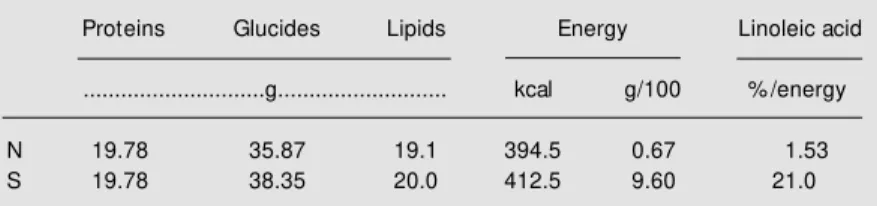
Each group was divided into two groups fed the experimental diet containing linoleic acid as 1.5% (normal, N) or 21% (supple-ment, S) of the total caloric intake for 61 days. Throughout the study, the animals were
pair-fed (CN vs CS and RN vs RS). At the
beginning of the study, animals were paired according to body weight and food con-sumption. Body weight and food consump-tion were determined daily throughout the study. Diets were elaborated in the Experi-mental Laboratory of the Faculty of Nutri-tion, Federal Fluminense University, Rio de Janeiro, RJ, Brazil, using an adaptation of the model of Tobian et al. (24). The diet
consisted of 80% of standard Purina®
rodent chow (Campinas, SP, Brazil), which was ground to a powder, and 20% soy oil or butter, with water added to form a paste. The diet was homogenized with an industrial mixer (Hobart), transformed into pellets and dried in an oven (Fabber Primar). After dry-ing, the diets were identified and stored un-der refrigeration. All ingredients were weighed on a digital electronic scale.
A sample of each diet was analyzed for linoleic acid content by the Brazilian Com-pany of Agriculture and Stock Raising Re-search (EMBRAPA). The result showed that the S diet had nine times more linoleic acid than the N diet. The basic composi-tion of the standard chow from Labina/
Purina®
, according to the manufacturer, con-tains corn, wheat bran, soy bran, meat meal, raw rice meal, calcium carbonate, bicalcium phosphate, and salt.
Gro ups
The following groups were studied: con-trol group fed the diet with normal linoleic acid content (CN, N = 9), CRF group fed the diet with normal linoleic acid content (RN, N = 10), control group fed the linoleic acid-rich diet (CS, N = 7), and CRF group fed the linoleic acid-rich diet (RS, N = 11). On days 21, 41 and 61 after starting the specific diets, 24-h proteinuria was determined. Urine was collected in metabolic cages, where the
ani-mals were kept only with water ad libitum.
Blood was collected at the end of the study to measure serum creatinine, cholesterol and triglycerides.
Mo rpho lo gy
At the end of the study, the kidneys were perfused with 1.25% glutaraldehyde in so-dium phosphate buffer, pH 7.4. Kidney frag-ments were fixed, and 3-4-µm sections were stained with periodic acid-Schiff. Glomeru-lar area was determined after measuring the glomerular diameter with a caliper mounted on the eyepiece. The reported glomerular area is the mean of 25 measurements. The GSI was determined by measuring the fre-quency of sclerosis in 100 glomeruli from each animal as described by Raij et al. (26), and the result is reported as the median. A score of 0 to 4+ was assigned to each glo-merulus according to the extent of sclerosis: normal glomerulus, 0; up to 25%
involve-ment, 1+; up to 50% involveinvolve-ment, 2+; up to 75% involvement, 3+; more than 75% in-volvement, 4+. The GSI score for each ani-mal was the sum of individual glomerular scores multiplied by the percent of glomeruli with the same score. Tubulointerstitial dam-age was evaluated as described by Shih et al. (27). Briefly, cortical involvement was ex-amined and graded according to a 0 to 4 scale (0 = normal, 0.5 = small focal areas of cellular infiltration and tubular damage, 1 = involvement of less than 10% of the cortex, 2 = involvement up to 25% of the cortex, 3 = involvement up to 50 to 75% of the cortex, and 4 = involvement greater than 75%). Additionally, mesangial fractional volume (Vv) was measured in ten glomeruli from each animal using the M42 test-system grid; Vv was estimated by counting the number of points falling on mesangium (pMes), includ-ing its matrix and cellular components, usinclud-ing Vv = pMes x 100/42 (28).
Analytical pro ce dure s
Serum creatinine, cholesterol and triglyc-erides were determined with an autoanalyzer in the Central Laboratory of the Pedro Ernesto Hospital. Proteinuria was determined using the sulfosalicylic acid method.
Statistical analysis
Data are reported as means ± SEM, and medians were compared by analysis of vari-ance. The difference between groups was determined by the Duncan test. The
Mann-Table 1. Estimated centesimal chemistry of the diets.
Proteins Glucides Lipids Energy Linoleic acid
...g... kcal g/100 % /energy
N 19.78 35.87 19.1 394.5 0.67 1.53
S 19.78 38.35 20.0 412.5 9.60 21.0
Whitney test was used to compare GSI data. The differences were considered to be
statis-tically significant if P£0.05.
Re sults
Body weights after surgery on the day the animals began the specific diet were: CS =
323 ± 8, CN = 317 ± 6, RS = 258 ± 12, and RN = 231 ± 11 g, and at the end of the study were CS = 387 ± 10, CN = 367 ± 7, RS = 317 ± 15, and RN = 282 ± 14 g. C groups were different from the respective R groups (P<0.001). Mean serum creatinine values were: CS = 0.65 ± 0.06, CN = 0.69 ± 0.03, RS = 1.44 ± 0.12, and RN = 1.80 ± 0.42 mg%. The CRF groups presented higher creatinine values (P<0.05), and RN tended to be higher than RS. Cholesterol values were higher in the CRF groups compared to their respective controls after 61 days (Fig-ure 1). The RN group showed higher serum lipid levels compared to RS (P<0.05). Val-ues for proteinuria were higher in the CRF groups after 21, 41 and 61 days (P<0.05) except for RS compared to CS after 21 days (Figure 2). Values for kidney weight: CS = 1.41 ± 0.09, CN = 1.19 ± 0.06, RS = 1.44 ± 0.08, and RN = 1.13 ± 0.06 g, were not statistically different among groups. Values for glomerular area, GSI, and tubulointersti-tial damage were higher in CRF groups com-pared to the respective controls, but were not
significantlydifferent among them.
Mesan-gial fractional volume was not different among the groups studied (Table 2).
D iscussio n
The diets were isocaloric and all groups showed the same percentage of increase in body weight, suggesting that the diet was adequate.
Animals fed a normal linoleic acid diet showed a worse lipid profile when com-pared to those fed a high linoleic acid diet. Disturbance of lipid metabolism, a charac-teristic of CRF (29,30), has been associated with the development of glomerular sclero-sis, and consequently with the progression of CRF (31,32). The mechanisms whereby lipids contribute to renal injury are incom-pletely understood. The PUFAs of the n-6 and n-3 series have beneficial effects on plasma lipids. Those of the n-6 series are
C
ho
le
st
er
ol
o
r
tr
ig
ly
ce
rid
es
(m
g/
dl
)
140
CS CN RS RN
Chol Tri
120
100
80 60
40
20
0 Figure 1. Effect of linoleic acid
dietary supplement on serum cholesterol (Chol) and triglyceri-des (Tri) 61 days after renal mass reduction. For group abbrevia-tions, see legend to Table 2. +P< 0.05 com pared t o CS; * P< 0.05 com pared t o CN (Duncan test).
U
rin
ar
y
pr
ot
ei
n
(m
g/
24
h
) 50
40
30
20
10
0
CS CN RS RN
PTN 21 PTN 41 PTN 61
+ +
*
* Figure 2. Effect of linoleic acid
dietary supplement on proteinu-ria (PTN) 21, 41 and 61 days af-ter renal mass reduction. For group abbreviations see legend to Table 2. +P<0.05 compared to CS; * P<0.05 compared to CN (Duncan test).
Table 2. Effect of linoleic acid dietary supplement on kidney morphology after mass reduction.
CS CN RS RN
N = 7 N = 7 N = 6 N = 7
GA (µm2 x 103) 11 ± 0.8 9.6 ± 0.4 19 ± 1.1+ 20 ± 0.4*
GSI 0 0 36 (3-112) 22 (21-103)
TID 0 0 1.9 ± 0.2 2.1 ± 0.3
Vv (% ) 62 ± 2.6 64 ± 1.7 62 ± 0.7 63 ± 2.1
GA = glomerular area, GSI = glomerular sclerosis index, TID = tubulointerstitial dam-age, Vv = mesangial fractional volume, C = control, R = 5/6 renal mass reduction, S = linoleic acid-rich diet, N = normal linoleic acid diet. Data are reported as means + SEM or as medians. +P<0.02 compared to CS; * P<0.02 compared to CN (Duncan test for all parameters and M ann-Whitney for GSI).
*
+
+ *
more effective in reducing cholesterol (23) whereas those of the n-3 series exert their main effect on triglycerides and their effect on lipoproteins has been questioned (33). It has also been suggested that PUFAs improve renal lesions not by reducing the serum lev-els of lipoproteins, but by modifying lipo-protein composition, their deposition within the glomeruli or the cholesterol or ester com-position in the tissues (20,34-36).
A marked increase in proteinuria was observed in both CRF groups, suggesting that glomerular selectivity was compromised to the same extent in both groups. Some studies have shown that dietary supplemen-tation with PUFAs reduces proteinuria and prevents functional deterioration in immune complex glomerulonephritis, and in genetic systemic lupus erythematosus (2,3,8). Di-etary supplementation by linoleic acid pre-vented functional deterioration after subto-tal nephrectomy in rats (37). Heifets et al. (22) showed that a linoleic acid-enriched diet fed to female rats with CRF led to an increase in glomerular filtration rate when compared with rats fed a low linoleic acid diet. Additionally, they showed better levels of arterial pressure and proteinuria. It has been suggested that PUFAs of the n-6 series may reduce the deterioration of renal func-tion and the glomerular sclerosis of rats with CRF (20,21,30). Conversely, Brown et al. (38) found that in dogs with CRF, supple-mentation with omega 6 PUFA enhanced renal injury, and supplementation with omega 3 was renoprotective. In a study evaluating partially nephrectomized rats fed a high lin-oleic acid diet (21), protection of renal func-tion was demonstrated, but both groups de-veloped proteinuria. However, proteinuria occurred later and was significantly less se-vere in rats fed the high linoleic acid diet. Serum cholesterol and triglycerides were not different between groups. Protection of the renal architecture was also demonstrated in CRF rats fed the high linoleic acid diet. The authors suggested that evolution of CRF could
be prevented by increasing the linoleic acid content of the diet, and showed that this protection was associated with increased cortical production of PGE2. These data show that there is no consensus about this issue and they should be interpreted carefully, firstly because they are not homogenous and secondly because different models of pro-gressive renal disease were used as well as different strains of rats.
Animals submitted to 75% reduction of total renal mass showed kidney weights that did not differ from control. These data sug-gest the occurrence of hypertrophy of the residual kidney (1), and show that this pro-cess was independent of the dietary lipid content. The glomerular area was larger in the CRF groups, increasing 78% in the RS group and 100% in the RN group. GSI and tubulointerstitial damage increased to the same extent in the CRF groups, while Vv did not change, suggesting that diet did not af-fect these parameters. These results were expected since proteinuria, that is consid-ered to be the main mediator of mesangial expansion and tubulointerstitial damage (39), was similar between CRF groups.
Sometimes the extent of glomerular le-sion is correlated with serum cholesterol (40). Endogenous hyperlipidemia in obese Zucker rats is well correlated with the devel-opment of albuminuria and glomerular le-sion. When the animals are treated with li-pid-lowering agents, albuminuria decreases, and glomerular lesions (40) as well as mes-angial matrix expansion are reduced (33). Thus, in some forms of glomerular lesion, serum lipid reduction is associated with the reduction of the structural lesions of the kidney.
protecting renal function in this model. Questions related to the source of lipids of the diet, playing a role in the progression
of CRF, remain unanswered, and longer stud-ies will be necessary to answer them.
Re fe re nce s
1. Klahr S, Schreiner G & Ichikaw a I (1988). The progression of renal disease. New England Journal of M edicine, 318: 1657-1666.
2. Barcelli UO & Pollak VE (1985). Is there a role for polyunsaturated fatty acids in the prevention of renal disease and renal fail-ure? Nephron, 41: 209-212.
3. Lianos EA (1989). Eicosanoids and the modulation of glomerular immune injury. Kidney International, 35: 985-992. 4. Lebbel M & Grose JH (1986). Abnormal
renal prostaglandin production during evo-lution of chronic nephropathy. American Journal of Nephrology, 6: 96-100. 5. von Schacky C, Fischer S & Weber PC
(1985). Long-term effects of dietary ma-rine-3 fatty acids upon plasma and cellular lipids, platelet function, and eicosanoid formation in humans. Journal of Clinical Investigation, 76: 1626-1631.
6. Scharschmidt LA, Lianos E & Dunn M J (1983). Arachidonate metabolites and the control of glomerular function. Federation Proceedings, 42: 3058-3063.
7. Kromhout B, Bosschieter EB & Coulander CDL (1985). The inverse relation betw een fish consumption and 20-year mortality from coronary heart disease. New Eng-land Journal of M edicine, 312: 1205-1209. 8. Barcelli UO & Pollak VE (1986). Prosta-glandins and the progressive renal insuffi-ciency. In: M itch WE, Brenner BM & Stein JH (Editors), The Progressive Nature of Renal Disease, Contemporary Issues in Nephrology. Churchill Livingstone, New York, NY, USA.
9. Cappelli P, Di Liberato L & Albertazzi A (1998). Role of dyslipidemia in the pro-gression of chronic renal disease. Renal Failure, 20: 391-397.
10. Hirschberg R, von Herrath D, Klaus H, Höfer W, Schuster C, Rottka H & Schaefer K (1984). Effect of diets containing vary-ing concentrations of essential fatty acids and triglycerides on renal function in ure-mic rats and NZB/NZW F1 ure-mice. Neph-ron, 38: 233-237.
11. Blum M , Bauminger S, Algueti A, Kisch E, Ayalon D & Aviram A (1981). Urinary pros-taglandin-E2 in chronic renal disease.
Clinical Nephrology, 15: 87-89.
12. Purkerson M L, Joist JH, Yates J, Valdes A, M orrison A & Klahr S (1985). Inhibition of tromboxane synthesis ameliorates the progressive kidney disease of rats w ith subtotal renal ablation. Proceedings of the National Academy of Sciences, USA, 82: 193-197.
13. Klahr S & Harris K (1989). Role of dietary eicosanoids on the progression of renal disease. Kidney International, 36 (Suppl 27): 27-31.
14. Izumi Y, Weiner TW, Franco-Saenz R & M ulrow PJ (1986). Effects of dietary lino-leic acid on blood pressure and renal func-tion in subtotally nephrectomized rats.
Proceedings of the Society for Experimen-tal Biology and M edicine, 183: 193-198. 15. Schlondorff D & Ardaillou R (1986).
Pros-taglandins and other arachidonic acid me-tabolites in the kidney. Kidney Interna-tional, 29: 108-119.
16. Stork JE, Rahman M A & Dunn M J (1986). Eicosanoids in experimental and human renal disease. American Journal of M edi-cine, 80 (1A): 34-45.
17. Stahl RA, Kudelka S, Paravicini M & Schollmeyer P (1986). Prostaglandin and thromboxane formation in glomeruli from rats w ith reduced renal mass. Nephron, 42: 252-257.
18. Ito Y, Barcelli U, Yamashita W, Weiss M , Deddens J & Pollak VE (1987). A low pro-tein-high linoleate diet increases glomeru-lar PGE2 and protects renal function in rats w ith reduced renal mass. Prostaglan-dins, Leukotrienes and M edicine, 28: 277-284.
19. Horrobin DF, M anku M S & Huang YS (1984). Effects of essential fatty acids on prostaglandin biosynthesis. Biomedica Biochimica Acta, 43: S114-S120. 20. Barcelli UO, M iyata J, Ito Y, Gallon L,
Laskarzew ski P, Weiss M , Hitzemann R & Pollak VE (1986). Beneficial effects of polyunsaturated fatty acids in partially ne-phrectomized rats. Prostaglandins, 32: 211-219.
21. Barcelli UO (1991). Effect of dietary pros-taglandin precursors on the progression of renal disease in animals. Kidney Inter-national, 31: 57S-64S.
22. Heifets M , M orrissey JJ, Purkerson M L,
M orrison AR & Klahr S (1987). Effect of dietary lipids on renal function in rats w ith subtotal nephrectomy. Kidney Interna-tional, 32: 335-341.
23. Klahr S, Buerkert J & Purkerson M L (1983). Role of dietary factors in the pro-gression of chronic renal disease. Kidney International, 24: 579-587.
24. Tobian L, Ganguli M , Johnson M A & Iw ai J (1982). Influence of renal prostaglandins and dietary linoleate on hypertension in Dahl S rats. Hypertension, 4 (Suppl II): II.149-II.153.
25. Report of the American Institute of Nutri-tion Ad Hoc Committee on Standards for Nutritional Studies (1978). Nutrient Re-quirements of Laboratory Animals. Na-tional Academy of Sciences, Washington, DC, USA.
26. Raij L, Azar S & Keane WF (1984). M esan-gial immune injury, hypertension and pro-gressive glomerular damage in Dahl rats.
Kidney International, 26: 137-143.
27. Shih W, Hines WH & Neilson EG (1988). Effects of cyclosporin A on the develop-ment of immumediated interstitial ne-phritis. Kidney International, 33:
1113-1118.
28. Weibel ER, Kistler GS & Scherle WF (1966). Practical stereological methods for morphometric cytology. Journal of Cell Biology, 30: 23-38.
29. Attman PO & Gustafson A (1989). Abnor-malities of lipid metabolism. In: Giovan-netti S (Editor), Nutritional Treatment of Chronic Renal Failure. Kluw er Academic Publishers, Boston, M A, USA.
30. Barcelli UO & Pollak VE (1989). M anipula-tion of alimentary lipids for the treatment of chronic renal failure. In: Giovannetti S (Editor), Nutritional Treatment of Chronic Renal Failure. Kluw er Academic Publish-ers, Boston, M A, USA.
31. Kasiske BL, O’Donnell M P, Schmitz PG, Kim Y & Keane WF (1990). Renal injury of diet-induced hypercholesterolemia in rats.
Kidney International, 37: 880-891. 32. Kasiske BL, O’Donnell M P, M argot PC &
Keane WF (1989). Effects of reduced re-nal mass on tissue lipids and rere-nal injury in hyperlipidemic rats. Kidney Interna-tional, 35: 40-47.
(1983). The comparative reductions of the plasma lipids and lipoproteins by dietary polyunsaturated fats: Salmon oil versus vegetable oils. M etabolism, 32: 179-184. 34. Attman PO & Alaupovic P (1991). Lipid abnormalities in chronic renal insuffi-ciency. Kidney International, 39 (Suppl 31): 16-23.
35. M aschio G, Oldrizzi L, Rugiu C, De Biase V & Loschiavo C (1991). Effect of dietary manipulation on the lipid abnormalities in patients w ith chronic renal failure. Kidney International, 39: S70-S72.
36. Keane WF (2000). The role of lipids in renal disease: Future challenges. Kidney International, 57 (Suppl 75): S27-S31. 37. Ingram AJ, Parbtani A, Clark WF, Spanner
E, Huff M W, Philbrick DJ & Holub BJ (1995). Effects of flaxseed and flax oil diets in a rat 5/6 renal ablation model.
American Journal of Kidney Diseases, 25: 320-329.
38. Brow n SA, Brow n CA, Crow ell WA, Barsanti JÁ, Allen T, Cow ell C & Finco DR (1998). Beneficial effects of chronic ad-ministration of dietary omega-3
polyun-saturated fatty acids in dogs w ith renal insufficiency. Journal of Laboratory and Clinical M edicine, 131: 447-455. 39. Benigni A, Zoja C & Remuzzi G (1995).
The renal toxicity of sustained glomerular protein traffic. Laboratory Investigation, 73: 461-468.