TEMAS LIVRES FREE THEMES
1 Núcleo de Pesquisa e Extensão em Saúde da Mulher, Universidade Estadual do Piauí. R. Olavo Bilac 2335, Centro/Sul. 64049-460 Teresina PI Brasil. [email protected] 2 Programa de Pós-Graduação em Política Social, Universidade de Brasília.
Induced abortion among Brazilian female sex workers:
a qualitative study
Aborto induzido entre prostitutas brasileiras:
um estudo qualitativo
Resumo As prostitutas estão vulneráveis à gra-videz não planejada e ao aborto. No Brasil, essa prática é crime e não há dados sobre aborto in-seguro entre essa população. O estudo descreve como prostitutas abortam ilegalmente e o impac-to à saúde. Foram realizadas entrevistas semies-truturadas com 39 prostitutas de três cidades do Brasil com experiência prévia em aborto induzido. Foram realizados 66 abortos, entre 1 e 8 ocorrên-cias por mulher. A maioria dos casos resultaram de atividades sexuais com os clientes. O uso in-consistente dos condoms e o consumo de álcool na prostituição foram indicadas como as principais causas de gravidez não planejada. O principal método para abortar foi uso intravaginal e oral de misoprostol, adquirido em farmácias ou no mer-cado clandestino. Métodos invasivos foram menos frequentes, apesar de com mais sérias implicações à saúde. O medo de denúncia à polícia fez com que a maioria das mulheres não informasse à equipe de saúde sobre a indução do aborto. A maioria das prostitutas abortou com uso de misoprostol adqui-rido ilegalmente, finalizando o aborto em hospital público com quadros de infecção e complicações hemorrágicas. Os dados indicam a necessidade de uma política pública voltada à saúde reprodutiva das prostitutas.
Palavras-chave Aborto, Profissionais do sexo, Prostitutas, Misoprostol, Saúde Reprodutiva Abstract Prostitutes are vulnerable to unplanned
pregnancies and abortions. In Brazil, abortion is a crime and there is no data about unsafe abortions for this population. The study describes how pros-titutes perform illegal abortions and the health consequences thereof. Semi-structured interviews with 39 prostitutes from three cities in Brazil with previous induced abortion experience were con-ducted. Sixty-six abortions, with between one and eight occurrences per woman, were recorded. The majority of the cases resulted from sexual activity with clients. The inconsistent use of condoms with regular clients and the consumption of alcohol during work were indicated as the main causes of unplanned pregnancies. The main method to perform abortion was the intravaginal and oral use of misoprostol, acquired in pharmacies or on the black market. Invasive measures were less frequently reported, however with more serious health complications. The fear of complaint to the police meant that most women do not inform the health team regarding induced abortion. The majority of prostitutes aborted with the use of il-legally-acquired misoprostol, ending abortion in a public hospital with infection and hemorrhagic complications. The data indicate the need for a public policy focusing on the reproductive health of prostitutes.
Abortion, Prostitutes, Misoprostol, Reproductive health
Alberto Pereira Madeiro 1
M
a
d
e
ir
o
AP
Introduction
The sexual and reproductive health of female sex workers is widely unexplored by public health studies in Latin America. In the last two decades, the political and research agenda for health has been focused on the HIV/AIDS epidemic and
oth-er sexually transmitted diseases1,2. There was an
increase in the use of condoms among female sex workers, but international research data demon-strate that they still have high rates of unplanned pregnancies and abortions compared with other
groups3-5. A Canadian study found that 36% of
local sex workers have had at least one abortion
in their reproductive life6, while 86% of Kenyan
sex workers have had at least one abortion and
50% of them have had more than one7.
In Brazil abortion is forbidden by the 1940 Penal Code. There are three exceptions in which women will not be prosecuted: in the case of rape, risk to the life of the woman, and foetal an-encephaly. Even in this restrictive legal frame, the magnitude of abortion is high. A 2010 national survey showed that one in five women at the age
of 40 have had at least one abortion8. Misoprostol
is widely used by women to perform an abortion, in spite of its illegal commercialization. Before its popularization in the 1990s, the most common methods were probes or perforating utensils,
with high levels of morbidity9. The popular use
of illegal misoprostol has changed the levels of infectious and haemorrhagic outcomes of unsafe
abortions in Brazil10; nevertheless, illegal and
un-safe abortion is still a significant cause of
mor-bidity in Brazil11,12.
Brazil has almost no epidemiological or qual-itative data about abortion among sex workers. This solely Brazilian study was conducted in Ter-esina, Piauí and found that 52.6% of the local fe-male sex workers have had at least one abortion and 16.5% of them reported three or more abor-tion events. Misoprostol was the most common method used among them (80%); however, half of the women had to be hospitalized to conclude
the abortion13. Our objective in this paper is to
describe how female sex workers perform an ille-gal abortion and the health consequences of the methods used.
Methods and materials
We have conducted a qualitative study with 39 women who declared themselves as sex workers in the cities of Porto Alegre, Belém, and Teresina
between April and November of 2012. The invi-tation to participate in the study was transmitted through the snowball technique and mediated by sex workers’ movements in each city. We inter-viewed women between 18 and 39 years old to avoid issues related to legal consent and memory errors in relation to previous reproductive events. In each city we interviewed women in different age groups (18-29; 30-39 years old) and at dif-ferent levels of education (primary school, high school and university degree) aiming to analyse the abortion experiences between the different social strata.
The interviews were conducted in their plac-es of work, such as brothels, public squarplac-es and streets at times defined by the participants. The interviews were conducted by the male author of this study to control any gender bias, and they were recorded. The interviews were guided by a semi-structured questionnaire divided into three sections: i. Socio-demographic information; ii. Methods to perform the abortion; iii. Medical complications.
The interviews were transcribed and inde-pendently analysed by the authors of this study (a physician and a social scientist). The data was codified using a 20-question instrument. The researchers compared the patterns obtained and in case of discordance they reviewed the raw data. The research proposal was reviewed and approved by the University of Brasilia Ethics Committee. All data was anonymized to avoid any identification of the participants, as abortion is illegal in the country. All participants were of-fered voluntary financial compensation of 8 USD to cover transportation costs. 90% of the wom-en interviewed accepted the compwom-ensation. The Brazilian ethical review system prohibits pay-ment for participation in academic research.
Results and Discussion
For all of the women interviewed, sex work is their main source of income and more than half of them (69.2%) indicated that they charge be-tween R$ 20 and R$ 50 (Brazilian reais) per
sexu-al encounter.Nearly 80% of them began sex work
when they were under the age of 18, generally justifying initiating prostitution due to financial necessity. The great majority (84.6%) had more than 2 clients per day and 10% more than 5 cli-ents per day. Over half (53.8%) did not have an intimate partner at the time of the interview and
aúd e C ole tiv a, 20(2):587-593, 2015
act of sex was described as routine by all of those who worked in brothels. The demographic data,
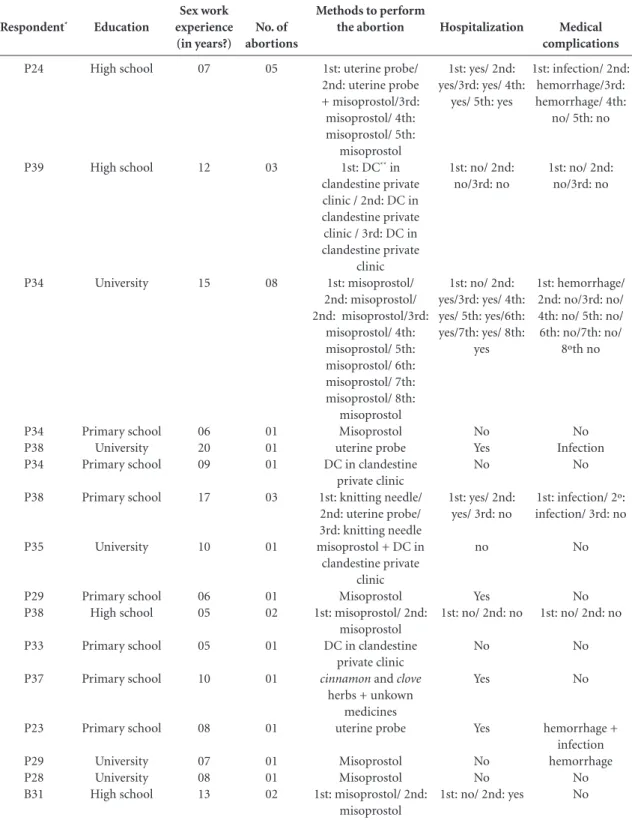
methods and medical outcomes are summarized in Table 1.
Respondent* P24 P39 P34 P34 P38 P34 P38 P35 P29 P38 P33 P37 P23 P29 P28 B31 Education High school High school University Primary school University Primary school Primary school University Primary school High school Primary school Primary school Primary school University University High school Sex work experience (in years?) 07 12 15 06 20 09 17 10 06 05 05 10 08 07 08 13
Table 1. Demographic data, methods and medical outcomes declared by 39 female sex workers in Brazil.
Methods to perform the abortion
1st: uterine probe/ 2nd: uterine probe + misoprostol/3rd: misoprostol/ 4th: misoprostol/ 5th:
misoprostol 1st: DC** in
clandestine private clinic / 2nd: DC in clandestine private clinic / 3rd: DC in clandestine private
clinic 1st: misoprostol/ 2nd: misoprostol/ 2nd: misoprostol/3rd:
misoprostol/ 4th: misoprostol/ 5th: misoprostol/ 6th: misoprostol/ 7th: misoprostol/ 8th: misoprostol Misoprostol uterine probe DC in clandestine
private clinic 1st: knitting needle/ 2nd: uterine probe/ 3rd: knitting needle misoprostol + DC in
clandestine private clinic Misoprostol 1st: misoprostol/ 2nd:
misoprostol DC in clandestine
private clinic
cinnamon and clove
herbs + unkown medicines uterine probe
Misoprostol Misoprostol 1st: misoprostol/ 2nd:
misoprostol No. of abortions 05 03 08 01 01 01 03 01 01 02 01 01 01 01 01 02 Hospitalization
1st: yes/ 2nd: yes/3rd: yes/ 4th:
yes/ 5th: yes
1st: no/ 2nd: no/3rd: no
1st: no/ 2nd: yes/3rd: yes/ 4th: yes/ 5th: yes/6th: yes/7th: yes/ 8th:
yes
No Yes No
1st: yes/ 2nd: yes/ 3rd: no
no
Yes 1st: no/ 2nd: no
No
Yes
Yes
No No 1st: no/ 2nd: yes
Medical complications
1st: infection/ 2nd: hemorrhage/3rd: hemorrhage/ 4th:
no/ 5th: no
1st: no/ 2nd: no/3rd: no
1st: hemorrhage/ 2nd: no/3rd: no/ 4th: no/ 5th: no/ 6th: no/7th: no/
8ºth no
No Infection
No
1st: infection/ 2º: infection/ 3rd: no
No
No 1st: no/ 2nd: no
M a d e ir o AP
Methods to perform abortion
All women interviewed have had at least one experience performing an illegal abortion. The most common method is misoprostol, followed by traditional herbs and clandestine clinics. Six of the women (15%) have had 2 abortions, 5 (13%) have had 3 abortions, one had 5 abortions,
and another one had 8 abortions. Even though the study was based on a convenience sample, we have not found any pattern relating education to recurrence of abortions. We can say that abortion is a common experience among female sex work-ers, but it is a solitary event for the majority of them. The same was found in other studies about
the general female population14. In contrast with
Respondent* B34 B26 B29 B29 B30 B25 B38 B23 B33 B32 B30 T22 T23 T26 T23 T35 T28 T30 T37 T31 T32 T22 T38 Education Primary school Primary school University Primary school Primary school Primary school Primary school High school High school High school High school Primary school Primary school High school University Primary school High school University Primary school High school High school University Primary school Sex work experience (in years?) 19 11 13 12 15 08 24 07 10 17 16 07 08 06 03 19 10 06 23 10 10 02 24
Table 1. continuation
Methods to perform the abortion
1st: misoprostol/ 2nd:
arnica and catuaba
herbs Misoprostol Misoprostol Misoprostol 1st: herbs / 2nd:
uterine probe Misoprostol Misoprostol 1st: misoprostol/ 2nd:
misoprostol Misoprostol misoprostol + DC in
clandestine private clinic Misoprostol Misoprostol Misoprostol 1st: cinnamon tea +
misoprostol/ 2nd: misoprostol Misoprostol
cabacinha and arruda
herbs + misoprostol Misoprostol 1st: misoprostol/ 2nd: misoprostol/ 3rd
misoprostol general herbs
Misoprostol 1st: misoprostol/ 2nd: misoprostol/ 3rd misoprostol + uterine
probe Misoprostol 1st: boldo and
buchinha herbs/ 2nd: general herbs + uterine probe/ 3rd
misoprostol No. of abortions 02 01 01 01 02 01 01 02 01 01 01 01 01 02 01 01 01 03 01 01 03 01 03 Hospitalization
1st: yes/ 2nd: yes
No Yes Yes 1st: no/ 2nd: no
Yes Yes 1st: no/ 2nd: no
Yes No
Yes No Yes 1st: yes/ 2nd: no
Yes Yes
Yes 1st: yes/ 2nd:
yes/ 3rd yes
Yes Yes 1st: yes/ 2nd:
yes/ 3rd yes
Yes 1st: yes/ 2nd:
yes/ 3rd: no
Medical complications No No No No No No hemorrhage hemorrhage Infection No hemorrhage No No no no Infection No no Infection Infection 1st: no/ 2nd: no/
3rd: infection (hysterectomy)
no 1st: no/ 2nd: infection/ 3rd: no
aúd
e C
ole
tiv
a,
20(2):587-593,
2015
the general population, abortion is a regular re-productive experience that a sex worker will inev-itably face during her professional life. 23 (59%) of them declared that the unplanned pregnancy happened as a “work accident” and not as the re-sult of an affective-sexual relationship.
Since the introduction of misoprostol as the main illegal method among Brazilian women to self-induce an abortion, there was a significant decrease in the rates of mortality and near miss
mortality11,12. If misoprostol empowered women
to perform an abortion without exposing them-selves to clandestine clinics, it also shifted the risk from clandestine medical practices to illegal drug sellers. Two Brazilian studies showed that miso-prostol is sold by illegal sellers specializing in body shape medicines, such as hormone growth
or loss weight15,16. Morbidity due to abortion was
also reduced; however, some studies found that it is dependent on the safeness and precedence
of the misoprostol used by the women17,18. The
medicines are commercialized by the clandestine market, and there is some evidence that coun-terfeit pills are also in circulation. The main evi-dence that suggests the circulation of counterfeit misoprostol is the number of pills used by wom-en to perform the abortion: the average was four, but some of them declared the use of eight pills to perform the abortion.
Considering the costs of the prostitute’s ser-vices and the education background as two in-dicators of income and social class, we found that the most vulnerable women are those who experienced high risks while performing an ille-gal abortion. Women who mentioned the use of uterine probes have the lowest educational back-ground and income. Brazilian female sex work-ers are full-time professionals working in pros-titution, and the vast majority of them are not included in the national social security system. The local and national organizations of female sex workers emerged in the late 1990s, but most of them are concentrated in large cities and have little political impact on national health policies. Recently, the national coordinator of the HIV/ AIDS policy at the Brazilian Ministry of Health was dismissed for an educational campaign on
sexually transmitted disease and prostitution19.
Prostitution is legal in Brazil, but operating a brothel and pimping remain illegal activities. Many women interviewed in this study were in-dependent professionals, renting their own plac-es to attend clients, but the majority of them, 22 (56%), were attached to a brothel administrated by female and male pimps.
Medical outcomes
and number of misoprostol tablets used
The World Health Organization recommends misoprostol for medical abortion – 800mcg vaginal or sublingual every 8 hours up to three doses. It is safe when used in the first trimester
of pregnancy20. In contrast with the results of
other qualitative Brazilian studies about the use of misoprostol among the general female pop-ulation, sex workers did not have difficulties or
discomfort using vaginal misoprostol21. The
dos-es used were from 1 to 8 pills, vaginal and oral. After using the medicines, the vast majority of them had vaginal bleeding and/or abdominal pain. These women, who did not have previous experience with medical abortion, learned how to use the misoprostol from the drug seller or from other sex workers. The most disturbing experience for them was to understand the body signals, such as if the expulsion of the foetus (in their words, “the expulsion of the ball”) was completed. As other studies have found among the general female population, many sex workers decide to go to a hospital to check if the abortion
has been successful14,17. Of those who were
hospi-talized, 63% of them did not disclose the induced abortion to the health care team.
Similar to other studies9,10,22, intense
abdomi-nal pain and voluminous bleeding were the most common post-abortion complications described by the prostitutes. Infectious complications, re-quiring prolonged hospitalization and a hyster-ectomy in one case, were more frequently ob-served among those who used invasive measures. Due to the variety of means and methods used by the women, it is difficult to establish exact caus-es of the complications dcaus-escribed. Neverthelcaus-ess, insufficient knowledge of appropriate doses of misoprostol and, moreover, the inability to rec-ognize the physical warning signs were frequent-ly described by the prostitutes as post-abortion complications.
Final considerations
Female sex work provokes moral and political debates on gender justice and women’s body
exploitation23. We have opted not to advance in
M
a
d
e
ir
o
AP
public health indicator of how risky sex work ac-tivity is in Brazil – the risk of unplanned preg-nancies and consequences of unsafe abortions. This study partially fills that gap describing who they are, how they performed the abortion and the health consequences of the adopted methods. The vast majority of the sex workers have had illegal abortions using similar means and meth-ods that the general female population in Brazil has reported using. A typical plan is to initiate the abortion at home with illegal misoprostol and to finish it at a public hospital. The medical complications were associated with the invasive methods, such as needles and probes. In almost all sex worker narratives, the abortion was a sol-itary experience, performed alone without help-ers, partners or other women. The prostitutes who had infectious complications as a result of
the abortion more frequently indicated that they delayed going to the hospital, despite fever or persistent bleeding. The main justification given was the fear of being reported by the health team to the police.
Even though abortion is on the agenda of reproductive and sexual rights in Latin Amer-ica, there is no reference to female sex workers’ vulnerability to unsafe abortion. The regular of-fer and use of contraceptives among female sex workers has the potential to reduce the magni-tude of abortion, but the focus of the Brazilian public health policies has been the HIV/AIDS infection and the use of condoms. A national health policy on contraceptive and barrier meth-ods targeting the sex worker population would be efficient in reducing their vulnerability to un-safe and illegal abortions.
Collaborations
aúd
e C
ole
tiv
a,
20(2):587-593,
2015
Madeiro AP, Rufino AC. Induced abortion among prostitutes: a survey using the ballot-box technique in Teresina – Piauí. Cien Saude Colet 2012; 17(7):1735-1742.
Diniz D, Medeiros M. Itineraries and methods of illegal abortion in five Brazilian state capitals. Cien Saude Co-let 2012; 17(7):1671-1681.
Diniz D, Castro R. The illegal market for gender-relat-ed drugs as portraygender-relat-ed in the Brazilian news mgender-relat-edia: the case of misoprostol and women. Cien Saude Colet 2011; 16(1):94-102.
Diniz D, Madeiro A. Cytotec and abortion: the po-lice, the vendors and women. Cien Saude Colet 2012; 17(7):1795-1803.
Zamberlin N, Romero M, Ramos S. Latin American women’s experiences with medical abortion in set-tings where abortion is legally restricted. Reprod Health
2012; 9(1):34.
Arilha MM. Misoprostol: pathways, mediation and so-cial networks for access to abortion using medication in the context of illegality of São Paulo. Cien Saude Co-let 2012; 17(7):1785-1794.
Ruiz E. As prostitutas não podem ser felizes. Rede Hu-manizaSUS. 2013. [acessado 2014 jan 14]. Disponível em: http://www.redehumanizasus.net/62924-as-prosti tutas-nao-podem-ser-felizes
World Health Organization (WHO). Safe Abortion:
Technical and Policy Guidance for Health Systems. 2nd
edition. Geneva: WHO; 2012.
Sherris J, Bingham A, Burns MA, Giroin S, Westley E, Gomez PI. Misoprostol use in developing countries: results from a multicountry study. Int J Gynecol Obstet
2005; 88(1):76-81.
Harper CC, Blanchard K, Grossman D, Henderson JT, Darney PD. Reducing maternal mortality due to elective abortion: potential impact of misopros-tol in low-resource setting. Int J Gynecol Obstet 2007; 98(1):66-69.
Mackinnon CA. Trafficking, Prostitution, and Inequal-ity. Harvard Civil Rights - Civil Liberties Law Review
2011; 46:217-309.
Artigo apresentado em 04/08/2014 Aprovado em 06/08/2014
Versão final apresentada em 10/08/2014 13.
14.
15.
16.
17.
18.
19.
20.
21.
22.
23. Referências
Pitpitan EV, Kalichman SC, Eaton LA, Strathdee AS, Patterson TL. HIV/AIDS risk among venue-based fe-male sex workers across the globe: a look back and the way forward. Curr HIV/AIDS Rep 2013; 10(1):65-78. Baral S, Beyrer C, Muessig K, Poteat T, Wirtz AL, Decker MR, Sherman SG, Kerrigan D. Burden of HIV among female sex workers in low-income and middle-income countries: a systematic review and meta-analysis. Lan-cet Infect Dis 2012; 12(7):538-549.
Feldblum PJ, Nasution M, Hoke TH, van Damme K, Turner AN, Gmach R, Wong EL, Behets F. Pregnancy among sex workers participating in a condom inter-vention trial highlights the need for dual protection.
Contraception 2007; 76(2):105-110.
Todd CS, Nasir A, Stanekzai MR, Scott PT, Strathdee SA, Botros BA, Tjaden J. Contraception utilization and pregnancy termination among female sex workers in Afghanistan. J Women’s Health 2010; 19(11):2057-2062. Morineau G, Neilsen G, Heng S, Phimpachan C, Mus-tikawati DE. Falling through the cracks: contraceptive needs of female sex workers in Cambodia and Laos.
Contraception 2011; 84(2):194-198.
Duff P, Shoveller J, Zhang R, Alexson D, Montaner JSG, Shannon K. High lifetime pregnancy and low contraceptive usage among sex workers who use drug – an unmet reproductive health need. BMC Pregnancy Childbirth 2011; 11:61.
Elmore-Meegan M, Conray RM, Agala BC. Sex work-ers in Kenya, numbwork-ers of clients and associated risks: on exploratory survey. Reprod Health Matters 2004; 12(23):50-57.
Diniz D, Medeiros M. Aborto no Brasil: uma pesquisa domiciliar com técnica de urna. Cien Saude Colet 2010; 15(Supl. 1):959-966.
Hardy E, Alves G. Complicações pós-aborto provo-cado: fatores associados. Cad Saude Publica 1992; 8(2):454-458.
Faúndes A, Santos LC, Carvalho M, Gras C. Post-abor-tion complicaPost-abor-tions after interrupPost-abor-tion of pregnancy with misoprostol. Adv Contrac 1996; 12(1):1-9. Camargo RS, Santana DS, Cecatti JG, Pacagnella RC, Tedesco RP, Melo Junior EF. Sousa MH. Severe mater-nal morbidity and factors associated with the ocur-rence of abortion in Brazil. Int J Obstet Gynecol 2011; 112(2):88-92.
Santana DS, Cecatti JG, Parpinelli MA, Haddad SM, Costa ML, Sousa MH, Souza JP, Camargo RS, Pacag-nella RC, Surita FC, Pinto e Silva JL; Brazilian Network for the Surveillance of Severe Maternal Morbidity. Se-vere maternal morbidity due to abortion prospectively identified in a surveillance network in Brazil. Int J Ob-stet Gynecol 2012; 119(1):44-48.
1.
2.
3.
4.
5.
6.
7.
8.
9.
10.
11.