AR
TIGO
AR
TICLE
1 Department of Preventive Medicine, College of Medicine, Dongguk University. 123, Dongdae-ro, Gyeongju-si, Gyeongsangbuk-do, SEOUL 780-714, Republic of Korea. [email protected] 2 Department of Preventive Medicine, College of Medicine, Chungbuk National University.
A study of the status of exposure to polycyclic aromatic
hydrocarbons (PAHs) in relation to its metabolites
among workers in a Korean chemical factory
Um estudo sobre o estado de exposição a hidrocarbonetos
aromáticos policíclicos (HAPs), em relação aos seus metabolitos,
entre os trabalhadores em fábricas de produtos químicos coreana
Resumo O presente estudo foi realizado para avaliar o estado de exposição a hidrocarbonetos aromáticos policíclicos (HAPs) em trabalhadores, por medição de metabólitos urinários, tais como 1-hidroxipireno (OHP) e 2-naftol. Foi realizada uma pesquisa por questionário envolvendo 326 trabalhadores e a mensuração dos metabólitos urinários de 1-OHP e 2-naftol. Foram analisadas as diferenças na urinária 1-OHP e as concentra-ções de 2-naftol e mudanças pelo trabalho, hábito de fumar e estilo de vida. O número de indivíduos do sexo masculino foi de 314 (96,3%), a maior fai-xa etária foi a quinta década (170 casos, 52,1 %). Com relação aos metabólitos urinários 1 -OHP e 2-naftol, as concentrações foram significativa-mente maiores nos trabalhadores produtivos. As concentrações dos metabólitos urinários 1-OHP e 2-naftol foram significativamente maiores nos fumantes. Em um modelo de regressão múltipla, log (1-OHP) aumentou em fumantes e em traba-lhadores produtivos, enquanto que log (2-naftol) aumentou apenas em fumantes. Nossos resultados sugerem que os trabalhadores desta fábrica foram expostos tanto a HAPs de fontes não ocupacionais como ocupacionais. A exposição ocupacional a HAPs pode ser diminuída através da melhoria do processo, mas a exposição devido ao fumo só pode ser impedida interrompendo esse hábito.
Palavras-chave Alcatrão de carvão, Hidrocar-bonetos aromáticos policíclicos, 1 - hidroxipireno, 2-naftol, Tabagismo
Abstract The study was conducted to evaluate the status of worker exposure to polycyclic aro-matic hydrocarbons (PAHs) through the mea-surement of urinary metabolites such as 1-hy-droxypyrene (OHP) and 2-naphthol. A survey using a questionnaire involving 326 workers with measurement of urinary metabolites of 1-OHP and 2-naphthol was conducted. The differences in urinary 1-OHP and 2-naphthol concentrations, and changes in work, smoking habits and lifestyle were analyzed. The number of male subjects was 314 (96.3%), the largest age group was the fifth decade (170 cases, 52.1%). The urinary 1-OHP and 2-naphthol concentrations were significant-ly higher in the production workers. The urinary 1-OHP and 2-naphthol concentrations were sig-nificantly higher in smokers. In a multiple regres-sion model, log (1-OHP) increased in smokers and production workers, while log (2-naphthol) only increased in smokers. Our results suggest that workers in this factory were exposed to PAHs from non-occupational as well as occupational sourc-es. The occupational exposure to PAHs can be reduced through the improvement of the process, but the exposure due to smoking can be prevented only by giving up smoking.
Key words Coal tar, Polycylic aromatic hydro-carbons, 1-hydroxypyrene, 2-naphthol, Smoking
Kwan Lee 1
Hyun-Sul Lim 1
Introduction
Polycyclic aromatic hydrocarbons (PAHs) result from the pyrolysis or incomplete combustion of carbonaceous organic compounds. Products including anthracene, benzopyrene (benzo(a) pyrene), bitumen, carbon black, Keure creosote, coal tar pitch, naphthalene, etc., contain PAHs1.
PAHs are known mainly as tumor initiators of skin and lung cancer but also are reported as carcinogens that cause bladder cancer, cancer of the larynx, kidney cancer, breast cancer, etc.2.
The International Agency for Research on Can-cer (IARC) prescribes aluminium, coal gas, coke manufacturing process, in which exposure to PAHs is possible through coal-tar pitch, etc., as a Group I substance, where there is a characteristic that causes cancer in the human body3-8.
In addition, the environmental protection agency (EPA) has set up an index of air pollu-tion that refers to sixteen PAHs including naph-thalene, acenaphthylene, acenaphthene, luorene, phenanthrene, anthracene, luoranthene, pyrene, benzo(a)anthracene, chrysene, benzo(b)luoran-thene, benzo(k)luoranbenzo(b)luoran-thene, dibenzo(a,h)an-thracene, benzo(ghi)perylene, indeno(1,2,3-cd) pyrene, benzo(a)pyrene, etc.9. IARC reports that
among these PAHs, benz(a)anthracene (2A), benzo(b)luoranthene (2B) benzo(k)luoran-thene (2B), dibenzo(a,h)anthracene (2A), inde-no(1,2,3-cd)pyrene (2B), benzo(a)pyrene (2A), etc., have characteristics that cause cancer8. In
the US, a government industrial hygiene panel (ACGIH) has determined that benzo(b)luoran-thene (A2), benzo(a)pyrene (A2), chrysene (A3), benzo(a)anthracene (A2), etc., have carcinogenic characteristics10. The target place of this study is
where workers process coal tar – whereby occu-pational exposure to PAHs arises – to produce tar, pitch, carbon black, etc. Coal tar is generated when solid-state organic material such as coal is carbonized; it has the consistency of a luid and is either brown or black. There is the physical prop-erties in which the great quantity of the PAHs is melted if it adds the heat of 200-250 since being the luid11.
There are skin disorders including dermatitis, local telangiectasia, dermatoma, etc., and respi-ratory disorders including bronchitis, bronchiol-itis, aveolbronchiol-itis, lung cancer, etc. that are associated with health problems arising from coal tar1. In
Korea, so far there have been ive cases of lung cancer (three involving PAHs, one case involving coke oven emissions, and one case involving coal tar pitch) related to coal tar12,13.
Much cost is entailed for measuring the PAH concentration in the work environment or the atmosphere, and there is a limit in terms of es-timating the exposure through many lifestyle factors and various other modes14. Therefore,
bi-ological monitoring is an alternative for measur-ing the environmental exposure15. In the case of
biological monitoring for PAHs, there are many biomarkers including thioethers, 1-naphthol, 2-naphthol, β-naphthylamine, hydroxyphenan-threne, and 1-hydroxypyrene (1-OHP). And among these, 1-OHP and 2-naphthol are widely used.
This study was carried out to evaluate the workers’ status of exposure to polycyclic aromatic hydrocarbons (PAHs) through the measurement of urinary metabolites such as 1-hydroxypyrene (OHP) and 2-naphthol, and an investigation of the working history and dietary and smoking habits among the workers in a chemical factory.
Subjects and methods
Study population
The subjects of this study consisted of 326 workers (314 male and 12 female) in a chemical factory. All the participants provided written and informed consent prior to participation in this study, and all the processes were reviewed and ap-proved by the institutional review board at Dong-guk University College of Medicine. This compa-ny, which is the research site, produces tar, carbon black, phthalic anhydride, plasticizer, carbomer, crude light oil, and HCP (hexachlorophene). The measurement of urinary metabolites was per-formed for the 326 subjects, and the changes in metabolites between before and after work were observed among 38 workers (Figure 1).
Questionnaire survey
aúd
e C
ole
tiv
a,
19(12):4809-4818,
2014
was consumed and the frequency of its intake, etc.; and smoking habits including the smoked amount, amount smoked on days other than that of the examination, amount smoked on the day of the examination, and the elapsed time from inal smoking.
Sampling and analysis of PAHs
Personal air sampling and analysis were con-ducted by NIOSH method 551516. Personal air
sampling was conducted in the 25 workers using PTFE (polytetraluoroethylene) membrane ilter (2 µm, 37 mm), XAD-2 tube (100 mg/50 mg, SKC, Eighty Four, PA, USA), and personal sam-pling pump (Personal air sampler, Gillian, Wayne, NJ, USA) at 2 L/min. And sixteen U.S. EPA PAH including naphthalene, acenaphthylene, ace-naphthene, luorene, phenanthrene, anthracene, luoranthene, pyrene, benzo[a]anthrancene, chrysene, benzo[b]luoranthene, benzo[k]luo-ranthene, benzo[p]pyrene, dibenz[a,h]anthra-cene, benzo[g,h,i]perylene, indenol[1,2,3-cd] pyrene were analyzed.
Analysis of urinary 1-OHP and 2-naphthol
For analyzing the urinary 1-OHP concentra-tion, the authors used the method developed by Jongeneelen et al.17 with slight modiications. For
analyzing the urinary 2-naphthol, we used the method developed by Kim et al.18. In a dark room,
1 ml of the urine samples was buffered with 100
µl of 0.2 M sodium acetate buffer (pH 5.0) and hydrolyzed enzymatically with 10 µl of β -glucu-ronidase with sulfatase activity (Sigma G-0876, St. Louis, Mo., USA) for 16 h at 37ºC in a shaking water bath. After hydrolysis, 1.5 ml of acetonitrile was added, and the samples were centrifuged at 10,000 g for 10 min. 1-OHP (361518, Sigma-Al-drich) and 2-naphthol (N-1250, Sigma-AlSigma-Al-drich) were used as the standard reagents.
A high-performance liquid chromatogra-phy (HPLC) system consisting of a pump (Wa-ters 600E, Millipore, Milford, Mass., USA) and a variable luorescence detector (RF-10AxL, Shi-madzu, Kyoto, Japan) was used. A 150 mm-long reverse phase column (TSK gel ODS-80, Tosoh, Tokyo, Japan) was used for 1-OHP analysis, and a 250 mm-long reverse phase column (J’sphere ODS-H80, YMC, Wilmington, N.C., USA) was used for 2-naphthol analysis. The mobile phase was 60% acetonitrile for 1-OHP and 38% ace-tonitrile for 2-naphthol. The low rate was 1 ml/min. The excitation/emission wavelengths used in the detection of 1-OHP and 2-naphthol were 242/288 nm and 227/355 nm, respective-ly. The detection limits, which were determined as three times the standard deviation of a blank or unspiked urine sample divided by the slope,
Figure 1. The lowchart of environmental and biological monitoring of personnel about chemical exposure.
Target population Chemical factory 331 workers
Total 326 worker Production workers 254
Clerical workers 72
excluded 5 workers
Environmental monitoring
Biological monitoring 1-OHP, 2-naphtol
Questionnaire
25 cases +
Before and after working 38 cases
Additional biological monitoring
Study participants
u
u
u u
u
were 0.13 ng/ml for 2-naphthol and 0.20 ng/ml for 1-OHP. The measured values of 1-OHP and 2-naphthol were corrected with the creatinine concentration for the urinary output. The cre-atinine concentration was measured using Jaffe’s reaction.
Statistical analysis
All the data were computerized. For statistical analysis, SPSS 18.0 for Windows was used. All the measured data were relected in the geometric mean and the geometric standard deviation. As to the smoking-rate comparison between pro-duction jobs and clerical work, the Chi-square test was used for the difference in the 1-OHP and 2-naphthol levels, while the Mann-Whitney U test was used to compare production jobs and clerical work and the smoking vs. non-smoking groups. The Wilcoxon signed rank test was used to analyze the change in 1-OHP between before and after work. Also, Spearman’s coeficient was used to analyze the correlation of 1-OHP and 2-naphthol in relation to the diet and smoking. In addition, by using multiple regression analy-sis, the concentrations of 1-OHP and 2-naphthol by the job type and smoking were observed.
Results
General characteristics
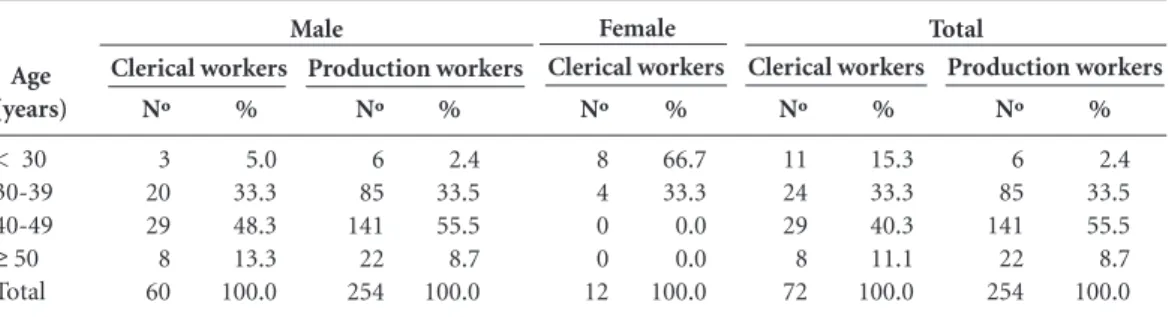
The age and sex distributions of the study subjects by clerical and production workers are shown in Table 1.
The concentrations of 1-OHP and 2-naphthol by jobs and smoking
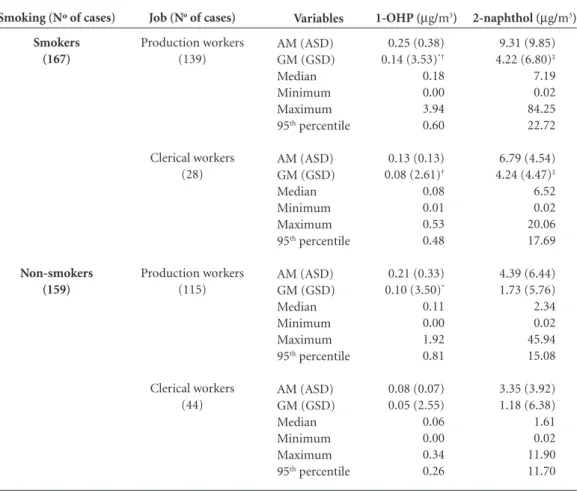
The geometric mean (geometric standard de-viation) of the concentration of 1-OHP in
pro-duction workers was 0.12 (3.54) µmole/mole·Cr., which was signiicantly higher than that for clerical workers (0.06 (2.60) µmole/mole·Cr.; p < 0.01), and the concentration of 2-naphthol in production workers was 2.82 (6.64) µmole/ mole·Cr., which was signiicantly higher than that for clerical workers (1.94 (6.19) µmole/ mole·Cr.; p < 0.05).
The corresponding value for the concen-tration of 1-OHP in smokers was 0.12 (3.50)
µmole/mole·Cr., which was higher than that for non-smokers (0.08 (3.29) µmole /mole·Cr.; p < 0.01). The corresponding value for the concen-tration of 2-naphthol in smokers was 4.27 (6.26)
µmole/mole·Cr., which was higher than that for clerical workers (1.61 (5.76) µmole/mole·Cr.; p < 0.05). The corresponding value for the concen-tration of 1-OHP in smoking production work-ers was 0.14 (3.53) µmole/mole·Cr., which was higher than that for smoking clerical workers (0.08 (2.61) µmole/mole·Cr.). The correspond-ing value for the concentration of 1-OHP in non-smoking production workers was 0.10 (3.50)
µmole/mole·Cr., which was higher than that for non-smoking clerical workers (0.05 (2.55)
µmole/mole·Cr.; p < 0.01). The concentration of 1-OHP in production workers (both smoking and non-smoking) was signiicantly higher than in clerical workers (p < 0.05). The correspond-ing value for the concentration of 2-naphthol in smoking production workers was 4.22 (6.80)
µmole/mole·Cr., which was higher than that for smoking clerical workers (4.24 (4.47) µmole/ mole·Cr.). The corresponding value for the con-centration of 2-naphthol in non-smoking pro-duction workers was 1.73 (5.76) µmole/mole·Cr., which was higher than that for non-smoking clerical workers (1.18 (6.38) µmole/mole·Cr.; p < 0.01). But, there were no differences in the con-centration of 2-naphthol between smokers and non-smokers in both production and clerical workers (Table 2).
Age (years)
< 30 30-39 40-49 ≥ 50 Total
Nº
3 20 29 8 60
%
5.0 33.3 48.3 13.3 100.0
Table 1. The distribution of the subjects by the gender, age group, and type of job.
Male
Nº
6 85 141 22 254
%
2.4 33.5 55.5 8.7 100.0
Nº
8 4 0 0 12
%
66.7 33.3 0.0 0.0 100.0
Nº
11 24 29 8 72
%
15.3 33.3 40.3 11.1 100.0
Nº
6 85 141 22 254
%
2.4 33.5 55.5 8.7 100.0 Clerical workers Production workers Clerical workers Clerical workers Production workers
aúd
e C
ole
tiv
a,
19(12):4809-4818,
2014
The changes in the concentration of 1-OHP between before and after working
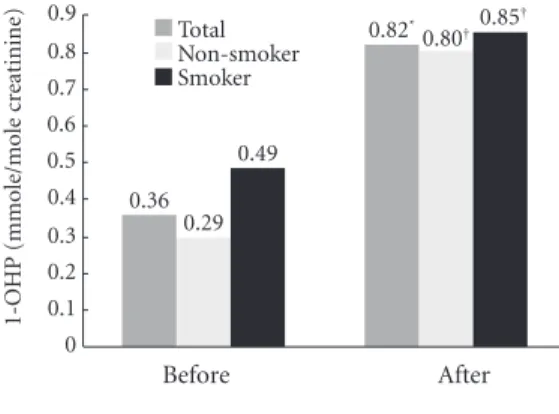
We measured the changes in the concentra-tion of 1-OHP between before and after working in 19 cases of the tar production process, 16 cases of the carbon-black production process, and 3 cases of task management (the section concern-ing the storage of oil) – a total of 38 cases.
The geometric mean (geometric standard deviation) of the concentration of 1-OHP sig-niicantly increased from 0.36 (2.81) µmole/ mole·Cr. before working to 0.82 (2.32) µmole/ mole·Cr. after working (p < 0.01). The corre-sponding value for the concentration of 1-OHP in smokers signiicantly increased from 0.49 (2.66) µmole/mole·Cr. before working to 0.85
(2.12) µmole/mole·Cr. after working (p < 0.01). The corresponding value for the concentration in non-smokers signiicantly increased from 0.29 (2.83) µmole/mole·Cr. before working to 0.80 (2.48) µmole/mole·Cr. after working (p < 0.01; see Figure 2).
The relationship between 1-OHP and the concentration of PAHs
Urinary 1-OHP concentration increased as log (PAHs) increased (rs = 0.675, p < 0.01). By multiple regression using smoking amount, 1-OHP = 1.121(95% CI: 0.496-1.745) × log (PAHs) (R2 = 0.448, n = 25) was derived. Through
this equation, we assumed the equation of log (PAHs) = 0.892 × 1-OHP (see Figure 3).
* p < 0.01 for the comparison with the clerical workers group by Mann-Whitney U test. †p < 0.05 for the comparison with the
corresponding non-smokers group by Mann-Whitney U test. ‡ p < 0.01 for the comparison with the corresponding non-smokers
group by Mann-Whitney U test. AM : arithmetic mean, ASD : arithmetic standard deviation. GM : geometric mean, GSD : geometric standard deviation.
Smoking (Nº of cases)
Smokers (167)
Non-smokers (159)
Job (No of cases)
Production workers (139)
Clerical workers (28)
Production workers (115)
Clerical workers (44)
Table 2. The concentration of urinary 1-hydroxypyrene (1-OHP) and 2-naphthol by type of job and smoking.
Variables
AM (ASD) GM (GSD) Median Minimum Maximum 95th percentile
AM (ASD) GM (GSD) Median Minimum Maximum 95th percentile
AM (ASD) GM (GSD) Median Minimum Maximum 95th percentile
AM (ASD) GM (GSD) Median Minimum Maximum 95th percentile
1-OHP (µg/m3)
0.25 (0.38) 0.14 (3.53)*†
0.18 0.00 3.94 0.60
0.13 (0.13) 0.08 (2.61)†
0.08 0.01 0.53 0.48
0.21 (0.33) 0.10 (3.50)*
0.11 0.00 1.92 0.81
0.08 (0.07) 0.05 (2.55) 0.06 0.00 0.34 0.26
2-naphthol (µg/m3)
9.31 (9.85) 4.22 (6.80)‡
7.19 0.02 84.25 22.72
6.79 (4.54) 4.24 (4.47)‡
6.52 0.02 20.06 17.69
4.39 (6.44) 1.73 (5.76) 2.34 0.02 45.94 15.08
The relationship between 1-OHP, 2-naphthol, diet, and smoking
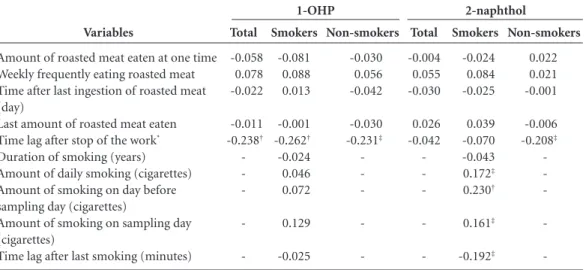
There was no correlation between 1-OHP, 2-naphthol, and the diet. But the concentra-tion of 1-OHP decreased with the elapsed time after the discontinuation of a task (p < 0.05).
The concentration of 2-naphthol increased with the amount of smoking and decreased with the elapsed time after the cessation of the last smoke (p < 0.05, Table 3). In the multiple regression analysis, 1-OHP increased in smokers (β = 0.15, p < 0.05) and production workers (β = 0.26, p0.01). Further, 2-naphthol increased in smokers (β = 0.43, p < 0.01).
Discussion
As to our results, both occupational and non-oc-cupational exposure to PAHs can exist in this study workplace when existing results18-21 are
considered whereby 1-OHP is a better indicator than 2-naphthol concerning occupational expo-sure to PAHs. On the other hand, 2-naphthol is a more sensitive indicator than 1-OHP regarding non-occupational exposure to PAHs. In addition, in multiple regression analysis, 1-OHP is signii-cantly correlated with the type of job and smok-ing, while 2-naphthol is signiicantly correlated with only smoking. In this study, the geometric mean (standard deviation) of the overall concen-tration of 1-OHP and 2-naphthol was respec-tively 0.10 (3.43) µmole/mole·Cr. and 2.60 (6.56)
µmole/mole·Cr. Compared with the study of Kim et al.19, the value for 1-OHP was lower than
the value of 0.33 µmole/mole·Cr. for shipyard workers, but that for 2-naphthol was higher than the value of 2.41 µmole/mole·Cr for shipyard workers. Our results for 1-OHP and 2-naphthol were respectively lower than those of 6.15 µmole/ mole·Cr. and 6.01 µmole/mole·Cr. for coke work-ers22, but higher than the values of 0.04 µmole/
mole·Cr. and 2.22 µmole/mole·Cr. for universi-ty students20. A recent result of 1-OHP for coal
tar-handling workers in Korea was 8.89 ~ 19.02
µmole/mole·Cr.23. In the study of Ovrebo et al.24,
the concentration of 1-OHP among residents adjacent to a coke factory area, other manufac-turing areas, and non-manufacmanufac-turing was on average 2.45~13.48 µmole/mole·Cr., 0.41~1.54
µmole/mole·Cr., and 0.14~ 0.20 µmole/mole·Cr., respectively.
The following conclusions of our study can be proposed from the results of various studies in domestic and foreign contexts.
First, the higher concentration of 1-OHP than in university students suggests some occu-pational exposure in our study factory. However, in spite of emissions of large amounts of PAHs in our study factory, the lower concentration of 1-OHP compared to the case of a factory
han-Figure 2. The geometric means of urinary
1-hydroxypyrene (1-OHP) concentration before and after working.
* p < 0.01, † p < 0.05 by Wilcoxon signed rank test. Before
1-OHP (mmole/mole cr
eat
inine)
0.36
After
0.29 0.49
0.82* 0.85† 0.80†
0 0.1 0.2 0.3 0.4 0.5 0.6 0.7 0.8 0.9
Total Non-smoker Smoker
Figure 3. Relationship between urinary
1-hydroxypyrene (1-OHP) concentration and log (PAHs).
Log (PAHs) (µg/m3)
R2=0.448 0.5
1.0 1.5 2.0
1-OHP (mmol/mol cr
eat
inine)
aúd e C ole tiv a, 19(12):4809-4818, 2014
dling coke or coal tar means that mechanisms that minimize the exposure including the sealing of the process, sanitation, etc., are in effect. And this means that the occupational exposure is less than in other workplaces.
Second, the facts that the concentration of 1-OHP in this study is lower than for shipyard workers but that of 2-naphthol is higher than for shipyard workers suggest that the exposure sources of PAHs are closely related to lifestyle as-pects such as smoking rather than occupational exposure in this study.
In this study, both 1-OHP and 2-naphthol were not related to dietary behaviors. In the study of Kim et al.19, the concentration of 1-OHP
was related to some dietary behaviors, but in the study of Kang et al.15, a signiicant
relation-ship was not observed. Because it is dificult to measure the exact dietary exposure through a questionnaire survey by categorizing and quan-tifying the ingestion amount, it is very dificult to discriminate whether the results are due to the measurement of the exposure amount in a wrong way or whether the dietary behaviors in Korea are especially less inluenced by PAH exposure. In addition, there is the possibility of being un-able to accurately measure the correlation with the diet because the character of data under an ordinal scale cannot conform to equal intervals15.
In the case of the smoking habit, in this study, there was no correlation with the concentration of 1-OHP but there was a correlation with the concentration of 2-naphthol. Particularly, the
high correlation with the amount smoked on the preceding day of the study is presumed to relect a characteristic of drug dynamics whereby the excretion volume of PAHs peaks after about 24-48 hours following inhalation in the case when PAHs are inhaled through respiratory routes16.
In this study, the concentration of 1-OHP in smokers was higher than that of non-smokers. This phenomenon is explained through a toxi-cological mechanism25 whereby the absorption
and re-absorption of PAHs increase and/or the process of pyrene metabolism changes through the suppression of the action of cilia in the up-per respiratory tract by smoking. Because pyrene is excreted mostly through the urine in the form of 1-hydroxypyrene glucuronide (1-OHPG) or 1- hydroxypyrene (1-OHP), the amount of PAHs ab-sorbed is measured through these excretions16,26-28.
1-OHP29,30 is known as a sensitive biological
ex-posure indicator that relects the amount of PAHs absorbed in the human body since it has been in-troduced as a metabolic product of a pyrene by Jongeneelen et al.17. Therefore, urinary 1-OHP
as a PAHs metabolite was a strong predictor of cigarette smoking31. However, because pyrene can
be absorbed through either the respiratory or the gastrointestinal route, it cannot accurately relect the degree of exposure to PAHs according to the exposed route. However, because naphthalene is mostly absorbed through the respiratory route, and when smoking, one cigarettes contains 2 ~ 4 ug of naphthalene, which is equivalent to 100 times of pyren (0.043 ug)32, 2-naphthol in urine * excluded 72 cases of clerical workers. † p < 0.01. ‡ p < 0.05
Variables
Amount of roasted meat eaten at one time Weekly frequently eating roasted meat Time after last ingestion of roasted meat (day)
Last amount of roasted meat eaten Time lag after stop of the work*
Duration of smoking (years) Amount of daily smoking (cigarettes) Amount of smoking on day before sampling day (cigarettes)
Amount of smoking on sampling day (cigarettes)
Time lag after last smoking (minutes)
Total -0.058 0.078 -0.022 -0.011 -0.238†
-Table 3. Spearman’s correlation coeficients (rs) between variables and urinary 1-hydroxypyrene (1-OHP) and
as a metabolite of naphthalene has been devel-oped and widely used18,33.
The overall exposure level, as conirmed through this study, was thought not to be high-er than in similar workplaces. The great signii-cance of this study conducted for the diagnosis of workplaces was to identify the level of occu-pational exposure and conirm the presence of non-occupational exposure through smoking besides occupational exposure.
In conclusion, workers in this study work-place were exposed to PAHs through both occu-pational exposure and lifestyle behaviors such as smoking. Because PAHs are known as hazardous chemicals that induce various health problems
including cancer, it may be very important to re-duce the exposure to PAHs in this workplace in the future.
For the prevention of occupational exposure, unnecessary leaks are avoided through thorough process management in advance; by the adop-tion of personal protective measures, exposure to PAHs can be minimized. Furthermore, for pre-venting exposure through smoking, all workers must cease to smoke, and all areas in the work-place must be smoke-free. Deinitely, a periodic survey regarding the workplace environment and metabolites of hazardous materials should be applied for the workplace and for high-risk workers.
Collaborations
aúd e C ole tiv a, 19(12):4809-4818, 2014 References
Stellman SD, Guidotti TL. Polycyclic aromatic hydro-carbons and petroleum industry. In: Rom WN, editor.
Environmental and occupational medicine. Philadel-phia: Lippincott Williams & Wilkins; 2007. p. 1240-1250.
Boffetta P, Jourenkova N, Custavsson P. Cancer risk from occupational and environmental exposure to polycyclic aromatic hydrocarbons. Cancer Causes Con-trol 1997; 8(3):444-472.
IARC. Monographs, Some non-heterocyclic polycyclic aromatic hydrocarbons and some related exposures, Vol-ume 92. Lyon: IARC; 2005.
IARC. Monographs on the evaluation of the carcinogenic risk to humans. Polynuclear Aromatic Compounds, Part 1: Chemical, Environmental and Experimental Data, Volume 32. Lyon: IARC; 1983.
IARC. Monographs on the evaluation of the carcinogenic risk to humans. Polynuclear Aromatic Compounds, Part 2: Carbon Blacks, Mineral Oils (Lubricant Base Oils and Derived Products) and Some Nitroarenes, Volume 33. Lyon: IARC; 1984.
IARC. Monographs on the evaluation of the carcinogenic risk of chemicals to humans. Polynuclear Aromatic Com-pounds, Part 3: Industrial exposures in aluminum pro-duction, coal gasification, coke production and iron and steel founding, Volume 33. Lyon: IARC; 1984.
IARC. Monographs on the evaluation of the carcinogenic risk to humans, Polynuclear Aromatic Compounds, Part 4: Bitumens, Coal-Tars and Derived Products, Shale-Oils and Soots, Volume 35. Lyon: IARC; 1985.
IARC. Overall Evaluations of Carcinogenicity, An Up-dating of IARC Monographs Volumes 1 to 42, Supple-ment No. 7. Lyon: IARC; 2005.
Harvath PV. Quantitative analysis of multiple PAH’s in the coal conversion atmosphere. Am Ind Hyg Assoc J 1983; 44(10):739-745.
ACGIH. Documentation of the threshold limit values and biological exposure indices. Cincinnati: ACGIH; 2005. ATSDR. Toxicological profile for wood creosote, coal tar creosote, coal tar, coal tar pitch, and coal tar pitch vola-tiles. update. Atlanta: Agency for Toxic Substances and Disease Registry; 2002.
Lim HS, Lee K. A case of lung cancer occurred to work-er handled coal tar. Dongguk J Med 2004; 11:81-88 (in Korean).
Kang SK, Ahn YS, Chung HK. Occupational cancer in Korea in the 1990s. Kor J Occup Environ Med 2001; 13(4):351-359 (in Korean).
Waldman JM, Lioy PJ, Greenberg A, Butler JP. Analysis of human exposure to benzo(a)pyrene via inhalation and food ingestion in the Total Human Environmental Exposure Study (THEES). J Expo Anal Environ Epide-miol 1991; 1(2):193-225.
Kang JW, Cho SH, Kim H, Lee CH. Urinary 1-hy-droxypyrene and 2-naphthol as a biological exposure markers of total suspended particulate in the general population. Korean J Prev Med 2000; 33(3):306-312 (in Korean).
National Institute of Occupational Safety and Health.
Polynuclear aromatic hydrocarbons by GC: method 5515. NIOSH manual of analytical methods. 4th edition. Cin-cinnati (USA): NIOSH; 1994.
Jongeneelen FJ, Anzion RB, Henderson PT. Determina-tion of hydroxylated metabolites of polycyclic aromatic hydrocarbons in urine. J Chromatogr 1987; 413:227-232.
Kim H, Kim YD, Lee H, Kawamoto T, Yang M, Katoh T. Assay of 2-naphthol in human urine by high-perfor-mance liquid chromatography. J Chromatogr B Biomed Sci Appl 1999; 734(2):211-217.
Kim H, Lim HS, Kang JW, Lee HI, Kim YD, Nan HM, Lee CH. Effects of occupation, life style and genetic polymorphism of CYP1A1, GSTM1, and GSTT1 on urinary 1-hydroxypyrene and 2-naphthol concentra-tion. Korean J Occup Environ Med 1999; 11:546-556 (in Korean).
Kim H, Cho SH, Kang JW, Kim YD, Nan HM, Lee CH, Lee H, Kawamoto T. Urinary 1-hydroxypyrene and 2-naphthol concentration in male Koreans. Int Arch Occup Environ Health 2001; 74(1):59-62.
Nan HM, Kim H, Lim HS, Choi JK, Kawamoto T, Kang JW, Lee CH, Kim YD, Kwon EH. Effects of occupa-tion, lifestyle and genetic polymorphisms of CYP1A1, CYP2E1, GSTM1 and GSTT1 on urinary 1-hydroxy-pyrene and 2-naphthol concentration. Carcinogenesis
2001; 22(5):787-793.
Yang M, Koga M, Katoh T, Kawamoto T. A study for the proper application of urinary naphthols, new bio-markers for airborne polycyclic aromatic hydrocar-bons. Arch Environ Contam Toxicol 1999; 36(1):99-108. Kim EA, LeeJT, Kwon EH, Lee JS, Lee YH, Kwag HS, Choi SB, Lee IJ, Shin JH, Shim KJ, Urm SH, Kim SJ, Shon HS, Chun JH. Monitoring of polycyclic aromat-ic hydrocarbons and the metabolites in workers using coal tar paints. Korean J Occup Environ Med 2005; 17(3):161-172 (in Korean).
Ovrebo S, Fjeldstad PE, Grzybowska E, Kure EH, Chorazy M, Haugen A. Biological monitoring of poly-cyclic aromatic hydrocarbon exposure in a highly pol-luted area of Poland. Environ Health Perspect 1995; 103(9):838-843.
Jongeneelen FJ, van Leeuwen FE, Oosterink S, Anzion RB, van der Loop F, Bos RP, van Veen HG. Ambient and biological monitoring of cokeoven workers: determi-nants of the internal dose of polycyclic aromatic hydro-carbons. Br J Ind Med 1990; 47(7):454-461.
Buchet JP, Gennart JP, Mercado-Calderon F, Delavi-gnette JP, Cupers L, Lauwreys R. Evaluation of expo-sure to polycyclic aromatic hydrocarbons in a coke pro-duction and a graphite electrode manufacturing plant: assessment of urinary excretion of 1-hydroxypyrene as a biological indicator of exposure. Br J Ind Med 1992; 49(11):761-768.
Singh R, Tucek M, Maxa K, Tenglerova J, Weyand EH. A rapid and simple method for the analysis of 1-hydroxy-pyrene glucuronide: a potential biomarker for polycy-clic aromatic hydrocarbon exposure. Carcinogenesis
1995; 16(12):2909-2915.
Strickland P, Kang D. Urinary 1-hydroxypyrene and other PAH metabolites as biomarkers of exposure to environmental PAH in air particulate matter. Toxicol Lett 1999; 108(2-3):191-199.
Jongeneelen FJ. Benchmark guideline for urinary 1-hy-droxypyrene as biomarker of occupational exposure to polycyclic aromatic hydrocarbons. Ann Occup Hyg
2001; 45(1):3-13.
Hansen AM, Poulsen OM, Christensen JM, Hansen SH. Determination of α-naphthol in human urine by high performance liquid chromatography. J Liq Chromatogr
1992; 15(3):479-499.
Lee KH, Byeon SH. The biological monitoring of uri-nary 1-hydroxypyrene by PAH exposure among smok-ers. Int J Environ Res 2010; 4(3):439-442
Grimmer G, Naujack KW, Dettbarn G. Gaschromato-graphic determination of polycyclic aromatic hydro-carbons, aza-arenes, aromatic amines in the particle and vapor phase of mainstream and sidestream smoke of cigarettes. Toxicol Lett 1987; 35(1):117-124. Tingle MD, Pirmohamed M, Templeton E, Wilson AS, Madden S, Kitteringham NR, Park BK. An inves-tigation of the formation of cytotoxic, genotoxic, pro-tein-reactive and stable metabolites from naphthalene by human liver microsomes. Biochem Pharmacol 1993; 46(9):1529-1538.
Artigo apresentado em 10/10/2013 Aprovado em 15/05/2014
Versão inal apresentada em 18/05/2014 29.
30.
31.
32.