CLINICAL SCIENCE
The relationship between the oral and pharyngeal
phases of swallowing
Rachel Aguiar Cassiani, Carla Manfredi Santos, Luana Casari Parreira, Roberto Oliveira Dantas
Clı´nica Me´dica - Faculdade de Medicina de Ribeira˜o Preto, Universidade de Sa˜o Paulo, Ribeira˜o Preto/SP, Brazil.
OBJECTIVE: This study was designed to investigate a possible relationship between the duration of the oral and pharyngeal phases of swallowing.
INTRODUCTION: The oral and pharyngeal phases of swallowing are independent from each other but may be related.
METHODS: We used videofluoroscopy to evaluate 30 healthy volunteers between 29 and 77 years of age who swallowed 5- and 10-ml liquid and paste boluses in duplicate. The duration of the oral phase, pharyngeal transit, and pharyngeal clearance were measured.
RESULTS: There were no differences in oral or pharyngeal transit times between the liquid and paste boluses or between the volumes of 5 and 10 ml (p.0.40). The pharyngeal clearance time for the paste bolus (0.48¡0.27 s) was longer than for the liquid bolus (0.38¡0.11 s, p= 0.03) with no difference between the volumes of 5 and 10 ml.
There was no significant correlation between the oral transit time and the duration of pharyngeal transit for the liquid (5 ml, Spearman’s coefficient r: 20.14; 10 ml, r: 0.18) or the paste (5 ml, r: 0.08; 10 ml, r: 0.10). The
correlation between the oral transit time and the pharyngeal clearance time was not significant for the liquid bolus (5 ml,r: 0.31; 10 ml,r: 0.18), but it was significant for both the 5 ml (r: 0.71) and 10 ml (r: 0.64) paste boluses.
DISCUSSION: The relationship between the oral and pharyngeal phases of swallowing can be affected by bolus consistency.
CONCLUSION:There is a correlation between the duration of oral transit and the duration of pharyngeal clearance during the swallowing of paste boluses.
KEYWORDS: Swallowing; Deglutition; Oral swallowing; Pharyngeal swallowing; Bolus consistency.
Cassiani RA, Santos CM, Parreira LC, Dantas RO. The relationship between the oral and pharyngeal phases of swallowing. Clinics. 2011;66(8):1385-1388.
Received for publication onMarch 9, 2011;First review completed onApril 4, 2011;Accepted for publication onMay 9, 2011
E-mail: [email protected]
Tel.: 55 16 3602-2457
INTRODUCTION
Swallowing is a complex function that is controlled by the central pattern-generating circuitry of the brain stem and the peripheral reflexes.1
The oral, pharyngeal, and esophageal phases of swallow-ing occur independently of one another.1,2Although central pattern generators of the brain stem control the timing of these events, the peripheral manifestations of these phases depend on sensory feedback through pharyngeal and esophageal reflexes.2
The oral phase of swallowing is a voluntary event, and the pharyngeal phase is an involuntary, independent event.1 However, swallowing occurs in a sequence that is always
the same. The responses of the pharynx and esophagus depend on the characteristics of the bolus.1-5Our hypothesis was that the oral phase might be able to influence the pharyngeal phase under certain conditions depending on the consistency and volume of the bolus.
Our objective in this investigation was to use video-fluoroscopy to evaluate the influence of oral phase duration on pharyngeal phase duration in healthy subjects after swallowing either liquid or paste boluses. Our hypothesis was that the duration of the oral phase of swallowing would influence the duration of the pharyngeal phase.
MATERIAL AND METHODS
Videofluoroscopic evaluations of swallowing were per-formed for a group of 30 healthy volunteers that was composed of 18 men and 12 women (age: 29-77 years; mean: 58¡13 years). Four of the subjects were between 29 and 40 years of age, 14 were between 41 and 60 years old and 12 were between the ages of 61 and 77. None of the Copyrightß2011CLINICS– This is an Open Access article distributed under
the terms of the Creative Commons Attribution Non-Commercial License (http:// creativecommons.org/licenses/by-nc/3.0/) which permits unrestricted non-commercial use, distribution, and reproduction in any medium, provided the original work is properly cited.
CLINICS 2011;66(8):1385-1388 DOI:10.1590/S1807-59322011000800013
volunteers had dysphagia, gastroesophageal reflux symp-toms, previous head, neck, esophagus, or stomach surgery, neurological diseases, or any problems ingesting liquid or solid food. No volunteer was taking any medication that could affect swallowing. The study was approved by the Human Research Committee of the University Hospital of Ribeira˜o Preto, and written informed consent was provided by all volunteers.
Videofluoroscopy was performed using an Arcomax Phillips Model BV 300 radiologic instrument (Veenpluis, The Netherlands), and the Ever Focus digital image processing system Model EDSR 100 V1.2 (Taipei, Taiwan), with a DVR monitor (Ever Focus) run at 60 frames/second and a digital clock that indicated the time in seconds and hundredths of a second on each video frame.
The volunteers were evaluated while seated and were viewed on the lateral plane. Images included the mouth, pharynx, and proximal esophageal body. The subjects swallowed, in duplicate, 5 and 10 ml boluses of liquid barium (100% barium sulfate, Bariogel, Laboratory Crista´lia, Itapira, SP, Brazil) and 5 and 10 ml boluses of paste barium, which were prepared by adding 4.5 g of instant food thickener (Thick & Easy, Hormel Health Labs, Savannah, GA, USA) to 50 ml of liquid barium.
We measured the following features: 1 - the onset of propulsive tongue-tip movement at the maxillary incisors; 2 – the passage of the bolus head through the fauces; 3 - the passage of the bolus tail through the fauces; and 4 - the offset of the upper esophageal sphincter (UES) opening. From these times, we calculated the oral transit time (the time required for the bolus to pass from the tip of the tongue at the incisors until the time that the tail of the bolus passes through the fauces), pharyngeal transit time (bolus tail at the fauces to the offset of the UES opening), and pharyngeal clearance (bolus head at the fauces to the offset of the UES opening).
Statistical analyses were performed at the Quantitative Methods Center (CEMEQ) of the Medical School of Ribeira˜o Preto USP. The data were analyzed using the Spearman correlation coefficient and a mixed-effects linear model.6 The results are reported as means, standard deviations, 95% confidence intervals, and Spearman’s coefficients (r).
RESULTS
There were no differences in the duration of oral transit or pharyngeal transit between liquid and paste boluses (p.0.16; Table 1) or between the 5- and 10-ml boluses (p.0.40). The pharyngeal clearance time for paste boluses (0.48¡0.27 s) was longer than for liquid boluses (0.38¡0.11 s, p= 0.03), but no differences were observed between the 5- and 10–ml volumes.
No correlation was observed between the oral transit time and the pharyngeal transit time for the liquid (5 ml,r: -0.14;
10 ml, r: 0.18) and paste (5 ml, r: 0.08; 10 ml, r: 0.10)
boluses. For liquid boluses, the correlation between the oral transit time and the pharyngeal clearance time was also not significant (5 ml, r: 0.31; 10 ml, r: 0.18). The correlation
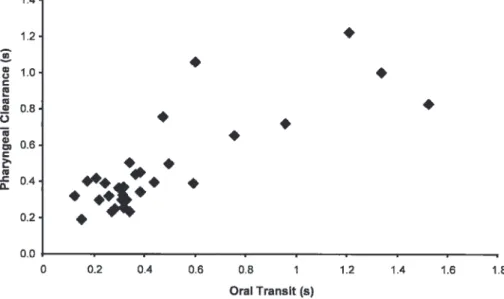
between the oral transit time and the pharyngeal clearance time of paste boluses was significant for both 5-ml (r: 0.71;
Figure 1) and 10-mL boluses (r: 0.64; Figure 2) (p,0.01). DISCUSSION
Our results indicate that paste boluses require a longer pharyngeal clearance time than liquid boluses and demon-strate a positive correlation between the oral transit time and pharyngeal clearance time during paste-bolus ing. Although the oral and pharyngeal phases of swallow-ing are independent, we found that a relationship exists between the two phases for paste boluses.
Such factors as bolus consistency and volume and the subject’s gender and age affect the temporal relationship of the onset of specific motor events.5It has been consistently observed that paste boluses cross the pharynx more slowly than do liquid boluses.4,5,7,8
Compared to less viscous boluses, boluses with high viscosity exhibit increases in the duration of oral ejection, the duration of UES opening, the deglutitive tongue force, and the duration of the hyoid movement.4,7,9,10The results of this investigation suggest that the oral and pharyngeal phases of swallowing paste boluses may be related to each other; i.e., as a consequence of a slower oral transit, the duration of the bolus’s transport through the pharynx increases.
Pharyngeal transit times and intrabolus pressure within the hypopharynx increase with increasing bolus consis-tency.3 This finding is in agreement with the findings of scintigraphy studies that suggest that increased bolus consistency is associated with slower pharyngeal transit.11
There is no change in the velocity of pharyngeal propagation contraction with alterations in bolus consis-tency, but the pressure difference between the bolus head and the bolus tail increases sharply.12 Greater pressure is applied to viscous boluses to maintain their transfer velocity through the pharynx; thus, the normal pharynx has adequate reserves to compensate for boluses of a thicker consistency.12A lack of velocity alterations to propagation contractions is associated with no alterations of bolus transit duration with increasing bolus consistency. Manometry studies have revealed an increase in UES relaxation duration with bolus viscosity increases in younger adults who swallowed a volume of 10 ml. This relationship was not observed in older subjects or when swallowing smaller volumes (5 ml).2
Table 1 -Duration, in seconds, of oral and pharyngeal transit times and pharyngeal clearance time after swallowing two volumes (5 ml and 10 ml) of liquid and paste boluses.
Liquid Paste
MEAN (SD) 95% CI MEAN (SD) 95% CI p-value
Oral transit time 0.42 (0.23) 0.36-0.48 0.41 (0.28) 0.34-0.49 0.72
Pharyngeal transit time 0.22 (0.09) 0.20-0.24 0.23 (0.07) 0.21-0.25 0.17
Pharyngeal clearance time 0.38 (0.11) 0.35-0.41 0.48 (0.27) 0.41-0.55 0.03
CI – Confidence interval. SD – Standard deviation.
Oral and pharyngeal transit correlation
Cassiani RA et al. CLINICS 2011;66(8):1385-1388
On the other hand, authors have claimed that orophar-yngeal swallowing represents a synergy of overlapping and interdependent events that propel the bolus through the oropharyngeal cavities, close the valves critical for airway protection, and open the valves necessary for bolus entry into the esophagus.13The stereotypic movements of each phase of swallowing are controlled by the pattern-generating circuitry of the brain.1 The oral phase is voluntarily initiated at the subject’s discretion, but the pharyngeal and esophageal phases of swallowing occur in response to stimulation of the pharynx and esophagus by the bolus.1
It has also been reported that an increase in bolus volume has no effect on oral and pharyngeal bolus transit time or on the duration of pharyngeal peristaltic waves but leads to prolonged UES opening, longer laryngeal closure duration and longer swallowing apnea.2,14,15In this study, we found
no relationship between increased bolus volume and oral and pharyngeal transit times or pharyngeal clearance for the consistencies tested. The increased UES opening duration with increased bolus volume is actually a consequence of the earlier opening of the UES to accommodate a larger bolus.2
The aging process causes prolonged oral transit, pro-longed pharyngeal transit and propro-longed pharyngeal clearance.16 Because we included volunteers over the age of 60 years, it is possible that some mild swallowing abnormalities were present in some subjects. However, evaluations of the correlation between the oral and pharyngeal phases of swallowing performed in the same subjects revealed a positive correlation between the dura-tions of these phases of swallowing. Prolonged oral transit was followed by prolonged pharyngeal transit duration. All of the volunteers were asymptomatic.
Figure 1 -The correlation between oral transit time and pharyngeal clearance time after swallowing a 5-ml paste bolus. The Spearman coefficient (r) was 0.71.
Figure 2 -The correlation between oral transit time and pharyngeal clearance time after swallowing a 10-ml paste bolus. The Spearman coefficient (r) was 0.64.
CLINICS 2011;66(8):1385-1388 Oral and pharyngeal transit correlation Cassiani RA et al.
In conclusion, for paste boluses, there was a relationship between the oral transit duration during swallowing and the pharyngeal clearance of the bolus. Slower oral transit was associated with slower pharyngeal clearance.
REFERENCES
1. Lang IM. Brain stem control of the phases of swallowing. Dysphagia. 2009;24:333-48, doi: 10.1007/s00455-009-9211-6.
2. Butler SG, Stuart A, Castell DO, Russel BG, Koch K, Kemp S. Effects of age, gender, bolus condition, viscosity, and volume on pharyngeal and upper esophageal sphincter pressure and temporal measurements during swallowing. J Speech Lang Hear Res. 2009;52:240–53, doi: 10. 1044/1092-4388(2008/07-0092).
3. Castell JA, Dalton CB, Castell DO. Effects of body position and bolus consistency on the manometric parameters and coordination of the upper esophageal sphincter and pharynx. Dysphagia. 1990;15:179–86, doi: 10.1007/BF02412685.
4. Dantas RO, Kern MK, Massey BT, Dodds WJ, Kahrilas PJ, Brasseur JG, et al. Effect of swallowed bolus variables on oral and pharyngeal phases of swallowing. Am J Physiol. 1990;258:G675-81.
5. Mendell DA, Logemann JA. Temporal sequence of swallow events during the oropharyngeal swallow. J Speech Lang Hear Res. 2007; 50:1256-71, doi: 10.1044/1092-4388(2007/088).
6. Shall R. Estimation in generalized linear models with random effects. Biometrika. 1991;78:719-27, doi: 10.1093/biomet/78.4.719.
7. Perlman AL, Schultz JG, Van Daele DJ. Effects of age, gender, bolus volume, and bolus viscosity on oropharyngeal pressure during swallow-ing. J Appl Physiol 1993;75:33–7.
8. Taniguchi H, Tsukada T, Ootaki S, Yamada Y, Inoue M. Correspondence between food consistency and suprahyoid muscle activity, tongue pressure, and bolus transit times during the oropharyngeal phase of swallowing. J Appl Physiol. 2008;105:791–9, doi: 10.1152/japplphysiol. 90485.2008.
9. Pouderoux P, Kahrilas PJ. Deglutitive tongue force modulation by volition, volume, and viscosity in humans. Gastroenterology. 1995; 108:1418–26, doi: 10.1016/0016-5085(95)90690-8.
10. Lazarus CL, Logemann JA, Rademaker AW, Kahrilas PJ, Pajak T, Lazar R, et al. Effects of bolus volume, viscosity, and repeated swallows in nonstroke subjects and stroke patients. Arch Phys Med Rehabil. 1993;74:1066-70, doi: 10.1016/0003-9993(93)90063-G.
11. Okubo PCMI, Dantas RO, Troncon LEA, Moriguti JC, Ferriolli E. Clinical and scintigraphic assessment of swallowing of older patients admitted to a tertiary care geriatric ward. Dysphagia. 2008;23:1-6, doi: 10.1007/ s00455-007-9087-2.
12. Raut VV, McKeeGJ, JohnstonBT. Effect of bolus consistency on swallowing – does altering consistency help? Eur Arch Otorhino-laryngol. 2001;258:49–53, doi: 10.1007/s004050000301.
13. Martin-Harris B, Michel Y, Castell DO. Physiologic model of orophar-yngeal swallowing revisited. Otolaryngology–Head and Neck Surgery. 2005;133:234-40, doi: 10.1016/j.otohns.2005.03.059.
14. Kendall KA, McKenzie S, Leonard RJ, Gonc¸alves MI, Walker A. Timing of events in normal swallowing: A videofluoroscopic study. Dysphagia. 2000;15:74–83.
15. Tsukada T, Taniguchi H, Ootaki S, YamadaY, Inoue M. Effects of food texture and head posture on oropharyngeal swallowing. J Appl Physiol 2009;106:1848–57, doi: 10.1152/japplphysiol.91295.2008.
16. Cook IJ, Weltman MD, Wallace K, Shaw DW, Mckay E, Smart RC, et al. Influence of aging on oral – pharyngeal bolus transit and clearance during swallowing: scintigraphic study. Am J Physiol. 1994;265:G972–7.
Oral and pharyngeal transit correlation
Cassiani RA et al. CLINICS 2011;66(8):1385-1388