DOI: 10.1590/0004-282X20150077
ARTICLE
Combination of pharmacotherapy and lidocaine
analgesic block of the peripheral trigeminal
branches for trigeminal neuralgia: a pilot study
Combinação de farmacoterapia e bloqueio analgésico com lidocaína sobre os ramos
periféricos trigeminais no tratamento da neuralgia do trigêmeo: um estudo piloto
Fabrizio Di Stani1 , Christine Ojango2 , Demo Dugoni1 , Luigi Di Lorenzo3 , Salvatore Masala2 , Roberto Delfini1 ,
Gianluca Bruti1, Giovanni Simonetti2, Elcio Juliato Piovesan4, Andrea Gennaro Ruggeri1
Classical trigeminal neuralgia (CTN) is a disorder char-acterized by recurrent unilateral brief electric shock-like pains, abrupt in onset and termination, limited to the distri-bution of one or more divisions of the trigeminal nerve and
triggered by innocuous stimuli. here may or may not be,
additionally, persistent background facial pain of moderate intensity. In general, the recurrent episodes prevail for a few seconds, although the duration of pain clusters may extend up to 2 minutes1. he episodes are caused by trivial
non-nociceptive stimuli, including eating, yawning, touching,
feeling cold or warm2,3,4. he CTN patients describe “trigger
zones” or speciic facial areas, where these stimuli provoke
pain2. CTN developes without apparent cause other than
neurovascular compression1.
he incidence of CTN is 4-5 per 100,000 persons per year and the disorder is more common in females over 50 years3,4,5.
he evidence of pressure to the trigeminal nerve from a
vascular structure in CTN has been shown in various cases
with imaging indings of artery crossing the nerve and/or pro -voking displacement3. In addition, intra-operative recordings
1University of Rome “La Sapienza”, Department of Neurology and Psychiatry, Neurosurgery A, Rome, Italy;
2University of Rome “Tor Vergata”, Department of Diagnostic and Molecular Imaging, Interventional Radiology and Radiation Therapy, Rome, Italy; 3“Rummo” Hospital, Rehabilitation Unit, Neuroscience Department, Benevento, Italy;
4Universidade Federal do Paraná, Hospital de Clínicas, Departamento de Clinica Médica, Especialidade de Neurologia, Curitiba PR, Brazil.
Correspondence: Fabrizio Di Stani; Via Sallustio Bandini, 10 – 00191; Rome Italy; E-mail: [email protected]
Conlict of interest: There is no conlict of interest to declare.
Received 08 November 2014; Received in inal form 19 March 2015; Accepted 08 April 2015. ABSTRACT
Classical trigeminal neuralgia (CTN) is treated predominantly by pharmacotherapy but side effects and unsuccessful occurs. The current study was carried out to evaluate the therapeutic effect of combination of pharmacotherapy and lidocaine block. Thirteen patients with CTN managed with pharmacotherapy were recruited and assigned either to no additional treatment (Group I) or to additional analgesic block (Group II). The primary endpoint was the reduction in the frequency of pain episodes in a month assessed at 30 and 90 days. Comparisons of measurements of pain, general health and depression scales were secondary endpoints. The results from the follow-up visits at 30 and 90 days showed the Group II to have larger reduction in the frequency of pain and exhibited a bigger improvement in the scores of the pain, general health and depression scales. The results from this preliminary study suggest a clinical beneit of the combination of pharmacotherapy and lidocaine block.
Keywords: analgesic block, classical trigeminal neuralgia, lidocaine, treatment.
RESUMO
A neuralgia clássica do trigêmio (NTC) é tratada predominantemente por drogas, porém efeitos colaterais e falhas terapêuticas ocorrem. Avaliamos o efeito terapêutico da combinação entre farmacoterapia e bloqueio analgésico utilizando a lidocaína. Treze pacientes portadores de NTC tratados com farmacoterapia foram divididos em dois grupos: Grupo I pacientes que mantiveram somente tratamento medicamentos e Grupo II pacientes que associaram bloqueio anestésico. O objetivo primário do estudo foi à redução da freqüência da dor 30 e 90 dias após o bloqueio. Secundariamente avaliamos o impacto sobre as escalas de depressão, dor e qualidade de vida. O grupo II teve uma redução signiicativa na freqüência da dor e uma melhora nos escores de qualidade de vida, dor e escala de depressão. Os resultados sugerem um benefício clinico da combinação de farmacoterapia e bloqueio anestésico no tratamento da NTC.
and the clinical improvement after de-compression are
evi-dences of the presence of neurovascular conlict2. he pres
-sure to the nerve is thought to cause de- and remyelination with the resulting of increased nerve excitability and mani-festation of pain impulses3.
he irst-line treatment for CTN pain is carbamaze -pine and oxcarbaze-pine6. Other anticonvulsants, such as
lamotrigine, and the muscle relaxant baclofen are used as second-line therapy2.In about 30% of cases the pharmaco
-logical approach is not suicient to control pain. he phar
-macotherapy may produce side-efect, commonest being
drowsiness, ataxia and decrease mental acuity5. he surgi
-cal management approaches include decompression of the trigeminal nerve or lesioning of the nerve or trigeminal gan-glion2. he choice of the surgical management depends on
patient’s age and co-morbidities, duration of symptoms and on the response to the pharmacotherapy, as
procedure-relat-ed complications have been reportprocedure-relat-ed with sensory deicit be -ing the most common6.
As an alternative management, trigeminal nerve block with local anaesthetics could be considered in combina-tion with pharmacotherapy7,8. he scope of this study was
to evaluate the clinical beneit of combination of pharma -cotherapy and lidocaine analgesic block in CTN patients.
hus, this preliminary study attempts to generate hypoth -eses for future randomised controlled study to evaluate the
eiciency of combination therapeutic approach in CTN
pain management.
METHOD
Study design and patients
All subjects seen for the irst time between may 2008 and september 2009 were recruited from the out-patient
neurosurgery department of the general hospital of the
University of Rome “La Sapienza”. All enrolled patients were diagnosed with CTN according to the IHS 2004 criteria9 and were retrospectively conirmed to be eligible according to IHS criteria 20131. Patients with symptomatic trigeminal
neuralgia were not included to the study. Additional
exclu-sion criteria were age < 18 years, diabetes mellitus or intol -erance to glucose, cardiac arrhythmias, coagulation dis-eases, pregnancy or lactation and sensibility to lidocaine. Ethics committee approval was acquired before the start of the study and all patients gave written informed consent before the enrolment.
Procedure
All patients were started with or were already previous-ly on the pharmacological therapy for the trigeminal neu-ralgia. Patients were randomly assigned to one of the two following treatment groups. Patients in Group I were treat-ed over the whole study period only with pharmacological
medications. In Group II, patients received in addition to their per os medication one injection of lidocaine to the trigger points. After the initial visit and conformation of eli-gibility, patients enrolled into Group II, were given the ap-pointment for the analgesic block with lidocaine injection.
he treatment procedure of analgesic block of the periph
-eral trigeminal branches was performed with 2-4 cc of 2 % lidocaine. he injection was done in supine position with
vertebral column in neutral position. After the application of the antiseptic on the area of interest, the injection with li-docaine was performed on one or on several levels of the ex-its of the three branches of the trigeminal nerve (V1, supra-orbital foramen; V2, infrasupra-orbital foramen; V3, mandibular foramen). After the procedure patients were monitored for 1 hour for early complications and subsequently discharged from hospital.
Evaluations
he patients were assessed 3 times during the study du
-ration. he irst visit (T = 0) was followed by a second visit at 30 days (T = 1) and a third visit at 90 days (T = 2) after the be
-ginning or modiication of the pharmacotherapy (Group I) or after lidocaine injection (Group II). he irst visit (T = 0) was
consisted of the assessment of neurological status and the evaluation of pain and quality of life scales in patients eligi-ble for the study. Baseline evaluations of routine blood tests, electrocardiography and neuroradiological evaluation with magnetic resonance and magnetic resonance angiography
with arterial and venous phase were performed. he latter
imaging data was acquired to exclude symptomatic
trigemi-nal neuralgia and the itrigemi-nal conirmation of eligibility was as -sessed according to the imaging data. During the follow-up
visits T = 1 and T = 2 patients in both groups were assessed
for the frequency of pain episodes in a month and with
qual-ity of life, depression and intensqual-ity of pain scales. he follow -ing scales as measures were recorded dur-ing the initial and
the follow-up visits: he Medical Outcomes Trust 36-Item Short Form Health Survey (SF-36®), Brief Pain Inventory (BPI)
and Beck Depression Inventory (BDI). All of these scales have been well validated and used extensively in clinical trials and pain management.
Case series analysis
Descriptive statistics including mean and standard
de-viation (SD) were calculated for demographic and clinical characteristics of the study patients in both groups. he
outcome measures for each patient was the frequency of
pain attacks in a month measured at T = 1 and T = 2 and expressed as a percentage relative to the baseline (0%- free from attacks; 100% same frequency of attacks as at base
-line) and measures on the assessment scales. he patients were asked to report any adverse efects to the physician
RESULTS
hirteen patients with classical trigeminal neuralgia, who met the IHS 2004 criteria9, were recruited. All patients seen were ofered to participate and none declined or dropped out. Seven patients were allocated to Group I, in which pa -tients received only pharmacological treatment for CTN pain during the whole study duration. In Group II six patients un-derwent regional analgesic block of the peripheral
trigemi-nal branches in addition to their pharmacotherapy. he gen -eral characteristics of patients in Group I and Group II are summarized in Table 1. Table 2 shows the results of the
base-line assessments of SF-36®, BPI and BDI scales separately in
both groups. Pharmacotherapy was not the same in all the patients, although carbamazepine was the commonest drug prescribed to the study patients, followed by oxcarbazepine, gabapentin and lamotrigine.
At the irst follow-up visit (T = 1) at 30 days patients in
Group I reported more pain episodes in a month (mean
18.11 ± 10) than patients in Group II (mean 8.33 ± 5,.16). Similarly, during the second follow-up visit at 90 days there was an evident diference of frequency of pain attacks be
-tween Group I (mean 22.1 ± 9.9) and Group II (mean 6.5 ± 7.1).
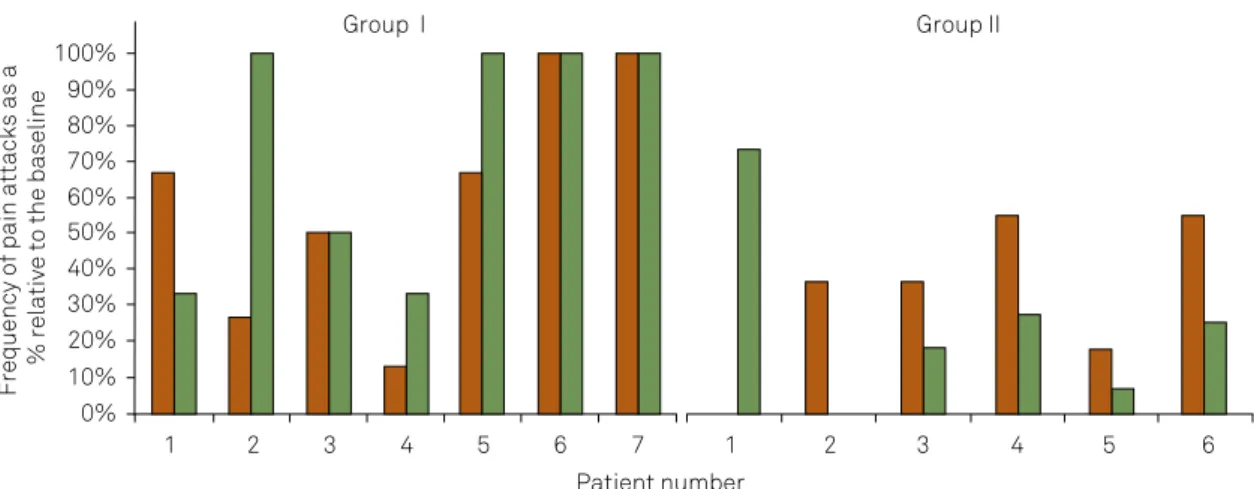
A side-by-side group comparison on individual subjects was made and the absolute frequency measures in follow-up studies were adjusted with baseline measurements in all pa-tients, in order to visualise the residual pain.In Figure 1 the
frequency of pain attacks in a month expressed as a
percent-age relative to the baseline (0%- free from attacks; 100% same
frequency of attacks as at baseline) for all patients in both
groups is shown. As seen in the Figure 1 patients in Group
I had smaller pain frequency changes from the baseline in both follow-up visits, while patients in Group II the changes
were bigger. he average of the frequency of pain attacks in a
month expressed as a percentage relative to the baseline or
residual pain in both groups is presented in Figure 2. he results of SF-36®, BPI and BDI scales showed the ten -dency of improved scores in the group who received the
Table 1. Baseline characteristics and clinical data of study patients.
Demographic characteristics of study patients.
Group I Group II
Age (years) Mean ± SD 63.0 11.8 68.2 10.8
Gender Women n % 4 57.1 4 66.7
Duration of symtoms (years)
Mean ± SD 5.0 2.90 16.8 9.20
Symtomatic facial side Right n % 2 28.6 3 50
Left n % 5 71.4 3 50
Pain location (trigeminal branches)
V2 or V3 n % 3 42.9 3 50
V1 + V2 or V2 + V3 n % 4 57.1 2 33.3
V1 + V2 + V3 n % 0 1 16.7
Frequency of pain attacks
dd/month 30 28.3
SD: standard deviation; n: number of patients; dd/month: days per month.
Table 2. Baseline assessment of SF-36®, BDI and BPI scales.
Group I Group II Mean ± SD Mean ± SD
SF-36 physical functioning 50.7 35.76 66.7 26.39
SF-36 physical role functioning 25.7 36.56 25 38.73
SF-36 bodily pain 25.9 14.38 39.8 21.18
SF-36 general health perceptions 38.6 19.32 46 11.88
SF-36 vitality 43.1 18.37 50 14.83
SF-36 social role functioning 39.2 25.45 52 14.71
SF-36 mental health 34.3 25.81 60.7 19.66
SF-36 emotional role functioning 19.6 26.59 38.9 49.07
BDI 26.7 16.18 14 11.24
BPI severity index 5.1 1.999 5.3 2.558
BPI interferference index 4.3 1.599 3.4 3.354
Baseline assessment of The Medical Outcomes Trust 36-Item; SF-36®: Short Form, Health Survey; BDI: Beck Depression
Inventory; BPI: Brief Pain Inventory scales.
Frequency of pain attacks as a
% relative to the baseline
100% 90% 80% 70% 60% 50% 40% 30% 20% 10% 0%
1 2 3 4 5 6 7
Patient number
Group II Group I
1 2 3 4 5 6
combination treatment during both follow-up visits of T = 1 and T = 2. he Figure 3 represents the values of the assess
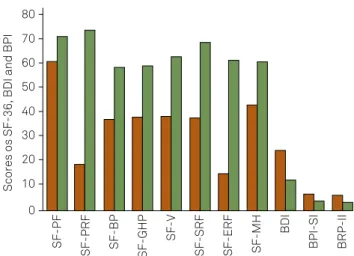
-ment scales during the follow-up visit 30 days post-injection. Figure 4 represents the scores after 90 days. Group I had in all of the SF-36® sections smaller scores and in Group II the
scores were higher, thus patients in Group II exhibited less-er disability and bettless-er emotional and physical functioning.
Although, the BPI and BDI results did not difer remarkably,
the tendency of lower depression and pain scores in Group II was noted. No systemic reactions were recorded and no injection-related adverse events of haematoma, itching or pain at the site of injection was reported.
Due to the small number of patients the statistical
analy-sis was not done to evaluate the diferences in frequency of
pain episodes in a month and to evaluate the values of the assessment scales.
DISCUSSION
he scope of the present study was to evaluate the ei -cacy of combination therapy of pharmacological treatment and the trigeminal nerve block with lidocaine in patients
with classical trigeminal neuralgia. he previous studies with
combination therapy of pharmacological treatment and an-algesic injections for peripheral branches of the trigemi-nal nerve pain management have shown promising results.
Han et al., evaluated high concentration of lidocaine for
trigeminal nerve block in patients with TN7. Eleven of 35 pa
-tients in the cited study experienced complete pain relief and general pain scores following the analgesic block were
mark-edly reduced compared to pre-treatment scores. he other study by Lemos et al. evaluated the protocol of gabapentin in association with ropivacaine block8. he clinical beneit
in this combination management was found to be
improve-ment of visual analogue scores (VAS) of pain until 28 days after the treatment. he results of the present study with in
-jections of 2% lidocaine are in accordance with these previ -ous studies of using local analgesic drug as a complementary treatment for pain management in CTN patients. Our study showed reduced frequency in both of the study groups, but more evident in the group which received the combination of pharmacological treatment and analgesic injection. In addi-tion, in the present study patients treated with combination therapy presented in follow-up visits with improved quality
of life (as assessed with several SF-36® scores), with less pain
(as assessed with BPI scale) and with less depression (as as-sessed with BDI scores).
he efect of the combination therapy was evident in both follow-up studies of 30 days and 90 days. In clinical practice
lidocaine is used as a local anaesthetic due to its rapid onset
Scores os SF-36, BDI and BPI
80
70
60
50
40
10 20 30
SF-PRF
SF-PF
SF-GHP
SF-BP
SF-SRF
SF-V
SF-MH
SF-ERF
BDI
BRP-II
BPI-SI
0
Figure 4. Assessment of scales at T = 2. Brown: Group I; Green: Group II. SF-36 dimensions: SF-PF - physical
functioning, SF-PRF - physical role functioning, SF-BP - bodily pain, SF-GHP- general health perception, SF-V- vitality, SF-SRF - social role functioning, SF-ERF - emotional role functioning, SF-MH - mental health, BDI- Beck Depression Inventory, BPI-SI - Brief Pain Inventory Severity Index, BPI-II - Brief Pain Inventory Interference Index.
Scores os SF-35, BDI and BPI
90
80
70
60
50
40
10 20 30
SF-PRF
SF-PF
SF-GHP
SF-BP
SF-SRF
SF-V
SF-MH
SF-ERF
BDI
BRP-II
BPI-SI
0
Figure 3. Assessment of scales at T = 1. Brown: Group I; Green: Group II. SF-36 dimensions: SF-PF - physical functioning, SF-PRF - physical role functioning,
SF-BP - bodily pain, SF-GHP- general health perception, SF-V- vitality, SF-SRF - social role functioning, SF-ERF - emotional role functioning, SF-MH - mental health, BDI- Beck Depression Inventory, BPI-SI - Brief Pain Inventory Severity Index, BPI-II - Brief Pain Inventory Interference Index.
Frequency of pain attacks
as a % relative to the baseline
100% T = 1 T = 2
T = 1 T = 2
20%
0% 10% 50%
30% 40% 80% 90%
60% 70%
Group I Group II
and relatively short duration of the pharmacological action.
he mechanism of the prolonged analgesic efect of the lido
-caine injections, however, is not entirely clear. he prolonged efect of lidocaine injections on CTN has been described also in the study by Han et al.. In that study the pain free
inter-val after the nerve block was from 3 weeks up to 172 weeks7.
he longer duration efect of the local analgesic is assumed to
be partly due to the physical action of the analgesic drug by
clearing adhesions or inlammatory exudates from the vicin -ity of the nerve7.
Several limitations of the study should be mentioned. First, the study included a very small number of patients. his
is due to fact that classical trigeminal neuralgia is relatively
rare disorder. Furthermore, patients who were recruited from
pain centers exhibited facial neuralgia symptoms already for
many years. In standard clinical practice the irst-line phar
-macological medical treatment is ofered for CTN patients
and most of patients who were recruited had developed
re-fractory to the irst-line treatment. It would be of interest to
evaluate the combination therapy also in the initial phase of the disease. Due to the small number of recruited patients
into the study no speciic statistical analyses was performed
and the results were evaluated qualitatively as case series in
References
1. Headache Classiication Committee of the International Headache Society (IHS). The International Classiication of Headache Disorders, 3rd edition (beta version). Cephalalgia. 2013;33(9):629-808. http://dx.doi.org/10.1177/0333102413485658
2. Nurmikko TJ, Eldridge PR. Trigeminal neuralgia pathophysiology, diagnosis and current treatment. Br J Anaesth. 2001;87(1):117-32. http://dx.doi.org/10.1093/bja/87.1.117
3. Kleef M, Genderen WE, Narouze S, Nurmikko TJ, Zundert J, Geurts JW et al. Trigeminal neuralgia. Pain Pract. 2009;9(4):252-9. http://dx.doi.org/10.1111/j.1533-2500.2009.00298.x
4. Love S, Coakham HB. Trigeminal neuralgia: pathology and pathogenesis. Brain. 2001;124(12):2347-60. http://dx.doi.org/10.1093/brain/124.12.2347
5. Joffroy A, Levivier M, Massager N. Trigeminal neuralgia:
pathophysiology and treatment. Acta Neurol Belg. 2001;101(1):20-5.
6. Obermann M. Treatment options in trigeminal neuralgia. Ther Adv Neurol Disorder. 2010;3(2):107-15. http://dx.doi.org/10.1177/1756285609359317
7. Han KR, Kim C, Chae YJ, Kim DW. Eficacy and safety of high concentration lidocaine for trigeminal nerve block in patients with trigeminal neuralgia. Int J Clin Pract. 2008;62(2):248-54. http://dx.doi.org/10.1111/j.1742-1241.2007.01568.x
8. Lemos L, Flores S, Oliveira P, Almeida A. Gabapentin supplemented with ropivacain block of trigger points improves pain control and quality of life in trigeminal neuralgia patients when compared with gabapentin alone. Clin J Pain. 2008;24(1):64-75. http://dx.doi.org/10.1097/AJP.0b013e318158011a
9. Headache Classiication Subcommittee of the International Headache Society. The International Classiication of Headache Disorders 2nd Edition. Cephalalgia. 2004;24 Suppl 1:9-160. this preliminary study. he qualitative results, however, are
encouraging in order to set-up an extended study with ran-domised controlled trial.
In most CTN cases the pharmacological treatment is ef-fective in the initial phase and the pharmacological
treat-ment is usually maintained until it is efective. However, the pharmacological medication is not suicient in all pa -tients and over the course of the disease pa-tients may de-velop refractoriness to the pharmacological treatment and often patients seek the alternative methods for their pain management. As the procedure of lidocaine analgesic injec-tion is simple and safe, it can be recommended for patients,
whose pain is not controlled suiciently with only pharma -cological drugs or to patients who have contra-indications for surgical intervention.
In conclusion, the combination of pharmacological ther-apy and lidocaine analgesic block of peripheral branches of the trigeminal nerve were able to achieve considerably lesser frequency of CTN pain attacks in a month than pain man-agement with only the pharmacological therapy. In addition, to the reduction of frequency of CTN pain crises, the results showed consistent reduction of pain and improvement in the