Magnitude and trend of
American Tegumentary
Leishmaniasis in the State of São
Paulo, Brazil, 1975 to 2008
Magnitude e tendência da
Leishmaniose Tegumentar
Americana no Estado de São Paulo,
Brasil, 1975 a 2008
Rubens Antonio da Silva
Vanessa Taís Cruz Mercado
Lúcia de Fátima Henriques
Ricardo Mário de Carvalho Ciaravolo
Dalva Marli Valério Wanderley
Departamento de Combate a Vetores - Superintendência de Controle de Endemias - Secretaria de Estado da Saúde de São Paulo
Correspondência: Rubens Antonio da Silva. Departamento de Combate a Vetores, Superinten-dência de Controle de Endemias, Secretaria de Estado da Saúde de São Paulo. Rua Paula Sousa 166, 1º andar, Luz, CEP 01027-000 São Paulo, SP. E-mail: [email protected]
Abstract
The aim of this study was to analyze the mag-nitude and trend of American Tegumentary Leishmaniasis (ATL) in the State of São Paulo from 1975 to 2008. An ecological study that classified municipalities according to the magnitude of transmission was performed. From 1975 to 1985, 1,281 cases of ATL were registered in 45 municipalities, rising to 258 municipalities and 4,093 cases from 1986 to 1995; and reaching 385 municipalities and
7,604 cases from 1996 to 2008. Lutzomyia
intermedia s.l. was collected in most of the entomological surveys. In the classification of municipalities according to magnitude, 67.5% were observed to have a “small magnitude,” 19.2% “moderate magnitude” and 13.3% “high magnitude.” The highest incidences of ATL have been restricted to underserved areas close to the Atlantic fo-rest. There was an increase in the number of municipalities with small occurrence of cases and expansion in the area of risk.
Resumo
O objetivo deste estudo foi analisar a magnitude e tendência da Leishmaniose Tegumentar Americana (LTA) no Estado de São Paulo entre 1975 e 2008. Foi condu-zido um estudo ecológico que categorizou os municípios segundo a magnitude da transmissão. No período de 1975 a 1985, 45 municípios foram responsáveis pelo registro de 1.281 casos de LTA, passando a 258 mu-nicípios e 4.093 casos entre 1986 e 1995, e a 385 municípios e 7.604 casos entre 1996 a
2008. O vetor Lutzomyia intermedias.l. foi
coletado na maioria das pesquisas ento-mológicas. Na classificação dos municípios segundo a magnitude pode-se verificar que 67,5% possuíam “pequena magnitude”, 19,2% “média magnitude” e 13,3% “grande magnitude”. As maiores incidências de LTA permanecem restritas a algumas áreas car-entes e próximas à Mata Atlântica. Houve aumento no número de municípios com pequena ocorrência de casos e ampliação da área de risco.
Palavras-chave: Leishmaniose Tegumentar Americana. Vigilância entomológica. Controle. Epidemiologia. Estado de São Paulo. Brasil.
Introduction
T h e A m e r i c a n Te g u m e n t a r y Leishmaniasis (ATL) is a zoonosis widely spread around the American continent, extending from the Southern United States to northern Argentina. It is considered to be one of the most relevant infectious
diseases in this continent1. In the last 20
years, in Brazil, the number of ATL cases and its geographic occurrence have in-creased. Currently, this disease is found in all Brazilian states, with different
epidemio-logical profiles and transmission patterns2.
In the state of São Paulo, ATL is an endemic disease transmitted by insects of the Order Diptera, Family Psychodidae,
mostly belonging to the genus Lutzomyia
and having two epidemiological patterns of transmission: the first one involves human beings coming into contact with the wild enzootic cycle; and the second one involves household transmission and human beings, synanthropic animals and Phlebotominae species that are adapting to rural and
peri-urban environments3, in areas where the
natural environment has greatly changed. Currently, the ATL transmission in the state of São Paulo is considered to remain associ-ated with the place where the case has been recorded and the woods; this disease has affected all age groups regardless of gender. In the past, ATL had a localized geographi-cal aspect and high incidence in workers
who performed forest-related activities4.
This situation changed with the years and a new epidemiological profile appeared in the 1970s, in which the occurrence of sporadic and/or small outbreaks characterizes the current pattern of ATL transmission in the state of São Paulo5 6 7.
The steady increase in the number of cases led to the formation of an inter-institu-tional group in 1993, under the coordination
of the Centro de Vigilância Epidemiológica
da Secretaria de Estado da Saúde de São Paulo (CVE/SES/SP – State of São Paulo Department of Health Epidemiological Surveillance Center) and participation
Endemias (SUCEN – Center for Endemic
Disease Control) and Instituto Adolfo Lutz
(IAL – Adolfo Lutz Institute) to reassess the Technical Norms of American Tegumentary Leishmaniasis Epidemiological Surveillance and Control. In this group, SUCEN was responsible for the assessment and devel-opment of an information system for ento-mological surveillance, case reporting and
feedback of information to Health Services9.
The Surveillance System is defined as a passive system, where reports derived from the public health network through primary health centers (PHC) are mandatory when a case is confirmed. Nonetheless, although ef-forts have been made for prompt reporting, the underreporting of an important number
of cases is still observed9.
With regard to entomological
surveil-lance, Lutzomyia intermedia s.l. (Lutz &
Neiva, 1912) has been pointed out as the most important taxon in the current epide-miological profile of ATL in the state of São Paulo, due to its predominance in altered environments and constant presence in
the intra and peridomicile7 10 11 12 13, although
being considered as a well-defined species
complex: Lu. intermedia s.str. and Lutzomyia
neivai14 15. However, transmission cannot
be only attributed to Lu. intermedia s.str.
10 16. This taxon has a major role as a vector
of Leishmania (Viannia) braziliensis in the
home environment, whereas Lutzomyia
whitmani (Antunes & Coutinho, 1939) and
Lutzomyia migonei (France, 1920) have this
role in the out-of-home environment17.
The present study aimed to analyze the magnitude and trend of ATL in the cities of the state of São Paulo, between 1975 and 2008, with the purpose of supporting the control program developed by the state.
Methods
An ecological descriptive study was conducted to analyze secondary data on au-tochthonous ATL cases and their geographi-cal distribution, obtained from the CVE/ SES/SP between 1975 and 2008; and infor-mation about the entomological surveys
conducted by SUCEN and originated from the confirmation of autochthonous cases between 1985 and 2008.
The entomological survey methodolo-gies used were as follows: without luminous bait, in a resting place, in the intradomicile or on the walls of outbuildings, with a mini-mum duration of three hours, using Castro traps, a deadly chamber or manual aspirator on the inner walls of the home with the use of the sheet technique when these walls are not dark or plastered; with luminous bait, using CDC electric traps installed in differ-ent points of the possible place of transmis-sion in the home, from dusk to dawn, with a duration of 12 hours; and Shannon trap for three hours after dusk, preferably situated in the peridomicile or by the edge of the
woods when these are close to the home8.
The objective of the entomological traps is to identify the vector species instead of quantifying it. Species were classified ac-cording to the classification developed by
Young & Duncan, 199418.
In the present study, the Lu. intermedia
s.l. classification was taken into
consider-ation rather than Lu. intermedia s.str. or
Lu. neivai, due to the data found in the databases referring to information previous to the distinction of this species complex.
Mean incidence rates were calculated from autochthonous cases reported to the CVE/SES/SP. The dates when clinical manifestations of each case reported be-tween 1998 and 2008 began to occur were considered for these incidences.
Cities were classified based on the magnitude of occurrence of cases as “small magnitude” (occurrence of 1 to 5 cases), “average magnitude” (occurrence of 6 to 20 cases) and “great magnitude” (occurrence of 20 or more cases) and analyzed according to their environmental characteristics, their ATL incidence rates and magnitude.
The figures that show the occurrence of vectors were developed with data from
Pessoa and Barretto4 in the 1940s and
(1996)14 and Andrade-Filho et al. (2003 and
2007)19,20 on Lutzomyia intermedia and
Lutzomyia neivai, represented in this study by Lutzomyia intermedias.l.
This study was conducted with second-ary data derived from the SUCEN and CVE/ SES/SP and only grouped data were pub-lished. The research protocol was submitted to and approved by SUCEN.
Results
Between 1975 and 2008, the CVE/SES/SP recorded 12,978 autochthonous ATL cases distributed in 385 cities, with a predomi-nance of those situated in the areas mostly covered by the Atlantic Forest. From 1975 to 1985, 45 cities were responsible for the re-cording of 1,281 ATL cases, increasing to 258 cities and 4,093 cases from 1986 to 1995 and to 32.9% of cities affected from 1996 to 2008, thus representing a linear trend of increase
in number of cases (r2=0.5243) (Figure 1).
There was an increase in the number of cities in the state of São Paulo where 1 to 5 autochthonous cases of ATL were reported. Between 1986 and 1995, cities with 1 to 5 cases represented 58.9% and those with up to 20 cases represented 80.6%; between 1998 and 2008, these percentages were 67.5 and 86.7, respectively. A number higher than 20 cases was observed in 19.4% of the cities in the state from 1986 to 1995 and in 13.3% from 1998 to 2008.
The coefficients of accumulated mean incidence between 1998 and 2008 were cal-culated and they varied from 0.00 to 152.48 cases/ 100,000 inhabitants, when the high-est indices were found in cities mainly situ-ated in the eastern part of the state (Figure 2). The southeastern, northeastern and central-west regions of Brazil contributed with high percentages. In the classification of cities according to the magnitude of oc-currence of cases, 67.5% had a “small mag-nitude”, 19.2% had an “average magnitude” and 13.3% had a “great magnitude”.
The Lutzomyia intermedia s.l. vector was associated with the majority of ento-mological surveys conducted by SUCEN.
When compared to the distribution of Lu.
intermedia made by Pessoa and Barretto
(1948)4, an increase in its distribution area
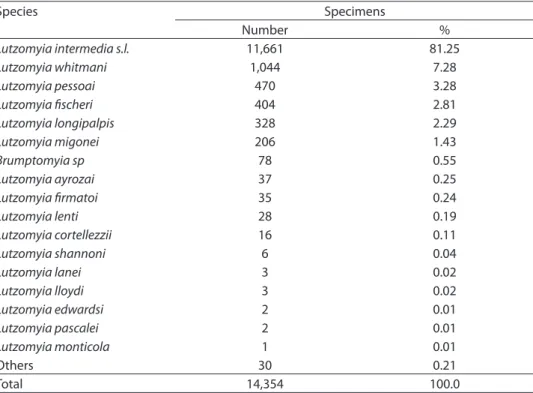
can be observed (Figure 3). Between 1998 and 2008, 14,354 Phlebotominae specimens
of 16 species of the genus Lutzomyia were
collected, mainly represented by Lu.
interme-dias.l. (81.25%), Lu. whitmani (7.28%) and
Lutzomyia pessoai (3.28%) (Table 1). When the 645 cities of the state and the entomologi-cal collections performed between 1985 and
2008 were considered, Lu. intermedia s.l. was
recorded in 148 of these cities (22.9%), Lu.
whitmani in 111 (17.2%), Lutzomyia fischeri
in 102 (15.8%), Lu. migonei in 87 (13.4%) and
Lu. pessoai in 66 (10.2%). Lower percentages were obtained for species of minor epidemio-logical importance.
Figure 1 - Number of autochthonous cases of American Tegumentary Leishmaniasis and municipalities afected by period. State of São Paulo, 1975 to 2008.
In possible areas of infection, the pres-ence of only one Phlebotominae species was observed in 41 (6.3%) cities of the state of São Paulo, two sub-species in 33 cities (5.1%), and a number higher than three species in 132 cities (20.5%).
The cross-over between ground cover
and geomorphological21 data and case
dis-tribution data, according to the magnitude between 1998 and 2008 and distribution of
ATL vectors between 1985 and 2008, enabled researchers to observe an increase in high-risk areas.
Discussion
In the first decades of the 20th century,
when the western part of the state of São Paulo was colonized, important endemic areas of ATL appeared, especially in the
Figure 2 - American Tegumentary Leishmaniasis in the State of São Paulo: (A) Cumulative incidence, 1998 to 2008, (B) Distribution of autochthonous cases according to the magnitude, 1998 to 2008.
Alta Sorocabana, Noroeste and Alta Paulista
regions22. After this stage, the cases were
concentrated in certain areas in a non-homogeneous way. Currently, the epide-miological status of ATL is characterized by the predominance of autochthonous cases with transmission occurring in the entire state and coinciding with the distribution of Phlebotominae vectors.
Higher incidence coefficients have been
observed in the southern, eastern, western and southeastern regions of the state of São Paulo. Previously known incidence areas increased and a great number of cases were recorded in new rural areas. The highest incidences of ATL remain restricted to cer-tain areas close to the Atlantic Forest in the state of São Paulo. There was an increase in the number of cities with a low occur-rence of cases (“small magnitude”). Cases
Figure 3 – State of São Paulo: Distribution of Lutzomyia intermedia according to Pessoa and Barretto4 (A) and Lu. intermedia s.l. from 1985 to 2008 (B).
are concentrated in growing populations, in areas with precarious housing and a low
per capita income23 and which are exposed
to the vector24, where control strategies must
emphasize measures directly associated with the human environment.
The presence of 17 Phlebotominae species indicates a high diversity, probably due to the diverse vegetation and terrain. The climate is a factor that affects the
dis-tribution of Lutzomyia species. The rise
in global temperature has an impact on climatic variability, enabling an increase in the density of Diptera species with an effect on the increase in ATL cases, which was ob-served with the El Niño Southern Oscillation
(ENSO) in certain places of Colombia25.
When the species found per city of the state are observed, even if they are in the same landscape features, one species or another seems to have a major role in ATL transmission, thus agreeing with data from
other authors11,26,27. In the past, during the
1930s and 1940s, ATL transmission was
as-sociated with Lu. whitmani, Lu. pessoai and
Lu. migonei, species with wild behavior28,29.
Currently, L. (V.) braziliensis is found to be
associated with a variety of Phlebotominae species with different transmission cycles in many geographic areas, where the vec-tor is present in and around homes and in
domestic animal shelters25.
Lu. intermedia s.l. has been pointed out as the most important taxon in the current epidemiological profile of ATL, due to its predominance in altered environments and constant presence in the intra- and peridomicile, corroborating the studies by
Shimabukuro et al.30. At that time, Pessoa
and Barretto (1948)4 classified the coastal
area of the state of São Paulo as an area with-out human cases or vectors and the Western Plateau as a high-endemicity area, where
Lu. whitmani and Lu. pessoai predominate.
Table 1 - Sand lies collected in entomological surveys at probable sites of transmission of leishmaniasis in the State of São Paulo, 1998 to 2008.
Tabela 1 – Flebotomíneos coletados em pesquisas entomológicas realizadas em locais prováveis de transmissão de Leishmaniose Tegumentar Americana no Estado de São Paulo, 1998 a 2008.
Species Specimens
Number %
Lutzomyia intermedia s.l. 11,661 81.25
Lutzomyia whitmani 1,044 7.28
Lutzomyia pessoai 470 3.28
Lutzomyia ischeri 404 2.81
Lutzomyia longipalpis 328 2.29
Lutzomyia migonei 206 1.43
Brumptomyia sp 78 0.55
Lutzomyia ayrozai 37 0.25
Lutzomyia irmatoi 35 0.24
Lutzomyia lenti 28 0.19
Lutzomyia cortellezzii 16 0.11
Lutzomyia shannoni 6 0.04
Lutzomyia lanei 3 0.02
Lutzomyia lloydi 3 0.02
Lutzomyia edwardsi 2 0.01
Lutzomyia pascalei 2 0.01
Lutzomyia monticola 1 0.01
Others 30 0.21
Total 14,354 100.0
In the present assessment, Lu. intermedia
s.l. was the main species involved in ATL
transmission in coastal areas and plateaus. The overlapping of distribution of species in the majority of cities with autochthonous cases of ATL indicates the need to perform longitudinal studies in different places as a strategy to understand the
transmis-sion cycles of Leishmania (V.) braziliensis.
According to Neves et al.31, it could be
as-sumed that the mere identification of one of the Phlebotominae species of greatest epidemiological importance already repre-sents a risk factor for ATL. In addition, this risk is not increased by the identification of more than one species.
The spatial distribution analysis of spe-cies in the state of São Paulo showed wide dispersion, although with a strong concen-tration in certain areas, enabling areas with lower endemicity or the occurrence of iso-lated cases to be identified. Phlebotominae species seem to occur in a distribution pattern, according to the natural ground cover, geomorphological aspects, isotherms and precipitation. Although certain wilder species have shown a different distribution pattern in the past and are associated with areas where there used to be woods, species with an endophilic behavior showed slight changes in distribution, when compared to literature data. Areas characterized as
of average endemicity by Neves (1999)24
became areas with a great magnitude of cases, including an abundance and diver-sity of vectors and resulting in the expan-sion of the ATL transmisexpan-sion area. This increase was also observed in the Pontal do Paranapanema region, in the westernmost part of the state, an area considered to be of low endemicity. There is a considerable level of exposure in this region, associated with farming population settlements that were formed and promoted the adapta-tion of mammal hosts and vectors to a new environment, resulting in an impact on
human health31.
The fact is that the onset of this infection is primarily associated with the migratory process and semi-urbanized areas where
the presence of domestic animals seems to
play a key role as new hosts of parasites24,31,32.
In this case, the infection only needs to enter the peridomestic cycle through synanthrop-ic (or domestsynanthrop-ic) animals and the disease will occur and increase due to unhealthy and precarious living conditions.
ATL is increasing in the state of São Paulo and the highest incidence rates are found in the Vale do Ribeira region, situated in the
southern part of this state33. Although this
region includes a great environmental and cultural heritage, it lacks sanitation infra-structure and adequate economic alterna-tives for sustainable development to enable the rational use of resources. The extensive areas with remnants of Atlantic Forest in the Vale do Ribeira region and the fact that homes are located near the woods have promoted the presence of Phlebotominae species, increasing the probability of
au-tochthonous ATL transmission33.
Although knowledge about the epide-miology and behavior of vectors has been increased, there is much to be investigated in terms of their dispersion and survival mechanisms due to the ecological imbal-ance. The existence of vectors out of the wilderness represents a chance of dissemi-nation of parasites away from the limits of the natural area of the disease and the
oc-currence of secondary cycles of Leishmania,
which means that several factors translate into the occurrence of cases and dynamics of transmission. This should be investigated to guarantee more adequate and efficient control strategies and protection mea-sures to prevent transmission in the areas emphasized in this study. The diversity of epidemiological and ecological profiles for different regions prevents the adoption
of common disease control measures34.
through the adoption of individual and
col-lective protection measures35.
Enabling the population to understand this is essential to control ATL. When chil-dren and teachers are informed, they can disseminate knowledge at home and in the community and perform relevant work to
control endemic diseases36.
The importance of reporting ATL cases should be emphasized, especially when considering the need to bring about and implement control measures. This is be-cause the underreporting of cases hinders
the understanding of the behavior of the disease in possible areas of transmission and its follow-up in areas already known, in addition to causing distortions in terms of incidence rates. With regard to the dis-tribution of ATL vectors, knowledge about high-risk areas and the dissemination of such knowledge provide support to the surveillance of this disease.
Authors declared that there were no conflicts of interest.
References
1. World Health Organization. Leishmaniasis: The Global Trend. 2009. Disponível em http://www.who.int/ neglected_diseases/integrated_media_leishmaniasis/ en/index.html [Acessado em 25de agosto de 2009]
2. Costa JML. Epidemiologia das Leishmanioses no Brasil.
Gaz Med Bahia 2005; 75(1): 3-17.
3. Gomes AC. Sandfly vectorial ecology in the State of São Paulo. Mem Inst Oswaldo Cruz 1994; 89: 457-60.
4. Pessôa SB, Barretto MP. Leishmaniose tegumentar americana. Rio de Janeiro, Brasil: Imprensa Nacional; 1948.
5. Gomes AC, Rabello EX, Santos JLF, Galati EAB. Aspectos da leishmaniose tegumentar americana. 1. Estudo experimental da freqüência de flebotomíneos a ecótopos artificiais com referência especial a
Psychodopygus intermedius. Rev Saúde Pública 1980; 14: 540-56
6. Gomes AC. Perfil Epidemiológico da leishmaniose tegumentar no Brasil. An Bras Dermatologia 1992; 67: 55-60.
7. Tolezano JE. Epidemiological aspects of American cutaneous leishmaniasis in the State of São Paulo, Brasil.
Mem Inst Oswaldo Cruz 1994; 89: 427-34.
8. Secretaria de Estado da Saúde. Manual de Vigilância Epidemiológica – Leishmaniose Tegumentar Americana. Normas e Instruções. Falta inserir cidade: Centro de Vigilância Epidemiológica Professor Alexandre Vranjac; 1995.
9. Gomes AC, Neves VLFC. Estratégia e perspectivas de controle da leishmaniose tegumentar no Estado de São Paulo. Rev Soc Bras Med Trop 1998; 31(6): 553-8.
10. Forattini OP, Rabelo EX, Serra OP, Galati EAB, Barata JMS. Observações sobre a transmissão da leishmaniose tegumentar no Estado de São Paulo, Brasil. Rev Saúde Pública 1976; 10: 31-43.
11. Taniguchi HH, Tolezano JE, Corrêa FMA, Moraes RHP, Marassá AM. Epidemiologia da leishmaniose tegumentar americana no Estado de São Paulo, Brasil. I. Composição da fauna flebotomínica no Município de São Roque, região de Sorocaba. Rev Inst Adolfo Lutz
1991; 51: 23-30.
12. Domingos MF, Bruno GCC, Ciaravolo RMC, Galati EAB, Wanderley DMV, Corrêa FMA. Leishmaniose tegumentar americana: flebotomíneos de área de transmissão no município de Pedro de Toledo, região sul do Estado de São Paulo, Brasil. Rev Soc Bras Med Trop 1998; 31(5): 425-32.
13. Condino MLF, Sampaio SMP, Henriques LF, Galati EAB, Wanderley DMV, Corrêa FMA. Leishmaniose tegumentar americana: flebotomíneos de área de transmissão no município de Teodoro Sampaio, região sudoeste do Estado de São Paulo, Brasil. Rev Soc Bras Med Trop 1998; 31(4): 355-60.
14. Marcondes CB. A redescription of Lutzomyia
(Nyssomyia) intermedia (Lutz & Neiva, 1912), and resurrection of L. neivai (Pinto, 1926) (Diptera, Psychodidae, Phlebotominae). Mem Inst Oswaldo Cruz
1996; 91: 457-62.
15. Marcondes CB. Morfometria e DNA mitochondrial de populações sul americanas de Lutzomyia (Nyssomyia) intermedia (Lutz & Neiva, 1912) (Diptera, Psychodidae,
Phlebotominae). Rev Soc Bras Med Trop 1997; 30: 533-4.
16. Mayo RC, Casanova C, Mascarini LM, Pgnatti MG, Rangel O, Galati EAB et al. Flebotomíneos (Diptera, Psychodidae) de área de transmissão de leishmaniose tegumentar americana, no município de Itupeva, região sudeste do Estado de São Paulo Brasil. Rev Soc Bras Med Trop 1998; 31(4): 339-45.
18. Young DG, Duncan MA. Guide to the identification and geographic distribution of Lutzomyia sand flies in Mexico, the West Indies, Central and South America (Diptera: Psychodidae). Memoirs of the American Entomological Institute54. Gainesville: Associated Publishers; 1994, 881p.
19. Andrade-Filho JD, Galati EAB, Falcão AL. Redescription of Nyssomyia intermedia (Lutz & Neiva, 1912) and
Nyssomyia neivai (Pinto, 1926) (Díptera: Psychodidae).
Mem Inst Oswaldo Cruz 2003; 98: 1059-65.
20. Andrade-Filho JD, Galati EAB, Falcão AL. Nyssomyia intermedia (Lutz & Neiva, 1912) and Nyssomyia neivai
(Pinto, 1926) (Diptera: Psychodidae: Phlebotominae) geographical distribution and epidemiological importance. Mem Inst Oswaldo Cruz 2007; 102: 481-7.
21. Secretaria de Estado do Meio Ambiente/Instituto Florestal. Inventário florestal da vegetação natural do Estado de São Paulo. Imprensa Oficial; 2005. 200p.
22. Pessoa SB, Pestana BR. Sobre a disseminação da leishmaniose tegumentar no Estado de São Paulo. Arq Higiene 1940; 8: 37-46.
23. Secretaria de Estado do Planejamento. Fundação de Sistema Estadual de Análise de Dados. Disponível em http://www.seade.gov.br/produtos/iprs/analises/ RARegistro.pdf [Acessado em 26 de agosto de 2009.
24. Neves VLFC. Características da transmissão da Leishmaniose Tegumentar Americana no Estado de São Paulo (dissertação de mestrado). São Paulo: Faculdade de Saúde Pública da USP; 1999.
25. Oddone R. Ecoepidemiology of American Tegumentary Leishmaniasis due to Leishmania braziliensis.In:
Update of American Trypanosomiasis and Leishmaniasis Control and Research: Final Report. Rio de Janeiro: PAHO/WHO; 2007.
26. Gomes AC, Galati EAB. Aspectos ecológicos da leishmaniose tegumentar americana. 5. Estratificação da atividade espacial e estacional de Phlebotominae (Diptera, Psychodidae) em áreas de cultura agrícola da região do Vale do Ribeira, Estado de São Paulo, Brasil.
Mem Inst Oswaldo Cruz 1987; 82: 467-73.
27. Shimabukuru PHF, Galati EAB. Lista de espécies de Phlebotominae (Diptera, Psychodidae) do Estado de São Paulo, Brasil, com comentários sobre sua distribuição geográfica. Biota Neotrop 2011; 11: 1-20.
28. Barretto MP. Observações sobre a biologia em condições naturais dos flebotómos do Estado de São Paulo (Diptera:Psychodidae). São Paulo: Faculdade de Medicina de Universidade de São Paulo; 1943; 162 p.
29. Forattini OP, Patoli D, Aun R. Algumas observações sobre o comportamento da Leishmania braziliensis em cães. Arq Fac Hig S. Paulo 1953; 7: 139-55.
30. Shimabukuro PHF, Silva TRR, Fonseca FOR, Baton LA, Galati EAB. Geographical distribution of American cutaneous leishmaniasis and its phlebotomine vectors (Diptera: Psychodidae) in the state of São Paulo, Brazil.
Parasites & Vectors 2010; 3: 121.
31. Neves VLFC, Gomes AC, Antunes JLF. Correlação da presença de espécies de flebotomíneos (Diptera: Psychodidae) com registros de casos da leishmaniose tegumentar americana no Estado de São Paulo, Brasil.
Rev Soc Bras Med Trop 2002; 35: 299-306.
32. Naiff-Jr RD, Pinheiro FG, Naiff MF, Souza IS, Castro LM, Menezes MP et al. Estudo de uma série de casos de leishmaniose tegumentar americana no município de Rio Preto da Eva, Amazonas, Brasil. Rev Pat Trop 2009; 38(2): 103-14.
33. Silva AF, Latorre MRDO, Galati EAB. Fatores relacionados à ocorrência de leishmaniose tegumentar americana no Vale do Ribeira. Rev Soc Bras Med Trop 2010; 43(1): 46-51.
34. Dourado MICE, Noronha CV, Alcântara N, Ishihara MY, Loureiro S. Epidemiologia da Leishmaniose Tegumentar Americana e suas relações com a lavoura e o garimpo, em localidade do Estado da Bahia (Brasil). Rev Saúde Pública 1998; 23: 2-8.
35. Secretaria de Vigilância em Saúde. Situação
epidemiológica das zoonoses de interesse para a saúde pública. Bol Eletr Epidemiol (BEPA) 2010; 10: 13-15.
36. Uchoa CMA,Serra CMB, Magalhães CM, Silva RMM, Figliuolo LP, Leal CA, Madeira MF. Educação em saúde: ensinando sobre leishmaniose tegumentar americana.
Cad Saúde Pública 2004; 20: 935-41.