ABSTRACT
Experimental evaluation of cyclic fatigue resistance
of four different nickel-titanium instruments
after immersion in sodium hypochlorite and/or
sterilization
Üreyen Kaya BULEM, Ayse Diljin KECECIGULDAS
Süleyman Demirel University, Faculty of Dentistry, Department of Endodontics, Isparta, Turkey.
!"#"" !""#$%&% '
()*+-$"/#"00!1$23*+-$"/#"!1$#$1*4 5)67
$%&'#%#()*+#)#(-++-%%"
N
fatigue). Chemomechanical preparation, cleaning procedures, chemical disinfection and resistance of the instruments. Objective: To assess the effects of NaOCl immersion and ! ! " #$%&%'(*'%+&!!0 (*% 1 +"234 in NaOCl and sterilized in one autoclave cycle; 5 cycles immersed in NaOCl and sterilized in autoclave and not immersed in NaOCl and not sterilized (control group). Dynamic cyclic & 1 "3+ 7%&%$+&8 09 <=> "3 (%&%%%+& "3 ! $$'&?$+ @AB&*B?'&*#B'$&#$ respectively. NaOCl immersion and autoclave sterilization have no effect on the NCF values of the tested instruments (P>.05). Conclusions: Cyclic fatigue resistance of the tested NiTi instruments cannot be adversely affected by NaOCl immersion and autoclave sterilization. +!!+ &
Key words: Endodontics. Fractures. Sterilization. Stress. Sodium chloride.
INTRODUCTION
Nickel-titanium (NiTi) instruments are very popular and provide many advantages during root &I" fatigue (cyclic fatigue)23. Fractures due to cyclic fatigue occur because of metal fatigue and are more prevalent in curved root canals. The instrument 1 so that the tensile and compressive stresses are & Resistance to fracture prior to an actual fracture 1 1 >
condition31&=>
binds in the root canal during rotation, torsional failure occurs23.
failure26. Environmental conditions affect crack initiation and propagation processes26. The corrosive effect of NaOCl on endodontic NiTi instruments has been studied previously only in a static mode and clinical conditions10.
The resistance to cyclic fatigue of NiTi rotary instruments can be increased via improvements 1 & V1W23MX&V&M&+ recently introduced, are reported to have better physical and mechanical properties than traditional " & <" a martensitic phase stable superelastic alloy under clinical conditions7,13. It has been reported that the additional heating of NiTi instruments might 130 and microhardness5.
There have been many studies on the cyclic "> different designs or compositions7,8,13. There are also several reports related to the effect of autoclave sterilization, for either improving or degrading the surface, mechanical, and cutting properties of various NiTi rotary systems11,24,28,29&I 1"23 and autoclave sterilization on the cyclic fatigue resistance of NiTi rotary instruments. Therefore, "23 solution and autoclave sterilization has on the cyclic fatigue resistance of three traditional (ProFile, ! !+ " < + " conditions similar to those used in clinical practice.
MATERIAL AND METHODS
Four NiTi rotary instruments - ProFile (Dentsply ! ] V+ ! ^_= `1I ! `+ V1W23MX&V&M&+!^_= `1I! `+< 4 of the same size (#25, 0.06 taper). Each group @% into four subgroups (n=10) to evaluate different protocols.
{ * #&$| "23 $ & { # immersed in NaOCl, under the same conditions as in group 1, and then subjected to one cycle of autoclave sterilization (Statim 5000S, SciCan, Leutkirch im Allgäu, Germany) at a temperature of 135°C for 32.5 min (17.5 min of sterilization and 15 +&{ B 1> as in group 2. In the control group, the instruments "23&
For the dynamic immersion, the endodontic
and rotated freely at a constant speed (300 rpm for !!4$%% + "23 >1
1 18. The
> the effect of the NaOCl and then dried.
A total of 160 instruments, 40 from each 1 &M> by providing a copper duplicate of each instrument to obtain accurately-sized canals. The copper duplicate
1 instrument by 0.1 mm, using a computer numeric 1M3"3 + according to the curvature properties (60° angle, 2.5 mm radius, curvature beginning 2 mm from the >+ &{ 1 the negative mold, using a die-sinking electrical-discharge machining process (Hartford M 65 series, V I { 3& & +& > the maximum diameter of the instrument plus 0.2 & > glass to prevent the instruments from slipping 1 & <> > canal and to guarantee the same three-dimensional positions of the instruments (Figures 1A, B). All the
at a constant speed of 300 rpm using a 16:1 contra 1 < motor (X-smart, Dentsply Maillefer, Ballaigues, V+1<< & rotated at a constant speed of 500 rpm, as per the manufacturer’s recommendation. The amplitude of B1 # &I<_!W ` X9+ > 1 &
<< **%%<& 1 "3+ 1 the time required to fracture the instrument into decimal units and then multiplying the time by the number of rotations per minute. The NCF (@%+1 1 the mean NCF value for each instrument (ProFile,
Tested NiTi instruments NCF (SD) 9#HPH$QP
ProFile (n=40) 365.25 (75.64)c 2.5 (0.4) FlexMaster (n=40) 376.12 (63.38)c 2.6 (0.4) Twisted File (n=40) 483.1 (133.85)b 2.5 (0.5)
Mtwo (n=40) 556.75 (78.58)a 2.7 (0.3)
O QR>> )777V?7>> 7
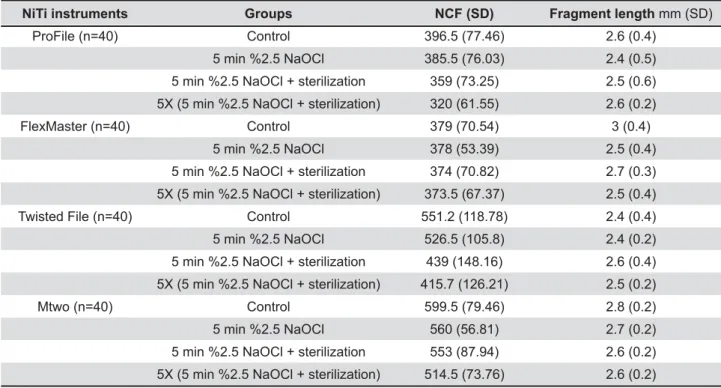
Table 1- The mean (SD) number of cycles to failure (NCF)* and fragment lengths in mm (SD) of tested NiTi instruments
NiTi instruments Groups NCF (SD) 9#mm (SD)
ProFile (n=40) Control 396.5 (77.46) 2.6 (0.4) 5 min %2.5 NaOCl 385.5 (76.03) 2.4 (0.5) 5 min %2.5 NaOCl + sterilization 359 (73.25) 2.5 (0.6) 5X (5 min %2.5 NaOCl + sterilization) 320 (61.55) 2.6 (0.2)
FlexMaster (n=40) Control 379 (70.54) 3 (0.4)
5 min %2.5 NaOCl 378 (53.39) 2.5 (0.4) 5 min %2.5 NaOCl + sterilization 374 (70.82) 2.7 (0.3) 5X (5 min %2.5 NaOCl + sterilization) 373.5 (67.37) 2.5 (0.4) Twisted File (n=40) Control 551.2 (118.78) 2.4 (0.4) 5 min %2.5 NaOCl 526.5 (105.8) 2.4 (0.2) 5 min %2.5 NaOCl + sterilization 439 (148.16) 2.6 (0.4) 5X (5 min %2.5 NaOCl + sterilization) 415.7 (126.21) 2.5 (0.2)
Mtwo (n=40) Control 599.5 (79.46) 2.8 (0.2)
5 min %2.5 NaOCl 560 (56.81) 2.7 (0.2) 5 min %2.5 NaOCl + sterilization 553 (87.94) 2.6 (0.2) 5X (5 min %2.5 NaOCl + sterilization) 514.5 (73.76) 2.6 (0.2)
SD=Standard deviation
!!+& &
Statistical analysis
] provide preconditions of homogeneity of variance 7%&%$+ 1 according to Anderson-Darling test (P<0.05). Thus, > 9 <= (P=0.05).
RESULTS
Kruskall-Wallis test indicated significant differences among the tested instruments in terms "3(%&%%%&"3!$$'&?$+ and ProFile, 483.1, 376.12, 365.25, respectively (Table 1).
9 <="23 and autoclave sterilization have no effect on the NCF &%$+ the effects of NaOCl immersion and autoclave (Table 2).
> among the tested instruments in terms of the length of fractured segments, (P>.05) (Table 1). The mean lengths of the separated segments as #&?#&' #&$#&$!! >1*+&
DISCUSSION
In the literature, there is still a debate regarding the impact of torsional stress and metal fatigue on the fracturing of NiTi rotary instruments. A number of studies have stated that fatigue is the predominant mechanism in material failure6,25. On the other hand, some authors have hypothesized that torsional failure occurs more frequently than
1,23.
The fatigue life of an instrument is determined 1 in the region of maximum bending3. Thus, as the diameter of the instrument increases and the curvature radius of the canal decreases, the fatigue resistance of the rotary instruments decreases29. Other factors related to cyclic fatigue are the design and cross section of the instrument27,31 speed, torque and sterilization procedures4,5 and clinical usage3,8.
To simulate clinical conditions, the test protocol chosen for this study included dynamic immersion in #&$|"23 >
sterilization, and dynamic cyclic fatigue resistance &< clinical practice and considering the mean life of the 1 * $*&B' !4**B&%'+$
& immersed in the irrigation solution, as is the case in root canal instrumentation procedures. This also served the purpose of avoiding galvanic corrosion phenomena4. A dynamic model that incorporates cyclic axial movement not only provides better simulation of the clinical environment but also >1 the compressive and tensile stresses are distributed along the instruments14,16&I"3 1 those obtained in other studies that used a dynamic
model16,31& >
1 > > 1 >& may have affected the fatigue life and resulted in a
1&21 (2009).
The number of times that rotary instruments 1 1* 109,12, depending on the canal conditions and the type of instrument usage. Clinicians often recycle
">11. In the
> 1>"23 sterilization.
In a recent study, Pedullà, et al.18 (2011) reported $|"23 > !8VVX& attributed this to the location of the corrosion. If the corrosion is not in the maximum stress area, then, the instrument’s resistance to cyclic fatigue probably cannot be reduced18. In another study, 83 in fatigue resistance after immersion in a heated NaOCl solution for 1 h19.
NaOCl immersion and autoclave sterilization also > < +&{ contrary, Hilfer, et al.11 (2011) found that repeated > "3 #$&%'&M*B$3 1 require a temperature of at least 170°C, and that the maximum fatigue resistance can be obtained at 430–440°C15. Furthermore, multiple autoclave cycles have been reported to increase the depth " > propagation1,28. On the other hand, Plotino, et al.20 (2012) suggested that autoclave sterilization might improve the mechanical properties of instruments (K3 XF protypes, SybronEndo) that are manufactured using a type of heat treatment. The quality of manufacturing processes and different NiTi rotary instruments because NiTi is an alloy that is very sensitive to both the thermal and mechanical (machining) stresses that can occur during the manufacturing process20. A better arrangement of the crystal structure and changes in the percentage of phases of the alloy obtained via thermal treatment provide improvements in superelastic and plastic behaviors20. In the production process 8< > > than that of traditionally processed materials, 1
1 16.
Although Plotino, et al.20 (2012) reported that mechanical properties of instruments, the results of >>& " ! 1 cyclic fatigue resistance than the other traditional instruments, ProFile and FlexMaster, and the & 1 and FlexMaster, as reported previously16. Oh, et
al.16#%*%+
+1 < ProFile instruments, characteristics that might 1 &I scanning electron micrography (SEM) micrographs <1
their level of stress during instrumentation31. All tested instruments fractured at the point of > & M expected, the lengths of the fractured segments of 1"23 immersion and autoclave sterilization.
CONCLUSION
the tested NiTi instruments cannot be adversely affected by NaOCl immersion and autoclave & + ! ! + &I the instruments cyclic fatigue resistance, fracture similar features to root dentine are necessary.
ACKNOWLEDGEMENTS
= like to thank Assistant Professor Dr. 9&
REFERENCES
*< M V] ] =M V M ! " JM, Daehn GS. SEM observations of nickel-titanium rotary endodontic instruments that fractured during clinical Use. J Endod. 2005;31:40-3.
2- Arruda MP, Carvalho Junior JR, Miranda CE, Paschoalato C, VV8&3 solutions and nickel-titanium rotary instrumentation. Braz Dent J. 2009;20:284-9.
3- Bahia MG, Buono VT. Decrease in the fatigue resistance of nickel-titanium rotary instruments after clinical use in curved root canals. Oral Surg Oral Med Oral Pathol Oral Radiol Endod. 2005;100:249-55.
4- Berutti E, Angelini E, Rigolone M, Migliaretti G, Pasqualini D. Influence of sodium hypochlorite on fracture properties and corrosion of ProTaper Rotary instruments. Int Endod J. 2006;39:693-9.
5- Chaves Craveiro de Melo M, Guiomar de Azevedo Bahia M, Lopes Buono VT. Fatigue resistance of engine-driven rotary nickel-titanium endodontic instruments. J Endod. 2002;28:765-9. 6- Cheung GS, Darvell BW. Fatigue testing of a NiTi rotary instrument. Part 2: Fractographic analysis. Int Endod J. 2007;40:619-25.
7- Gambarini G. Cyclic fatigue of nickel-titanium rotary instruments << & Endod. 2001;27:772-4.
8- Gambarini G. Cyclic fatigue of ProFile rotary instruments after prolonged clinical use. Int Endod J. 2001;34:386-9.
9- Gambarini G, Grande NM, Plotino G, Somma F, Garala M, De Luca M, et al. Fatigue resistance of engine-driven rotary 1 & J Endod. 2008;34:1003-5.
10- Haikel Y, Serfaty R, Wilson P, Speisser JM, Allemann C. Mechanical properties of nickel-titanium endodontic instruments and the effect of sodium hypochlorite treatment. J Endod. 1998;24:731-5.
11- Hilfer PB, Bergeron BE, Mayerchak MJ, Roberts HW, Jeansonne BG. Multiple autoclave cycle effects on cyclic fatigue of > 1 & Endod. 2011;37:72-4.
13- Larsen CM, Watanabe I, Glickman GN, He J. Cyclic fatigue & J Endod. 2009;35:401-3.
14- Li UM, Lee BS, Shih CT, Lan WH, Lin CP. Cyclic fatigue of endodontic nickel titanium rotary instruments: static and dynamic tests. J Endod. 2002;28:448-51.
15- Mize SB, Clement DJ, Pruett JP, Carnes DL Jr. Effect of sterilization on cyclic fatigue of rotary nickel-titanium endodontic instruments. J Endod. 1998;24:843-7.
16- Oh SR, Chang SW, Lee Y, Gu Y, Son WJ, Lee W, et al. A comparison of nickel-titanium rotary instruments manufactured using different methods and cross-sectional areas: ability to resist cyclic fatigue. Oral Surg Oral Med Oral Pathol Oral Radiol Endod. 2010;109:622-8.
17- O’Hoy PY, Messer HH, Palamara JE. The effect of cleaning ">&{ Endod J. 2003;36:724-32.
18- Pedullà E, Grande NM, Plotino G, Pappalardo A, Rapisarda E. Cyclic fatigue resistance of three different nickel-titanium instruments after immersion in sodium hypochlorite. J Endod. 2011;37:1139-42.
19- Peters OA, Roehlike JO, Baumann MA. Effect of immersion in sodium hypochlorite on torque and fatigue resistance of nickel-titanium instruments. J Endod. 2007;33:589-93.
20- Plotino G, Costanzo A, Grande NM, Petrovic R, Testarelli L, `1`&W < instruments. J Endod. 2012;38:222-5.
21- Plotino G, Grande NM, Cordaro M, Testarelli L, Gambarini `& M < instruments. J Endod. 2009;35:1469-76.
##< V "9 8 = V ] `1 M& 1 & 2 Rehabil. 1983;10:121-8.
23- Sattapan B, Nervo GJ, Palamara JE, Messer HH. Defects in rotary nickel-titanium files after clinical use. J Endod. 2000;26:161-5.
#@<VW&W > PVD-coated nickel-titanium endodontic instruments. Int Endod J. 2002;35:867-72.
25- Shen Y, Cheung GS, Peng B, Haapasalo M. Defects in nickel-titanium instruments after clinical use. Part 2: Fractographic analysis of fractured surface in a cohort study. J Endod. 2009;35:133-6.
26- Shen Y, Qian W, Abtin H, Gao Y, Haapasalo M. Effect of < titanium rotary instruments. J Endod. 2012;38:376-80. #?< 3 ^ !&{ cross-sections on torsional and bending stresses of nickel-titanium root canal instrument models. J Endod. 2000;26:414-7. 28- Valois CR, Silva LP, Azevedo RB. Multiple autoclave cycles < >0 microscopy study. J Endod. 2008;34:859-62.
#<^M3`]!] ^]!`&{ sterilization on mechanical properties and fatigue resistance of nickel-titanium rotary endodontic instruments. Int Endod J. 2006;39:709-15.
B%<IW1M_II Suda H. Effect of heat treatment on transformation temperatures and bending properties of nickel-titanium endodontic instruments. Int Endod J. 2009;42:621-6.