ACPD
9, 5231–5261, 2009A product study of the isoprene+NO
3
reaction
A. E. Perring et al.
Title Page
Abstract Introduction
Conclusions References
Tables Figures
◭ ◮
◭ ◮
Back Close
Full Screen / Esc
Printer-friendly Version
Interactive Discussion Atmos. Chem. Phys. Discuss., 9, 5231–5261, 2009
www.atmos-chem-phys-discuss.net/9/5231/2009/ © Author(s) 2009. This work is distributed under the Creative Commons Attribution 3.0 License.
Atmospheric Chemistry and Physics Discussions
This discussion paper is/has been under review for the journalAtmospheric Chemistry and Physics (ACP). Please refer to the corresponding final paper inACPif available.
A product study of the isoprene
+
NO
3
reaction
A. E. Perring1, A. Wisthaler2,*, M. Graus2, P. J. Wooldridge1, A. L. Lockwood4, L. H. Mielke4, P. B. Shepson3,4, A. Hansel2, and R. C. Cohen1,5
1
Department of Chemistry, University of California Berkeley, Berkeley, CA, USA 2
Institut fuer Ionenphysik und Angewandte Physik, University of Innsbruck, Innsbruck, Austria 3
Purdue Climate Change Research Center, Purdue University, West Lafayette, IN, USA 4
Department of Chemistry, Purdue University, West Lafayette, IN, USA 5
Department of Earth and Planetary Sciences, University of California Berkeley, Berkeley, CA, USA
*
equally contributing author
Received: 27 January 2009 – Accepted: 3 February 2009 – Published: 27 February 2009
Correspondence to: R. C. Cohen ([email protected])
ACPD
9, 5231–5261, 2009A product study of the isoprene+NO
3
reaction
A. E. Perring et al.
Title Page
Abstract Introduction
Conclusions References
Tables Figures
◭ ◮
◭ ◮
Back Close
Full Screen / Esc
Printer-friendly Version
Interactive Discussion Abstract
Oxidation of isoprene through reaction with NO3 is a significant sink for isoprene that persists after dark. The products of the reaction are multifunctional nitrates. These nitrates constitute a significant NOxsink in the nocturnal boundary layer and they likely play an important role in formation of secondary organic aerosol. Products of the
5
isoprene+NO3reaction will, in many locations, be abundant enough to affect nighttime radical chemistry and to persist into daytime where they may represent a source of NOx. Product formation in the isoprene+NO3 reaction was studied in a smog cham-ber at Purdue University. Isoprene nitrates and other hydrocarbon products were ob-served using Proton Transfer Reaction-Mass Spectrometry (PTR-MS) and reactive
ni-10
trogen products were observed using Thermal Dissociation–Laser Induced Fluores-cence (TD-LIF). The organic nitrate yield is found to be 62±6% and the combined yield
of MACR+MVK is found to be ∼10%. Additional hydrocarbon products, thought to
be primarily C4 and C5 carbonyl compounds, were observed by the PTR-MS at vari-ous m/z ratios and their yields quantified. These other oxidation products are used as
15
additional constraints on the reaction mechanism.
1 Introduction
Global isoprene emissions are estimated to be 440–660 Tg/yr (Guenther et al., 2006) and are larger than emissions for any other single organic molecule (Bey et al., 2001; Guenther et al., 1995). Thus even minor changes in the oxidation of isoprene have a
20
major influence on the chemistry of the atmosphere. For example, isoprene nitrate (IN) production, the focus of this manuscript, is calculated to be a major sink of NOx. The removal of NOxand possible subsequent release (Perring et al., 2008) affects regional and global ozone and also the response of ozone to climate change (Horowitz et al., 2007; Wu et al., 2007). Isoprene is also likely a significant source of secondary organic
25
ACPD
9, 5231–5261, 2009A product study of the isoprene+NO
3
reaction
A. E. Perring et al.
Title Page
Abstract Introduction
Conclusions References
Tables Figures
◭ ◮
◭ ◮
Back Close
Full Screen / Esc
Printer-friendly Version
Interactive Discussion role of INs as a NOxsink and thus to the indirect role of INs as a regulator of available
NOxand more directly to the subsequent oxidation of INs leading to low vapor pressure and/or highly water soluble molecules. INs are produced during the daytime as a minor product of OH-initiated isoprene oxidation in the presence of NO (Tuazon and Atkinson, 1990; Werner et al., 1999) and at night as a major product of oxidation by NO3(Barnes 5
et al., 1990; Berndt and Boge, 1997; Kwok et al., 1996; Skov et al., 1992).
Nitrate product formation as a result of isoprene oxidation by NO3 was first studied by Barnes et al. (1990) who report a nitrate yield of 80%. Isoprene emission occurs mostly during the daytime, increasing with temperature and radiation over the course of the morning and falling offin the afternoon (Fehsenfeld et al., 1992). Several
stud-10
ies have found reaction with NO3 to be the dominant loss process for isoprene that remains during the early evening in moderately polluted environments (Stroud et al., 2002; Warneke et al., 2004), and this can result in substantial conversion of NOxto or-ganic nitrates at night (Starn et al., 1998). Not only is NO3an important isoprene sink but, because of the high yield, INs formed by NO3-initiated oxidation may represent a 15
large fraction of the total IN source (Horowitz et al., 2007).
Kwok et al. (1996) studied the products of the NO3+isoprene reaction using API-MS and observed the formation of C5-carbonyl nitrates, C5-hydroxy nitrates, C5 -hydroperoxy nitrates and C5-hydroxy carbonyls. They also observed methacrolein (CH2C(CH3)CHO or MACR) and methyl vinyl ketone (CH3C(O)CHCH2 or MVK)
for-20
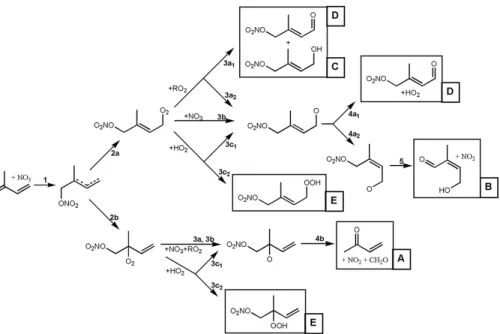
mation and found each produced with a 3.5% yield. A partial oxidation scheme that illustrates likely formation pathways and structures of the observed products is shown in Fig. 1. Oxidation is initiated by addition of NO3to a double bond to produce an unsta-ble radical adduct intermediate (step 1). This intermediate reacts with O2to produce a nitrooxy peroxy radical (step 2), which undergoes subsequent reactions to form a
sta-25
ACPD
9, 5231–5261, 2009A product study of the isoprene+NO
3
reaction
A. E. Perring et al.
Title Page
Abstract Introduction
Conclusions References
Tables Figures
◭ ◮
◭ ◮
Back Close
Full Screen / Esc
Printer-friendly Version
Interactive Discussion NO3at the C2or C3 positions is negligible and that addition of NO3at the C1position
(shown) dominates over addition at the C4position (not shown). Estimates range from 75-85% C1 addition with the balance C4addition (Berndt and Boge, 1997; Skov et al., 1992). These estimates are consistent with structure-reactivity relationships described by Pfrang et al. (2006a, b) that indicate that the double bond between C1 and C2 is 5
almost an order of magnitude more reactive to NO3than the bond between C3and C4 due to its increased substitution. Figure 1 shows those products resulting from initial NO3addition at the C1position. Pathways and products resulting from addition at other positions are similar to those shown here.
Due to the presence of conjugated double bonds in isoprene, the reaction of the
10
alkyl radical with oxygen (step 2) forms both aδ-peroxy radical (pathway 2a) and a β-peroxy radical (pathway 2b) (Skov et al., 1992). Subsequent reactions of these β-peroxy radicals can lead to either keto or hydroxy nitrate products or to the release of NO2and production of an oxidized hydrocarbon via a short lived alkoxy radical intermediate. MVK and MACR are produced from reactions of the β-peroxy radicals. C5-hydroxy 15
carbonyls are thought to result from a cyclic hydrogen abstraction rearrangement of theδ-alkoxy radicals (pathway 5) (Kwok et al., 1996).
Here we report a product study of the NO3+isoprene reaction that incorporates com-prehensive measurements of both the nitrogen and carbon containing products. This includes two independent, direct measurements of the nitrate product yield for the
re-20
action of NO3with isoprene and a wide suite of oxidized hydrocarbon products.
2 Methods
ACPD
9, 5231–5261, 2009A product study of the isoprene+NO
3
reaction
A. E. Perring et al.
Title Page
Abstract Introduction
Conclusions References
Tables Figures
◭ ◮
◭ ◮
Back Close
Full Screen / Esc
Printer-friendly Version
Interactive Discussion NO2and 145 ppbv of O3into dry zero air and allowing the mixture to react for∼4 h.
NO2+O3→NO3+O2 (R1)
NO3+NO2↔N2O5 (R2)
38 L from a cylinder of 19.5±0.9 ppmv isoprene in nitrogen was injected into the
smog chamber to give a calculated “initial” isoprene concentration of 134±7 ppbv. We 5
define t=0 immediately prior to the isoprene addition. The full injection was completed by t=6 min and products were monitored for the subsequent half hour. Isoprene was consumed rapidly during the injection. O3 was measured using a calibrated TECO Model42 UV absorption ozone monitor. The sampling flow was∼10 sccm during the
NO3/N2O5production phase and∼3 L/min after isoprene injection, leading to an overall 10
depletion of∼3% in chamber volume by the end of the experiment (∼1 h after isoprene
injection). Due to the low sampling rate and to avoid dilution effects no replenishment flow was supplied. The chamber volume varies by up to 8% with changes in internal pressure but has been routinely observed to be constant to within 1% over the course of a single-day experiment.
15
Alkyl and multifunctional nitrates (ΣANs), peroxy nitrates including N2O5 (ΣPNs), NO2 and HNO3 were measured by the Berkeley Thermal-Dissociation Laser Induced Fluorescence (TD-LIF) instrument (Day et al., 2002; Thornton et al., 2000). Briefly, gas is pulled simultaneously through each of 4 channels, one for each class of com-pounds listed above. Each channel consists of a section of heated quartz tube followed
20
by detection of NO2 using laser-induced fluorescence. Due to differing X-NO2 bond strengths, ΣPNs, ΣANs and HNO3 all thermally dissociate to NO2 and a companion radical at a characteristic temperature. The ambient channel measures NO2 alone, the second channel (180◦C) measures NO2 produced from the dissociation of ΣPNs in addition to ambient NO2 so the observed signal is NO2+ ΣPNs, the third chan-25
ACPD
9, 5231–5261, 2009A product study of the isoprene+NO
3
reaction
A. E. Perring et al.
Title Page
Abstract Introduction
Conclusions References
Tables Figures
◭ ◮
◭ ◮
Back Close
Full Screen / Esc
Printer-friendly Version
Interactive Discussion difference in NO2signal between the 180◦C and the 380◦C channel, for example, is the
ΣANs mixing ratio. To minimize the impact of secondary chemistry following thermal decomposition, the quartz tubes are maintained at reduced pressure (∼300 Torr).
NO2was observed by laser-induced fluorescence as described in detail by Thornton et al. (2000). Briefly, a tunable dye laser is pumped at 7 kHz by a Q-switched, frequency
5
doubled Nd+3YAG laser. The dye laser (Pyrromethene 597 in isopropanol) is tuned to a specific rovibronic feature of NO2 around 585nm. The frequency is held for 20 sec-onds at the peak of the feature and then for 5 s at an offline position in the continuum absorption and the NO2 number density is proportional to the difference between the online and offline signals. The laser light is focused through two multipass (White) cells
10
in series and the red-shifted fluorescence is detected using a red-sensitive photomulti-plier tube (Hamamatsu). Fluorescence counts are collected at 5 Hz, scattered light at wavelengths less than 700nm is rejected by bandpass filters and time-gated detection is used to eliminate prompt noise. Calibrations were performed at least once every two hours using a 4.7 ppmv NO2reference gas with a stated uncertainty of±5% which is 15
regularly compared (∼6 months) to a library of tanks in the Cohen lab to confirm its
stability.
The instrument used in these experiments had two detection cells. Cell 1 sampled either the ambient or the 380◦C channel while cell 2 sampled either the 180◦C or the 580◦C channel. The direction of flow into the cell was controlled using a three-way
20
valve and a bypass pump was used to maintain flow in the non-sampled channel. Cell 1 sampled the unheated NO2channel 25% of the time and the 380◦C channel (ΣANs) 75% of the time. Cell 2 sampled the 180◦C 75% of the time and the 580◦C channels 25% of the time. Thus for every∼2 minute duty cycle there was 20s of NO2 data, 20s ofΣPNs data, 40 s ofΣANs data and 20s of HNO3 data. Here we have averaged to a
25
1 min time resolution.
ACPD
9, 5231–5261, 2009A product study of the isoprene+NO
3
reaction
A. E. Perring et al.
Title Page
Abstract Introduction
Conclusions References
Tables Figures
◭ ◮
◭ ◮
Back Close
Full Screen / Esc
Printer-friendly Version
Interactive Discussion the large majority of polyatomic volatile organics and also a few inorganic molecules
(e.g. HNO2, HNO3 and N2O5). The PTR-MS technique has been described in detail elsewhere (see reviews by de Gouw and Warneke, 2007 and Hansel et al., 1999). The results presented here build on previous smog chamber work including product studies (D’Anna et al., 2005; Wegener et al., 2007; Wisthaler et al., 2001) and intercomparison
5
exercises (Apel et al., 2008; Wisthaler et al., 2008).
Isoprene was calibrated using a dynamically diluted multi-component VOC standard (Apel-Riemer Environmental Inc., Broomfield, CO, USA) containing∼1.2 ppmv of
iso-prene. The specified accuracy of the gas mixture for isoprene was±3% and a
volumet-rically calibrated isoprene standard prepared in the Shepson lab agreed to within 6%.
10
The multi-component VOC standard also contained ∼1 ppmv of acetone and methyl
ethyl ketone (MEK), respectively, with a specified uncertainty of ±5%. Both ketones
produced an identical instrumental response factor which was used as a proxy for determining the sum of the isomeric species MVK and MACR. Results from an inter-comparison exercise (Apel et al., 2008; Wisthaler et al., 2008) have shown that the
15
sum of MVK and MACR can be accurately (±5%) determined with this calibration
ap-proach. Volumetrically calibrated MVK and MACR standards prepared in the Shepson lab agreed to within 3% and 6%, respectively.
PTR-MS formaldehyde measurements are described by Wisthaler et al. (2008). PTR-MS response factors for formaldehyde were obtained by three independent
meth-20
ods: i) by calculation using simple pseudo first-order ion molecule reaction kinetics (Hansel et al., 1998; Wisthaler et al., 2008) ii) by using a permeation-tube-based gas standard generator (Dassau et al., 2002), and references therein) and iii) by using a molybdenum catalyst to quantitatively convert a calibrated amount of methanol into formaldehyde (Chu et al., 1997). Based on the uncertainties associated with the
vari-25
ous calibration methods we estimate the accuracy of the formaldehyde values reported herein to be within−5% and+50%.
ACPD
9, 5231–5261, 2009A product study of the isoprene+NO
3
reaction
A. E. Perring et al.
Title Page
Abstract Introduction
Conclusions References
Tables Figures
◭ ◮
◭ ◮
Back Close
Full Screen / Esc
Printer-friendly Version
Interactive Discussion pathway for alkyl nitrates is HNO3 loss after protonation [MH+-HNO3], resulting in the
formation of the bare alkyl ions. The protonated parent ions [MH+] are only present in trace amounts (<2%) but both studies also indicate that, at standard PTR-MS op-erating conditions (E/N∼120 Td; 1 Td=10−17cm2V molecule−1), significant amounts of
the NO+2 fragment are produced from alkyl nitrates. To reduce this fragmentation, we
5
lowered the E/N value to∼75 Td where we expect the alkyl ions to dominate the mass
spectrum (with minor contributions from hydrated alkyl ions [MH+-HNO3+H2O] and alkoxy ions [MH+-HNO2]). The product studies described herein were performed in dry air and the primary PTR-MS reagent ions were H3O+ and H3O+(H2O) ions in an apparent 60:40 ratio. During a preliminary experiment the PTR-MS instrument was run
10
in the full scan mode (scan range: m/z 20–241; dwell time: 0.1 s per m/z) to identify the m/z-signals of interest. In the experiment presented here the instrument was run in the selected ion monitoring (SIM) mode with a single ion dwell time of 0.5 s and a total SIM cycle time of 35 s.
Calibration factors for isoprene nitrates (INs) were obtained by assuming that
ni-15
troxy compounds have a∼20% lower sensitivity than simple oxygenated compounds
(D’Anna et al., 2005) and by taking into account typical alkyl nitrate fragmentation patterns (Aoki et al., 2007; D’Anna et al., 2005). We performed an intercomparison measurement with the TD-LIF instrument in which we sampled dry zero air passed over a home-made isopropyl nitrate permeation source and, based on this calibration
20
approach, isopropyl nitrate data from both instruments agreed to within 12%. We esti-mate the PTR-MS accuracy for alkyl nitrates to be within−20% and+30%. D’Anna et al. (2005) suggest that the variability of PTR-MS calibration factors for mono- and multi-functional VOCs is less than±30% so it is reasonable to assume that even unidentified
m/z-signals can be quantified with a similar accuracy.
25
ACPD
9, 5231–5261, 2009A product study of the isoprene+NO
3
reaction
A. E. Perring et al.
Title Page
Abstract Introduction
Conclusions References
Tables Figures
◭ ◮
◭ ◮
Back Close
Full Screen / Esc
Printer-friendly Version
Interactive Discussion interferences at m/z=46 may arise from alkyl nitrates and HNO3(Wisthaler et al., 2006).
At low E/N the interference from alkyl nitrates is expected to be negligible and the HNO3 contribution to the m/z=46 signal can be determined by thermally decomposing N2O5 in the inlet as described below.
The commercial PTR-MS instrument used for this study was equipped with a∼50 cm 5
(ID: 0.01 in.) long passivated stainless steel capillary (Restek Corp., Bellefonte, PA, USA). The inlet flow was∼50 sccm. A switchable 5-channel inlet system was set-up
between PTR-MS instrument and the environmental chamber. Channel 1, in which chamber air was directly fed to the PTR-MS instrument, was active during most of the experiment. At the end of the experiment chamber air was sequentially directed to the
10
instrument via inlet channels 2 through 4, which were kept at 150, 250, and 350◦C, re-spectively, and via channel 5, which included a basic scrubber (Na2CO3impregnated nylon wool). All channels were connected to the PTR-MS instrument via 3-way Teflon solenoid valves (Teqcom Industries, Inc. Santa Ana, California, USA). Depending on valve position the flow was either fed to the PTR-MS instrument or discarded into a
15
pump. Channels 2–4 were used for thermal decomposition studies similar to the ap-proach used in the TD-LIF instrument (Day et al., 2002). In contrast to the TD-LIF where the increase in NO2 with temperature is monitored, in the PTR-MS instrument the signal decrease with increased inlet temperature can be used to identify thermo-labile species such as PAN-type compounds (Hansel et al., 1999), alkyl nitrates (Aoki
20
et al., 2007) or N2O5. The basic scrubber was used to aid identification of acidic compounds. The instrumental background was determined using zero air from a zero air generator (Parker-Balston, Haverhill, MA, USA). All inlet lines were temperature-controlled at 35◦C. The drift tube was kept at 60◦C.
3 Results 25
ACPD
9, 5231–5261, 2009A product study of the isoprene+NO
3
reaction
A. E. Perring et al.
Title Page
Abstract Introduction
Conclusions References
Tables Figures
◭ ◮
◭ ◮
Back Close
Full Screen / Esc
Printer-friendly Version
Interactive Discussion 10 ppbv, respectively, prior to injection of isoprene. The TD-LIF instrument sampled
from the chamber approximately once per hour and observed increases in bothPPNs (including N2O5) and HNO3 (presumably produced from conversion of N2O5 to HNO3 within the chamber). NOy was lost to the walls at an average rate of∼4% per hour for the 4 h prior to injection, corresponding to a wall loss rate of 5·10−6s−1for N2O5. 5
The PTR-MS instrument sampled from the chamber continuously and observed in-creases of greater than 1ppbv in ion signals at m/z=31, 45, 46, 47, 59, 61 and 64. The ion signals at m/z 31, 45 and 59 arise from formaldehyde, acetaldehyde and ace-tone/propanal. The m/z 47 and m/z 61 signals are assigned to formic acid and acetic acid/hydroxyacetaldehyde, respectively. These carbonyls and carboxylic acids are
be-10
lieved to be formed during the O3generation/injection process and/or due to heteroge-neous reactions with organic impurities on the chamber walls. As they are less reactive with NO3than isoprene (Wayne et al., 1991), their presence at low concentrations does not affect the experimental results presented here. In the case of formaldehyde a back-ground concentration of 1.5ppbv present in the chamber prior to isoprene injection was
15
subtracted to calculate product yields of the isoprene-NO3reaction.
The m/z 46 and m/z 64 signals are produced from both HNO3 ([MH+-H2O], [MH+]) and N2O5 ([MH+-HNO3], [MH+-HNO3+H2O]). Thermal decomposition of N2O5 in the 150◦C PTR-MS inlet channel 2 made it possible to quantify the relative contributions of N2O5 and HNO3 to the observed signal and the HNO3signal observed at the end 20
of the experiment was subtracted from the total to calculate N2O5. A calibration factor calculated purely from ion-molecule reaction kinetics was scaled by−15% to bring the
TD-LIF and PTR-MS measurements of HNO3at the end of the experiment into agree-ment. This allowed us to take advantage of the fast time resolution and continuous coverage provided by the PTR-MS measurement. Approximately half an hour prior to
25
the isoprene injection, the TD-LIF observed∼42 ppbv HNO3and∼90 ppbv P
PNs (in-cluding N2O5) and just prior to injection the PTR-MS observed ∼82 ppbv N2O5. NO3 was calculated to be∼540 pptv just prior to injection.
ACPD
9, 5231–5261, 2009A product study of the isoprene+NO
3
reaction
A. E. Perring et al.
Title Page
Abstract Introduction
Conclusions References
Tables Figures
◭ ◮
◭ ◮
Back Close
Full Screen / Esc
Printer-friendly Version
Interactive Discussion during which time the isoprene was partially consumed by reaction with NO3. The
PTR-MS instrument detected a∼100 ppbv increase in the m/z=69 ion signal, assigned
to isoprene, and a simultaneous increase in a series of ion signals from the products of the isoprene-NO3 reaction. Both instruments observed a rapid consumption of N2O5. N2O5 measured by PTR-MS decreased to∼5 ppbv after half an hour and
P
PNs
de-5
creased to∼8 ppbv. Since the PPNs measurement would detect not only N2O5 but also any other peroxy- or peroxy-acyl nitrates present in the chamber, it is not surpris-ing that it is slightly higher than the N2O5 measured by PTR-MS. It should be noted that both instruments will respond to HO2NO2in the same signal as N2O5but HO2NO2 concentrations are not expected to exceed 5ppbv.
10
3.1 Product identification
Major product ion signals were observed at m/z=31, 43, 71, 83, 85, 87, 99 and 101 with minor product signals detected at m/z=(89), (103), (105), (117), (119), 130, 132, 146, 148, 162, 164. Signals written in parentheses are believed to be hydrated ions [MH++H2O] of the major signals given above and will not be discussed further. In PTR 15
mass spectra even-numbered signals are produced from compounds containing one nitrogen atom so the even-numbered high molecular weight signals are indicative of the formation of nitrooxy compounds. Experiments involving isoprene addition without NO3 present showed that the non-isoprene signals were not due to impurities in the isoprene standard.
20
The observed PTR mass spectrum of the products of the isoprene-NO3reaction is in excellent agreement with a previously reported API mass spectrum (Fig. 2 in Kwok et al., 1996). PTR-MS and H+(H2O)n-based API-MS are closely related techniques and similar mass spectra are expected. In general, our results are consistent with the as-sociated compound assignments. The main differences between the two mass spectra
25
ACPD
9, 5231–5261, 2009A product study of the isoprene+NO
3
reaction
A. E. Perring et al.
Title Page
Abstract Introduction
Conclusions References
Tables Figures
◭ ◮
◭ ◮
Back Close
Full Screen / Esc
Printer-friendly Version
Interactive Discussion Based on MS/MS analyses and isoprene d8-studies Kwok et al. (1996) identified
product ions, in ascending order of mass, as follows: m/z 71 [MH+] as the sum of MVK and MACR (A), m/z 101 [MH+] as C5-hydroxycarbonyls (B), m/z 130 [MH+-H2O] and m/z 148 [MH+] as hydroxy-nitrates (C), m/z 83 [MH+-HNO3] and m/z 146 [MH+] as nitrooxy-aldehydes (D) and m/z 164 [MH+] as nitrooxy-hydroperoxides (E). Capital
let-5
ters in parentheses indicate the respective compounds in the reaction scheme shown in Fig. 1. Note that neither API-MS nor PTR-MS resolve isomers that arise from NO3 addition at different positions on the isoprene molecule.
We sampled chamber air through three heated inlets (150◦C, 250◦C and 350◦C) and one inlet equipped with a basic scrubber. We use these observations to aid in
10
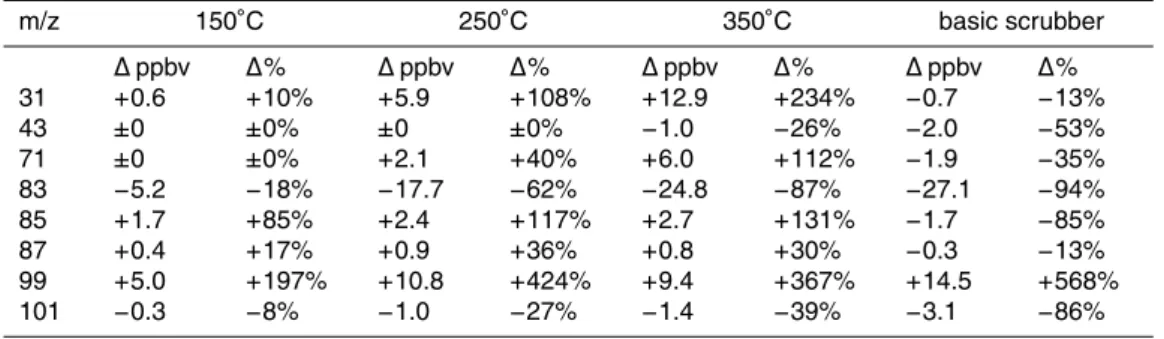
compound assignment and identification of thermally labile or acidic compounds. Con-founding results may occur however if multiple species are detected on the same m/z signal in that one compound may be destroyed upon heating while another, detected at the same m/z, is formed upon heating. The absolute and relative changes of the main product signals are reported in Table 1. Low intensity signals are not included in
15
the table but all even numbered high molecular weight signals disappeared at 350◦C as expected for nitrooxy-compounds. Notably, all of these nitrooxy-compounds were completely removed by the basic scrubber indicating that a similar uptake may occur on basic surfaces in nature.
The ion signal at m/z 71 was partially scrubbed by the basic filter indicating either
20
that some species other than MVK and MACR may also produce that ion signal or that MVK and/or MACR are partially removed by the basic scrubber. We therefore recommend reported MACR+MVK yields to be taken as an upper limit. Also, we should note that when air was sampled through the 350◦C PTR-MS inlet, the m/z 69 signal decreased by ∼4 ppbv which leads us to deduce either a minor (<5%) interference 25
from a thermolabile species detected at m/z 69 or a partial decomposition of isoprene in the 350◦C inlet. Due to the small size of the potential interference, however, we do not consider this effect in further analysis.
con-ACPD
9, 5231–5261, 2009A product study of the isoprene+NO
3
reaction
A. E. Perring et al.
Title Page
Abstract Introduction
Conclusions References
Tables Figures
◭ ◮
◭ ◮
Back Close
Full Screen / Esc
Printer-friendly Version
Interactive Discussion tributions from hydroxy-nitrates [MH+-HNO2], nitrooxy-carbonyls [MH+-HNO3+H2O]
and nitrooxy-hydroperoxides [MH+-HNO3], was observed to decrease somewhat with increasing temperature and to decrease strongly when sampling through the basic scrubber. C5-hydroxycarbonyls are expected to show such behavior although we would expect full decomposition at 350◦C. As pointed out above, the thermal decay may be
5
obscured by formation of a different species also detected at m/z 101.
The ion signal at m/z 83 shows a ∼90% decrease at both 350◦C and when
sam-pling through the basic scrubber. Nitrooxy-carbonyls have been seen to be a major product of the isoprene-NO3 reaction (Barnes et al., 1990; Berndt and Boge, 1997; Kwok et al., 1996; Skov et al., 1992). We expect their main appearance at this ion
10
mass [MH+-HNO3]. m/z 83 may also be generated from the C5-hydroxy-carbonyls [MH+-H2O] but previous work (Kwok and Atkinson, 1995; Zhao et al., 2004) indicates that detection of C5-hydroxycarbonyls at m/z 101 dominates over that at m/z 83 and we therefore conclude that the m/z=83 signal is dominated by nitrooxy-carbonyls. We attribute the ion signal at m/z 146 to nitrooxy-carbonyls but note that it may also be
pro-15
duced from dinitrates [MH+-HNO2], nitrooxy-peroxy-nitrates [MH+-HNO3] and nitrooxy-hydroperoxides [MH+-H2O]. m/z 164 may arise from the nitrooxy-hydroperoxides [MH+] or nitrooxy-peroxy-nitrates [MH+-HNO3+H2O]or it may simply be the hydrated m/z 146 ion [MH++H2O].
In addition to the ion signals reported by Kwok et al. (1996), we also observed signals
20
at m/z 31, 43, 85, 87, 132 and 162. The signal at m/z 31 is assigned to formaldehyde [MH+]. The signal at m/z 43 is a CH3CO+ fragment ion that cannot be assigned to a specific parent molecule but MS/MS spectra from hydroxy-nitrates show an intense fragment at m/z 43 (Kwok et al., 1996). The signal at m/z 85 may be an additional hydroxy-nitrate signal [MH+-HNO3] although the epoxide (C5H8O), which has been
ob-25
ACPD
9, 5231–5261, 2009A product study of the isoprene+NO
3
reaction
A. E. Perring et al.
Title Page
Abstract Introduction
Conclusions References
Tables Figures
◭ ◮
◭ ◮
Back Close
Full Screen / Esc
Printer-friendly Version
Interactive Discussion detected at m/z 87 and 132 remain unassigned.
3.2 Product quantification and yields
Clearly compound identification in PTR-MS and API-MS is non-trivial as the ion formed upon loss of functional groups (-ONO2, -NO2, -OH) after protonation is not necessarily specific to a single compound. Although we are unable to identify all detected
com-5
pounds with certainty, we take advantage of the inherent similarity of PTR-MS calibra-tion factors for oxygenated species to convert product ion signals at m/z=31, 43, 71, 83, 85, 87, 99 and 101 into volume mixing ratios. PTR ionization occurs under well-defined conditions (temperature, pressure, reaction time) and strictly follows pseudo-first-order kinetics. As proton transfer reaction rate coefficients are similar to within ±30% for all 10
oxygenated species, calibration factors for oxygenates including multifunctional com-pounds containing carbonyl, hydroxy and nitrooxy groups can be determined to within
±30% (D’Anna et al., 2005).
As described above, the m/z=31 signal was calibrated using several different formaldehyde standards with an estimated accuracy of−5 to+50%. For the remain-15
ing signals we used a calibration factor typical of C3and C4 carbonyls and using this quantification, we observe mass balance in the carbon-containing products to within 10%. We assume that all observed signals except that for formaldehyde arise from C5compounds. MVK and MACR (m/z=71) are C4compounds, but the simultaneously formed C1fragment (formaldehyde) was observed in approximately the same amounts 20
as MVK and MACR so if formaldehyde is excluded from the mass balance, m/z 71 can be treated as a C5 compound. The signal at m/z=43 is assumed to be an ionic frag-ment of a C5compound. The sum of isoprene and all major products is 134±16 ppbv at the beginning of the experiment and 144±17 ppbv at the end of the experiment (solid
blue line in Fig. 2a). The observed 7% increase may be explained by small diff
er-25
ences in PTR-MS calibration factors for different species. The initially observed sum of isoprene and all major products of 134±16 ppbv is in excellent agreement with the
ACPD
9, 5231–5261, 2009A product study of the isoprene+NO
3
reaction
A. E. Perring et al.
Title Page
Abstract Introduction
Conclusions References
Tables Figures
◭ ◮
◭ ◮
Back Close
Full Screen / Esc
Printer-friendly Version
Interactive Discussion gray region.
Figure 2b shows the time evolution of the main product ion signal observed at m/z=83 (nitrooxy-carbonyls) together with the P(organic nitrates) signal determined by the TD-LIF instrument. The two measurements agree well and, as expected, the nitrooxy-carbonyls account for almost all (>95%) of theP(organic nitrates) produced
5
from the isoprene-NO3 reaction. The uncertainty in the PTR-MS data is estimated to be−20% to+30% and, as discussed above, we have seen evidence of additional
ni-trooxy compounds at m/z ratios other than 83. If all signals except the portion of the m/z 71 signal which is not scrubbed by the basic scrubber (corresponding to the sum of MVK+MACR) are assumed to arise from organic nitrates this would increase reported
10
nitrooxy-carbonyl concentrations by 30%. This is an upper limit for total nitrates which is in reasonable agreement with the upper margin (+15%) in the TD-LIF data.
Figure 2c shows the time evolution of the other observed product ion signals. It is interesting to note that they do not all have the same temporal behavior. Signals at m/z=99 and m/z=101, for example, continue to increase after most other
concentra-15
tions have reached steady state and the signal at m/z=101 continues to increase even after m/z=99 has plateaued.
The fact that the sum (isoprenemeasured+productsmeasured) matches (isopreneinjected) implies that we are likely not missing any major products and that the calibration factors for the unidentified products are reasonably accurate. The fractional yield of any one
20
product can therefore be calculated simply as the concentration of that product divided by the sum of all products. Figure 3a shows the observed correlation between the sig-nal at m/z 71 and the sum of all products seen by PTR-MS. MVK and MACR are formed with an 10% yield (upper limit); considering a potential∼35% signal interference (as
indicated by the signal drop when the basic filter is switched in) this could be as low as
25
pro-ACPD
9, 5231–5261, 2009A product study of the isoprene+NO
3
reaction
A. E. Perring et al.
Title Page
Abstract Introduction
Conclusions References
Tables Figures
◭ ◮
◭ ◮
Back Close
Full Screen / Esc
Printer-friendly Version
Interactive Discussion duction with MVK and MACR. This value is, however, in excellent agreement with the
11% yield reported by Barnes et al. (1990). Skov et al. (1992) report a formaldehyde yield<5%. Figure 3b displays the correlation between the LIF PANs measurement and the sum of all products and between the PTR-MS m/z=83 measurement and the sum of all products. These correlations imply a nitrooxy-carbonyl formation ratio of
5
between 63% (based on PTRMS) and 67% (based on LIF) from NO3+isoprene. We can also calculate fractional yields as the concentration of a given product di-vided by the difference (isopreneinjected–isoprenemeasured). This has the advantage of depending solely on the injected amount and the PTR-MS measurement of iso-prene which has been rigorously tested and compared with other measurement
tech-10
niques rather than on the quantification of unidentified products. This calculation gives slightly but not significantly different product yields as implied by the agreement be-tween (isoprenemeasured+productsmeasured) and (isopreneinjected).
Taking instrumental error and the 95% confidence interval for the linear fit into ac-count the range of nitrate formation ratios based on the present, carbon-based
calcula-15
tion is 65±3%. Barnes et al. (1990) and Berndt and B ¨oge (1997) report values of 80%
and 90–95% total nitrate yields, respectively. Upper limits for total nitrates are∼83%
(PTR-MS derived) and 77% (TD-LIF derived). We note that the “yields” are not nec-essarily fixed fundamental quantities, as they depend on the relative concentrations of NO3and RO2/HO2radicals (see Fig. 1), and thus potentially on the reaction conditions.
20
The molar yields for the other signals are: m/z 43 (7.5%), m/z 85 (2%), m/z 87 (5.5%), m/z 99 (5%) m/z 101 (7%). It should be noted that part of the m/z 99 and m/z 101 signals may also represent additional nitrooxy-carbonyl compounds as it is difficult to assign these signals to specific compounds. If we assume that m/z 43 derives from the hydroxy-nitrates and consider that m/z 130 is the second most abundant of the
25
minor, even-numbered product ion signals (m/z 148, nitrooxy-carbonyls, being the most abundant), we can speculate that the hydroxy-nitrates are the second most abundant of the nitrooxy species, but we are unable to quantify the yield.
in-ACPD
9, 5231–5261, 2009A product study of the isoprene+NO
3
reaction
A. E. Perring et al.
Title Page
Abstract Introduction
Conclusions References
Tables Figures
◭ ◮
◭ ◮
Back Close
Full Screen / Esc
Printer-friendly Version
Interactive Discussion dependent lens through which to assess the fractional yield of INs in the NO3+isoprene
reaction. The TD-LIF observed a decrease in total NOy between half an hour prior to and just after isoprene injection. In an earlier trial run of this experiment we observed almost a complete loss of N2O5 without the expected consumption of isoprene upon injection into a relatively humid chamber. We hypothesize that this was due to particle
5
or droplet formation or some other process which removed N2O5 from the gas phase precipitated by the presence of extremely high localized concentrations of isoprene. While we tried to keep the chamber as dry as possible and to inject the isoprene at a moderate rate for the present experiment, the relative humidity was still 10–15% and we believe that the observed sudden loss of NOyis similar to but less extreme than the
10
loss observed in the earlier experiment. Once the isoprene injection was complete, nitrogen closure for the subsequent 20 min was better than 95%. For the portion of the experiment where total NOy is constant, we extract information about the nitrate yield from the relationships between the NOy reservoirs which are interconverting. Using
a rate constant of 3.03×10⁻¹²×e−440/T for NO3+isoprene (Barnes et al., 1990), the 15
lifetime of NO3against reaction with 100 ppbv of isoprene is less than 1s but NO3 will continue to be generated from decomposition of N2O5, which has a thermal lifetime of about 20 s, until NO3and N2O5reach a stationary state with the NO2, O3and isoprene in the chamber. Thus, the amount of NO3 that will react rapidly with isoprene is equal to the initial sum (NO3 +N2O5) and this N2O5is essentially being converted into NO2 20
and INs via the interaction between isoprene and NO3. If the NO3+isoprene reaction is the only process converting one NOyreservoir into another, then we would expect
P
ANs and N2O5to be related as follows, whereαis the nitrate formation branching ratio:
∆Σ[ANs]=α∆[N2O5] (R3)
25
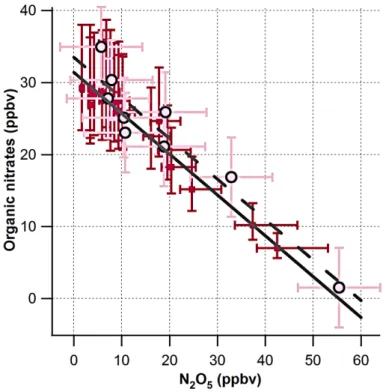
Figure 4 shows the correlations observed between both the TD-LIF measurements of N2O5 and
P
ACPD
9, 5231–5261, 2009A product study of the isoprene+NO
3
reaction
A. E. Perring et al.
Title Page
Abstract Introduction
Conclusions References
Tables Figures
◭ ◮
◭ ◮
Back Close
Full Screen / Esc
Printer-friendly Version
Interactive Discussion respectively corresponding to an IN yield of 57±6% accounting for the 95%
confi-dence interval for the linear fit and instrumental uncertainties. As noted above, the TD-LIFPPNs measurement was ∼3 ppbv higher than the PTR-MS measurement of
HO2NO2 + N2O5, possibly due to the presence of other peroxy-nitrate compounds. These issues should not, in fact, impact the slope of the correlation but simply change
5
the intercept of the best-fit line and the absolute agreement of the two N2O5 observa-tions.
4 Discussion
The discrepancy between the carbon- (65%±3%) and nitrogen- (57%±6%) based
cal-culations of nitrate yield for NO3+isoprene is small but significant. As discussed above, 10
the carbon-based calculation could be an overestimate if there are appreciable unmea-sured products. Similarly, the nitrogen-based calculation could be an underestimate if there is a significant reaction that converts NO3 directly into NO2 other than the NO3+isoprene reaction. Since the two measurements of the nitrate products agree well, the discrepancy between the two yields is driven entirely by our different proxies
15
for the extent to which reaction has occurred.
For the carbon budget calculation we used the sum of all measured products to infer the amount of isoprene that had reacted and for the nitrogen budget we used
∆N2O5 to infer the amount of NO3 consumed by reaction with isoprene. The first method assumes that we have measured all of the possible products, an assumption
20
supported by the fact that the calculated “initial” isoprene and the observed sum of isoprene+products agree to within 10%. The second method assumes that NO3and N2O5 interact with only isoprene and do not deposit to or react with the walls of the chamber or any other chemical species. NO3is likely both to the walls of the chamber, to reaction with RO2and HO2and to reaction with products such as MVK, MACR, and 25
ACPD
9, 5231–5261, 2009A product study of the isoprene+NO
3
reaction
A. E. Perring et al.
Title Page
Abstract Introduction
Conclusions References
Tables Figures
◭ ◮
◭ ◮
Back Close
Full Screen / Esc
Printer-friendly Version
Interactive Discussion the two and we take our best estimate of the nitrate formation ratio to be 62±6% given
all of the results and the instrumental uncertainties.
The nitrate yield of 62±6% for the NO3+isoprene reaction given here is slightly lower than the previously reported value of 80% by Barnes et al. (1990). That measurement depends on an estimated IR cross section for the nitrate functional group rather than
5
on a product mass balance. Both of the techniques used in this study are more direct measurements of the nitrate product. The observation of closure in both the nitrogen and carbon budgets lends strong support for the reaction proceeding as outlined above and the uncertainty in the nitrate yield is smaller than that previously reported of±20%.
This measured yield implies a significant amount of NO2 regenerated via reactions 10
similar to pathways 4b and 5 shown in Fig. 1.
The majority of isoprene oxidation occurs during the daytime and via reaction with OH but the much higher nitrate formation branching ratio for the NO3 oxidation path-way means that uncertainties in the nitrate yield of this pathpath-way will have a large im-pact on overallΣAN concentrations. Atmospheric concentrations of INs derived from
15
NO3+isoprene, and thus their effectiveness as a NOx reservoir and their availability for incorporation into SOA, however, are determined not only by formation processes but also by their atmospheric lifetime to deposition and further oxidation. We note that these nitrates, which retain a double bond, will be rapidly oxidized in the atmosphere. Highly oxidized products of isoprene oxidation have been seen to be an important
20
component of SOA formation (Kroll et al., 2005, 2006; Ng et al., 2007; Surratt et al., 2006) and this could be especially important in the relatively humid and cool nighttime boundary layer environment.
As discussed above, previous studies (Barnes et al., 1990; Berndt and Boge, 1997; Kwok et al., 1996; Skov et al., 1992) have indicated that the major products will be
25
ACPD
9, 5231–5261, 2009A product study of the isoprene+NO
3
reaction
A. E. Perring et al.
Title Page
Abstract Introduction
Conclusions References
Tables Figures
◭ ◮
◭ ◮
Back Close
Full Screen / Esc
Printer-friendly Version
Interactive Discussion at trends in reactivity of double bonds with increasing substitution assuming substitution
with hydrocarbon R groups so this reactivity estimate is likely an overestimate in our case as isoprene nitrates have nitrooxy, hydroxyl and carbonyl functional groups that are more electron withdrawing than a hydrocarbon functional group. Also, if the product nitrate were an order of magnitude more reactive than isoprene itself, we would expect
5
to see appreciable dinitrate formation which would make the PTR-MS and LIF nitrate measurements diverge significantly. The effect of non-hydrocarbon functional groups on the reactivity of a double bond is unknown but likely large. By analogy, the reactivity of the double bond in MVK is 20 times less reactive than that in the non-oxidized C4 analogue 1-butene. Further study is clearly needed to determine the lifetime to 10
further oxidation by NO3 of the nitrates produced via NO3+isoprene. Based on the current experiment we expect the product nitrates to be no more reactive to NO3than is isoprene itself but, importantly, they will be rapidly consumed by OH and O3, with daytime lifetimes on the order of a few hours. Thus a significant fraction of theΣANs in isoprene-impacted boundary layers is likely highly oxidized.
15
The permanence of INs as a NOx reservoir is also uncertain. This has to do partly with their oxidative lifetimes but also with the products formed from further oxidation of INs. If INs maintain their nitrate functionality through an additional oxidation step, the resulting compounds would be small keto- and hydroxy-nitrates and di-nitrates which could allow for transport of oxidized nitrogen on local, regional and global scales.
How-20
ever these highly polar, multifunctional product nitrates may also be likely to deposit via wet or dry deposition (Shepson et al., 1996). If, on the other hand, subsequent oxidation leads to the release of NO2, then INs would constitute only a temporary NOx reservoir. Earlier work has shown a high (75–90%) recycling efficiency for nitrate prod-ucts (i.e. a low probability of NOxregeneration) resulting from the OH-initiated oxidation 25
ACPD
9, 5231–5261, 2009A product study of the isoprene+NO
3
reaction
A. E. Perring et al.
Title Page
Abstract Introduction
Conclusions References
Tables Figures
◭ ◮
◭ ◮
Back Close
Full Screen / Esc
Printer-friendly Version
Interactive Discussion 5 Conclusions
The initial step in the oxidation of isoprene by NO3was studied in a 5500 L smog cham-ber using PTR-MS and TD-LIF. The combination of these measurements allows us to close both the nitrogen and carbon budgets over the course of the experiment. The or-ganic nitrate yield for the NO3+isoprene reaction was calculated from both the carbon 5
and nitrogen perspective and found to be 62±6%. This is a downward revision and a
significant reduction in uncertainty as compared to the previously reported 80% yields. Other products from this reaction include, MACR and MVK which were produced in a combined 10% yield, in rough agreement with previous studies. Small (<10%) yields of hydrocarbon products at masses 85, 87, 99 and 101 were also observed. The lower
10
IN yield we report will have significant effects on predictions of local and global concen-trations of alkyl and multifunctional nitrates orΣANs and on NOx. However, while these carbonyl nitrates are produced in substantial yields from NO3 reaction with isoprene, they are likely quite short lived (a few hours) in the atmosphere. How changes to noc-turnal isoprene chemistry affect predictions will thus depend in detail on treatment of
15
the second generation oxidation step in the chemical mechanism. The reaction kinetics and mechanisms for OH, O3, and NO3reaction with these olefinic carbonyl nitrates are poorly known and require further study.
Acknowledgements. The analysis described here funded by NASA grants NNG05GH196 and by NASA headquarters under the NASA Earth and Space Science Fellowship Program.
20
References
Aoki, N., Inomata, S., and Tanimoto, H.: Detection of C1-C5 alkyl nitrates by proton transfer reaction time-of-flight mass spectrometry, Int. J. Mass Spectrom., 263, 12–21, 2007.
Apel, E. C., Brauers, T., Koppmann, R., Bandowe, B., Bossmeyer, J., Holzke, C., Tillmann, R., Wahner, A., Wegener, R., Brunner, A., Jocher, M., Ruuskanen, T., Spirig, C., Steigner,
25
ACPD
9, 5231–5261, 2009A product study of the isoprene+NO
3
reaction
A. E. Perring et al.
Title Page
Abstract Introduction
Conclusions References
Tables Figures
◭ ◮
◭ ◮
Back Close
Full Screen / Esc
Printer-friendly Version
Interactive Discussion
Ladstatter-Weissenmayer, A., Simmonds, P., Young, D., Hopkins, J. R., Lewis, A. C., Legreid, G., Reimann, S., Hansel, A., Wisthaler, A., Blake, R. S., Ellis, A. M., Monks, P. S., and Wyche, K. P.: Intercomparison of oxygenated volatile organic compound measurements at the SAPHIR atmosphere simulation chamber, J. Geophys. Res.-Atmos., 113, 22293–22316, 2008.
5
Barnes, I., Bastian, V., Becker, K. H., and Tong, Z.: Kinetics and products of the reactions of NO3with monoalkenes, dialkenes, and monoterpenes, J. Phys. Chem., 94, 2413–2419, 1990.
Berndt, T. and Boge, O.: Gas-phase reaction of NO3 radicals with isoprene: A kinetic and mechanistic study, Int. J. Chem. Kinet., 29, 755–765, 1997.
10
Bey, I., Jacob, D. J., Yantosca, R. M., Logan, J. A., Field, B. D., Fiore, A. M., Li, Q. B., Liu, H. G. Y., Mickley, L. J., and Schultz, M. G.: Global modeling of tropospheric chemistry with assimilated meteorology: Model description and evaluation, J. Geophys. Res.-Atmos., 106, 23073–23095, 2001.
Bohringer, H., Fahey, D. W., Fehsenfeld, F. C., and Ferguson, E. E.: The Role Of Ion Molecule
15
Reactions In The Conversion Of N2O5To HNO3In The Stratosphere, Planet. Space Sci., 31, 185–191, 1983.
Chen, X. H., Hulbert, D., and Shepson, P. B.: Measurement of the organic nitrate yield from OH reaction with isoprene, J. Geophys. Res.-Atmos., 103, 25563–25568, 1998.
Chu, P. M., Thorn, W. J., Sams, R. L., and Guenther, F. R.: On-demand generation of a
20
formaldehyde-in-air standard, J. Res. Nat. Inst. Stand. Tech., 102, 559–568, 1997.
D’Anna, B., Wisthaler, A., Andreasen, O., Hansel, A., Hjorth, J., Jensen, N. R., Nielsen, C. J., Stenstrom, Y., and Viidanoja, J.: Atmospheric chemistry of C3-C6cycloalkanecarbaldehydes, J. Phys. Chem. A, 109, 5104–5118, 2005.
Dassau, T. M., Sumner, A. L., Koeniger, S. L., Shepson, P. B., Yang, J., Honrath, R. E., Cullen,
25
N. J., Steffen, K., Jacobi, H. W., Frey, M., and Bales, R. C.: Investigation of the role of the snowpack on atmospheric formaldehyde chemistry at Summit, Greenland, J. Geophys. Res.-Atmos., 107, 4394, doi:10.1029/2002JD002182, 2002.
Davidson, J. A., Viggiano, A. A., Howard, C. J., Dotan, I., Fehsenfeld, F. C., Albritton, D. L., and Ferguson, E. E.: Rate Constants For Reactions Of O+2, NO+2, NO+, H3O+, CO−
3, NO
−
2, And
30
Halide Ions With N2O5At 300 K, J. Chem. Phys., 68, 2085–2087, 1978.
ACPD
9, 5231–5261, 2009A product study of the isoprene+NO
3
reaction
A. E. Perring et al.
Title Page
Abstract Introduction
Conclusions References
Tables Figures
◭ ◮
◭ ◮
Back Close
Full Screen / Esc
Printer-friendly Version
Interactive Discussion
alkyl nitrates, and HNO3, J. Geophys. Res.-Atmos., 107, 4046, doi:10.1029/2001JD000779, 2002.
de Gouw, J. and Warneke, C.: Measurements of volatile organic compounds in the earths atmosphere using proton-transfer-reaction mass spectrometry, Mass. Spectrom. Rev., 26, 223–257, 2007.
5
Farmer, D. K. and Cohen, R. C.: Observations of HNO3,ΣAN,ΣPN and NO2fluxes: Evidence for rapid HOx chemistry within a pine forest canopy, Atmos. Chem. Phys, 8, 3899–3917, 2008.
Fehsenfeld, F., Calvert, J., Fall, R., Goldan, P., Guenther, A. B., Hewitt, C. N., Lamb, B., Liu, S., and Trainer, M.: Emissions of volatile organic compounds from vegetation and the
implica-10
tions for atmospheric chemistry, Global Biogeochem. Cy., 6, 389–430, 1992.
Guenther, A., Hewitt, C. N., Erickson, D., Fall, R., Geron, C., Graedel, T., Harley, P., Klinger, L., Lerdau, M., McKay, W. A., Pierce, T., Scholes, B., Steinbrecher, R., Tallamraju, R., Taylor, J., and Zimmerman, P.: A Global-Model Of Natural Volatile Organic-Compound Emissions, J. Geophys. Res.-Atmos., 100, 8873–8892, 1995.
15
Guenther, A., Karl, T., Harley, P., Wiedinmyer, C., Palmer, P. I., and Geron, C.: Estimates of global terrestrial isoprene emissions using MEGAN (Model of Emissions of Gases and Aerosols from Nature), Atmos. Chem. Phys., 6, 3181–3210, 2006,
http://www.atmos-chem-phys.net/6/3181/2006/.
Hansel, A., Jordan, A., Warneke, C., Holzinger, R., and Lindinger, W.: Improved detection limit
20
of the proton-transfer reaction mass spectrometer: On-line monitoring of volatile organic compounds at mixing ratios of a few PPTV, Rapid Commun. Mass Spectrom., 12, 871–875, 1998.
Hansel, A., Jordan, A., Warneke, C., Holzinger, R., Wisthaler, A., and Lindinger, W.: Proton-transfer-reaction mass spectrometry (PTR-MS): on-line monitoring of volatile organic
com-25
pounds at volume mixing ratios of a few pptv, Plasma Sour. Sci. Technol., 8, 332–336, 1999. Horowitz, L. W., Fiore, A. M., Milly, G. P., Cohen, R. C., Perring, A., Wooldridge, P. J., Hess,
P. G., Emmons, L. K., and Lamarque, J. F.: Observational constraints on the chemistry of isoprene nitrates over the eastern United States, J. Geophys. Res.-Atmos., 112, D12808, doi:10.1029/2006JD007747, 2007.
30
ACPD
9, 5231–5261, 2009A product study of the isoprene+NO
3
reaction
A. E. Perring et al.
Title Page
Abstract Introduction
Conclusions References
Tables Figures
◭ ◮
◭ ◮
Back Close
Full Screen / Esc
Printer-friendly Version
Interactive Discussion
Kroll, J. H., Ng, N. L., Murphy, S. M., Flagan, R. C., and Seinfeld, J. H.: Secondary organic aerosol formation from isoprene photooxidation, Environ. Sci. Technol., 40, 1869–1877, 2006.
Kwok, E. S. C. and Atkinson, R.: Estimation Of Hydroxyl Radical Reaction-Rate Constants For Gas-Phase Organic-Compounds Using A Structure-Reactivity Relationship – An Update,
5
Atmos. Environ., 29, 1685–1695, 1995.
Kwok, E. S. C., Aschmann, S. M., Arey, J., and Atkinson, R.: Product formation from the reaction of the NO3radical with isoprene and rate constants for the reactions of methacrolein and methyl vinyl ketone with the NO3 radical, Int. J. Chem. Kinet., 28, 925–934, 1996. Ng, N. L., Kroll, J. H., Keywood, M. D., Bahreini, R., Varutbangkul, V., Flagan, R. C., Seinfeld, J.
10
H., Lee, A., and Goldstein, A. H.: Contribution of first- versus second-generation products to secondary organic aerosols formed in the oxidation of biogenic hydrocarbons, Environ. Sci. Technol., 40, 2283–2297, 2006.
Ng, N. L., Chhabra, P. S., Chan, A. W. H., Surratt, J. D., Kroll, J. H., Kwan, A. J., McCabe, D. C., Wennberg, P. O., Sorooshian, A., Murphy, S. M., Dalleska, N. F., Flagan, R. C., and
15
Seinfeld, J. H.: Effect of NOx level on secondary organic aerosol (SOA) formation from the photooxidation of terpenes, Atmos. Chem. Phys., 7, 5159–5174, 2007,
http://www.atmos-chem-phys.net/7/5159/2007/.
Perring, A. E., Bertram, T. H., Wooldridge, P. J., Fried, A., Heikes, B. G., Dibb, J., Crounse, J. D., Wennberg, P. O., Blake, N. J., Blake, D. R., Singh, H. B., and Cohen, R. C.: Airborne
20
observations of total RONO2: New constraints on the yield and lifetime of isoprene nitrates, Atmos. Chem. Phys., 9, 1451–1463, 2009,
http://www.atmos-chem-phys.net/9/1451/2009/.
Pfrang, C., King, M. D., Canosa-Mas, C. E., and Wayne, R. P.: Correlations for gas-phase reactions of NO3, OH and O3 with alkenes: An update, Atmos. Environ., 40, 1170–1179,
25
2006a.
Pfrang, C., King, M. D., Canosa-Mas, C. E., and Wayne, R. P.: Structure-activity relations (SARs) for gas-phase reactions of NO3, OH and O3with alkenes: An update, Atmos. Envi-ron., 40, 1180–1186, 2006b.
Shepson, P. B., Mackay, E., and Muthuramu, K.: Henry’s law constants and removal processes
30
for several atmospheric beta-hydroxy alkyl nitrates, Environ. Sci. Technol., 30, 3618–3623, 1996.
ACPD
9, 5231–5261, 2009A product study of the isoprene+NO
3
reaction
A. E. Perring et al.
Title Page
Abstract Introduction
Conclusions References
Tables Figures
◭ ◮
◭ ◮
Back Close
Full Screen / Esc
Printer-friendly Version
Interactive Discussion
Of The Reactions Of The Nitrate Radical (NO3) With Isoprene, 1,3-Butadiene And 2,3-Dimethyl-1,3-Butadiene In Air, Atmospheric Environment Part A-General Topics, 26, 2771– 2783, 1992.
Skov, H., Benter, T., Schindler, R. N., Hjorth, J., and Restelli, G.: Epoxide Formation In The Reactions Of The Nitrate Radical With 2,3-Dimethyl-2-Butene, Cis-2-Butene And
Trans-2-5
Butene And Isoprene, Atmos. Environ., 28, 1583–1592, 1994.
Starn, T. K., Shepson, P. B., Bertman, S. B., White, J. S., Splawn, B. G., Riemer, D. D., Zika, R. G., and Olszyna, K.: Observations of isoprene chemistry and its role in ozone production at a semirural site during the 1995 Southern Oxidants Study, J. Geophys. Res.-Atmos., 103, 22425–22435, 1998.
10
Stroud, C. A., Roberts, J. M., Williams, E. J., Hereid, D., Angevine, W. M., Fehsenfeld, F. C., Wisthaler, A., Hansel, A., Martinez-Harder, M., Harder, H., Brune, W. H., Hoenninger, G., Stutz, J., and White, A. B.: Nighttime isoprene trends at an urban forested site during the 1999 Southern Oxidant Study, J. Geophys. Res.-Atmos., 107, 2002.
Suh, I., Lei, W. F., and Zhang, R. Y.: Experimental and theoretical studies of isoprene reaction
15
with NO3, J. Phys. Chem. A, 105, 6471–6478, 2001.
Surratt, J. D., Murphy, S. M., Kroll, J. H., Ng, N. L., Hildebrandt, L., Sorooshian, A., Szmigielski, R., Vermeylen, R., Maenhaut, W., Claeys, M., Flagan, R. C., and Seinfeld, J. H.: Chemical composition of secondary organic aerosol formed from the photooxidation of isoprene, J. Phys. Chem. A, 110, 9665–9690, 2006.
20
Thornton, J. A., Wooldridge, P. J., and Cohen, R. C.: Atmospheric NO2: In situ laser-induced fluorescence detection at parts per trillion mixing ratios, Anal. Chem., 72, 528–539, 2000. Tuazon, E. C. and Atkinson, R.: A Product Study Of The Gas-Phase Reaction Of Isoprene With
The OH Radical In The Presence Of NOx, Int. J. Chem. Kinet., 22, 1221–1236, 1990. Warneke, C., de Gouw, J. A., Goldan, P. D., Kuster, W. C., Williams, E. J., Lerner, B. M.,
25
Jakoubek, R., Brown, S. S., Stark, H., Aldener, M., Ravishankara, A. R., Roberts, J. M., Marchewka, M., Bertman, S., Sueper, D. T., McKeen, S. A., Meagher, J. F., and Fehsenfeld, F. C.: Comparison of daytime and nighttime oxidation of biogenic and anthropogenic VOCs along the New England coast in summer during New England Air Quality Study 2002, J. Geophys. Res.-Atmos., 109, D10309, doi:10.1029/2003JD004424, 2004.
30
ACPD
9, 5231–5261, 2009A product study of the isoprene+NO
3
reaction
A. E. Perring et al.
Title Page
Abstract Introduction
Conclusions References
Tables Figures
◭ ◮
◭ ◮
Back Close
Full Screen / Esc
Printer-friendly Version
Interactive Discussion
1991.
Wegener, R., Brauers, T., Koppmann, R., Bares, S. R., Rohrer, F., Tillmann, R., Wahner, A., Hansel, A., and Wisthaler, A.: Simulation chamber investigation of the reactions of ozone with short-chained alkenes, J. Geophys. Res.-Atmos., 112, D13301, doi:10.1029/2006JD007531, 2007.
5
Werner, G., Kastler, J., Looser, R., and Ballschmiter, K.: Organic nitrates of isoprene as atmo-spheric trace compounds, Angew. Chem.-Int. Edit., 38, 1634–1637, 1999.
Wisthaler, A., Jensen, N. R., Winterhalter, R., Lindinger, W., and Hjorth, J.: Measurements of acetone and other gas phase product yields from the OH-initiated oxidation of terpenes by proton-transfer-reaction mass spectrometry (PTR-MS), Atmos. Environ., 35, 6181–6191,
10
2001.
Wisthaler, A., Apel, E. C., Bossmeyer, J., Hansel, A., Junkermann, W., Koppmann, R., Meier, R., Muller, K., Solomon, S. J., Steinbrecher, R., Tillmann, R., and Brauers, T.: Technical Note: Intercomparison of formaldehyde measurements at the atmosphere simulation cham-ber SAPHIR, Atmos. Chem. Phys., 8, 2189–2200, 2008,
15
http://www.atmos-chem-phys.net/8/2189/2008/.
Wu, S. L., Mickley, L. J., Jacob, D. J., Logan, J. A., Yantosca, R. M., and Rind, D.: Why are there large differences between models in global budgets of tropospheric ozone? J. Geophys. Res.-Atmos., 112, D05302, doi:10.1029/2006JD007801, 2007.
Zhao, J., Zhang, R. Y., Fortner, E. C., and North, S. W.: Quantification of hydroxycarbonyls from
20
ACPD
9, 5231–5261, 2009A product study of the isoprene+NO
3
reaction
A. E. Perring et al.
Title Page
Abstract Introduction
Conclusions References
Tables Figures
◭ ◮
◭ ◮
Back Close
Full Screen / Esc
Printer-friendly Version
Interactive Discussion
Table 1.Summary of product masses observed by PTR-MS in heated and scrubbed inlets.
m/z 150◦C 250◦C 350◦C basic scrubber
∆ppbv ∆% ∆ppbv ∆% ∆ppbv ∆% ∆ppbv ∆%
31 +0.6 +10% +5.9 +108% +12.9 +234% −0.7 −13%
43 ±0 ±0% ±0 ±0% −1.0 −26% −2.0 −53%
71 ±0 ±0% +2.1 +40% +6.0 +112% −1.9 −35%
83 −5.2 −18% −17.7 −62% −24.8 −87% −27.1 −94%
85 +1.7 +85% +2.4 +117% +2.7 +131% −1.7 −85%
87 +0.4 +17% +0.9 +36% +0.8 +30% −0.3 −13%
99 +5.0 +197% +10.8 +424% +9.4 +367% +14.5 +568%
ACPD
9, 5231–5261, 2009A product study of the isoprene+NO
3
reaction
A. E. Perring et al.
Title Page
Abstract Introduction
Conclusions References
Tables Figures
◭ ◮
◭ ◮
Back Close
Full Screen / Esc
Printer-friendly Version
Interactive Discussion
ACPD
9, 5231–5261, 2009A product study of the isoprene+NO
3
reaction
A. E. Perring et al.
Title Page
Abstract Introduction
Conclusions References
Tables Figures
◭ ◮
◭ ◮
Back Close
Full Screen / Esc
Printer-friendly Version
Interactive Discussion
ACPD
9, 5231–5261, 2009A product study of the isoprene+NO
3
reaction
A. E. Perring et al.
Title Page
Abstract Introduction
Conclusions References
Tables Figures
◭ ◮
◭ ◮
Back Close
Full Screen / Esc
Printer-friendly Version
Interactive Discussion
ACPD
9, 5231–5261, 2009A product study of the isoprene+NO
3
reaction
A. E. Perring et al.
Title Page
Abstract Introduction
Conclusions References
Tables Figures
◭ ◮
◭ ◮
Back Close
Full Screen / Esc
Printer-friendly Version
Interactive Discussion
Fig. 4. Red squares and the solid line show the correlation between N2O5 and m/z 83 as observed by PTR-MS, slope=−0.57±0.029 (R2=0.973). Light pink circles with black outline