www.atmos-meas-tech.net/8/2531/2015/ doi:10.5194/amt-8-2531-2015
© Author(s) 2015. CC Attribution 3.0 License.
Systematic evaluation of the impacts of GPSRO data on the
prediction of typhoons over the northwestern Pacific in 2008–2010
Y.-C. Chen1, M.-E. Hsieh1, L.-F. Hsiao1, Y.-H. Kuo2, M.-J. Yang3, C.-Y. Huang4, and C.-S. Lee1
1Taiwan Typhoon and Flood Research Institute, National Applied Research Laboratories, Taipei, Taiwan 2National Center for Atmospheric Research, Boulder, Colorado, USA
3National Taiwan University, Department of Atmospheric Sciences, Taipei, Taiwan
4National Central University, Department of Atmospheric Sciences, Jhongli, Taoyuan County, Taiwan
Correspondence to:Y.-C. Chen ([email protected])
Received: 31 October 2014 – Published in Atmos. Meas. Tech. Discuss.: 29 January 2015 Revised: 08 May 2015 – Accepted: 15 May 2015 – Published: 23 June 2015
Abstract.In this paper, we perform a systematic evaluation of the impact of Global Positioning System radio occultation (GPSRO) data on typhoon-track prediction over the north-western Pacific. Specifically, we perform data assimilation and forecast experiments using the Typhoon Weather Re-search and Forecasting (TWRF) system at 45 km resolution on 11 typhoons (with a total of 327 cases) in the period of 2008–2010 over the northwestern Pacific, with or without the use of GPSRO refractivity observations. On average, about 100 GPSRO soundings are assimilated over a 12 h partially cycling assimilation period. The results indicate that the as-similation of GPSRO data reduces the 72 h track forecast er-rors by approximately 12 km (5 %). Although this is only a modest improvement, it is statistically significant. The assim-ilation of GPSRO data improves the analysis and the forecast of temperature, water vapor, and wind fields. Further analy-sis shows that the reduction in typhoon-track forecast errors can be attributed to the improved prediction of western Pa-cific subtropical high (WPSH) and its associated circulation, which leads to better forecasting of the environmental steer-ing flow.
1 Introduction
Typhoons are the worst among the four major catastrophic natural disasters, which are responsible for significant loss in human lives and properties in the Taiwan area almost ev-ery year. However, the rainfall brought by typhoons is also the main source of water for the residents of the island in
the summer. Therefore, the prediction of typhoons and their associated rainfall has always been one of the most diffi-cult forecasting problems in Taiwan. Given the strong mod-ulation of Taiwan’s Central Mountain Range (CMR) on ty-phoon’s wind and rainfall distributions, the greatest chal-lenge for typhoon prediction is the forecast of typhoon track, which largely dictates the subsequent local wind and rainfall distributions. Taiwan is located on the climatological mean path for typhoons originating from the western North Pacific Ocean. The western Pacific subtropical high (WPSH) has a profound influence on the track of typhoons. The growth and decay of both the oceanic warm-core subtropical high over the western Pacific and continental cold-core Siberian high affect the position and movement of frontal systems in the vicinity of Taiwan. In addition, the circulation of WPSH af-fects not only the position of the East Asian summer mon-soon trough but also the track of typhoons over the western North Pacific.
A successful forecast of a numerical model depends not only on the dynamics and physical processes of the model but also on the quality of the model initial condition. In par-ticular, the latter can be improved through the assimilation of available observation. Since conventional radiosonde ob-servations are mostly available only over land, there are very few in situ sounding data over the ocean, which makes it dif-ficult to accurately analyze and predict the WPSH. The use of non-traditional sounding observations over the tropical ocean is very important.
satel-lites of the Global Navigation Satellite System (GNSS) by using receivers on board a low earth orbit (LEO) satellite. By measuring the changes in phase caused by the refraction of Earth’s atmosphere on the electromagnetic wave, the bend-ing angle of the rays and the refractivity of Earth’s atmo-sphere are derived (Ware et al., 1996). With the advantage of high vertical resolution (∼10’s of m to 1 km, from surface to stratosphere), global coverage, all-weather sensing (Kursin-ski et al., 1997), Global Positioning System (GPS) radio oc-cultation data can complement conventional sounding data and microwave and infrared satellite observations.
Since the launch of GPS/MET (GPS Meteorology; Ware et al., 1996) in 1995, a proof-of-concept mission, the ad-vantages of Global Positioning System radio occultation (GPSRO) measurement technique have been demonstrated (Kuo et al., 1997) by several subsequent missions, including the CHAllenging Minisatellite Payload (CHAMP) of Ger-many (Wickert et al., 2001), the Satellite de Aplicaciones Cientificas-C (SAC-C) of Argentine (Hajj et al., 2004), the joint Germany–US Gravity Recovery And Climate Experi-ment (GRACE) (Wickert et al., 2008), the TerraSAR–X of Germany (Wickert et al., 2008), and the Meteorological Op-erational (MetOp) satellites of European Organization for the Exploitation of Meteorological Satellites (EUMETSAT) (Larsen et al., 2004). The joint Taiwan-US FORMOSAT– 3/Constellation Observing System for Meteorology, Iono-sphere, and Climate (COSMIC; Anthes et al., 2008) launched in 2006 is the first GPSRO mission with a constellation of six satellites, providing full global coverage. Since launch, COSMIC has been providing 1500–2500 GPSRO soundings per day in near real time, supporting operational numerical weather prediction around the world. All major operational centres have reported significant positive impacts from the assimilation of GPS RO data (Healy, 2008; Buontempo et al., 2008; Cucurull et al., 2007; Cucurull and Derber, 2008; Aparicio et al., 2009; Poli et al., 2010).
In recent years, several studies have assessed the impact of GPSRO observation on the prediction of tropical cyclones. Huang et al. (2005) used the MM5 3DVAR system to assim-ilate the GPSRO refractivity data from CHAMP and SAC-C to investigate its impact on the forecast of Typhoon Nari (2001) and Nakri (2002). They showed that the assimilation of GPSRO improves the track and intensity forecast of Ty-phoon Nari. In the simulation of TyTy-phoon Nakri, assimilat-ing GPSRO observations reduces the rainfall over southeast-ern Taiwan, bringing it closer to the observed amount. Kueh et al. (2009) performed sensitivity tests for the simulation of Typhoon Bilis (2006) with only two COSMIC GPSRO soundings and found that the one to the east of the typhoon produced a significant positive impact on the track forecast. Kuo et al. (2009) assimilated the refractivity of COSMIC GPSRO with WRF-3DVAR and WRF-DART data assimila-tion systems and showed that the track forecast of Typhoon Shanshan (2006) was significantly improved. In particular, they showed that the ensemble Kalman filter data
assimila-tion system was able to extract the informaassimila-tion provided by GPSRO more effectively than the 3-D variational data assim-ilation system to improve typhoon prediction. More recently, Liu et al. (2012) showed that the assimilation of GPSRO re-fractivity was critical in capturing the genesis of Hurricane Ernesto (2006), by correcting the dry bias of model initial condition, which was based on the NCEP (National Centers for Environmental Prediction) global analysis.
Most previous researches investigating the impact of GP-SRO observations on typhoon forecast are case studies. There are few systematic evaluations based on a large num-ber of cases. Therefore, statistical significance of the im-pact of GPSRO on typhoon prediction has been lacking. Shen et al. (2011) assessed the impact of GPSRO data on typhoon-track forecast over the northwestern Pacific using the Global Forecast System of Taiwan’s Central Weather Bu-reau (CWB). Their study showed that the assimilation of GP-SRO can effectively reduce the track error for recurving ty-phoons, and the reduction in cross-track errors is more sig-nificant than along-track errors. However, for operational re-gional model systems, a systematic evaluation of the impact of GPSRO data on typhoon forecasts has not been reported.
Typhoon Weather Research and Forecasting (TWRF) is a typhoon forecast model, which has been in operation at CWB since 2010 and has been shown to possess good skills in ty-phoon forecasting (Hsiao et al., 2012). In this study, we per-form a systematic evaluation of the impact of GPSRO data on typhoon-track forecast on 11 typhoons occurring over the northwestern Pacific between 2008 and 2010 using the TWRF modeling system.
2 Experiment design
plan-Figure 1.Domain of the TWRF and CWB best tracks of typhoons listed in Table 1. The curves indicate the track for each typhoon during its life cycle. Colors of different segments of each curve des-ignate different stages of the corresponding storm.
etary boundary layer scheme (Hong et al., 2006), the Noah land surface model (Chen and Dudhia, 2001), and the Rapid Radiative Transfer Model (RRTM) longwave (Mlawer et al., 1997) and Goddard shortwave (Chou and Suarez, 1994) ra-diation schemes.
In this study, we assimilate GPSRO refractivity processed with CDAAC (COSMIC Data Analysis and Archive Center) (Kuo et al., 2004; Ho et al., 2009) software version 3.0 ob-tained from UCAR (University Corporation for Atmospheric Research) CDAAC, which is defined as
N =77.6P
T +3.73×10
5 e
T2, (1)
where P is the pressure (hPa), T is the temperature (K), andeis the partial pressure of water vapor in the air (hPa) (Smith and Weintraub, 1953). With this local refractivity op-erator, the assimilation of GPSRO observations directly af-fects those fields that are related to mass (temperature, pres-sure, and water vapor), and indirectly affect the kinematic variables (u,vcomponents of wind fields) through the back-ground error covariance. In these data assimilation and fore-cast experiments, the typhoon center is relocated before each assimilation cycle, whereas the tropical cyclone (TC) bogus scheme is applied only at the cold start. The first set of exper-iments (Partial cycle With GPSRO – PWG) uses all available observation data; the second set (Partial cycle with No GP-SRO – PNG) uses all other available data except GPGP-SRO.
The primary factor affecting typhoon movement is the en-vironmental steering flow (Galarneau and Davis, 2013). Over the northwestern Pacific, the circulation associated with the WPSH provides the primary environmental steering for ty-phoons. The internal circulation of a typhoon and its inter-action with the environment also affect its motion. However, the steering of the environmental wind field is still the dom-inant factor. Therefore, in the subsequent discussion on the impact of the assimilation of GPSRO on typhoon forecasting
Table 1.List of typhoon cases between 2008 and 2010 over the western North Pacific Ocean.
Typhoon Date-Time Intensity
Kalmaegi 07/15/2008 06:00:00–07/19/2008 18:00:00 typhoon Fung-Wong 07/25/2008 06:00:00–07/29/2008 06:00:00 typhoon Nuri 08/18/2008 00:00:00–08/22/2008 18:00:00 typhoon Sinlaku 09/08/2008 18:00:00–09/19/2008 18:00:00 super typhoon Hagupit 09/19/2008 12:00:00–09/24/2008 06:00:00 typhoon Jangmi 09/24/2008 12:00:00–09/28/2008 00:00:00 super typhoon Morakot 08/03/2009 18:00:00–08/10/2009 12:00:00 typhoon Parma 09/29/2009 00:00:00–10/14/2009 06:00:00 typhoon Melor 09/29/2009 12:00:00–10/08/2009 12:00:00 super typhoon Fanapi 09/15/2010 12:00:00–09/20/2010 12:00:00 typhoon Megi 10/13/2010 12:00:00–10/23/2010 00:00:00 typhoon
we will pay special attention to the impact on the environ-mental flow.
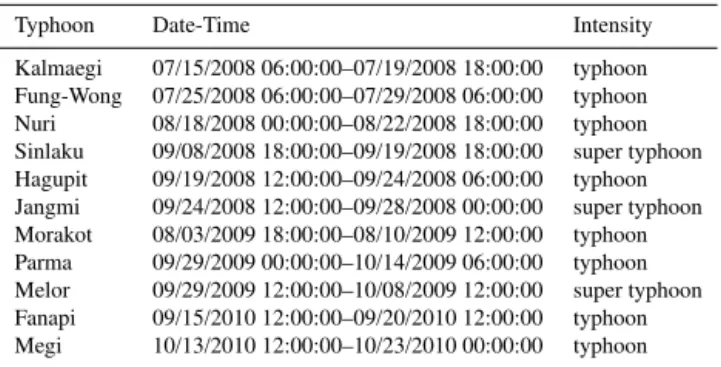
In this paper, we study 11 typhoon cases in the northwest-ern Pacific between 2008 and 2010 as listed in Table 1, for which the CWB issued typhoon warning and the storm inten-sity was stronger than the category of a tropical storm. Re-stricting to the period of 2008 to 2010 allows us to conduct this study with a relatively homogeneous experiment setting (a stable number of RO soundings, on changes in the assimi-lation system). For these cases, forecast experiments are ini-tiated every 6 h within the time range given in Table 1 and the best track for each typhoon is shown in Fig. 1. The number of forecast cases for both PNG and PWG is 284, including 43 cases in which there are two typhoons within the model domain; therefore, the total number of typhoon cases for the statistics is 327.
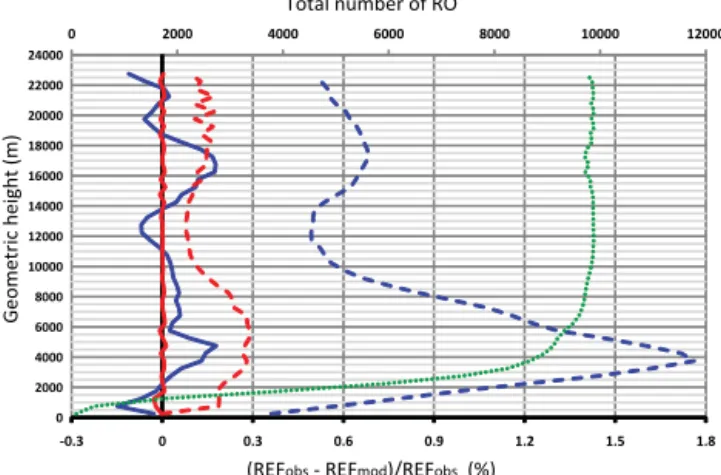
Before proceeding to the results section, it is important to confirm that the GPSRO data assimilation functions as expected. In Fig. 2 we show the statistics of background (6 h forecast) deviation (OmB) and observation-analysis deviation (OmA) averaged over all the cases. The results indicate that the background (6 h forecast) deviation (from observation) is significantly reduced following the as-similation of GPSRO data, both in terms of standard devia-tion and mean. It indicates that the WRF 3DVAR properly assimilates the RO refractivity observations.
3 Results
3.1 Verification against ECMWF analysis
In order to assess the impact of RO observations on the analy-sis and forecast of tropical cyclones, we verify the PNG and PWG grid-point fields against the ECMWF high-resolution analysis. The RMSE (root-mean-square error) of tempera-ture (T), water vapor mixing ratio (Q), zonal wind (U) and meridional wind (V) are calculated.
0 2000 4000 6000 8000 10000 12000
-0.3 0 0.3 0.6 0.9 1.2 1.5 1.8
0 2000 4000 6000 8000 10000 12000 14000 16000 18000 20000 22000 24000
Total number of RO
(REFobs - REFmod)/REFobs (%)
Geometric height (m)
Figure 2.The solid lines are the observation-background (6 h fore-cast) deviation (OmB, blue) and observation-analysis deviation (OmA, red) and the dash line are their standard deviation (blue for OmB and red for OmA) averaged over all the cases. The green line represents the total number of assimilated RO soundings. The bot-tom horizontal axis gives the percentage, normalized by observation refractivity, and the top horizontal axis shows the number associated with the green line.
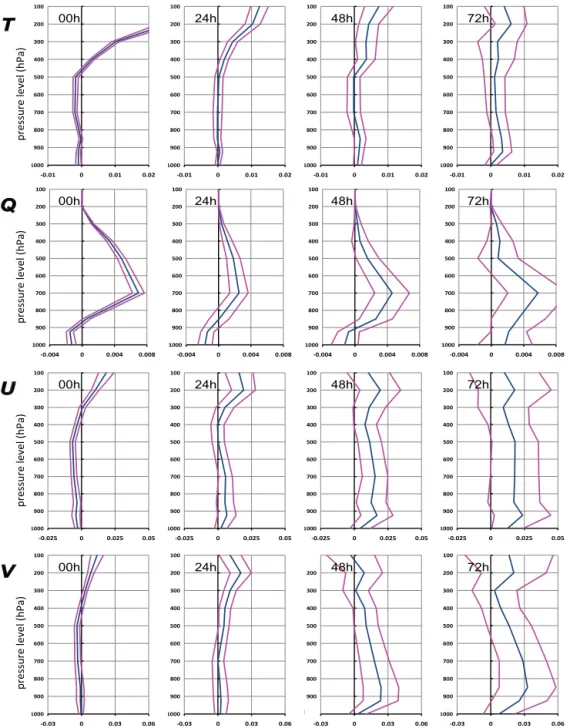
analysis as the “truth”. From top to bottom, the four rows of figures are for T, Q, U, and V, respectively. Each row has four panels, from left to right, which show the results of 00, 12, 24, 48, and 72 h forecast. The vertical axis is pres-sure levels, and the horizontal axis is the difference in RMSE between PNG and PWG averaged over all cases. The blue line is the mean difference, and the area enclosed by the two pink lines surrounding the blue line represents the 95 % con-fidence interval derived from theT distribution (Student’sT
test).
The significant positive impact of GPSRO observations on temperature analysis is quite apparent, and this impact in-creases with height. The impact is slightly negative below 400 hPa for the analysis. As the forecast progresses, the posi-tive impact at the upper level decreases with time. The slight negative impact below 400 hPa at the initial analysis (00 h forecast) becomes positive after 1 day. The contribution of GPSRO to the water vapor analysis is concentrated in the middle and lower levels, because the water vapor content is relatively low at high altitudes. In the lower troposphere the assimilation of GPSRO data gives a negative impact below 850 hPa, and remains negative for the first and second day. A significant positive impact in moisture is found between 700 and 200 hPa, with the largest impact at 700 hPa. By 72 h, GPSRO assimilation gives a positive impact on mois-ture throughout the entire troposphere. We suspect that the slight negative impact of GPSRO assimilation below 850 hPa may be affected by differences in data quality control be-tween ECMWF and TWRF data assimilation systems. Also, moisture is the most challenging variable for models to an-alyze and predict. There may be considerable uncertainties
in the ECMWF moisture analysis. We anticipate that further improvement in GPSRO data quality control may improve its use in the lower troposphere. For theU wind field, GPSRO assimilation gives a significant positive impact only at upper levels (above 300 hPa). As forecast progresses, the positive impact on theU wind gradually extends to the lower levels. By 72 h, theU wind component exhibits strong positive im-pact throughout the troposphere. The imim-pact of GPSRO as-similation on theV wind component behaves very similarly to that of theU wind component. These results suggest that impacts of GPSRO on the analysis mainly occur at the up-per levels. This implies that the TWRF model’s short-range forecast (first guess for cycling assimilation) has larger un-certainty in upper levels, and the GPSRO can provide useful information to correct the first guess. The improved analy-sis at the upper levels then propagates to the lower levels, and improves the TWRF model forecast throughout the tro-posphere.
Through the local refractivity observation operator, the as-similation of GPSRO observations directly affects the anal-ysis of the temperature and water vapor. Our experiments show that the GPSRO observations provide statistically sig-nificant positive contribution to water vapor analysis above 700 hPa and temperature analysis above 500 hPa. The value of GPSRO observations for improving meteorological anal-ysis in the upper troposphere and lower stratosphere is quite evident. The improvement in temperature analysis indirectly affects the analysis of the wind field through the back-ground error covariance and the subsequent forecast through geostrophic adjustment. As a result, the wind field exhibits a similar behavior to that of the temperature field, i.e., a signif-icant improvement in the low stratosphere initially, followed by positive impact throughout the troposphere, and the posi-tive impact continues to increase with time through 72 h fore-cast. As will be shown later, the robust positive impact on the wind fields provides more accurate environmental steering flows, leading to improved track forecast.
3.2 Impacts to typhoon-track errors
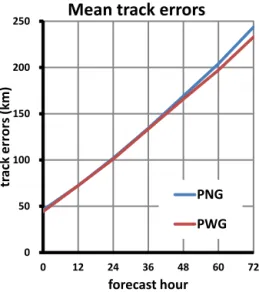
Figure 4 shows the track error, verified against the CWB best track analysis, averaged over all 327 cases for 11 typhoons for PNG and PWG, respectively. The results show that the assimilation of GPSRO does not make a significant differ-ence in typhoon-track error for the first 24 h forecast. How-ever, after 36 h, the difference becomes progressively larger with time, and the forecast track error of PWG is statistically significantly smaller than that of PNG by the end of 72 h fore-cast.
pos-T
-0.01 0 0.01 0.02
100 200 300 400 500 600 700 800 900 1000 24h
-0.01 0 0.01 0.02
100 200 300 400 500 600 700 800 900 1000 48h
-0.01 0 0.01 0.02
100 200 300 400 500 600 700 800 900 1000 72h
-0.01 0 0.01 0.02
100 200 300 400 500 600 700 800 900 1000 00h
Q
-0.004 0 0.004 0.008
100 200 300 400 500 600 700 800 900 1000 24h
-0.004 0 0.004 0.008
100 200 300 400 500 600 700 800 900 1000 48h
-0.004 0 0.004 0.008
100 200 300 400 500 600 700 800 900 1000 72h
-0.004 0 0.004 0.008
100 200 300 400 500 600 700 800 900 1000 00h
U
-0.025 0 0.025 0.05
100 200 300 400 500 600 700 800 900 1000 24h 0.025 0.05 100 200 300 400 500 600 700 800 900 1000 48h
-0.025 0 0.025 0.05
100 200 300 400 500 600 700 800 900 1000 72h
-0.025 0 0.025 0.05
100 200 300 400 500 600 700 800 900 1000 00h 100 1000
pressure level (hPa)
pressure level (hPa)
pressure level (hPa)
V
-0.03 0 0.03 0.06
100 200 300 400 500 600 700 800 900 1000 24h
-0.03 0 0.03 0.06
200 300 400 500 600 700 800 900 48h
-0.03 0 0.03 0.06
100 200 300 400 500 600 700 800 900 1000 72h
-0.03 0 0.03 0.06
100 200 300 400 500 600 700 800 900 1000 00h
pressure level (hPa)
0 -0.025
Figure 3.Mean difference in RMSE between PNG and PWG (blue line). From top to bottom: temperature (T, unit: K), mixing ratio of water vapor (Q, unit: kg kg−1), zonal wind (U, unit: ms−1)and meridional wind (V, unit: m s−1). The vertical axis is pressure level (unit: hPa) and the area enclosed by the pink lines in each panel is the 95 % confidence interval.
itive impact on forecast track error. The light blue area gives the 95 % confidence interval of mean difference of track er-ror derived from the Student’sT test. If the lower bound of the confidence interval is positive, then the positive impact of GPSRO assimilation is statistically significant. Figure 5 shows that the assimilation of the GPSRO observation has a positive impact on the initial analysis of the typhoon position, a neutral impact at 12 h forecast, and a slight positive impact between 24 to 36 h forecast. From 48 h forecast onward, the
positive impact becomes increasingly more significant as the forecast progresses.
0 50 100 150 200 250
0 12 24 36 48 60 72
tr
a
ck er
rors
(km)
forecast hour
Mean track errors
PNG
PWG
Figure 4. Mean track errors for PNG (blue line) and PWG (red line).
or the direction of the typhoon (indicated by cross-track er-ror). The red columns and green columns of Fig. 5 illustrate the difference in along-track error and cross-track error be-tween PNG and PWG, respectively. The assimilation of GP-SRO contributes to a small increase in along-track error at the 12 and 36 h forecast. After 48 h forecast, GPSRO assimi-lation consistently reduces the along-track error. On the con-trary, GPSRO assimilation reduces cross-track error through-out the entire 72 h forecast. The impact is the largest at 72 h forecast. As will be shown later, the large positive impact on cross-track error may be attributed to the improved analy-sis and prediction of environmental steering flow associated with WPSH.
3.3 The importance of GPSRO data relative to radiosonde observations
The routine radiosondes observations are available only at 00:00 and 12:00 UTC, and therefore, the relative impor-tance of GPSRO observations on the analysis may vary, depending on the quantity of radiosonde observations. It would be interesting to assess the impact of GPSRO data with the 00:00/12:00 UTC analysis cycle versus that of 06:00/18:00 UTC analysis cycle. In our experiments, there are a total of 164 analysis cycles at 00:00/12:00 UTC and 163 analysis cycles at 06:00/18:00 UTC. On average, 7523 GPSRO observations are used at 00:00/12:00 UTC and 7376 GPSRO observations at 06:00/18:00 UTC, respec-tively. The variation in the amount of GPSRO observation at 00:00/12:00 UTC and 06:00/18:00 UTC is small, but the ra-tio of the amount of GPSRO and none-GPSRO data is 1 : 6.12 at 00:00/12:00 UTC vs. 1 : 5.60 at 06:00/18:00 UTC. This is likely to cause a variation in the impacts of GPSRO as-similation between 00:00/12:00 UTC and 06:00/18:00 UTC analysis-forecast cycles.
-4 0 4 8 12 16 20
0 12 24 36 48 60 72
diff
e
re
nce
of
tr
ack err
o
rs
(km)
forecast hour
Difference of track errors (PNG-PWG)
aln-trk errs
crs-trk errs
mean track errs
Figure 5.Difference between mean track errors, along-track errors and cross-track errors of PNG and PWG.
Figure 6 shows the impacts of GPSRO averaged over the 72 h forecast for 00:00/12:00 UTC and 06:00/18:00 UTC analysis cycle, respectively. The positive impacts of GPSRO on the temperature at upper levels are more pronounced for the 06:00/18:00 UTC cycle than the 00:00/12:00 UTC cy-cle. The maximum positive impact on the water vapor is at 700 hPa for both cycles. However, the negative impact on wa-ter vapor at levels below 900 hPa is also slightly larger for the 06:00/18:00 UTC cycle. For the wind field, the positive im-pact is generally greater for the 06:00/18:00 UTC except for the zonal wind at 400 to 300 hPa.
The greater positive impact for 06:00/18:00 UTC analy-sis cycle is also reflected in the typhoon-track forecasts. Fig-ure 7 compares the impacts of GPSRO assimilation on the forecast typhoon-track error for 00:00/12:00 UTC (Fig. 7a) and 06:00/18:00 UTC (Fig. 7b) cycles, respectively. For the 00:00/12:00 UTC cycle, the impact of GPSRO is not signifi-cant until 72 h forecast, and only the 72 h forecast shows the positive impact with statistical significance (when the lower bound of vertical bar indicating 95 % confidence is positive). On the other hand, the 06:00/18:00 UTC cycle gives statis-tically significant positive impact after 48 h forecast and the impact continues to increase with time.
-0.008 0 0.008 0.016 0.024 100
200
300
400
500
600
700
800
900
1000
(a)
pressure level (hPa)
RMSE difference of T (K)
(b)
-0.002 0 0.002 0.004 0.006
100
200
300
400
500
600
700
800
900
1000
pressure level (hPa)
RMSE difference of Q (kg kg-1)
(c)
-0.015 0 0.015 0.03
100
200
300
400
500
600
700
800
900
1000
pressure level (hPa)
RMSE difference of U (m s-1)
(d)
-0.008 0 0.008 0.016 0.024
100
200
300
400
500
600
700
800
900
1000
pressure level (hPa)
RMSE difference of V (m s-1)
Figure 6.PNG-PWG difference of 00 to 72 h forecast average of RMSE for(a)temperature,(b)mixing ratio of water vapor,(c)zonal wind, and(d)meridional wind. The red line is the mean of 00:00/12:00 UTC cycles, the green line is the mean of 06:00/18:00 UTC cycles.
3.4 Impacts on environmental steering flow
As shown earlier, the assimilation of GPSRO improves the forecast of wind fields significantly. Moreover, most of the improvements in track forecast are associated with the reduc-tion of cross-track error. It would be interesting to examine how GPSRO assimilation affects the synoptic-scale circula-tion, particularly, the environmental steering flow. For this purpose, we calculate the mean differences of wind fields at 500 hPa between PWG and PNG, and apply a low pass filter with a wavelength of 1200 km. The difference field (Fig. 8a) clearly shows an anti-cyclonic gyre over the northwestern Pa-cific Ocean. This indicates that the assimilation of GPSRO leads to the strengthening of the anti-cyclonic circulation of WPSH (Fig. 8b). The southwesterly flow on the western
pe-riphery of WPSH becomes stronger, and will affect the cross-track movement of the typhoons. Most likely, the model er-ror is responsible for the weakening of WPSH. Through the assimilation of GPSRO, the strength of WPSH is partially restored.
im--10 -5 0 5 10 15 20 25
00 12 24 36 48 60 72
(b) -10
-5 0 5 10 15 20 25
00 12 24 36 48 60 72
(a)
difference of track errors (km)
forecast hour
forecast hour
difference of track errors (km)
Figure 7.Difference between mean track errors of PNG and PWG for initial hour(a)00:00/12:00 and(b)06:00/18:00.
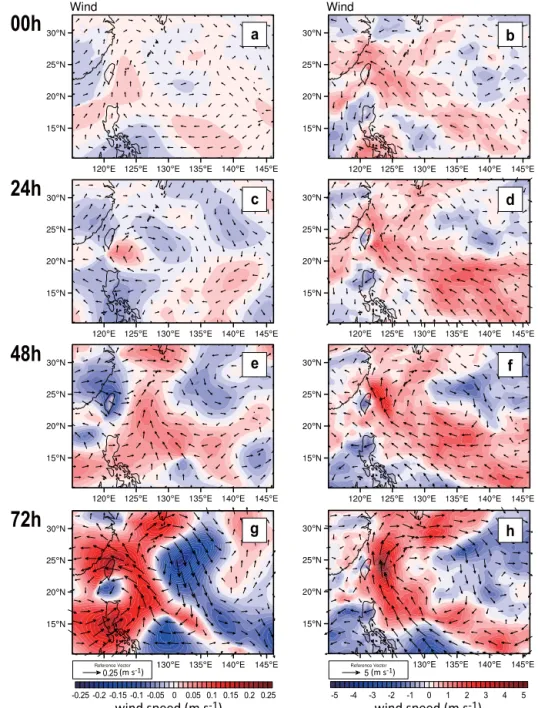
plies that the forecast of PWG is closer to ECMWF analysis than PNG does. The ECMWF-PNG difference wind fields (right column of Fig. 9) show an anti-cyclonic gyre on the western periphery of the WPSH (east of Taiwan) at the 00 h, and the difference wind speed on the south and west edge of WPSH becomes progressively stronger with time. This sug-gests that WPSH as predicted by PNG is weaker than the ECMWF analysis (Fig. 8b). The PWG-PNG (left column of Fig. 9) difference wind fields give a pattern very similar to that of ECMWF-PNG, and the wind speed of PWG in the area southeast of Taiwan is also larger than PNG after 48 h forecast. Although the area with anti-cyclonic wind differ-ence from PWG-PNG is smaller than that of ECMWF-PNG, its location is very close to that of ECMWF-PNG. The area to the southeast of Taiwan is particularly important, as this is the region where most of the typhoons in this study pass though (Fig. 1). It is clear that the assimilation of GPSRO re-fractivity improves the forecast of synoptic-scale circulation, which in turn leads to improved typhoon-track forecasts.
The motion of typhoons is largely dictated by the environ-mental steering flow and the beta effect of the intrinsic dy-namics of typhoon circulation. For the majority of typhoon cases, the environmental steering flow is the dominating fac-tor. The steering flow is often represented by the deep layer mean (from 1000 to 200 hPa) of the averaged asymmetrical wind inside the typhoon circulation. To assess the impact of
a
150 140 130 120 110 100 90 80
150 140 130 120 110 100 90 80
a
b
geopotenal height (m)
(m s-1) 20
(m s-1) 0.1
Figure 8. (a)Mean differences of analysis wind field at 500 hPa between PWG and PNG and(b) the mean of wind (vector) and geopotential height (shading) of PNG at 500 hPa.
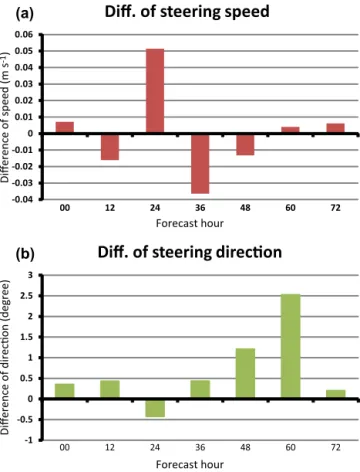
GPSRO data assimilation on the prediction of steering flow, we compare the respective absolute error in steering flow between PWG and PNG (verified against the steering flow calculated from the ECMWF analysis). We define the differ-ence between the two such that a positive differdiffer-ence indicates that the assimilation of GPSRO has a positive impact on the steering flow. Figure 10a shows that there is no clear system-atic difference in the speed of the steering flow. However, for the direction of the steering flow, the assimilation of GPSRO clearly has a positive impact throughout the 72 h forecast, ex-cept for the 24 h forecast. This is consistent with the results, shown in Fig. 5, that the improvement in typhoon-track fore-cast is mainly associated with the reduction of cross-track error.
(m s-1)
0.25 5 (m s-1)
wind speed (m s-1) wind speed (m s-1)
00h
24h
48h
72h
0.25 0.2 0.15 0.1 0.05 0 -0.05 -0.1 -0.15 -0.2
-0.25 -5 -4 -3 -2 -1 0 1 2 3 4 5
a b
c d
e f
g h
Figure 9. Mean differences of wind speed (shading) and wind vectors at 700 hPa between PWG and PNG (left column), and between ECMWF and PNG (right column) at forecast time from 00 to 72 h.
the observation location as forecast progresses. This implies that the speed for predicted typhoon motion is systematically too slow both in PWG and PNG. However, the assimilation of GPSRO extends the WPSH southward and westward, and improving the prediction of the direction of steering flow. As a result, the northward and eastward systematic position bias is reduced.
4 Summary and conclusions
In this study, we perform a systematic evaluation of the im-pacts of GPSRO on typhoon-track forecast. The operational
-0.04 -0.03 -0.02 -0.01 0 0.01 0.02 0.03 0.04 0.05 0.06
Diff. of steering speed
(a)-1 -0.5 0 0.5 1 1.5 2 2.5 3
Diff. of steering direcon
(b)00 12 24 36 48 60 72
00 12 24 36 48 60 72
Forecast hour Forecast hour
Difference of speed (m s
-1)
Difference of direcon (degree)
Figure 10. Difference of absolute error (against the steering flow derived from analysis of ECMWF) on steering flow(a)speed and
(b)direction between PNG and PWG.
(2013) for the following reasons. (a) The best track position errors may be large for an individual case at a specific time. However, the position errors are random and the mean posi-tion error would be close to 0 when averaged over 300 cases. (b) With “vortex relocation”, the storms in both PNG and PWG are placed at the same position (based on best track) initially. Therefore, the best track uncertainty does not fa-vor one experiment versus the other. (c) The mean 72 h fore-cast track error of PWG is 234 km, which is significantly largely than the best track uncertainty. As stated by Land-sea and Franklin (2013), the best track uncertainty should not pose a problem for assessing improvement on a 3-day track forecast. (d) The Student’sT test has demonstrated that the impact of GPSRO assimilation on typhoon-track forecast is statistically significant. (e) Our subsequent analysis of the results demonstrate that the improvement due to GPSRO as-similation can be attributed to improved prediction of WPSH and the steering flow. Therefore, there is solid physical ex-planation supporting the robustness of the impact of GPSRO assimilation on typhoon-track forecast.
Further analysis shows that the assimilation of GPSRO data improves the analysis and prediction of the WPSH, such that it is further extended westward and southward, consis-tent with the ECMWF analysis. The wind fields over the
-10 0 10 20
-10 0 10 20 30 40 50 60 70
differ
e
nce in y
(km)
difference in x (km) PNG
PWG
00
12
24 36 48
60
72
Figure 11. Mean track bias in longitude (x axis) and latitude (yaxis) direction.
southwestern periphery of WPSH are improved as a result of GPSRO data assimilation. The improved environmental steering flow associated with the WPSH, in turn, leads to im-proved track forecast.
Although the assimilation of GPSRO data only produces a very modest improvement in track forecast, these results are very encouraging, given the relatively small number of GPSRO soundings assimilated and the limitations of the cur-rent experiment framework. With a 12 h partial cycling anal-ysis, only about 100 GPSRO soundings are used over a do-main of 9945 km×5670 km. Most data impact studies
us-ing a global model are performed with a fully cyclus-ing anal-ysis over a period of at least 2 weeks. This would allow a significantly larger amount of data being assimilated. Also, the impact of the data is allowed to accumulate with time. With a fresh cold start of each cycle for a partial cycling strategy, there is no accumulation of the impact of GPSRO. The TWRF has a horizontal resolution of 45 km, which can-not properly capture the mesoscale circulation of a tropical cyclone. Also the assimilation of GPSRO data using a 3D-Var system with a simple local refractivity operator is sub-optimal. The FORMOSAT-7/COSMIC-2, which is expected to be launched in May 2016, will provide an order of magni-tude increase in GPSRO soundings over the tropics. The as-similation of FORMOSAT-7/COSMIC-2 using an advanced data assimilation system with a sophisticated observation op-erator and a high-resolution mesoscale model is expected to produce a significant improvement in typhoon prediction both in terms of track and intensity.
Acknowledgements. This study was supported by National Space
Organization (NSPO) in Taiwan. The computational resources were partly provided by the National Center for High-performance Computing (NCHC) in Taiwan. In addition, we acknowledge the Atmospheric Research Data Bank at the Taiwan Typhoon and Flood Research Institute for supplying the atmospheric research data. Y.-H. Kuo acknowledges the support of NOAA Hurricane Forecast Improvement Project (HFIP) through the Developmental Testbed Center (DTC).
References
Anthes, R. A., Ector, D., Hunt, D. C., Kuo, Y.-H., Rocken, C., Schreiner, W. S., Sokolovskiy, S. V., Syndergaard, S., Wee, T.-K., Zeng, Z., Bernhardt, P. A., Dymond, K. F., Chen, Y., Liu, H., Manning, K., Randel, W. J., Trenberth, K. E., Cucurull, L., Healy, S. B., Ho, S.-P., McCormic, C., Meehan, T. K., Thompson, D. C., and Yen, N. L.: The COSMIC/FORMOSAT-3 mission: Early re-sults, B. Am. Meteorol. Soc., 89, 313–333, 2008.
Aparicio, J. M., Deblonde, G., Garand, L., and Laroche, S.: The signature of the atmospheric compressibility factor in COSMIC, CHAMP and GRACE radio occultation data, J. Geophys. Res., 114, D16144, doi:10.1029/2008JD011156, 2009.
Buontempo, C., Jupp, A., and Rennie, M. P.: Operational NWP as-similation of GPS radio occultation data, Atmos. Sci. Lett., 9, 129–133, 2008.
Chen, F. and Dudhia, J.: Coupling an advanced land surface-hydrology model with the Penn State-NCAR MM5 modeling system. Part I: Model implementation and sensitivity, Mon. Weather Rev., 129, 569–585, 2001.
Cucurull, L. and Derber, J. C.: Operational implementation of COS-MIC observations into NCEP’s global data assimilation system, Weather Forecast., 23, 702–711, 2008.
Cucurull, L., Derber, J. C., Treadon, R., and Purser, R. J.: Assim-ilation of Global Positioning System Radio Occultation Obser-vations into NCEP’s Global Data Assimilation System, Mon. Weather Rev., 135, 3174–3193, 2007.
Galarneau, T. J. and Davis, C. A.: Diagnosing forecast errors in tropical cyclone motion, Mon. Weather Rev., 141, 405–430, 2013.
Hajj, G. A., Ao, C. O., Iijima, B. A., Kuang, D., Kursinski, E. R., Mannucci, A. J., Meehan, T. K., Romans, L. J., Juarez, M. de la Torre, and Yunck, T. P.: CHAMP and SAC-C atmospheric oc-cultation results and intercomparisons, J. Geophys. Res., 109, D06109, doi:10.1029/2003JD003909, 2004.
Healy, S. B.: Forecast impact experiment with a constellation of GPS radio occultation receivers, Atmos. Sci. Lett., 9, 111–118, 2008.
Ho, S.-P., Kerchengast, G., Leroy, S., Wickert, J., Mannucci, A. J., Steiner, A., Hunt, D., Schreiner, W., Sokolovskiy, S., Ao, C., Borsche, M., von Engeln, A., Foelsche, U., Heise, S., Iijima, B., Kuo, Y.-H., Kursinski, R., Pirscher, B., Ringer, M., Rocken, C., and Schmidt, T.: Estimating the uncertainty of using GPS radio occultation data for climate monitoring: Intercomparison of CHAMP refractivity climate records from 2002 to 2006 from different data centers, J. Geophys. Res., 114, D23107, doi:10.1029/2009JD011969, 2009.
Hong, S.-Y., Noh, Y., and Dudhia, J.: A new vertical diffusion pack-age with an explicit treatment of entrainment processes, Mon. Weather Rev., 134, 2318–2341, 2006.
Hsiao, L.-F., Chen, D.-S., Kuo, Y.-H., Guo, Y.-R., Yeh, T.-C., Hong, J.-S., Fong, C.-T., and Lee, C.-S.: Application of WRF 3DVAR to operational typhoon prediction in Taiwan: impact of outer loop and partial cycling approaches, Weather Forecast., 27, 1249– 1263, 2012.
Huang, C.-Y., Kuo, Y.-H., and Chen, S.-H.: Improvements on Ty-phoon Forecast with Assimilated GPS Occultation Refractivity, Weather Forecast., 20, 931–953, 2005.
Kain, J. S. and Fritsch, J. M.: A one-dimensional entrain-ing/detraining plume model and its application in convective pa-rameterization, J. Atmos. Sci., 47, 2784–2802, 1990.
Kueh, M.-T., Huang, C.-Y., Chen, S.-Y., Chen, S.-H., and Wang, C.-J.: Impact of GPS radio occultation soundings on prediction of Typhoon Bilis (2006) landfalling Taiwan, Terr. Atmos. Ocean Sci., 20, 115–131, 2009,
http://www.ocean-sci.net/20/115/2009/.
Kuo, Y.-H., Zou, X., and Huang, W.: The impact of Global Po-sitioning System data on the prediction of an extratropical cy-clone: An observing system simulation experiment, Dynam. At-mos. Oceans, 27, 439–470, 1997.
Kuo, Y.-H., Wee, T.-K., Sokolovskiy, S., Rocken, C., Schreiner, W., Hunt, D., and Anthes, R. A.: Inversion and error estimation of GPS radio occultation data, J. Meteorol. Soc. Jpn., 82, 507–531, 2004.
Kuo, Y.-H., Liu, H., Guo, Y.-R., Terng, C.-T., and Lin. Y.-T.: Impact of FORMOSAT-3/COSMIC data on typhoon and Mei-yu predic-tion, in: Recent Progress in Atmospheric Sciences: Applications to the Asia-Pacific Region, World Scientific, 458–483, 2009. Kursinski, E. R., Hajj, G. A., Hardy, K. R., Schofield, J. T., and
Lin-field, R.: Observing Earth’s atmosphere with radio occultation measurements, J. Geophys. Res., 102, 23429–23465, 1997. Landsea, C. W. and Franklin, J. L.: Atlantic Hurricane Database
Uncertainty and Presentation of a New Dataset Format, Mon. Weather Rev., 141, 3576–3592, 2013.
Larsen, G. B., Lauritsen, K. B., Rubek, F., and Sorensen, M. B.: GRAS-SAF Radio Occultation Data from EPS/Metop, in: Oc-cultation for Probing Atmosphere and Climate, Kirchengast, G., Foelsche, U., and Steiner, A. K., Springer, 111–118, 2004. Liu, H., Anderson, J., and Kuo, Y.-H.: Improved Analyses and
Fore-casts of Hurricane Ernesto’s Genesis Using Radio Occultation Data in an Ensemble Filter Assimilation System, Mon. Weather Rev., 140, 151–166, 2012.
Mlawer, E. J., Taubman, S. J., Brown, P. D., Iacono, M. J., and Clough, S. A.: Radiative transfer for inhomogeneous atmo-spheres: RRTM, a validated correlated-k model for the longwave, J. Geophys. Res., 102, 16663–16682, 1997.
Poli, P., Healy, S. B., and Dee, D. P.: Assimilation of Global Po-sitioning System radio occultation data in the ECMWF ERA-Interim reanalysis, Q. J. Roy. Meteor. Soc., 136, 1972–1990, doi:10.1002/qj.722, 2010.
Shen, Y.-C., Chen, Y.-C., Yang, M.-J., Fong, C.-T., and Chen, W.-M.: The Impacts of GPSRO data to the forecast typhoon tracks in Central Weather Bureau’s Global Forecast System, 2011 Con-ference on Weather Analysis, Forecasting and Seismic Observa-tion, Taipei, Taiwan, 20–22 September 2011, 90–93, 2011 (in Chinese).
Smith, E. K. and Weintraub, S.: The constants in the equation for atmospheric refractive index at radio frequencies, P. IRE, 41, 1035–1037, 1953.
Tao, W.-K., Simpson, J., Baker, D., Braun, S., Chou, M.-D., Ferrier, B., Johnson, D., Khain, A., Lang, S., Lynn, B., Shie, C.-L., Starr, D., Sui, C.-H., Wang, Y., and Wetzel, P.: Microphysics, radiation and surface processes in the Goddard Cumulus Ensemble (GCE) model, Meteorol. Atmos. Phys., 82, 97–137, 2003.
Mel-bourne, W., and Businger, S.: GPS soundings of the atmosphere from low earth orbit: Preliminary results, B. Am. Meteorol. Soc., 77, 19–40, 1996.
Wickert, J., Reigber, C., Beyerle, G., König, R., Marquardt, C., Schmidt, T., Grunwaldt, L., Galas, R., Meehan, T. K., and Mel-bourne, W. G.: Atmosphere sounding by GPS radio occultation: First results from CHAMP, Geophys. Res. Lett., 28, 3263–3266, 2001.