OVERVIEW OF THE CLEF 2008 MULTILINGUAL
QUESTION ANSWERING TRACK
Pamela Forner1, Anselmo Peñas2, Eneko Agirre3, Iñaki Alegria4, Corina For scu5, Nicolas Moreau6, Petya Osenova7, Prokopis Prokopidis8, Paulo Rocha9, Bogdan
Sacaleanu10, Richard Sutcliffe11, and Erik Tjong Kim Sang12
1 CELCT, Trento, Italy ([email protected])
2 Departamento de Lenguajes y Sistemas Informáticos, UNED, Madrid, Spain ([email protected])
3 Computer Science Department, University of Basque Country, Spain ([email protected]) 4 University of Basque Country, Spain ([email protected])
5 UAIC and RACAI, Romania ([email protected]) 6 ELDA/ELRA, Paris, France ([email protected])
7 BTB, Bulgaria, ([email protected]) 8 ILSP Greece, Athena Research Center ([email protected]) 9 Linguateca, DEI UC, Portugal, ([email protected])
10 DFKI, Germany, ([email protected])
11 DLTG, University of Limerick, Ireland ([email protected]) 12 University of Groningen ([email protected])
1 Introduction
QA@CLEF 2008 was carried out according to the spirit of the campaign, consolidated in previous years. Beside the classical main task, three additional exercises were proposed:
• the main task: several monolingual and cross-language sub-tasks, were offered: Bulgarian, English, French, German, Italian, Portuguese, Romanian, Greek, Basque and Spanish were proposed as both query and target languages.
• the Answer Validation Exercise (AVE) [2]: in its third round was aimed at evaluating answer validation systems based on textual entailment recognition. In this task, systems were required to emulate human assessment of QA responses and decide whether an Answer to a Question is correct or not according to a given Text. Results were evaluated against the QA human assessments.
• the Question Answering on Speech Transcripts (QAST) [3]: which continued last year’s successful pilot task, aimed at providing a framework in which QA systems could be evaluated when the answers to factual and definition questions must be extracted from spontaneous speech transcriptions.
• the Word Sense Disambiguation for Question Answering (QA- WSD) [4], a pilot task which provided the questions and collections with already disambiguated Word Senses in order to study their contribution to QA performance.
As far as the main task is concerned, following last year experience, the exercise consisted of topic-related questions, i.e. clusters of questions which were related to the same topic and contained co-references between one question and the others. The requirement for questions related to a topic necessarily implies that the questions refer to common concepts and entities within the domain in question. This is accomplished either by co-reference or by anaphoric reference to the topic, implicitly or explicitly expressed in the first question or in its answer.
Moreover, besides the usual news collections provided by ELRA/ELDA, articles from Wikipedia were considered as an answer source. Some questions could have answers only in one collection, i.e. either only in the news corpus or in Wikipedia.
As a general remark, this year we had the same number of participants as in 2007 campaign, but the number of submissions went up. Due to the complexity of the innovations introduced in 2007 - the introduction of topic-related sets of questions and anaphora, list questions, Wikipedia corpus - the questions tended to get a lot more difficult and the performance of systems dropped dramatically, so, people were disinclined to continue the following year (i.e. 2008), inverting the positive trend in participation registered in the previous campaigns.
As reflected in the results, the task proved to be even more difficult than expected. Results improved in the monolingual subtasks but are still very low in the cross-lingual subtasks.
2 Task Description
As far as the main task is concerned, the consolidated procedure was followed, capitalizing on the experience of the task proposed in 2007.
The exercise consisted of topic-related questions, i.e. clusters of questions which were related to the same topic and contained co-references between one question and the others. Neither the question types (F, D, L) nor the topics were given to the participants.
The systems were fed with a set of 200 questions -which could concern facts or events (F-actoid questions), definitions of people, things or organisations (D-efinition questions), or lists of people, objects or data (L-ist questions)- and were asked to return up to three exact answers per question, where exact meant that neither more nor less than the information required was given.
The answer needed to be supported by the docid of the document in which the exact answer was found, and by portion(s) of text, which provided enough context to support the correctness of the exact answer. Supporting texts could be taken from different sections of the relevant documents, and could sum up to a maximum of 700 bytes. There were no particular restrictions on the length of an answer-string, but unnecessary pieces of information were penalized, since the answer was marked as ineXact. As in previous years, the exact answer could be exactly copied and pasted from the document, even if it was grammatically incorrect (e.g.: inflectional case did not match the one required by the question). Anyway, systems were also allowed to use natural language generation in order to correct morpho-syntactical inconsistencies (e.g., in German, changing dem Presidenten into der President if the question implies that the answer is in nominative case), and to introduce grammatical and lexical changes (e.g., QUESTION: What nationality is X? TEXT: X is from the Netherlands
EXACT ANSWER: Dutch).
The subtasks were both:
• monolingual, where the language of the question (Source language) and the language of the texts collection (Target language) were the same;
• cross-lingual, where the questions were formulated in a language different from that of the texts collection.
Table 1. Tasks activated in 2008 (coloured cells)
TARGET LANGUAGES (corpus and answers)
BG DE EL EN ES EU FR IT NL PT RO
S
O
U
R
C
E
L
A
N
G
U
A
G
E
S
(q
ue
st
io
ns
)
BG
DE
EL
EN
ES
EU
FR
IT
NL
PT
RO
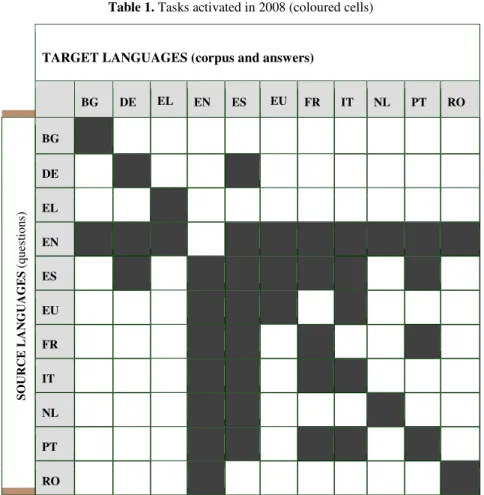
As shown in Table 1, 43 tasks were proposed:
• 10 Monolingual -i.e. Bulgarian (BG), German (DE), Greek (EL), Spanish (ES), Basque (EU), French (FR), Italian (IT), Dutch (NL), Portuguese (PT) and Romanian (RO);
• 33 Cross-lingual (as customary in recent campaigns, in order to prepare the cross-language subtasks, for which at least one participant had registered, some target language question sets were translated into the combined source languages).
Anyway, as Table 2. Tasks chosen by at least 1 participant in QA@CLEF
campaigns2 shows, not all the proposed tasks were then carried out by the participants.
Table 2. Tasks chosen by at least 1 participant in QA@CLEF campaigns
MONOLINGUAL CROSS-LINGUAL
CLEF-2004 6 13
CLEF-2005 8 15
CLEF-2006 7 17
CLEF-2007 7 11
CLEF-2008 8 12
2.1 Questions Grouped by Topic
The procedure followed to prepare the test set was the same as that used in the 2007 campaign. First of all, each organizing group, responsible for a target language, freely chose a number of topics. For each topic, one to four questions were generated. Topics could be not only named entities or events, but also other categories such as objects, natural phenomena, etc. (e.g. George W. Bush; Olympic Games; notebooks; hurricanes; etc.). The set of ordered questions were related to the topic as follows: • the topic was named either in the first question or in the first answer
• the following questions could contain co-references to the topic expressed in the first question/answer pair.
Topics were not given in the test set, but could be inferred from the first question/answer pair. For example, if the topic was George W. Bush, the cluster of questions related to it could have been:
Q1: Who is George W. Bush?; Q2: When was he born?; Q3: Who is his wife?
The requirement for questions related to a same topic necessarily implies that the questions refer to common concepts and entities within the domain. The most common form is pronominal anaphoric reference to the topic declared in the first question, e.g.:
Q4: What is a polygraph?; Q5: When was it invented?
However, other forms of co-reference occurred in the questions. Here is an example:
Q6: Who wrote the song "Dancing Queen"?; Q7: How many people were in the group?
2.2 Document collections
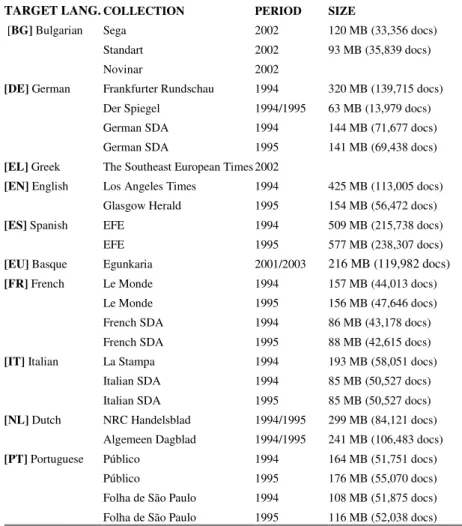
Beside the data collections composed of news articles provided by ELRA/ELDA (see Table 3), also Wikipedia was considered.
The Wikipedia pages in the target languages, as found in the version of November 2006, could be used. Romanian had Wikipedia1 as the only document collection, because there was no newswire Romanian corpus. The “snapshots” of Wikipedia were made available for download both in XML and HTML versions. The answers to the questions had to be taken from actual entries or articles of Wikipedia pages. Other types of data such as images, discussions, categories, templates, revision histories, as well as any files with user information and meta-information pages, had to be excluded.
One of the major reasons for using Wikipedia was to make a first step towards web formatted corpora where to search for answers. In fact, as nowadays so large information sources are available on the web, this may be considered a desirable next level in the evolution of QA systems. An important advantage of Wikipedia is that it is freely available for all languages so far considered. Anyway the variation in size of Wikipedia, depending on the language, is still problematic.
2.3 Types of Questions
As far as the question types are concerned, as in previous campaigns, the three following categories were considered:
1. Factoid questions, fact-based questions, asking for the name of a person, a location, the extent of something, the day on which something happened, etc. We consider the following 8 answer types for factoids:
− PERSON, e.g.: Q8: Who was called the “Iron-Chancellor”? A8: Otto von Bismarck.
− TIME, e.g.: Q9: What year was Martin Luther King murdered? A9: 1968.
− LOCATION, e.g.: Q10: Which town was Wolfgang Amadeus Mozart born in? A10: Salzburg.
− ORGANIZATION, e.g.: Q11: What party does Tony Blair belong to?: A11: Labour Party.
− MEASURE, e.g.: Q12: How high is Kanchenjunga? A12: 8598m.
− COUNT, e.g.: Q13: How many people died during the Terror of PoPot? A13: 1 million.
− OBJECT, e.g.: Q14: What does magma consist of? A14: Molten rock.
− OTHER, i.e. everything that does not fit into the other categories above, e.g.: Q15: Which treaty was signed in 1979? A15: Israel-Egyptian peace treaty.
Table 3. Document collections used in QA@CLEF 2008
TARGET LANG. COLLECTION PERIOD SIZE
[BG] Bulgarian Sega 2002 120 MB (33,356 docs) Standart
Novinar
2002 2002
93 MB (35,839 docs)
[DE] German
[EL] Greek
Frankfurter Rundschau 1994 320 MB (139,715 docs) Der Spiegel 1994/1995 63 MB (13,979 docs) German SDA 1994 144 MB (71,677 docs) German SDA
The Southeast European Times 1995 2002
141 MB (69,438 docs)
[EN] English Los Angeles Times 1994 425 MB (113,005 docs) Glasgow Herald 1995 154 MB (56,472 docs) [ES] Spanish
[EU] Basque
EFE 1994 509 MB (215,738 docs)
EFE Egunkaria
1995 2001/2003
577 MB (238,307 docs) 216 MB (119,982 docs) [FR] French Le Monde 1994 157 MB (44,013 docs)
Le Monde 1995 156 MB (47,646 docs) French SDA 1994 86 MB (43,178 docs) French SDA 1995 88 MB (42,615 docs) [IT] Italian La Stampa 1994 193 MB (58,051 docs)
Italian SDA 1994 85 MB (50,527 docs) Italian SDA 1995 85 MB (50,527 docs) [NL] Dutch NRC Handelsblad 1994/1995 299 MB (84,121 docs)
Algemeen Dagblad 1994/1995 241 MB (106,483 docs) [PT] Portuguese Público 1994 164 MB (51,751 docs)
Público 1995 176 MB (55,070 docs) Folha de São Paulo 1994 108 MB (51,875 docs) Folha de São Paulo 1995 116 MB (52,038 docs)
2. Definition questions, such as “What/Who is X?”, are divided into the following subtypes:
− PERSON, i.e., questions asking for the role/job/important information about someone, e.g.: Q16: Who is Robert Altmann? A16: Film maker
− ORGANIZATION, i.e., questions asking for the mission/full name/important information about an organization, e.g.: Q17: What is the Knesset? A17: Parliament of Israel.
−
OBJECT, i.e., questions asking for the description/function of objects, e.g.: Q18: What is Atlantis? A18: Space Shuttle.3. Closed list questions: i.e., questions that require one answer containing a determined number of items, e.g.: Q20: Name all the airports in London, England. A20: Gatwick, Stansted, Heathrow, Luton and City.
As only one answer was allowed, all the items had to be present in sequence in the document and copied, one next to the other, in the answer slot.
Besides, all types of questions could contain a temporal restriction, i.e. a temporal specification that provided important information for the retrieval of the correct answer, for example:
Q21: Who was the Chancellor of Germany from 1974 to 1982? A21: Helmut Schmidt.
Q22: Which book was published by George Orwell in 1945? A22: Animal Farm.
Q23: Which organization did Shimon Perez chair after Isaac Rabin’s death? A23: Labour Party Central Committee.
Some questions could have no answer in the document collection, and in that case the exact answer was "NIL" and the answer and support docid fields were left empty. A question was assumed to have no right answer when neither human assessors nor participating systems could find one.
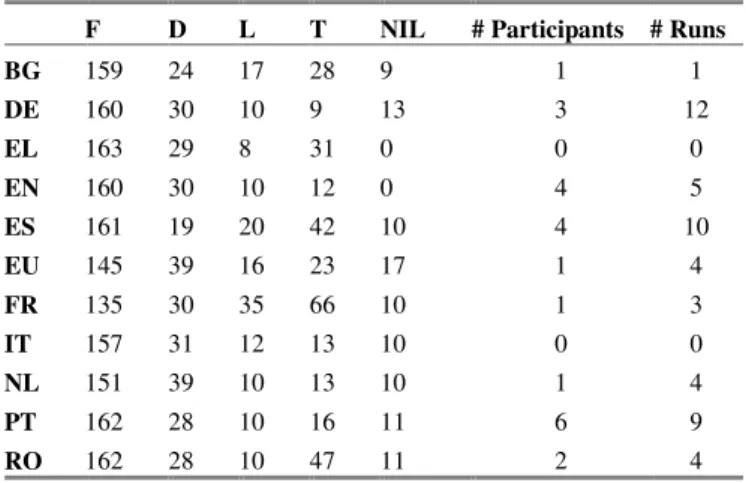
The distribution of the questions among these categories is described in Table 4. Each question set was then translated into English, which worked as inter-language during the translation of the datasets into the other tongues for the activated cross-lingual subtasks.
Table 4. Test set breakdown according to question type, number of participants and number of runs
F D L T NIL # Participants # Runs
BG 159 24 17 28 9 1 1
DE 160 30 10 9 13 3 12
EL 163 29 8 31 0 0 0
EN 160 30 10 12 0 4 5
ES 161 19 20 42 10 4 10
EU 145 39 16 23 17 1 4
FR 135 30 35 66 10 1 3
IT 157 31 12 13 10 0 0
NL 151 39 10 13 10 1 4
PT 162 28 10 16 11 6 9
2.4 Formats
As the format is concerned, also this year both input and output files were formatted as an XML file. For example, the first four questions in the EN-FR test set, i.e. English questions that hit a French document collection - were represented as follows:
<input>
<q target_lang="FR" source_lang="EN" q_id="0001"
q_group_id="1600">Which is the largest bird in Africa?</q>
<q target_lang="FR" source_lang="EN" q_id="0002" q_group_id="1600">How many species of ostriches are there?</q>
<q target_lang="FR" source_lang="EN" q_id="0003" q_group_id="1601">Who served as a UNICEF goodwill ambassador between 1988 and 1992?</q> <q target_lang="FR" source_lang="EN" q_id="0004"
q_group_id="1601">What languages did she speak?</q> ...
</input>
An example of system output which answered the above questions was the following:
<?xml version="1.0" encoding="UTF-8"?> <!DOCTYPE output SYSTEM "QA-CLEF-OUTPUT.dtd"> <output>
<a q_id="0001" q_group_id="1600" run_id="syna081enfr" score="0.000"> <answer>version</answer>
<docid>Afrique des Grands Lacs</docid> <support>
<s_id>Afrique des Grands Lacs</s_id>
<s_string>Comprendre la crise de l'Afrique des grands lacs - dossier RFI (version archivée par Internet Archive).</s_string>
</support> </a>
<a q_id="0002" q_group_id="1600" run_id="syna081enfr" score="0.000"> <answer>500 000</answer>
<docid>ATS.940202.0138</docid> <support>
<s_id>ATS.940202.0138</s_id>
<s_string>Avec une superficie de seulement 51 000 km2, le Costa Rica abrite quelque 500 000 espèces végétales et animales. Il compte plus d'espèces d'oiseaux et d'arbres qu'il n'y en a sur l'ensemble du territoire des Etats-Unis. </s_string>
</support> </a>
<a q_id="0003" q_group_id="1601" run_id="syna081enfr" score="0.000"> <answer>NIL</answer>
<docid/> <support> <s_id/> <s_string/> </support> </a>
<a q_id="0004" q_group_id="1601" run_id="syna081enfr" score="0.000"> <answer>NIL</answer>
2.5 Evaluation Measures and Assessment
As far the evaluation process is concerned, no changes were made with respect to the previous campaigns. Human judges assessed the exact answer (i.e. the shortest string of words which is supposed to provide the exact amount of information to answer the question) as:
• R (Right) if correct; • W (Wrong) if incorrect;
• X (ineXact) if contained less or more information than that required by the query;
• U (Unsupported) if either the docid was missing or wrong, or the supporting snippet did not contain the exact answer.
Most assessor-groups managed to guarantee a second judgement of all the runs. As regards the evaluation measures, the main one was accuracy, defined as the proportion of questions that received a correct answer in first place. In addition most assessor groups computed Confident Weighted Score (CWS) [16] and the Mean Reciprocal Rank (MRR) over up to three assessed answers per question.
In the next section the particularities in evaluation are reported for each target language.
3 Results
As far as accuracy is concerned, scores were generally far lower than usual, as Figure 1 shows. Although comparison between different languages and years is not possible, in Figure 1 we can observe some trends which characterized this year’s competition: best accuracy in the monolingual task increased with respect to last year, going up again to the values recorded in 2006. But systems - even those that participated in all previous campaigns - did not achieve a brilliant overall performance. Apparently systems could not manage suitably the new challenges, although they improved their performances when tackling issues already treated in previous campaigns.
0 10 2 0 3 0 4 0 5 0 6 0 7 0 8 0 M o n o B ilin g u a l M o n o B ilin g u a l M o n o B ilin g u a l M o n o B ilin g u a l M o n o B ilig u a l M o n o B ilin g u a l
B est A verage
CLEF 03 CLEF 04 CLEF 05 CLEF 06 CLEF 07 CLEF 08
Fig. 1. Best and average scores in QA@CLEF campaigns
3.1 Participation
Table 5. Number of participants in QA@CLEF
America Europe Asia Australia TOTAL
CLEF 2003 3 5 0 0 8
CLEF 2004 1 17 0 0 18
CLEF 2005 1 22 1 0 24
CLEF 2006 4 24 2 0 30
CLEF 2007 3 16 1 1 21
CLEF 2008 1 20 0 0 21
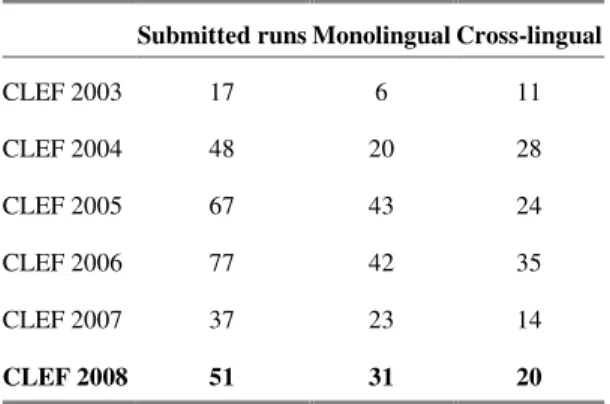
The number of participants has remained almost the same as in 2007 (see Table 5). As noticed, this is probably the consequence of the new challenges introduced last year in the exercise.
Also the geographical distribution remained almost unchanged, even though there was no participation from Australia and Asia. No runs were submitted neither for Italian or Greek tasks.
Table 6. Number of submitted runs
Submitted runs Monolingual Cross-lingual
CLEF 2003 17 6 11
CLEF 2004 48 20 28
CLEF 2005 67 43 24
CLEF 2006 77 42 35
CLEF 2007 37 23 14
CLEF 2008 51 31 20
In the following subsections a more detailed analysis of the results in each language follows, giving specific information on the performances of the participating systems in the single sub-tasks and on the different types of questions, providing the relevant statistics and comments.
3.2 Basque as target
In the first year working with Basque as target only one research group submitted runs for evaluation in the track having Basque as target language (Ixa group from the University of the Basque Country). They sent four runs: one monolingual, one English-Basque and two Spanish-Basque.
The Basque question set consisted of 145 factoid questions, 39 definition questions and 16 list questions. 39 questions contained a temporal restriction, and 10 had no answer in the Gold Standard. 40 answers were retrieved from Wikipedia, the remains from the news collections. Half of the questions were linked to a topic, so the second (and sometimes the 3rd) question was more difficult to answer.
The news collection was the Egunkaria newspaper during 2000, 2001 and 2002 years and the information from Wikipedia was the exportation corresponding to the 2006 year.
Table 7 shows the evaluation results for the four submitted runs (one monolingual and three cross-lingual). The table shows the number of Right, Wrong, ineXact and Unsupported answers, as well as the percentage of correctly answered Factoids, Temporally restricted questions, Definition and List questions.
Table 7. Evaluation results for the four submitted runs
Run R
# W # X # U # %F [145] %T [23] %D [39] L% [16] NIL CWS Overall
accur acy
# %
[*] ixag08
1eueu 26 163 11 0 15.9 8.7 7.7 0 4 7.0 0.023 13
ixag08
1eneu 11 182 7 0 5.5 4.3 7.7 0 6 6.2 0.004 5.5
ixag08
1eseu 11 182 7 0 6.9 4.3 2.6 0 4 4.8 0.004 5.5
ixag08
2eseu 7 185 8 0 4.8 4.3 0 0 3 3.5 0.003 3.5
Looking to the cross-lingual runs, the loss of accuracy respect to the monolingual system is a bit more than 50% for the two best runs. This percentage is quite similar with runs for other target languages in 2007. The overall accuracy is the same for both (English and Spanish to Basque) but only they agree in five correct answers (each system gives other six correct answers). The second system for Spanish-Basque get poorer results and only is slightly better in inexact answers. These runs get also a lot of NIL answers.
3.3 Bulgarian as Target
Table 8. Results for the submitted run for Bulgarian
Run
R W X U % F % T % D % L NIL
C
W
S
M
R
R
O
ve
ra
ll
ac
cu
ra
cy
# # # # [*] [*] [*] [*] # % [*]
btb1 20 173 7 0 8.80 7.14 25.00 0.00 - 0.00 0.01 - 10 %
This year, contrary to the expectations, only one run by one group (BTB) was performed for Bulgarian. As the table above shows, the result is far from satisfying. Again, the definitions were detected better in comparison to other question types. Also, the difference between the detection of factoids and of temporally restricted questions is negligible.
3.4 Dutch as Target
The questions for the Dutch subtask of CLEF-QA 2008 were written by four native speakers. They selected random articles from either Wikipedia or the news collection and composed questions based on the topics of the articles.
Table 9. Properties of the 200 Dutch questions (134 topics) in the test set
Question types Factoid answer types Temporal restriction
Definition 39 Count 20 No 187
Factoid 151 Location 18 Yes 13
List Measure 20 Question per topic
Answer source Object 19 1 question 100
News 20 Organization 18 2 questions 15
None (NIL answer) 5 Other 17 3 questions 6
Wikipedia 175 Person 19 4 questions 13
Definition answer types Time 20 Topic types
Location 3 List answer types Location 15
Object 6 Location 6 Object 23
Organization 8 Other 1 Organization 14
Other 12 Person 2 Other 50
Person 10 Time 1 Person 32
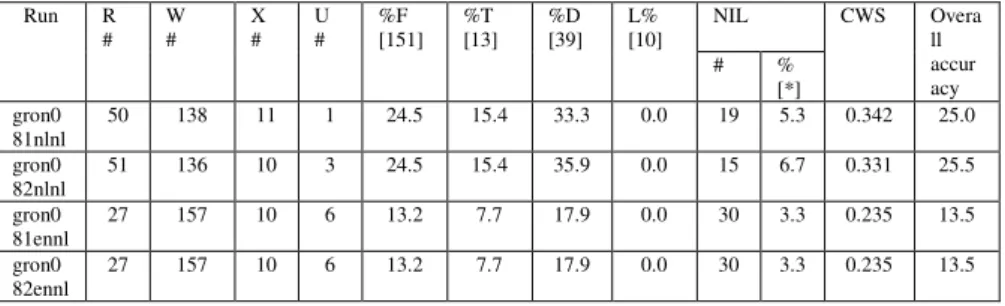
This year, only one team took part in the question answering task with Dutch as target language: the University of Groningen. The team submitted two monolingual runs and two cross-lingual runs (English to Dutch). All runs were assessed twice by a single assessor. This resulted in a total of eight conflicts (1%). These were corrected. The results of the assessment can be found in Table 10.
Table 10. Assessment results for the four submitted runs for Dutch
Run R
# W # X # U # %F [151] %T [13] %D [39] L% [10] NIL CWS Overall
accur acy
# %
[*] gron0
81nlnl 50 138 11 1 24.5 15.4 33.3 0.0 19 5.3 0.342 25.0
gron0
82nlnl 51 136 10 3 24.5 15.4 35.9 0.0 15 6.7 0.331 25.5
gron0
81ennl 27 157 10 6 13.2 7.7 17.9 0.0 30 3.3 0.235 13.5
gron0
82ennl 27 157 10 6 13.2 7.7 17.9 0.0 30 3.3 0.235 13.5
The two cross-lingual runs gron081ennl andron082ennl produced exactly the same answers.
The best monolingual run (gron082nlnl) achieved exactly the same score as the best run of 2007 (25.5%). The same is true for the best monolingual run (13.5%). The fact that the two scores are in the same range as last year is no big surprise since the task has not changed considerably this year and all scores have been achieved by the same system.
subtypes but the cross-lingual runs did not contain a correct answer to any question of the second subtype.
None of the runs obtained any points for the list questions. The answers contained some parts that were correct but none of them were completely correct. We were unable to award points for partially correct answers in the current assessment scheme. All the runs were produced by the same system and the differences between the runs are small. The cross-lingual runs contained seven correct answers that were not present in any of the monolingual runs (for questions 20, 25, 120, 131, 142, 150 and 200). Eight questions were only answered correctly in a single monolingual run (1, 28, 54, 72, 83, 143, 193 and 199). Thirty-five questions were answered correctly in two runs, three in three runs and seventeen in all four runs. 137 questions failed to receive any correct answer.
3.5 English as Target
The task this year was exactly the same as in 2007 and moreover the three collections were the same: Glasgow Herald, LA Times and Wikipedia. However, given the considerable interest in the Wikipedia which has been shown by Question Answering groups generally, it was decided to increase the number of questions drawn from it to 75% overall, with just 25% coming from the two newspaper collections. This means that 40 of the 160 Factoids came from the newspapers, together with seven of the 30 Definitions and two of the ten Lists. These questions were divided equally between the Glasgow Herald and LA Times. All the remainder questions were drawn from the Wikipedia.
Table 11. Evaluation results for the English submitted runs
Run R W X U % F % T % D % L NIL
C
W
S
K
1 Overa
ll
ac
cu
ra
cy
# # # # [160] [12] [30] [10] # %[0]
dcun081deen 16 168 7 9 5.00 8.33 26.67 0.00 0 0.00 0.00516 0.10 8.00
dcun082deen 1 195 3 1 0.63 0.00 0.00 0.00 0 0.00 0.00013 0.03 0.50
dfki081deen 28 164 5 3 6.25 8.33 60.00 0.00 0 0.00 0.01760 N/A 14.00
ilkm081nlen 7 182 2 9 4.38 0.00 0.00 0.00 0 0.00 0.00175 N/A 3.50
wlvs081roen 38 155 2 5 11.25 0.00 66.67 0.00 0 0.00 0.05436 0.13 19.00
In addition to the above distribution, we also controlled the distribution of topics for the question groups, something which was made practicable by the use of the Wikipedia. Questions were drawn from a number of predefined subject fields: countries towns, roads and bridges, shops, politicians and politics, sports and sports people, foods and vegetables, cars, classical music including instruments, popular music, literature poetry and drama, philosophy, films, architecture, languages, science, consumer goods, and finally organisations. Questions were distributed among these topics. The maximum in any topic was twenty (sports) and the minimum was two (shops). For the majority there were between four and six question groups. For each such topic, one or more questions were set depending on what information the texts contained. As a change from last year, the organisers asked us to include 100 singleton topics. This effectively meant that half the questions in the overall set of 200 were simple "one-off" queries as were set in CLEF prior to 2007 and for the earlier TREC campaigns.
Questions were entered via a web interface developed by the organisers last year. However, this year they improved it considerably, for example allowing modifications to be made to existing entries. This was a great help and a commendable effort on their part.
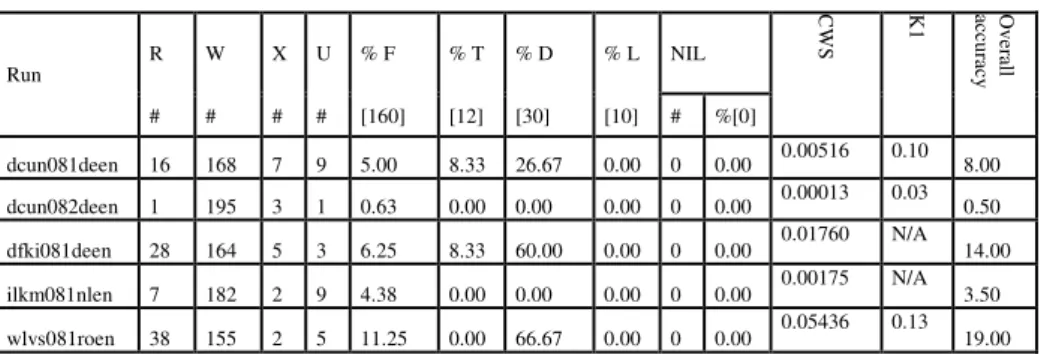
Five cross-lingual runs with English as target were submitted this year, as compared with eight in 2007 and thirteen in 2006. Four groups participated in three languages, Dutch, German and Romanian. Each group worked with only one source language, and only DCUN submitted two runs. The rest submitted only one run.
All answers were double-judged. Where the assessors differed, the case was reviewed and a decision taken. There were 63 judgement differences in total. Three of the runs contained multiple answers to individual questions in certain cases, and these were all assessed, as per the requirement of the organisers. If we assume that the number of judgements was in fact 200 questions * five runs, i.e. 1,000, we can compute a lower bound for the agreement level. This gives a figure of (1,000-63)/1,000, i.e. 93.7%. The equivalent figure for 2007 (called Agreement Level 2 in the Working Notes for last year) was 97.6%. Given that we have computed a lower bound this year (and not therefore the exact figure) this seems acceptable.
Of the five runs with English as target, wlvs081roen was the best with an accuracy of 19.00% overall. They also did very will on the definitions, scoring 66.67%. The only source language for which there was more than one run was German, for which there were three submissions from two groups: dfki081 scored the best with 14.00% and this was followed by dcun081deen with 8.00% and dcun082deen with 0.50%. DFKI also did very well on definitions with an accuracy of 60.00. Interestingly, none of the systems answered any of the list questions correctly. Only dcun082deen answered one list question inexactly.
3.6 QA-WSD subtask for English as Target
The QA-WSD task brought semantic and retrieval evaluation together. The participants were offered the same queries and document collections as for the main QA exercise, but with the addition of word sense tags as provided by two automatic word sense disambiguation (WSD) systems. Contrary to the main QA task, Wikipedia articles were not included, and thus systems need to reply to the questions that have an answer in the news document collection. In the QA-WSD track only English monolingual and Spanish to English bilingual tasks are offered, i.e. English is the only target language, and queries are available on both English and Spanish. The queries were the same as for the main QA exercise, and the participation followed the same process, except for the use of the sense-annotated data.
The goal of the task was to test whether WSD can be used beneficially for Question Answering, and is closely related to the Robust-WSD subtask of the ad-hoc track in CLEF 2008. Participants were required to send two runs for each of the monolingual/bilingual tasks where they participate: one which does not use sense annotations and another one which does use sense annotations. Whenever possible, the only difference between the two runs should be solely the use or not of the sense information. Participants which send a single run would be discarded from the evaluation.
The WSD data is based on WordNet version 1.6 and was supplemented with freely available data from the English and Spanish WordNets in order to test different expansion strategies. Two leading WSD experts run their systems [17][18], and provided those WSD results for the participants to use. The task website [4] provides additional information on data formats and resources.
From the 200 questions provided to participants, only 49 queries had a correct answer in the news collection, the rest having their reply in Wikipedia. The table below provides the results for the participant on those 49 questions.
Table 12. Results of the EN2EN QA-WSD runs on the 49 queries which had replies in the news collections
Run R
# W # X # U # %F [40] %T [5] %D [7] L% [2] NIL CWS Overall accuracy
0 %
[0] nlel08
1enen 8 41 0 0 17.5 0 14.2 0 0 0 0.03 16.32
nlel08
2enen 7 42 0 0 15.0 0 0 0 0 0 0.02 14.29
Table 13. Results of the EN2EN QA-WSD runs on all 200 queries, just for the sake of comparison
Run R
# W #
X #
U #
%F [160]
%T [5]
%D [7]
L% [10]
NIL CWS Overall
accuracy
0 % [0]
nlel08
1enen 10 188 0 2 5.6 0 3.3 0 0 0 0.00 5.00
nlel08
The first run does not use WSD, while the second uses the sense tags returned by the NUS WSD system. The WSD tags where used in the passage retrieval module. The use of WSD does not provide any improvement, and causes one more error. For the sake of completeness we also include below the results on all 200 queries. Surprisingly the participant managed to find two (one in the WSD run) correct answers for the Wikipedia questions in the news collection.
3.7 French as Target
This year only one group took part in the evaluation tasks using French as a target language: the French group Synapse Développement. Last year’s second participant, the Language Computer Corporation (LCC, USA) didn’t send any submission this time.
Synapse submitted three runs in total: one monolingual run and two bilingual runs (English-to-French and Portuguese-to-French).
As last year, three types of questions were proposed: factual, definition and closed list questions. Participants could return one exact answer per question and up to two runs. Some questions (10%) had no answer in the document collection, and in this case the exact answer is "NIL".
The French test set consists of 200 questions where 135 were factoids (F), 30 definitions (D), and 35 closed list questions (L).
Among these 200 questions, 66 were temporally restricted questions (T) and 12 were NIL questions (i.e. a “NIL” answer was expected, meaning that there is no valid answer for this question in the document collection).
Table 14. Results of the monolingual and bilingual French runs
R un A ss es se d A ns w er s ( #) R
# W # X # U # %F [135] %T [66] %D [30] L% [35]
NIL Answers CWS O ve ra ll ac cu ra cy
# % [12]
sy
n0
8f
rf
r
200 131 77 9 1 54.8 51.5 86.7 37.1 20 50.0 0.30937 56.5
sy
n0
8e
nf
r
200 36 157 6 1 15.6 15.1 50.0 0.0 60 8.3 0.02646 18.0
sy
n0
8p
tf
r
200 33 163 4 0 14.1 13.6 43.3 2.9 67 11.9 0.02387 16.5
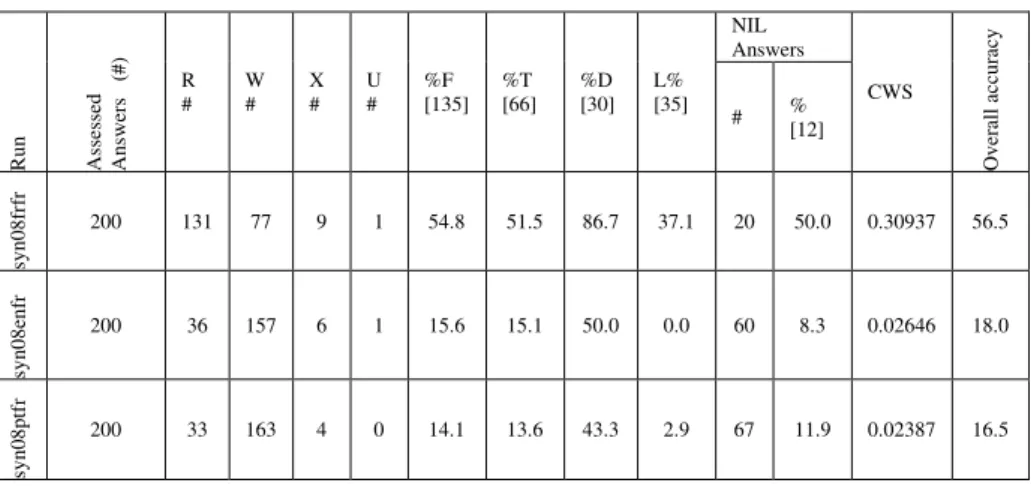
Table 14 shows the final results of the assessment of the 3 runs submitted by Synapse. For each run, the following statistics are provided:
• The accuracy calculated within each of the categories of questions: F, D, T and L questions,
• The number of NIL answers and the proportion of correct ones (i.e. corresponding to a NIL questions),
• The Confidence Weighted Score (CWS) measure. • The accuracy calculated over all answers.
Figure 2 shows the best scores for systems using French as target in the last five CLEF QA campaigns.
Figure 2: Best scores for systems using French as target in CLEF QA campaigns
For the monolingual task, the Synapse system returned 113 correct answers (accuracy of 56.5%), comparable to last year (accuracy of 54.0%). The bilingual runs performance is quite low, with an accuracy of 18.0% for EN-to-FR and 16.5% for PT-to-FR.
The level of performance strongly depends on the type of questions. The monolingual runs score very high on the definition questions (86.7%). The lowest performance is obtained with closed list questions (37.1%). It is even more obvious when looking at the bilingual runs. If the systems performed pretty well on the definition questions (50.0% and 43.3% for EN-to-FR and PT-to-FR respectively), they could not cope with the closed list questions. The PT-to-FR system could only give one close list correct answer. The EN-to-FR system could not even answer to any of these questions. The bilingual runs did not reach high accuracy with factoid and temporally restricted questions (50.0% and 43.3% for EN-to-FR and PT-to-FR respectively). This year, the complexity of the task, in particular regarding closed list questions, seems to have been hard to cope with for the bilingual systems.
The bilingual systems returned 60 (EN-to-FR) and 67 (EN-to-FR) NIL answers, i.e. at least 5 times more as expected.
It is also interesting to look at the results when categorizing questions by the size of the topic they belong to. This year, topics could contain from 1 single question to 4 questions. The CLEF 2008 set consists of:
• 52 single question topics,
• 33 topics with 2 questions (66 questions in total), • 18 topics with 3 questions (54 questions in total), • 7 topics with 4 questions (28 questions in total).
Table 15, Table 16 and Table 17 give the results of each run according to the size of the topics.
Table 15. Results per topic size (FR-to-FR)
Run Size of topic
Assessed
Answers # Overall accuracy (%)
syn08frfr 1 52 55.8
syn08frfr 2 66 50.0
syn08frfr 3 24 66.7
syn08frfr 4 28 53.6
Table 16.Results per topic size (EN-to-FR)
Run
Size of topic
Assessed
Answers # Overall accuracy (%)
syn08enfr 1 52 21.2
syn08enfr 2 66 22.7
syn08enfr 3 24 13.0
syn08enfr 4 28 10.7
Table 17. Results per topic size (PT-to-FR)
Run
Size of topic Assessed
Answers Overall accuracy (%) #
syn08ptfr 1 52 25.0
syn08ptfr 2 66 18.2
syn08ptfr 3 24 9.3
syn08ptfr 4 28 10.7
4-question sets. A possible explanation is that the bilingual systems perform poorly with questions containing anaphoric references (which are more likely to occur in the 3- and 4-question sets).
This year, the number and complexity of closed list questions was clearly higher than the previous year. In the same way, there were more temporally restricted questions, more topics (comprising from 2 to 4 questions) and more anaphoric references. It seems that this higher level of difficulty particularly impacted the bilingual tasks. In spite of this, the monolingual Synapse system performed slightly better than last year.
3.8 German as Target
Three research groups submitted runs for evaluation in the track having German as target language: The German Research Center for Artificial Intelligence (DFKI), the Fern Universität Hagen (FUHA) and the Universität Koblenz-Landau (LOGA). All groups provided system runs for the monolingual scenario, DFKI and FUHA submitted runs for the cross-language English-German scenario and FUHA had also runs for the Spanish-German scenario.
Compared to the previous editions, this year monolingual runs registered an increase in accuracy while bilingual runs showed a slight decrease (Figure 3).
The number of topics covered by the test set questions was of 120 distributed as it follows: 74 topics consisting of 1 question, 24 topics of 2 related questions, 10 topics of 3 related questions, and 12 topics of 4 related questions. The distribution of the topics over the document collections (CLEF vs. Wikipedia) is presented in Table 18.
According to Table 19 the most frequent topic types were OTHER (32), OBJECT (29) and ORGANIZATION (24), with first two types more present for the Wikipedia collection of documents (WIKI).
The details of systems’ results can be seen in Table 21.
0 10 20 30 40 50 60 70
2008 2007 2006 2005 2004
Best Mono
Aggregated Mono
Best Cross
Aggregated Cross
Figure 3. Results evolution in German as target
Table 18. Topic distribution over data collections
Topic Size # Topics / CLEF
# Topics /
WIKI # Topics
1 39 35 74
2 10 14 24
3 5 5 10
4 3 9 12
Total 57 63 120
Table 19. Topic type breakdown over data collections
CLEF WIKI
Topic Type Topic Size Total Topic Size Total
1 2 3 4 1 2 3 4
PERSON 5 2 1 1 9 0 1 0 2 3
OBJECT 7 1 0 0 8 16 3 0 2 21
ORGANIZATION 9 1 2 1 13 7 2 1 1 11
LOCATION 8 2 2 1 13 1 3 2 2 8
EVENT 0 0 0 0 0 0 2 0 0 2
OTHER 9 4 0 1 14 11 3 2 2 18
Table 20. Question EAType breakdown over data collections
EAType CLEF WIKI Total
PERSON 15 15 30
LOCATION 13 12 25
TIME 13 8 21
COUNT 13 7 20
OBJECT 7 18 25
MEASURE 12 8 20
ORGANIZATION 15 13 28
OTHER 9 22 31
Total 97 103 200
Table 21. System Performance – Details
Run
R W X U % F % T % D % L NIL
C
W
S
M
R
R
O
v
er
a
ll
a
cc
u
ra
cy
# # # # [160] [9] [30] [10] # % [10]
dfki081dedeM 73 119 2 6 30.62 44.44 80 0 0 0 0.16 0 36.5 dfki082dedeM 74 120 2 4 31.25 33.33 80 0 0 0 0.16 0 37 fuha081dedeM 45 141 8 6 24.37 44.44 20 0 1 4.76 0.05 0.29 22.5 fuha082dedeM 46 139 11 4 25.62 33.33 16.66 0 21 4.76 0.048 0.29 23 loga081dedeM 29 159 11 1 13.75 0 20 10 55 5.45 0.031 0.19 14.5 loga082dedeM 27 163 9 1 13.12 0 16.66 10 48 4.16 0.029 0.17 13.5 dfki081endeC 29 164 2 5 10 0 43.33 0 0 0 0.038 0 14.5 fuha081endeC 28 163 6 3 15 11.11 13.33 0 81 7.4 0.023 0.24 14 fuha082endeC 28 160 6 6 15 11.11 13.33 0 81 7.4
0.019 0.22 14
fuha081esdeC 19 169 9 2 9.43 0 13.33 0 9 0
0.015 0.15 9.54
fuha082esdeC 17 173 5 5 8.12 0 13.33 0 61 3.27 0.007 0.13 8.5
3.9 Portuguese as Target
The Portuguese track had six different participants: beside the veteran groups of Priberam, Linguateca, Universidade de Évora, INESC and FEUP, we had a new participants this year, Universidade Aberta. No bilingual task occurred this year.
with extra text or other kinds of inexactness. In Table 22 we present the overall results (all tables in these notes refer exclusively to the first answer by each system).
Table 22: Results of the runs with Portuguese as target: all 200 questions (first answers only)
To provide a more direct comparison with pre-2006 results, in Table 23 we present the results both for first question of each topic (which we believe is more readily comparable to such results) and for the linked questions.
On the whole, compared to last year, Priberam and Senso (UE) improved their results, which were already the best. INESC system and Esfinge (Linguateca) also showed some improvement, at a lower level Raposa (FEUP) showed similar results. The system of Universidade Aberta appeared with good results compared to some veteran systems. We leave it to the participants to comment on whether it might have been caused by harder questions or changes (or lack thereof) in the systems.
Table 23. Results of the runs with Portuguese as target: answers to linked and unlinked questions Run Name First questions (# 151) Linked questions (# 49) R (#) W (#) X+ (#) X- (#) U (#) Accuracy (%) R (#) Accuracy (%)
diue081 82 59 6 3 1 54.3 11 22.4
esfi081 42 92 5 7 5 27.3 7 14.3
esfi082 33 97 6 9 6 21.9 8 16.3
feup081 29 116 2 2 2 19.2 3 6.1
feup082 25 120 3 1 2 16.6 3 6.1
idsa081 54 85 6 6 35.8 11 22.4
ines081 35 106 2 3 5 23.2 8 16.3
ines082 35 106 2 3 5 23.2 8 16.3
prib081 105 32 9 4 1 69.5 22 44.9
Run Name R (#) W (#) X+ (#) X- (#) U (#) Overall Accuracy (%) NIL Accuracy
# Precision (%)
Recall (%)
Table 24. Results of the assessment of the monolingual Portuguese runs: definitions
Run loc obj org oth per TOT %
1 6 6 8 6 27
diue081 5 6 8 5 24 89%
esfi081 1 2 4 2 9 33%
esfi082 1 1 2 7%
feup081 1 1 1 1 4 15%
feup082 1 1 1 1 4 15%
idsa081 1 5 1 5 5 17 63%
ines081 1 5 1 7 3 17 63%
ines082 1 5 1 7 3 17 63%
prib081 5 5 6 2 18 67%
combination 1 6 6 8 6 27 100%
Unlike last year , the results over linked questions are significatively different (and below) from those over not-linked. Question 180 was wrongly redacted, referring to Aida’s opera Verdi instead of the other way around, which also affected two linked questions. Therefore, we accepted both NIL answers to those questions, as well as correct ones.
Table 24 shows the results for each answer type of definition questions, while Table 25 shows the results for each answer type of factoid questions (including list questions). As it can be seen, four out of six systems perform clearly better when it comes to definitions than to factoids. Particularly Senso has a high accuracy regarding definitions.
Table 25. Results of the assessment of the Portuguese runs: factoids, including lists
Run cou loc mea obj org
oth per tim TOT % 17 38 16 2 10 33 33 24 173
diue081 6 17 8 1 5 13 8 11 69 35%
esfi081 8 8 2 2 2 14 4 40 20%
esfi082 8 8 2 2 2 13 4 39 20%
feup081 5 4 4 1 2 8 4 28 14%
feup082 5 3 4 1 2 6 3 24 12%
idsa081 9 9 9 6 8 7 48 24%
ines081 4 9 2 1 4 6 26 13%
ines082 4 9 2 1 4 6 26 13%
prib081 11 21 13 1 7 18 22 16 109 55% combination 16 31 15 1 7 23 27 21 141 82%
Table 26. Average size of answers (values in number of words)
Run name Non-NIL Answers (#)
Average answer size
Average answer size (R only)
Average snippet size
Average snippet size (R only)
diue081 179 2.8 3.6 25.9 26.1
esfi081 180 2.6 3.0 78.4 62.5
esfi082 180 1.8 1.7 78.2 62.4
feup081 58 1.8 3.4 64.2 51.6
feup081 51 1.8 3.7 63.3 51.4
idsa081 188 5.0 10.0 28.6 34.4
ines081 77 3.0 7.4 79.6 36.6
ines082 77 3.0 7.4 79.6 36.6
prib081 192 3.2 3.4 27.6 25.1
The system with best results, Priberam, answered correctly 64.8% the questions with at least one correct answer. In all, 130 questions were answered by more than one system.
In Table 26, we present some values concerning answer and snippet size.
Temporally restricted questions: Table 27 presents the results of the 17 temporally
restricted questions. As in previous years, the effectiveness of the systems to answer those questions is visibly lower than for non-TRQ questions.
Table 27. Accuracy of temporally restricted questions
Run name Correct answers (#)
T.R.Q correctness (%)
Non-T.R.Q correctness (%)
Total correctness (%)
diue081 4 23.5 48..6 46.5
esfi081 3 17.6 24.0 23.5
esfi082 3 17.6 19.7 19.5
feup081 1 5.9 15.3 14.5
feup082 1 5.9 13.1 12.5
Idsa081 2 11.8 34.4 32.5
ines081 1 5.9 21.3 20.0
ines082 1 5.9 21.3 20.0
prib081 8 47.1 65.0 63.5
List questions: ten questions were defined as list questions all closed list factoids
with two to five each2. The results haven’t improved with UE getting two correct answers. Priberam three and all other system zero. There were however seven cases of incomplete answers (i.e.. answering some elements of the list only) although only two of them with than one element of the answer.
2There were some open list questions as well, but they were classified
Table 28. Answers by source and their correctness
Run News Wikipedia NIL
# % correct # % correct # % correct
Selection 34 - 144 - 10 -
diue081 35 40% 144 53% 21 10%
esfi081 85 21% 95 28% 20 10%
esfi082 81 17% 99 24% 20 5%
feup081 10 40% 48 33% 142 6%
feup082 9 44% 42 29% 149 6%
idsa081 50 28% 138 36% 12 17%
ines081 31 23% 46 52% 123 7%
ines082 31 23% 46 52% 123 7%
prib081 46 63% 146 66% 8 13%
Answer source: Table 28 presents the distribution of questions by source during
their selection. The distribution of sources used by the different runs and their correctness.
3.10 Romanian as Target
In the third year of Romanian participation in QA@CLEF, and the second one with Romanian addressed as a target language, the question generation was based on the collection of Wikipedia Romanian pages frozen in November 20063- the same corpus as in the previous edition4.
Table 29. Question & Answer types distribution in Romanian (in brackets the number of temporally restricted questions)
Q type /expected A type
PERS
ON TIME LOC. ORG.
MEAS URE
COU NT
OBJE CT
OTH
ER TOTAL FACTOID 20 (9) 23 (5) 26 (4) 20 (10) 17 (3) 22 (5) 18 (4) 16 (4) 162 (44)
DEF. 8 1 6 (2) 6 7 28 (2)
LIST 3 1 (1) 1 2 (1) 3 10 (2)
NIL 8
The questions were generated starting from the corpus and based on the Guidelines for Question Generation5, the Guidelines for Participants [5] and the final decisions taken after email discussions between the organizers. The 200 questions are distributed according to Table 29, where for each type of question and expected
3http://static.wikipedia.org/downloads/November_2006/ro/
4 At http://static.wikipedia.org/downloads/ the frozen versions of
answer we indicate also the temporally restricted questions out of the total number of questions. Without counting the NIL questions, 100% of the questions has the answer in Wikipedia collection.
As the Guidelines for Question Generation did not change since the previous edition, there were no major difficulties in creating the Romanian gold standard for the 2008 QA@CLEF. The working version of the GS was uploaded on the question generation interface developed at CELCT (Italy), by filling all the required fields.
For the topic-related questions (clusters of up to four questions, related to one same topic) we kept about the same number as in the previous edition: in 2007 we had 122 topics and now there are 119 topics. The percentage of topic-linked questions is illustrated in Table 30, showing that 127 questions were grouped under 46 topics, hence 63.5% out of the total 200 questions were linked in topics with more than one question.
Table 30. Topic-related questions
# of questions
/ Topic type PERSON LOC. ORG.
EVEN
T OBJECT OTHER Total topics
Total questio ns
4 Qs 5 1 1 5 12 48
3 Qs 5 1 1 1 3 11 33
2 Qs 5 3 4 2 9 23 46
1 Q 13 6 19 17 18 73 73
TOTAL 28 11 24 1 20 35 119 200
In fact the questions contain not 127, but only 51 anaphoric elements of various types, so that 25.5% of the questions are linked through coreferential relations. The personal, possessive or demonstrative pronouns were used in most of the cases to create anaphoric relations. The antecedents are mainly the focus of the previous question, or the previous answer. Few such questions require inference in order to be correctly answered. For example in order to correctly answer the F-Time question When was the first Esperanto dictionary for Romanian published? and then the L-Other Name all the grammatical cases of this artificial language., one needs to correctly link the anaphor “artificial language” to its antecedent which is “Esperanto” and not “Romanian” (also a language but not artificial); this is possible by establishing, based on a text snippet, that Esperanto is an artificial language.
nor in an evaluation based on an open text collection such as the web. The question What is a micron? has no answer in the Romanian wiki articles from 2006, but it can have an answer in other Romanian webpages, and, moreover, in the English wiki articles it has more than a correct answer depending on the domain where the term is used (in the metric system or in vacuum engineering).
For the LIST type we created only questions whose answers are to be found in one same text section. The 2007 evaluation for Romanian showed that “open list” questions (with answers in various sections of an article or even in various articles) are difficult to handle, therefore we made the LIST questions easier.
Since especially at the evaluation time we realized some of the initial questions were badly classified according to their category (F, D or L with their subtypes, as well as with respect to the temporal restrictions), after the final official evaluation we provided the gold standard of questions with all necessary corrections. The final version, available since October 2008 on the CLEF website6, has no major impact on the official judgements: modifying the standard does not change the types of R, X, U or W answers submitted by the participants.
Systems’ analysis and evaluation. Like in the 2007 edition, this year two
Romanian groups took part in the monolingual task with Romanian as a target language: the Faculty of Computer Science from the Al. I. Cuza University of Iasi (UAIC), and the Research Institute for Artificial Intelligence from the Romanian Academy (ICIA), Bucharest. Each group submitted two runs, the four systems having an average of 2.4 answers per question for ICIA, and 1.92 for UAIC. The 2008 general results are presented in Tables 31 below.
The statistics includes a system, named combined, obtained through the combination of the 4 participating RO-RO systems. Because at the evaluation time we observed that there are correct answers not only in the first position, but also on the second or the third, the combined system considers that an answer is R if there exists at least one R answer among all the answers returned by the four systems. If there is no R answer, the same strategy is applied to X, U and finally W answers. This “ideal” system permits to calculate the percentage of the questions (and their type), answered by at least one of the four systems in any of the maximum 3 answers returned for a question.
All three systems crashed on the LIST questions. The best results were obtained by ICIA for DEFINITION questions, whereas UAIC performed best with the FACTOID questions. The combined system suggests that a joint system, developed by both groups, would improve substantially the general results for Romanian.
Using in a first stage the web interface for assessing the QA runs, developed at UNED in Spain, the assessment took into consideration one question with all its answers at the time, assuring that the same evaluation criteria are uniformly applied to all answers. The judgment of the answers was based on the same Guidelines as in 2007, therefore we kept the same criteria as in 2007, in order to assure consistency inside the Romanian language, which gives also the possibility to evaluate the systems in their evolution from one year to another. For example, one could easily see that the UAIC systems had most of the answers for the DEFINITION questions
evaluated as ineXact, because the answers were judged as being “longer than the minimum amount of information required” and hence “unnecessary pieces of information were penalized”. Since all the 2007 and 2008 answers were evaluated this way, we considered it is more important to have uniformly applied rules inside one language than to change the evaluation in order to be consistent across languages. On the other hand the ICIA answers judged as ineXact are due to answers that are too long, snippets shortened as such as they do not contain the answer, or because the answer and the snippet has no connections.
Tables 31. Results in the monolingual task, Romanian as target language
Run R W U F T D L NIL
C
W
S
M
R
R
O
v
er
a
ll
a
cc
u
ra
cy
# # # [162] [47] [28] [10] # % [8] icia081
roro 10 179 1 0 4.938 8.51
1 7.143 0.0 15 6.667 0.00812 0.08217 5.0 icia082
roro 21 168 1 0 6.173 8.51
1 39.286 0.0 15 6.667 0.02191 0.14319 10.5 uaic08
1roro 41 128 7 3 24.691 25.5
32 3.571 0.0 65 7.692 0.03679 0.34324 20.5 uaic08
2roro 45 125 6 4 26.543 27.6
60 3.571 10.0 64 9.375 0.04892 0.36799 22.5
Run FACTOID QUESTIONS LIST QUESTIONS DEFINITION QUESTION
R W X U ACC R W X U ACC R W X U ACC
Combined 72 75 12 3 44.444 1 9 0 0 10.000 14 5 10 0 50.000
icia081roro 8 144 10 0 4.938 0 10 0 0 0.000 2 25 1 0 7.143
icia082roro 10 143 9 0 6.173 0 10 0 0 0.000 11 15 2 0 39.286
uaic081roro 40 113 6 3 24.691 0 9 1 0 0.000 1 6 21 0 3.571
uaic082roro 43 110 5 4 26.543 1 9 0 0 10.000 1 6 21 0 3.571
3.11 Spanish as Target
percentage) of factoids (F), factoids with temporal restriction (T), definitions (D) and list questions (L). Best values are marked in bold face.
Table 32 shows the big overall difference (around relative 50%) between the first system (Priberam) and the rest. However, as in last three editions, INAOE is the best system answering definitions (up to 95% of accuracy this year). We wonder why the rest of participants don’t implement their technology.
This year, up to three answers were assessed per question and thus, MRR values are given.
Table 32. Results for Spanish as target
Run R
# W # X # U # % F [124] % T [36] % D [20] % L [20] NIL # F [10] M R R O v er a ll a cc u ra cy
prib081eses 86 105 5 4 41,13 41,67 75 20 3 0,17 0,4483 42,5 inao082eses 44 152 3 1 19,35 8,33 80 5 4 0,10 0,2342 22 inao081eses 42 156 1 1 15,32 8,33 95 5 3 0,13 0,2375 21 qaua082eses 39 156 4 1 22,58 13,89 30 - 6 0,15 0,2217 19,5 mira081eses 32 156 3 9 12,90 2,78 75 - 3 0,21 0,1766 16 mira082eses 29 159 3 9 11,29 2,78 70 - 3 0,23 0,1591 14,50 qaua081enes 25 173 - 2 11,29 16,67 20 5 6 0,19 0,1450 12,50 qaua082enes 18 176 3 3 9,68 8,33 15 - 8 0,15 0,1108 9
mira081fres 10 185 2 3 5,65 - 15 - 3 0,12 0,0533 5
Table 33 shows that the first question of the topic group is answered much more easily than the rest of the questions of the group. The first one is, somehow, self-contained, while the rest contain references to the previous questions and answers.
Table 33. Results for self-contained and linked questions, compared with overall accuracy
Run % Accuracy over Self-contained questions [139] % Accuracy over Linked questions [61] % Overall Accuracy [200]
prib081eses 53,24 18,03 42,50
inao082eses 25,18 13,11 22,00
inao081eses 25,18 9,84 21,00
qaua082eses 22,30 13,11 19,50
mira081eses 21,58 3,28 16,00
mira082eses 21,58 3,28 14,50
qaua081enes 17,27 - 12,50
qaua082enes 12,23 1,64 9,00
Table 34 shows the harmonic mean (F) of precision and recall for NIL questions. The values are very low at this respect.
Table 34. Results for Spanish as target for NIL questions
F-measure
(Self-contained@1)
F-measure
(@1)
Precision
(@1)
Recall
(@1)
prib081eses 0,26 0,17 0.12 0.30 inao082eses 0,14 0.10 0.06 0.40 inao081eses 0,19 0.13 0.08 0.30 qaua082eses 0,27 0.15 0.09 0.60 mira081eses 0,27 0.21 0.17 0.30 mira082eses 0,29 0.23 0.19 0.30 qaua081enes 0,26 0.19 0.11 0.80 qaua082enes 0,20 0.15 0.09 0.60 mira081fres 0,15 0.12 0.07 0.30
The correlation coefficient r between the self-score and the correctness of the answers (shown in Table 35) has been similar to the obtained last year in general terms. The table shows also the performance in the Answer Extraction step. Since a supporting snippet is requested in order to assess the correctness of the answer, we have evaluated the systems capability to extract the answer when the snippet contains it. The first column of Table 35 shows the percentage of cases in which the correct answer was finally extracted from the snippet once the snippet was the right one. This information is very useful to diagnose if the lack of performance is due to the passage retrieval or to the answer extraction process. In general, all systems have improved their performance in Answer Extraction compared with previous editions.
Observe that the best system achieves the best r score and has the best answer extraction module.
Table 35. Answer extraction and correlation coefficient (r) for Spanish as target
Run %Answer


![Table 7. Evaluation results for the four submitted runs Run R # W # X # U # %F [145] %T [23] %D [39] L% [16] NIL CWS Overall accur acy # % [*] ixag08 1eueu 26 163 11 0 15.9 8.7 7.7 0 4 7.0 0.023 13 ixag08 1eneu 11 182 7](https://thumb-eu.123doks.com/thumbv2/123dok_br/18773966.406178/13.892.193.692.241.400/table-evaluation-results-submitted-runs-run-overall-accur.webp)