DOI: 10.1590/0004-282X20160054
VIEW AND REVIEW
Neurocysticercosis, familial cerebral
cavernomas and intracranial calcifications:
differential diagnosis for adequate management
Neurocisticose, cavernoma cerebral familiar e calcificações intracranianas: diagnóstico
diferencial e acompanhamento adequado
Emerson Leandro Gasparetto
1, Soniza Alves-Leon
2, Flavio Sampaio Domingues
3, João Thiago Frossard
3,
Selva Paraguassu Lopes
4, Jorge Marcondes de Souza
3NEUROCYSTICERCOSIS
Cysticercosis is the result of the infestation of the larval
form of “
T. solium
” and neurocysticercosis (NCC) is the
estab-lished involvement of the central nervous system (CNS). he
disease is endemic in developing countries, more prominently
in Latin America and in some regions of Asia and Africa
1.
NCC is also becoming an emerging infectious health problem
in developed countries due to immigration
2. Contamination
of humans by consumption of the
T. solium
eggs leads to
person-to-person or auto-infestation but the real prevalence
of NCC is not yet established. NCC is commonly described
1Universidade Federal do Rio de Janeiro, Departamento de Radiologia, Rio de Janeiro RJ, Brazil;
2Universidade Federal do Estado do Rio de Janeiro, Departamento de Neurologia, Programa de Epilepsias, Rio de Janeiro RJ, Brazil; 3Universidade Federal do Rio de Janeiro, Departamento de Neurocirurgia, Rio de Janeiro RJ, Brazil;
4Aliança Cavernoma Brasil, Brasília DF, Brazil.
Correspondence: Jorge Marcondes de Souza; Departamento de Neurocirurgia, Universidade Federal do Rio de Janeiro; Rua Rodolpho Rocco, 255, Hospital Universitário; 25622-826 Rio de Janeiro RJ, Brasil; E-mail: [email protected]
Conflict of interest: There is no conlict of interest to declare.
Received 02 September 2015; Received in inal form 16 November 2016; Accepted 22 December 2015.
ABSTRACT
Neurocysticercosis (NCC) is an endemic disease and important public health problem in some areas of the World and epilepsy is the
most common neurological manifestation. Multiple intracranial lesions, commonly calciied, are seen on cranial computed tomography
(CT) in the chronic phase of the disease and considered one of the diagnostic criteria of the diagnosis. Magnetic resonance imaging (MRI)
is the test that better depicts the different stages of the intracranial cysts but does not show clearly calciied lesions. Cerebral cavernous
malformations (CCM), also known as cerebral cavernomas, are frequent vascular malformations of the brain, better demonstrated by MRI
and have also epilepsy as the main form of clinical presentation. When occurring in the familial form, cerebral cavernomas typically present
with multiple lesions throughout the brain and, very often, with foci of calciications in the lesions when submitted to the CT imaging. In the
countries, and geographic areas, where NCC is established as an endemic health problem and neuroimaging screening is done by CT scan,
it will be important to consider the differential diagnosis between the two diseases due to the differences in adequate management.
Keywords: neurocysticercosis; epilepsy; cavernomas; familial cerebral cavernous malformation; computerized tomography; magnetic resonance.
RESUMO
A neurocisticercose (NCC) é um importante problema endêmico de saúde pública em algumas áreas do mundo, sendo epilepsia sua
manifestação clínica mais comum. Múltiplas lesões intracranianas, geralmente com calciicações visualizadas em tomograia computorizada
de crânio, são interpretadas como um dos critérios diagnósticos na fase crônica da doença. A ressonância magnética é o melhor teste de
imagem para identiicar a doença em diferentes estágios de sua forma cística mas apresenta limitações para demonstrar lesões calciicadas.
Malformações cavernosas cerebrais, ou cavernomas, são malformações vasculares comuns ao sistema nervoso e epilepsia é também a sua
forma mais frequente de apresentação. Na sua forma familiar cavernomas apresentam-se tipicamente com múltiplas lesões encefálicas e,
frequentemente, com focos de calciicações na TC. Em alguns países, e determinadas regiões geográicas, onde neurocisticercose é endêmica,
a neuroimagem mais usada para diagnóstico é a TC de crânio. Nesse contexto torna-se importante estabelecer bases para o diagnóstico
diferencial entre as duas doenças, devido às diferentes formas de acompanhamento e tratamento adequado.
as the leading cause of epilepsy in endemic regions, although
the distinction of seizures occurrence and epilepsy related to
NCC has not achieved complete elucidation
3. With cerebral
cyst degeneration there is a contrast enhancement of the
le-sion surrounded by edema on CT as well as high signal
imag-es on MRI T2 sequencimag-es and gadolinium enhancement on T1
images supposedly due to inlammatory reactions
4,5.
Epilepsy, in general grounds, is deined by unprovoked
seizures in more than one occasion
6and usually correlates
with the most probable condition directly involved on its
de-velopment. Although there are evidences supporting seizures
as the most common manifestation of NCC in the
symptom-atic patients
7NC can be asymptomatic in some cases and
seropositiveness through enzyme-linked immune transfer
blot assay (EITB) does not always indicate active disease nor
CNS involvement
8. Carpio detected that the proportion of
the seropositivity in epileptic NCC patients was the same
re-ported in the general population in the same geographic
ar-eas
3. On the other hand there is a chance of dual disease, like
temporal lobe epilepsy with hippocampal sclerosis and NCC,
in endemic regions, being involved in the pathogenesis of
epi-lepsy in patients diagnosed with NC and the diferential di
-agnosis will only be reached by means of special
neurophysi-ological testing
9. Evidence-based data from well designed
prospective studies to establish the surrogates for epilepsy
due to NCC is scarce
3,10,11,12, showing the importance of
dif-ferential diagnosis with other diseases on the determination
of NCC as seizures etiology and the risk of overestimation of
neurocysticercosis as a prime cause of seizures.
FAMILIAL CEREBRAL CAVERNOUS
MALFORMATIONS (FCCM)
Cavernous malformations are common
cerebrovascu-lar abnormalities, afecting 0.4–0.8% of the general popula
-tion
13,14,15. Pathologically, CCM are deined by clusters of di
-lated capillary cavities, in back-to-back disposition, lined by
a single layer of endothelium, lacking smooth muscle and no
intervening brain parenchyma
16(Figure 1).
Cavernomas may occur in the brain or spinal cord as an
isolated single lesion. he familial form of cerebral cavernomas
(FCCM) is characterized by multiple brain lesions (Figure 2),
usually as the result of loss-of-function mutations in one of the
known CCM genes, namely CCM1 (KRIT1), CCM2 (MGC4607)
and CCM3 (PDCD10)
16. he pattern of inheritance of the fa
-milial form is of autosomal dominance and its proportion
in the CCM population has been estimated as high as 50%
in Hispanic-American patients and 10-40% in other popula
-tions
16,17. Mutations in the CCM1, CCM2 and CCM3 genes
ac-count generally for 50–65%, 15–19% and less than 10% of the
FCCM cases, respectively
18,16. In the United States, mainly in the
State of New Mexico and southwestern regions, there has been
described a high frequency of a Common Hispanic Mutation
of the gene CCM1/KRIT1 (Q455X, rs 267607203) in families of
Mexican heritage up to the point where most insurance
com-panies are paying for its screening
19.
he New Mexico CCM cohort recently reported a study
searching for association between inlammatory biomarkers
and aggressiveness of the disease, with most patients having
multiple lesions and epilepsy as the main symptoms
20.
In an ongoing study for a Register of Disease for Cerebral
Cavernomas in Brazil, the CCM cohort at the Federal
University of Rio Janeiro has also detected the predominance
of CCM1 mutational proile in the studied families
21.
In another multicenter study it was reported a very
ag-gressive proile of FCCM cases due to mutations of the gene
CCM3
22, with a mean age at presentation of 12 years and an
excessive lesion burden, meaning 33% of the patients having
Figure 1.
Cavernous malformation. Dilated capillary cavities,
in back-to-back disposition, with a single layer of endothelium
and no intervening brain parenchyma. HE 40X.
more than 100 lesions and 78% with more than 20 lesions.
Epilepsy was also the most common symptom of this
aggres-sive form of the disease.
Epilepsy is the more common manifestation of the
cere-bral cavernomas, with most studies showing seizures as
lead-ing symptom in 40% to 70% of the cases
23,24,25. he mechanisms
of seizures pathogenesis in CCMs are disputed but there is a
literature trend toward rendering hemosiderin, from de blood
products leaked from the endothelial cells junctional defect,
the main cause due to its epileptogenic efect
26,27.
Hemispheric cavernomas are associated with higher
ten-dency of seizures than other mass lesions in the brain
paren-chyma, with the potential for evolution for refractory
epilep-sy in 40% of the cases
25. Al-Shahi detected, in a prospective
study in Scotland that, for adults without lesional
hemor-rhage or focal neurological deicit, cavernomas were more
frequently multiple in the patients with seizures (43%) than
in the ones without seizures (6%)
23.
THE QUEST FOR THE NEUROIMAGING
In the geographic areas of the world where NCC is
more prevalent, CT is the more utilized imaging test and,
regarding the calciications of the late phase of the dis
-ease, it would be the neuroimaging for conirmation of di
-agnosis. Carpio et al. listed, in the methodology of a case
control-study of cysticercosis, in Ecuador
28, CT as the
im-aging test of choice and have described their proposed CT
criteria for the lesional characterization. Alive cysts are
de-picted as one or more hypodense areas, variable in size and
without constrast enhancement whereas the transitional
ones as cysts with contrast enhacement. Inactive lesions
are depicted as rounded, hypodense, without enhancement
and with areas of calciication
28.
MRI is the best test for definition of the cyst stage in
their evolution in the brain on T1, T2, FLAIR sequences,
including the inflammatory aspects when using enhanced
images with gadolinium infusion (Figures 3A, B and C)
29although not as accurate in detection of calcifications.
Diffusion weighted images were demonstrated as
bet-ter defining the scolex and increasing the confidence for
the NCC diagnosis by MRI
30. A recent review on NCC
showed that MRI findings are better predictive for the
stage of the cysts and diffusion-weighted images and
ap-parent diffusion coefficient maps allowing better
dem-onstration of the cysticerci in their colloidal phase.
Calcified cysts were described as not well depicted and
there was a suggestion that more sophisticated
sequenc-es, as susceptibility-weighted protocols, would be
neces-sary
9. Cavernous malformations, on the other hand, are
not well seen on CT images, where the lesions will range
from non-visualization to the mildly enhancing ones,
vari-able format and, very often, with calcification. Batra et al.
Figure 3.
Axial T1 There is a round lesion with low signal on T1
(A); Coronal T2 with high signal on T2, surrounded by vasogenic
edema on the Right parieto-occipital area (B); After gadolinium
admnistration ring-enhancement is seen in the lesion, as well
as additional small rign-enhancing lesions are demonstrated
on the right and left frontal lobes (C).
A
B
described, in their series of CCMs at the Johns Hopkins
University, 58% of the specimens with thrombosis and
41% with calcifications
31. MRI is the neuroimaging test of
choice in CCM, with the typical pattern of “popcorn”
ap-pearance in the sequences T1 and T2 sequences, result
from the mixed old and new blood residua inside the
le-sions, usually with hyperintense core and a hypointense
dark surrounding rim
32. The sequences with higher
sen-sitivity to the hemosiderin susceptibility effect are much
more accurate in depicting the hemosiderin deposits in
the lesions and the worldwide most used ones are the
gradiente-echo imaging (GRE) or susceptibility-weightet
imaging (SWI) sequences. We have shown that SWI
se-quence has superior accuracy in detecting small lesions
and its usefulness in detecting familial cases of CCM and
a more acurate lesional burden
33.
As an example of possible misdiagnosis that an initial
screening with CT scan might create we present a case of a
25-yrs-old female, with recent episode of seizures and
cra-nial MRI test showing typical multiple cerebral cavernous
malformations (Figure 4A). She was an index case of a
fa-milial form of CCM living in a small town in Brazil, in a
geo-graphic area known as endemic for cysticercosis. Her father
was diagnosed as harboring neurocysticercosis for the last
30 years, and treated accordingly, based on epileptic proile
and his CT scan with multiple calciications (Figure 4B).
he multiple typical CCM lesions diagnosis of his daughter
raised the high probability of familial cavernomas and,
according-ly, his cranial MRI showed several characteristic cavernous lesions
matching the calciied areas on CT scan (Figures 4C and D).
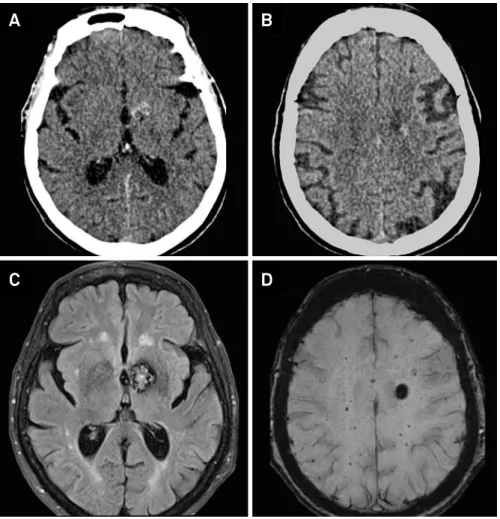
Likewise, many patients of the CCM cohort of the
Universidade Federal do Rio de Janeiro, which has a
con-solidated follow-up of 22 Brazilian families, harbor
multi-ple intracranial calcifications on CT imaging and epilepsy
as the main symptoms (Figures 5 A, B, C and D). The use
of calcifications seen on cranial CT as a valid surrogate for
neurocysticercosis, in those circumstances, would
cer-tainly constitute a misdiagnosis.
An interesting confounding aspect is that there are few
stud-ies showing familial aggregation of NC
28,34and, on this situation,
it would be reasonable to use MRI scan to establish the diferen
-tial diagnosis with FCCM. As the familial form of cavernomas is
more prone to develop epilepsy
24and also characterized by
mul-tiple brain lesions, often calciied on the CT scan, ranging from a
few to uncountable ones, the diferent nature of the two diseases
certainly raises the importance the correct diagnosis.
Figure 4.
(A) MRI on coronal T2 image depicts two cavernous lesions at the mesiobasal and subcortical left temporal lobe (A);
CTcan with calciied lesions on the right and left hemisphere (B); MRI Axial T2 imaging shows left justa-ventricular and right
cortical frontal typical cavernous malformation (C); G-Echo sequence showing the lesions with usual low signal of the lesions (D).
A
B
CONSEQUENCES OF THE MISDIAGNOSIS
Cavernous malformations are prone to bleeding and have
a 2.4% person/year rate of lesional hemorrhage
13. he preva
-lence on the general population is estimated on 0.4–0.8% and
the familial form around 50% of them, rendering the formal
diagnosis and counseling clearly an important step on
man-agement. he misdiagnosis between the NCC and FCCM has
several important consequences deserving awareness of the
medical and, specially, neurologic community. Patients with
CCM, erroneously diagnosed as NCC, might receive
prescrip-tion of medicaprescrip-tions for NCC treatment, namely praziquantel,
and submitted to unnecessary side efects. Genetic counsel
-ing on cases of familial cavernomas will not be done
render-ing patients unaware of the probabilities, and consequences,
of their ofsprings having the disease. Likewise, the sugges
-tion for annual/bi-annual MRI checking for new lesions or
biological changes in the known CCMs will not be made.
Prevention of intracranial bleeding in CCM patients
usually includes counseling to avoid medications such as
AAS or any other anti-thrombotic drugs, as well as
antico-agulants, like coumadin, heparin or heparinoids, and this
will not be done having the misdiagnosis of
neurocysti-cercosis been made
35,36.
In conclusion, with the widespread access to the MRI
technology it might be worthwhile to consider reviewing the
prevalent paradigm for NCC diagnosis, when calciied cysts
are detected in cranial CT in patients sufering from sei
-zures in endemic areas. Cavernous malformations are lesions
that bleed spontaneously, leading to the risk of intracranial
hemorrhage. In its familial form, with multiple lesions and
frequent calciication, there are real chances for being con
-founded with calciied cysts due to NCC when cranial image
done only by CT scan.
Although MRI notoriously does not clearly detect calcii
-cation, it is the best neuroimaging test of choice for correct
diagnosis of cerebral cavernous malformation, including the
SWI or GRE for detection of familial form, and NCC.
In the geographical areas where NCC still prevails as an
important endemic health problem the diferential diagno
-sis with familial cavernous malformations should be taken
into consideration whenever facing patients with seizures
and multiple intracranial calciications on CT scan, for the
adequate management of the diseases.
Figure 5.
A CT scan image showing left basal ganglia calciication (A); Another left subcortical frontal calciication in the same
patient (B); MRI FLAIR axial depicting typical cavernoma imaging at the left basal ganglia (C); More lesions detected by MR-SWI
sequence than other sequences (D).
A
B
References
1. Carpio A. Neurocysticercosis: an update. Lancet Infect Dis 2002;2(12):751-62. doi:10.1016/S1473-3099(02)00454-1
2. Fabiani S, Bruschi F. Neurocysticercosis in Europe: still a public health concern not only for imported cases. Acta Trop. 2013;128(1):18-26. doi:10.1016/j.actatropica.2013.06.020
3. Carpio A, Romo M. The relationship between neurocysticercosis and epilepsy: an endless debate. Arq Neuropsiquiatr. 2014:72(5):383-90. doi:10.1590/0004-282X20140024
4. Carpio A, Placenua M. Deinition of contemporary surgical management in cisternal and parenchymatous cysticercosis cerebri. Neurosurgery. 1992;30(6):968-9. doi:10.1227/00006123-199206000-00035
5. Santos GT, Leite CC, Machado LR, McKinney AM, Lucato LT. Reduced diffusion in neurocysticercosis: circumstances of appearance and possible natural history implications. AJNR Am J Neuroradiol. 2013;34(2):310-6. doi:10.3174/ajnr.A3198
6. Thurman DJ, Beghi E, Begley CE, Berg AT, Buchhalter JR, Ding D et al. Standards for epidemiologic studies and surveillance of epilepsy. Epilepsia. 2011;52 Suppl 7:S2-26. doi:10.1111/j.1528-1167.2011.03121.x
7. Carabin H, Ndimubanzi PC, Budke CM, Nguyen H, Qian Y, Cowan LD et al. Clinical manifestations associated with neurocysticercosis: a systematic review. PLoS Negl Trop Dis. 2011;5(5):e1152. doi:10.1371/journal.pntd.0001152
8. Machado LR. The diagnosis of neurocysticercosis: a closed question? Arq Neuropsiquiatr. 2010;68(1):1-2. doi:10.1590/S0004-282X2010000100001
9. Garcia HH, Nash TE, Del Brutto OH. Clinical symptoms, diagnosis and treatment of neurocysticercosis. Lancet Neurol. 2014;13(12):1202-15. doi:10.1016/S1474-4422(14)70094-8
10. Montano SM, Villaran MV, Ylquimiche L, Figueroa JJ, Rodriguez S, Bautista CT et al. Neurocysticercosis association between seizures, serology and brain CT in rural Peru. Neurology. 2005;65(2):229-33. doi:10.1212/01.wnl.0000168828.83461.09
11. Medina MT, Rosas E, Rubio-Donnadieu F, Sotelo J. Neurocysticercosis as the main cause of late-onset epilepsy in Mexico. Arch Intern Med. 1990;150(2):325-7. doi:10.1001/archinte.1990.00390140065014
12. Singh G, Singh P, Singh I, Rani A, Kaushal S, Avasthi G. Epidemiologic classiication of seizures associated with neurocysticercosis: observations from a sample of seizure disorders in neurologic care in India. Acta Neurol Scand. 2006;113(4):233-40. doi:10.1111/j.1600-0404.2005.00575.x
13. Batra S, Lin D, Recinos PF, Zhang J, Rigamonti D. Cavernous
malformations: natural history, diagnosis and treatment. Nat Rev Neurol. 2009;5(12):659-70. doi:10.1038/nrneurol.2009.177
14. Gross BA, Lin N, Du R, Day AL. The natural history of intracranial cavernous malformations. Neurosurg Focus 2011;30(6):E24. doi: 10.3171/2011.3.FOCUS1165
15. Al-Shahi Salman R, Hall JM, Horne MA, Moultrie F, Josephson CB, Bhattacharya JJ et al. Untreated clinical course of cerebral cavernous malformations: a prospective, population-based cohort study. Lancet Neurol. 2012;11(3):217-24. doi:10.1016/S1474-4422(12)70004-2
16. Labauge P, Denier C, Bergametti F, Tournier-Lasserve E. Genetics of cavernous angiomas. Lancet Neurol. 2007;6(3):237-44. doi:10.1016/S1474-4422(07)70053-4
17. Mondéjar R, Solano F, Rubio R, Delgado M, Pérez-Sempere A, González-Meneses A et al. Mutation prevalence of cerebral cavernous malformation genes in Spanish patients. PLOS One. 2014;9(1):e86286. doi:10.1371/journal.pone.0086286
18. Riant F, Cecillon M, Saugier-Veber P, Tournier-Lasserve E. CCM molecular screening in a diagnosis context: novel unclassiied variants leading to abnormal splicing and importance of large deletions. Neurogenetics. 2013;14(2):133-41. doi:10.1007/s10048-013-0362-0
19. Morrison L. Genetic counselling. In: Rigamonti D, editor. Cavernous malformation of the nervous system. Cambridge: Cambridge University Press; 2011. p. 181-3.
20. Choquet H, Pawlikowska L, Nelson J, McCulloch CE et al. Polymorphisms in inlammatory and immune response genes associated with cerebral cavernous malformation type 1 severity. Cerebrovasc Dis, 2014;38(6):433-40. doi:10.1159/000369200
21. Domingues F, Gasparetto EL, Andrade R, Noro F, Eiras A, Gault J et al. Familial cerebral cavernous malformations: Rio de Janeiro study and review of the recommendations for management. Arq Neuropsiquiatr. 2008;66(4):795-9. doi:10.1590/S0004-282X2008000600003
22. Shenkar R, Shi C, Rebeiz T, Stockton RA, McDonald DA, Mikati AG et al. Exceptional aggressiveness of cerebral cavernous malformation disease associated with PDCD10 mutations. Genet Med. 2015;17(3):188-96. doi: 10.1038/gim.2014.97
23. Salman RA. The outlook for adults with epileptic seizures associated with cerebral cavernous malformations or arteriovenous malformations. Epilepsia. 2012;53(Suppl 4):34-42. doi:10.1111/j.1528-1167.2012.03611.x
24. Rosenow F, Alonso-Vanegas MA, Baumgartner C, Blümcke I, Carreño M, Gizewski ER et al. Cavernoma-related epilepsy: review and recommnedations for management. Report of the Surgical Task Force of the ILAE Commission on Therapeutic Strategies. Epilepsia. 2013;54(12):2025-35. doi:10.1111/epi.12402
25. Englot DJ, Han SJ, Lawton MT, Chang EF. Predictors of seizure freedom in the surgical treatment of supratentorial cavernous malformations. J Neurosurg. 2011;115(6):1169-74. doi:10.3171/2011.7.JNS11536
26. Clatterbuck RE, Eberhart CG, Crain BJ, Rigamonti D. Ultrastructural and immunocytochemical evidence that an incompetent blood-brain barrier is related to the pathophysiology of cavernous malformations. J Neurol Neurosurg Psychiatry. 2001;71(2):188-92. doi:10.1136/jnnp.71.2.188
27. Awad I, Jabbour P. Cerebral cavernous malformations and epilepsy. Neurosurg Focus. 2006;21(1):e7. doi:10.3171/foc.2006.21.1.8
28. Goodman KA, Ballagh SA, Carpio A. Case-control study of seropositivity for cysticercosis in Cuenca, Ecuador. Am J Med Hyg. 1999;60(1):70-4.
29. Lucato LT, Guedes MS, Sato JR, Bacheschi LA, Machado LR, Leite CC. The role of conventional MR imaging sequences in the evaluation of neurocysticercosis: impact on characterization of the scolex and lesion burden. AJNR Am J Neuroradiol, 2007;28(8):1501-4. doi:10.3174/ajnr.A0623
30. Santos GT, Leite CC, Machado LR, McKinney AM, Lucato LT. Reduced diffusion in neurocysticercosis: circunstances of appearance and possible natural history implications. AJNR Am J Neuroradiol. 2013;34(2):310-6. doi:10.3174/ajnr.A3198
31. Batra S, Crain B, EngelmannR, Camara-Quintana J, Rigamonti D. Pathology of cavernous malformations. In: Rigamonti D, editor. Cavernous malformation of the nervous system. Cambridge: Cambridge University Press; 2011. p 1-7.
32. Lin DDM, Abdalla W. Neuroimaging of cavernous malformation. In: Rigamonti D, editor. Cavernous malformation of the nervous system. Cambridge: Cambridge University Press; 2011. p. 49-63.
33. Souza JM, Domingues RC, Cruz LC Jr, Domingues FS, Iasbeck T, Gasparetto EL. Susceptiblility-weighted imaging for the evaluation of patients with familial cerebral cavernous malformations: a comparison with T2-weighted fast spin-echo and gradient-echo sequences. AJNR Am J Neuroradiol. 2008;29(1):154-8. doi:10.3174/ajnr.A0748
34. Fleury A, Escobar A, Fragoso G, Sciutto E, Larralde C. Clinical heterogeneity of human neurocysticercosis results from complex interactions among parasytes, host and environmental factors. Trans R Soc Trop Med Hyg. 2010;104(4):243-50. doi:10.1016/j.trstmh.2010.01.005
35. Leigh R, Wityk RJ. Special problems in cavernous malformations: migraine, pregnancy, hormonal replacement, anticoagulation, NSAIDS, and altitude elevation. In: Rigamonti D, editor. Cavernous malformation of the nervous system. Cambridge: Cambridge University Press; 2011. p. 185-9.