Gender and health: profile
and trends of the scientific
production in Brazil
ABSTRACT
The differences in health between men and women have been object of great interest, but interpretations tend to be naturalized and essentialists. Gender-oriented studies have criticized this literature and offered new analythical alternatives. The present study was intended to describe the profile and trends of scientific production on gender and health in Brazil. Data sources comprised the Research Groups Directory of Conselho Nacional de Desenvolvimento Científico e Tecnológico (National Research Council), CAPES (Coordination for the Improvement of Higher Education Personnel) Thesis Bank, and four journals available in SciELO - Scientific Eletronic Library Online. Fifty-one groups with at least one line of research in the subject were identified, with regional and institutional concentrations. The results confirmed the marked growth of scientific production in this field as 98 master and 42 doctoral dissertations and 665 articles on gender and health were retrieved. Women authored 86.0% and 89.0% of doctoral and master dissertations respectively, and 70.5% of the articles. Most were published in the 2000s when diversification of the studied topics was also seen. The studied subjects can be divided into five subgroups: reproduction and contraception; gender and violence; sexuality and health with emphasis on STD/ AIDS; work and health, including domestic and night work; other emergent or less explored topics. There are major political, epistemological and methodological challenges for strengthening these advancements. The gender perspective offers possibilities for enlightment of theoretical dilemmas in public health. Furthermore, it can be added to other intellectual and political efforts towards understanding health and its determinants and fighting against inequalities and for social justice.
Keywords: Public health, Brazil; Gender and health; Woman’s health; Sexuality; Reproductive health; Scientific publications.
Estela M L Aquino
Instituto de Saúde Coletiva. Universidade Federal da Bahia. Salvador, BA, Brasil
Correspondence: Estela M. L. Aquino
MUSA - Programa de Estudos em Gênero e Saúde
Rua Basílio da Gama, s/n 2º andar Campus Universitário do Canela 40110-040 Salvador, BA, Brasil E-mail: [email protected]
INTRODUCTION
For a long time health differences between men and women have been naturalized following so-called neu-tral biological theories. Many authors have sought to show these differences derive from gender conceptions where “man” is regarded an universal model of human being and “woman” as the “other”, special, deviant.
The notion of two biological sexes only emerged in the eighteenth century57 when reproductive organs were differentiated linguistically and acquired abso-lute centrality for establishing differences between men and women. Women became seen as more fragile and vulnerable to all kind of influences, whether physical, moral or intellectual, due to an alleged sensibility that made them especially suited to motherhood.77
The maternal-infant perspective has prevailed in bio-medical literature, where women have been represented as mothers or potentially pregnant.56 In this sense, sci-entific production has been guided by the reproductive aspects of health, privileging the health of the unborn.60
In the 1970s, with the growth of the “second wave” of feminism,64 a systematic critique of essentialism and of androcentric bias in the sciences initially focused on exposing women’s invisibility and highlighting the manner in which subjects directly related to wom-en’s experience had been obscured, such as house-work and marital violence.
Early studies investigating “woman” – an empirical category – were replaced by “gender” studies – an analytical category that rejected the biological de-terminism of sexual differences and emphasized the social construction of female and male.52 In the 1990s, men were included as an empirical category and an approach questioning hegemonic masculinity mod-els was joined to the efforts deconstructing essential-ism. This developing field4 also drew on the studies of sexuality, that were legitimated by the need to cope with AIDS pandemic.
There has been an ongoing paradigmatic transition from studies about “women’s health” to studies about “gender and health”. This transition translates into the superpimposition of concepts, ideas and theories and mixes up terms like “women”, “gender”, “female”, and “feminist”, each of which has very specific meanings: “A ‘woman’ is a particular individual; ‘gender’ denotes power relations between the sexes and refers to both men and women; (...) ‘feminine’ refers to women’s ide-alized mannerisms and behaviors in particular periods and settings, potentially exhibited by men; and ‘femi-nist’ defines a political standpoint or agenda”.82
“Gender” is a grammatical term borrowed by Anglo-Saxon feminists and alludes to the social organiza-tion of the relaorganiza-tion between the sexes.86 A pronounced increase in the use of ‘gender’ in English titles is no-ticeable in the Web of Science interface of the Insti-tute for Scientific Information (ISI)/Thomson data-base. This can be attributed to its adoption by aca-demic feminism after 1970.48 Before then, its non-grammatical use was rarely seen and “sex” was used to make a distinction between men and women. At first, the term “gender” spread without restricting the use of “sex”. But, by the end of the 1980s, “sex” became increasingly circumscribed to def ining sexual behaviors and practices: anal, vaginal and oral sex, safe sex, sex workers, among others.48
Use of the term gender by academic feminists began in the 1960s.48 But, it was Rubin79 in 1975 who proposed a sex/gender system defined as: “(…) a set of arrange-ments by which the biological raw material of human sex and procreation is shaped by human, social inter-vention and satisfied in a coninter-ventional manner”.
The original influence of political economy and the Marxist inspiration have been replaced by an em-phasis on identities and on the “cultural construc-tion” of sexual differences.42 This has entailed strong debate as different disciplinary and theoretical per-spectives confront each other, reflecting tensions be-tween modernity and postmodernity. The critique of universal theories and of dualisms, such as nature and culture, on which the proposition opposing sex to gender was based, has destabilized this concept and given rise to many controversies. Poststructuralist and postmodern lines of thought have challenged the very material basis of sex, claiming that it was gender that created sexual difference as a classifica-tory system ordering the world.20,57 This debate is on-going and will not be presented here as it is highly complex; however, its richness has profound impli-cations for thinking about health and disease.
Besides feminism’s direct influence on academic set-tings, organizations such as the Pan-American Health Organization have promoted the institutionalization of a gender perspective in health research and public poli-cies,46 although not free of conceptual distortions. Its generalization has often voided the concept’s heuristic strength by reducing it a description of differences be-tween men and women, as a mere replacement of “sex”.
Bra-zil, this polysemy has implications for the mapping of scientific production. As a result, it is necessary to exclude articles where gender was used in this sense. The impact of the gender perspective in health re-search has still to be investigated and is beyond the scope of this article. The present study aims at begin-ning to explore this emerging thematic field by pro-filing and describing trends of scientific work on gender and health in Brazil.
MAPPING THE FIELD
Information was collected from the directory*of the Conselho Nacional de Desenvolvimento Científico and Tecnológico (CNPq - National Council for Scientific and Technological Development) to investigate lines of research. This directory gathers more than 80% of active groups in Brazil.47 Groups identified in the up-dated database (version 5.0) as of 5/4/2005 showing at least one line of research in the subject field studied were included. Data on field of knowledge, sex of re-searchers and group heads, date of creation, institu-tion and country region were collected. The definiinstitu-tion of the search keywords – “gender and health,” “wom-en’s health” and “sexuality” – was based on the his-torical development of the subject field. Other key-words such as “men’s health,” “reproductive health,” and “feminism” did not add any further information for defining research groups in collective health.
To assess scientific production two data sets were stud-ied. In the first set, doctoral theses and master disserta-tions were identif ied from the Coordenação de Aperfeiçoamento de Pessoal de Nível Superior (Capes -Coordination for the improvement of Higher Education Personnel) bank of theses.** Abstracts have been in-cluded in this bank on an ongoing regular basis since 1987, and the reference date for search was 3/6/2006. Data on study title, year of submission, program, au-thor’s sex, institution and country region were collected.
In the second set, four periodicals were explored: Revista de Saúde Pública (RSP), published by Facul-dade de Saúde Pública da UniversiFacul-dade de São Paulo (FSP-USP) and it is the oldest journal in the field (since 1967); Cadernos de Saúde Pública (CSP), published since 1985 by Escola Nacional de Saúde Pública da Fundação Oswaldo Cruz (ENSP-Fiocruz); and Ciência e Saúde Coletiva (CiSC) and Revista Brasileira de Epidemiologia (RBE), both created by the Associação Brasileira de Pós-Graduação em Saúde Coletiva (Abrasco - Brazilian Association of Collective Health Postgraduate Programs) in 1996 and 1998 respectively.
All articles from these periodicals available between 1980 and 2005 in SciELO (Scientific Electronic Li-brary Online),*** a virtual collection for online ac-cess of scientific periodicals, were studied.
CSP and RBE were explored from their creation; CiSC was explored between 2000 and 2005 as this was the time period available in the database; and RSP was explored from 1980 to 2005, the entire study period. The terms “gender”, “woman”, and “sexuality” were investigated in all search fields (title, abstract, and keywords). The study comprised a quantitative assess-ment of titles per year, first author’s sex, and a qualita-tive assessment of subjects, through the selection of articles representing new trends and approaches.
INSTITUTIONALIZATION OF A NEW FIELD OF STUDY IN BRAZIL
Brazilian academic production has been influenced by feminism from its early days but it was only in the 1980s that the first centers for women’s studies were created at Brazilian universities, inspired by the Wom-en’s Studies American model.25
During the 1980s, propositions presented at national meetings on health, sexuality, and reproductive rights contributed to be the creation of the Programa de Assistência Integral à Saúde da Mulher (PAISM -Comprehensive Women’s Health Care Program). But feminism’s influence in academic work began to be noticed only in the next decade with the creation of the first focal points on “women’s health”, parallel to the emergence of gender studies in human sciences.52
Research groups on gender and health
The study search identified 131 research groups in 18 fields of knowledge with at least one line of re-search in “gender and health”. Most are in collective health (28.2%), totalizing 34 groups (Figure 1). Due to historical reasons, selecting this single keyword – “gender and health” – leaves out part of academic production in this subject field (Figure 2). For this reason, 27 groups were identified based on “women’s health”, of which only 48.7% included “gender and health”; 22 showed “sexuality” (77.3% of them had also “gender and health”). By adding up these three keywords, a total of 51 groups were found, 38.1% having lines of research exclusively focusing on gen-der and health, nine showing “gengen-der” in the title and eight showing “women’s health”. The remaining had generic denominations of collective health or
referred to subjects such as violence, work, and health-care. This reflects the way the institutionalization of gender studies has proceeded in Brazil, with a search for legitimacy by integrating them into the dynamics of the scientific community and through the avoid-ing of “ghettos” in alternative areas.
Nonetheless, female involvement in research groups has been strong (73.3% of researchers and 73.8% of students) and most groups are headed, though not exclusively, by women (67.3%). However, 65.5% of groups had a second head, of which 80.5% were women, which may suggest that the gender hierarchy of academic work organization has been reproduced even in this field, originally influenced by feminism.
Studies were mostly concentrated in certain Brazilian regions, reflecting a general trend of Brazilian scientific activity: 56.6% of groups were from the Southeastern region, almost all from Rio de Janeiro and São Paulo; 22.6% were from the Northeastern region and 17.0% from the Southern region. A closer examination re-vealed that four leading institutions – Universidade de São Paulo (USP), Fundação Oswaldo Cruz (Fiocruz), Universidade Federal da Bahia (UFBA), and Universidade do Estado do Rio de Janeiro (UERJ), together house a total of 23 groups (45.0%).
Groups on gender and health in collective health were largely established in the 1990s (43.6%), at first in the Southeastern and Northeastern regions, and, after 2000, when another 23 groups (45.5%) were established in all regions, except for the Midwestern states. This trend partially reflects the sustained development of col-lective health47 but also the influence of factors fa-vourable to this thematic field, which require further analysis cannot be discussed here.
For now, it can be stressed that short- and intermediate-term teaching programs have been joined to research scholarship programs providing dozens of young re-searchers with education in this field nationwide.4 These initiatives have been supported by international associations, in particular, the Ford Foundation. The Brazilian Ministry of Science and Technology, through CNPq, and the Ministry of Health, through the Depart-ment of Science and Technology, have re-cently announced funding for research on a variety of aspects that may be grouped under the headings “women’s health” and “men’s health,” thus favouring ther scaling up and legitimizing of scientific production on gen-der and health.
The institutionalization of this field is also noticeable by the regular presence of scien-tific activities in specialized events. These have gained visibility since 1995 with the creation of the Grupo de Trabalho Gênero e Saúde (Task Force on Gender and Health), which works together with Abrasco’s execu-tive board.
Scientific production on gender and health in Brazil
Academic production on gender and health in Brazil has not been limited either to collec-tive health or to the larger domain of health. Figure 1 - Distribution of research groups on gender and health by field
of knowledge. Brazil, 2005.
Source: CNPq/Lattes - Directory of Research Groups in Brazil (version 5.0, as for 5/ 4/2005)
Figure 2 - Distribution of research groups on gender, sexuality and women’s health in collective health according to keyword. Brazil, 2005. Source: CNPq/Lattes - Directory of Research Groups in Brazil (version 5.0, as of 5/ 4/2005)
Sexuality
Women's health Gender
and
health 13
3
12 9
4 2 8
Stricto sensu graduate programs have produced 686 master’s dissertations and 222 doctoral theses includ-ing the term “gender” associated to “health” and/or “sexuality” from 1987 to 2004. These studies covered almost two dozen different fields of knowledge, but the studies were mostly concentrated in psychology, education, nursing, social sciences and collective health. The latter had 98 dissertations and 42 theses.
The first doctoral thesis to include gender in its title was submitted in 1992, proposing that gender would be applied in the study of women’s mental health95 – paradoxically still an underexplored subject under this perspective. Most studies had been examined from 2000 (75% of theses and 70% of dissertations), a time when this subject field enjoyed its greatest growth. Following the same trend as the research groups, 74% of academic work in collective health on this subject area was developed in the ambit of four institutions – Fiocruz (28.6%), USP (21.8%), UERJ (12.8%), and UFBA (10.5%). These institutions provided the graduate programs (master’s degree and doctorate) that are most highly rated by Capes, in-cluding two rated at level 6 (UFBA and Fiocruz) and four at level 5 (USP, UERJ, and Fiocruz).
Publications on gender and health in the collective health area
As an interdisciplinary field, collective health inte-grates different cultures of producing and dissemi-nating its scientific production. Published in the pe-riodicals studied, the production in question is also found dispersed in national and international publi-cations of various related areas, as well as in books and in technical publications. For this reason, the present study covered part of this production, albeit that which is most disseminated because electroni-cally available. A thoroughgoing assessment is not intended, but rather the aim is to address the most representative Brazilian scientific production
con-cerning the theme under scrutiny. Exceptionally, some landmark books making available collections of ar-ticles will also be cited.
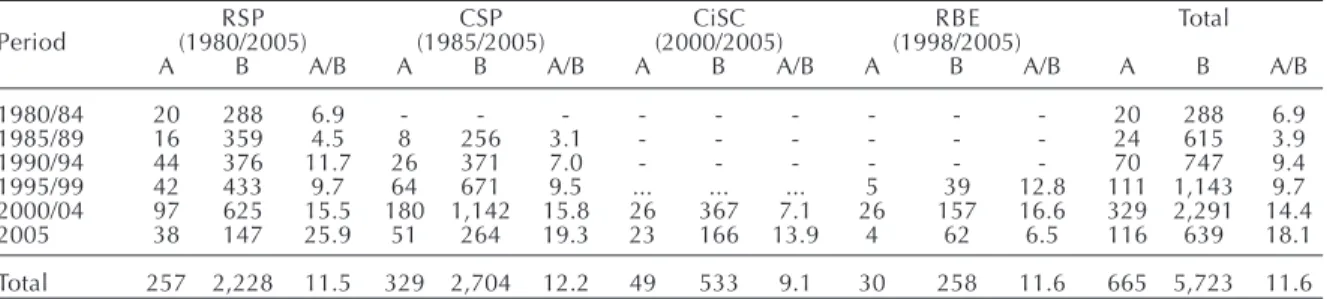
In the four periodicals studied, from 1980, 665 cles on the subject were published, 11.6% of all arti-cles published (Table). RSP published 257 (38.6%) articles on gender and health, 11.5% of all published articles in this journal between 1980 and 2005. A growing trend was seen from 2000, notably in 2005, when these subjects were covered in more than 25% of articles published in RSP. A 2002 supplement in-cluded articles focusing on different aspect of “HIV prevention in the context of social vulnerability”.71
CSP had the highest absolute number of articles, the equivalent of 49.8% of all publications on gender and health and 13.6% of all articles published in CSP. A characteristic is the inclusion of a variety of subjects, especially through the publication of three supplements. The first CSP supplement, published in 1991, focused on “Women and health”,43 strongly criticizing the ma-ternal-infant perspective; the second one (1998) ad-dressed “Reproductive health in Latin America”,50 and the third one (2003) dealt with “Gender, sexuality, and reproductive health”.4 In addition to these three, other supplements on work, violence and inequalities in-cluded articles with a gender perspective.
Given their shorter life, the two Abrasco journals – CiSC and RBE – had a minor contribution to the body of articles studied. However, CiSC has recently published a supplement entitled “Man as public health focus”, including extensive reviews on the subject.85
The publishing of supplements not only reflects a response to social needs in this field but also an edi-torial board’s responsiveness to emerging subjects or to subjects overlooked by “normal science”. The prac-tice clearly contributes to the dissemination of new ideas, concepts and approaches.
Table - Number of articles on gender and health and proportion over all articles published in selected periodicals in collective health. Brazil, 1980-2005.
RSP CSP CiSC RBE Total
Period (1980/2005) (1985/2005) (2000/2005) (1998/2005)
A B A/B A B A/B A B A/B A B A/B A B A/B
1980/84 20 288 6.9 - - - 20 288 6.9
1985/89 16 359 4.5 8 256 3.1 - - - 24 615 3.9
1990/94 44 376 11.7 26 371 7.0 - - - 70 747 9.4
1995/99 42 433 9.7 64 671 9.5 ... ... ... 5 39 12.8 111 1,143 9.7
2000/04 97 625 15.5 180 1,142 15.8 26 367 7.1 26 157 16.6 329 2,291 14.4
2005 38 147 25.9 51 264 19.3 23 166 13.9 4 62 6.5 116 639 18.1
Total 257 2,228 11.5 329 2,704 12.2 49 533 9.1 30 258 11.6 665 5,723 11.6 Source: SciELO - Scientific Electronic Library Online
RSP: Revista de Saúde Pública; CSP: Cadernos de Saúde Pública; CiSC: Ciência e Saúde Coletiva; RBE: Revista Brasileira de Epidemiologia
Who has published on gender and health
As in other fields of knowledge, it is women them-selves who are producing academic publications on gender. They have authored most studies, 86.0% of theses and 89.0% of dissertations in this field, and they were the main authors in 70.5% of 665 articles on gender and health studied. This somewhat reflects the increasing representation of women in collective health, but it could also be explained by factors in-trinsic to the development of the gender and health field. Noting the same phenomenon with respect to production on gender in the social sciences, Heilborn & Sorj52 offered some interpretations that may apply to collective health: “On the one hand, this reflects the weight of the prestige hierarchy between the sexes on the ordering of scientific objects and scientists; on the other hand, it shows that the strong association between gender studies and women’s movements hin-ders male researchers’ involvement”.
Men are more likely to be authors in two instances: first, in studies with a maternal-infant perspec-tive,1,12,59,88,89 especially those published in the 1980s, and then afterwards, in the emerging field of mascu-linity studies14,39,40,45 and, to some degree, in studies concerning AIDS and sexuality49,63,76 in the 1990s. But the unique article on feminist theory and medi-cal sociology23 was written by two male authors.
What the scientific production is about
In the first half of the 1980s, a maternal-infant approach prevailed, and 75% of the articles focused on pregnancy, delivery and breastfeeding.21,89,92 Maternal mortality, later incorporated to the priority agenda of the feminist movement and the health sector, began to be investi-gated88 at this time, though still from a clinical epide-miological view aiming to identify a profile of causes.
A remarkably original and groundbreaking study by Barroso13 (1984) opened the discussion on fe-male sterilization from a feminist perspective. It also anticipated this subject’s inflection from “concep-tion” to “contracep“concep-tion” starting in the second half of 1980s as a consequence of dramatically reducing fecundity rates among Brazilian women. From then, there has been increased interest in contraceptive methods, including reversible methods, abortion, and tubal ligation.29,55,93
Reproduction – and its opposite, contraception – has started to be investigated from “women’s” perspective, an empirical category that would later be included in studies on epidemiology and health care in Brazil sup-ported by PAISM.26,70 This comprehensive view
ex-panded the scope of health issues addressed in all life cycles, including cancer8,62 and high blood pressure,91 though still circumscribed to reproductive life.
A collection on “Mulher, saúde e sociedade no Brasil” (Women, health, and society in Brazil),58 (1989) and the CSP supplement on “Mulher e saúde” (Women and health)43 (1991) illustrate this new view. Both dealt with so far overlooked aspects, such as work16 and violence.66 New subjects have emerged, such as AIDS in women,54 Cesarean section delivery,38 and abortion.61 An article investigated sex differences in mortality that contrib-uted to increased survival of Brazilian women.7 This same approach is recovered in the first article to include gender in its title and addressing sex differences in mor-bidity and health care utilization.5 It discussed the ap-parent paradox described in the international literature that was also seen in Brazil: although women live longer than men, they have worse self-rated morbidity and use more health services, which reflects the high medicalization of female reproductive cycles.
In the 1990s, there was extensive scientific produc-tion on aborproduc-tion, a controversial issue requiring a complex methodological approach but highly val-ued by the feminist movement. Early studies focused on giving it more visibility by describing users’ pro-files41,51,83,94 but later more complex population-based studies were published,69,90 and introduced gender relations as practice determinants.28,37
A noteworthy publication is the CSP supplement (1998) on “Saúde reprodutiva na América Latina” (Reproductive health in Latin America)”,50 which first discussed the dilemmas of assisted reproduction, in-cluding articles on reproductive health care and the major issue of female sterilization. The link between religion and reproductive health was addressed in one of its articles53 and two of them dealt for the first time with the role of men in reproductive health.40,96
A year later, another collection also focused on “Questões da saúde reprodutiva” (Issues in reproduc-tive health)”,44 and reviewed concepts such as sexual and reproductive health and sexual and reproductive rights, and problematized notions like ‘the body’ and medicalization and the role of health services.
The relationship between gender and work has been explored throughout the study period but production has been scarce and centered in two institutions: Fiocruz,16-18,78 and UFBA, through its two research groups – Programa de Estudos em Gênero e Saúde (MUSA -Gender and Health Studies Program)6,9 and Programa de Investigação sobre a Saúde do Trabalhador (PISAT-Program of Environmental and Worker’s Health)80,81 in the Instituto de Saúde Coletiva. On this theme, some epidemiological studies exploring the link between gender and health stand out, as does an update on breast-feeding from female workers’ perspective.75
Violence is another subject that has been studied throughout this period but scientific production on the topic actually increased in the 1990s. The link between violence, gender, and health has a huge po-tential for deconstructing biological essentialism, an important issue to feminism. Early studies sought to render more visibility to violence in domestic and family settings31 and in health services.32,84 Research-ers also called attention to the role of health services in generating another kind of violence – so-called institutional violence – which even occasioned the publication in Lancet of one of the few articles of international repercussion.30
Due to its exceptional character and its potential of opening up new frontiers of investigation, the use a gender perspective in the study of endemic transmis-sible diseases, such as schistosomiasis65 and hanseniasis68 should be highlighted.
The variety of subjects and issues addressed in two publications4,11 from the Interinstitutional Training Program of Research Methodology on Gender, Sexu-ality and Reproductive Health is typical of the first half of the 2000s, when there has been a profusion of titles. This period is illustrated by a growth of studies on health evaluation,2,24,33,35,36,67,72,74,87 and bioethics and gender.34 Further developments were seen in the field with studies linking subjects such as violence and pregnancy,22 HIV/AIDS and sterilization,10 AIDS death and maternal deaths,15 sexuality and steriliza-tion,94 and paternity and childcare.19
FINAL CONSIDERATIONS
The mapping of the field of gender and health un-dertaken here confirms the remarkable growth of sci-entific production in this field, in particular in the last five years. Roughly, the subjects can be divided into five subgroups: reproduction and contracep-tion; gender violence and its variants, like domes-tic, family, marital and sexual violence; sexuality and health with emphasis on STDs/AIDS; work and
health, including housework and night work; and other emerging or underexplored subjects such as aging and mental health.
A large number of empirical studies can now be re-corded. However, there is a scarcity of theoretical and epistemological production directed to understand-ing not only gender relations, as these affect health, but also their impact on the production of scientific knowledge about health.
Some early factors have hindered the introduction of the gender perspective in collective health, especially the influence of marxism with its emphasis on social class for explaining social inequalities. But the in-tense politicization of this f ield beside a strong critiique of the neutrality of science, alongside an unquestionable commitment to social change, have contributed to the legitimization of the subject area. These factors play different roles in the sub-fields of social sciences in health, epidemiology, and health planning and policies.
Evidently, most production has been in social sciences in health, privileging a gender approach as a cultural construction and making use of qualitative strategies. Methodological choices reflect Brazilian social sci-ences’ qualitative approach tradition but they also derive from the understanding held by many feminist researchers that quantitative methods cannot capture the complexity of gender relations and their effects on different levels of social life, notably health.
This likely explains the weak penetration of this per-spective in epidemiological studies combining the use of quantitative methods and the influence of biomedi-cal sciences in defining objects of interest, which has always been a resistance factor in the gender field. In other words, epidemiology has investigated clinically defined diseases, reserving social theories for study-ing its determinants. In social epidemiology, the pre-dominance of social class as an explanatory category of inequalities has resulted in the relative imperme-ability to incorporating categories such as gender, race/ ethnicity and generation. It is still common to con-sider age as a “biological factor” and to refuse to rec-ognize race as a social construction, since its biologi-cal base has been deconstructed by genetics.
The smallest production with a gender perspective can be observed in health planning and policies, ex-cept in recent health evaluation studies, most of which concern women’s health. The “noble” subjects in this sub-field, such as health care models, social control and movements, power relations and health sector structure, have been little influenced by a gender perspective. In human sciences a similar lower pen-etration of the perspective is apparent in political science, when compared to anthropology, sociology, and history.73 One can speculate that the same gender conceptions that define politics as a male world also rules over the science devoted to its study. However, the distancing of gender studies from the original influence of political economy towards a culturally constructed approach, with a concominitant privileging of identity issues,42 may have contrib-uted to this gap as well, due to inadequate theoriza-tion of these subjects. Aiming at changing this sce-nario, Abrasco’s Task Force on Gender and Health developed initiatives such as a seminar in partner-ship with the Asociación Latinoamericana de Medicina Social (ALAMES - Latin American Asso-ciation of Social Medicine) on “Health, equity and gender” in 1999. The seminar produced a collection where this relation is explored from different angles.27
There are huge political, epistemological and meth-odological challenges for further strengthening the advances made. The profusion of titles and the great diversity of issues addressed make any panoramic re-view incomplete and insufficient. There is a need to summarize each subthematic issue of this literature to better assess lacunae and directions for investigation.
From an ethical standpoint, this field has considered
REFERENCES
1. Albuquerque RM, Cecatti JG, Hardy E, Faúndes A. Mortalidade materna em Recife. 1. Avaliação da subenumeração de estatísticas oficiais. Cad Saúde Pública. 1997;13:59-65.
2. Alves AM, Coura-Filho P. Avaliação das ações de atenção às mulheres sob violência no espaço familiar, atendidas no Centro de Apoio à Mulher (Belo Horizonte), entre 1996 e 1998. Ciênc Saúde Coletiva. 2001;6:243-57.
3. Aquino EML, Heilborn ML, Knauth D, Bozon M, Almeida Mda C, Araujo J, Menezes G. Adolescência e reprodução no Brasil: a heterogeneidade dos perfis sociais. Cad Saúde Pública. 2003;19(Suppl 2):S377-88.
4. Aquino EM, Heilborn ML, Barbosa RM, Berquo E. Gênero, sexualidade e saúde reprodutiva: a constitui-ção de um novo campo na Saúde Coletiva. Cad Saúde Pública. 2003;19(Suppl 2):S198-9.
5. Aquino EML, Menezes GMS, Amoedo MB. Gênero e saúde no Brasil: considerações a partir da Pesquisa Nacional por Amostra de Domicílios. Rev Saúde Pública. 1992;26:195-202.
6. Aquino EML, Menezes GMS, Marinho LFB. Mulher, saúde e trabalho no Brasil: desafios para um novo agir. Cad Saúde Pública. 1995;11:281-90.
7. Aquino EML, Menezes GM, Amoedo MB, Nobre LC. Mortalidade feminina no Brasil: sexo frágil ou sexo forte? Cad Saúde Pública. 1991;7:174-89.
such potentially challenging issues as sexuality, sexual violence, and abortion. These are intimate and private issues, sometimes involving secrecy and ille-gal activities, the ethical aspects of which have meth-odological implications and vice-versa.
There is much to be done from a theoretical view-point. Two main challenges arisein this respect. First, there are difficulties involved in integrating knowl-edge produced by the biomedical sciences with that produced by the social sciences. This is because, when investigating a huge range of health issues, despite the need for denaturalizing the phenomena of inter-est and disclosing the gender representations that guide knowledge production, biological aspects can-not be treated exclusively in their symbolic and cul-tural dimensions.
Another challenge concerns the transversalitly of gender and the need to articulate this analytical cat-egory to others, such as race/ethnicity, social class, and generation. A gender perspective provides ex-tensive possibilities for further enriching theoretical reflection in collective health. It could be joined with other intellectual and political efforts aiming at un-derstanding health and its determinants in the fight against inequalities and for social justice.
ACKNOWLEGDMENTS
8. Aquino EML, Carvalho AI, Faerstein E, Ribeiro DCS. Situação atual da detecção precoce do câncer cérvico-uterino no Brasil. Cad Saúde Pública. 1986;2:53-65.
9. Araújo TM, Aquino E, Menezes G, Santos CO, Aguiar L. Aspectos psicossociais do trabalho e distúrbios psíquicos entre trabalhadoras de enfermagem. Rev Saúde Pública. 2003;37:424-33.
10. Barbosa RM, Knauth DR. Esterilização feminina, Aids e cultura médica: os casos de São Paulo e Porto Alegre, Brasil. Cad Saúde Pública. 2003;19(Suppl 2):365-76.
11. Barbosa RM, Aquino EML, Heilborn ML, Berquó E, organizadores.In: Interfaces: gênero, sexualidade e saúde reprodutiva. Campinas: Unicamp; 2002. 12. Barros FC, Victora CG, Tomasi E. Saúde
materno-infantil em Pelotas, Rio Grande do Sul, Brasil: principais conclusões da comparação dos estudos das coortes de 1982 e 1993. Cad Saúde Pública. 1996;12(Suppl 1):87-92.
13. Barroso C. Esterilização feminina: liberdade e opressão. Rev Saúde Pública. 1984;18:170-80. 14. Batista LE. Masculinidade, raça/cor e saúde. Ciênc
Saúde Coletiva. 2005;10:71-80.
15. Bonciani RDF, Spink MJP. Morte por Aids ou morte materna: a classificação da mortalidade como prática social. Cad Saúde Pública. 2003;19:645-52.
16. Brito JC, D’Acri V. Referencial de análise para a estudo da relação trabalho, mulher e saúde. Cad Saúde Pública. 1991;7:201-14.
17. Brito JC. Enfoque de gênero e relação saúde/trabalho no contexto de reestruturação produtiva e
precarização do trabalho. Cad Saúde Pública. 2000;16:195-204.
18. Brito J. Trabalho e saúde coletiva: o ponto de vista da atividade e das relações de gênero. Ciênc Saúde Coletiva. 2005;10:879-90.
19. Bustamante V. Participação paterna no cuidado de crianças pequenas: um estudo etnográfico com famílias de camadas populares. Cad Saúde Pública. 2005;21:1865-74.
20. Butler J. Problemas de gênero: feminismo e subver-são de identidade. Rio de Janeiro: Civilização Brasileira; 2003.
21. Candeias NMF. Educação em saúde na prevenção do risco de desmame precoce. Rev Saúde Pública. 1983;17:71-82.
22. Castro R, Ruíz A. Prevalencia y severidad de la violencia contra mujeres embarazadas, México. Rev Saúde Pública. 2004;38:62-70.
23. Castro RP, Bronfman MP. Teoría feminista y sociología médica: bases para una discusión. Cad Saúde Pública. 1993;9:375-94.
24. Cesar JÁ, Horta BL, Gomes G, Houlthausen RS, Willrich RM, Kaercher A, Iastrenski FM. Fatores associados à não realização de exame citopatológico de colo uterino no extremo Sul do Brasil. Cad Saúde Pública. 2003;19:1365-72.
25. Costa AOC, Blay EA, organizadores. Gênero e universidade. São Paulo: NEMGE-USP; 1992. p. 222. 26. Costa AM, Aquino EML. Saúde da mulher na Reforma
Sanitária Brasileira. In: Costa AM, Mérchan-Hamann E, Tajer D, organizadores. Saúde, eqüidade e gênero: um desafio para as políticas públicas. Brasília (DF): UNB/ABRASCO-ALAMES; 2000. p. 181-202. 27. Costa AM, Mérchan-Hamann E, Tajer D,
organizadores. Saúde, eqüidade e gênero: um desafio para as políticas públicas. Brasília (DF): UNB/ ABRASCO-ALAMES; 2000.
28. Costa RG, Hardy E, Osis MJD, Faúndes A. A decisão de abortar: processo e sentimentos envolvidos. Cad Saúde Pública. 1995;11:97-105.
29. Costa SH, Martins IR, Pinto CS, Freitas SRS. A prática de planejamento familiar em mulheres de baixa renda no município do Rio de Janeiro. Cad Saúde Pública. 1989;5:187-206.
30. d’Oliveira AF, Diniz SG, Schraiber LB. Violence against women in health-care institutions: an emerging problem. Lancet. 2002;359:1681-5. 31. Dantas-Berger SM, Giffin K. A violência nas relações de conjugalidade: invisibilidade e banalização da violência sexual? Cad Saúde Pública. 2005;21:417-25.
32. Deslandes SF, Gomes R, Silva CMFP. Caracterização dos casos de violência doméstica contra a mulher atendidos em dois hospitais públicos do Rio de Janeiro. Cad Saúde Pública. 2000;16:129-37. 33. Diniz CSG. Humanização da assistência ao parto no
Brasil: os muitos sentidos de um movimento. Ciênc Saúde Coletiva. 2005;10:627-37.
34. Diniz D. Aborto e inviabilidad fetal: el debate brasileño. Cad Saúde Pública. 2005;21:634-9. 35. Domingues RMSM, Santos EM, Leal MC. Aspectos da
satisfação das mulheres com a assistência ao parto: contribuição para o debate. Cad Saúde Pública. 2004;20(Suppl 1):52-62.
36. d’Orsi E, Chor D, Giffin K, Angulo-Tuesta A, Barbosa GP, Gama AS, Reis AC, Hartz Z. Qualidade da atenção ao parto em maternidades do Rio de Janeiro. Rev Saúde Pública. 2005;39:645-54.
37. Duarte GA, Alvarenga AT, Osis MJMD, Faúndes A, Hardy E. Perspectiva masculina acerca do aborto provocado. Rev Saúde Pública. 2002;36:271-77. 38. Faundes A, Cecatti JG. A operação cesárea no
39. Figueiredo W. Assistência à saúde dos homens: um desafio para os serviços de atenção primária. Ciênc Saúde Coletiva. 2005;10:105-9.
40. Figueroa-Perea JG. Algunos elementos para interpre-tar la presencia de los varones en los procesos de salud reproductiva. Cad Saúde Pública.
1998;14(Suppl 1):87-96.
41. Fonseca W, Misago C, Correia LL, Parente JAM, Oliveira FC. Determinantes do aborto provocado entre mulheres admitidas em hospitais em localidade da região Nordeste do Brasil. Rev Saúde Pública. 1996;30:13-8.
42. Fraser N. Políticas feministas na era do reconheci-mento: uma abordagem bidimensional da justiça de gênero. In: Bruschini C, Unbehaum SG,
organizadores. Gênero, democracia e sociedade brasileira. São Paulo: Fundação Carlos Chagas/Ed. 34; 2002. p. 59-78.
43. Giffin KM. Mulher e saúde. Cad Saúde Pública. 1991;7:133-4.
44. Giffin KM, Costa SH, organizadores. Questões da saúde reprodutiva. Rio de Janeiro: Fiocruz; 1999. 45. Gomes R. Sexualidade masculina e saúde do homem:
proposta para uma discussão. Ciênc Saúde Coletiva. 2003;8:825-9.
46. Gomez GE. Equity, gender, and health: challenges for action. Rev Panam Salud Pública. 2002;11:454-61. 47. Guimarães R, Lourenço R, Cosac S. A pesquisa em
epidemiologia no Brasil. Rev Saúde Pública. 2001;35:321-40.
48. Haig D. The inexorable rise of gender and the decline of sex: social change in academic titles. Arch Sexual Behavior. 2004;33:87-96.
49. Hamman E. A construção da solidariedade: Aids, sexualidade e política no Brasil. Cad Saúde Pública. 1994;10:406-7.
50. Hardy EE [editorial]. Cad Saúde Pública. 1998;14(Supl 1):4-5.
51. Hardy E, Alves G. Complicações pós-aborto provocado: fatores associados. Cad Saúde Pública. 1992;8:454-8. 52. Heilborn ML, Sorj B. Estudos de gênero no Brasil. In:
Miceli S, organizador. O que ler na ciência social brasileira (1970-1995). São Paulo: Sumaré/ANPOCS; 1999. p. 183-221.
53. Kissling F. Perspectivas católicas progressistas em saúde e direitos reprodutivos: o desafio político da ortodoxia. Cad Saúde Pública. 1998;14(Suppl 1):135-7. 54. Koifman RJ, Quinhões EP, Monteiro GTR, Rodrigues
R, Koifman S. Aids em mulheres adultas no município do Rio de Janeiro. Cad Saúde Pública. 1991;7:232-50. 55. Koifman S, Paes SJP, Paula Oliveira DP, Vianna NF,
Giovanini ME, Castro MLO et al. Avaliação do anticon-cepcional Norplant no Município do Rio de Janeiro, RJ (Brasil). Rev Saúde Pública. 1987;21:513-22.
56. Krieger N, Fee E. Man-made medicine and women’s health: the biopolitics of sex/gender and race/ ethnicity. Intern J Health Serv. 1994;24:265-83. 57. Laqueur T. Inventando o sexo: corpo e gênero dos
gregos a Freud. Rio de Janeiro: Relume Dumará; 2001. 58. Labra ME organizador. Mulher, saúde e sociedade no
Brasil. Petrópolis: Vozes/Abrasco; 1989.
59. Laurenti R, Jorge MHPM, Gotlieb SLD. A mortalidade materna nas capitais brasileiras: algumas característi-cas e estimativa de um fator de ajuste. Rev Bras Epidemiol. 2004;7:449-60.
60. Lewin E, Olesen V. Occupational health and women: the case of clerical work. In: Lewin E, Olesen V, editors. Women, health and healing: toward a new perpective. New York/: Tavistock Publications; 1985. p. 53-86.
61. Martins IR, Costa SH, Freitas SRS, Pinto CS. Aborto induzido em mulheres de baixa renda: dimensão de um problema. Cad Saúde Pública. 1991;7:251-66. 62. Mendonça GAS. Câncer na população feminina
brasileira. Rev Saúde Pública. 1993;27:68-75. 63. Mota MP. Gênero e sexualidade: fragmentos de
identidade masculina nos tempos da Aids. Cad Saúde Pública. 1998;14:145-55.
64. Nicholson L, editor. The second wave: a reader in feminist theory. New York: Routledge; 1997. 65. Noronha CV, Barreto ML, Silva TM, Souza IM. Uma
concepção popular sobre a esquistossomose mansônica: os modos de transmissão e prevenção na perspectiva de gênero. Cad Saúde Pública.
1995;11:106-17.
66. Noronha CV, Daltro ME. A violência masculina é dirigida para Eva ou Maria? Cad Saúde Pública. 1991;7:215-31.
67. Oliveira LA, França Junior I. Demandas reprodutivas e a assistência às pessoas vivendo com HIV/Aids: limites e possibilidades no contexto dos serviços de saúde especializados. Cad Saúde Pública. 2003;19(Suppl 2):315-23.
68. Oliveira MHP, Romanelli G. Os efeitos da hanseníase em homens e mulheres: um estudo de gênero. Cad Saúde Pública. 1998;14:51-60.
69. Osis MJD, Hardy E, Faúndes A, Rodrigues T. Dificul-dades para obter informações da população de mulheres sobre aborto ilegal. Rev Saúde Pública. 1996;30:444-51.
70. Osis MJMD. PAISM: um marco na abordagem da saúde reprodutiva no Brasil. Cad Saúde Pública. 1998;14(Suppl 1):25-32.
72. Pinho AA, França Jr I, Schraiber LB, D’Oliveira AFPL. Cobertura e motivos para a realização ou não do teste de Papanicolaou no Município de São Paulo. Cad Saúde Pública 2003;19(Suppl 2):303-13. 73. Pinto C. Movimentos sociais: espaços privilegiados da
mulher enquanto sujeito político. In: Costa AO, Bruschini C, organizadores. Uma questão de gênero. Rio de Janeiro: Rosa dos Tempos; São Paulo: Funda-ção Carlos Chagas; 1992. p.127-50.
74. Porto M, McCallum C, Scott RP, Morais HMM. A saúde da mulher em situação de violência: represen-tações e decisões de gestores/as municipais do Sistema Único de Saúde. Cad Saúde Pública. 2003;19(Suppl 2):243-52.
75. Rea MF, Venâncio SI, Batista LE, Santos RG, Greiner T. Possibilidades e limitações da amamentação entre mulheres trabalhadoras formais. Rev Saúde Pública. 1997;31:149-56.
76. Rios LF. Parcerias e práticas sexuais de jovens homossexuais no Rio de Janeiro. Cad Saúde Pública. 2003;19(Suppl 2):223-32.
77. Rohden F. A construção da diferença sexual na medicina. Cad Saúde Pública. 2003;19(Suppl 2):201-12. 78. Rotenberg L, Portela LF, Marcondes WB,
Nascimento CMCP. Gênero e trabalho noturno: sono, cotidiano e vivências de quem troca a noite pelo dia. Cad Saúde Pública. 2001;17:639-49.
79. Rubin G. The traffic in women: notes on the “political economy” of sex. In: Nicholson L, editor. The second wave: a reader in feminist theory. New York: Routledge; 1997. p. 32.
80. Santana VS, Amorim AM, Oliveira R, Xavier S, Iriart J, Belitardo L. Emprego em serviços domésticos e acidentes de trabalho não fatais. Rev Saúde Pública. 2003;37:65-74.
81. Santana VS, Loomis DP, Newman B. Housework, paid work and psychiatric symptoms. Rev Saúde Pública. 2001;35:16-22.
82. Schienbinger L. O feminismo mudou a ciência? Bauru: EDUSC; 2001. p. 32.
83. Schor N. Investigação sobre ocorrência de aborto em pacientes de hospital de centro urbano do Estado de São Paulo, Brasil. Rev Saúde Pública.
1990;24:144-51.
84. Schraiber LB, d’Oliveira AFPL, França-Jr I, Pinho AA. Violência contra a mulher: estudo em uma unidade de atenção primária à saúde. Rev Saúde Pública. 2002;36:470-7.
85. Schraiber LB, Gomes Ro, Couto MT. Homens e saúde na pauta da saúde coletiva. Ciênc Saúde Coletiva. 2005;10:7-17.
86. Scott J. Gênero: uma categoria útil para análise histórica. Educ & Realidade. 1990;16:5-22. 87. Serruya SJ, Cecatti JG, Lago TG. O Programa de
Humanização no Pré-natal e Nascimento do Ministério da Saúde no Brasil: resultados iniciais. Cad Saúde Pública. 2004;20:1281-9.
88. Siqueira AAF, Tanaka ACA, Santana RM, Almeida PAM. Mortalidade materna no Brasil, 1980. Rev Saúde Pública. 1984;18:448-65.
89. Siqueira AAF, Santos JLF, Silva JF. Relação entre estado nutricional da gestante, fumo durante a gravidez, crescimento fetal e no primeiro ano de vida. Rev Saúde Pública. 1986;20:421-34.
90. Souza e Silva R. Patterns of induced abortion in urban area of Southeastern region, Brazil. Rev Saúde Pública. 1998;32:7-17.
91. Szwarcwald CL, Costa SH, Costa EA, Klein CH, Leal MC. Anticoncepcionais orais e pressão arterial: pesquisa epidemiológica de hipertensão arterial no Rio Grande do Sul. Cad Saúde Pública. 1985;1:177-91. 92. Tudisco ES, Manoel NJ, Goldenberg P, Novo NF,
Sigulem DM. Avaliação do estado nutricional materno e duração do aleitamento natural. Rev Saúde Pública. 1984;18:313-22.
93. Vieira EM. A esterilização de mulheres de baixa renda em região metropolitana do sudeste do Brasil e fatores ligados à sua prevalência. Rev Saúde Pública. 1994;28:440-8.
94. Villela W, Barbosa R. Opções contraceptivas e vivências da sexualidade: comparação entre mulheres esterilizadas e não esterilizadas em região metropolitana do Sudeste do Brasil. Rev Saúde Pública. 1996;30:452-9.
95. Villela WV. Mulher e saúde mental: da importância do conceito de gênero na abordagem da loucura feminina [tese de Doutorado]. São Paulo: Universida-de Universida-de São Paulo; 1992. p. 187.