Elisabete Pereira SilvaI
Ana Bernarda LudermirII
Thália Velho Barreto de AraújoII
Sandra Alves ValongueiroII
I Programa de Pós-Graduação Integrado em
Saúde Coletiva. Universidade Federal de Pernambuco (UFPE). Recife, PE, Brasil
II Departamento de Medicina Social. Centro
de Ciências de Saúde. UFPE. Recife, PE, Brasil
Correspondence: Elisabete Pereira Silva
R. Baltazar Passos, 611 – Aptº 1.206 Boa Viagem
51130-290 Recife, PE, Brasil E-mail: [email protected] Received: 11/12/2010
Approved: 7/4/2011
Article available from: www.scielo.br/rsp
Frequency and pattern of
intimate partner violence
before, during and after
pregnancy
ABSTRACT
OBJECTIVE: To estimate the prevalence and analyze the pattern of intimate
partner violence, before and during pregnancy and in the postpartum period.
METHODS: This was a cohort study undertaken on 960 women aged 18 to 49
years, who were registered in the Family Health Program of the city of Recife, Northeastern Brazil, between 2005 and 2006. The women were interviewed during pregnancy and in the postpartum period, using a questionnaire adapted from the World Health Organization’s Multi-country Study on Women’s Health and Domestic Violence. To assess the pattern of intimate partner violence occurrences between a given time period and the subsequent period, the odds ratio (OR) was calculated with 95% confi dence intervals (95%CI).
RESULTS: The prevalence of intimate partner violence before, during and/or
after pregnancy was estimated to be 47.4%. For the three periods separately, it was 32.4%, 31.0% and 22.6% respectively. The women who reported violence before pregnancy were 11.6 times more likely to report violence during pregnancy (95%CI: 8.3;16.2). When the women reported violence during pregnancy, the chance of reports in the postpartum period was 8.2 times higher (95%CI: 5.1;11.7). Psychological violence was more prevalent, especially during pregnancy (28.8%; 95%CI: 26.0%;31.7%). Sexual violence was less prevalent, especially after delivery (3.7%; 95%CI: 2.6%;5.0%). Physical violence diminished by almost 50% during pregnancy, in comparison with the preceding period.
CONCLUSIONS: A signifi cant proportion of women of reproductive age
experience situations of intimate partner violence. The periods of prenatal and childcare consultations are opportunities for healthcare professionals to identify situations of violence.
DESCRIPTORS: Violence Against Women. Pregnant Women.
Postpartum Period. Spouse Abuse. Cohort Studies.
INTRODUCTION
Intimate partner violence (IPV) during pregnancy and the postpartum period is considered by many authors3,6,8,12,17 to be a serious public health problem and a
The prevalences of some types of IPV over the 12 months preceding pregnancy have been reported to be 10.6% in England2 and 24.4% in Mexico,5 becoming
3.0% and 31.1%8 respectively, during pregnancy. In
Brazil, the prevalences have been estimated as 24.7% in Recife, state of Pernambuco (northeastern), and 32.0% in the city of São Paulo (southeastern), before preg-nancy, and as 30.6% and 31.8%, respectively, during pregnancy.a In the postpartum period, the prevalences
found have ranged from 8.3%, in China,12 to 24.2%,
in Sweden.13 In Brazil, until the present study was
concluded, there were no papers on the prevalence and incidence of IPV, comparing the periods before and during pregnancy with the postpartum period.
Physical violence has been most studied, and its prevalence over the 12 months preceding pregnancy has been found to range from 3.0% to 13.1%;17,21 during
pregnancy from 1.0% to 7.4%;3,21 and after delivery
from 1.2% to 19.7%.11,17 Sexual violence has been least
evaluated, with lowest frequency of occurrence: preva-lence before pregnancy from 1.5% to 6.8%;12,17 during
pregnancy from 1.3% to 4.0%;17,a and during the
post-partum period from 0.9% to 4.9%.12,17 Psychological
violence during the period preceding pregnancy has been found to range from 1.9% to 26.6%;12,a during
pregnancy from 1.5% to 29.4%;12,a and after pregnancy
from 2.5% to 18.0%.12,17
These different results should be interpreted carefully, because they are infl uenced by differences in the meth-odology, data-gathering instrument, sample composi-tion and time when the interview was held, which impairs comparability, especially regarding the types of violence studied. Among the studies cited, only Guo et al12 and Hedin13 evaluated all three types of violence
during the three periods, as done in the present study.
Studies conducted both in Brazil and in other coun-tries1,5,9,11,23 have shown the high magnitude of IPV.
Furthermore, episodes of violence may be severe and recurrent, thus indicating that they may present a continuous pattern.
Increased levels of arguments within couples caused by stress and changes in life due to pregnancy were reported by Martin et al20 (2004) to be situations
that could trigger violence during pregnancy and the postpartum period. According to Burch & Gallup Jr.4
(2004), if pregnancy is linked with an atmosphere of jealousy and mistrust regarding paternity, violence may then start to be experienced, with the likelihood that this will continue into the postpartum period. According to Jasinski14 (2004), during the postpartum period, with a
a Schraiber LB, D’Oliveira AFPL, Kiss LB, Durand J, Hanada H, Silva VN et al. Saúde da mulher, relações familiares e serviços de saúde do
Sistema Único de Saúde (SUS) em duas capitais – Recife e São Paulo. São Paulo: Faculdade de Medicina da Universidade de São Paulo; 2007. Projeto CNPq: Linha de pesquisa Violência, Acidentes e Trauma, nº 506705/2004-8. Caderno de primeiros resultados extraídos do Relatório Final da Pesquisa do CNPq.
newly born child, the sleepless nights and changes in family dynamics may provoke greater confl icts within couples, including arguments about sexual activity, which may lead to sexual violence during this period. In addition to these factors, Stewart25 (1994) cited the
increased fi nancial responsibility, the woman’s physical and hormonal changes and the adjustments to the roles of father and mother, relationships between the couple and interactions with relatives. Other authors have also shown that IPV before pregnancy is a risk factor for violence during pregnancy and during the postpartum period, just as violence during pregnancy is a risk factor for violence during the postpartum period.12,13,19,25
The aim of the present study was to estimate the preva-lence and analyze the pattern of physical, psychological and sexual violence perpetrated by an intimate partner, before and during pregnancy and in the postpartum period.
METHODS
This prospective cohort study was conducted within the scope of the project “Violence during pregnancy: determinants and consequences for reproductive health, mental health and perinatal results”, in Health District II of the city of Recife, Pernambuco.
The data were gathered by means of applying a ques-tionnaire in face-to-face interviews that were conducted between July 2005 and December 2006.
The fi rst contact with the pregnant women was made during a prenatal consultation. The interviews were conducted at the Family Health Unit itself, in the researchers’ car or at a time and place that were more convenient for the woman, with the aim of ensuring their comfort and safety. The contacts with the pregnant women who were not undergoing prenatal consultations at the Family Health Unit and with those who were not having prenatal consultations on a regular basis were made at their homes. This latter group of pregnant women was identifi ed from the Community Health Agents’ records.
During the postpartum period, the women were contacted at childcare consultations or at home, following the same standards as stipulated for the inter-views during pregnancy. The majority of the interinter-views were conducted at the women’s homes.
Two questionnaires were applied: one during preg-nancy and the other during the postpartum period. The questions relating to IPV were drawn up with reference to the questionnaire of the World Health Organization’s Multi-country Study on Women’s Health and Domestic Violence, which has already been validated in Brazil.10,15,24
The questionnaire applied covered social, demographic, economic and cultural characteristics and the repro-ductive health situation. Questions on the woman’s relationship with her partner and her experiences of violence were placed at the end, i.e., the situations of greater sensitivity were introduced gradually so that the woman would gain confi dence to speak.
The intimate partner was defi ned as the partner or former partner with whom the woman was living or had lived, independent of whether the relationship was a formal union or a situation of cohabitation.
To identify violence,15,16,23 the questions characterized
physical violence as physical aggression or use of objects or weapons to produce injuries; psychological violence as threatening behavior, humiliation and insults; and sexual violence as sexual intercourse imposed by means of physical force or threats and imposition of acts that were considered humiliating. A more detailed description of the questions has already been published. Women who answered “yes” to at least one of the questions that made up each type of violence were considered to be positive cases. Each report of violence was explored regarding occurrences before and during pregnancy and in the postpartum period.
The analysis was done using the Stata software, version 8.0. The frequencies of the different types of violence (psychological, physical and sexual) were estimated
separately and with their overlaps, for the periods of before, during and after pregnancy. To test differences between the proportions, the chi-square (2) test was
used. Proportions with p < 0.05 were considered statis-tically signifi cant. To assess the pattern of occurrence of IPV, between one period and the subsequent period, the odds ratio (OR) and its 95% confi dence interval (95%CI) was calculated.
To ascertain the prevalence of IPV, all cases of psycho-logical, physical and sexual violence were taken into consideration, both separately and with overlaps, infl icted by the current or most recent partner and occurring before or during pregnancy or after delivery.
The incidence of IPV during pregnancy and in the postpartum period was taken to be all cases of violence that started during the respective periods.
All the interviews were conducted without the partner or any other person aged greater than or equal to two years. If, during the interview, anyone that the woman knew came into the interview area, the questionnaire on violence was automatically replaced by another relating to women’s health.
The women who were interviewed received informa-tion on the services providing assistance to women who are victims of violence that are available in the city of Recife.
The research was approved by the Ethics Committee of the Universidade Federal de Pernambuco (protocol number 303/2004).
RESULTS
The present study achieved a high response rate, such that 1057 women concluded the postpartum interview. This represented 94.3% of the 1,121 women who were interviewed during pregnancy, with a small percentage of losses. The 64 women interviewed during pregnancy who were not reinterviewed during the postpartum period had lower schooling levels (p = 0.001) but did not show any statistically signifi cant differences in relation to the other socioeconomic and demographic variables, or in relation to the frequency of violence during pregnancy. The 960 women studied represented 90.8% of the 1,057 women reinterviewed during the postpartum period.
Figure 1 shows the prevalences and incidences of IPV found in this study. Among the women studied, 455 (47.4%; 95%CI: 44.3%; 50.6%) reported that some type of violence (psychological, physical or sexual) had occurred at some time (before, during or after pregnancy). Violence before pregnancy was reported by 311 women (32.4%; 95%CI: 29.5%; 35.4%); during pregnancy, by 298 women (31.1%; 95%CI: 28.2%; 34.0%); and during the postpartum period, by 217 women (22.6%; 95%CI: 20.0%; 25.3%). The preva-lence of IPV during the postpartum period was less than the prevalence before the pregnancy (p = 0.01) and during the pregnancy (p = 0.03). The incidence of IPV during pregnancy was 9.7% (95%CI: 7.9%; 11.8%) and during the postpartum period, it was 5.3% (95%CI: 4.0%; 6.9%).
The percentages presented in Figure 2 were calculated taking the reference point of the numbers of women “with” and “without” violence during the preceding period. They show that if IPV had already been suffered, the chance of violence during the subsequent period became greater. The women who reported suffering violence before pregnancy had a 11.6 times greater chance (205 x 556 / 93 x 106) of violence during preg-nancy (95%CI: 8.3; 16.2). The frequency of violence
during the postpartum period was 8.2 times greater (147 x 591 / 70 x 151) for the women who reported violence during pregnancy (95%CI: 5.80; 11.69) and 7.23 times greater (111 x 649 / 106 x 94) for those who reported it both before and during pregnancy (95%CI: 5.06; 10.34). Among the women who reported suffering IPV before, but that the violence ceased during pregnancy, the chance that they would again suffer violence during the postpartum period was 4.6 times greater (130 x 562 / 87 x 181) than among those had not reported violence before pregnancy (95%CI: 3.33; 6.47).
Among the women “with” reports of violence before pregnancy, 66% continued to suffer this during preg-nancy; among the remainder, IPV during pregnancy was reported by 14% (p < 0.001). Among those who reported violence before and during pregnancy, 54% presented reports during the postpartum period. The proportion was 9.2% among those who had not suffered IPV during preg-nancy or before this (p < 0.001), as shown in Figure 2.
Psychological violence was the type of highest preva-lence at all the times evaluated (Table 2), especially during pregnancy (28.8%; 95%CI: 26.0%; 31.7%). Sexual violence had the lowest prevalence, especially during the postpartum period (3.7%; 95%CI: 2.6%; 5.0%), but among these cases, 57.2% occurred during the puerperium. Physical violence diminished by almost 50% during pregnancy, in comparison with the period preceding pregnancy.
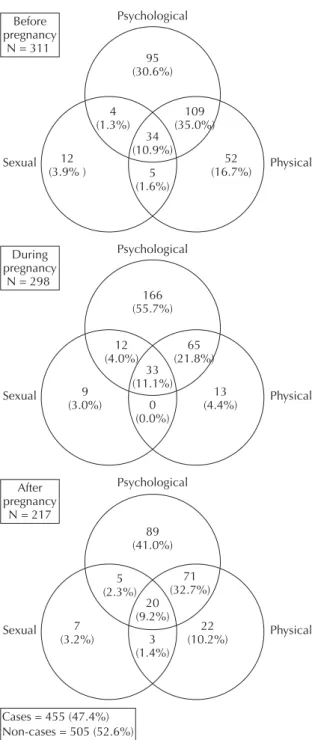
The frequency and overlapping of types of violence (Figure 3) showed that psychological violence alone was the most frequent type in all the periods. During pregnancy, the number of cases increased from 95 (30.6%) to 166 (55.7%), but when it overlapped with physical violence, it decreased from 109 (35.0%) to 65 (21.8%), in comparison with the preceding period (p < 0.001). Although physical violence alone decreased from 16.7% before pregnancy to 4.4% during preg-nancy, this reduction was not statistically signifi cant (p = 0.66). Sexual violence alone remained at around 3.0% in all three periods. Psychological, physical and sexual violence occurred simultaneously in 10% of the cases.
DISCUSSION
The present study was the fi rst known Brazilian cohort to estimate the prevalence and incidence of violence against women perpetrated by an intimate partner and assess the occurrences of psychological, physical and sexual violence before and during pregnancy and in the postpartum period.
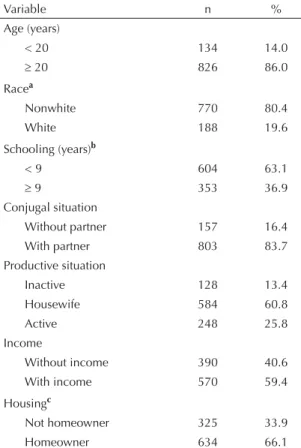
Because the women were interviewed on two occasions (during pregnancy and in the postpartum period), this made it possible to identify changes in the types and magnitude of IPV. The large sample and the small percentage of losses (5.7%) ensured that the results Table 1. Distribution of the women according to
socioecono-mic and demographic characteristics. Recife, Northeastern Brazil, 2005-2006. (N = 960)
Variable n %
Age (years)
< 20 134 14.0
20 826 86.0
Racea
Nonwhite 770 80.4
White 188 19.6
Schooling (years)b
< 9 604 63.1
9 353 36.9
Conjugal situation
Without partner 157 16.4
With partner 803 83.7
Productive situation
Inactive 128 13.4
Housewife 584 60.8
Active 248 25.8
Income
Without income 390 40.6
With income 570 59.4
Housingc
Not homeowner 325 33.9
Homeowner 634 66.1
5 Figure 1. Prevalence of intimate partner violence before and during pregnancy and in the postpartum period, and incidence during pregnancy and in the postpartum period. Recife, Northeastern Brazil, 2005-2006.
Violence before pregnancy (32.4%; 95%CI: 29.4%-35.4) Violence during pregnancy (31.1%; 95%CI: 28.2%-34.0) 960
(100.0%) Interviewees
311 (32.4%) With violence before
pregnancy
205 (21.4%) With violence during
pregnancy
Violence in postpartum (22.6%; 95%CI: 20.0%-25.3)
111 (11.6%) With violence in postpartum
period
94 (45.9%) Without violence
in postpartum
19 (2.0%) With violence in postpartum
87 (9.1%) Without violence
in postpartum period
36 (3.8%) With violence in postpartum
period
57 (5.9%) Without violence
in postpartum period
51 (5.3%) With violence in
postpartum period
505 (52.6%) Without violence
in postpartum period 649 (67.6%)
Without violence before
pregnancy
106 (11.0%) Withou violence during pregnancy
93 (9.7%) With violence during
pregnancy
556 (57.9%) Without violence before
were representative. Furthermore, the data were gathered by means of a questionnaire that had been validated previously10,15,24 and which measured violence
according to concrete acts, which increases the trust-worthiness of the results.
However, IPV is a complex, delicate and intimate topic. Thus, the woman’s psychological resources for facing up to the trauma suffered and her diffi culties and blockages in recalling this painful experience may interfere with her ability to speak about it, which may contribute towards underestimating the prevalence of IPV. In addition to these factors that are intrinsic to the woman, others may cause underestimation of the violence, such as: a relationship lacking in empathy between the interviewer and interviewee; the location for the interview; the woman’s insecurity regarding the confi dentiality of her report;2 the current relationship
with the partner causing the aggression; a feeling of fear in relation to the partner causing the aggression; and the protection that the woman gives to the partner because of her desire to maintain the relationship,4 especially
if this partner is the father of the child. Furthermore, among many other factors, there is the stigma and shame of having suffered the aggression.15
In Brazil, the social and institutional responses to the demands made by women’s movements have favored publication of more reports, which has given greater visibility to IPV.23 However, it is possible that
under-estimation of cases revealed by women and cases noti-fi ed by institutions and healthcare professionals still persists.2,21 Therefore, the high prevalence of IPV of any
type (47.4%) found in the three periods studied may still be an underestimate. This prevalence was much greater than what was cited by Guo et al12 (12.6%), in China,
in an analysis on the same types of violence and the same periods, and the prevalence found by Durand et al9
(20%) during pregnancy, among users of public services in the city of São Paulo. Among many other factors, the prevalences depend on the socioeconomic conditions of the women and their partners, personal concepts and sociocultural contexts, in which the gender hierarchy is legitimated to a greater or lesser extent, which contrib-utes towards increasing or decreasing the reports of violence.1,3,6,10,19,21,23
Like in the studies by Castro et al5 in Mexico and
Schraiber et ala in Brazil, there was no change in the
prevalence of IPV in the comparison between the
periods before and during pregnancy. However, during pregnancy, the physical violence diminished and the psychological violence increased, and that pattern was also found in the present study and by other authors.5,20,a
The data in these cited studies show that pregnancy does not protect the woman from violent situations, but the type of violence becomes modifi ed. Although psycho-logical violence does not leave visible signs like physical violence does, its severity and its consequences for the woman cannot be neglected, both during pregnancy and during the puerperium.16
There is a discussion in the literature as to whether pregnancy is a protection or a risk factor for IPV. Some studies, like the present study, have shown that there is a decrease in IPV, especially regarding physical violence;21 others have shown that the percentages
remain unaltered;19 others have shown that IPV appears
or increases;4 and yet others have shown that the
incidence of IPV was low, affecting around 1% of the cases.12 The fi ndings from the present study contribute
towards this discussion, through showing a pattern of continuity, with a very high chance of reports of violence during pregnancy continuing from before pregnancy. Thus, since the incidence of IPV during pregnancy was almost 10%, this shows that the preg-nancy period did not provide protection for the woman.
The reduction in prevalence in the postpartum period is consistent with the fi ndings of some other studies.19
Like the present study, these studies showed that there was a higher percentage of cessation of violence during the postpartum period that of its maintenance. On the other hand, despite the lower prevalence in the postpartum period, the women who reported violence during pregnancy always had higher frequency in the postpartum period than did the women without such reports during pregnancy. These results indicate that a pattern of recurrence and continuity existed. Other studies that revealed increased levels of IPV in the post-partum period, in comparison with the period before and/or during pregnancy,3,6,11 presented high rates of
maintenance of IPV.
In the present study, like in others,12,23 the types of
violence very often occurred in an overlapping manner, especially between physical and sexual violence.
The prevalence of psychological violence in the three periods was almost twice as large (42.0%) as physical violence (28.6%) and four times greater than sexual
Table 2. Prevalence of intimate partner violence, according to period and type. Recife, Northeastern Brazil, 2005-2006.
Type of violence Before pregnancy During pregnancy After delivery At any time
n (%) 95%CI n (%) 95%CI n (%) 95%CI n (%) 95%CI
7 Figure 2. Pattern of intimate partner violence during the periods before and during pregnancy and in the postpartum period. Recife, Northeastern Brazil, 2005-2006.
960 (100.0%) Interviewees
311 (32.4%) With violence before pregnancy
205 (65.9%) With violence during pregnancy
111 (54.1%) With violence in postpartum
period
94 (45.9%) Without violence
in postpartum period
19 (18.0%) With violence in postpartum
period
87 (82.1%) Without violence
in postpartum period
36 (38.8%) With violence in postpartum
period
57 (61.3%) Without violence
in postpartum period
51 (9.2%) With violence in postpartum
period
505 (90.9%) Without violence
in postpartum period 649 (67.6%)
Without violence before pregnancy
106 (34.1%) Without violence during pregnancy
93 (14.3%) With violence before pregnancy
violence (9.8%). This higher percentage of psycho-logical violence is consistent with some studies,3,6,17
but is discordant with a study conducted in China,12
which found that sexual violence was more prevalent than psychological violence in all three periods, and that there was higher prevalence of physical violence than of psychological violence, both before pregnancy and after delivery. The low percentages of psychological violence reported in some studies may have been due to cultural infl uences and structured gender inequality
relationships, which make it diffi cult for women to recognize situations that are considered to consist of psychological aggression. According to Charles & Perreira,6 the high percentage of psychological violence
during the postpartum period may result from high levels of stress and discord, with are associated with the signifi cant changes to the woman’s life and to the couple, consequent to the birth of a child.
The percentage of sexual violence remained practically the same before and during pregnancy, but it decreased in the postpartum period. It is important to highlight that almost 60% of these cases occurred during the fi rst 40 days of the puerperium. In North Carolina, Macy et al17
also found a higher percentage of sexual violence over the fi rst month of the postpartum period. According to Jasinski,14 this was due, among other reasons, to the
woman’s lower interest in sexual activity during the immediate postpartum period, possibly because of the special hormonal state of the puerperium. During this phase, the woman presents high levels of prolactin, a hormone that is fundamental for breastfeeding and which diminished libido.18 Moreover, studies have
shown that there may be physical problems during the puerperium, going from fatigue to pains in various parts of the body.22 Women also face problems of
psycho-social adaptation to maternity and diffi culties due to lack of support and understanding of the dynamics of the puerperium, especially on the part of the partner.7,18
Healthcare professionals need to be alert to women who suffer IPV before pregnancy, since these women’s chance of suffering violence during pregnancy is almost 12 times greater. This has also been found in other studies.12,19
The role of healthcare professionals in identifying violence against women is still a question under debate. Some authors have advocated routine investigation, but have mentioned the need for an institutionalized support network, formed by healthcare services and social and legal assistance.17,19 The period during which
the woman is attending prenatal consultations and the fi rst year after delivery (when she takes the child for childcare consultations) enable longer contact with healthcare professionals, which increases the chance of identifying situations of violence. Primary care is of fundamental importance, given that following up low-risk pregnancies and childcare are priorities of the Family Health Program.
In conclusion, this study shows the high magnitude and continuity of IPV among women of reproductive age, especially during the period around pregnancy and in the postpartum period. Thus, public policies for prevention of different types of violence are essential, along with treatment for its consequences, with support for women seeking protection for themselves and for their children.
Figure 3. Frequency and overlapping of types of intimate partner violence, according to period of occurrence. Recife, Northeastern Brazil, 2005-2006.
Cases = 455 (47.4%) Non-cases = 505 (52.6%)
Psychological
95 (30.6%)
4 (1.3%)
12 (3.9% )
Sexual Physical
5 (1.6%)
52 (16.7%) 34
(10.9%) 109 (35.0%) Before
pregnancy N = 311
166 (55.7%)
12
(4.0%) (21.8%)65 33
(11.1%) 9
(3.0%) 0 (4.4%)13 (0.0%)
Sexual Physical
Psychological During
pregnancy N = 298
89 (41.0%)
5 (2.3%)
7
(3.2%) 3 (10.2%)22 (1.4%)
71 (32.7%) 20
(9.2%) Psychological
Sexual Physical
After pregnancy
1. Audi CAF, Segall-Corrêa AM, Santiago SM, Andrade MGG, Pérez-Escamilla R. Violência doméstica na gravidez: prevalência e fatores associados. Rev Saude
Publica. 2008;42(5):877-85.
DOI:10.1590/S0034-89102008005000040
2. Bacchus L, Mezey G, Bewley S. Domestic violence: prevalence in pregnant women and associations with physical and psychological health. Eur J Obstet
Gynecol Reprod Biol. 2004;113(1):6-11. DOI:10.1016/
S0301-2115(03)00326-9
3. Bowen E, Heron J, Waylen A, Wolke D, ALSPAC Study Team. Domestic violence risk during and after pregnancy: fi ndings from a British longitudinal study.
BJOG. 2005;112(8):1083-9.
DOI:10.1111/j.1471-0528.2005.00653.x
4. Burch RL, Gallup Jr GG. Pregnancy as a stimulus for domestic violence. J Fam Viol. 2004;19(4):243-247. DOI:10.1023/B:JOFV.0000032634.40840.48 5. Castro R, Peek-Asa C, Ruiz A. Violence against
women in Mexico: a study of abuse before and during pregnancy. Am J Public Health. 2003;93(7):1110-6. 6. Charles P, Perreira KM. Intimate partner violence
during pregnancy and 1-year postpartum. J Fam Viol. 2007;22(7):609-19. DOI:10.1007/s10896-007-9112-0 7. Cheng CY, Fowles ER, Walker LO. Postpartum
maternal health care in the United States: a critical review. J Perinatal Educ.2006;15(3):34-42. DOI:10.1624/105812406X119002
8. Doubova (Dubova) SV, Pámanes-González V, Billings DL, Torres-Arreola LP. Violencia de pareja en mujeres embarazadas en la ciudad de México. Rev Saude
Publica. 2007;41(4):582-90.
DOI:10.1590/S0034-89102007000400012
9. Durand JG, Schraiber LB. Violência na gestação entre usuárias de serviços públicos de saúde da Grande São Paulo: prevalência e fatores associados. Rev Bras
Epidemiol. 2007;10(3):310-22.
DOI:10.1590/S1415-790X2007000300003
10. Garcia-Moreno C, Jansen HAFM, Ellsberg M, Heise L, Watts CH. Prevalence of intimate partner violence: fi ndings from the WHO multi-country study on women’s health and domestic violence. Lancet. 2006;368(9543):1260-9. DOI:10.1016/S0140-6736(06)69523-8
11. Gielen AC, O’Campo PJ, Faden RR, Kass NE, Xue X. Interpersonal confl ict and physical violence during the childbearing year. Soc Sci Med. 1994;39(6);781-7. 12. Guo SF, Wu JL, Qu CY, Yan RY. Domestic abuse on
women in China before, during, and after pregnancy.
Chin Med J (Engl). 2004;117(3):331-6.
13. Hedin LW. Postpartum, also a risk period for domestic violence. Eur J Obstet Gynecol Reprod Biol. 2000;89(1):41-5.
14. Jasinski JL. Pregnancy and domestic violence: a review of the literature. Trauma Violence Abuse. 2004;5(1):47-64. DOI:10.1177/1524838003259322
15. Ludermir AB, Schraiber LB, D’Oliveira AFPL, França-Junior I, Jansen HA. Violence against women by their intimate partner and common mental disorders.
Soc Sci Med. 2008;66(4):1008-18. DOI:10.1016/j.
socscimed.2007.10.021
16. Ludermir AB, Lewis G, Valongueiro SA, Araújo TVB, Araya R. Violence against women by their intimate partner during pregnancy and postnatal depression: a prospective cohort study. Lancet. 2010;376(9744):903-10. DOI:2010;376(9744):903-10.1016/S0140-6736(10)60887-2
17. Macy RJ, Martin SL, Kupper LL, Casanueva C, Guo S. Partner violence among women before, during, and after postpartum: multiple opportunities for intervention. Womens Health Issues. 2007;17(5):290-9. DOI:10.1016/j.whi.2007.03.006
18. Martell LK. Heading toward the new normal: a contemporary postpartum experience. J Obstet
Gynecol Neonatal Nurs. 2001;30(5):496-506.
DOI:10.1111/j.1552-6909.2001.tb01569.x 19. Martin SL, Mackie L, Kupper LL, Buescher PA,
Moracco KE. Physical abuse of women before, during, and after pregnancy. JAMA. 2001;285(12):1581-4. DOI:10.1001/jama.285.12.1581
20. Martin SL, Harris-Britt A, Li Y, Moracco KE, Kupper LL, Campbell, JC. Changes in intimate partner violence during pregnancy. J Fam Violence. 2004;19(4):201-10. DOI:10.1023/B:JOFV.0000032630.50593.93
21. Menezes TC, Amorim MMR, Santos LC, Faúndes A. Violência física doméstica e gestação: resultado de um inquérito no puerpério. Rev Bras Ginecol
Obstet. 2003;25(5):309-16.
DOI:10.1590/S0100-72032003000500002
22. Saurel-Cubizolles MJ, Romito P, Lelong N, Ancel PY. Women’s health after childbirth: a longitudinal study in France and Italy. BJOG. 2000;107(10):1202-9. DOI:10.1111/j.1471-0528.2000.tb11608.x
23. Schraiber LB, D’Oliveira AFPL, França-Junior I, Diniz S, Portella AP, Ludermir AB et al. Prevalência da violência contra a mulher por parceiro íntimo em regiões do Brasil. Rev Saude Publica. 2007;41(5):797-807. DOI:10.1590/S0034-89102007000500013 24. Schraiber LB, Latorre MRD, França-Junior I, Segri
NJ, D’Oliveira AFPL. Validade do instrumento WHO VAW STUDY para estimar violência de gênero contra a mulher. Rev Saude Publica. 2010;44(4):658-66. DOI:10.1590/S0034-89102010000400009
25. Stewart DE. Incidence of postpartum abuse in women with a history of abuse during pregnancy. CMAJ. 1994;151(11):1601-4.
REFERENCES
Article based on the master’s dissertation of Silva EP presented to the Universidade Federal de Pernambuco in 2009. The research project “Violence during pregnancy: determinants and consequences for reproductive health, mental health and perinatal results”, was funded by the Conselho Nacional de Desenvolvimento Científi co e Tecnológico (CNPq – procedural number 403060/2004-4) and by the Departamento de Ciência e Tecnologia da Secretaria de Ciência, Tecnologia e Insumos