To tell or not: parental thoughts on disclosure of urologic
surgery to their child
_______________________________________________
Christina B. Ching
1, Douglass B. Clayton
1, John C. Thomas
1, John C. Pope IV
1, Mark C. Adams
1, John
W. Brock III
1, Stacy T. Tanaka
11 Division of Pediatric Urology, Monroe Carell Jr. Children’s Hospital at Vanderbilt, Nashville, Tennessee,
USA
ABSTRACT
ARTICLE
INFO
______________________________________________________________ ______________________
Purpose: Literature pertaining to surgical disclosure to the pediatric patient is lacking. We hypothesized parents would find it difficult to disclose urologic surgery to a child. Materials and Methods: Parents of patients <5 years old undergoing urologic surgery were contacted for telephone survey. Parents were asked about future plans of surgical disclosure, comfort with disclosure, and any support received.
Results: 98 parents consented to study participation. 87% of surgeries were on the genitalia with 62% being minor genitalia surgery (i.e. circumcision). 70% of parents would tell their child about minor genital surgery while 84% would tell about major genital surgery (p=0.07). 4 of 20 parents of children undergoing hypospadias repair (major genital surgery) did not plan to tell their child about surgery. All parents of children undergoing non-genital surgery would tell. Of all parents planning to tell their children about surgery, only 14% were nervous. 34% of parents would find gui-dance in talking to their child helpful despite the majority (90%) stating no guigui-dance had ever been provided.
Conclusions: Parents seem comfortable discussing urologic surgeries with a child but about 1/3 would appreciate further counseling. 20% of parents of children undergoing hypospadias repair hope to avoid telling their child.
Key words:
Pediatrics; Parents; Disclosure; Hypospadias; Child
Int Braz J Urol. 2015; 41: 562-8
_____________________
Submitted for publication: April 07, 2014
_____________________
Accepted after revision: October 31, 2014
INTRODUCTION
The current existing literature on medi-cal disclosure to the pediatric patient tends to address disclosure of life-threatening illnesses such as pediatric cancers and the human im-munodeficiency virus (HIV) or issues related to adoption and assisted reproductive technology (1-6). There is little in the literature about pa-rental communication of a prior surgery to their child. Specifically, there is limited information on disclosure of urologic surgery which some
parents may find difficult to discuss as it often involves socially taboo parts of the body such as the external genitalia.
MATERIALS AND METHODS
After receiving institutional review board approval (#121876), we contacted parents of all pediatric patients <5 years old undergoing urologic surgery between February 2013 and May 2013 at Monroe Carell Jr. Children’s Hospital at Vanderbilt University. This included patients of all 6 pediatric urologists at Vanderbilt. Parents consented at time of post-operative follow-up phone call. These calls were all performed the day after surgery as part of our standard post-operative follow-up phone call protocol at which time parents were then told about the study and asked to participate in a te-lephone survey. The survey questions are listed in Figure-1 and include whether parents ever plan to disclose such prior surgery to their child, the age at which parents would disclose such information, parental comfort with disclosing such informa-tion to their child, prior support given and desire for future support in how to tell their child about surgery, and the parent’s own personal experience with childhood surgery. The exact type of surgery the parent underwent and surgical history of the other parental unit was not asked. The electronic medical record (EMR) of each pediatric patient was also reviewed for evidence of other prior sur-geries and major patient co-morbidities. Categori-cal variables were compared with chi-square test while continuous variables were compared using Student’s t-test. Significance was determined by a p value <0.05.
RESULTS
103 parents of children undergoing urolo-gic surgery at <5 years of age were contacted in consecutive post-operative follow-up phone calls of which 98 parents consented to participate in our study.No patient parents were specifically ex-cluded from the study. For all participants, only one of the parental units was questioned during the survey (the parent answering the phone) and the parents did not have time to consult each other at time of phone survey. The 5 parents decli-ning to participate included 3 patients undergoing chordee lysis/circumcision, 1 undergoing inguinal hernia repair, and 1 undergoing labiaplasty for
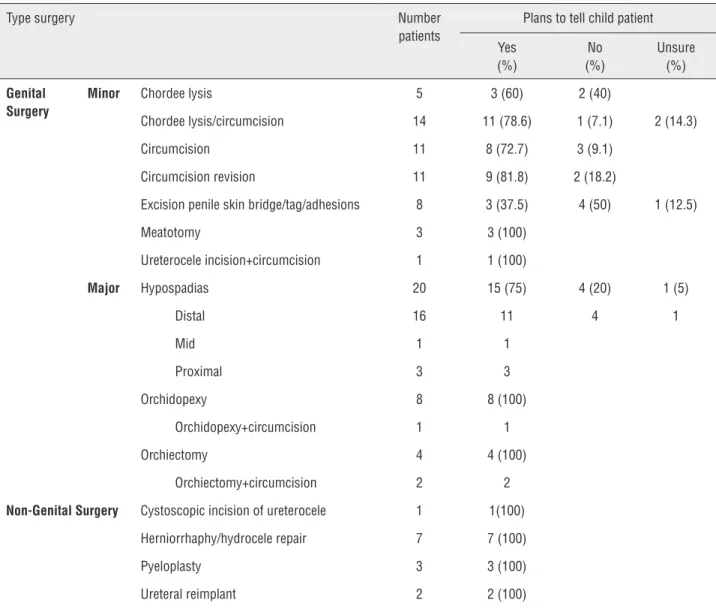
congenital adrenal hyperplasia. The average age of patients included was 15.7 months (median 8.2 months, range 3.7-57.7 months). The majority of patients were male (95 patients); however, 3 were female. Table-1 lists the types of surgeries and corresponding parental decision about disclosure. There were 85 genital surgeries (penis and testi-cular surgery) and 13 non-genital surgeries (her-nia surgery, bladder surgery, and kidney surgery). All parents of children undergoing non-genital surgery were planning on disclosing surgery to their child. 16 of 85 (18.8%) of parents of children undergoing genital surgery were not planning to tell their child about surgery; 4 of 85 (4.7%) were unsure. This difference in plans for disclosure be-tween genital versus non-genital surgery was not statistically significant (p=0.06).
Among genital surgery, the majority of surgeries (53/85; 62.4%) were minor (circumci-sion, circumcision revi(circumci-sion, chordee lysis, exci-sion penile ski bridge/tag/adheexci-sion, and meato-tomy) while the rest (32/85; 37.6%) constituted more major genital surgery (orchiopexy, orchiec-tomy, and hypospadias). 37/53 (69.8%) of pa-rents of children undergoing minor genital sur-gery would definitely disclose the recent sursur-gery to their child; 3/53 (5.7%) were unsure. 27/32 (84.4%) of parents of children undergoing major genital surgery would definitely disclose surgery to their child; 1/32 (3.1%) was unsure. There was not a significant difference in plans for disclosure based on whether a child underwent minor versus major genital surgery (p=0.07). Interestingly, 4 of the 20 parents of children undergoing hypospa-dias repair (major genital surgery) did not plan to tell their children. All 4 of the children underwent distal hypospadias repair. All parents of children undergoing mid or proximal hypospadias repair planned to tell their children.
hypos-Figure 1 - Parental Disclosure of Surgery Questionnaire.
1. How old is your child?
2. What surgery did your child just undergo?
3. Do you plan to tell your child about this surgery? YES NO
a. If you plan to tell your child, Do you know when (ie how old) you will tell your child?
b. If you plan to tell your child, Do you know how you will tell your child?
4. Are you nervous or concerned to tell your child? YES NO
a. If you are nervous or concerned, why?
5. Has anyone ever talked to you about telling your child? YES NO
6. Would you find it helpful to talk to someone about telling your child? YES NO
7. Before taking this survey, had you given any thought to talking to your child? YES NO
a. Have you ever had surgery?
8. How old were you? YES NO
padias repair who did not plan on telling them about surgery, all had undergone surgery themsel-ves but none at less than 5 years of age. Prior ma-jor surgery or mama-jor co-morbidity in the pediatric patient was not predictive of parental choice to disclose their child’s recent urologic surgery, and neither was patient race (p=0.56). Parents seem to agree to tell their child about surgery “when they can understand” however the definition of this ranged in age from 2-16 years old (mean 9 years).
Of all parents planning to disclose surgery (78), only 11 (14.1%) of these parents were ner-vous to do so. Overall, 33/98 (33.7%) of parents would find it helpful to have guidance in talking to their child about surgery despite the overwhel-ming majority (88/98; 89.8%) reporting not ha-ving received any such guidance.
DISCUSSION
Our interest in parental disclosure of prior childhood urologic surgery began after at-tempting to reach teenage patients for long-term follow-up after childhood hypospadias repair and encountering one parent’s refusal for parti-cipation due to the fact they had never told their
child about the initial surgery. We wondered the regularity of this occurrence and the literature that may exist on the topic of surgical disclosu-re. Overall, there is minimal information on dis-closure of prior urologic surgery to a child, with the few articles that exist primarily focusing on disorders of sexual development. These tend to emphasize decisions of gender assignment and timing of surgical intervention (7-11).
The majority of literature on disclosing childhood medical conditions is primarily limited to grave illnesses such as HIV, cancer, Duchenne muscular dystrophy, and fetal alcohol syndrome (1-3, 12-17) where disclosure has important tre-atment ramifications. In HIV, disclosure of disease may improve patient medication compliance and the sharing of disease status to future sexual par-tners to prevent disease transmission (13, 14, 18).
While diagnoses related to urologic surgery are often not as grave as HIV, important lessons regarding potential medical compliance and ne-cessary follow-up may follow with its disclosure.
Table 1 - Parental decision on whether or not to tell their child about surgery and the type of surgery the patient underwent.
Type surgery Number
patients
Plans to tell child patient
Yes (%)
No (%)
Unsure (%)
Genital Surgery
Minor Chordee lysis 5 3 (60) 2 (40)
Chordee lysis/circumcision 14 11 (78.6) 1 (7.1) 2 (14.3)
Circumcision 11 8 (72.7) 3 (9.1)
Circumcision revision 11 9 (81.8) 2 (18.2)
Excision penile skin bridge/tag/adhesions 8 3 (37.5) 4 (50) 1 (12.5)
Meatotomy 3 3 (100)
Ureterocele incision+circumcision 1 1 (100)
Major Hypospadias 20 15 (75) 4 (20) 1 (5)
Distal 16 11 4 1
Mid 1 1
Proximal 3 3
Orchidopexy 8 8 (100)
Orchidopexy+circumcision 1 1
Orchiectomy 4 4 (100)
Orchiectomy+circumcision 2 2
Non-Genital Surgery Cystoscopic incision of ureterocele 1 1(100)
Herniorrhaphy/hydrocele repair 7 7 (100)
Pyeloplasty 3 3 (100)
Ureteral reimplant 2 2 (100)
obstruction or fistula. Prior hernia or orchiope-xy may affect fertility. Some urologic conditions have a genetic association and could affect the patient’s own future offspring: one mother in our study planned to tell her son about his hypospa-dias because it was “important for him to know if he has his own kids”. Failing to disclose such in-formation to a child may result in delayed feelings of resentment and deception (19).
One mother being interviewed expressed regret that she and her husband had only recen-tly been told of the husband’s prior childhood hy-pospadias repair; she intended to discuss her son’s urologic surgery earlier in his life.
they “did not want (their child) to feel different”. The potential sensitive nature of urologic surgery was evident by the response of one of the parents who declined participation in the study. The child had undergone labiaplasty for congenital adrenal hyperplasia and the parent specifically stated their desire to only discuss their child’s condition with the surgeon. None of the other 4 parents declining to participate gave such a strong explanation for their decision.
Given the possibility that parental dis-closure could be influenced by the body part on which is being operated, we decided to evaluate parental response based on genital versus non--genital surgery. While we did not find that pa-rental thoughts on disclosure between genital and non-genital surgery was significantly different, it did approach statistical significance (p=0.06) and was perhaps limited by the small number of patients in our non-genital surgery group (only 13). Again, this could suggest that parents may be more hesitant to discuss genital versus non-geni-tal surgery with their child; however, it could also demonstrate a distinction in perceived severity of the surgery and need for continued follow-up. For example, some of the non-genital surgeries may require ongoing follow-up due to the risk of se-rious complications (i.e. vesico-urinary reflux and the possibility of associated reflux nephropathy) which may influence a parent’s attitude towards disclosure. While we did not have enough patients to do a meaningful comparison of overall major versus overall minor surgery, we did evaluate pa-rental plan for disclosure based on major versus minor genital surgery but did not find a signifi-cant difference in disclosure plans.
Overall, we found that parents generally planned to discuss surgery with their child and felt relatively comfortable doing so. While 34% of parents would find it helpful to have some sort of guidance in talking to their child, some parents stated they thought the discussion of dis-closure “should be between husband and wife” and “should not include a 3rd party.” It appeared a highly personal decision–that often involved talk amongst family members via anecdotal responses. One thing is evident, we as urologists do not do an adequate job of addressing this issue or at least
acknowledging the future need for disclosure. Of the 10 parents responding they had entered dis-cussions of how to disclose surgery to their child, only 5 had been counseled by a medical profes-sional while the other 5 had sought counsel with other family members or in their church. Approxi-mately one-third of our parents would apprecia-te some counseling from a healthcare profession about talking to their child. One of the most com-monly stated reason for being nervous to discuss surgery was being unsure “how” to tell their child or “what words to use”. Better collaboration with Child Life resources may help aid in choosing the most appropriate words to explain to a child about a prior surgery. This may help ensure a gradual, age appropriate discussion that would be most tangible and thus beneficial in conveying this in-formation to the patient.
There is no data to help determine the best age of the patient at which to disclose medical information (19). Some argue that early discus-sions are important in order to create a sense of “teamwork” and establish open early channels of communication (20).
In the case of maternity or paternity as with donor reproduction, it appears disclosure to a child at a younger age is important (4, 5); howe-ver, this scenario is difficult to extrapolate to ours given the differences in the nature of information being conveyed with the latter case more directly affecting parent/child relationships when compa-red to our study.
When evaluating the literature for timing of disclosure on other issues, there does not appe-ar to be a specific age where disclosure seems ap-propriate with most studies concluding there is no obvious appropriate age (6) other than just when it “seemed right” or when parents thought their child could optimally understand (4).
Children undergoing circumcision clearly ultimately know they have been circumcised inde-pendent of whether the child’s parents specifically tell them. We also chose to survey parents of chil-dren <5 years old. Arguably this included some children who already realized they were undergoing surgery and thus would not need specific disclosure of their surgery. A future study may want to include surveying parents of younger children.
One thing we did not specifically deline-ate when asking parents about their plan was if their plan of disclosure was specific to the surgery or just about disclosing a childhood surgery and whether they would specifically withhold infor-mation about surgery from their child. We also did not specifically ask parents why or why not they would tell their child of a prior surgery and did not include parental age and educational and socioeconomic status in our analysis.
A future study may want to probe further how exactly we as urologists can help counseling these parents and the potential role education/ socioeconomic status may play in a parent’s de-cision for disclosure. We are also relying on the ability of parents to recall prior guidance on dis-closure which may not be completely accurate as to whether guidance was actually offered and gi-ven. This study was only a preliminary evaluation of this issue and can continue with evaluation of more complex surgeries such as hypospadias re-pair or even children with ambiguous genitalia or disorders of sexual differentiation in which these issues of disclosure are of more consequence. In addition, it would be nice to correlate the future plans as found in this study with the actual reality of disclosure in a prospective study. It will remain to be seen what the true impact of disclosing or not disclosing such information to former child patients will be.
CONCLUSIONS
Disclosure of a urologic surgical procedu-re is a personal decision for each paprocedu-rent.
Parents seem overall relatively comforta-ble telling a child about prior urologic surgery, although we as urologists could do a better job of discussing this issue with parents.
Those parents willing to avoid specifically telling their child about a surgery seem content to do so unless the child notices a physical difference post-operatively. Parents seem more reluctant to discuss hypospadias repair with their child when compared to other urologic surgeries which may necessitate a more informed discussion between urologist and parent about potential long-term complications of hypospadias surgery.
ACKNOWLEDGEMENTS
We would like to acknowledge the aid of Karen Brownlee, RN, Linda Blair, RN, and Eva Todd, RN in making this study possible
CONFLICT OF INTEREST
None declared.
REFERENCES
1. Wiener LS, Battles HB, Heilman N, Sigelman CK, Pizzo PA. Factors associated with disclosure of diagnosis to children with HIV/AIDS. Pediatr AIDS HIV Infect. 1996;7:310-24. 2. Arun S, Singh AK, Lodha R, Kabra SK. Disclosure of the HIV
infection status in children. Indian J Pediatr. 2009;76:805-8. 3. Funck-Brentano I, Costagliola D, Seibel N, Straub E, Tardieu
M, Blanche S. Patterns of disclosure and perceptions of the human immunodeficiency virus in infected elementary school-age children. Arch Pediatr Adolesc Med. 1997;151:978-85.
4. Rumball A, Adair V. Telling the story: parents’ scripts for donor offspring. Hum Reprod. 1999;14:1392-9.
5. Mac Dougall K, Becker G, Scheib JE, Nachtigall RD. Strategies for disclosure: how parents approach telling their children that they were conceived with donor gametes. Fertil Steril. 2007;87:524-33.
6. Peters C, Kantaris X, Barnes J, Sutcliffe A. Parental attitudes toward disclosure of the mode of conception to their child conceived by in vitro fertilization. Fertil Steril. 2005;83:914-9.
7. Lee PA. A perspective on the approach to the intersex child born with genital ambiguity. J Pediatr Endocrinol Metab. 2004;17:133-40.
9. Austin J, Tamar-Mattis A, Mazur T, Henwood MJ, Rossi WC. Disorders of sex development-when and how to tell the patient. Pediatr Endocrinol Rev. 2011;8:213-7.
10. Barthold JS. Disorders of sex differentiation: a pediatric urologist’s perspective of new terminology and recommendations. J Urol. 2011;185:393-400.
11. Daaboul J, Frader J. Ethics and the management of the patient with intersex: a middle way. J Pediatr Endocrinol Metab. 2001;14:1575-83.
12. Todorow M, Paris K, Fantus E. Ethical considerations when communicating a diagnosis of a fetal alcohol spectrum disorder to a child. J Popul Ther Clin Pharmacol. 2012;19:e361-8.
13. Calabrese SK, Martin S, Wolters PL, Toledo-Tamula MA, Brennan TL, Wood LV. Diagnosis disclosure, medication hiding, and medical functioning among perinatally infected, HIV-positive children and adolescents. AIDS Care. 2012;24:1092-6.
14. Santamaria EK, Dolezal C, Marhefka SL, Hoffman S, Ahmed Y, Elkington K, et al. Psychosocial implications of HIV serostatus disclosure to youth with perinatally acquired HIV. AIDS Patient Care STDS. 2011;25:257-64.
15. Hatano Y, Yamada M, Fukui K. Shades of truth: cultural and psychological factors affecting communication in pediatric palliative care. J Pain Symptom Manage. 2011;41:491-5. 16. Lester P, Chesney M, Cooke M, Weiss R, Whalley P, Perez
B, et al. When the time comes to talk about HIV: factors associated with diagnostic disclosure and emotional distress in HIV-infected children. J Acquir Immune Defic Syndr. 2002;31:309-17.
17. Fujino H, Saito T, Imura O, Matsumura T, Shinno S. [Survey for assessing how Duchenne muscular dystrophy is explained to children with the disorder]. No To Hattatsu. 2013;45:11-6.
18. Lee CL, Johann-Liang R. Disclosure of the diagnosis of HIV/ AIDS to children born of HIV-infected mothers. AIDS Patient Care STDS. 1999;13:41-5.
19. de Vinck-Baroody O, Weitzman C, Vibbert M, Augustyn M. Disclosure of diagnosis: to tell or not to tell? J Dev Behav Pediatr. 2012;33:441-3.
20. Slavin LA, O’Malley JE, Koocher GP, Foster DJ. Communication of the câncer diagnosis to pediatric patients: impact on long-term adjustment. Am J Psychiatry. 1982;139:179-83.
_______________________