LITERA
TURE REVIEW
Student body posture in Brazilian studies
Investigação da postura corporal de escolares em estudos brasileiros
La investigación sobre la postura corporal de estudiantes en estudios brasileños
Ana Fátima Viero Badaró1; Lidiane de Fátima Ilha Nichele2; Patrícia Turra2Mailing address: Ana Fátima Viero Badaró – Avenida Roraima, 1000, sala 1431 – Camobi – CEP 97105-900 – Santa Maria (RS), Brazil – E-mail: [email protected] Presentation: Apr. 2014 – Accepted for publication: Apr. 2015
A study conducted in Universidade Federal de Santa Maria (RS), Brazil.
1Professor in the Physical Therapy course at Universidade Federal de Santa Maria (UFSM); Doctor of Health Science – Santa Maria (RS),
Brazil.
2Physical therapist. Graduate Student on Physical-Motor Rehabilitation (UFSM) – Santa Maria (RS), Brazil.
ABSTRACT | To identify and characterize the proile of Brazilian reports that have examined body posture of students, between 6 and 18 years old, the methods used and the results found. The research has been made on the SciELO, LILACS, PubMed and in the physiotherapy national journal, through the words in portuguese and english: posture, posture assessment, student and child. The research was taken from july 2012 to december 2013, taking into account the following inclusion criteria: national studies, with students between 6 and 18 years old, developed in schools that evaluated at least two body segments. Have been selected 28 students, from 68 found. The age range of 10 years old has been the most examined (24). The amount of students assessed was 5.334. There has been objective evaluation predominance (50.0%), in which photographic records have been used in 12 evaluations. Software was used in 8 evaluations in order to analyze the asymmetries. The Southeast stood out with 16 publications. The main body changes that appeared: lumbar hyperlordosis, thoracic hyperkyphosis, valgus knee and protrusion and/or uneven shoulders. From the ages of 7 and 8, the hyperlordosis and the valgus knee prevailed. Was concluided than the variability of methods used on the researches, as well as the age range diversity, has limited the characterization of these studies related to the prevalence of alterations in this group. Keywords | Child; Adolescent; Literature Review as Topic; Process Assesment (Health Care).
RESUMO | O objetivo deste estudo foi identiicar e caracterizar o peril das publicações brasileiras que investigaram a postura corporal de escolares, na idade de 6 a 18 anos. Os artigos analisados foram encontrados nas bases de dados eletrônicas SciELO, LILACS, PubMed e em
197
periódicos nacionais de isioterapia, por meio das seguintes palavras, suas combinações e correspondências na língua inglesa: postura, avaliação postural, escolar e criança. O período de busca foi de julho de 2012 a dezembro de 2013. Foram incluídos os estudos nacionais que avaliaram, no ambiente escolar, a postura de no mínimo dois segmentos corporais em crianças e adolescentes. Selecionaram-se 28 estudos dos 68 encontrados. A idade dos 10 anos foi a mais investigada (24). O total de escolares avaliados foi de 5.334. Houve predominância de avaliações objetivas (50,0%), das quais 12 foram realizadas com registros fotográicos. Para a análise das assimetrias, 8 utilizaram software. No Sudeste, houve 16 investigações. As principais alterações veriicadas foram: hiperlordose lombar, hipercifose torácica, joelho valgo e protrusão e/ou desnível de ombros. Prevaleceram a hiperlordose e o joelho valgo, com escolares entre 7 e 8 anos. Concluiu-se que as publicações sobre investigações da postura dos escolares são recentes. A variabilidade de métodos utilizados e também a diversidade das faixas etárias estudadas limitou a caracterização das alterações. Descritores | Criança; Adolescente; Postura; Literatura de Revisão como Assunto; Avaliação de Processos (Cuidados de Saúde).
hasta diciembre del 2013. Para eso tuvo en cuenta los siguientes criterios: estudios nacionales desarrollados en las escuelas, que evaluaron, al menos, dos segmentos corporales con estudiantes de 6 hasta los 18 años de edad. De los 68 estudios encontrados, se eligieron 28. La franja de edad más investigada fue de 10 años encontrándose 24 publicaciones. El total de estudiantes evaluados fue de 5.334. Se predominaron las evaluaciones objetivas con un 50%, siendo registradas a través de fotos 12 evaluaciones. Para el análisis de las asimetrías se utilizaron en ocho el software. Entre las regiones estudiadas, el Sureste alcanzó
16 investigaciones. Se obtuvieron las principales alteraciones: la hiperlordosis lumbar, la hipercifosis torácica, la rodilla en valgo y la protrusión y/o hombros desnivelados, prevaleciendo la hiperlordosis y la rodilla en valgo en los estudiantes de los 7 y 8 años de edad. Se concluyó que son recientes las publicaciones sobre las investigaciones de sus posturas. Sin embargo, la variedad de los métodos utilizados y la diversidad de las franjas etarias limitaron la caracterización de las alteraciones.
Palabras clave | Niño; Adolescente; Postura; Literatura de Revisión; Evaluación de Procesos y Resultados; Atención a la Salud.
INTRODUCTION
Brazil’s Estatuto da Criança e do Adolescente - ECA (Children and Adolescents’ Act)1 sees children as people
younger than 12 years of age, and adolescents as the ones between 12 and 18 years. During the childhood and adolescence, the growth period, many psychological, afective, social, and physical transformations take place, and they are important to the development of individuals2.
In Brazil, the basic education is organized by age ranges. Childhood education covers ages up to ive years; elementary school, from 6 to 14 years, and high school, from 15 to 17 years3
. In that school period, the
musculoskeletal system has not reached its maturity, and using improper furniture, carrying excessive loads, and staying still for long periods are risk factors to body development, and they may also cause discomfort, pain, or functional disabilities with physical-motor alterations4,5.
hus, routine exams are fundamental to early diagnose growth malformations6. Posture assessment
uses low-cost technologies which are easily applied in the diagnosis and control of posture alterations7,8. In it,
individuals are seen as orthostatic in coronal and sagittal planes, in subjective or objective ways. In the subjective assessment, the posture inspection is conducted by the eyes of the therapist, who checks tilting and asymmetries7, depending only on his/her skill and
experience to interpret results, which may lead to mistakes9. In the objective assessments, photographic4,10
or radiologic11 images are used. Photographs, besides
being more practical, ensure better accuracy in results when they are associated with softwares that measure and analyze angles and distances12.
In that sense, it is fundamental to know the national methodologies that are used in studies which deal with body posture assessment in that phase, when posture habits are being established, in order to thus gather and produce discussion about the assessment types that are generally used, the existing protocols to assess posture, and the instruments which help professionals perform that activity. hus, it is possible to observe how complex and signiicant this subject is and also the way it has been developed in Brazil. Considering that, this study aimed to characterize and identify the proiles of Brazilian publications which investigated the body posture of students, used methods, and obtained results.
METHODOLOGY
his descriptive, bibliographical research investigated body posture assessment in children and adolescents. he Brazilian scientiic production was studied through SciELO, LILACS, PubMed databases, and also through national physical therapy periodic publications, regardless of the year they were published. Searches were independently conducted by three investigators, between July 2012 to December 2013, through the following words, their combinations, and corresponding terms in English: posture, posture assessment, school, and child.
with special populations (obese people, athletes, mouth breathers, and people with special needs) was excluded, when they did not have a control group. In the studies with special populations and control groups10,13-20, that
was the only sample share that was considered.
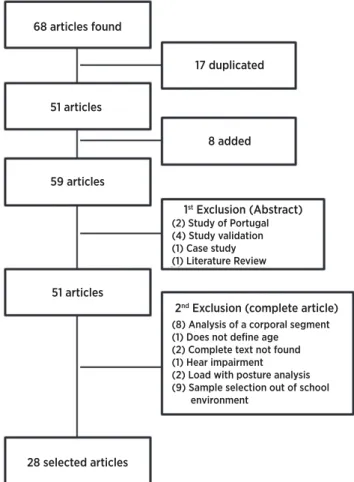
Initially, 68 studies were found. Out of those, 17 were duplicate, 8 were excluded, and 8 were added. After articles were fully read, another 23 articles were excluded, so 28 studies were obtained for analysis (Figure 1).
68 articles found
17 duplicated
8 added
1st Exclusion (Abstract)
(2) Study of Portugal (4) Study validation (1) Case study (1) Literature Review
2nd Exclusion (complete article)
(8) Analysis of a corporal segment (1) Does not define age
(2) Complete text not found (1) Hear impairment (2) Load with posture analysis (9) Sample selection out of school environment
51 articles
59 articles
51 articles
28 selected articles
Figure 1. Article selection lowchart
he sample proile was designed according to the articles and the years they were published, types of study, cities, and regions were investigations were conducted, sample sizes, age ranges, and genders. he methods and resources used in the assessments were veriied, and the obtained results were compiled according to age ranges and genders.
RESULTS AND DISCUSSION
he Brazilian body posture investigation on children and adolescents resulted in 28 studies, the irst one of
which from 1986. Two articles are from that decade and another two from the following decade. Six publications were found between 2001 and 2006. hat research evolved, and 2007 stands out, as ive articles were obtained from that year. Between 2013 and 2013, another 13 studies were published (Figure 2). hat demonstrates the increased interest in the subject, even though it has not been very explored.
Some qualiied periodicals have been bringing up this subject, which shows its importance. Brazilian Journal of Physical herapy magazine published four of those studies. Revista Paulista de Pediatria (São Paulo’s Pediatrics Magazine) has three publications, and Revista Fisioterapia e Pesquisa (Physical herapy and Research Magazine) and Revista Brasileira de Ciência e Movimento (Brazilian Science and Movement Magazine) have two publications each (Table 1).
Y
Annual F
requenc
y of Publica
tions
198
9 1991 2001 200
3
20052006 200
720082009 2010201120122013 199
5
Figure 2. Annual frequency of publications
Most studies had transverse designs (92.9%), and only two were longitudinal. A large part of the studies (78.6%) comprised descriptive ones, analytical research appearing in smaller numbers (21.4%) - both of them had observational approaches.
In regards to their division in regions, investigations were focused in the southeastern region (57.2%), with 14 studies in São Paulo, one in Rio de Janeiro, and another one in Minas Gerais. In the southern region (35.7%), ive studies took place in Santa Catarina, four in Rio Grande do Sul, and one in Paraná. he northeast region (7.1%) has one study in Piauí and another one in Pernambuco (Table 1).
Many studies used postural analysis grid charts - with and without plumb lines - to support exams, both in subjective (10) and in objective studies (5). Detsch and Candotti2 consider their use as a good
goniometry, conirmation indices are high. In regards to the observed planes, only two studies evaluated posture in one plane only. he remaining studies did it in two planes.
Among objective assessments (50.0%), most of them were conducted through photographic records (12); one of them was conducted through Moiré topography23 and
another one through the New York Posture Rating18.
Six studies used body markers through photography. In order to analyze and interpret asymmetries, eight studies used softwares - Corel Draw®, Posture Assessment Softwares (SAPO)®, or Posturograma®.
Iunes et al.36 and Souza et al.37 found higher results and
reliability in objective assessments when they compared inter-rater agreements between postural inspection and photogrammetry36, and also when they analyzed the
inter-rater reliability of biophotogrammetry37.
Adam’s forward bend test, which is performed to check for deviations and/or twisting of the spine12
- as indicative of scoliosis, was only conducted in ive subjective studies. Karachalios et al.38 found
84.4% sensitivity and 93.4% speciicity for that test. Some authors2,12,39,40 consider it a simple and reliable
procedure to preventively investigate scoliosis.
Table 1. Characterization of articles according to: identiication, year, and periodical of publication, Capes qualis (set of criteria used by CAPES – Coordination for the Improvement of Undergraduate Personnel - to classify studies), sample, gender, and study location
ID Ano Periodic Qualis Capes* Sample Masc. Fem. Study Place
1(21) 1986 Rev Bras Ciênc Esporte B1 201 91 110 Rio Claro - SP
2(13) 1989 Rev Bras Ciênc Mov B2 60** 27 33 São Caetano do Sul - SP
3(22) 1991 Rev Bras Ciênc Mov B2 791 Florianópolis - SC
4(23) 1995 Rev Bras Ativ Fís Saúde B2 229 118 111 Florianópolis - SC
5 (2) 2001 Movimento A2 154 0 154 Novo Hamburgo - RS
6(24) 2003 Fisioter Pesqui B1 186 98 88 Uberaba - MG
7(25) 2005 Braz J Phys Ther A2 72 Barra Mansa - RJ
8(4) 2005 Clinics - 132 0 132 São Paulo - SP
9(26) 2006 Rev Paul Pediatr B1 13 6 7 São José dos Campos - SP
10(27) 2006 Rev Bras Epidemiol B1 344 Tangará - SC
11(5) 2007 Rev Panam Salud Pública B1 495 0 495 São Leopoldo - RS
12(14) 2007 Fisioter Mov B1 40** São Paulo - SP
13(15) 2007 Fisioter Pesqui B1 42** 17 25 São Paulo e Guarulhos - SP
14(16) 2007 Braz J Phys Ther A2 48** 0 48 São Paulo - SP
15(17) 2007 Cinergis B4 40** 14 26 Araraquara - SP
16(28) 2008 Braz J Phys Ther A2 191 77 114 São Paulo - SP
17(29) 2008 Fit Perf J B3 47 31 16 Terezinha - PI
18(8) 2009 Rev Paul Pediatr B1 247 131 116 Jaguariúna - SP
19(30) 2009 Conscientiae Saúde B2 465 205 260 Descalvado - SP
20(31) 2009 Braz J Phys Ther A2 44 15 29 Tubarão - SC
21(32) 2009 J Manipulative
Physiol Ther A2 230 100 130 Amparo - SP
22(33) 2010 Interfaces B4 31 0 31 Alto do Tiete – SP
23(18) 2010 Pró-fono. A2 58** 24 34 Santa Maria - RS
24(34) 2010 Ter Man B2 186 93 93 Florianópolis - SC
25(19) 2011 Braz J Otorhinolaryngol A2 62** 23 39 Campinas - SP
26(10) 2011 Rev Bras Cineantropom
Desempenho Hum B1 18** 9 9 Paraná - PR
27(20) 2012 Fisioter Mov B1 44** 22 22 Caruaru - PE
28(35) 2013 Rev Paul Pediatr B1 864 441 423 Caxias do Sul - RS
Total 5.334 1.542 2.545
he body posture investigations of the 28 studies involved 5,334 subjects. he smallest sample size was 13, and the largest one, 864. In regards to the ages, the most investigated one was 10 years (24), and the most varied sample involved 6 to 17-year old subjects. Some only analyzed children (9); others, only teenagers (2); and most of them, both groups (17) (Figure 3). In regards to genders, 19 studies evaluated both; 5 of them only studied girls, and 4 did not specify whether results were from males or females. Girls are observed to be more engaged in the studies (2,545) than boys (1,542) (Table 1), which was justiied by the authors2,4,5,18, as
girls are more prone to have posture alterations.
When evaluating the posture of students, some studies have not considered the peculiarities and specificities that are related to genders (4) and to age ranges (12) (Table 1 and Figure 3). The collective analysis of data from children and adolescents compromises the interpreting of results, in which natural body changes may be pointed out as problems. The importance of specifying ages and genders in studies is due to the fact that postural patterns constantly vary in children, because they are always seeking new ways to react to gravity.
However, during late adolescence, patterns are not deined anymore, and they may or may not be considered satisfactory4,39.
It is important to remember that the growth peak in puberty takes place earlier in girls, and it lasts from ages 9 to 13, with its apex at year 11. In turn, for boys, it takes place between ages 11 and 15, peaking at 13. In both, growth can happen in a slower way for some more years39,40.
As per Asher39, posture varies according to growth
stages and body segments. he author also considers that physiological lumbar hyperlordosis in children of six years of age is associated with anterior pelvic tilt, as a way to seek body balance, and it must decrease with their development. he valgus knee, which arises at the 2nd or 3rd year of life, tends to correct itself from ages 5 to 7, and it may last around the growth peak due to development interferences, with a higher prevalence in girls of ages 10 to 14. Knee hyperextension takes place from ages 6 to 11, due to the anti-gravitational balance that is required in order to keep an erect posture. hus, those alterations are still present during adolescence, and they vary according to the genders, due to puberty.
A
Selec
ted Articles (ID
)
13 14 15 16 17 18
3 2 4 5 6 7 8 9 10 11 12 13 14 15 16 17 18 19 20 21 22 23 24 25 26 27 28
ID: identiication according to Table 1
In the sample of this review, the segments of the spine, shoulder girdle, and lower limbs were the ones which were found to have more alterations pointed out. Out of the 18 articles which investigated lumbar hyperlordosis, 7 of them limited themselves to ages 10 and below, which points out great prevalence variability (from 15.3% to 78.0%). Detsch and Candotti2 found
high lumbar hyperlordosis indices in the age range from 10 to 11 years, whereas Martelli and Traebert27 veriied
its presence from ages 10 to 16. Also, Bach, and Lima31
associated hyperlordosis, cervical straightening, and protruding heads with breathing problems.
horacic hyperkyphosis was veriied in 16 studies; 6 of them were limited to 10 years and found prevalences from 9.0% to 53.8%. In girls it generally takes place as a way to conceal breast development2; for boys, in turn,
there is no deined pattern41.
he presence of scoliosis was analyzed in 14 studies, covering the age range from 6 to 17 years, with prevalences for girls from 12.0% to 52.0%; and for boys, from 13.9% to 48.0%. Karachalios et al.38
consider that the great diferences that were found for scoliosis prevalence (1.0% to 21.0%) were due to the variability of criteria that were used for that diagnosis. However, in the sample of this review, that fact is believed to have taken place due to the lack of criteria for diferentiating scoliotic attitude, postural scoliosis, and structural scoliosis. Also, Penha et al.32 state that
identifying scoliosis through photographic records may lead to errors, due to the locations of anatomic points as deined by softwares.
In the shoulder girdle, shoulder protrusions or asymmetries in children and adolescents were highlighted by 11 authors, with prevalences which ranged from 19.4% to 74.8%; whereas shoulder blade abduction was pointed out by 3 of them, with prevalences of 40.3%4, 52.17%16, and 80.51%2 in female
samples. Some authors41,42 used the term winged scapula
to qualify an alteration in that structure; however, as that is a disorder that is characteristic of damage in the long thoracic nerve, with speciic pathological signs41,42,
those data were disregarded.
In the bottom limbs, the articulation that was shown to have more alterations pointed out was the knee. Valgus deformities were veriied in 11 studies, with prevalences from 4.5% to 81.2%. Some studies separated their results by body mass index or by age, inding a higher prevalence among obese subjects10,15
and among ages 7 and 84,8,23. However, the researchers
have not deined the criteria they used to determine valgus knees, which may justify the great variability of those results. he prevalence of valgus knees was from 21% to 43%, veriied in the age range from 7 to 15 years of age, in ive studies. Finally, knee hyperextension was the one that was veriied the most in children, ranging from 19% to 26%, and some authors8,23,31 found a higher
prevalence at ages 7 and 8.
he posture alteration prevalence diferences among students with the same age, gender, height, and body mass arise from the growth and development levels, and also from the improper furniture in the school environment43. Conversely, some authors5,27 consider
that the age range diferences in samples and the methodologies used in posture assessments account for the great variation in the results.
Asher39 points out that growth-related changes
must be respected. To Kendall7, corrective measures in
children are unnecessary most times, as the correction of physiological posture patterns may lead to the presence of problems which are more diicult to be treated. hus, the use of more objective methodologies is considered to be required in order to analyze body posture.
However, there is a consensus that posture assessment leads to the identiication of posture problems which follow the normal growth patterns. hat way, the earlier investigation is started, the more possibilities for success will exist, with great chances of preventing problems from progressing and keeping pathologies from getting worse in the adult phase27,33.
CONCLUSION
he articles analyzed in this review demonstrated that national publications on body posture investigation are recent. Many authors were also observed not to distinguish, for posture analysis, the growth phases of children and adolescents, nor have they mentioned that posture alterations take place according to genders and age ranges.
ACKNOWLEDGMENTS
To physical therapist Tielen Dias Marques, for her collaboration in the collection of data.
REFERENCES
1. Brasil. Ministério da Saúde. Estatuto da Criança e do Adolescente. Lei n° 8.069/90; 2012. Disponível em: http:// bd.camara.gov.br/bd/bitstream/handle/bdcamara/785/ estatuto_crianca_adolescente_7ed.pdf
2. Detsch C, Candotti CT. A incidência de desvios posturais em meninas de 6 a 17 anos da cidade de Novo Hamburgo. Movimento. 2001;7(15):43-56.
3. Brasil. Ministério da Educação. Leis de Diretrizes e Bases da Educação. Lei n° 9.394; 1996. Disponível em: http://www. planalto.gov.br/ccivil_03/leis/L9394.htm
4. Penha PJ, João SMA, Casarotto RA, Amino CJ, Penteado DC. Postural assessment of girls between 7 and 10 years of age. Clinics. 2005;60(1):9-16.
5. Detsch C, Luz AMH, Candotti CT, Oliveira DS, Lazaron F, Guimarães LK, et al. Prevalência de alterações posturais em escolares do ensino médio em uma cidade no Sul do Brasil. Rev Panam Salud Publica. 2007;21(4):231-8.
6. Bunnell WP. Selective screening for scoliosis. Clin Orthop Relat Res. 2005;434:40-5. Disponível em: http://journals.lww.com/corr/Abstract/2005/05000/ Selective_Screening_for_Scoliosis_.7.aspx
7. Kendall FP, Mccreary EK, Provance PG, Rodgers MM, Romani WA. Músculos: provas e funções. 2ª ed. São Paulo: Manole; 2007.
8. Santos CIS, Cunha ABN, Braga VP, Saad IAB, Ribeiro MAGO, Conti PBM, et al. Ocorrência de desvios posturais em escolares do ensino público fundamental de Jaguariúna, São Paulo. Rev Paul Pediatr. 2009;27(1):74-80.
9. Normand MC, Harrison DE, Calliet R, Black P, Harrison DD, Holland B. Reliability and measurement error of the BioTonix video posture evaluation system - part I: inanimate objects. J Manipulative Physiol Ther. 2002;25(4):246-50.
10. Silva LR, Rodacki ALF, Brandalize M, Lopes MFA, Bento PCB, Leite N. Alterações posturais em crianças e adolescentes obesos e não-obesos. Rev Bras Cineantropom Desempenho Hum. 2011;13(6):448-54.
11. Rosa LP, Moraes LC, Moraes MEL, Medici Filho E, Castilho JCM. Avaliação da postura corporal associada às maloclusões de classe II e classe III. Rev Odonto Ciênc. 2008;23(1):20-5. 12. Döhnert MB, Tomasi E. Validade da fotogrametria
computadorizada na detecção de escoliose idiopática adolescente. Rev Bras Fisioter. 2008;12(4):290-7.
13. Gonçalves DV, Santos ARB, Duarte CR, Matsudo VKR. Avaliação postural em praticantes de natação: uma análise crítica. Rev Bras Ciênc Mov. 1989;3(2):16-23.
14. Kussuki MOM, João SMA, Cunha ACP. Caracterização postural da coluna de crianças obesas de 7 a 10 anos. Fisioter Mov. 2007;20(1):77-84.
15. Cicca LO, João SMA, Sacco ICN. Caracterização postural dos membros inferiores de crianças obesas de 7 a 10 anos. Fisioter Pesq. 2007;14(2):40-7.
16. Guimarães MMB, Sacco ICN, João SMA. Caracterização postural da jovem praticante de ginástica olímpica. Braz J Phys Ther. 2007;11(3):213-9.
17. Arruda MF, Simões MJS. Peril do excesso de peso na infância e sua inluência sobre o sistema músculo-esquelético de escolares. Cinergis. 2007;8(2):37-47.
18. Roggia B, Correa B, Pranke GI, Facco R, Rossi AG. Controle postural de escolares com respiração oral em relação ao gênero. Pró-Fono R Atual Cient. 2010;22(4):433-8.
19. Okuro RT, Morcillo AM, Sakano E, Schivinski CIS, Ribeiro AGO, Ribeiro JD. Exercise capacity, respiratory mechanics and posture in month breathers. Braz J Otorhinolaryngol. 2011;77(5):656-62.
20. Melo RS, Silva PWA, Macky CFST, Silva LVC. Análise postural da coluna vertebral: estudo comparativo entre surdos e ouvintes em idade escolar. Fisioter Mov. 2012;25(4):803-9. 21. Brighetti V, Bankof ADP. Levantamento da incidência de
cifose postural e ombros caídos em alunos de 1ª a 4ª série escolar. Rev Bras Ciênc Esporte. 1986;7(3):93-7.
22. Neto FR. Avaliação postural e escolares de 1ª a 4ª série do 1º grau. Rev Bras Ciênc Mov. 1991;5(2):7-11.
23. Pinho RA, Duarte MFS. Análise postural em escolares de Florianópolis-SC. Rev Bras Ativ Fís Saúde. 1995;1(2):49-58. 24. Fernandes LFRM, Barros JW, Shimano AC, Moreira FBR,
Gonçalves FF, Amorim GS, et al. Utilização da técnica de Moiré para detectar alterações posturais. Fisioter Pesqui. 2003;10(1):16-23.
25. Correa AL, Pereira JS, Silva MAG. Avaliação dos desvios posturais em escolares: estudo preliminar. Braz J Phys Ther. 2005;6(3):175-78.
26. Resende FLS, Borsoe AM. Investigação de distúrbios posturais em escolares de seis a oito anos de uma escola em São José dos Campos, São Paulo. Rev Paul Pediatr. 2006;24(1):42-6.
27. Martelli RC, Traebert J. Estudo descritivo das alterações posturais da coluna vertebral em escolares de 10 a 16 anos de idade. Tangará-SC, 2004. Rev Bras Epidemiol. 2006;9(1):87-93.
28. Penha PJ, Casarotto RA, Sacco ICN, Marques AP, João SMA. Qualitative postural analysis among boys and girls of seven to ten years of age. Braz J Phys Ther. 2008;12(5):286-91 29. Rego ARON, Scartoni FR. Alterações posturais de alunos
de 5ª e 6ª séries do ensino fundamental. Fit Perf J. 2008;7(1):10-5.
30. Contri DE, Petrucelli A, Perea DCBNM. Incidência de desvios posturais em escolares do 2º ao 5º ano do ensino fundamental. Conscientiae Saúde. 2009;8(2):219-24.
31. Back CMZ, Lima IAX. Fisioterapia na escola: avaliação postural. Braz J Phys Ther. 2009;10:72-7.
32. Penha PJ, Baldini M, João SMA. Spinal postural alignment variance according to sex and age in 7 and 8 year-old children. J Manipulative Physiol Ther. 2009;32(2):154-9. 33. Silva VS, Souza MT, Cubas JJM. Parâmetros para a avaliação
postural em escolares com faixa etária de 10 a 14 anos. Rev Interfaces. 2010;2(2):41-6.
34. Souza ACS, Santos GM. A inluência do peso da mochila nas alterações posturais em pré-adolescentes. Ter Man. 2010;38(8):277-84.
35. Bueno RCS, Rech RR. Desvios posturais em escolares de uma cidade do sul do Brasil. Rev Paul Pediatr. 2013;31(2):237-42. 36. Iunes DH, Bevilaqua-Grossi D, Oliveira AS, Castro FA, Salgado
37. Souza JA, Pasinato F, Basso D, Corrêa ECR, Silva AMT. Biofotogrametria coniabilidade das medidas do protocolo do software para avaliação postural (SAPO). Rev Bras Cineantropom Desempenho Hum. 2011;13(4):299-305. 38. Karachalios T, Soianos J, Roidis N, Sapkas G, Korres D,
Nikolopoulos K. Ten-year follow-up evaluation of a school screening program for scoliosis. Is the forward-bending test an accurate diagnostic criterion for the screening of scoliosis? Spine. 1999;24(22):2318-24.
39. Asher C. Variações de postura na criança. São Paulo: Manole; 1976.
40. Gallahue DL, Ozmun JC. Compreendendo o desenvolvimento motor: bebês, crianças, adolescentes e adultos. 3a ed. São
Paulo: Phorte; 2005.
41. Salate ACB. Mensuração da gibosidade em escoliose. Fisioter Bras. 2003;4(1):360-3.
42. Paim CR, Paula Lima ED, Fu MR, Paula Lima A, Cassali GD. Post lymphadenectomy complications and quality of life among breast cancer patients in Brazil. Cancer Nurs. 2008;31(4):302-9.