Licenciado sob uma Licença Creative Commons DO): http://dx.doi.org. . / - . . .AO
[T]
Use of visual feedback for balance training
in hemiparetic Stroke patients
[)]
Utilização do
feedback
visual no treinamento do equilíbrio
de hemiparéticos por Acidente Vascular Cerebral
[A]
Fabiane Maria Klitzke dos Santos[a], Franciely Voltolini Mendes[a], Simone Suzuki Woellner[a], Noé Gomes Borges Júnior[b], Antonio Vinicius Soares[a]*
[a] Faculdade Guilherme Guimbala FGG , Joinville, SC, Brazil
[b] Universidade do Estado de Santa Catarina UDESC , Florianópolis, SC, Brazil
[R]
Abstract
Introduction: (emiparetic Stroke patients have their daily activities affected by the balance impairment.
Techniques that used visual information for training this impairment it seems to be effective. Objective:
To analyze the effects of the unstable balance board training and compare two ways of visual feedback: the biomechanical instrumentation and the mirror. Materials and methods: Eight chronic hemiparetic
Stroke patients participated in the research, randomized in two groups. The first group G accomplished
* FMKS: grad., e-mail: [email protected] FVM: grad., e-mail: [email protected]
SSW: grad. specialist , e-mail: [email protected] NGBJ: PhD, e-mail: noé[email protected]
the training with biomechanical instrumentation, and the second group G trained in front of the mir-ror. Sixteen training sessions were done with feet together, and feet apart. The evaluation instruments that were used before and after the period of training were the Time Up and Go Test TUGT , Berg Balance Scale BBS and the )nstrumented Balance Board )BB , that quantified the functional mobility, the balance and the posture control respectively. Results: The TUGT showed significant results p < . favorable to G .
Despite the results of BBS were significant for G , the intergroup comparison did not reveal statistical sig-nificance. Both groups obtained decrease in levels of )BB oscillation, what can indicate a higher stability, however the results did not indicate statistical significance p > . . A strong correlation between all the applied tests was observed in this research. Conclusion: Although the advantages found were different
between the groups, in both it could be observed that the training brought benefits, with the transference to the functional mobility.
[P]
Keywords: Biofeedback. Postural balance. Stroke.
[B] Resumo
Introdução: Pacientes hemiparéticos por Acidente Vascular Cerebral (AVC) têm suas atividades diárias afetadas pelo comprometimento do equilíbrio. Técnicas que utilizam informações visuais para o treinamento de adaptação a esse comprometimento parecem ser efetivas. Objetivo: Analisar os efeitos do treinamento do equilíbrio em plata-forma instável e comparar duas plata-formas de feedback visual: a instrumentação biomecânica e o espelho. Materiais e método: Participaram da pesquisa oito pacientes hemiparéticos por AVC na fase crônica, randomizados em dois grupos. O primeiro grupo (G1) realizou o treinamento com instrumentação biomecânica e o segundo grupo (G2) realizou esse treinamento em frente ao espelho. Foram 16 sessões, treinando com os pés unidos e com os pés se-parados. Como instrumentos de avaliação foram utilizados, antes e depois do período de treinamento, o Timed Up and Go Test (TUGT), a Escala de Equilíbrio de Berg (EEB) e a Prancha de Equilíbrio Instrumentada (PEI), que quantificaram a mobilidade funcional, o equilíbrio e o controle postural respectivamente. Resultados: O TUGT re-velou resultados significativos (p < 0,05) favoráveis ao G1. Apesar de os resultados da EEB terem sido significativos para o G2, a comparação intergrupos não revelou significância estatística. Ambos os grupos obtiveram diminuição nos níveis de oscilação da PEI, o que pode indicar uma maior estabilidade, porém os resultados não indicaram significância estatística (p > 0,05). Observou-se forte correlação entre todos os testes realizados nessa pesquisa. Conclusão: Embora as vantagens encontradas tenham sido diferentes entre os grupos, em ambos pôde-se observar que o treinamento trouxe benefícios, com transferência para a mobilidade funcional. [K]
Palavras-chave: Biorretroalimentação. Equilíbrio postural. Acidente Vascular Cerebral.
Introduction
The mortality rates caused by Stroke in Brazil are the highest in Latin America, so for
men / , inhabitants , and for women
. / , inhabitants , and can be related to
social determinants , as identified in the study
accomplished in Joinville, between and ,
where the variation in different districts was ob-served and its inverse correlation with the level of
schooling. )n that period , cases were
regis-tered, being , as the first episode. The incidence
rate was of . / , inhabitants .
Neuron lesions resulting from the interruption of the blood flux in Stroke, can result in disabilities involving the weakness, sensorial deficits, spasticity, loss of motion selectivity, in addition, aphasia, dysar-thria and cognitive impairment . An evident symp-tom is the impairment of the contralateral hemibody distinguished by the hemiparesis. An inability occurs in transfer the weight to the injured side evidencing incapacities and limitations, mainly in relation to the balance and normal mobility , .
anticipation feed forward as preparation for risks that can appear, and the retro feeding feedback that per-mits necessary adjustments to the movement that is be-ing performed, or correction for future movements . The integration of the somatosensory, visual and vestibular systems produces information to the central commands that interpret the messages and return a motor answer allowing the maintenance of the postural control . To keep standing, walk and integrate with the environment in a safe and efficient way it is necessary a good posture orientation and a good balance, gotten through suitable postural con-trol. The orientation is the adjustment that allows the positioning and alignment of the body. So the balance keeps the body in the position and suitable orienta-tion during the motor acorienta-tions .
To keep maintenance of the balance in the static posture we generally use movements up to the ankle before little oscillations, hip movements when the support base decreases and becomes more unstable, and the pace strategy avoids fall when it occurs great perturbations . (emiparetic Stroke patients em-ploy very often the pace strategy, and to the mainte-nance of the support base they use the hip strategy most of the times .
Therefore, deficiencies in the integration process-es of different concerned systems, rprocess-esulting from the Stroke, as neural as musculoskeletal, will directly
af-fect the postural control , endangering the daily
life activities and increasing the risk of falls in these
people , , . )n addition the deficit of balance
cause more fatigue, disturb attested in a study that compared the spent of energy of patients with and without Stroke during activities on a force plate, the group of patients with Stroke had the energetic
de-mand twice more than the control group .
Strategies to the balance rehabilitation have been researched and have been necessary for the recovery of these patients. The use of the unstable board with biofeedback through the biomechanical instrumenta-tion, has already demonstrated benefits in hemipa-retic Stroke patients. This kind of training permits the individuals visualizes the dislocation of the body in the anteroposterior, latero-lateral and diagonal direc-tions, and it stimulates the necessary and appropriate
adjustments face to the caused oscillation .
Visual information can be used to compensate the inappropriate proprioception, and correct the body asymmetry through the reorganization of in-formation, effect observed in the study of Trípoli et
al. that used a mirror, and Kerdoncuff et al.
that carried out a prospective study and random-ized comparing the conventional rehabilitation with the rehabilitation on force plate and visual feedback during three weeks with two sessions a day, obtain-ing a significant upgrade in the clinic test and in the stabilometry with the use of technic.
Thus, the objective of this research was to ana-lyze the effects of balance training in hemiparetic Stroke patients in unstable board, and compare the use of two ways of visual feedback: the
biomechani-cal instrumentation used by Soares et al. , and
the training where the patient has as reference the visualized shift by his own image in the mirror.
Materials and methods
The research had the approval of the Committee of Ethics in Research of (ospital Municipal São José in Joinville, Santa Catarina, Brazil, according to the
re-port number . )t is about a randomized clinical
trial involving hemiparetic Stroke patients attended in the neurological physiotherapy ambulatory of Faculdade Guilherme Guimbala, in Joinville, Santa Catarina, Brazil.
Eight patients framed in the inclusion criteria which were the presence of hemiparesis by Stroke in the chronic stage, and the capacity of walk in-dependently. The hemiparesis by other pathology determined exclusion criteria, as sensorial aphasia, visual and/or auditory deficits and cognitive deficit. All patients are dexterous.
The patients were randomized into two groups, being the first group G composed by four men affected by the ischemic Stroke, average age of
± . , with time of lesion of months ± , three
of them featuring left hemiparesis and one with right hemiparesis.
)n the second group G four male patients par-ticipated, being one afflicted by hemorrhagic Stroke and the others by the ischemic type, aging average
years old ± , two of them with left hemiparesis
and two with right hemiparesis, with average lesion time of months ± . .
The BBS evaluates the balance through items with scores from to that require keeping positions, or performing tasks of different levels of difficulty. The highest score more independence and safety of the patient. )t is a very reliable scale to quantify the evolution after clinic interventions, besides it, it is
easy to apply it and it is safe for the patient , .
To monitor the mobility progress, the TUGT is an efficient test, and consists in timing how much time the patient takes to accomplish the following func-tional activities: standing up from a chair, walking three meters, spinning on his own axis, returning and sit again. A longer time is consistent with the symptomatology of Stroke, whereas the paresis, the spasticity and the asymmetric distribution of the cor-poral weight, makes the accomplishment of specific
functional activities difficult , .
The )nstrumented Balance Board )BB devel-oped by the Laboratory of )nstrumentation Centro de Ciências da Saúde e do Esporte da Universidade do Estado de Santa Catarina was used to evaluate and training. )t permits to the patient to visualize through the monitor, the oscillations through the sensors dis-posed in five levels N , N , N , N , and N located in the bottom side of the board that is unstable. The N is the most stable, the N indicates instability twice
higher than N , and so on . Therefore, the values
of oscillation seen in each level were multiplied by them, after summed up and divided by five, obtaining a total value. Lower values indicated more stability. The patient remained during the evaluation in ortho-static position for seconds on the board with the arms along the body with the eyes opened, initially with the feet apart ankles distant centimeters and forefeet free , and followed with the feet together for the same time, keeping centimeters of distance
from the eyes to the monitor .
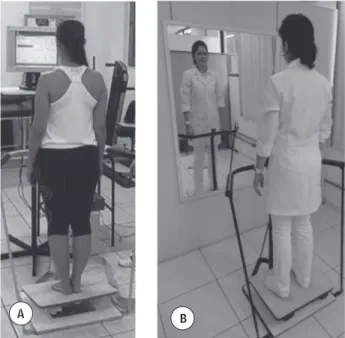
The G trained the balance through the biomechan-ics instrumentation Figure A . The system permits the patient accomplish the necessary adjustments to the maintenance of the balance using a visual
feed-back the oscillation shown on the monitor , .
The G trained the balance on the same unstable board in front of a mirror Figure B . Both groups trained twice a week, during eight weeks, complet-ing sixteen sessions with the time approximately of thirty minutes.
Each session was accomplished in four series of five minutes each, being two with the feet apart and two with the feet together, with a rest time of
two minutes between the series. Both groups were kept in conventional physiotherapy, based in classic kinesiotherapy.
The collected data were tabulated on Microsoft
Office Excel ™, and exported to the Graph Pad
Prism ™ software where the average and standard
deviation were determined. To compare the pre and post tests in each group and between them, the
Student’s t Test was applied for paired samples in
significant level of % p ழ . . The comparison
between the groups was accomplished using the ANOVA Kruskal-Wallis Test . To determine the cor-relation between the tests it was used the Pearson
Correlation Test p ழ . .
Figure 1 - (A) Simulation of balance training on the
Instru-mented Balance Board; (B) Simulation of the training in front of the mirror
A B
Results
Regarded to the individual characteristics, both groups were composed by men and did not differ statistically in terms of age, time of lesion, and
re-sults of TUGT pre tests p = . , scores of BBS p =
. and levels of oscillation in )BB with feet apart
p = . and feet together p = . .
and apart respectively. Both groups obtained im-provement in postural control, although the dif-ferences pre and post tests were not significant in both groups. With feet together G obtained an
improvement of % p = . , and G decreased
the oscillation in . % p = . . )t is noticeable that
G reduced the level of oscillation in % p = .
with feet apart and G in . % p = . in the
same position.
The coefficient r of correlation test between the results of )BB, TUGT and BBS are represented in Table .
When the comparison between the two groups was accomplished the Kruskal-Wallis Test identified a significant statistics difference only in the results of the functional mobility evaluated by TUGT
favor-able to G p < . . Both the BBS pointing and the
level of oscillation of the )BB sensors did not have
significant differences p > . .
obtained significant results. The average time of G was of . s ± . in the pre test and . s ± . in the post test, indicating an improvement of
. % p = . . The G accomplished the pre test
in the average time of . s ± . , that represents
a decrease in time of performance of . % p = . .
The results of BBS in G showed an average of . ± . in the pre test, and ± . in the post test, demonstrating an average increase of . points
. % , but, this value was not significant p = . .
)n the meantime G had an average of ± . in the pre test and . ± . in the post test, average
increase of . points . % , indicating statistical
significance p = . .
A strong negative correlation was observed be-tween the results of TUGT and )BB with the obtained value of r - , in G , and r - , in G .
The average oscillation value in )BB can be vi-sualized in the Figures and , with feet together
Figure 2 - Comparison between the groups, average values
of oscillation on the balance board with feet to-gether, before and after the treatment
Figure 3 - Comparison between the groups, average values
of oscillation on the balance board with feet apart, before and after the treatment
Table 1 - Correlation of IBB with the other tests
G1 G2
IBB ft TUGT BBS IBB ft TUGT BBS
IBB fa 0.95* 0.87* -0.75* 0.76* 0.67* -0.87*
IBB fa TUGT BBS IBB fa TUGT BBS
IBB ft 0.95* 0.83* -0.81* 0.76* 0.52* -0.75*
Note: IBB fa = Instrumented Balance Board with feet apart; IBB ft = Instrumented Balance Board with feet together; TUGT = Timed Up and Go Test; BBS = Berg Balance Scale.*signifi cant correlation.
Sensor activation level
2500
2000
1500
1000
500
0
G1 2022 Pre test
Post test 1805 1500
2042 G2
Sensor activation level
2500
2000
1500
1000
500
0
G1 2104 Pre test
Post test 1978 1571
dependence of the visual information for the senso-rial reorganization.
Srivastava et al. , in a prospective study, trained
the balance on a force plate with visual feedback and verified an improvement in the rate of BBS and stabi-lometry, that lead to the functional independence observed through the scores of Barthel )ndex. )n the current research, G obtained significant results on BBS scores, however the comparison between the groups do not demonstrate meaningful differences, both evolved in score, that can be the result of a better
symmetric weight distribution on the lower limbs ,
since the asymmetry blocks the properly performance of standing from a chair, go up on stairs, among other
activities that are evaluated in BBS .
This weight unloading more asymmetric was proved in some studies with the use of visual
feed-back, although in relation to the balance when
com-pared with conventional techniques there were no benefits, despite this, the force plates were stable as
the strength ones , , , and not unstable, like
in this study. The unstable plates challenge more the patients, provide more perturbations to the balance and need more dynamic reactions facing the task.
Controversial results are found in studies with patients in a sharper stage of the Stroke. Some re-searches reveled improvement on scores, although they do not indicate additional benefit in the use of
visual feedback, comparing with the rehabilitation
without the use of the technique , , however,
others obtained advantages using the technique com-paring with the conventional physical therapy, with significant results on the score that evaluate the
dy-namic balance .
A comparison between the conventional physio-therapy and the balance training with visual
feed-backthrough the Wii Fit in twelve hemiparetic Stroke
patients in the chronic stage, demonstrated in both groups, significant improvements on the static and dynamic balance evaluated by BBS. The group that made use of the visual information obtained an ad-vantage in relation to the evaluation on the force plate, where the results were significant in the de-crease of anteroposterior oscillation comparing with the conventional technic .
To verify the effects on the corporal oscillation
Vaillant et al. used a frontal image on a mirror
in elderly training. Exactly as they expected, the re-sults indicated a decrease in medio-lateral oscillation, while the anteroposterior oscillation kept unchanged,
Discussion
The repercussion related to the central nervous system recurring from the Stroke change the pos-ture reactions endangering significantly the daily
activities , , , , what makes the training of
the postural control a fundamental strategy for the rehabilitation of these patients. Although it does not exist consensus about the best techniques for the training of this function, balance boards associated to the visual feedback are habitually used for this population with different and, so controversial
re-sults , , , .
The present research had as objective to compare two ways of training the balance on the unstable board with two different kinds of visual feedback, one through the biomedical system and the other using the own image in the mirror. Once the train-ing on unstable boards/surfaces is very common in clinic practice.
Regarding the individuals of the study the sample was constituted by men, age group over , the ma-jority stricken by ischemic stroke, consistent
charac-teristics with the current literature , , , . The
patients had similar clinic characteristics and they did not differ statistically in age, time of lesion, and results of pre tests, the groups were considered ho-mogenous, permitting the comparison between them. The decrease in time in the TUGT reflected an im-provement of the functional mobility of the patients,
with favorable results to G . )n Soares et al. study,
the patients trained on )BB the same way as G of this study, and it was equally observed after weeks of training a significant decrease in performing time. Therefore, as the TUGT is a good predictor of fall risks it can be emphasized the importance of the balance training for greater safety of the patient in the
ac-complishment of the functional activities , .
The G trained the balance in front of the mirror, and through the reflected image had the possibil-ity to observe their position and corrected it, being considered an efficient method for the balance and
posture training . This instrument was also used
in the Trípoli et al. study that applied the
in insecurity, risk of falls and different levels of func-tional dependence. Therefore, training the postural alignment and the balance reactions are fundamental requirements for the strategies of treatment of this population of patients. Even though there was found different advantages in both groups, in both it could be observed that the training brought benefits along, with transference to the functional mobility.
)t is important to remark the necessity to expand the studies about this topic, where it is essential the development of research with a larger number of patients, comparing different techniques, and seek to measure the effects related to the daily life activities, beyond the control and other factors, such as atten-tion and motivaatten-tion, that can influence decisively the process of rehabilitation.
References
. Lotufo PA. Stroke in Brazil: a neglected disease. São Paulo Med J. ; : - .
. Cabral NL, Longo A, Moro C, Ferst P, Oliveira FA, Vieira CV, et al. Education level explains differences in stroke incidence among city districts in Joinville, Brazil: a three-year population-based study. Neuroepidemiology.
; :
-. Lundy-Ekman L-. Neurociência: fundamentos para reabilitação. . ed. São Paulo: Elsevier; . . Trípoli F, Moreira SR, Oberg TD, Lima NMFV.
Tare-fas orientadas e biofeedback: efeitos na trans-ferência de peso em hemiparéticos. Acta Fisiatr.
; : - .
. Barcala L, Colella F, Araujo MC, Salgado AS), Oliveira CS. Análise do equilíbrio em pacientes hemiparéticos após o treino com o programa Wii Fit. Fisioter Mov.
; : - .
. Kerdoncuff V, Durufle A, Petrilli S, Nicolas B, Robineau S, Lasalle A, et al. )ntérêt de la rééducation par biofeedback visuel sur plateforme de stabilomét-rie dans le prise en charge des troubles posturaux des hémiplégiques vasculaires. Ann Readapt Med Phys.
; : - .
. (orak FB. Postural orientation and equilibrium: what do we need to know about neural central of balance to prevent falls. Age Ageing. ; Suppl :ii - .
probably by the fact that the reflected image shows more clearly the average lateral oscillations. Possibly the application of )BB would have the advantage to decrease also the anteroposterior oscillations, be-sides the medio-lateral, regarding that the equipment enables the individual visualize the displacements of
his body in all directions .
As it was observed, the majority of the studies uses force plates not only for the balance training
but, also as an evaluation instrument , , , ,
and reinforcing, the difference of the balance board used in this research is its instability, what demands more concentration to keep the posture regarding
the oscillations . Soares et al. , obtained
sig-nificant results after the )BB training, where it had a decrease in oscillation of . % with feet together,
and of . % with feet apart, evidencing potential
benefits in its application. Although not significant, in the present research, the use of biomechanical in-strumentation and the use of the mirror resulted in average values of minor oscillation, what can indicate a better stability for the patients.
A strong correlation was observed between the )BB and the other tests. The values obtained with feet together correlated positively with the TUGT results and negatively with BBS. )t indicates that as less the level of oscillation is, less is also the time to accomplish the TUGT, and higher is the rate in BBS. Therefore, a suitable postural control profit the reac-tions of balance with positive repercussions over the
functional mobility , , . The strong
correla-tion observed between the )BB and TUGT, was also
evidenced in other studies , , , confirming
the fact that individuals with high scores in )BB ac-complish the sequence of TUGT with a better perfor-mance, observed by the lower run time.
There are benefits with the use of the technic that can be explained regarded to the use of visual in-formation that are fundamental to the maintenance of the balance, as well as supply sensor afferent to the compensatory adjustments face to perturbations , being, therefore a relevant help for the indi-viduals rehabilitation with this kind of impairment recurring from the Stroke.
Conclusion
. Soares AV, Bertoni A, Borges L, Borges NG. Develop-ment and validation of a biomechanical instruDevelop-menta- instrumenta-tion to evaluainstrumenta-tion of the trunk balance. Motor Control.
; Suppl : - .
. Srivastava A, Taly AB, Gupta A, Kumar S, Murali T. Post-stroke balance training: role of force plat-form with visual feedback technique. J Neurol Sci.
; - : - .
. Geiger AR, Allen JB, O’Keefe J, (icks RR. Balance and mobility following stroke: effects of physical therapy interventions with and without biofeedback/force-plate training. Phys Ther. ; : - . . Chen )C, Cheng PT, Chen CL, Chen SC, Chung CY, Yeh
T(. Effects of balance training on hemiplegic stroke patients. Chang Gung Med J. ; : - . . Lisinski P, (uber J, Gajewska E, Szlapinski P. The
body balance training effect on improvement of mo-tor functions in paretic extremities in patients after stroke. A randomized, single blinded trial. Clin Neurol Neurosurg. ; :
-. Goldman L, Ausiello D-. Cecil: Tratado de medicina in-terna. . ed. Rio de Janeiro: Elsevier; .
. O’Sullivan SB. Acidente vascular cerebral. )n O’Sullivan SB, Schmitz TJ. Fisioterapia: avaliação e tratamento.
. ed. São Paulo: Manole; . p. - .
. Barclay-Goddard R, Stevenson T, Poluha W, Moffat MEK, Taback SP. Force platform feedback for standing bal-ance training after stroke. Stroke. ; : - . . Costa MCF, Bezerra PP, Oliveira APR. )mpacto da hemi-paresia na simetria e na transferência de peso: reper-cussões no desempenho funcional. Rev Neurocienc.
; : - .
. Walker C, Brouwer BJ, Culham EG. Use of visual feed-back in retraining balance following acute stroke. Phys Ther. ; : - .
. Eser F, Yavuzer G, Karakus D, Karaoglan B. The effect of balance training on motor recovery and ambulation after stroke: a randomized controlled Trial. Eur J Phys Rehabil Med. ; : - .
. Vaillant J, Vuillerme N, Janvy A, Louis F, Juvin R, Nou-gier V. Mirror versus stationary cross feedback in controlling the center of foot pressure displacement in quiet standing in elderly subjects. Arch Phys Med Rehabil. ; : - .
. Carvalho RL, Almeida GL. Aspectos sensoriais e cog-nitivos do controle postural. Rev Neurocienc. ;
: - .
. Oliveira CB, Medeiros )R, Frota NA, Greters ME, Con-forto AB. Balance control in hemiparetic stroke pa-tients: main tools for evaluation. J Rehabil Res Dev.
; : - .
. Giriko C(, Azevedo RAN, Kuriki (U, Carvalho AC. Ca-pacidade funcional de hemiparéticos crônicos sub-metidos a um programa de fisioterapia em grupo. Fisioter Pesqui. ; : - .
. Belgen B, Beninato M, Sullivan PE, Narielwalla K. The association of balance capacity and falls self-efficacy with history of falling in community-dwelling people with chronic stroke. Arch Phys Med Rehabil. ;
: - .
. Weerdesteyn V, Niet M, Duijnhoven (J, Geurts AC. Falls in individuals with stroke. J Rehabil Res Dev.
; : - .
. (oudijk (, (oeve N, Nooijen C, Rijntjes D, Tolsma M, La-moth C.Energy expenditure of stroke patients during postural control tasks. Gait Post. ; : - . . Soares AV, (ochmüller ACOL, Silva P, Fronza D, Woell-ner SS, Noveletto F. Biorretroalimentação para trein-amento do equilíbrio em hemiparéticos por acidente vascular encefálico: estudo preliminar. Fisioter Pesqui.
; : - .
. Miyamoto ST, Lombardi Junior ), Berg KO, Ramos LR, Natour J. Brazilian version of the Berg balance scale. Braz J Med Biol Res. ; : - .
. Conradsson M, Lundin-Olsson L, Lindelof N, Littbrand (, Malmqvist L, Gustafson Y, et al. Berg balance scale: intrarater test-retest reliability among older people dependent in activities of daily living and living in resi-dential care facilities. Phys Ther. ; : - . . Ng SS, (ui-Chan CW. The Timed Up & Go Test: its reli-ability and association with lower-limb impairments and locomotor capacities in people with chronic stroke. Arch Phys Med Rehabil. ; : -. Torriani C, Mota EPO, Gomes CS, Batista C, Costa MC,
Vieira EM, et al. Avaliação comparativa do equilí-brio dinâmico em diferentes pacientes neurológi-cos por meio do teste Up and Go. Rev Neurocienc.
-. Thorbahn LDB, Newton RA-. Use of the Berg bal-ance test to predict falls in elderly persons. Phys Ther. ; : - .
. Soares AV. A contribuição visual para o controle pos-tural. Rev Neurocienc. ; : - .
Received: / /
Recebido: / /
Approved: / /