Endothermal heat-induced thrombosis (EHIT): reports on two
case treated with rivaroxaban and literature review
Trombose induzida pelo calor endovenoso: relato de dois casos tratados com
rivaroxabana e revisão da literatura
Walter Junior Boim de Araujo1
*
, Jorge Ruino Ribas Timi1, Fabiano Luiz Erzinger1, Filipe Carlos Caron1
Abstract
Endothermal heat-induced thrombosis (EHIT) is deined as propagation of a thrombus from a supericial vein into a deeper vein and is generally considered clinically insigniicant if the thrombus does not propagate to the deep venous system. he condition can be treated with anticoagulation therapy, although monitoring may be suicient, especially in less severe cases. In this paper we report on two cases of EHIT that met the criteria for indication of low molecular weight heparin until resolution of symptoms. However, the treatment actually chosen was 15 mg of rivaroxaban every 12 h and the outcomes were complete thrombus resolution in 4 weeks in Case 1 and 7 days in Case 2. Rivaroxaban may be a promising alternative for treatment of severe EHIT because the dosage regimen is simpliied without compromising eicacy or safety. Prospective, randomized, controlled studies are needed to better understand EHIT and to develop more deinitive recommendations on prevention and treatment options for this condition.
Keywords: varicose veins; intravenous laser treatment; vascular ultrasonography; venous thrombosis.
Resumo
Deine-se trombose induzida pelo calor endovenoso como a propagação do trombo a partir de uma veia supericial em direção a uma veia mais profunda. Em geral, é considerada clinicamente insigniicante quando não há propagação do trombo para o sistema venoso profundo. Essa condição pode ser tratada com terapia anticoagulante, embora a observação pareça ser suiciente, principalmente para graus menores. Neste estudo, relatamos dois casos de trombose induzida pelo calor endovenoso que teriam indicação de heparina de baixo peso molecular até a resolução do quadro. Porém, optou-se pelo uso da rivaroxabana (15 mg de 12 em 12h), com resolução completa do trombo em 4 semanas (caso 1) e em 7 dias (caso 2). A rivaroxabana pode ser uma alternativa promissora no tratamento da trombose induzida pelo calor endovenoso avançada, pela simplicidade da posologia, sem comprometimento da eicácia ou da segurança. São necessários estudos prospectivos, randomizados e controlados que possibilitem melhor entendimento da condição e o desenvolvimento de recomendações mais deinitivas sobre opções de prevenção e tratamento.
Palavras-chave: varizes; laser endovenoso; ecograia vascular; trombose venosa.
1Universidade Federal do Paraná – UFPR, Departamento de Cirurgia, Curitiba, PR, Brazil.
Financial support: None.
Conlicts of interest: No conlicts of interest declared concerning the publication of this article. Submitted: December 09, 2015. Accepted: March 31, 2016.
INTRODUCTION
The mechanism of action of endovenous laser treatment (EVLT) for ablation of varicose veins in the lower limbs is based on generating heat that causes
endothelial damage, resulting in thickening and ibrosis
and culminating in non-thrombotic occlusion of the incompetent veins.1
The intensity of vein wall contraction appears to be important, because the residual vein lumen after laser treatment is subject to occlusion by clot formation.2 Endothermal heat-induced thrombosis
(EHIT) is deined as propagation of a thrombus from a supericial vein into a deeper vein. It is generally considered clinically insigniicant if the thrombus
does not propagate to the deep venous system. As a result it is rarely described in the literature and
observation appears to be suficient, particularly for
less severe cases.3
This paper describes two cases of EHIT from a retrospective analysis of 278 great and small saphenous veins treated with the EVLT technique at our service over a 5-year period. These two cases were treated using rivaroxaban for anticoagulation because it
simpliies posology, without affecting eficacy or
safety, making it an attractive option for prevention and treatment of deep venous thrombosis (DVT).4
DESCRIPTION OF CASE 1
The patient was a 52-year-old female with diabetes and hypertension, a body mass index (BMI) of 31.2 and a clinical diagnosis of unilateral
varicose veins of the left lower limb with a Clinical-Etiology-Anatomy-Physiopathology (CEAP)
classiication of C5. She was given spinal anesthesia
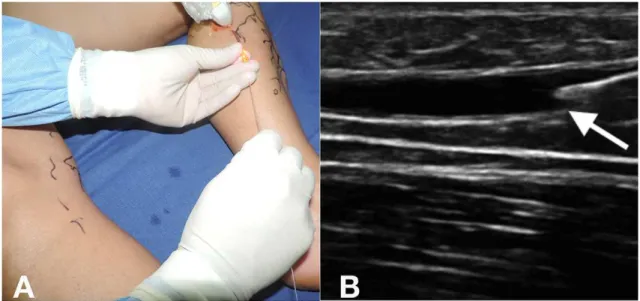
and placed in decubitus dorsal. Next, ultrasound-guided
puncture was performed and a bare optical iber
advanced up to 2 cm from the saphenopopliteal
junction (SPJ) (Figures 1 and 2).
Tumescence was induced with saline solution at room temperature and then EVLT was conducted with a 1470 nm laser and linear intravenous energy density
(LEED) of 38.5 J/cm, with a good control ultrasound of the SPJ immediately postoperatively (Figure 3).
During the same procedure, tributary varicose veins and incompetent perforating-communicating veins were removed. The patient was given a single 40 mg dose of enoxaparin 6 hours after the end of surgery and was encouraged to walk as soon as she
had recovered from the anesthetic. She was discharged
10 hours after the operation, with a prescription for
anti-inlammatories and analgesics.
Five days after the procedure, at the irst follow-up
appointment, the patient was examined with color Doppler ultrasonography (CDU), which detected an EHIT compromising less than 50% of the lumen and a decision was taken to choose outpatient anticoagulant treatment with 15 mg of rivaroxaban every 12h. The examination was repeated 4 weeks later and it was found that the thrombus had undergone regression and the clinical picture had normalized, which is when the anticoagulant was withdrawn.
DESCRIPTION OF CASE 2
The patient was a 42-year-old female with venous
insuficiency of the lower limbs and a CEAP classiication
of C3, free from other comorbidities, but with a family
history (sister) of DVT. Spinal anesthesia was given
and then the great saphenous vein was punctured at the level of the knee and EVLT was conducted
with a bare iber and a 1470 nm laser using a LEED of 36 J/cm for the right great saphenous vein and a LEED of 42 J/cm for the left great saphenous vein, starting 2 cm from the SPJ and guided by CDU,
without inducing tumescence in either limb and with the patient in the Trendelenburg position throughout. During the same procedure, incompetent perforating veins and tributary varicose veins in the legs were resected.
The patient was discharged the same day on
anti-inlammatories and a single 40 mg dose of
enoxaparin 6 hours after the end of surgery and encouraged to walk every day. Despite having been instructed to return to the clinic 7 days later, the patient only returned 28 days after the operation, when she underwent a control CDU, which showed
EHIT with a thrombus that appeared to be loating
compromising less than 50% of the lumen of the right common femoral vein (Figure 4). She was prescribed home treatment with 15 mg of rivaroxaban every 12h.
Seven days after the control CDU, the thrombus was
no longer detectable (Figure 5). The patient remained
Figure 2. Fiber tip positioned 2 cm from the saphenopopliteal
junction.
Figure 3. Control scan of saphenopopliteal junction immediately
after thermoablation.
Figure 4. Endovenous heat-induced thrombosis with thrombus with a loating appearance and extension of less than 50% of the
asymptomatic and was kept on anticoagulation for 3 months. The results of thrombophilia tests were negative, but the thrombus having disappeared in 7 days was considered a warning sign of possible pulmonary embolism (PE) and so an angiotomography of the chest was conducted, which ruled out this diagnostic hypothesis.
DISCUSSION
Endothermal heat-induced thrombosis is a inding
that is expected during follow-up after EVLT of the great saphenous vein. However, what is not entirely clear in the literature is the clinical progression of patients who exhibit EHIT close to or extending to
the SPJ.5
Although there is no evidence of a correlation between
the distance from the SPJ at which thermoablation is
started and the likelihood of EHIT, it is possible that
the iber can migrate after tumescence is induced, with minimal displacement of the iber by external
compression.6 It has been suggested that increasing the
distance from the SPJ of the thermoablation starting
position to 2.5 cm or greater could result in reduced incidence of EHIT.7
Several systems for EHIT classiication have been
developed and they can differ in terms of the need for and type of treatment and anticoagulation dose and duration.8-10
Kabnick et al.8 developed a system for classifying
EHIT according to the extent of the thrombus and its propagation into the deep vein system (Chart 1).
Lawrence et al.9 also developed a system for
classiication of the level of endovenous thermoablation
with relation to the SPJ, with a proposal for treatment
for each level (Chart 2).
Harlander-Locke et al.10,11 described a system for
classiication of extension of endovenous thermoablation with relation to the SPJ, including incidence and a
proposal for treatment for each level (Chart 3). There are no convincing data on which routine use of anticoagulants for EVLT at prophylactic doses
could be based. Selected patients with a history of supericial venous thrombosis, DVT or obesity are
candidates for prophylaxis.12 Rhee et al., conducted a
retrospective analysis of 519 EVLT procedures over a 3-year period and found that DVT risk assessment score (the Caprini score)13 and male sex were
independent risk factors. They concluded that there appeared to be a correlation between thrombophilia and EHIT and that calculating a risk assessment score for patients could enable prediction of increased risk
of EHIT and indicate which patients could beneit
from pharmaceutical prophylaxis.6
Suian et al. conducted a prospective study to
evaluate the incidence of EHIT and its progression and concluded that the risk factors include: size of the vein, age and concomitant phlebectomies.14
Thankfully, PE is rare after EVLT procedures. Rosales-Velderrain et al. reported on three cases of patients who developed PE after radio frequency ablation of the great saphenous vein and mini-phlebectomies of primary symptomatic varicose veins of the lower limbs.15 Although DVT prophylaxis studies with new
anticoagulants are designed for speciic situations,
such as orthopedic surgery,16 off-label use of these
drugs for prophylaxis is becoming more and more
Figure 5. Control Doppler ultrasound after 7 days’ treatment with Rivaroxaban. (A) Color-mode image with transverse transducer;
common in the most varied range of clinical and surgical situations.
Nowadays, drugs that work by direct inhibition of factor II (thrombin) and factor Xa are also being used for anticoagulation, offering a simplified treatment option for DVT.4 An EINSTEIN study17
compared use of rivaroxaban with traditional treatment (enoxaparin-warfarin) for DVT and demonstrated it
was not inferior in terms of eficacy or safety when
used for oral monotherapy.
Werth et al.18 documented a case of asymptomatic
EHIT, class I on the Kabnick classiication, that
progressed to class III after 7 days of watchful waiting with clinical monitoring. After 14 days’ treatment with rivaroxaban the outcome was complete resolution of the thrombus.
Although supporting data are needed, we are in agreement with the American Venous Forum guidelines19 that recommend postoperative CDU at
24 to 72h (recommendation level of 2C) to identify and treat patients with more advanced degrees of EHIT, with extension of thrombus to the femoral vein.
Chart 3. System for classiication of extension of endovenous thermoablation to the saphenopopliteal junction described by
Harlander-Locke et al.10,11.
Level Extension of thrombosis Treatment
A ≥ 1 mm distal of the popliteal vein Watchful waiting
B At the level of the popliteal vein Watchful waiting
C Extends beyond the popliteal vein Surgeon’s choice
D Totally occlusive deep venous thrombosis Low molecular weight heparin and vitamin k antagonist
In this paper we have described two cases of EHIT, Kabnick class II and Lawrence level 5, in which the standard indication would be low molecular weight heparin until resolution of the condition. Despite being aware that treatment of less severe EHIT is more controversial and left to the surgeon’s judgment, we wanted to treat these patients with at least one short course of anticoagulation. In view of the similar mechanism of action, the ease of treatment, the possibility of oral administration and of maintenance of treatment in an ambulatory setting, it was decided to use 15 mg of rivaroxaban every 12h, with complete resolution of the thrombus in 4 weeks in case 1 and in 7 days in case 2.
CONCLUSIONS
Rivaroxaban and other new oral anticoagulants may be promising options for treatment of advanced cases
of EHIT because of the posological simpliication
they offer. As the number of procedures increases, the techniques for endovenous thermoablation become more widespread and their principal complications
Chart 1. Classiication system for endothermal heat-induced thrombosis described by Kabnick et al.8.
Class Extension of thrombosis Treatment
I Up to the junction of supericial and deep venous systems. Watchful waiting, with serial ultrasound follow-up.
II Extends beyond the junction, with a cross-sectional diameter
< 50%.
Low molecular weight heparin until resolution of the throm-bus, with ultrasound follow-up.
III Extends beyond the junction, with a cross-sectional diameter
> 50%. Low molecular weight heparin and vitamin k antagonist.
IV Totally occlusive deep venous thrombosis. Low molecular weight heparin and vitamin k antagonist.
Chart 2. System for classiication of extension of endovenous thermoablation to the saphenopopliteal junction described by
Lawrence et al.9.
Class Extension of thrombosis Treatment
1 Below the level of the supericial epigastric vein Watchful waiting
2 At the level of the supericial epigastric vein Watchful waiting
3 At the level of the common femoral vein Surgeon’s choice
4 Bulging into the common femoral vein Low molecular weight heparin
5 Beyond the saphenopopliteal junction, adjacent to the wall of the common femoral vein Low molecular weight heparin
6 In the common femoral vein, consistent with deep venous thrombosis Low molecular weight heparin and
are better studied, it is expected that more cases of EHIT will be documented, making it possible to conduct prospective, randomized and controlled studies that offer better understanding and lead to
more deinitive recommendations on the options for
prevention and treatment.
REFERENCES
1. Min RJ, Khilnani N, Zimmet SE. Endovenous laser treatment of saphenous vein reflux: long-term results. J Vasc Interv Radiol. 2003;14(8):991-6. http://dx.doi.org/10.1097/01.RVI.0000082864.05622. E4. PMid:12902556.
2. Proebstle TM, Lehr HA, Kargl A, et al. Endovenous treatment of the greater saphenous vein with a 940-nm diode laser: thrombotic occlusion after endoluminal thermal damage by laser-generated steam bubbles. J Vasc Surg. 2002;35(4):729-36. http://dx.doi. org/10.1067/mva.2002.121132. PMid:11932671.
3. Kane K, Fisher T, Bennett M, et al. The incidence and outcome of endothermal heat-induced thrombosis after endovenous laser ablation. Ann Vasc Surg. 2014;28(7):1744-50. http://dx.doi. org/10.1016/j.avsg.2014.05.005. PMid:24911803.
4. Gonsalves WI, Pruthi RK, Patnaik MM. The new oral anticoagulants in clinical practice. Mayo Clin Proc. 2013;88(5):495-511. http:// dx.doi.org/10.1016/j.mayocp.2013.03.006. PMid:23639500.
5. Kabnick LS, Berland TL. Endovenous heat induced thrombosis (EHIT). In: Proceedings of the 38th Annual Vascular and Endovascular Issues, Techniques and Horizons (VEITHsymposium); 2011; New York. New York; 2011. [citado 2015 dez 09]. http://www.cooltouch. com/PDF_CTEV/Endothermal_Heat_Induced_Thrombosis_EHIT. pdf
6. Rhee SJ, Stoughton J, Cantelmo NL. Procedural factors influencing the incidence of endovenous heat-induced thrombus (EHIT). J Vasc Surg. 2011;53(2):555. http://dx.doi.org/10.1016/j.jvs.2010.11.077.
7. Sadek M, Kabnick LS, Rockman CB, et al. Increasing ablation distance peripheral to the saphenofemoral junction may result in a diminished rate of endothermal heat-induced thrombosis. J Vasc Surg. 2013;1(3):257-62. PMid:26992584.
8. Kabnick LS, Ombrellino M, Agis H, et al. Endovenous heat induced thrombosis (EHIT) at the superficial deep venous junction: a new post-treatment clinical entity, classification and potential treatment strategies. In: Proceedings of the 18th Annual Meeting of the American Venous Forum; 2006; Miami, FL. Miami; 2006.
9. Lawrence PF, Chandra A, Wu M, et al. Classification of proximal endovenous closure levels and treatment algorithm. J Vasc Surg. 2010;52(2):388-93. http://dx.doi.org/10.1016/j.jvs.2010.02.263. PMid:20646894.
10. Harlander-Locke M, Jimenez JC, Lawrence PF, et al. Management of endovenous heat-induced thrombus using a classification system and treatment algorithm following segmental thermal ablation of the small saphenous vein. J Vasc Surg. 2013;58(2):427-31. http:// dx.doi.org/10.1016/j.jvs.2013.01.026. PMid:23663871.
11. Harlander-Locke M, Jimenez JC, Lawrence PF, Derubertis BG, Rigberg DA, Gelabert HA. Endovenous ablation with concomitant phlebectomy is a safe and effective method of treatment for symptomatic patients with axial reflux and large incompetent tributaries. J Vasc Surg. 2013;58(1):166-72. http://dx.doi.org/10.1016/j. jvs.2012.12.054. PMid:23571079.
12. Geerts WH, Bergqvist D, Pineo GF, et al. Prevention of venous thromboembolism: American College of Chest Physicians Evidence-Based Clinical Practice Guidelines (8th Edition). Chest. 2008;133(6, Supl):381S-453S. http://dx.doi.org/10.1378/ chest.08-0656. PMid:18574271.
13. Bahl V, Hu HM, Henke PK, Wakefield TW, Campbell DA Jr, Caprini JA. A validation study of a retrospective venous thromboembolism risk scoring method. Ann Surg. 2010;251(2):344-50. http://dx.doi. org/10.1097/SLA.0b013e3181b7fca6. PMid:19779324. 14. Sufian S, Arnez A, Labropoulos N, Lakhanpal S. Endovenous
heat-induced thrombosis after ablation with 1470 nm laser: Incidence, progression, and risk factors. Phlebology. 2015;30(5):325-30. http:// dx.doi.org/10.1177/0268355514526588. PMid:24609619.
15. Rosales-Velderrain A, Gloviczki P, Said SM, Hernandez MT, Canton LG, Kalra M. Pulmonary embolism after endovenous thermal ablation of the saphenous vein. Semin Vasc Surg. 2013;26(1):14-22. http:// dx.doi.org/10.1053/j.semvascsurg.2013.07.001. PMid:23932557.
16. Turpie AG, Lassen MR, Davidson BL, et al. Rivaroxaban versus enoxaparin for thromboprophylaxis after total knee arthroplasty (RECORD4): a randomised trial. Lancet. 2009;373(9676):1673-80. http://dx.doi.org/10.1016/S0140-6736(09)60734-0. PMid:19411100.
17. Bauersachs R, Berkowitz SD, Brenner B, et al. Oral rivaroxaban for symptomatic venous thromboembolism. N Engl J Med. 2010;363(26):2499-510. http://dx.doi.org/10.1056/NEJMoa1007903. PMid:21128814.
18. Werth S, Halbritter K, Mahlmann A, Weiss N. Treatment of an endovenous heat-induced thrombosis (EHIT) with rivaroxaban (Xarelto®). Phlebologie. 2015;44(4):184-7. http://dx.doi.org/10.12687/ phleb2264-4-2015.
19. Gloviczki P, Comerota AJ, Dalsing MC, et al. The care of patients with varicose veins and associated chronic venous diseases: clinical practice guidelines of the Society for Vascular Surgery and the American Venous Forum. J Vasc Surg. 2011;53(5, Supl):2S-48S. http://dx.doi.org/10.1016/j.jvs.2011.01.079. PMid:21536172.
*
Correspondence
Walter Junior Boim de Araujo Instituto da Circulação Rua Sete de Setembro, 5348, cj. 905 CEP 80240-000 - Curitiba (PR), Brazil Tel.: +55 (41) 3244-5000 E-mail: [email protected]
Author information
WJBA - MSc and PhD candidate, Universidade Federal do Paraná (UFPR), Departamento de Cirurgia. JRRT - MSc, PhD, and associate professor of Vascular Surgery, Universidade Federal do Paraná (UFPR), Departamento de Cirurgia. FLE and FCC - MScs from Universidade Federal do Paraná (UFPR), Departamento de Cirurgia.
Author contributions
Conception and design: WJBA Analysis and interpretation: WJBA Data collection: WJBA, FLE, FCC Writing the article: WJBA, FLE Critical revision of the article: JRRT Final approval of the article*: WJBA, JRRT, FLE, FCC Statistical analysis: N/A. Overall responsibility: WJBA