Respiratory muscle evaluation in elective thoracotomies
and laparotomies of the upper abdomen*
LARYSSA MILENKOVICH BELLINETTI1, JOÃO CARLOS THOMSON2
* Study carried out at the Universidade Estadual de Londrina (UEL, State University at Londrina) University Hospital - Londrina, Paraná, Brazil; Londrina Evangelical Hospital, Londrina, Paraná, Brazil.
1. Doctoral student in Health Sciences at the Universidade Estadual de Londrina (UEL, State University at Londrina) -Londrina, Paraná, Brazil.
2. Associate Professor of Thoracic Surgery in the Department of Clinical Surgery of the Universidade Estadual de Londrina (UEL, State University at Londrina) - Londrina, Paraná, Brazil.
Correspondence to: Larissa Milenkovich Bellinetti. Rua Conde de Nova Friburgo, 77 - apto. 501, Jardim Petrópolis - CEP.: 86015-630, Londrina - PR, Brasil. Tel.: 55 43 3342-7281. E-mail: [email protected]
Submitted: 4 October 2004. Accepted, after review: 29 July 2005.
ABSTRACT
Objective: To identify any possible relation between lower than predicted preoperative respiratory muscle function and the incidence of postoperative respiratory complications and death in elective thoracotomies and laparotomies of the upper abdomen. Methods: A prospective cohort study was conducted, in which 70 patients over the age of 18 were monitored in two similar hospitals. In the preoperative evaluation performed at admission, patients were classified as presenting respiratory muscle function (as determined by measurement of maximal respiratory pressures) > 75% of the predicted value (n = 50) or < 75% of the predicted value (n = 20). Patients were monitored until discharge. In both groups, the incidence of pneumonia was determined, as was that of acute respiratory failure, bronchospasm, prolonged mechanical ventilation, atelectasis, pleural effusion, pneumothorax and death. A comparative analysis was made between the groups, and relative risk was calculated. Results: In the study sample, the overall incidence of postoperative complications was 22.86% (16/70): 55% (11/20) in the group of patients presenting < 75% of the predicted value; and 10% (5/50) in the group of patients presenting > 75% of the predicted value. Patients in the < 75% of the predicted value group presented a relative risk of 5.5 (95% confidence interval between 2.19 and 13.82). Conclusion: Respiratory muscle function below the predicted value was found to be related with higher relative risk of postoperative complications in the surgical procedures studied.
INTRODUCTION
Postoperative respiratory complications (PRCs) increase the length, as well as the predicted cost, of hospital stays and contribute significantly to increasing mortality rates, especially in elective thoracotomies and laparotomies of the upper abdomen, which are considered high-risk surgical procedures.(1-2) The PRC incidence varies considerably
due to the lack of standardization in defining PRCs and to the variability in the risk factors analyzed, ranging from 10% to 40% for thoracotomies, from 13% to 33% for laparotomies of the upper abdomen, and from 0 to 16% for laparotomies of the lower abdomen.(3)
The expected reduction in vital capacity ranges from approximately 60% to 70% in thoracotomies and from 50% to 68% in laparotomies.(4) Postoperative
diaphragmatic dysfunction, which is the main cause of this reduction,(5) peaks within two to eight hours
after the surgery, typically returning to preoperative values within seven to ten days. These alterations, which occur in response to the surgical procedure, may evolve to PRCs when they modify the initially predicted course of the postoperative recovery.(6)
Notable among the objective measures of diaphragmatic respiratory dysfunction performed at the bedside are those of maximal inspiratory pressure (MIP) and maximal expiratory pressure (MEP).(7)
Prevention of PRCs has motivated several studies, (8-11) many of which aimed to validate predictive indices
of surgical risk.(12-16) Currently, spirometry, which was
considered very valuable in the 1970s and 1980s,(6)
has proven to be useful only in patients who are scheduled for lung resection(17) or who present
respiratory symptoms.(18) Other parameters of the
cardiorespiratory evaluation, such as diffusing capacity for carbon monoxide, maximal oxygen uptake, and anaerobic cut-off point, have been studied in order to predict risks, specifically in lung resections.(19-21) There
have been few studies of the value of respiratory muscle function in the preoperative period.(19-21) Some authors (22-23) observed that patients who, despite respiratory muscle
training in the thoracotomy preoperative period, do not manage to raise their MIP and MEP values present a higher risk of developing PRC. Other authors(24) suggest
that MEP be included in the risk scale proposed for patients submitted to cardiac surgery.
In the present study, it is suggested that respiratory muscle dysfunction(25-27) prior to the surgical procedure
can cause a longer than expected delay in the recovery from the physiopathological alterations, thereby favoring the appearance of PRCs, especially when the incisions are close to the diaphragm. Therefore, the objective of the present study was to determine whether lower than predicted preoperative respiratory muscle function (respiratory muscle dysfunction) can be considered a risk factor for PRC and death in elective noncardiac thoracotomies and laparotomies of the upper abdomen.
METHODS
gastric surgery. Uncooperative patients were excluded, as were those who were being treated with psychotropics, immunosuppressive drugs or muscle relaxants, all of which could interfere with the results. In addition, patients presenting pulmonary infection after the preoperative evaluation and prior to the surgery were excluded.
Personal data, as well as those related to the clinical history(12) and physical examination, were
collected, taking into consideration the following covariables: gender; age (up to the age of 49, or age 50 and up(12)); smoking (smokers were defined as
patients who reported having smoked at least one cigarette per day during the preceding year or more than twenty packs during their lifetime, and nonsmokers were defined as patients who had never smoked or had smoked less than twenty packs during their lifetime); respiratory symptoms (complaining of at least one of the following symptoms: cough or chronic cough (with or without expectoration) -especially within the last eight weeks); previous lung disease (chronic obstructive or restrictive disease diagnosed prior to or during the hospitalization period); comorbidities (arterial hypertension, diabetes mellitus or heart disease); body mass index (patients with a body mass index between 21 and 29 were considered to be well nourished, and patients with body mass index lower than or equal to 20 or above 29 were considered malnourished(11)); and spirometry
values, collected using a Respiradyne Plus spirometer (Sherwood Medical, St. Louis, MO, USA) according to the recommendations of the Consenso Brasileiro de Espirometria (I Brazilian Consensus on Spirometry).(29)
Abnormal spirometry results were defined as forced vital capacity or forced expiratory volume in one second below 80% of predicted and a relationship between those two below 75%.
Maximal respiratory pressures were measured using an analog vacuum manometer (Makil, Londrina, Brazil) that was 100 mm in diameter, with a capsule-like sensor, a spikelike connector and a scale ranging from -200 to 200 cm of H2O. The patient remained in a sitting position. A nose clip and a rigid plastic mouthpiece with a lowered rim were used. The vacuum monometer was connected to the mouthpiece by means of a tube, and a connector with a 2-mm diameter opening joined the mouthpiece to the tube. For the MIP measurements, patients were asked to exhale until reaching the point of residual volume, inhale as deeply as possible and hold their breath for at least two seconds. For the MEP
measurements, the patient was asked to inhale as deeply and as long as possible, and then to exhale as forcefully as possible until reaching residual volume. The technique was repeated, with one-minute resting intervals, until we obtained the values of at least three acceptable maneuvers (MIP and MEP), with a variation of less than 10% among them. The highest sustained value obtained, as long as it was not that of the final measurement, was then selected.
The values obtained were compared to the normality criteria(28) and are expressed as percentages
(%MIP and %MEP). The patients were divided into two groups based on the degree of respiratory muscle function presented: lower than 75% of the predicted value (n = 20); and equal to or greater than 75% of the predicted value (n = 50).(7,27)
In the postoperative period, the researcher reviewed and monitored, on a daily basis, the records kept by the surgical team. The following data were obtained: surgical time (longer or shorter than 210 minutes) and length of hospital stay (preoperative stay, postoperative stay, stay in intensive care unit and total stay) were noted. In addition, data were obtained regarding the following complications: pneumonia (temperature over 38°C, radiological signs of pulmonary consolidation, and productive cough); atelectasis with evident clinical repercussions; bronchospasm; prolonged mechanical ventilation; pleural effusion or pneumothorax; surgical reintervention caused by inadequate lung re-expansion; and death related or not to pulmonary disease.
RESULTS
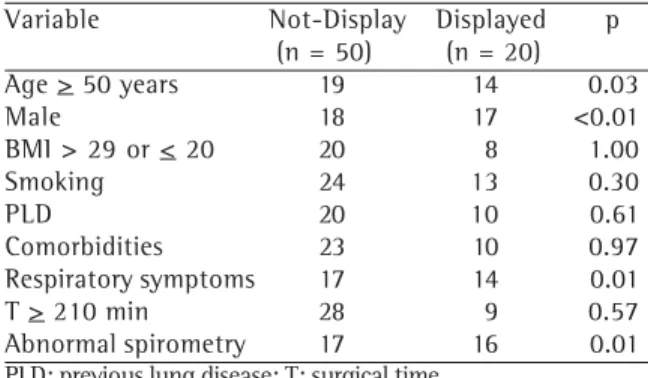
Of the 70 patients studied, 37 (52.9%) were smokers, 28 (40%) were dystrophic, 33 (47.1%) presented comorbidities, 30 (42.9%) had a history of lung disease, 31 (44.3%) presented respiratory symptoms at the time of the surgery, and 30 (47.1%) presented abnormal spirometry results. The symptomatic patient who presented no lung disease complained of dry cough, and this was attributed to the emotional state evoked by the prospect of the surgery. Mean surgical time was 210.7 minutes, with a standard deviation of 111 minutes and ranging from 40 to 490 minutes. All patients were submitted to general anesthesia through intravenous administration, orotracheal intubation, and controlled ventilatory support. Table 1 shows the clinical characteristics of the patients of both groups studied. It
can be seen that most of the risk factors studied were present in the same proportions, except for those regarding age (p < 0.03), gender (p < 0.01), respiratory symptoms (p = 0.01) and spirometry (p = 0.01).
In 16 of the 70 patients, the clinical profile evolved to at least one PRC or death, comprising a total of 32 occurrences, which are described in Table 2. Therefore, the total incidence of PRCs, including death, was 22.86% (16/70). All deaths (7/70) resulted from PRCs. The clinical profile of 5 (10%) of the 50 patients presenting respiratory muscle function = 75% of the predicted value evolved to PRC or death in the postoperative period, and the same occurred to 11 (55%) of the 20 patients presenting respiratory muscle function < 75% of the predicted value. This difference was statistically quite significant (p < 0.001).
Table 3 shows the distribution of patients according to the incidence of PRCs and death in those two groups of patients. Relative risk was 5.5, with a 95% confidence interval between 2.19 and 13.82, for the patients presenting respiratory muscle function < 75% of the predicted value, according to values predicted for Brazilians of the same age and gender. Analysis of the group that evolved to PRC or death (n = 16) and of the group that did not (n = 54) revealed a statistically significant difference between the means of the maximal respiratory pressures - MIP (p < 0.01) and MEP (p < 0.02) - between the groups.
As shown in Table 4, the Mann-Whitney tests revealed a statistically significant difference in the total number of days of hospitalization between the group of patients presenting resenting respiratory muscle function < 75% of the predicted value and the group of patients presenting respiratory muscle function = 75% of the predicted value.
When analyzed in the presence of most of the risk factors, the statistical association between
TABLE 1
Characteristics of the patients (n = 70) in the two groups studied (Londrina, 2003)
Variable Not-Display Displayed p (n = 50) (n = 20) Age > 50 years 19 14 0.03 Male 18 17 <0.01 BMI > 29 or < 20 20 8 1.00 Smoking 24 13 0.30 PLD 20 10 0.61 Comorbidities 23 10 0.97 Respiratory symptoms 17 14 0.01 T > 210 min 28 9 0.57 Abnormal spirometry 17 16 0.01
PLD: previous lung disease; T: surgical time
TABLE 2
Distribution of the types and frequencies of the postoperative complications observed in the two groups of patients studied (Londrina, 2003)
Complication Displayed Not-Display Total N (%) N (%) N (%) Pneumonia 5(21.7) 3 (33.4) 8 (25.0) Death 5(21.7) 2 (22.2) 7 (21.9) ARF* 4(17.4) 1 (11.1) 5 (15.6) MV > 48 hours 3(13.0) 1 (11.1) 4 (12.5) Bronchospasm 2 (8.7) 1 (11.1) 3 (9.4) Atelectasis 2 (8.7) - - 2 (6.2) Pleural alteration 1 (4.4) 1 (11.1) 2 (6.2) Reoperation 1 (4.4) - - 1 (3.2) Total 23 (71,9) 9 (28,1) 32(100,0)
ARF: acute respiratory failure; MV: mechanical ventilation
TABLE 3
Distribution of postoperative respiratory complications or death by respiratory muscle
strength (Londrina, 2003)
Group PRC or Death Total of patients Yes No
N % N % N % Displayed 11 68.8 9 16.7 20 28.6 Not-Display 5 31.2 45 83.3 50 71.4 Total 16 100.0 54 100.0 70 100.0
abnormal respiratory muscle function and PRC or death remained statistically significant (Table 5). The exceptions were the risk factors age = 50 years (p = 0.08) and presence of comorbidities (p = 0.40).
DISCUSSION
Although some of the risk factors related to patients or to the procedure cannot be altered. Identifying such risk factors can aid the treatment team by allowing them to devote more attention to patients at higher risk, thereby preventing, as much as possible, PRCs and death. Respiratory muscle dysfunction has proven to be a very influential factor in the evolution of innumerable clinical situations, such as pulmonary, orthopedic, rheumatic, and neurological conditions, as well as in the evolution of surgical conditions.(26) The main objective of the
present study was to determine whether respiratory muscle dysfunction prior to the surgical intervention could be considered a risk factor for PRCs or death following the surgical procedures studied.
The groups of patients evaluated, both the group of patients presenting respiratory muscle function < 75% of the predicted value and the group of patients presenting respiratory muscle function = 75% of the predicted value, presented the same proportion of cases regarding most of the high-risk preoperative variables. The heterogeneity found between the groups in the variables age, gender and respiratory symptoms probably did not interfere with the results since neither age(2) nor gender in
isolation have proven to be risk factors for PRCs or death. According to a review article,(9) the literature
suggests that age is a minor risk factor for PRCs when adjusted for comorbidities. It is therefore difficult to confirm the existence of an isolated risk. There is little documentation in the literature regarding the influence of gender on the incidence of PRCs in the surgical procedures studied herein, and the few studies that have been conducted have yielded contradictory results. Therefore, further scientific evidence is needed before gender and age can be considered risk factors for PRCs.
The number of patients presenting respiratory symptoms was slightly higher among those presenting respiratory muscle function < 75% of the predicted value. We can infer that some of the patients who presented respiratory symptoms not resulting from respiratory infection were suffering from chronic pulmonary diseases. Many of those patients presented preoperative respiratory muscle weakness, which had an impact on their maximal respiratory pressures. One would expect that the number of patients with abnormal spirometry results would be higher among those presenting respiratory muscle function < 75% of the predicted value since this test provides little information about the respiratory muscles.
The cases of PRCs were added to the deaths in the final estimate of the complications, and all deaths
TABLE 4
Hospitalization periods for the two groups of patients studied (Londrina, 2003)
Period Not-Display (n = 50) Displayed (n = 20) p* Mean SD Mean SD
Preoperative 8,90 11,82 11,60 8,70 0,07 Postoperative 7,44 6,85 16,10 18,52 0,21
ICU 1,04 1,14 5,35 11,58 0,72
Total hospital stay 16,34 15,53 27,75 20,70 0,01 *Mann-Whitney test
TABLE 5
Distribution of patients who evolved to PRC or death (n = 16) and exposure risk adjusted for the high-risk
variables (Londrina, 2003)
Variable Not-Display Displayed RR p (n = 5) (n = 11)
were caused by respiratory complications, which is in consonance with the literature.(11,13) Pneumonia was the
most frequent PRC, a finding that is also in accordance with those of most of the studies consulted. However, the low frequency of atelectasis (6.3%) observed in the present study might be attributable to a lack of critical investigation of every case since we only recorded those cases that were clinically significant and required specific therapeutic intervention.
Our results were similar to those found by other authors.(22-23) However, in the two articles whose
objective was to determine the role that preoperative respiratory muscle function plays in the development of PRCs, the authors worked with reference values of -80 cmH2O for MIP and 80 cmH2O for MEP (absolute values), not taking into consideration the variables gender and age. The reference values of the present study, in addition to taking into consideration these variables (relative values), were specific for the population studied.(28) This made it possible to quantify
respiratory muscle function more objectively.
The analysis of the individual variables of the relative maximal respiratory pressures (%MIP and %MEP) revealed the great statistical significance of the difference between the means observed in the group that evolved to PRC or death and the group that did not. It was also observed that the values of %MIP in isolation would already make it possible to correlate preoperative inspiratory muscle dysfunction with PRCs, with a relative risk of 4.47 and a confidence interval between 1.89 and 10.62, indicating the importance of this measurement. This finding is in disagreement with that of another study,(24) in which MIP was not included in the risk scale
proposed. The authors of that study prospectively monitored 117 patients with the objective of developing a PRC risk scale model for myocardial revascularization. The variables MEP equal to or greater than 75% of the predicted value and inspiratory vital capacity equal to or greater than 76% of the predicted value were considered protective against PRCs and were included in the risk scale model proposed by those authors.
Comparing the group of patients presenting respiratory muscle function < 75% of the predicted value and the group of patients presenting respiratory muscle function = 75% of the predicted value in terms of length of hospital stay, we observed a visible difference in the mean number of days for the four periods indicated in Table 4. However, we observed a statistically significant difference only in the total number of days of hospitalization. This fact makes it
possible to state that the presence of preoperative respiratory muscle dysfunction may increase the length of the hospital stay.
Relative risk values remained significant when adjusted for most of the other risk factors (Table 5). When the variables age = 50 years and presence of comorbidities were analyzed, the relative risks were considerable and significant, suggesting a statistical association. The variable respiratory symptoms could have been considered a confounding factor in the study. However, when relative risk was adjusted for the presence of respiratory symptoms, we observed that it remained significant for patients presenting respiratory muscle function < 75% of the predicted value and respiratory symptoms (relative risk of 2.73, confidence interval between 1.07 and 7.01, p = 0.05). Of the 17 symptomatic patients presenting respiratory muscle function = 75% of the predicted value, only 4 (23.5%) developed a PRC or died, whereas 9 (64%) of the 14 patients presenting respiratory muscle function < 75% of the predicted value and respiratory symptoms developed PRCs.
A limitation of voluntary testing(27) for the evaluation
of respiratory muscle strength is its dependence on patient cooperation since there is no means of confirming whether a given patient has given the maximum effort. Therefore, a diagnosis of respiratory muscle weakness could not be made with precision in the present study. In addition, we did not investigate the cause of the respiratory muscle strength deficiency found. However, taking into account the results obtained, respiratory muscle evaluation proved important for the identification of patients at higher risk of PRC or death, regardless of the cause or of the diagnostic confirmation of muscle weakness, which are matters that may call for further investigation.
1. Smetana GW. Preoperative pulmonary evaluation. N Engl J Med. 1999;340(12):937-44. Comment in: N Engl J Med. 1999;341(8):613-4.
2. Ferguson MK. Preoperative assessment of pulmonary risk. Chest. 1999;115(5 Suppl):58S-63S.
3. Arozullah AM, Conde MV, Lawrence VA. Preoperative evaluation for postoperative pulmonary complications. Med Clin North Am. 2003;87(1):153-73.
4. Olsen GN. Avaliação e tratamento pré e pós-operatório do paciente de cirurgia torácica. In: Fishman AP. Diagnóstico das doenças pulmonares. 2a. ed. São Paulo: Manole; 1992. p.2491-510.
5. Siafakas NM, Mistrouska I, Bouros D, Georgopoulos D. Surgery and the respiratory muscles. Thorax. 1999;54(5):458-65. Comment in: Thorax. 1999;54(12):1140-1.
6. Tisi GM. Preoperative evaluation of pulmonary function. Validity, indications, and benefits. Am Rev Respir Dis. 1979;119(2):293-310.
7. Clanton TL, Diaz PT. Clinical assessment of the respiratory muscles. Phys Ther. 1995;75(11):983-95.
8. Pezzella AT, Adebonojo SA, Hooker SG, Mabogunje OA, Conlan AA. Complications of general thoracic surgery. Curr Probl Surg. 2000;37(11):733-858.
9. Smetana GW. Preoperative evaluation assessment of the older adult. Clin Geriatr Med. 2003;19(1): 35-55. 10. Thomson JC, Kikuchi R, Onishi L, Turkiewicz G, Perre
A, Nazima FL, et al. Complicações pulmonares em pós-operatório de cirurgias eletivas no HURNP. In: 42º. Congresso Médico da Associação Médica de Londrina, 2000. Anais. Londrina; 2000. p.17-21.
11 . Pereira EDB, Faresin SM, Juliano Y, Fernandes ALG. Fatores de risco para complicações pulmonares no pós-operatório de cirurgia abdominal alta. J Pneumol. 1996;22(1):19-26.
12. Pereira ED, Fernandes AL, Anção MS, Peres CA, Atallah AN, Faresin SM. Prospective assessment of the risk of postoperative pulmonary complications in patients submitted to upper abdominal surgery. São Paulo Med J. 1999;117(4):151-60.
13. Filardo FA, Faresin SM, Fernandes ALG. Validade de um índice prognóstico para ocorrência de complicações pulmonares no pós-operatório de cirurgia abdominal alta. Rev Assoc Med Bras. 2002;48(3):209-16. 14. Fisher BW, Majumdar SR, McAlister FA. Predicting
pulmonary complications after nonthoracic surgery: a systematic review of blinded studies. Am J Med. 2002;112(3):219-25.
15. Torrington KG, Henderson CJ. Perioperative respiratory therapy (PORT). A program of preoperative risk assessment and individualized postoperative care. Chest. 1988;93(5):946-51.
16. Faresin SM, Barros JA, Beppu OS, Peres CA, Atallah AN. Aplicabilidade da escala de Torrington e Henderson. Rev Assoc Med Bras. 2000;46(2):159-65.
17. Bolliger CT. Evaluation of operability before lung resection. Curr Opin Pulm Med. 2003;9(4):321-6. 18. Faresin SM, Barros JA, Beppu OS, Peres CA, Atallah
AN. Quem deve realizar a espirometria durante a avaliação pulmonar pré-operatória? Folha Med. 1998;116(2):85-90.
19. Brutsche MH, Spiliopoulos A, Bolliger CT, Licker M, Frey JG, Tschopp JM. Exercise capacity and extent of resection as predictors of surgical risk in lung cancer. Eur Respir J. 2000;15(5):828-32.
20. Girish M, Trayner E Jr, Dammann O, Pinto-Plata V, Celli B. Symptom-limited stair climbing as a predictor of postoperative cardiopulmonary complications after high-risk surgery. Chest. 2001;120(4):1147-51. Comment in: Chest. 2001;120(4):1057-8; Chest. 2003;124(3):1179. 21. Datta D, Lahiri B. Preoperative evaluation of patients undergoing lung resection surgery. Chest. 2003;123(6):2096-103. Comment in: Chest. 2004;125(5):1966-7; author reply 1967.
22. Nomori H, Kobayashi R. [Postoperative pulmonary complications in patients undergoing thoracic surgery with special reference to preoperative respiratory muscle strength and nutrition]. Nippon Kyobu Geka Gakkai Zasshi. 1994;42(9):1272-5. Japanese.
23. Nomori H, Kobayashi R, Fuyuno G, Morinaga S, Yashima H. Preoperative respiratory muscle training. Assessment in thoracic surgery patients with special reference to postoperative pulmonary complications. Chest. 1994; 105(6):1782-8.
24. Hulzebos EH, Van Meeteren NL, De Bie RA, Dagnelie PC, Helders PJ. Prediction of postoperative pulmonary complications on the basis of preoperative risk factors in patients who had undergone coronary artery bypass graft surgery. Phys Ther. 2003;83(1):8-16.
25. Flaminiano LE, Celli BR. Respiratory muscle testing. Clin Chest Med. 2001;22(4):661-77.
26. Laghi F, Tobin MJ. Disorders of the respiratory muscles. Am J Respir Crit Care Med. 2003;168(1):10-48. 27. American Thoracic Society; European Respiratory Society.
ATS/ERS Statement on respiratory muscle testing. Am J Respir Crit Care Med. 2002;166(4):518-624.
28. Neder JA, Andreoni S, Lerario MC, Nery LE. Reference values for lung function tests. II. Maximal respiratory pressures and voluntary ventilation. Braz J Med Biol Res. 1999;32(6):719-27.
29. Sociedade Brasileira de Pneumologia e Tisiologia. I Consenso brasileiro sobre espirometria. J Pneumol. 1996;22(3):105-64.