Impact that a program to control severe asthma has on
the use of Unified Health System resources in Brazil*
Eduardo Ponte1, Rosana Abreu Franco2, Adelmir Souza-Machado3,
Carolina Souza-Machado4, Álvaro Augusto Cruz5
Abstract
Objective: To quantify the use of health care resources among patients enrolled in the Bahia State Asthma and Allergic Rhinitis Control
Program. Methods: As of January of 2006, 1405 patients had enrolled in the program, which is carried out in four referral centers in the city of Salvador. These patients formed the basis of this retrospective/prospective, observational cohort study. The preliminary analysis involved 269 consecutive patients, all above the age of 12 and diagnosed with severe asthma. After being seen by pulmonologists, nurses, pharmacologists and psychologists, the patients received inhaled asthma medications. Based on patient interviews and charts, the year preceding enrollment in the program was compared with the first year enrolled in the program in terms of the following quantifiable parameters: hospital admissions; emergency room visits; courses of oral corticosteroids; and days of school/work missed due to asthma attacks. Results: In this sample of patients with severe asthma, enrollment in the program resulted in significant reductions in the number of emergency room visits and hospital admissions (of 85% and 90%, respectively). There were also reductions in the number of school/work days missed due to asthma attacks and in the number of courses of oral corticosteroids (of 86% and 67%, respectively). Conclusion: A program designed to control severe asthma in referral outpatient clinics and including pharmacological services at no charge can lead to a pronounced reduction in the demand for Unified Health Care System resources.
Keywords: Asthma/therapy; Asthma/prevention & control; Hospitalization; National Health System (BR).
* Study carried out at the Universidade Federal da Bahia (UFBA, Federal University of Bahia) Professor Edgard Santos University Hospital, Salvador (BA) Brazil. 1. Coordinator of the First Referral Outpatient Clinic of the Programa para o Controle da Asma e Rinite Alérgica na Bahia (ProAR, Bahia State Asthma and Allergic Rhinitis Control Program) – Salvador (BA) Brazil
2. Executive Coordinator of the Programa para o Controle da Asma e Rinite Alérgica na Bahia (ProAR, Bahia State Asthma and Allergic Rhinitis Control Program) – Salvador (BA) Brazil
3. Adjunct Professor of the Escola Bahiana de Medicina e Saúde Pública (EBMSP, Bahia School of Medicine and Public Health) – Salvador (BA) Brazil. 4. Assistant Professor at the Universidade Católica de Salvador (UCSAL, Catholic University of Salvador) – Salvador (BA) Brazil.
5. Professor at the Universidade Federal da Bahia (UFBA, Federal University of Bahia) – School of Medicine, Salvador (BA) Brazil.
Correspondence to: Eduardo Ponte. ProAR - Ambulatório Magalhães Neto. Rua Pe. Feijó, 240, 1º. andar, CEP 40110-170, Salvador, BA, Brasil. Phone 55 71 3203-2548. E-mail: [email protected]
Introduction
Asthma is a highly prevalent disease that causes great morbidity and has a considerable economic impact. It is estimated that the annual cost of asthma in the USA is eleven billion dollars.(1)
Hospitalizations account for half of these expen-ditures.(2) Although only 20% of the patients with
asthma suffer from the severe form of the disease, these patients consume 80% of the total funds allo-cated for the treatment of asthma.(2)
Currently, there are efficacious medications for the treatment of asthma. The regular use of inhaled corticosteroids reduces asthma symptoms, thereby preventing asthma-related exacerbations,(3) hospital
admissions,(4) and deaths.(5) In patients with severe
asthma, the association of moderate dose inhaled corticosteroids with long-acting b2-agonist works
better in the control of asthma symptoms than do high-dose inhaled corticosteroids.(6) Non-medication
options, such as psychological support, education on asthma, and self-management plans are impor-tant in asthma treatment. Studies demonstrate that these measures, used in conjunction with drug therapy, reduce symptoms as well as the number of asthma-related hospital admissions.(7,8) However, the
treatment of rhinitis in patients with asthma has been associated with a reduced number of asthma-related hospital admissions and emergency room visits.(9-11)
The Programa de Controle da Asma e Rinite Alérgica na Bahia (ProAR, Bahia State Asthma and Allergic Rhinitis Control Program) was initiated in the year 2003 with the aim of offering full medical assistance to the patient with severe asthma. This is a treat-ment, teaching and research program that offers the patient with severe asthma free medication, medical treatment, psychological treatment, pharmacological services and education on asthma. The first ProAR outpatient clinic was installed in the Professor Edgard Santos University Hospital at the Federal University of Bahia, in Salvador, and the program expanded with the opening of three more referral outpatient clinics in the two following years (2004 and 2005). As of January of 2006, 1405 patients had enrolled in the ProAR. The objective of this study was to quantify the reduced use of health care resources among patients treated at the first ProAR referral outpatient clinic.
Methods
The subjects included in this study were patients diagnosed with severe asthma, above the age of 12,
and treated at the ProAR outpatient clinic of the Professor Edgard Santos University Hospital, which is part of the Sistema Único de Saúde (SUS, Unified Health Care System) of Brazil. The study was approved by the Ethics in Research Committee of the institution, and all of the patients gave written informed consent. This was a retrospective/prospective observa-tional cohort study. On the first day of treatment, the patients were asked about the number of hospital admissions, emergency room visits, cycles of systemic corticosteroids, and school/work days missed due to an asthma attack within the twelve months prior to their enrollment in the program, according to pre-established standard forms filled out by the attending physician. In the first year of the follow-up period, visits were scheduled three months apart, at most. During each medical visit, the patients were asked about the occurrence of these events during the follow-up, and a specific standardized form was filled out to register this information, which was subsequently entered into a database.
The diagnosis of severe asthma followed the recommendations made in the III Brazilian
Consensus on Asthma Management.(12) The patients
were monitored by a pulmonologist, and had access to an otorhinolaryngologist and to a program of education on asthma, as well as to pharmacolog-ical services and psychologpharmacolog-ical assistance. For the treatment of asthma, an inhaled corticosteroid/long-acting b2-agonist combination (budesonide and
formoterol) and an inhaled short-acting b2-agonist
were provided at no charge. The patients with rhinitis were given a topical nasal corticosteroid. Adherence to the asthma treatment in this program was 70%, a result similar to that obtained in other programs in which drug therapy for asthma was provided.(13)
Spirometry was performed with a KoKo®
spirom-eter (Software PDS Instrumentation, Inc., Louisville, CO, USA), according to the norms of the American Thoracic Society (1994)(18), using the parameters of
normality devised by Pereira.(19) Forced expiratory
volume in one second, expressed as a percentage of the predicted value, was used to quantify the degree of airway obstruction.
comparing these data with those recorded during the first year of follow-up evaluation. The variables were expressed as total number of events and in number of events per patient/year. The statistical analysis was carried out using the SPSS program for Windows. The Wilcoxon test was used in the comparisons. Values of p < 0.05 on a two-tailed test were considered statistically significant.
Results
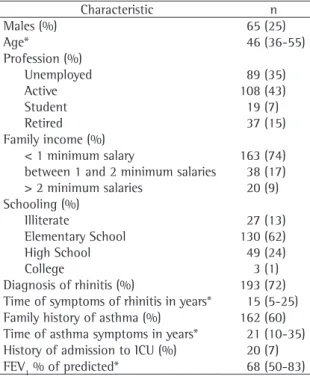
In the period from January of 2003 to September of 2004, 315 patients were admitted. A total of 17 patients were excluded from this analysis due to insufficient data in their records, 22 patients abandoned the program, and 7 patients died before completing the one-year follow-up period. A total of 269 patients completed the study. As can be seen in Table 1, the median age of the patients included was 46 years (range, 36-55 years), and there was a predominance of females. Most patients were unemployed, with low family income and limited
schooling. A diagnosis of rhinitis was made in 72% of the patients, and the median duration of the symp-toms of rhinitis was 15 years (range, 5-25 years). The duration of asthma symptoms was also long (median, 21 years; range, 10-35 years), and 60% of the patients had a family history of asthma. The median forced expiratory volume in one second was 68% of predicted (range, 50-83%).
Table 2 demonstrates that, among the patients who had been monitored in the program, the number of cycles of systemic corticosteroids was reduced to one-third of that registered in the previous year, and that the numbers of school/work days missed, emergency room visits and hospital admissions for asthma attacks were reduced to approximately one-ninth of those reported for the previous year. There was a significant reduction in the outcomes evalu-ated, both from the statistical point of view as well as from the clinical point of view. Over 7000 emer-gency room visits and over 300 hospital admissions were prevented. It is worth mentioning the ratio of the number of emergency room visits to the use of systemic corticosteroids. Before the ProAR follow-up treatment, the ratio was six emergency room visits to each corticosteroid cycle, and after the ProAR follow-up treatment, this ratio dropped to three visits to one cycle.
Discussion
This study confirms that an asthma control program aimed at the low income population, based on providing medication free of charge, as well as medical, psychological, and pharmacological assist-ance, has a great impact on the use of health care resources, which reflects the high efficacy of the program. Although these results had been expected, due to the efficacy of the asthma treatment with inhaled corticosteroids, the present study deserves special attention for quantifying the benefit of a program in a representative sample of patients with severe asthma assisted by the SUS. Due to the great reduction in the number of school/work days missed, emergency room visits and hospital admissions, the cost of financing the program, including the medi-cations provided, is probably lower for the SUS than that of asthma without adequate treatment. There is an ongoing study to evaluate the cost/usefulness ratio of ProAR, and that study will provide data on the value of the resources saved both by the families and by the government.
Table 1 - Demographic and socioeconomic clinical
characteristics of 269 patients completing at least one-year of follow-up in the ProAR outpatient clinic at the Professor Edgard Santos University Hospital.
Characteristic n
Males (%) 65 (25)
Age* 46 (36-55)
Profession (%) Unemployed Active Student Retired
89 (35) 108 (43) 19 (7) 37 (15) Family income (%)
< 1 minimum salary
between 1 and 2 minimum salaries > 2 minimum salaries
163 (74) 38 (17) 20 (9) Schooling (%)
Illiterate
Elementary School High School College
27 (13) 130 (62) 49 (24) 3 (1)
Diagnosis of rhinitis (%) 193 (72)
Time of symptoms of rhinitis in years* 15 (5-25)
Family history of asthma (%) 162 (60)
Time of asthma symptoms in years* 21 (10-35) History of admission to ICU (%) 20 (7)
FEV1 % of predicted* 68 (50-83)
Wilcoxon Test. Continuous variables expressed in median and interquartile range (25th–75th percentile); ProAR: Asthma and
An interesting additional finding of the present study is the ratio of six emergency room visits to each cycle of systemic corticosteroids used to treat asthma attacks in the year prior to the enrollment of the patients in ProAR. If each emergency visit represents an exacerbation of the disease, it would be expected that these patients would have used the systemic corticosteroid more often, and that this ratio would be equal to or greater than 1:1. It is possible that the patients do not recall having made use of a systemic corticosteroid, or that the patients have the habit of using the emergency room visits for mild symptoms and for nebulizations, in the absence of adequate outpatient assistance, which would not represent an exacerbation of asthma for which the use of corticos-teroids would be indicated. Nevertheless, a ratio of three emergency room visits to each cycle of systemic corticosteroids was observed during the period in which the patients were prospectively monitored, with frequent visits and access to medication at no charge, including inhaled short-acting b2-agonists,
making it improbable that under-reporting or the lack of access to rescue bronchodilators would fully explain this finding. In view of this, it is possible to suppose that the patients with asthma exacer-bations treated in emergency situations are being discharged without recommendation of the use of the systemic corticosteroids. Studies indicate that underuse of systemic corticosteroids in the treatment of asthma attacks in the emergency room occurs in developed countries.(14,15) This medication is useful
after discharge from the emergency room because it prevents the early recurrence of the asthma attack(16)
and improves pulmonary function.(17) Its underuse
can be hazardous to the patients. The treatment given to patients presenting asthma attacks in the emergency rooms in Brazil should be investigated, and, as proposed by the Ministry of Health, training programs should be provided for the professionals involved in the primary health care given to our population so that the recommendations set forth in
Asthma and Rhinitis, Conduct Lines in Basic Health Care, published in 2005 as the result of a joint effort by the Ministry of Health, the Brazilian Thoracic Society, the Brazilian Allergy Society, and the Brazilian Society of Pediatricians, are made available.
One of the methodological weaknesses of the present study is the retrospective form of data collection related to events occurring prior to patient enrollment in the ProAR and therefore subject to memory bias. Since the program involves providing medications free of charge to patients with severe asthma, ethical issues prevented us from carrying out a randomized clinical trial with prospective monitoring of a control group of patients with severe asthma without the assistance provided by the program. It is possible that the patients have under-reported the number of events that occurred prior to admission in the study, principally less remarkable events such as the use of systemic corti-costeroids. A more precise record of the events occurring prior to admission would probably demonstrate an even greater impact of the program, reinforcing the conclusions, unless there has been deliberate exaggeration in the information given by some individuals with the objective of obtaining admission into a protocol that demanded the char-acterization of severe asthma. The validation of the retrospective and prospective information related to hospital admissions, confronting the information of the patients with the SUS database, is important and will be the aim of a subsequent study. The patients included in this study represent approximately 20% of the patients that currently participate in the ProAR. Although it is not possible to state that the profile of the patients who seek treatment at other outpatient clinics of the program is the same, it is not likely that there is a great difference in terms of the severity of the disease and impact of the treatment, since it is a required condition for all ProAR patients to have severe asthma, and the same treatment is provided at all of the centers. We have
Table 2 - Reduced use of health care resources by patients completing at least one-year of follow-up in the ProAR
outpatient clinic at the Professor Edgard Santos University Hospital.
Year preceding the ProAR n total (n/patient-year)
First year of the ProAR n Total (n/patient-year)
p
Number of cycles of systemic corticosteroid* 1281 (4.69) 421 (1.57) < 0.01
Number of school/work days missed* 3056 (11.36) 431 (1.60) < 0.01
Number of emergency room visits* 8577 (31.88) 1289 (4.79) < 0.01
Number of hospital admissions* 383 (1.42) 38 (0.14) < 0.01
also tried to quantify, through the use of question-naires, the effect of the program on the control of the asthma symptoms and on the quality of life of the patients, which, combined with the information on the costs, will permit a cost-effectiveness and cost-usefulness analysis of the ProAR.
Our results allow us to conclude that a multi-disciplinary outpatient clinic, specialized in the treatment of severe asthma, with pharmacological services available at no charge, makes it possible to significantly reduce the use of SUS resources by patients with severe asthma, as a consequence of the control of the exacerbations of the disease. In view of these results, an even greater effort must be made in order to broaden the access of the patients to ProAR in Bahia. New ProAR referral centers for the treat-ment of the patients with severe asthma are being created in the urban and rural areas of Bahia, and, simultaneously, we are providing training in order to prepare the basic health care professionals of the SUS for the control of mild to moderate asthma.
Acknowledgments
For their invaluable assistance in the execution of this study, we would like to offer our most sincere thanks to Professor Jorge Luiz Pereira e Silva, to the former mayor of Salvador, Antônio Imbassahy, to the Secretary of Health of Salvador, to Professor Luís Eugênio Portela de Souza, to Professor Antônio dos Santos Barata, Coordinator of the Ethics in Human Research Committee of the Maternity Climério de Oliveira of the Federal University of Bahia, to the pharmacists Juliana Avena and Rosa Martinez, from the Secretary of Health of the State of Bahia, and to the team of professionals of the first referral outpa-tient clinic of ProAR: Ana Paula Barreto, Liliane Oliveira, Vanessa Vazquez, Aurélio Laborda, Marta Leite, Mylene Leite, Pablo Moura, Giovanna Santana, Koonj Saah, Dayse Naiane, Laina Gabrieli, Valesca Sarkis, and the manager Ana Tereza Campos.
References
1. National Institutes of Health: National Heart, Lung, and Blood Institute. Data fact sheet: asthma statistics. Washington, DC: U.S. Department of Health and Human Services; 1999. 2. Smith DH, Malone DC, Lawson KA, Okamoto LJ, Battista
C, Saunders WB. A national estimate of the economic costs of asthma. Am J Respir Crit Care Med. 1997;156(3 Pt 1):787-93.
3. O’Byrne PM, Barnes PJ, Rodriguez-Roisin R, Runnerstrom E, Sandstrom T, Svensson K, Tattersfield A. Low dose inhaled
budesonide and formoterol in mild persistent asthma: the OPTIMA randomized trial. Am J Respir Crit Care Med. 2001;164(8 Pt 1):1392-7.
4. Smith MJ, Rascati KL, McWilliams BC. Inhaled anti-inflammatory pharmacotherapy and subsequent hospitalizations and emergency department visits among patients with asthma in the Texas Medicaid program. Ann Allergy Asthma Immunol. 2004;92(1):40-6.
5. Suissa S, Ernst P, Benayoun S, Baltzan M, Cai B. Low-dose inhaled corticosteroids and the prevention of death from asthma. N Engl J Med. 2000;343(5):332-6.
6. Masoli M, Weatherall M, Holt S, Beasley R. Moderate dose inhaled corticosteroids plus salmeterol versus higher doses of inhaled corticosteroids in symptomatic asthma. Thorax. 2005;60(9):730-4.
7. Castro M, Zimmermann NA, Crocker S, Bradley J, Leven C, Schechtman KB. Asthma intervention program prevents readmissions in high healthcare users. Am J Respir Crit Care Med. 2003;168(9):1095-9.
8. Georgiou A, Buchner DA, Ershoff DH, Blasko KM, Goodman LV, Feigin J. The impact of a large-scale population-based asthma management program on pediatric asthma patients and their caregivers. Ann Allergy Asthma Immunol. 2003;90(3):308-15.
9. Crystal-Peters J, Neslusan C, Crown WH, Torres A. Treating allergic rhinitis in patients with comorbid asthma: the risk of asthma-related hospitalizations and emergency department visits. J Allergy Clin Immunol. 2002;109(1):57-62. 10. Adams RJ, Fuhlbrigge AL, Finkelstein JA, Weiss ST. Intranasal
steroids and the risk of emergency department visits for asthma. J Allergy Clin Immunol. 2002;109(4):636-42. 11. Corren J, Manning BE, Thompson SF, Hennessy S, Strom
BL. Rhinitis therapy and the prevention of hospital care for asthma: a case-control study. J Allergy Clin Immunol. 2004;113(3):415-9.
12. Sociedade Brasileira de Pneumologia e Tisiologia. III Consenso Brasileiro no Manejo da Asma 2002. J Pneumol. 2002;28(Supl 1):S1-51.
13. Souza-Machado C, Ponte EV, Silva DNF, Santana GS, Moura P, Souza-Machado A, et al. Adesão ao tratamento em um programa de asma grave com fornecimento gratuito de medicação. J Bras Pneumol. 2004;30(Supl 1):S111. 14. Reid J, Marciniuk DD, Cockcroft DW. Asthma
management in the emergency department. Can Respir J. 2000;7(3):255-60.
15. Salmeron S, Liard R, Elkharrat D, Muir J, Neukirch F, Ellrodt A. Asthma severity and adequacy of management in accident and emergency departments in France: a prospective study. Lancet. 2001;358(9282):629-35.
16. Rowe BH, Spooner CH, Ducharme FM, Bretzlaff JA, Bota GW. Corticosteroids for preventing relapse following acute exacerbations of asthma. Cochrane Database Syst Rev. 2001;(1):CD000195.
17. Coyle YM, Aragaki CC, Hynan LS, Gruchalla RS, Khan DA. Effectiveness of Acute Asthma Care Among Inner-city Adults. Arch Intern Med. 2003; 14;163(13):1591-6. 18. ATS - American Thoracic Society. Standardization of
Spirometry. 1994 Update. Am J Respir Crit Care Med. 1995; 152:1107-36.