FELIPE MORAES GOMES
ON EFFECTIVE DYNAMIC SEARCH SYSTEMS
Dissertation presented to the Graduate Program in Computer Science of the Fed-eral University of Minas Gerais in partial fulfillment of the requirements for the de-gree of Master in Computer Science.
Advisor: Rodrygo Luis Teodoro Santos
Co-Advisor: Nivio Ziviani
© 2017, Felipe Moraes Gomes. Todos os direitos reservados
Ficha catalográfica elaborada pela Biblioteca do ICEx - UFMG
Gomes, Felipe Moraes.
G633o On effective dynamic search systems / Felipe Moraes Gomes – Belo Horizonte, 2017.
xxiii, 74 f.: il.; 29 cm.
Dissertação (mestrado) - Universidade Federal de
Minas Gerais – Departamento de Ciência da Computação.
Orientador: Rodrygo Luis Teodoro Santos Coorientador: Nívio Ziviani
1. Computação – Teses. 2. Recuperação da informação. 3.Sistemas de recuperação da informação – avaliação. I. Orientador. II. Coorientador. III. Título.
To my nephew.
Acknowledgments
I would like to express my immense gratitude to many people that contributed to this work in different levels.
First and foremost, I would like to thank my advisor Rodrygo Santos. He has been more than a great advisor, and has spent hours chatting with me, answering my e-mails (more than 300!), and shedding light in many of my decisions. I could not express how thankful I am of having the experience of working with Rodrygo. Besides, I consider Rodrygo a great friend, and I hope that we will have the chance to cheer many beers to come, including in our hometown! Of course, I cannot forget my co-advisor, Nivio Ziviani, to whom I am grateful especially in things beyond academia. He was always available to share his wisdom and point me out directions.
I am thankful to all my professors at UFMG that contributed somehow to this work, but I would like to thank two of them in particular. First, to Jussara Almeida, who taught me for two years the basics of research, being kind and receptive. Also, it was because of her that I decided to pursue a career in computer science. Second, to Adriano Veloso who was open to talk and to give pieces of advise about personal and work life.
This paragraph is dedicated to LATIN, the best laboratory at DCC! I am grateful to all my peers, but above all: Arthur Cˆamara, Alberto Ueda, Bruno Laporais, Jordan Silva, Marlon Dias, Raul Sanchez, Rafael Glater, and Sabir Ribas.
What is life without family and friends? I am extremely grateful to my parents Divina and Jo˜ao, and my sisters, Kellen and Keroleine. Without their love and dedi-cation to help me reach each step in my life I would not be where I am today. I am so thankful to my friends, which tolerate me and listen to all my complaints about life. I would like to thank my friends in my hometown, Divin´opolis, because every time I went home they were there to talk and to celebrate many achievements. I am also thankful to the friends that greatly participated in this step of my life: Andr´e Harder, Bruna Neuenschwander, Camila Vieira, Luis Eduardo, Mauri Miguel, Marco T´ulio, Mariana Arantes, Patrick Prado, and Rafael Almeida.
“On a given day, a given circumstance, you think you have a limit. And you then go for this limit and you touch this limit, and you think, “Okay, this is the limit.” As
soon as you touch this limit, something happens and you suddenly can go a little bit
further. With your mind power, your determination, your instinct, and the experience
as well, you can fly very high.”
(Ayrton Senna)
Abstract
Dynamic search in specialized domains is a challenging task, in which systems must learn about the user’s need from his or her interactive exploration. Despite recent initia-tives to advance the state-of-the-art for this task, limited progress has been achieved, with the best performing dynamic search systems only marginally improving upon vanilla ad-hoc search systems. In this dissertation, we perform a comprehensive anal-ysis of the impact of several components of a typical dynamic search system on the effectiveness of the entire system. Through a series of simulations, we discuss the im-pact of producing an initial ranking of candidate documents, modeling the possible aspects underlying the user’s query given his or her feedback, leveraging the modeled aspects to dynamically rerank the initial set of candidates, and deciding when to stop the interactive process. In addition, we provide preliminary results on practical instan-tiations of the dynamic reranker component via interactive search result diversification approaches. Our results using data from the TREC 2015-2016 Dynamic Domain track shed light on these components and provide directions for the design of effective dy-namic search systems for specialized domains.
Keywords: Dynamic Search; Search Systems Effectiveness.
Resumo
Busca dinˆamica em dom´ınios especializados ´e uma tarefa desafiadora, em que sistemas devem aprender sobre a necessidade do usu´ario atrav´es da sua explora¸c˜ao interativa. Apesar das recentes iniciativas para melhorar o estado da arte para essa tarefa, avan¸cos limitados foram alcan¸cados at´e ent˜ao, com os melhores sistemas de busca dinˆamica conseguindo melhorias marginais em rela¸c˜ao aos sistemas de busca ad-hoc. Nesta disserta¸c˜ao, n´os realizamos uma an´alise abrangente do impacto de v´arios componentes de um sistema de busca dinˆamico gen´erico sobre a efic´acia de todo o sistema. Atrav´es de uma s´erie de simula¸c˜oes, discutimos o impacto da produ¸c˜ao de um ranking inicial de documentos candidatos, da modelagem dos poss´ıveis aspectos subjacentes `a consulta do usu´ario com seu feedback, da utiliza¸c˜ao dos aspectos modelados para dinamicamente reordenar o ranking inicial de candidatos e da decis˜ao de quando parar o processo interativo. Al´em disso, apresentamos resultados preliminares de instancia¸c˜oes pr´aticas do componente de reranking dinˆamico por meio de abordagens para diversifica¸c˜ao interativa de resultados da busca. Nossos resultados usando dados das cole¸c˜oes de teste da TREC 2015-2016 Dynamic Domain track demonstram o impacto de cada componente e apresentam diretrizes para o projeto de sistemas eficazes para busca dinˆamica em dom´ınios especializados.
Palavras-chave: Busca Dinˆamica, Efic´acia de Sistemas de Busca.
List of Figures
1.1 Per-domain ACT of the best dynamic search systems submitted to the TREC 2015-2016 Dynamic Domain track against ad-hoc search baselines (LM, DPH, and BM25). The best TREC systems were chosen as the most
stable across iterations. . . 3
2.1 Flow diagram of a typical dynamic search system. . . 8
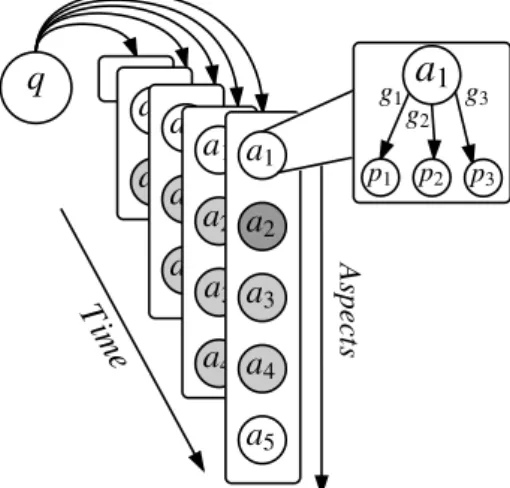
3.1 Query aspect modeling over time. . . 18
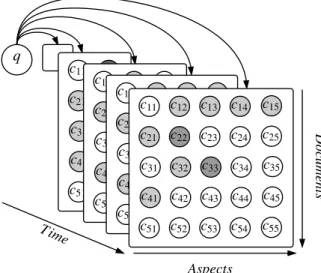
3.2 Aspect coverage over time. . . 20
3.3 Hierarchical aspect tree for a query q. . . 21
5.1 Impact of baseline rankers of various quality levels at times t 2 {1,2,10} (see Appendix A.1 for separated domains). . . 33
5.2 Impact of inaccurate or incomplete aspect models (see Appendix A.2 for separated domains). . . 35
5.3 Impact of perturbed coverage estimates (see Appendix A.3 for separated domains). . . 37
5.4 Critical leakage (CL) and room for improvement (RI) for queries with dif-ferent numbers of relevant aspects. . . 38
5.5 Impact of different stopping strategies for DPHF. . . 39
5.6 Gain-effort trade-off of stopping strategies. . . 40
6.1 Effectiveness breakdown by domain. . . 51
6.2 Effectiveness breakdown by query type. . . 52
6.3 Effectiveness breakdown by aspect size. . . 53
6.4 Differences in ACT@10 between DPH vanilla ad-hoc search baseline and other baselines, and interactive diversification approaches. . . 53
A.1 Ebola 2015 domain - Impact of baseline rankers of various quality levels at times t2{1,2,10}. . . 59
A.2 Local Politics domain - Impact of baseline rankers of various quality levels
at timest 2{1,2,10}. . . 60
A.3 Illicit Goods domain - Impact of baseline rankers of various quality levels at timest 2{1,2,10}. . . 60
A.4 Ebola 2016 domain - Impact of baseline rankers of various quality levels at times t2{1,2,10}. . . 61
A.5 Polar domain - Impact of baseline rankers of various quality levels at times t2{1,2,10}. . . 61
A.6 Inaccurate aspect modeling. . . 62
A.7 Incomplete aspect modeling. . . 62
A.8 Impact of perturbed coverage estimates. . . 63
B.1 Ebola 2015 . . . 65
B.2 Local Politics . . . 65
B.3 Illicit Goods . . . 66
List of Tables
2.1 Subtasks of learning and investigation tasks based on Marchionini [2006]. 8 2.2 Overview of dynamic search systems submitted to the TREC 2015-2016
Dynamic Domain tracks. . . 9
4.1 TREC 2015-16 Dynamic Domain track collections. T is the number of topics. S is the average number of sub-topics per topic. RT and RS are the average number of relevant documents per topic and per sub-topic, respectively. . . 26 4.2 TREC 2015 Dynamic Domain track, topic DD15-33, along with its
corre-sponding sub-topics and a few passages. . . 26
5.1 Correlation between ACT@t and Precision@5 or Recall@500 attained by the baseline ranker component. . . 34
6.1 Evidence features fi. . . 46
6.2 Comparison of DPH, DPH+MMR, DPH+RMR, and interactive search re-sult diversification with document passage relevance and selecting relevant terms using external evidence in terms of ACT. . . 49 6.3 Comparison of DPH, DPH+MMR, DPH+RMR, and interactive search
re-sult diversification with document passage relevance and selecting relevant terms using external evidence in terms of ↵-nDCG. . . 49 6.4 Comparison of DPH, DPH+MMR, DPH+RMR, and interactive search
re-sult diversification with document passage relevance and selecting relevant terms using external evidence in terms of ERR-IA. . . 50
Contents
Acknowledgments ix
Abstract xiii
Resumo xv
List of Figures xvii
List of Tables xix
1 Introduction 1
1.1 Motivation . . . 3
1.2 Dissertation Statement . . . 4
1.3 Contributions . . . 5
1.4 Dissertation Outline . . . 5
2 Related Work 7 2.1 Exploratory Search . . . 7
2.2 Dynamic Search . . . 8
2.3 Search Quality . . . 10
2.3.1 User Satisfaction . . . 10
2.3.2 Summarization of User Satisfaction . . . 11
2.4 Summary . . . 13
3 Dynamic Search via Interactive Search Result Diversification 15 3.1 Baseline Ranker . . . 15
3.2 Stopping . . . 16
3.3 Aspect Modeling . . . 17
3.4 Dynamic Reranker . . . 18
3.4.1 Coverage-based models . . . 19
3.4.2 Proportionality-based models . . . 21 3.5 Summary . . . 23
4 Experimental Setup 25
4.1 Test Collections . . . 26 4.2 Evaluation metrics . . . 27 4.2.1 Average Cube Test . . . 27 4.2.2 Novelty and Diversity Metrics . . . 28 4.3 Ad-hoc Search System . . . 29 4.4 Summary . . . 29
5 Simulation Results 31
5.1 Baseline Ranker . . . 32 5.2 Aspect Modeling . . . 34 5.3 Dynamic Reranker . . . 36 5.4 Stopping Strategies . . . 38 5.5 Summary . . . 40
6 Practical Instantiations 43
6.1 Estimating Aspect Coverage . . . 44 6.1.1 Document Passage Relevance . . . 44 6.1.2 Selecting Terms using External Evidence . . . 44 6.2 Experimental Setup . . . 46 6.2.1 Baselines . . . 47 6.2.2 Training and Test Procedure . . . 47 6.3 Experimental Results . . . 48 6.3.1 Breakdown Analyses . . . 50 6.4 Summary . . . 54
7 Conclusions and Future Work 55
7.1 Summary of Contributions . . . 56 7.2 Summary of Conclusions . . . 56 7.3 Directions for Future Research . . . 57 7.4 Final Remarks . . . 58
Appendices 58
A Simulation Results 59
A.1 Baseline Ranker . . . 59
A.2 Aspect Modeling . . . 62 A.3 Dynamic Reranker . . . 63
B Practical Instantiations 65
Bibliography 67
Chapter 1
Introduction
Presently, people spend a considerable part of their daily life interacting with infor-mation systems such as search engines, recommender systems, and social news feeds, either on desktops or mobile devices. In particular, a user interacts with a search sys-tem to find facts, to learn, and to help in making informed decisions. At first, the user interacts with the system through a query. A query is often a short text that is the materialization of a user’s information need. The user receives a result list of docu-ments from the system and interacts with the system by looking over the docudocu-ments or by posing new queries.
To provide a result list of documents, a search system uses a model that is op-timized to return the documents that best satisfy the user’s information need [Baeza-Yates and Ribeiro-Neto, 2011]. At first, a ranking function sorts a collection of docu-ments using the query terms or query aspects. Afterwards, the ranking function may be updated based on the user’s interactions and returns a new result list of documents that more accurately fulfills the user’s need. Whenever a user interacts with the sys-tem, the system interprets his or her interactions as feedback. Essentially, feedbacks are categorized based on user’s input nature: implicit feedbacks in which the user’s interactions represent, for instance, clicks, time spent viewing a document, scrolling actions, and eye-tracking; explicit feedbacks in which the user’s interactions are graded relevance judgments; and pseudo-feedbacks in which user’s interactions are simulated by assuming that the top-k documents will be assessed positively by the user.
As information technology grows, users have been using search systems in an exploratory manner to complete tasks that are more complex. The need for explo-ration commonly arises in professional search settings such as in medical, legal, patent, military intelligence, and academic search, but also in personal searches such as in travel planning or personal health research [Wildemuth and Freund, 2012; Marchionini,
2 Chapter 1. Introduction
2006]. Exploratory searches often involve complex search sessions, demanding multi-ple interactions between the user and a search system. Along the interactive process, the system must dynamically adapt to each feedback provided by the user in order to improve the understanding of the user’s need and the quality of the subsequently retrieved results [White, 2016].
Research on exploratory search has been supported by several initiatives. The Text REtrieval Conference (TREC) has hosted related research tracks on interactive search Allan [2006], search within sessions Carterette et al. [2016], search for task completion Yilmaz et al. [2015] and, more recently, dynamic search in specialized do-mains Grace Hui Yang [2015, 2016]. The latter problem, embodied by the TREC Dynamic Domain track,1 is the focus of this paper.2 Given an initial query, a dynamic search system must improve its understanding of the user’s information need through a series of interactions. In each interaction, the user may provide the system with feedback on the relevance of specific passages of the retrieved documents with respect to one or more aspects underlying his or her information need. The system must then choose to either provide the user with further documents or end the interactive pro-cess. An effective system should be able to satisfy as many query aspects as possible (to maximize user satisfaction) with as few interactions as possible (to minimize user effort).
A dynamic search system must cope with four key problems: (i) produce an initial sample of candidate documents given the user’s query and the domain of interest; (ii) decide whether the user’s information need has been satisfied and eventually stop the interactive process; (iii) leverage the user’s feedback to learn an improved aspect model; (iv) produce an enhanced ranking given the learned aspect model. As we will discuss in Chapter 2, several attempts have been made to produce dynamic search systems that could effectively tackle these problems. Nevertheless, as shown in Figures 1(a)-(e) for the two domains considered in the TREC 2016 Dynamic Domain track,3 even the reportedly most effective system in each domain shows only marginal improvements compared to vanilla ad-hoc search baselines, which leverage no user feedback.
In this dissertation, we aim to better understand the challenges involved in build-ing effective dynamic search systems. To this end, we isolate each of the aforementioned problems as a separate component of a dynamic search system. Through controlled simulations, we assess how the effectiveness of each component impacts the eff
ective-1
http://trec-dd.org/
2
A further related task on Dynamic Search for Complex Tasks has recently been proposed at CLEF:https://ekanou.github.io/dynamicsearch/
3
1.1. Motivation 3
(a) Ebola 2015 (b) Local Politics (c) Illicit Goods
(d) Ebola 2016 (e) Polar
Figure 1.1: Per-domain ACT of the best dynamic search systems submitted to the TREC 2015-2016 Dynamic Domain track against ad-hoc search baselines (LM, DPH, and BM25). The best TREC systems were chosen as the most stable across iterations.
ness of the whole system. In particular, we show that high-precision document samples are beneficial at early interactions, whereas high-recall samples help towards later in-teractions. Moreover, mishandled user feedback leads to inaccurate aspect models, which hinder the system effectiveness. Likewise, inaccurately estimating the coverage of the modeled aspects leads to poor reranking, which also hinders effectiveness. Lastly, despite the inherent trade-off, we show that stopping late typically incurs more effort than gain. In addition, we present a preliminary analysis of practical instantiations of one component that dynamically reranks the initial ranking of candidate documents. To our knowledge, this is the first systematic attempt to shed light on the effectiveness of dynamic search in specialized domains.
1.1
Motivation
4 Chapter 1. Introduction
practitioners to retrieve relevant information in their day-to-day tasks. There are sev-eral examples of these tasks as in health search, legal search, patent search, marketing research, and scientific literature review. For illustration, take the following scenarios:
• Health search: a physician needs to review all the patients’ records that satisfy some conditions to select a group for clinical trials;
• Legal search: a lawyer needs to find every piece of evidence related to his or her case from documents that are under legal hold;
• Patent search: before launching a product, a tech company needs to check all the patents related to their product.
• Marketing research: a social analyst needs to identify all the different posts in which a rumor disseminates in order to recreate the diffusion process and measure the impact of the rumor;
• Scientific literature review: scientists need to find all pieces of prior work that are related to their research.
1.2
Dissertation Statement
The statement of this dissertation is that the current state-of-the-art in dynamic search in specialized domains is hindered by the suboptimal effectiveness of different dynamic search components, namely, candidate result sampling, user feedback modeling, dy-namic reranking, and interaction stopping. In particular, this dissertation aims to answer the following research questions:
Q1 – How does each component of a dynamic search system impact the overall system effectiveness?
Q2 – Can a practical instantiation of the framework through interactive diversification improve over a vanilla ad-hoc search baseline?
1.3. Contributions 5
1.3
Contributions
Our main contributions are three-fold:
• Contribution 1: A thorough analysis of the impact of different components on the effectiveness of a dynamic search system.
• Contribution 2: A preliminary investigation on practical instantiations of one component of dynamic search system via interactive search result diversification.
1.4
Dissertation Outline
The remainder of this dissertation is structured as follows:
• Chapter 2: Related Work presents related work on exploratory search, dy-namic search, and search quality. Moreover, it presents a unifying characteriza-tion of state-of-the-art dynamic search systems for specialized domains.
• Chapter 3: Dynamic Search via Interactive Search Result Diversifica-tion presents a working instantiation of the introduced dynamic search frame-work that will be used in our experiments.
• Chapter 4: Experimental Setuppresents test collections, evaluation metrics, and vanilla ad-hoc search system baselines for the conducted evaluation.
• Chapter 5: Simulation Results investigates the impact of different compo-nents on the effectiveness of a dynamic search system.
• Chapter 6: Practical Instantiationspresents preliminary results on practical instantiations of a dynamic search system via interactive diversification.
Chapter 2
Related Work
In this chapter, we describe related work on exploratory search in general in Section 2.1 and on dynamic search in particular in Section 2.2. In addition, we present a general framework for dynamic search systems in Section 2.2. Furthermore, we discuss search result quality and evaluation of dynamic search systems in Section 2.3.
2.1
Exploratory Search
Several information retrieval researchers have investigated what makes a search process exploratory in nature [Wildemuth and Freund, 2012; Marchionini, 2006; Athukorala et al., 2016]. For instance, Marchionini [2006] categorized information seeking tasks as lookup (or known-item) search tasks and exploratory search tasks, with the latter being further decomposed into learning and investigation tasks (as shown in Table 2.1). Another example is the user study conducted by Wildemuth and Freund [2012], which provided an ample characterization of search tasks. Later, Athukorala et al. [2016] described distinctive behaviors of search users during an exploratory search with respect to query length, scroll depth, and task completion time.
Many studies in exploratory search focused on developing user interfaces to sup-port complex information needs [Ruotsalo et al., 2014; Golovchinsky et al., 2012]. For instance, Ruotsalo et al. [2014] proposed an interactive user interface that enhances a user’s capacity to explore the results through a visualization of the possible aspects un-derlying his or her information need. Recently, Krishnamurthy et al. [2016] presented an exploratory search system for domain discovery and used the TREC 2015 Dynamic Domain track data to perform user studies. While most research on exploratory search has focused on the user’s perspective of the task, here we focus on the effectiveness
8 Chapter 2. Related Work
Learning
Knowledge Acquisition
Comprehension or interpretation Comparison
Aggregation or Integration Socialize
Investigation
Accretion Analysis
Exclusion or Navigation Synthesis
Discovery
Planning or forecasting Transformation
Table 2.1: Subtasks of learning and investigation tasks based on Marchionini [2006].
of exploratory search from a system’s perspective. In particular, we address a specific exploratory search task, namely, dynamic search.
Figure 2.1: Flow diagram of a typical dynamic search system.
2.2
Dynamic Search
Dynamic search is an exploratory search task [Yang et al., 2016]. Previous research in this area have focused on approaches for session search or multi-page search through reinforcement learning [Luo et al., 2014, 2015a,b; Sloan and Wang, 2015; Jin et al., 2013]. Sloan and Wang [2015] proposed a theoretical framework for multi-page dynamic search that learns the best policy based on implicit user feedback, such as clicks. Similarly, Luo et al. [2014, 2015a,b] proposed several approaches to leverage users’ implicit feedback in the form of clicks and query reformulations within a session. These include reinforcement learning approaches such as Markov decision processes, direct policy learning, and dual-agent learning.
2.2. Dynamic Search 9
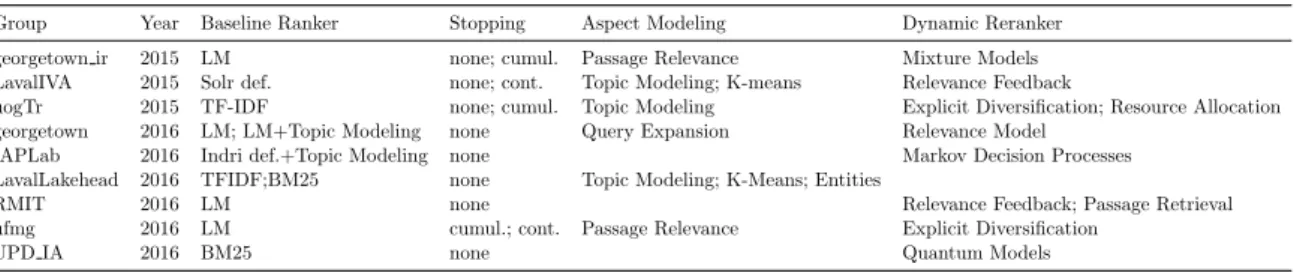
Table 2.2: Overview of dynamic search systems submitted to the TREC 2015-2016 Dynamic Domain tracks.
Group Year Baseline Ranker Stopping Aspect Modeling Dynamic Reranker georgetown ir 2015 LM none; cumul. Passage Relevance Mixture Models LavalIVA 2015 Solr def. none; cont. Topic Modeling; K-means Relevance Feedback
uogTr 2015 TF-IDF none; cumul. Topic Modeling Explicit Diversification; Resource Allocation georgetown 2016 LM; LM+Topic Modeling none Query Expansion Relevance Model
IAPLab 2016 Indri def.+Topic Modeling none Markov Decision Processes LavalLakehead 2016 TFIDF;BM25 none Topic Modeling; K-Means; Entities
RMIT 2016 LM none Relevance Feedback; Passage Retrieval ufmg 2016 LM cumul.; cont. Passage Relevance Explicit Diversification
UPD IA 2016 BM25 none Quantum Models
Web [Barbosa and Freire, 2007]. In this setting, users provide explicit feedback on the relevance of each retrieved document with respect to multiple aspects underlying their information need. As part of the evaluation campaigns of the TREC 2015-2016 Dy-namic Domain tracks [Grace Hui Yang, 2015, 2016], several dyDy-namic search approaches have been proposed that attempt to leverage such a structured feedback. In common, these approaches deploy a multi-step framework for dynamic search, as illustrated in Figure 2.1.
Given the user’s queryq, in the first step, abaseline ranker produces an initial re-sult set R, which is presented to the user. Standard ad-hoc retrieval models have been used for this step, including vector space [Salton et al., 1975], best matching [Robert-son et al., 1996], and language models [Zhai, 2008]. In the second step, a stopping
mechanism must choose to either continue the interactive process or to end the search session immediately. Stopping heuristics have been proposed that take into account the amount of irrelevant documents observed continuously or cumulatively up to the point of decision [Maxwell et al., 2015]. In the third step, the user feedback F on passages extracted from the presented ranking is used to update the system’s knowl-edge about the multiple aspectsA underlying his or her need. Attempted solutions for
aspect modeling include direct passage modeling, clustering [Lloyd, 2006], and query
expansion [Zhai, 2008; Rocchio, 1971]. Lastly, in the fourth step, the updated aspect model A is used by a dynamic reranker to produce an improved result set D, which is again presented to the user for feedback. Effective solutions here include mixture models [Zhai and Lafferty, 2001], relevance feedback models [Rocchio, 1971], and result diversification models [Santos et al., 2015].
10 Chapter 2. Related Work
case. In the next chapter, we introduce a working instantiation of the aforementioned framework to enable a controlled assessment of the impact of all four components illustrated in Figure 2.1 on the performance of a dynamic search system. To our knowledge, this is the first systematic attempt to shed light on the effectiveness of dynamic search systems for specialized domains.
2.3
Search Quality
The quality of a search experience is a prerogative of the users of a search system. Therefore, an ideal evaluation would occur by directly enquiring users about their experience. However, such intervention could affect the overall user search experience. Consequently, many researchers have proposed different methodologies for evaluating search effectiveness (see Kanoulas [2016] for a survey).
User studies have been a common evaluation methodology, whereby a selected group of users perform a set of instructed tasks. In such methodology, besides captur-ing the user interactions with the system, the users answer a questionnaire durcaptur-ing and after the experiment. However, a small modification of a search system would require a new user study, which makes this methodology expensive. In light of this, commercial search engines prefer to evaluate in situ, for example, using A/B tests with implicit feedback (e.g., clicks, dwell-time, scrolling depth, and others). Althoughin situ eval-uation is less expensive than user studies, it is somewhat restricted to the access of commercial search engines. Thus, many researchers have been improving the method-ology of collection-based evaluation in many campaigns such as in the Text REtrieval Conference (TREC), and the Conference and Labs of the Evaluation Forum1 (CLEF). This evaluation methodology has many advantages such as its reusability, being also a less expensive and intrusive approach [Sanderson, 2010].
In a collection-based evaluation, similarly to user studies, assessors (a selected group of users) evaluate their search experience with respect to their satisfaction with a pool of documents for an instructed task. The produced relevance assessments form a benchmark that is used later to evaluate other search systems. To build the test benchmark, we need to cope with how to capture the user satisfaction about a document and how to summarize the user satisfaction with a search system, which we further discuss in the remainder of this section.
1
2.3. Search Quality 11
2.3.1
User Satisfaction
In a TREC-style evaluation, the user satisfaction is simplified to the pragmatic view of relevance judgment. Many factors impact the assessors relevance judgment about a document with the foremost factor being the instructions given to the assessors. In addition, Xu and Chen [2006] investigated other five factors, including topicality, novelty, understandability, reliability, and scope. In particular, of the five factors, they found that topicality and novelty were the two essential ones for relevance judgment on a document.
Several researchers have argued that relevance is not a proper measure for cap-turing user satisfaction with a search system. Cooper [1997] was the first to argue that utility of a document should be used instead of relevance as a measure of user satisfaction. Moreover, Saracevic [1975, 2007a,b] argued that search systems should return documents not only relevant but also based on cost and benefits as in economy theory. Additionally, in his recent work, Saracevic [2007a,b] suggests that effort should be considered jointly with relevance in the evaluation of search systems.
Furthermore, recent user studies have found mismatches between user satisfaction and relevance judgments of collection-based evaluation. Yilmaz et al. [2014] found that many of these mismatches might be explained by the absence of judgment based on effort. Later, Verma et al. [2016] conducted a user study by questioning users about the effort they spent on finding relevant information within a document. They analyzed three factors that may impact the effort judgment of a user: findability, readability, and understandability. Also, they found that new features should be considered in the design of effort-focused search systems.
Jiang et al. [2017] conducted a user study to capture the user satisfaction within a search system, which they defined as the ephemeral state of relevance (ESR). They investigated several factors that impact the ESR, including novelty, effort, understand-ability, and reliability. In a similar conclusion to that of Verma et al. [2016], Jiang et al. [2017] found that effort along with other factors explains the ESR. In particular, they found that novelty significantly impact the judgment of user satisfaction with a search system. Furthermore, Luo et al. [2017] concluded that the perception of time spent consuming information might be influenced by the relevance of a document.
12 Chapter 2. Related Work
2.3.2
Summarization of User Satisfaction
To summarize the user satisfaction, we use evaluation metrics. Several evaluation metrics have been proposed based on the concept of relevance judgment. Set-based metrics summarize the user satisfaction by extending metrics such as precision, recall, and average precision. Position-based and cascade-based metrics such as Rank-biased Precision (RBP) and Expected Reciprocal Ranking (ERR) model the user’s behavior in analyzing the search results [Moffat and Zobel, 2008; Chapelle et al., 2009]. As discussed in Section 2.3.1, several user studies indicated that novelty and effort should be considered to evaluate search system effectiveness. Instead of instructing user’s to judge based on these factors, some evaluation metrics attempt to simulate this type of user judgment, for instance, effort-based metrics and novelty and diversity metrics.
Many effort-based metrics have been proposed in the literature. Smucker and Clarke [2012] proposed the Time-Based Gain (TBG), a general framework that takes into account the time spent by a user reading a document, accounting on whether a document is relevant. Later, Clarke and Smucker [2014] introduced an instantiation of TBG, which they called the Time Well Spent (TWS), which considers how users read a trail of documents by simulating the speed at which they read a piece of text. Sakai and Dou [2013] presented U-measure, an even more general framework inspired by TBG. The U-measure metric can be used to evaluate not only search results on documents but also passages of documents and question answering tasks. Recently, Ferro et al. [2016] proposed Twist, a metric that measures the avoidable effort that a user could obtain based on the position of the graded relevance judgment of the search result list. Although these metrics attempt to take into account the effort a user spends consuming relevant information, all of them still rely on the TREC-style of relevance. Despite the formulation account for being general, none of them has been employed to evaluate a complex information need as is common in dynamic search tasks.
2.4. Summary 13
information about a document in their formulation.
In this dissertation, we use the Average Cube Test (ACT) metric proposed by Luo et al. [2013]. ACT belongs to a family of metrics that measures the search speed of a user in fulfilling a complex information need [Jiang and Allan, 2016]. In par-ticular, ACT explicitly computes the benefit-effort ratio a user has when consuming information. Although ACT is similar to TBG [Smucker and Clarke, 2012] in its ba-sic formulation, it incorporates the capacity of evaluating complex information need regarding diversity and novelty of multiple aspects. For these reasons, we mainly use ACT to evaluate the effectiveness of a dynamic search system.
2.4
Summary
Chapter 3
Dynamic Search via Interactive Search
Result Diversification
Dynamic search in a specialized domain brings several challenges. For instance, to find about “hand washing importance” in a domain covering Ebola outbreak in Africa, a dynamic search system should find documents covering multiple aspects of the user’s underlying information need, such as “Sierra Leone campaign” and “Nigeria campaign” so as to maximize user satisfaction. At the same time, to minimize user effort, this broad coverage of aspects should be achieved as early as possible. This informal defi-nition resembles that of a related problem, which has received considerable attention from the IR community in recent years: search result diversification [Santos et al., 2015]. However, in contrast to the standard diversification problem, dynamic search is inherently interactive. In particular, a dynamic search system must interact with the user in order to continually identify aspects of interest that should be covered by the subsequently returned documents. Inspired by state-of-the-art diversification approaches [Santos et al., 2010; Dang and Croft, 2012; Hu et al., 2015], in this chap-ter, we introduce a working instantiation of the general framework for dynamic search described in Figure 2.1, as a means to analyze the impact of each of its components.
3.1
Baseline Ranker
In the baseline ranker component, a retrieval model returns a list of candidate docu-ments Rfor a queryq. It also provides a relevance estimaterel(q, d) for each document d 2 R to be used by the next components. Without loss of generality, following the standard evaluation paradigm proposed by the TREC Dynamic Domain track, we con-sider user interactions performed on batches of five documents each. Precisely, at each
16
Chapter 3. Dynamic Search via Interactive Search Result Diversification
time t, the user is presented with a batch of documents Dt selected from the list R
of candidates and provides a set of feedback Ft. At time t = 1, before any feedback
is received, D1 comprises the five highest scored documents in R. At all other times t >1,Dtis chosen by the dynamic reranker component (see Section 3.4) fromR\Dt−1,
whereDt−1 (note the superscript) denotes all documents returned before time t. Intuitively, the baseline ranker may impact the effectiveness of the entire system in two distinct moments. At timet= 1, because no feedback is available and hence no further reranking is performed, the effectiveness of the system depends on the precision attained by the baseline ranker itself. At all other times t > 1, the effectiveness of the system is more influenced by the recall of the baseline ranker. Indeed, with the availability of user feedback starting from t = 2 to be leveraged by the dynamic reranker, the attainable effectiveness of the system will be limited by the amount of relevant documents available in the candidate ranking R. In order to assess the impact of the baseline ranker on the entire system, we instantiate this component through a series of simulations, producing candidate rankingsR of a range of different performances.
3.2
Stopping
As illustrated in Figure 2.1, at a given timet, the user is shown a batch of documents Dt generated either by the baseline ranker or the dynamic ranker component. At this
point, the set of feedbackFtprovided by the user is fed to the second component in the
framework: a stopping mechanism. The role of this mechanism is to predict whether the user’s information need has been fulfilled or there is more knowledge to be gained through further interactions with the system. Stopping too early may result in reduced user satisfaction, while stopping too late may result in wasted user effort.
To take an informed decision, the stopping mechanism must assess all the feedback provided by the user thus far. Because documents without feedback are considered irrelevant for evaluation purposes, we consider the amount of irrelevant documents observed as the main criterion for a stopping decision. In particular, inspired by related research on user browsing behavior [Maxwell et al., 2015], we instantiate the stopping mechanism with three different strategies:
none The interactive process never stops.
3.3. Aspect Modeling 17
cumul. The interactive process stops after n2 irrelevant documents have been observed cumulatively.
The “none” strategy serves as a baseline for the assessment of the other two. Regarding the parameters of “cont.” and “cumul.”, Maxwell et al. [2015] originally reported effective n1 values ranging from 1 to 20, and effective n2 values ranging from 25 to 50. Given the multi-batch nature of our interactive setting and the considered batch size of only five documents, we experiment with multiple values for ↵ and in a lower range, as we discuss in Section 5.4. In order to assess the impact of the stopping mechanism on the entire system, we instantiate this component through a series of simulations, producing stopping strategies of a range of different performances.
3.3
Aspect Modeling
Whenever the stopping mechanism allows the interactive process to continue, the user feedbackFtis made available to improve the subsequently returned document batches.
In particular, a feedback f 2 Ft for a document d 2 Dt is a tuple f = ha, p, gi
com-prising a passage p that the user deemed relevant to aspect a at a given relevance level g 2{1,2,3,4}. The aspect modeling component is responsible for leveraging this feedback in order to continuously improve its knowledge of the possible aspects At
underlying the user’s information need. While external resources (e.g., query refor-mulations [Santos et al., 2010], taxonomy classes [Agrawal et al., 2009]) could also be used for an improved modeling, we leave their exploration to future work and focus on aspect modeling based on the user feedback alone.
18
Chapter 3. Dynamic Search via Interactive Search Result Diversification
Figure 3.1: Query aspect modeling over time.
3.4
Dynamic Reranker
Given the aspect model At and the set of all documents Dt presented up to time t,
the dynamic reranker must produce an ideally improved ranking Dt+1 ✓ R \ Dt of documents from the candidate set R that are yet to be seen by the user. Several ap-proaches could be used to instantiate this component, including passage-level relevance feedback [Na et al., 2008] or a mixture of passage-specific language models [Li and Zhu, 2008]. However, one important objective of a dynamic search system is to achieve a high coverage of multiple aspects as early as possible, in order to reduce the incurred user effort. As discussed in the beginning of this section, search result diversification models [Santos et al., 2015] are a natural fit in this scenario, as they aim to improve aspect coverage with minimum redundancy in the ranking.
Achieving maximum aspect coverage at a fixed ranking depth has been demon-strated to be an NP-hard problem [Agrawal et al., 2009]. Most diversification ap-proaches in the literature adopt a well-known greedy algorithm to this problem, which approximates the optimum within a factor of (1 1/e) ⇡ 0.632 [Nemhauser et al., 1978]. In particular, to build the target rankingDt+1, the greedy algorithm iteratively selects one documentd∗
2R \ Dt at a time according to the following objective:
d∗
= arg max
d∈R\Dt
score(q, d,At,Dt[Dt+1), (3.1)
where score() quantifies the extent to which document d covers the set of aspects At
3.4. Dynamic Reranker 19
ones presented to the user in all previous batches, namely,Dt. This slight modification
makes existing diversification approaches directly applicable to the dynamic search setting. In the remainder of this section, we describe four state-of-the-art approaches, which two of which are used in our simulations of the dynamic reranker component. In our practical instantiations, we compare the four diversification approaches listed here.
3.4.1
Coverage-based models
3.4.1.1 Flat models
Santos et al. [2010] introduced the xQuAD framework, which estimates score() in Equation (3.1) as the probability that document d covers explicitly identified aspects A underlying the query q that are not well covered by the already selected documents in D. Precisely,1 we have:
scorexQuAD(q, d,A,D) = (1 )rel(q, d) + div(q, d,A,D), (3.2)
where rel(q, d) is given by the baseline ranker component (see Section 3.1) and
div(q, d,A,D) is defined as:
div(q, d,A,D) = X
a∈A
P(a|q)P(d|q, a) Y
dj∈D
(1 P(dj|q, a)), (3.3)
where P(a|q) denotes the relative importance of aspecta givenq, P(d|q, a) denotes the coverage of document dwith respect to this aspect, and the rightmost product denotes the novelty of any document covering this aspect, according to how badly this aspect is covered by the documents previously observed inD. Importantly, while no modification to the actual xQuAD formulation is needed, its input changes at every timestep t. Indeed, as illustrated in Figures 3.1 and 3.2, both the set of aspects At as well as the
coverage matrix, comprising coverage estimates P(d|q, a) for every document-aspect pair, are updated at every timestep t.
To assess the impact of the dynamic reranker component on the whole system, we simulate coverage estimates of various performances. To this end, in our simulations, we gradually introduce noise into a perfect coverage matrix, which is defined as follows:
P(d|q, a) = P g(a, d) ai∈Atg(ai, d)
, (3.4)
1
20
Chapter 3. Dynamic Search via Interactive Search Result Diversification
Figure 3.2: Aspect coverage over time.
where g(a, d) is the highest relevance grade assigned to any passage p in document d that was judged relevant to aspect a. In other words, we assume that a document is as relevant as its best passage.
3.4.1.2 Hierarchical models
Hu et al. [2015] proposed HxQuAD as an extension of the xQuAD framework to support diversification using hierarchically organized aspects. Such hierarchy can be modeled as a tree in which each node represents an aspect and the set of aspects at the i-th level of the tree is denoted Ai. In Figure 3.3, we illustrate a example of aspect tree
for a queryq. Therewith, we can define the diversity of a document d with respect to aspects at thei-th level according to:
divi(q, d,D) = X
a∈Ai
P(a|q)P(d|q, a) Y
dj∈D
(1 P(dj|q, a)), (3.5)
where bothP(a|q) andP(d|q, a) are defined recursively, so that, for any non-leaf aspect a with childrenC, we have:
P(a|q) =X
c∈C
P(c|q) and P(d|q, a) = 1 Y
c∈C
(1 P(d|q, c)). (3.6)
3.4. Dynamic Reranker 21
linearly combining its diversity estimates at multiple hierarchy levels, according to:
divH(q, d,D) = ↵div1(q, d,D) + (1 ↵)div2(q, d,D)+
(1 ↵)2
↵ div3(q, d,D) +...+
(1 ↵)n−1
↵n−2 divn(q, d,D), (3.7) where the ↵ hyperparameter controls the influence of different hierarchy levels in the final estimation, with ↵ = 0.5 indicating that all levels are equally weighted. Finally, HxQuAD score function is defined in a similar manner as of xQuAD:
scoreHxQuAD(q, d,AH,D) = (1 )rel(q, d) + divH(q, d,A,D). (3.8)
Figure 3.3: Hierarchical aspect tree for a query q.
In our practical instantiations, we consider a tree as the aspectaand the passages p which belongs to a as the children C of a.
3.4.2
Proportionality-based models
3.4.2.1 Flat models
22
Chapter 3. Dynamic Search via Interactive Search Result Diversification
scorePM2(q, d,A,Dt) =
v∗
2s∗+ 1
P(d|q, a∗)+
(1 ) X
aj∈A\a⇤
vj
2sj+ 1
P(d|q, aj), (3.9)
wherevj =P(aj|q) andsi denotes the proportion of seats assigned toai. A parameter
trades off relatedness to aspect a∗ vs. all other aspects. At each document
selec-tion, a∗ is selected as the highest quotient vi/(2si + 1). After selecting d∗ based on
Equation (3.9),si is update as:
si =si+
P(d|q, si) P
sj∈SP(d|q, sj)
(3.10)
3.4.2.2 Hierarchical models
Hu et al. [2015] presented HPM2 as an extension of the PM2 framework to support diversification using hierarchically organized aspects. Similarly to HxQuAD, we have:
scoreHP M2(q, d,A,D) =↵score1(q, d,A1,D) + (1 ↵)score2(q, d,A2,D)+
(1 ↵)2
↵ score3(q, d,A3,D) +...+
(1 ↵)n−1
↵n−2 scoren(q, d,An,D), (3.11)
where the ↵ hyperparameter controls the influence of different hierarchy levels in the final estimation, with↵ = 0.5 indicating that all levels are equally weighted. We denote the set of aspects at thei-th level of the tree Ai. Next, we defined scorei as:
scorei(q, d,Ai,Dt) =
v∗
2s∗+ 1
P(d|q, a∗)+
(1 ) X
aj∈Ai\a⇤
vj
2sj+ 1
P(d|q, aj)P(aj|ai) (3.12)
where both vj = P(aj|q) and P(d|q, a∗) are defined recursively as in Equation (3.6).
a∗ is a selected aspect node at each aspect level i in Ai. A parameter trades off
relatedness to sub-aspect nodea∗ vs. all other aspects nodes. P(aj|a∗) is the weight of
3.5. Summary 23
P(aj|a∗) =
2j dis(a, a∗)
2j (3.13)
where dis(a, a∗) is the length of the path for moving from a to a∗. As both aspect
nodes are at level j, the maximal distance between a and a∗ is 2j, which is used to
normalize the distance. To select a document d∗
, we first select an aspect node a∗ as
the highest quotient vi/(2si + 1). After selecting d∗ based on Equation (3.11), si is
updated as:
si =si+
P(d|q, ai) P
aj∈AiP(d|q, aj)
(3.14)
3.5
Summary
Chapter 4
Experimental Setup
In this chapter, we describe the general setup for the experiments conducted in Chap-ter 5 and 6. In particular, our experiments aim to answer the following research questions:
Q1 – How does each component of a dynamic search system impact the overall system
effectiveness?
Q1.1 – How does the initial document sample impacts the effectiveness of a dynamic search system?
Q1.2 – What is the impact of feedback modeling on the system’s knowledge of the aspects underlying the user’s query?
Q1.3 – How do improved coverage estimates impact the system’s ability to
dynam-ically adapt its ranking strategy?
Q1.4 – What is the impact of early and late stopping strategies on the attained gain-effort trade-off?
Q2 – Can a practical instantiation of the framework through interactive diversification improve over a vanilla ad-hoc search baseline?
Q2.1 – Can we use external evidence to improve the aspect coverage estimates?
Q2.2 – What queries are improved the most and the least?
In the remainder of this chapter, in Section 4.1, we detail the test collections, whereas Section 4.2 presents the evaluation metrics used in our experiments. In Sec-tion 4.3, we describe the ad-hoc search system settings used to return a list of candidate documents in the first step of the framework presented in Chapter 3.
26 Chapter 4. Experimental Setup
4.1
Test Collections
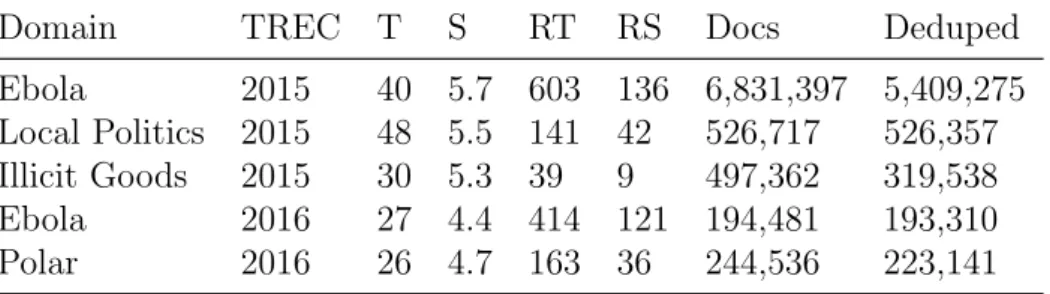
We conduct our effectiveness analysis within the standard experimentation paradigm provided by the task of the TREC 2015-2016 Dynamic Domain tracks [Grace Hui Yang, 2015, 2016]. In particular, this task comprises topics in four domains, as presented in Table 4.1. They are: (i) Ebola, which is related to the Ebola outbreak in Africa in 2014-2015; (ii) Illicit Goods, which is related to how illicit and counterfeit goods such as fake Viagra are made, advertised, and sold in the Internet; (iii) Local Politics, which is related to regional politics, the small-town politicians and personalities in the Pacific Northwest; (iv) Polar, which is related to the polar sciences. To retrieve novel documents as soon as possible, we perform a duplication removal procedure. To this end, we generated an MD5 hash signature for each document and iterated through them and removing the duplicated ones. In Table 4.1, Docs and Deduped are the number of documents before and after the duplicate removal. Moreover, in Table 4.2, we present an example of query topic, sub-topics, and document passages for some of the subtopics. Note that we use the term aspect instead of sub-topic as originally proposed only to facilitate the comparison with the literature.
Table 4.1: TREC 2015-16 Dynamic Domain track collections. T is the number of topics. S is the average number of sub-topics per topic. RT and RS are the average number of relevant documents per topic and per sub-topic, respectively.
Domain TREC T S RT RS Docs Deduped
Ebola 2015 40 5.7 603 136 6,831,397 5,409,275 Local Politics 2015 48 5.5 141 42 526,717 526,357 Illicit Goods 2015 30 5.3 39 9 497,362 319,538 Ebola 2016 27 4.4 414 121 194,481 193,310 Polar 2016 26 4.7 163 36 244,536 223,141
Table 4.2: TREC 2015 Dynamic Domain track, topic DD15-33, along with its corre-sponding sub-topics and a few passages.
Domain Local Politics Passages
Topic DD15-33 Australian Nursing Home Fire
DD15-33.1
4 There were 87 residents in the home on Hambledon Road when the fire broke out. 4 AS 96 elderly men and women lay in their beds the flames were building around them. 4 There were up to 100 residents in the nursing home and all have now been removed.
Sub-topics
DD15-33.1 Patients DD15-33.2 Liability DD15-33.3 Cause
DD15-33.4 Arrest and Charges DD15-33.5 Fatalities and Injuries
DD15-33.5
4.2. Evaluation metrics 27
4.2
Evaluation metrics
In this section, we present the evaluation metrics used in our experiments. In Sec-tion 4.2.1, we detail the primary metric used in this dissertaSec-tion, and in SecSec-tion 4.2.2, we present additional metrics used in this work.
4.2.1
Average Cube Test
In this dissertation, we use the Cube Test evaluation metric proposed by Luo et al. [2013], which measures the speed of completing a user’s need or task q represented as a cube. Luo et al. [2013] defined the average search speed at timestep t as:
CT(q, t) = Gain(q, t)
Effort(q, t), (4.1)
where Gain(q, t) is the amount of information the user found and Effort(q, t) is the effort the user spent on the search task. Thus, by using Equation 4.1, Luo et al. [2013] derived the average CT as:
ACT(q, t) = 1 N 1 t t X k=1
Gain(q, k)
Effort(q, k), (4.2)
whereN is a normalization factor which maps theACT score into the range 0–1. Next, we describe Gain, and Effort.
4.2.1.1 Gain
The amount of information is related to how much an object has been influenced by another object. Gain measures the amount of information the user found from the search system. Given a list of documents Dt={d
1, d2, d3, ..., dt}retrieved by a search
system to the user up to timestep t, we define Gain as:
Gain(q, t) =
t X
i=1
Gain(q, di, t), di 2Dt (4.3)
28 Chapter 4. Experimental Setup
the amount of information conveyed by a document is defined as:
Gain(q,d,t) = X
a∈A
I(q, a)UPR(q, d, a, t)Nov(q, a, t), (4.4)
whereI(q, a) is the importance of an aspecta, which stands for the area of the cuboid representing a. UPR(q, d, a, t) is the user-perceived relevance of a document d for a query d and aspect a, which illustrates the extent to which a document contributes to fulfill the cuboid a. Finally, Nov(q, a, t) is the novelty of an aspect a, which comes across as the friction faced when fulfilling the aspect cuboida. In this dissertation, we follow the official definitions of the three factors described above that were proposed by the TREC Dynamic Domain organizers: I(q, a) is uniform for all aspects; Nov(q, a, t) is a decay function na, where is a value ranging between 0–1, and nais the number
of documents found about aspect a in the previously selected documents; andUPR is defined as
UPR(q, d, a, t) =URR(d, q, a)1
t X
k=1
URR(dk, q, a)Nov(q, a, t)<T !
, (4.5)
where URR (User-Received Relevance) measures the amount of relevant information a document d conveys to a user with respect to an aspect a into the range 0–1. In contrast toUPR,URR is independent from the previously selected documents. UPRr
andUPRn measureUPR by assuming that there is a maximum amount of information
a user can absorb about an aspecta. Consequently, right after reaching a thresholdT
there is no absorption of documentd by the user.
4.2.1.2 Effort
Effort measures the amount of time or cost spent investigating the list of documents until a timestept. In this dissertation, we follow the official definition ofEffort proposed by the TREC Dynamic Domain organizer: bt/bc, wheret is the number of documents and b the batch size which is five.
4.2.2
Novelty and Diversity Metrics
4.3. Ad-hoc Search System 29
↵, defined as:
↵-nDCG(q, t) = 1 N
t X
k=1
P
a∈Arel(dk, a)(1 ↵) P
j=1k 1rel(dk,a)
log2(k +1) , (4.6)
where rel(dk, a) is the (binary) relevance grade of the k-the ranked document with
respect to each aspect a 2A, and N is the normalization factor from the traditional nDCG. The larger the value of↵, the more diversity is rewarded. In contrast, when↵= 0, only relevance is rewarded, and this metric is equivalent to the nDCG. In addition, we use the intent-aware (IA) of the expected reciprocal ranking (ERR) [Chapelle et al., 2011], defined as:
ERR-IA(q, t) =X
a∈A
P(a|q)ERR(a, t), (4.7)
where ERR(q, t) is computed individually for each aspecta2A, following the assump-tion that none of the other query aspects is of interest of the user.
4.3
Ad-hoc Search System
As an ad-hoc search system, we use the open source search library Lucene1 for both indexing and retrieval, with Porter stemmer and standard English stopwords removal. Additionally, we indexed each data domain separately. For document parsing (HTML, XML, RSS, etc.), we use the AutoDetectParser of Apache Tika.2
We use a field-based extension of DPH [Amati et al., 2007] (henceforth “DPHF”), a hypergeometric model from the divergence from randomness framework, with field weights set to 0.15 and 0.85 for title and content. Besides being parameter-free, DPHF outperformed similar field-based extensions of best-matching and language models in our preliminary investigations. Using DPHF, we retrieve the top 1,000 documents as a candidate set R for each query q.
4.4
Summary
This chapter introduced the research questions underlying the proposed dissertation and provided details of the general experimental setup used to answer them in the
1
https://lucene.apache.org
2
30 Chapter 4. Experimental Setup
Chapter 5
Simulation Results
In this chapter, we evaluate the impact of each component of the framework presented in Chapter 3.1 In particular, our experiments aim to answer the following research questions related toQ1, “How does each component of a dynamic search system impact the overall system effectiveness?”:
Q1.1 – How does the initial document sample impacts the effectiveness of a dynamic search system?
Q1.2 – What is the impact of feedback modeling on the system’s knowledge of the aspects underlying the user’s query?
Q1.3 – How do improved coverage estimates impact the system’s ability to dynamically adapt its ranking strategy?
Q1.4 – What is the impact of early and late stopping strategies on the attained
gain-effort trade-off?
To this end, we propose hypotheses related to the above research questions and answer the questions in the following sections: Section 5.1 studies the impact on the initial list of documents in the system; Section 5.2 studies the contribution of the user’s feedback to update the system’s knowledge about the aspects underlying a user’s need; Section 5.3 investigates the impact of coverage estimates for dynamically reranking the initial list of documents; Section 5.4 analyzes different strategies for stopping the interactive search process.
1
To avoid any bias towards any of these components, we applied the standard setting ofλ= 0.5 to balance relevance and diversity in the case of xQuAD, and current best aspect novelty and the novelty of other aspects in the case of PM2.
32 Chapter 5. Simulation Results
5.1
Baseline Ranker
The baseline ranker component may impact the effectiveness of a dynamic search sys-tem in different moments. In particular, to addressQ1.1, we propose two complemen-tary hypotheses:
H1. At earlier interactions, the effectiveness of the system is influenced by the
preci-sion attained by the baseline ranker.
H2. At later interactions, the effectiveness of the system is influenced by the recall
attained by the baseline ranker.
Regarding H1, because little feedback is available at early interactions (with ab-solutely no feedback att= 1), the overall system effectiveness depends on the relevance of the documents surfaced by the baseline ranker itself (i.e., precision). RegardingH2, the potential improvement brought by dynamically reranking the set of candidate doc-uments at later interactions depends on the amount of relevant docdoc-uments (i.e., recall) available in this set. To test these hypotheses, we simulate baseline rankers of various quality levels. Following Turpin and Scholer [2006], for each query q, we generate a series of permutations of the reference rankingR produced by DPHF (as discussed in Section 4.3) by repeatedly swapping randomly chosen pairs involving one relevant doc-ument and one irrelevant docdoc-ument each, until a target average precision (AP) value is achieved. As target AP values for this simulation, we split the range [0,1] of possible values into 20 equally sized bins (i.e., each bin has size 0.05) and randomly select 20 values from each bin, providing a total of 400 simulated permutations per query.
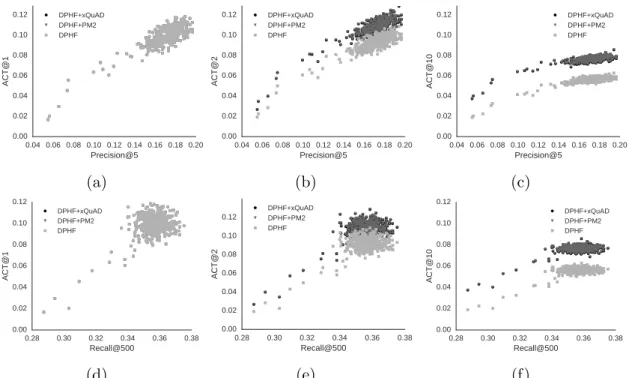
Figure 5.1 shows the effectiveness of three dynamic search systems (DPHF with-out reranking, DPHF+xQuAD, and DPHF+PM2) as we vary the quality of the base-line ranking produced by DPHF. Dynamic search effectiveness is given by ACT@twith t 2{1,2,10},2 whereas the effectiveness of the baseline ranker is given by either Pre-cision@5 (Figures A.5a-c) or Recall@500 (Figures A.5d-f). To make sure documents below the 500 cutoff cannot contribute to the reported ACT figures, for this particular experiment, both xQuAD and PM2 are restricted to diversify the top 500 documents returned by the baseline ranker. In addition, to further isolate any impact from the dynamic reranker component itself, both xQuAD and PM2 leverage perfect coverage estimates, as given by Equation (3.4).
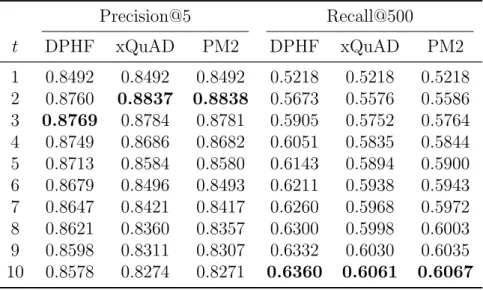
From Figure 5.1, we first note that dynamic search effectiveness (measured by ACT@t) is highly correlated with the effectiveness of the baseline ranker component
2
5.1. Baseline Ranker 33
(a) (b) (c)
(d) (e) (f)
Figure 5.1: Impact of baseline rankers of various quality levels at times t 2 {1,2,10} (see Appendix A.1 for separated domains).
34 Chapter 5. Simulation Results
Table 5.1: Correlation between ACT@t and Precision@5 or Recall@500 attained by the baseline ranker component.
Precision@5 Recall@500
t DPHF xQuAD PM2 DPHF xQuAD PM2
1 0.8492 0.8492 0.8492 0.5218 0.5218 0.5218 2 0.8760 0.8837 0.8838 0.5673 0.5576 0.5586 3 0.8769 0.8784 0.8781 0.5905 0.5752 0.5764 4 0.8749 0.8686 0.8682 0.6051 0.5835 0.5844 5 0.8713 0.8584 0.8580 0.6143 0.5894 0.5900 6 0.8679 0.8496 0.8493 0.6211 0.5938 0.5943 7 0.8647 0.8421 0.8417 0.6260 0.5968 0.5972 8 0.8621 0.8360 0.8357 0.6300 0.5998 0.6003 9 0.8598 0.8311 0.8307 0.6332 0.6030 0.6035 10 0.8578 0.8274 0.8271 0.6360 0.6061 0.6067
5.2
Aspect Modeling
Section 5.1 showed how the precision and recall of the baseline ranker component may impact the effectiveness of the entire dynamic search system. In this section, we analyze the contribution of an accurate modeling of the multiple aspectsAtunderlying
the user’s need based upon the feedback Ft provided by the user at each time t. To
addressQ1.2, we propose the following hypothesis:
H3. The effectiveness of a dynamic search system can be hindered by an inaccurate
or incomplete aspect modeling.
To investigate this hypothesis, we perform two simulations that perturb the refer-ence aspect model described in Section 3.3. First, we simulate the case where we may mishandle some of the user’s feedback on different passages associated with a given query aspecta. Leta=Pp∈∪tFtg(a, p) denote the accuracy of the aspect model built˜
for a, where ˜g(a, p) denotes the relevance grade assigned to a passage p with respect to aspect a, normalized by the total grade of all passages relevant to a (i.e., the “rel-evance mass” of passage p).3 In our simulation, a mishandled feedback on passage p for aspecta incurs a probability (1 a) of zeroing out coverage estimates P(d|q, a) of
any documentd given this aspect, hence introducing noise in the subsequent dynamic reranking. Conversely, with probability a, perfect estimates are used, as defined in
3
5.2. Aspect Modeling 35
Equation (3.4). In our second simulation, we consider all aspects as perfectly accurate (i.e., a = 1,8a 2 At) and evaluate the impact of incomplete aspect models, by
mis-handling entire aspects as opposed to individual passages. For this simulation, we zero out coverage estimates P(d|q, a) of all documents that are relevant to a mishandled aspect a.
Figure 5.2 shows the impact on dynamic search effectiveness in terms of ACT@10 for DPHF, DPHF+xQuAD, and DPHF+PM2 as we perturb the underlying aspect model. To this end, in Figure 5.2a, we vary the probability of mishandling individual passages within the range [0,1] with steps of 0.05. In Figure 5.2b, we vary the fraction
of mishandled aspects, also within the range [0,1] with steps of 0.05. In both figures, for a given step, the whole process is repeated 100 times, with error bars denoting standard deviations. Recall that DPHF alone is not affected by perturbations, as it does not leverage any user feedback for reranking. As a result, it provides a natural lower bound for both DPHF+xQuAD and DPHF+PM2.
(a) Inaccurate aspect modeling.
(b) Incomplete aspect modeling.
Figure 5.2: Impact of inaccurate or incomplete aspect models (see Appendix A.2 for separated domains).
mis-36 Chapter 5. Simulation Results
handling feedback on individual passages or the fraction of mishandled aspects, dy-namic search effectiveness is hindered, which answers Q1.2 by providing supporting evidence forH3. On the other hand, these results demonstrate a reasonable resilience of both xQuAD and PM2 to inaccurate or incomplete aspect models. In particular, as highlighted in Figure 5.2a, mishandling feedback on individual passages with 50% probability accounts for 35.8% of the total drop in ACT@10. In turn, mishandling 50% of all aspects underlying a query accounts for 37.8% of the total drop in Figure 5.2b.
5.3
Dynamic Reranker
In Section 5.2, we investigated how perturbed aspect models could impact the eff ec-tiveness of a dynamic search system. In that investigation, we isolated the impact of the dynamic reranker component, by leveraging perfect estimates of the coverage of each document with respect to each modeled aspect. In this section, we addressQ1.3, by investigating the impact of the dynamic reranker component itself. To this end, we propose the following hypothesis:
H4. The effectiveness of a dynamic search system can be enhanced by improved doc-ument coverage estimates for a given aspect model, more so for narrower queries.
Accurate coverage estimates have been shown to contribute to the effectiveness of explicit diversification approaches, such as xQuAD and PM2 [Santos et al., 2012], which are used here as reference models for dynamic reranking. Our hypothesis is that such estimates will also be key in a dynamic search scenario, particularly for narrower queries, which have a smaller number of relevant aspects and hence are arguably harder to diversify. To test this hypothesis, we simulate increasingly innacurate coverage estimates, by gradually adding noise to the perfect estimates given by Equation (3.4). Inspired by related research on differentially private recommender systems [Berlioz et al., 2015], we perturb the relevance gradeg(a, d) assigned to documentdwith respect to aspect a by adding a Laplacian noise Y ⇠ Laplace(0, b) to it. In this dissertation, we parameterize b as ∆a/✏. The sensitivity parameter ∆a captures the dispersion of
relevance grades associated with aspecta, as the difference between the maximum and minimum values returned by g(a, d) for all documentsd2R sampled for the query q. In turn, the leakage parameter✏determines how much of the perfect coverage estimates is allowed to “leak” to the dynamic reranker. In other words, lower ✏ values denote noisier coverage estimates, whereas higher✏ values denote cleaner estimates.
5.3. Dynamic Reranker 37
0.1. For a given step, the entire process is repeated 100 times. On the x-axis, instead of reporting actual leakage values, which cannot be easily interpreted, we indicate how much the resulting (perturbed) coverage estimates differ from perfect coverage esti-mates. To this end, for each aspect a, we compute the ordering over all documents d 2 R induced by the perturbed coverage estimates P(d|q, a) and compute its nDCG using the expected ordering (induced by the perfect coverage estimates) as ground-truth. The aspect nDCG for a query q is then computed by averaging over the nDCG obtained for its aspects a2At.
Figure 5.3: Impact of perturbed coverage estimates (see Appendix A.3 for separated domains).
From Figure 5.3, we first note that DHF+xQuAD and DPHF+PM2 increasingly outperform the DPHF baseline ranker as their underlying coverage estimates improve, in support of H4. In particular, xQuAD begins to outperform DPHF at a critical leakage (CL) point of 0.3, measured in terms of aspect nDCG. On the other hand, PM2 requires slightly improved coverage estimates at a CL point of 0.4. To better understand the impact of improved coverage estimates, Figure 5.4 provides a breakdown analysis of the results in Figure 5.3 for queries organized in different bins in the range{1,2, ...,10} according to the number of relevant aspects underlying each query.4
From Figure 5.4, we observe a slight decrease in CL as the number of aspects per query increases, particularly for PM2. In addition to CL points, Figure 5.4 also shows the room for improvement (RI) in each bin, measured as the difference between the ACT@10 attained by the dynamic reranker (xQuAD or PM2) with perfect coverage estimates and the ACT@10 attained by the baseline ranker (DPHF). As shown in the figure, RI increases with the number of aspects per query. These results suggest that narrower queries (i.e., those with fewer aspects) are indeed harder to improve and
4

![Table 2.1: Subtasks of learning and investigation tasks based on Marchionini [2006].](https://thumb-eu.123doks.com/thumbv2/123dok_br/15649724.620353/32.892.233.636.145.410/table-subtasks-learning-investigation-tasks-based-marchionini.webp)