www.bjorl.org
Brazilian
Journal
of
OTORHINOLARYNGOLOGY
ORIGINAL
ARTICLE
Comparison
of
microRNA
profiles
between
benign
and
malignant
salivary
gland
tumors
in
tissue,
blood
and
saliva
samples:
a
prospective,
case-control
study
夽
Ovgu
Cinpolat
a,
Zeynep
Nil
Unal
b,
Onur
Ismi
c,∗,
Aysegul
Gorur
d,
Murat
Unal
caGaziantepStateHospital,Gaziantep,Turkey
bUniversityofMersin,FacultyofPharmacy,DepartmentofBiochemistry,Mersin,Turkey cUniversityofMersin,FacultyofMedicine,DepartmentofOtorhinolaryngology,Mersin,Turkey dUniversityofMersin,FacultyofMedicine,DepartmentofMedicalBiochemistry,Mersin,Turkey
Received12December2015;accepted23March2016 Availableonline27April2016
KEYWORDS
Salivaryglandtumor; MicroRNA;
miR-21; miR-30e; Pathogenesis
Abstract
Introduction:Salivaryglandtumors(SGTs)arerareheadandneckmalignanciesconsistingofa spectrumoftumorswithdifferentbiologicalbehaviors.
Objective:In this study we aimed to find out differential expression of microRNA profiles betweenbenignandmalignantSGTs.
Methods:Weinvestigatedthepossibleroleof95microRNAsinthe20patients withsalivary glandtumorswith comparisonof17 patientswithoutmalignancyorsalivary glanddiseases. Sixteenofthetumorswerebenign(sevenpleomorphicadenomas,nineWarthintumors),four ofthemweremalignant(twosquamouscellcarcinomas,onehighgrademucoepidermoid carci-noma,oneadenocarcinoma).Serumandsalivasampleswerecollectedfrombothpatientsand controlgroup.Tissuesamplesoftumormasseswerealsocollectedfrompatientgroup. Results:AmongstudiedmicroRNAs miR-21,miR-23a,miR-27a,miR-223,miR-125b,miR-126, miR-146a,miR-30eweredownregulatedinthebenigngroupcomparedtocontrolgroupinthe serumsamples(p-valuesare0.04,0.00005,0.00005,0.0022,0.031,0.00008,0.044,and0.0007, respectively).WhentissuesampleswerestudiedmiR-21,miR-31,miR-199a-5p,miR-146b, miR-345wereup-regulatedinthemalignantgroupcomparedtobenigngroup(pvaluesare0.006, 0.02,0.013,0.013,0.041,respectively).miR-30eshowedstatisticallysignificantup-regulation inmalignanttumorgroup’splasmasamplescomparedtobenigngroup(p=0.034).Therewas nostatisticallysignificantdifferenceinsalivasamplesbetweengroups.
夽 Pleasecitethisarticleas:CinpolatO,UnalZN,IsmiO,GorurA,UnalM.ComparisonofmicroRNAprofilesbetweenbenignandmalignant salivaryglandtumorsintissue,bloodandsalivasamples:aprospective,case-controlstudy.BrazJOtorhinolaryngol.2017;83:276---84.
∗Correspondingauthor.
E-mails:[email protected],[email protected](O.Ismi).
PeerReviewundertheresponsibilityofAssociac¸ãoBrasileiradeOtorrinolaringologiaeCirurgiaCérvico-Facial.
http://dx.doi.org/10.1016/j.bjorl.2016.03.013
Conclusion: OurresultsshowedthatdifferentmicroRNAsmayplayroleinsalivarytumor patho-genesisaccordingtobiologicalbehavior.Although therewas nodifferenceinsalivasamples betweengroups,accordingtotissueandserumsamplesmiR-21and30emayhaveanimportant role;sincetheyweredown-regulatedinbenigntumorswhereasup-regulatedinmalignantones. © 2016 Associac¸˜ao Brasileira de Otorrinolaringologia e Cirurgia C´ervico-Facial. Published by Elsevier Editora Ltda. This is an open access article under the CC BY license (http:// creativecommons.org/licenses/by/4.0/).
PALAVRAS-CHAVE
Tumordeglândula salivar;
MicroRNA; miR-21; miR-30e; Patogenia
Comparac¸ãodeperfisdemicroRNAentretumoresdeglândulasalivarbenignose
malignosemamostrasdetecido,sangueesaliva:estudocaso-controleprospectivo
Resumo
Introduc¸ão: Ostumoresdaglândulasalivar(TGS)sãolesõesmalignasrarasdecabec¸aepescoc¸o queconsistememumespectrodetumorescomdiferentescomportamentosbiológicos. Objetivo: Nesteestudo,tivemoscomoobjetivoidentificaraexpressãodiferencialdeperfisde microRNAentreTGSbenignosemalignos.
Método: Investigamosapossívelparticipac¸ãode95microRNAem20pacientescomtumoresde glândulassalivarescomparadoa17pacientessemdoenc¸amalignaoudoenc¸asdasglândulas sali-vares;16dostumoreserambenignos(seteadenomaspleomórficos,novetumoresdeWarthin), quatrodeleserammalignos(doiscarcinomasespinocelulares,carcinomamucoepidermoidede altograu,umadenocarcinoma).Asamostrasdesoroesalivaforamcoletadasdepacientesedo grupocontrole.Amostrasdetecidodostumorestambémforamcolhidasdogrupodepacientes comtumores.
Resultados: EntreosmicroRNAestudados,miR-21,miR-23a,miR-27a,miR-223,miR-125b, miR-126,miR-146a,miR-30eforaminfrarreguladosnogrupobenignoemcomparac¸ãocomogrupo controle nasamostras dosoro (osvalores de p são0,04, 0,00005, 0,00005, 0,0022,0,031, 0,00008,0,044 e0,0007,respectivamente).Quandoasamostrasdetecidoforamestudadas, miR-21,omiR-31,omiR-199-5p,miR-146b,omiR-345foramsuprarreguladosnogrupomaligno em relac¸ãoao grupobenigno(valoresdepsão0,006,0,02,0,013,0,013,0,041, respectiva-mente).OmiR-30eapresentousuprarregulac¸ãoestatisticamentesignificativaemamostrasde plasmadogrupodetumormalignoemrelac¸ãoaogrupobenigno(p=0,034).Nãohouvediferenc¸a estatisticamentesignificativaemamostrasdesalivaentreosgrupos.
Conclusão:Nossos resultados mostraram que diferentes microRNA podem desempenhar um papelnapatogeniadotumorsalivardeacordocomocomportamentobiológico.Emboranão tenhahavidodiferenc¸aemamostrasdesalivaentreosgrupos,deacordocomasamostrasde tecidoedesoro,miR-21e30epodemterumpapelimportante,jáqueforaminfrarregulados nostumoresbenignosenquantosuprarreguladosnostumoresmalignos.
© 2016 Associac¸˜ao Brasileira de Otorrinolaringologia e Cirurgia C´ervico-Facial. Publicado por Elsevier Editora Ltda. Este ´e um artigo Open Access sob uma licenc¸a CC BY (http:// creativecommons.org/licenses/by/4.0/).
Introduction
Salivaryglandtumors(SGT)compriseonly3---5%ofallhead andneckmalignancies;theyhaveatleast24differenttypes accordingtoWorldHealthOrganization2005classification.1 Among these pleomorphic adenoma is the most common benign tumor whereas mucoepidermoid carcinoma is the mostcommonmalignantone.2Theexactpathogenesisand waytomalignanttransformationforsalivaryglandtumors arenotwellknown.Although cigarettesmokingand alco-hol consumption are important risk factors for head and SquamousCell Carcinomas (SCC), they arenot admissible for salivaryglandtumors,andoccupational exposuresare unlikelytotakepartinthepathogenesis.3
salivaandtissuelevelsofmiRNAsamongsalivarygland neo-plasms.
Methods
Local ethical committee approval was acquired for our study. 20 patients with salivary gland tumors and 17 sex andagematchedhealthycontrolswithoutanysalivarygland or systemic disorders were included. Mean age for sali-varyglandtumorwas53.1andmeanageforcontrolgroup was46.4.There were10 male(50%) and10 female(50%) patientsin tumor groupand 9male(52.9%) and8female (47.1%)patientsinthecontrolgroup.Therewasno statis-tically significant difference regardingage (p=0.251) and sex(p=0.858)betweentumorandcontrolgroups.Fromthe tumorgrouptherewere16benignand4malignanttumors. Malignant ones were two SCCs, one high grade mucoepi-dermoidcarcinoma,oneadenocarcinoma.Onlytheprimary squamouscellcarcinomasweretakentothestudyaccording toGaughan’sinclusioncriteria,8,9metastaticsquamouscell carcinomaswereexcluded.BenignoneswerenineWarthin tumorsandsevenpleomorphicadenomas.Listofthetumors weresummarizedinTable1.Inthetumorgroupone(25%) of fourin the malignant group and five(31.25%) of 16 in thebenigngroupwerefemale.Regardingsexandage dif-ferencesbetweenmalignantandbenigntumorgroups,there wasnostatisticallydifferentforbothsex(p=0.807)andage (p=0.9355).
MicroRNAanalysis
Serumcollection
Bloodsamples of 5mL were collected to 7.5% EDTA con-tainingtubesfrompatientgrouppreoperativelyandcontrol group. After centrifugation serums were collected and storedat−80◦C.
Salivacollection
Aftercatheterizationoftheinvolvedsalivaryglandductus, byusinglemonassialogogue200Lsalivaoftheinvolved gland was collected. The saliva was mixed with 200L RNAlater (QIAGEN Inc., Valencia, CA) solution. After two hoursinroomtemperature,theywerestoredat−80◦Cin
deepfreezer.10 200
L salivawas also collected fromthe controlgroup.
Tissuecollection
Tissue samples were taken only from the salivary gland tumor group. During surgery for salivary gland tumor; a
Table 1 Histopathologic types of tumors in the patient group.
Tumortype Percentage
Warthin’stumor 9/20(45%)
Pleomorphicadenoma 7/20(35%)
Squamouscellcarcinoma 2/20(10%) Highgrademucoepidermoidcarcinoma 1/20(5%)
Adenocarcinoma 1/20(5%)
3---4mm3tumoral tissuewasusedfor analysis.Tissue
sam-ples were put into 1mL RNAlater (QIAGENInc., Valencia, CA) solution. After two hours in room temperature, they werestoredat −80◦Cindeepfreezer.Tissueswerediced
withasurgicalbladeandhomogenizedwithpestleand mor-tar. MicroRNA isolation from the homogenized tissue was done byMicroRNAisolation kit(RocheDiagnostics,GmbH, Mannheim,Germany)according tomanufacturer’s instruc-tions.
MicroRNAexpressionprofiling
AfterMicroRNAs wereisolatedfromserum, salivaand tis-sue by MicroRNA isolation kit (Roche Diagnostics, GmbH, Mannheim,Germany)according tomanufacturer’s instruc-tions;RNA samplesconvertedtocDNAbyusingmiScriptII RT Kit (Qiagen). cDNA samples are preamplified by using miScriptMicrofluidicsPreAMP Kit(Qiagen).qRT-PCR analy-sisperformedbyusingmiScriptmiRNAAssays(Qiagen)with Dynamic Array 96.96 (Fluidigm) on BioMark System (Flu-idigm).Basically95typesofmicroRNAswerestudied.
Dataanalysis
qRT-PCR results analyzed by using 2−Ct method.11,12
Briefly,upordownregulationofmicroRNAswerecompared between groups. Student’s t-test was used for analyzing age differences and Chi-square test was used for analyz-ingsexdifferencesbetween groups.Expression datawere controlled for normal distribution with the Shapiro---Wilk test. According to the results; all data were not nor-mallydistributed.Mann---WhitneyU-testwasusedtodetect expressiondifferencesofmiRNAsinserum,tissueandsaliva samples. p-Value of <0.05 was considered as statistically significant.
Results
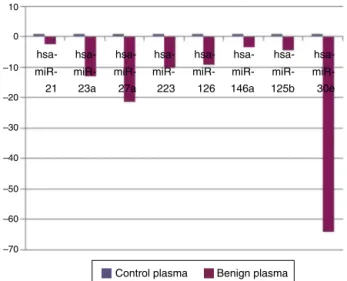
When benign tumors were compared with control group; 8 miRNAs(miR-21,miR-23a,miR-27a,miR-223,miR-125b, miR-126,miR-146a,andmiR-30e)asshowninFig.1,had sta-tisticallysignificantdown-regulationinbenigntumorgroup
10
0
–10
–20
–30
–40
–50
–60
–70
miR-21 23a 27a 223 126 146a 125b 30e miR- miR- miR- miR- miR- miR- hsa- hsa- hsa- hsa- hsa- hsa-
hsa-Control plasma Benign plasma
Table 2 MicroRNAs showing statistically significant fold changesbycomparingtheplasmasamplesofbenigntumor andcontrolgroupswithpvalueswerepresented.
MicroRNAtype Foldregulation p-Values
Mir-21 −2.5197 0.04
Mir-23a −13.05 0.00005
Mir-27a −21.4 0.00005
Mir-125b −4.644 0.031
Mir-126 −9.2 0.00008
Mir-30e −64.38 0.0007
Mir-146a −3.5 0.044
Mir-223 −10.34 0.0022
5
0
–5
has-miR-31 has-miR-199a
has-miR-146b
has-miR-21
has-miR-345
–10
–15
–20
Malign tissue Benign tissue
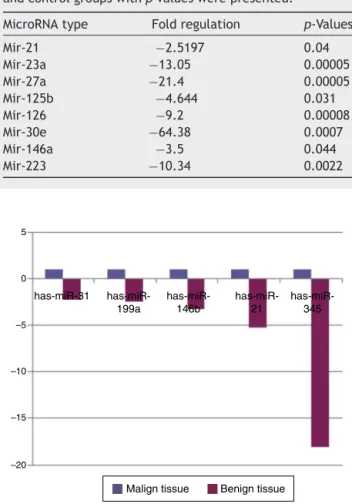
Figure2 ComparisonoftissuemicroRNAexpressionprofiles betweenbenignandmalignanttumorgroups.
in serumsamples.Table2 summarizes thefoldregulation and p-valuesof these miRNAs. There was no statistically significantup-regulationofmiRNAsinserumsamples.
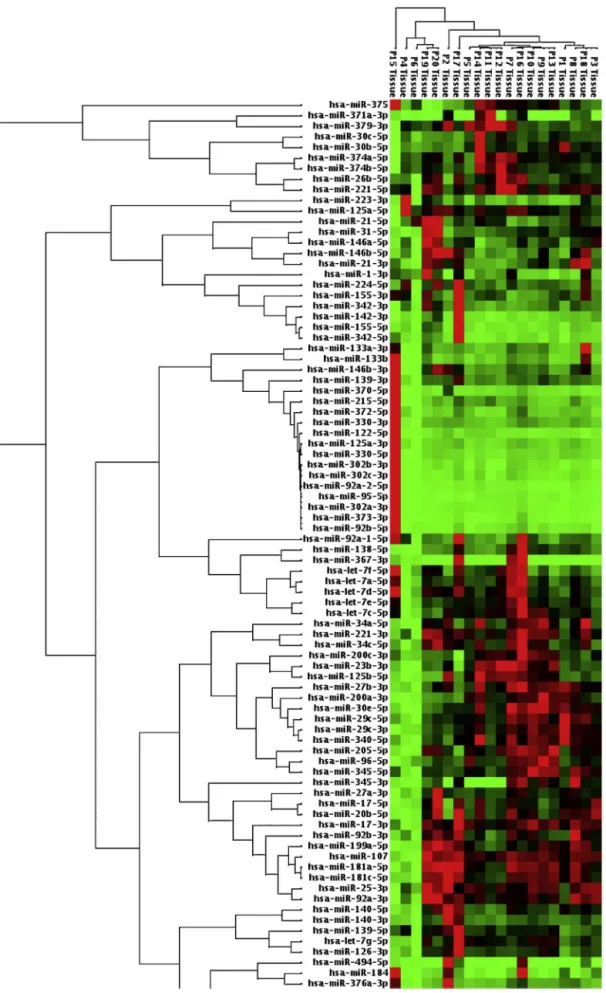
When malignant tumor group patients were compared withbenigntumorgroupintissuesamples;5miRNAs (miR-21, 31, 199a, 146b, 345) showed statistically significant up-regulationinmalignanttumorgroup(Fig.2).Table3 sum-marizesthefoldregulationvaluesinmalignanttumorgroup withp-values.Heatmap diagramof clustering of miRNAs intissuesampleswereshownin Fig.3.Among these miR-NAsmiR-199aalsoshowedstatisticallysignificant(p=0.042)
Table 3 MicroRNA expression ofmalignant tumor group comparedtobenigntumorgroupintissuesamplesshowing statisticallysignificantfoldchangeswereshown.
MicroRNAtype Foldregulation p-Values
Mir-21 +5.23 0.0006
Mir-31 +2.24 0.02
Mir-199a +2.36 0.013
Mir-146b +3.21 0.013
Mir-345 +18.063 0.041
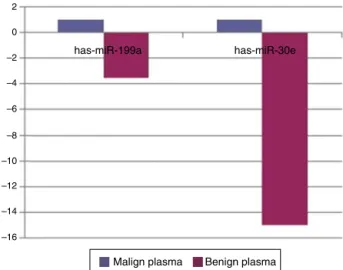
up-regulation in serum samples of malignant group com-pared to benign group. miR-30e showed 15.06 fold up-regulation(p=0.034)inmalignanttumorgroup’splasma samplescomparedtobenigngroup(Fig.4).
Whenmalignanttumorgroupwascomparedwithcontrol groupmiR-23ashowed10.5folddownregulation(p=0.02) inserumsamplesofmalignanttumors(datanotshown).
Therewasnostatisticallysignificantdifferenceinsaliva samplesbetweenbenign,malignantandcontrolgroups.
Discussion
Sincetheywerefirstfound inthenematode Caenorhabdi-tis elegans in 1993,13 miRNAs have been investigated for their probable roles in normal physiological and diseased stateswithseveralstudies.Theyareaclassofendogenous smallRNAswhichtarget geneexpression inthe posttrans-criptional level that negatively regulate messenger RNA translation.4,14 Aftertranscriptedvia RNApolymeraseII or III,theyhave multipleimportantbiologicalbehaviorssuch asproliferation,differentiation,apoptosisandmotility.4,14 Theseimportantfeaturesmakethemcrucialinphysiological developmentoftissuesandanomaliesintheirtranscription mayleadtoaberrantdifferentiationandcarcinogenesis.6
For normal embryological development of salivary glands,rolesofmiRNAshavebeeninvestigatedbyauthors. In a murine model Jevnaker and Osmundsen15 found that there were tissue specific miRNAs in the submandibular glandfornormaldevelopmentsuchashas-miR-28,150,222, 299,322,329,341,375and429.miRNAsmiR-23a,27a,223, 125b, 126, 30e which were shown to be down regulated inbenigntumorgroupinourstudywerealsoexpressedin submandibularglandofmiceembryo.Alsosomemembers of miRNA 17---92 cluster such as miR-19b, miR-20a, miR-92werehighlyexpressedduringmicesubmandibulargland development.14 miR-21 whichwasoneof themost impor-tantmiRNAsstudied inourreport,isalsoacrucialmiRNA forembryologicaldevelopmentofsubmandibularglandand itsbranchingmorphogenesis.Itwasshowntobeexpressed in mesenchymal tissue of mice submandibular gland,this expression was up-regulated by epidermal growth factor whichhascriticalroleinbranchingofsubmandibulargland ductus.16
2
0
–2 has-miR-199a has-miR-30e
–4
–6
–8
–10
–12
–14
–16
Malign plasma Benign plasma
Figure4 Comparisonofplasmasamplesofbenignand malig-nanttumorgroupformicroRNAexpressionprofiles.
ThismiRNAmayhaveacriticalroleinbothbenignand sali-varyglandtumorpathogenesis.
InourstudymiR-125bwasshowntobedownregulated in serum samples of benign salivary gland tumors. miR-125bandmiR-100aretwoimportantmiRNAsmapping the chromosome11. Alterationsin thischromosome maylead to both oral cancers and mucoepidermoid carcinoma of salivary gland.19,20 In the study of Hui et al.18 expression of miR-125b was also down regulated in head and neck squamous cell carcinoma like our study. Down regulation of this miRNA may cause increased cell proliferation and carcinogenesis.19
MiR-23a and miR-27a belong to miR 23a∼27a∼24-2
cluster located on chromosome 9q22. They have multi-ple functions in both healthy and disease states such as cell cycle, proliferation, differentiation and cardiac hypertrophy.21 Literature investigating the role of these miRNAsin carcinogenesis is conflicting. miR-23aand miR-27a was shown to be down regulated in oral SCC,22 whereasrecentlyPengetal.showedthatmiR-23apromotes chemoresistancetocisplatinchemotherapyintongueSCC.23 miR-23aand27-aarealsodownregulatedinacute promy-elocyticleukemiawhereastheyareupregulatedin acute myeloid leukemia, acute lymphoblastic leukemia, gastric cancer andhepatic cancer.21 In thelight of recent litera-tureitis obviousthatthesemiRNAsmaybehavedifferent inpathogenesisofdifferentcancers,theymayactastumor suppressorgeneinonecancer while oncogenein another. InourstudymiR-23aand27awereshown tobedown reg-ulatedin serum samples of benign salivarygland tumors. miR-23awasalsodownregulatedinmalignanttumorgroup comparedtocontrolgroupinserumsamples.miR-23amay behave like a tumor suppressor gene in both benign and malignantsalivaryglandtumors.
Whentissueandplasmasampleswerecomparedamong benign and malignant salivary gland tumorsin ourstudy; there was a 2.3656 fold up-regulation (p=0.01357) of miR-199a-5p in tissue samples and 3.5 fold up regula-tion (p=0.042) in serum samples of malignant tumors. This miRNA was also shown to be up-regulated in colon,
hepatocellular,gastriccancerandmalignantmelanoma.24,25 InthestudyofLiuetal.,26miR-31wasup-regulatedinoral SCCandlevelsweredecreased aftertreatment,regarding possible role of this miRNA as a marker in this cancer. There was a 2244 fold (p=0.0208) up-regulation of this miRNAinmalignantsalivarytumorgroupintissuesamplesin ourstudy.miR-146bwasshowntobeimportantprognostic factor for papillarythyroid cancerpatients, more expres-sionofthismiRNAin tumorcellshasdecreasedsurvival.27 miR-146bexpression wasalsoincreased inanaplastic thy-roidcancercells.28 Howeverfor breastcancer, expression of miR-146b has caused reduction in metastatic ability by suppressing NF-kB activity.29 In our study there was a 3.21 fold up-regulation (p=0.013) of miR-146b in malig-nant tumor group compared to benign group in tumor tissuespecimens.miR-345wasfoundtohavea prognostic value in prostate30 and colorectal31 cancer. In our study, itwas18foldup-regulated(p=0.041)inmalignantgroup. For miR-30e; it was shown to be up-regulated in hepa-tocellular cancer32 whereas down-regulated in anaplastic thyroid cancer.33 In our study miR-30e showed15.06 fold up-regulation(p=0.034)inmalignanttumorgroup’splasma samplescompared tobenign group,whereas there wasa down-regulationinbenigntumorgroupcomparedtocontrol group(p=0.0007)inplasmasamples.
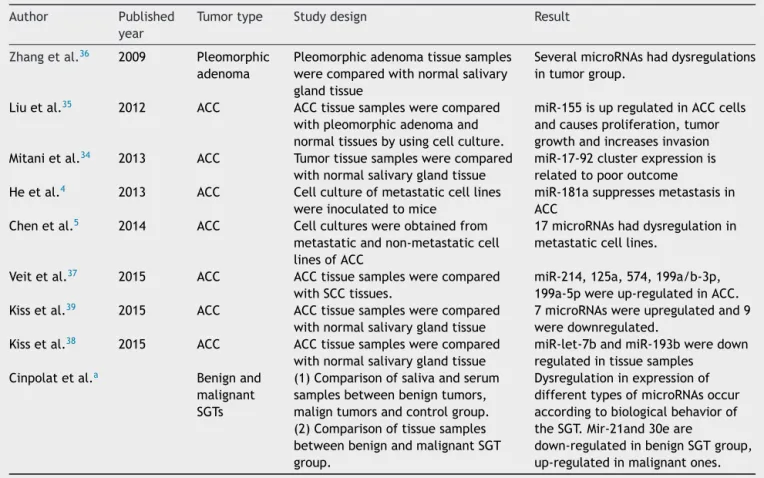
Studies concerning the relationship between salivary glandtumors and miRNAs arelimited. Mitani et al. stud-iedmiRNAprofiles of ACC specimenscomparedtonormal salivarytissues.Theyfoundthatover-expressionofmiR-17 andmiR-20awasrelatedtopooroutcome.34Heetal.found thatexpressionof miR-181ainACC tumorcells decreased metastaticpotential of the tumor.4 Liu etal. speculated that suppression of miR-155 can inhibit cell proliferation and tumor growth for ACC.35 Chen et al. found that 17 differentmiRNAs had statisticallysignificant foldchanges inthemetastaticACCcomparedtonon-metastaticonesin celllines.5Amongbenignsalivaryglandtumorspleomorphic adenomaswereinvestigatedforpossibleroleofmiRNAsin pathogenesis.Zhangetal.found that17differentmiRNAs wereup-regulatedintumorsamplesincludingmiR-21.36This resultwasnotconsistentwithourstudy.Inourstudy;there wasadownregulationofmiR-21inserumsamplesofbenign tumorgrouppatientscomparedtocontrolgroup.This dif-ferencemayarisefromtwopoints.Firstly;ourbenigntumor groupcomposedofmultiplepathologies,notonly pleomor-phicadenoma.Secondly;serumsampleswerestudiedinthe controlgroup insteadof tissuesamples. Inanother study, Veitetal.comparedthemiRNAprofilesofACCandSCCof theheadandneckregion.miR-214,125a, 574,199a/b-3p and199a-5p were up-regulatedin ACC group.37 miR-199a was also up-regulated in malignant group tissue samples in ourstudy. Recently Kiss etal.38 demonstrated possible roleofdown-regulationofmiR-let-7bandmiR-193bin sali-varyglandACCpathogenesis.AgainKissetal.39foundseven overexpressedmiRNAsandninedown-expressedmiRNAsin salivary ACC tissue samples in another study. Previously publishedstudies withcomparisonofourstudywere sum-marizedinTable4.
Table4 PreviouslypublishedstudiesconcerningtherelationshipbetweenMicroRNAsandsalivaryglandtumors.
Author Published year
Tumortype Studydesign Result
Zhangetal.36 2009 Pleomorphic adenoma
Pleomorphicadenomatissuesamples werecomparedwithnormalsalivary glandtissue
SeveralmicroRNAshaddysregulations intumorgroup.
Liuetal.35 2012 ACC ACCtissuesampleswerecompared withpleomorphicadenomaand normaltissuesbyusingcellculture.
miR-155isupregulatedinACCcells andcausesproliferation,tumor growthandincreasesinvasion Mitanietal.34 2013 ACC Tumortissuesampleswerecompared
withnormalsalivaryglandtissue
miR-17-92clusterexpressionis relatedtopooroutcome Heetal.4 2013 ACC Cellcultureofmetastaticcelllines
wereinoculatedtomice
miR-181asuppressesmetastasisin ACC
Chenetal.5 2014 ACC Cellcultureswereobtainedfrom metastaticandnon-metastaticcell linesofACC
17microRNAshaddysregulationin metastaticcelllines.
Veitetal.37 2015 ACC ACCtissuesampleswerecompared withSCCtissues.
miR-214,125a,574,199a/b-3p, 199a-5pwereup-regulatedinACC. Kissetal.39 2015 ACC ACCtissuesampleswerecompared
withnormalsalivaryglandtissue
7microRNAswereupregulatedand9 weredownregulated.
Kissetal.38 2015 ACC ACCtissuesampleswerecompared withnormalsalivaryglandtissue
miR-let-7bandmiR-193bweredown regulatedintissuesamples
Cinpolatetal.a Benignand malignant SGTs
(1)Comparisonofsalivaandserum samplesbetweenbenigntumors, maligntumorsandcontrolgroup. (2)Comparisonoftissuesamples betweenbenignandmalignantSGT group.
Dysregulationinexpressionof differenttypesofmicroRNAsoccur accordingtobiologicalbehaviorof theSGT.Mir-21and30eare
down-regulatedinbenignSGTgroup, up-regulatedinmalignantones.
ACC,adenoidcysticcarcinoma;SGT,salivaryglandtumors;miR,microRNA.
aPresentedstudy.
genesofthesemiRNAs.(Thesegenes weresearchedusing Mirwalk and Mirtarbase microRNA database systems.)40,41 RPS7genefoundonchromosome2,codesaribosomal pro-teinbelonging to S7E family, and LIMCH1 gene,found on chromosome 4, codes zinc ion-binding proteins.40,41 With futurestudies,zincion-bindingproteinsandribosomal pro-teinsbelongingtoS7Efamilymaybenewtargetmolecules fordifferingbiologicalbehaviorofthesalivaryglandtumors in serum samples and/or fine needle aspiration biopsy results.
Althoughourmalignanttumor sample sizeseemstobe small,therehavebeenpublishedarticlesinvestigatingthe rolesofmiRNAsinSGT carcinogenesis withsimilarsample size.InthestudyofVeitetal.37 theyhadcomparisonof5 tumortissuesamplesofACCwith10tumortissuesamples ofSCC.InthestudyofLiuetal.35theycompared10cases of ACC with 4 cases of pleomorphic adenoma and 8 nor-malparotid glandtissues. RecentlyKiss etal.39 published theirstudywithonly twocasesofsalivaryACCs.We think thatourresultsaremeaningfulforinvestigation ofmiRNA pathogenesisinSGTs.
Conclusion
Asaresult;underthelightofpreviouslypublishedarticles andcurrentstudy;wecouldspeculatethatmiRNAsmayhave
a roleinsalivaryglandtumor pathogenesis.Dysregulation of miRNA type differs according to the biological behav-ior.miR-21andmiR-30emayhaveacriticalroleinsalivary glandtumordevelopmentwithtargetingRPS7andLIMCH1 genes.
Conflicts
of
interest
Theauthorsdeclarenoconflictsofinterest.
Acknowledgement
Funding ofthisstudy wasmaintainedby MersinUniversity AcademicResearchProjectUnit.
References
1.EvesonJW,AuclairPL,GneppDR,El-NaggarAK.Tumorsofthe salivaryglands:introduction.In:BarnesEL,EvesonJW,Reichart P,SidranskyD, editors.WorldHealth Organization classifica-tionsoftumours:pathology&genetics.Headandnecktumours. Lyon:IARCPress;2005.p.221---2.
3.Muscat JE, Wynder EL. A case/control study of risk factors formajorsalivaryglandcancer.OtolaryngolHeadNeckSurg. 1998;118:195---8.
4.HeQ, ZhouX,Li S,JinY,ChenZ,ChenD,etal. MicroRNA-181asuppressessalivaryadenoidcysticcarcinomametastasis by targeting MAPK-Snai2 pathway. Biochim Biophys Acta. 2013;1830:5258---66.
5.ChenW, Zhao X, Dong Z, Cao G, Zhang S. Identification of microRNAprofiles in salivary adenoid cystic carcinoma cells duringmetastaticprogression.OncolLett.2014;7:2029---34. 6.ChenD,CabayRJ,JinY, Wang A,LuY, Shah-KhanM,etal.
MicroRNAderegulationsinheadandnecksquamouscell carci-noma.JOralMaxillofacRes.2013;4:e2.
7.JamaliZ,AslAminabadiNA,AttaranR,PournagiazarF, Gher-tasiOskoueiS,AhmadpourF.MicroRNAsasprognosticmolecular signatures in human head and neck squamous cell carci-noma: a systematic review and meta-analysis. Oral Oncol. 2015;51:321---31.
8.LeeSW, KimGE, ParkCS, ChoiEC,YangWI, Lee CG,etal. Primarysquamouscellcarcinoma oftheparotidgland. AmJ Otolaryngol.2001;22:400---6.
9.GaughanRK,OlsenKD,LewisJE.Primarysquamouscell carci-nomaoftheparotidgland.ArchOtolaryngolHeadNeckSurg. 1992;118:798---801.
10.ParkNJ,ZhouH,ElashoffD,HensonBS,KastratovicDA, Abe-mayorE,etal.SalivarymicroRNA:discovery,characterization, andclinicalutilityfororalcancerdetection.ClinCancerRes. 2009;15:5473---7.
11.SchmittgenTD,LivakKJ.Analyzingreal-timePCRdatabythe comparativeC(T)method.NatProtoc.2008;3:1101---8. 12.LivakKJ,SchmittgenTD.Analysisofrealgeneexpressiondata
using real-time quantitative PCR and the 2(-DeltaDeltaC(T)) Method.Methods.2001;25:402---8.
13.LeeRC,FeinbaumRL,AmbrosV.TheC.elegansheterochronic genelin-4encodessmallRNAswithantisensecomplementarity tolin-14.Cell.1993;75:843---54.
14.JevnakerAM,KhuuC,KjøleE,BryneM,OsmundsenH. Expres-sionofmembersofmiRNA17-92clusterduringdevelopment andincarcinogenesis.JCellPhysiol.2011;226:2257---66. 15.Jevnaker AM, Osmundsen H. MicroRNA expression profiling
of thedeveloping murinemolar tooth germ and the devel-oping murine submandibular salivary gland. Arch Oral Biol. 2008;53:629---45.
16.HayashiT,KoyamaN,AzumaY,KashimataM.Mesenchymal miR-21regulatesbranchingmorphogenesisinmurinesubmandibular glandinvitro.DevBiol.2011;352:299---307.
17.CalinGA,DumitruCD,ShimizuM,BichiR,ZupoS,NochE,etal. Frequent deletions and down-regulation of micro-RNA genes miR15andmiR16at 13q14inchroniclymphocyticleukemia. ProcNatlAcadSciUSA.2002;99:15524---9.
18.HuiAB,LenarduzziM,KrushelT,WaldronL,PintilieM,ShiW, etal.ComprehensiveMicroRNAprofilingforheadandneck squa-mouscellcarcinomas.ClinCancerRes.2010;16:1129---39. 19.HensonBJ,BhattacharjeeS,O’DeeDM,FeingoldE,GollinSM.
DecreasedexpressionofmiR-125bandmiR-100inoralcancer cellscontributesto malignancy.Genes ChromosomesCancer. 2009;48:569---82.
20.ClauditzTS,Gontarewicz A, WangCJ, MünscherA, LabanS, TsourlakisMC,et al.11q21rearrangementis afrequentand highly specific genetic alteration in mucoepidermoid carci-noma.DiagnMolPathol.2012;21:134---7.
21.ChhabraR,DubeyR, SainiN. Cooperativeand individualistic functions of the microRNAs in the miR-23a∼27a∼24-2
clus-teranditsimplicationinhumandiseases.MolCancer.2010;9: 232.
22.Kozaki K, Imoto I,Mogi S, Omura K, Inazawa J. Exploration oftumor-suppressivemicroRNAssilencedbyDNA hypermeth-ylationinoralcancer.CancerRes.2008;68:2094---105. 23.Peng F, Zhang H, Du Y, Tan P. miR-23a promotes cisplatin
chemoresistanceandprotectsagainstcisplatin-induced apopto-sisintonguesquamouscellcarcinomacallsthroughTwist.Oncol Rep.2015;33:942---50.
24.KimBK,YooHI,KimI,ParkJ,KimYoonS.FZD6expressionis neg-ativelyregulatedbymiR-199a-5pinhumancolorectalcancer. BMBRep.2015,epubaheadofprint.
25.ZhouJ,LiuR,WangY,TangJ,TangS,ChenX,etal. miR-199a-5p regulates the expression of metastasis-associated genes in B16F10 melanoma cells. Int J Clin Exp Pathol. 2014;7: 7182---90.
26.LiuCJ,KaoSY,TuHF,TsaiMM,ChangKW,LinSC.Increaseof microRNAmiR-31levelinplasmacouldbeapotentialmarker oforalcancer.OralDis.2010;16:360---4.
27.ChouCK,YangKD,ChouFF,HuangCC,LanYW,LeeYF,etal. Pro-gnosticimplicationsofmiR-146bexpressionanditsfunctional roleinpapillarythyroid carcinoma.JClinEndocrinol Metab. 2013;98:E196---205.
28.Fuziwara CS, Kimura ET. MicroRNA deregulation in anaplas-tic thyroid cancer biology. Int J Endocrinol. 2014;2014: 743450.
29.Bhaumik D,ScottGK,SchokrpurS,PatilCK, CampisiJ,Benz CC.ExpressionofmicroRNA-146suppressesNF-KBactivitywith reductionofmetastaticpotentialinbreastcancercells. Onco-gene.2008;27:5643---7.
30.Wang SY, Shiboski S, Belair CD, Cooperberg MR, Simko JP, StopplerH,etal.miR-19,miR-345,miR-519c-5pserumlevels predictadversepathologyinprostatecancerpatientseligible foractivesurveillance.PLoSOne.2014;9:e98597.
31.SchouJV,RossiS,JensenBV,NielsenDL,PfeifferP,HøgdalLE, etal.miR-345inmetastaticcolorectalcancer:anon-invasive biomarkerfor clinicaloutcome in non-KRASmutantpatients treated with 3rd line cetuximab and irinotecan. PLoS One. 2014;9:e99886.
32.El-HalawanyMS,IsmailHM,ZeeneldinAA,ElfikyA,TantawyM, KobaisiMH,etal.InvestigatingthepretreatmentmiRNA expres-sionpatternsofadvancedhepatocellularcarcinomapatientsin associationwithresponsetoTACEtreatment.BiomedResInt. 2015;2015:649750.
33.HébrantA,FloorS,SaiseletM,AntoniouA,DesbuleuxA,Snyers B,et al.miRNA expressioninanaplastic thyroid carcinomas. PLoSOne.2014;9:e103871.
34.MitaniY,RobertsDB,FataniH,WeberRS,KiesMS,LippmanSM, etal.MicroRNAprofilingofsalivaryadenoidcysticcarcinoma: associationofmiR-17-92upregulationwithpooroutcome.PLoS One.2013;8:e66778.
35.LiuL,HuY,FuJ,YangX,ZhangZ.MicroRNA155inthegrowth andinvasionofsalivaryadenoidcysticcarcinoma.JOralPathol Med.2013;2:140---7.
36.Zhang X, Cairns M, Rose B, O’Brien C, Shannon K, Clark J, etal.AlterationsinmiRNAprocessingandexpressionin pleo-morphicadenomasofthesalivarygland.IntJCancer.2009;124: 2855---63.
37.VeitJA,ScheckenbachK, SchulerPJ,LapanS,Wiggenhauser SP, Thierauf J, et al. MicroRNA expression in differentially metastasizing tumors of the head and neck: adenoid cys-ticversussquamouscellcarcinoma.AnticancerRes.2015;35: 1271---7.
39.Kiss O, T˝okés AM,Spisák S, Szilágyi A, Lippai N, Székely B, etal.Breast-andsalivarygland-derivedadenoidcystic carcino-mas:potentialpost-transcriptionaldivergencies.Apilotstudy basedonmiRNAexpressionprofilingoffourcasesandreview ofthepotentialrelevance ofthefindings.PatholOncol Res. 2015;21:29---44.
40.Dweep H, Gretz N. miRWalk 2.0: a comprehensive atlas of microRNA-targetinteractions.NatMethods.2015;12:697. 41.HsuSD,TsengYT,ShresthaS,LinYL,KhaleelA,ChouCH,etal.