*Correspondence: André Rolim Baby. Laboratório de Cosmetologia. Depar-tamento de Farmácia. Faculdade de Ciências Farmacêuticas. Universidade de São Paulo. Av. Prof. Lineu Prestes, 580 - Bl. 15 - 05508-000 - São Paulo - SP, Brazil. E-mail: [email protected]
A
vol. 52, n. 2, apr./jun., 2016 http://dx.doi.org/10.1590/S1984-82502016000200005
Particle size and morphological characterization of cosmetic
emulsified systems by Optical Coherence Tomography (OCT)
Paula Souza Prestes
1, Daniela D’Almeida Peres
1, Anderson Zanardi de Freitas
2, Vladi Olga
Consiglieri
1, Telma Mary Kaneko
1, Maria Valéria Robles Velasco
1, André Rolim Baby
1,*1Department of Pharmacy, Faculty of Pharmaceutical Sciences, University of São Paulo, São Paulo, SP, Brazil, 2Nuclear and Energy Research Institute, IPEN–CNEN/SP, São Paulo, SP, Brazil
The physicochemical attributes of emulsiied systems are inluenced by the characteristics of their internal
phase droplets (concentration, size and morphology), which can be modiied not only by the formulation
components, but also by the analytical methodology employed. Thus, the aim of this work involved the
physicochemical characterization of cosmetic emulsions obtained from diferent surfactants, as well as
the introduction of the optical coherence tomography (OCT) as the analytical technique employed for the morphological characterization and particle size determination of the formulations. Three emulsions
were prepared, difering at the type and concentration of the surfactant used, and their droplet sizes were evaluated through optical microscopy, laser difraction and OCT. The microscopic analysis and the laser difraction techniques provided an average particle size minor than 6.0 µm, not detected by the OCT technique, which could identify only bigger particles of the emulsiied systems’ internal phase. The results
testify that OCT was suitable for the morphological characterization of cosmetic emulsions; however, the technique needs to be improved to ensure a better sensitivity in the analysis of smaller particles.
Uniterms: Cosmetic emulsions/physicochemical characterization. Surfactants. Optical coherence tomography/morphological characterization. Optical microscopy/morphological characterization. Laser
difraction/morphological characterization.
Os atributos físico-químicos de sistemas emulsionados são inluenciados pelas características de suas gotículas de fase interna (concentração, tamanho e morfologia), as quais podem ser modiicadas não
apenas pelos componentes da formulação, mas também pela metodologia analítica empregada. Desta forma, o objetivo deste trabalho envolveu a caracterização físico-química de emulsões cosméticas obtidas
a partir de diferentes tensoativos, bem como a introdução da tomograia de coerência óptica (OCT) como
a técnica analítica utilizada para a caracterização morfológica e determinação do tamanho de partícula das formulações. Três emulsões foram preparadas, diferindo no tipo e concentração do tensoativo empregado, e seus tamanhos de gotícula foram avaliados por meio das técnicas de microscopia óptica, difração a laser e OCT. As técnicas de microscopia óptica e difração a laser forneceram tamanhos de partícula
médios menores de 6.0 µm, não detectados pela técnica de OCT, que permitiu apenas a identiicação
de partículas maiores pertencentes à fase interna dos sistemas emulsionados. Os resultados reforçam a introdução da OCT como metodologia promissora para a caracterização morfológica de emulsões cosméticas; no entanto, a técnica requer aprimoramento para garantir maior sensibilidade na análise de partículas de menor tamanho.
Unitermos: Emulsões cosméticas/caracterização físico-química. Tensoativos. Tomograia de coerência
INTRODUCTION
The investigation on how physical and chemical parameters influence the morphological micro-organization of emulsion systems is mandatory, once emulsions are a vehicle broadly used in drugs and cosmetics development (McClements, 2007).
These systems attributes, especially the particles size
and morphology, are inluenced by the composition of each
formulation. Therefore, suitable analytical procedures are required to assess these characteristics – being microscopy
and laser difraction techniques the most broadly applied
(Salager, 2000; Aulton, 2005).
In this context, to contribute with the science and technical improvement, it was suggested the use (advent) of an innovative methodology, the Optical Coherence Tomography (OCT), aiming the characterization of
emulsiied systems.
The OCT is a non-invasive and non-destructive technique for image diagnosis that generates transversal images with a high (especial) resolution. The technique is capable of obtain microscopic images exploring the short temporal coherence of the sources with large spectral bandwidths, overcoming the confocal optical microscopes and being capable to reach depths of up to 2.0 cm in transparent samples (Freitas et al., 2006; Pinto, Waksman,
2006; Podoleanu, 2012).
In the nineties, Huang and coworkers (1991) applied the OCT principles in biological tissues images, which disseminated the use of this technique to other areas, such as ophthalmology (Meirelles et al., 2005; Shoughy et al., 2015), dermatology (Freitas et al., 2010), cardiology (Bernelli, Sirbu, Guagliumi, 2015), odontology (Melo et
al., 2005; Freitas et al., 2006), and industrial area.
Furthermore, OTC is already employed in the cosmetic field: its use covers the evaluation of hair fibers and the skin assessment in order to measure the effectiveness of anti-aging products; however, the technique has never been used to characterize cosmetic emulsions, or to determine the droplet size of its inner phase (Velasco et al., 2009; Freitas, Amaral, Raele, 2010).
Here, we developed and morphologically evaluated
emulsiied systems containing the non-ionic surfactants
steareth-21 and oleth-20, in different proportions. Additionally, the study aims the introduction of the Optical Coherence Tomography (OTC) as an analytical tool to determine the particle size and morphological
characterization of emulsiied systems.
MATERIAL AND METHODS
Emulsified systems development
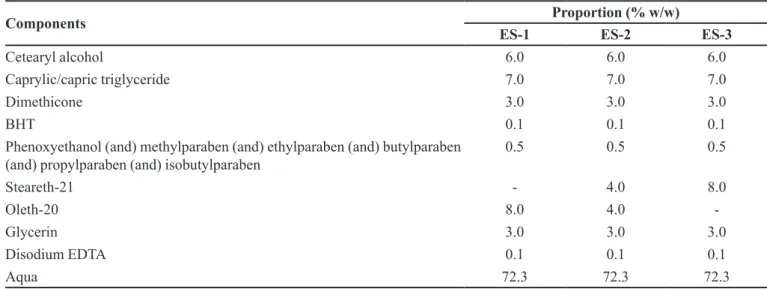
Three emulsified systems were prepared, with
diferent proportions of the following non-ionic surfactants:
steareth-21 and oleth-20 (Table I). These surfactants are not electric charged, and, thus, are less irritant and allow the incorporation of a great variety of active compounds to the formulations (Balcan et al., 2002; Liu, Pohl, 2008; He et al., 2014).
Microscopic analysis
The formulations were transferred to a glass slide covered by a cover slip, and evaluated at an optical microscope coupled with a software for image analysis
TABLE I - Emulsiied systems composition (% w/w)
Components Proportion (% w/w)
ES-1 ES-2 ES-3
Cetearyl alcohol 6.0 6.0 6.0
Caprylic/capric triglyceride 7.0 7.0 7.0
Dimethicone 3.0 3.0 3.0
BHT 0.1 0.1 0.1
Phenoxyethanol (and) methylparaben (and) ethylparaben (and) butylparaben (and) propylparaben (and) isobutylparaben
0.5 0.5 0.5
Steareth-21 - 4.0 8.0
Oleth-20 8.0 4.0
-Glycerin 3.0 3.0 3.0
Disodium EDTA 0.1 0.1 0.1
(Image Pro Plus®). Three regions of the slide were
evaluated randomly to verify the samples homogeneity. The experiment were conducted at room temperature (25.0 ± 2.0 °C), with further counting of the inner phase droplets performed by the equipment software Image® Pro Plus
(Masson et al., 2005; Santos et al., 2005).
Laser diffraction
The particle size determination was assessed by laser
difraction (LS® 230, Beckman Coulter, with optical model of Fraunhofer PIDS). Samples were dispersed in puriied water and homogenized in an ultrasound bath for 460
seconds, to guarantee the particles disaggregation; then, samples were slowly added to a suitable compartment of
the equipment, containing puriied water, in order to obtain an acceptable level of obscuration (up to 8%), speciied by
the equipment software (Baby et al., 2008).
Results were expressed as the particles diameters dispersed in a certain volume. Therefore, the expression
D (v 0.5) means that 50% of the particles, in a certain
volume (v), have a lower diameter (D) than the calculated value. The same criteria apply for D (v 0.1) and D (v 0.9),
representing 10% and 90% of the particles, respectively.
The expression D [4,3] represents the particles medium diameter in the respective volume (Hecq et al., 2006).
Optical coherence tomography
T h e e m u l s i f i e d s y s t e m s m o r p h o l o g i c a l characterization was performed by Optical Coherence Tomography (OCP930SR®, Thorlabs, Newton, NJ, USA).
The equipment speciications were the following:
center wavelength of 930 ± 5 nm; spectral width
(FWHM – full width at half maximum) of 100 ± 5 nm; and maximum imaging width and depth of 6.2 mm and 1.6 mm, respectively. The optical power was 2.0 mW,
w i t h i m a g i n g s p e e d o f f o u r f r a m e s p e r s e c o n d (2000 × 512 pixels).
The samples were dispersed in purified water, in ratios of 1:1, 1:10, 1:50, 1:100 and 1:1000, and disposed them in a glass apparatus were longitudinal laser scans were performed, in order to evaluate the droplets physical aspect.
Statistical analysis
Results were carried in triplicate and data were
treated considering a confidence interval of 95%
(p < 0.05). The statistical package used was Statistica® 7.0
(Stat softTM, Tulsa, Oklahoma, USA).
RESULTS AND DISCUSSION
Microscopic analysis
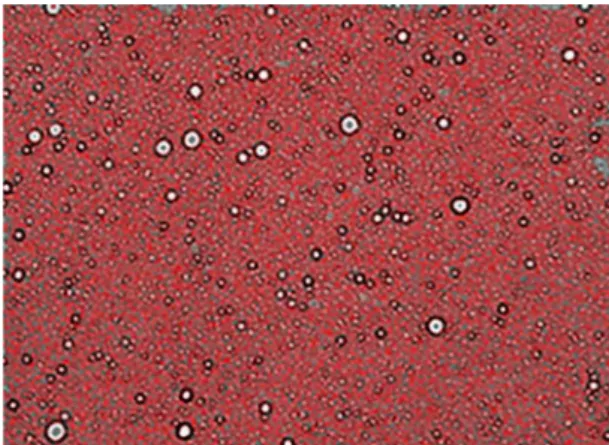
The red portions, observed at Figure 1, represent
6542 droplets. The results obtained through optical
microscopy are presented in Table II.
Statistical analysis of average and maximum values
of particle sizes, obtained for the emulsiied systems ES-1, ES-2 and ES-3, showed no signiicant diferences among
the samples (p > 0.05). In most of the cases, systems
showed droplet sizes close to 1 µm, but larger droplets
could also be observed and they were represented by the maximum particle size values. This phenomenon characterizes these emulsions as polydisperse systems, once they did not present a single droplet size.
Laser diffraction
The particle size results obtained by laser difraction
are presented in Table III. Considering the variables
analyzed, the mean values, despite having diferent droplet TABLE II - Average and maximum particle sizes of the emulsiied
systems, measured by optical microscopy
Emulsiied systems
Average particle size (µm)
Maximum particle size (µm)
ES-1 1.87 a ± 0.30 35.69 b ± 13.46
ES-2 1.96 a ± 0.29 28.77 b ± 12.21
ES-3 1.78 a ± 0.19 44.46 b ± 14.14
*Results presented as mean ± standard deviation. Different letters in the same column represent statistically diferent results, according to the ANOVA (One-way) and Tukey tests (p < 0.05).
FIGURE 1 - Example of droplets counting in the emulsion’s
sizes, they did not show signiicant statistical diferences.
Thus, it was concluded that the surfactants used did not
inluence the distribution parameter of the particles in the emulsiied systems.
Optical coherence tomography
Microspheres, immobilized in a carbomer gel
(1.0% w/w), were used as reference to verify the equipment calibration (Figure 2). The results conirmed
the calibration status of the equipment, once the spheres
diameter were 651.48 µm (a) and 724.84 µm (b), within
their recommended diameter range: 425.00 to 850.00 µm.
Aiming to determine the optimum parameters for droplet size analysis, preliminary tests were performed. Figure 3 shows the tomographic image of ES-1 without
dispersion in puriied water. From this image, we observed
the need of performing the dispersion procedure, since it was not possible to detect appropriate droplet size of the system internal phase.
Further, in a further test, it was required to minimize the time between the sample dispersion and the droplet size analysis, once the time has led to the droplets accumulation on the surface of the sample - and not in the central region - preventing the correct reading.
After preliminary tests, further studies were conducted with samples dispersed in purified water.
Figures 4, 5 and 6 represent tomographic images of the
ES-1, ES-2 and ES-3, in the 1:10, 1:50 and 1:100 dispersion ratios, respectively.
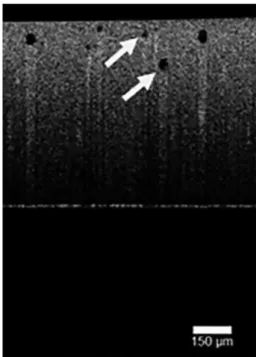
In OCT analysis, interfaces generally present high light scattering, represented by bright regions in the tomographic images. On the other hand, the internal phase particles of the emulsion are constituted by the oily phase of the system, which does not have the property of spreading light, appearing as dark regions in the images (Schimitt, 1999; Podoleanu, 2012). In all tomographic images, it was possible to observe bright and dark regions, due to the intensity of the generated signal. Although
TABLE III - Droplets distribution on the inner phase of the emulsiied systems, measured by laser difraction
Emulsiied systems D (v 0.1) (µm) D (v 0.5) (µm) D (v 0.9) (µm) D [4,3] (µm)
ES-1 1.98 a ± 0.96 3.82 a ± 0.21 10.02 a ± 4.64 5.15 a ± 0.94
ES-2 1.46 a ± 0.21 3.40 a ± 0.30 8.59 a ± 1.20 4.60 a ± 0.47
ES-3 1.37 a ± 0.11 3.79 a ± 0.13 9.35 a ± 0.38 4.84 a ± 0.17
*Results presented as mean ± standard deviation. Diferent letters in the same column represent statistically diferent results, according to the ANOVA (One-way) and Tukey tests (p < 0.05).
FIGURE 2 - Microspheres and carbomer gel 1.0% (w/w), (a) sphere above the carbomer gel and (b) sphere within the carbomer gel.
FIGURE 4 - Tomographic images of the emulsiied systems (1:10 dispersion in puriied water); where (a) ES-1, (b) ES-2 and (c)
ES-3. The arrows indicate possible droplets of the emulsion’s inner phase.
FIGURE 5 - Tomographic images of the emulsiied systems (1:50 dispersion in puriied water); where (a) ES-1, (b) ES-2 and (c)
ES-3. The arrows indicate possible droplets of the emulsion’s inner phase.
FIGURE 6 - Tomographic images of the emulsiied systems (1:100 dispersion in puriied water); where (a) ES-1, (b) ES-2 and (c)
there were no differences between the 1:50 (Figure 5)
and 1:100 dispersions (Figure 6), the presence of bright
regions was pronounced in the 1:10 dispersion (Figure 4), representing particles with high scattering properties. This occurs because this dispersion is the most concentrated, and, therefore, may present agglomerated particles.
Another important factor to be considered for the images analysis is the OCT equipment detection limit, which could only measure particles with sizes greater
than 6.0 µm (Velasco et al., 2009). According to the tests
performed by laser difraction and optical microscopy, the average particle size of the emulsiied systems was lower than 6.0 µm and, therefore, below the OTC equipment
detection limit.
Considering the above, it is suggested that the dark regions observed on the tomography images (Figures
4, 5 and 6) represent the internal phase droplets of the
emulsified systems, while the bright regions represent
the interface between diferent emulsion droplets, which are close to each other and have particles below 6.0 µm
microns - not possible to be detected by the equipment. The
particle size of the emulsiied systems droplets, indicated by the arrows in Figures 4, 5 and 6, is shown in Table IV.
These results corroborate the data obtained by optical microscopy for the maximum particle sizes of the
emulsiied systems (Table II). Analyzing other images
obtained for ES-3 (Figure 7), it was possible to observe
dark regions of different sizes, ranging from 17.63 to 33.67 µm.
It is also important to emphasize that, although the results are consistent with those found by other techniques employed in this research, further studies are still suggested to certainly identify the dark regions as the internal phase droplets.
Particle size results – techniques comparison
Comparative particle size results for the optical
microscopy and laser diffraction methodologies are described in TABLE V. From the statistical analysis, it was found that the methodologies could not be compared,
once they presented statistically diferent results for the
same sample.
This data is corroborated by the literature, which reports that microscopic analysis cannot be compared to
laser difraction technique (optical microscopy examines
the diameter of the droplets and, laser diffraction, the volume distribution) (Brewer, Ramsland, 1995).
CONCLUSIONS
The OCT technique allowed the visualization and
TABLE IV - Particle size of the emulsified systems droplets (regions indicated by the arrows in Figures 4, 5 and 6), obtained by optical coherence tomography
Emulsiied systems
Particle size (µm)
1:10 dispersion
1:50 dispersion
1:100 dispersion
ES-1 35.20 32.65 30.00
ES-2 18.00 20.92 14.54
ES-3 21.81 15.31 25.00; 22.45
TABLE V - Particle size of the emulsiied systems – comparison
between the optical microscopy and laser difraction techniques
Emulsiied systems
Optical
microscopy Laser difraction
SE-1 1.87 a ± 0.30 µm 5.15 b ± 0.94 µm
SE-2 1.96 a ± 0.29µm 4.60 b ± 0.47 µm
SE-3 1.78 a ± 0.19 µm 4.84 b ± 0.17 µm
*Results presented as mean ± standard deviation. Different letters in the same column represent statistically diferent results, according to the ANOVA (One-way) and Tukey tests (p < 0.05).
FIGURE 7 - Tomographic image of the emulsiied system ES-3
morphological characterization of particles within the emulsions, suggested to be the internal phase droplets. Optical microscopy and laser diffraction techniques
provided average particle sizes lower than 6.0 µm, which
could not be measured by OTC due to methodology limitations.
Through microscopic analysis, it was possible to
observe particles with sizes greater than 6.0 µm - data
also reported by OCT, in which the dark regions probably
represented the emulsion’s internal phase droplets. These indings reinforce the introduction of the OCT as methodology for the analysis of cosmetic emulsiied
systems, which stability and sensory characteristics
are greatly influenced by emulsions’ particle size and
morphology. Although further studies are required in order to improve the equipment sensitivity, it was possible to assess the OTC technique contribution in the cosmetic
ield, with possibility to expand its application to other
areas, such as the morphological study of hair and skin.
ACKNOWLEDGMENTS
The authors would like to thank The São Paulo Research Foundation (FAPESP) – 2009/12502-5 and 2008/57735-4 – and the National Counsel of Technological and Scientific Development (CNPq), for the financial support. Also, authors are greatly thankful to Dra Catarina Rosado for her high quality technical support.
REFERENCES
AULTON, M.E. Delineamento de formas farmacêuticas. 2.ed. Porto Alegre: Artmed, 2005. 677p.
B A B Y, A.R.; S AN TO R O, D.M.; V E L AS C O, M.V.R.; SERRA, C.H.R. Emulsified systems based on glyceryl monostearate and potassium cetyl phosphate: scale-up and characterization of physical properties. Int. J. Pharm., v.361, n.1/2, p.99-103, 2008b.
BALCAN, M.; ANGHEL, D.F.; VOICU, A.; BALCAN, D.C. Determination of thermodynamic parameters of ethoxylated nonionic surfactants by means of reversed-phase high-performance liquid chromatography. Coll. Surf. A, v.204, n.1-3, p.141-151, 2002.
BERNELLI, C.; SIRBU, V.; GUAGLIUMI, G. Percutaneous coronary intervention planning and optimization with Optical Coherence Tomography. Interv. Cardiol. Clin., v.4, n.3, p.251-284, 2015.
BREWER, E.; RAMSLAND, A. Particle size determination by automated microscopical imaging analysis with comparison to laser difraction. J. Pharm. Sci., v.84, n.4, p.499-501, 1995.
FREITAS, A.Z.; ZEZELL, D.M.; VIEIRA Jr., N.D.; RIBEIRO, A.C.; GOMES A.S.L. Imaging carious human dental tissue with optical coherence tomography. J. Appl. Phys., v.99, n.2, p.24906/1-24906/6, 2006.
FREITAS, A.Z.; AMARAL, M.M.; RAELE, M.P. Optical coherence tomography: development and applications. In: DUARTE, F.J.(Ed.) Laser pulse phenomena and applications. Rijeka: InTech, 2010. cap.20, p.409-432.
HE, Z.; ZHANG, M.; FANG, Y.; JIN, G.; CHEN, J. Extended surfactants: a well-designed spacer to improve interfacial performance through a gradual polarity transition. Coll. Surf. A, v.450, p.83-92, 2014.
HECQ, J.; DELEERS, M.; FANARA, D.; VRANCKX, H.; BOULANGER, P.; LE LAMER, S.; AMIGHI, K. Preparation and in vitro/in vivo evaluation of nano-sized crystals for dissolution rate enhancement of ucb-35440-3, a highly dosed poorly water-soluble weak base. Eur. J. Pharm. Biopharm., v.64, n.3, p.360-368, 2006.
HUANG, D.; SWANSON, E.A.; LIN, C.P.; SCHUMAN, J.S.; STINSON, W.G.; CHANG, W.; HEE, M.R.; FLOTTE, T.; GREGORY, K.; PULIAFITO, C.A.; FUJIMOTO, J.G. Optical coherence tomography. Science, v.254, n.5035, p.1178-118, 1991.
LIU, X.; POHL, C. New hydrophilic interaction/reversed-phase mixed-mode stationary phase and its application for analysis of nonionic ethoxylated surfactants. J. Chromatogr. A, v.1191, n.1/2, p.83-89, 2008.
MASSON, D.S.; MORAIS, G.G.; MORAIS, J.M.; ANDRADE, F.F.; SANTOS, O.D.H.; OLIVEIRA, W.P.; ROCHA FILHO, P.A. Polyhydroxy alcohols and peach oil addition influence on liquid crystal formation and rheological behaviour of O/W emulsions. J. Disper. Sci. Technol., v.26, n.4, p.463-468, 2005.
McCLEMENTS, D.J. Critical review of techniques and methodologies for characterization of emulsion stability.
MEIRELLES, R.L.; AGGIO, F.B.; COSTA, R.A.; FARAH, M.E. STRATUS optical coherence tomography in unilateral colobomatous excavation of the optic disc and secondary retinoschisis. Graefe Arch. Clin. Exp., v.243, n.1, p.76-81,
2005.
MELO, L.S.A.; ARAUJO, R.E.; FREITAS, A.Z.; ZEZELL, D.M.; VIEIRA, N.D; GIRKIN, J.; HALL, A.; CARVALHO, M.T.; GOMES, A.S.L. Evaluation of enamel dental restoration interface by optical coherence tomography. J. Biomed. Opt., v.10, n.6, p.1-5, 2005.
PINTO, T.L.; WAKSMAN, R. Clinical applications of optical coherence tomography. J. Interv. Cardiol., v.19, n.6, p.566-573, 2006.
PODOLEANU, A.G. Optical Coherence Tomography. J. Microsc., v.247, n.3, p.209-219, 2012.
SALAGER, J.L. Formulation concepts for the emulsion maker. In: NIELLOUD, F.; MARTI-MESTRES, G., eds. Pharmaceutical emulsions and suspensions. New York: Marcel Dekker, 2000. p.20-68. (Drugs and the pharmaceutical sciences, v.105).
SANTOS, O.D.H.; MIOTTO, J.V.; MORAIS, J.M.; OLIVEIRA, W.P.; ROCHA-FILHO, P.A. Attainment of emulsions with liquid crystal from marigold oil using the required HLB method. J. Disper. Sci. Technol., v.26, n.2, p.243-249, 2005.
SCHIMITT, J.M. Optical Coherence Tomography: a review.
IEEE J. Sel. Top. Quant., v.5, n.4, p.1205-1215, 1999.
SHOUGHY, S.S.; JAROUDI, M.O.; KOZAK, I.; TABBARA, K.F. Optical Coherence Tomography in the diagnosis of sclerits and episclerits. Am. J. Ophthalmol., v.159, n.6,
p.1045-1049, 2015.
VELASCO, M.V.R.; BABY, A.R.; SARRUF, F.D.; KANEKO, T.M.; SAMAD, R.E.; VIEIRA JÚNIOR, N.D.; FREITAS, A.Z. Prospective ultramorphological characterization of human hair by optical coherence tomography. Skin Res. Technol., v.15, n.4, p.440-443, 2009.
Received for publication on 27th January 2015