Castro AA et al. / Ectopic ovary with torsion: diagnosis by ultrasound
Radiol Bras. 2017 Jan/Fev;50(1):60–61 60
0100-3984 © Colégio Brasileiro de Radiologia e Diagnóstico por Imagem
Case Report
Ectopic ovary with torsion: uncommon diagnosis made
by ultrasound
Ovário ectópico torcido: diagnóstico incomum definido por ultrassonografia
Castro AA, Morandini F, Calixto CP, Barros WH, Nakatani ET, Castro AA. Ectopic ovary with torsion: uncommon diagnosis made by ultrasound. Radiol Bras. 2017 Jan/Fev;50(1):60–61.
Abstract
R e s u m o
Ultrasound is an important diagnostic tool in inguinal hernia and in the evaluation of the contents of the hernia sac. This report presents a case in which ultrasound revealed a herniated ectopic ovary, complicated by torsion of its vascular pedicle, in the right labia majora. We also present a brief discussion of ovarian hernia, its potential complications, and the treatments available.
Keywords: Ectopic ovary; Ultrasonography; Ovary torsion.
A ultrassonografia é uma importante ferramenta diagnóstica no quadro de hérnia inguinal e na avaliação do conteúdo do saco herniário. Neste relato será apresentado um caso com diagnóstico ultrassonográfico de ovário ectópico herniado na região do grande lábio vulvar direito, complicado com torção de seu pedículo vascular, assim como será feita uma breve discussão sobre herniação ovariana, suas complicações e tratamentos.
Unitermos: Ovário ectópico; Ultrassonografia; Torção de ovário.
Study conducted in the Hospital Universitário Evangélico de Curitiba, Curitiba, PR, Brazil.
1. MSc, Doctoral Student at the Medical Research Institute of the Faculdade Evangélica do Paraná – Hospital Evangélico de Curitiba, Curitiba, PR, Postgraduate Student in Musculoskeletal Radiology at the Hospital Israelita Albert Einstein, São Paulo, SP, Brazil.
2. MD, Radiologist at Hospital Vita Curitiba, Curitiba, PR, Brazil.
3. MD, Resident in Radiology and Diagnostic Imaging at the Hospital Universitário Evangélico de Curitiba, Curitiba, PR, Brazil.
4. MD, Radiologist for the Grupo Fleury / Hospital Alemão Oswaldo Cruz, São Paulo, SP, Brazil.
5. MD, Gynecologist and Obstetrician, Specialist in Fetal Medicine at the Instituto da Mulher e Medicina Fetal, Curitiba, PR, Brazil.
6. MD, Radiologist at Prefeitura Municipal de Paranaguá, Paranaguá, PR, Brazil. Mailing address: Dr. Adham do Amaral e Castro. Alameda Augusto Stellfeld, 1980, Bigorrilho. Curitiba, PR, Brazil, 80730-150. E-mail: [email protected].
Received April 15, 2014. Accepted after revision June 20, 2014.
Adham do Amaral e Castro1, Fernando Morandini2, Caroline Paludo Calixto3, Wagner Haese Barros4,
Edson Tetsuya Nakatani5, Allan do Amaral e Castro6
http://dx.doi.org/10.1590/0100-3984.2014.0031
INTRODUCTION
The differential diagnosis of a labial mass in a prepu-bescent patient includes inguinal hernia, ultrasound being an important tool in the diagnosis and evaluation of the con-tents of the hernia sac(1). Here, we report a case of
hernia-tion of the right ovary through the ipsilateral labia majora, complicated by ovarian torsion.
CASE REPORT
A two-month-old female patient was brought to the emer-gency department of our hospital by her mother, who re-ported a “painful lump” on the right labia majora of the in-fant. On physical examination, we observed palpable, irre-ducible, localized nodulation, with no signs of inflammation. Ultrasound revealed a right-sided solid structure with multiple peripheral cysts, characterized as an ectopic ovary
(Figures 1 and 2). On Doppler flow studies, we observed no ovarian flow. That finding, together with the multiple pe-ripheral cysts and the increased size of the organ, suggested the diagnosis of torsion (Figure 3).
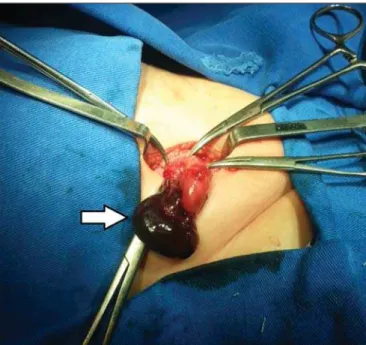
We carried out emergency surgery, which revealed signs of ischemia in the affected ovary (Figure 4). After reversal
Figure 2. Ultrasound of the right labia majora. Note the invasion of the pedicle into the inguinal canal (arrow).
Castro AA et al. / Ectopic ovary with torsion: diagnosis by ultrasound
Radiol Bras. 2017 Jan/Fev;50(1):60–61 61
of the torsion, the ischemia diminished, the ovary was repo-sitioned within the abdominal cavity, connecting to the her-nia sac. The patient showed favorable postoperative evolu-tion.
DISCUSSION
The formation of the inguinal canal is centered in the gubernaculum testis and the processus vaginalis(2). The first
is a fibromuscular cord, which, in girls, gives rise to the labia majora and the inferior pole of the fetal gonad. The guber-naculum testis also gives rise to the uterine-ovarian ligament and the round ligament, which connect the ovary to the medial region of the uterus, preventing its descent via the inguinal canal(2,3). The processus vaginalis peritonei (also
known as the canal of Nuck in females) is a tubular invagi-nation (pouch) within the inguinal canal. Normally, it is completely obliterated in females(2). In rare cases, failure of
the obliteration process leads to congenital alterations, such as evagination of the canal of Nuck in the inguinal canal or in the labia majora(3).
Herniation of the canal of Nuck involves the ovary in 15–20% of cases(4), increasing the risk of the ovary
becom-ing trapped or strangulated, because it becomes swollen to the extent that it is trapped, progressively increasing in vol-ume and becoming less compressible than bowel loops(5).
The risk of torsion also increases when there is suspension and narrowing of the vascular pedicle of the ovary(6).
The choice between elective and emergency surgery in the treatment of a trapped ovarian hernia using either is controversial. In cases of strangulation or torsion, emergency surgery is preferable. The surgical technique involves expo-sure of the peritoneal sac for evaluation of its content, the viscera being returned to the abdominal cavity when viable, with high ligation of the hernia sac. If the vitality of the hernia content is impaired, warm compresses are applied for a few minutes in order to evaluate the degree of improvement and thus determine the best practice; in the absence of improve-ment, the viscera should be resected(7).
Typical ovarian morphology can be observed on ultra-sound, and blood flow can be identified through Doppler flow studies(8).
This report demonstrates the importance of the use of ultrasound in the diagnosis of ovarian torsion in herniation of the canal of Nuck. In the case presented here, the condi-tion was confirmed and treated through surgery, which per-mitted the preservation of the organ.
REFERENCES
1. Patel B, Zivin S, Panchal N, et al. Sonography of female genital her-nias presenting as labia majora masses. J Ultrasound Med. 2014;33: 155–9.
2. Shadbolt CL, Heinze SBJ, Dietrich RB. Imaging of groin masses: inguinal anatomy and pathological conditions revisited. Radiographics. 2001;21(Suppl 1):S261–71.
3. Healey A. Embryology of female reproductive tract. In: Mann G, Blair JC, Garden AS, editors. Imaging of gynecological disorders in infants and children. 1st ed. London: Springer-Verlag; 2012. p. 21– 30.
4. Ming YC, Luo CC, Chao HC, et al. Inguinal hernia containing uterus and uterine adnexa in female infants: report of two cases. Pediatr Neonatol. 2011;52:103–5.
5. Laing FC, Townsend BA, Rodriguez JR. Ovary-containing hernia in a premature infant: sonographic diagnosis. J Ultrasound Med. 2007; 26:985–7.
6. Merriman TE, Auldist AW. Ovarian torsion in inguinal hernias. Pediatr Surg Int. 2000;16:383–5.
7. Gabriel E. Hérnia inguinal na infância. Rev Col Bras Cir. 2001;28: 444–52.
8. Yao L, Mou Y, Wang HX. Sonographic diagnosis of an ovary-con-taining inguinal hernia with the formation of a corpus luteum in an adult female. Ultrasound Obstet Gynecol. 2009;34:359–60.
Figure 3. Doppler flow study showing the absence of vascular flow in the right ovary.