170
Gonçalves FG et al. Posterior migration of lumbar disc herniation
Radiol Bras. 2012 Mai/Jun;45(3):170–172
Posterior migration of lumbar disc herniation – imaging
dilemma due to contrast contraindication: a case report
*
Hérnia discal lombar com migração posterior – dilema em diagnóstico por imagem devido a contraindicação ao uso de contraste: relato de um caso
Fabrício Guimarães Gonçalves1, Prasad Baladev Hanagandi2, Carlos Ignacio Torres3, Raquel
DelCarpio-O’Donovan4
Disc herniation with posterior epidural migration is a rare and often symptomatic entity. Multiple are the natural barriers that prevent this pattern of migration. Enhanced magnetic resonance imaging is the diagnostic modality of choice in these cases. The diagnostic dilemma in this case was the contraindication to the use of contrast since the patient was known to have chronic renal failure.
Keywords: Lumbar hernia; Complication; Epidural space; Posterior; Magnetic resonance imaging; Contrast.
Hérnia discal com migração epidural posterior é uma entidade rara e frequentemente sintomática. Múltiplas são as barreiras naturais que impedem esse padrão de migração. A ressonância magnética contrastada é a modalidade diag-nóstica de escolha nesses casos. O dilema diagnóstico, neste caso, foi a contraindicação ao uso de contraste, uma vez que o paciente era portador de insuficiência renal crônica.
Unitermos: Hérnia lombar; Complicações; Espaço epidural; Posterior; Ressonância magnética; Contraste.
Abstract
Resumo
* Study developed at Montreal General Hospital, Department of Diagnostic Neuroradiology, McGill University Health Center (MUHC), Montreal, Quebec, Canada, and at the Neuroradiology Department of Infinita Diagnóstico por Imagem, Brasília DF, Brazil. 1. MD, Neuroradiologist Chief of the Department of Neuro-radiology of Infinita Diagnóstico por Imagem, Brasília, DF, Brasil, Clinical Fellow, Montreal General Hospital, McGill University Health Center (MUHC), Montreal, Quebec, Canada.
2. MD, Neuroradiology Clinical Fellow, Montreal General Hos-pital, McGill University Health Center (MUHC), Montreal, Que-bec, Canada.
3. MD, Neuroradiologist, Montreal General Hospital, McGill University Health Center (MUHC), Montreal, Quebec, Canada.
4. MD, Neuroradiologist, Professor and Vice Chair of Radiol-ogy, Associate Director of Radiology at McGill University Health Center (MUHC) and Program Director of Neuroradiology, Montreal, Quebec, Canada.
Gonçalves FG, Hanagandi PB, Torres CI, DelCarpio-O’Donovan R. Posterior migration of lumbar disc herniation – imaging dilemma due to contrast contraindication: a case report. Radiol Bras. 2012 Mai/Jun;45(3):170–172.
0100-3984 © Colégio Brasileiro de Radiologia e Diagnóstico por Imagem CASE REPORT • RELATO DE CASO
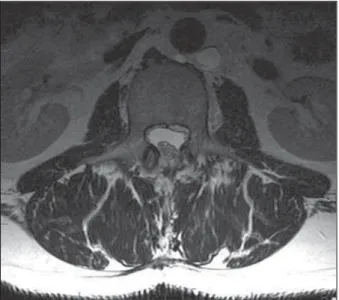
of the height of the L2 vertebral body (Fig-ure 2). The thecal sac was partially encased, compressed and deviated to the right side. Contrast was contraindicated due to known history of renal insufficiency. Epidural he-matoma, epidural empyema, nerve sheath tumor and meningioma were included in the differential diagnosis. Though rare, PEM of disc was also considered in the list of differential diagnosis. The absence of trauma or an infection syndrome made the possibility of an epidural empyema or he-matoma less likely.
The patient underwent surgery and the epidural soft tissue was excised by a L3 hemilaminectomy and excisional biopsy was performed (Figure 3). The epidural material was adherent to the dura but how-ever completely excised. The pathological report was consistent with a disc fragment in the posterior epidural space. The pain and sensory symptoms markedly improved during the first few weeks after the surgery.
DISCUSSION
DH is a displacement of disc material beyond the limits of the intervertebral disc space. According to the shape, DH can be classified as protrusions or extrusions. Disc The patient was not known for a
malig-nancy and did not have a history of trauma. Physical examination was remarkable for low back pain radiating to the anterior and lateral aspect of the left thigh, which wors-ened with hip flexion. No signs of urinary retention or bowel dysfunction were found. There were no constitutional symptoms. The axillary temperature and the erythro-cyte sedimentation rate were normal. The laboratory analysis was negative for an in-fectious process. He had a long history of diabetes mellitus, hypertension and renal insufficiency.
At the emergency room, plain films of the lumbar spine were obtained, which failed to reveal any signs of acute fractures. Magnetic resonance imaging (MRI) exami-nation was obtained for further evaluation of the lumbar spine and demonstrated a T1 hypointense and T2WI hyperintense epidu-ral mass at L2-3 on the left side (Figure 1), with no cleavage plane with the interver-tebral disc. This mass was extending to the posterior epidural space, occupying most INTRODUCTION
Disc herniation (DH) with posterior epidural migration (PEM) is a quite rare and symptomatic entity(1). Its imaging
di-agnosis is usually difficult, as it can mimic a variety of conditions involving the epi-dural space(2). In this report we present a
case of a herniated disc with PEM and em-phasize the imaging dilemma due to con-traindication for contrast administration.
CASE REPORT
A 51-year-old man was admitted to the emergency room with a two-year history of intermittent low back pain that has pro-gressed significantly in the last three days.
Corresponding author: Fabrício Guimarães Gonçalves, MD. 1650 Cedar Avenue, Room C5 118 Montreal, QC H3G 1A4 Canada. E-mail: [email protected]
171
Gonçalves FG et al. Posterior migration of lumbar disc herniation
Radiol Bras. 2012 Mai/Jun;45(3):170–172 sequestration is a type of disc extrusion in which the disc has lost its continuity with the native disc. DH may also be categorized in contained or uncontained, whether these are covered or not by the annulus fibro-sus(3). In relation to the dural sac, DH is
commonly located anteriorly or antero-lat-erally(2). DH with PEM is a quite rare
en-tity with 31 cases reported in the litera-ture(4). The first case of a DH with PEM
was reported by Lichtor in 1989(5). DH with
PEM is usually a sequestered disc without annulus fibrosus covering. In a series of
2880 patients operated for lumbar DH, Sengoz et al. reported an incidence of 0.27%. In their series the migrated frag-ments were located mainly at the L3-4 level (75%) and the L4-5 (25%)(4).
Anatomical peculiarities of the lumbar region may explain the rarity of this con-dition. The first major barrier for posterior migration is the posterior longitudinal liga-ment, a very strong ligaliga-ment, which almost never ruptures as opposed to the annulus fibrosus. Another obstacle is a midline sep-tum called sepsep-tum posticum. This sepsep-tum
connects the periosteum of the vertebral bodies to the posterior longitudinal liga-ment, preventing a fragment to move from one side to the other(6). A fibrous lateral
(peridural) membrane defined by Fick, with one fourth of the resistance of the dura, also acts as hurdle. This membrane is located anteriorly to the posterior longitu-dinal ligament, attached to its deep margin. The ligament of Hoffmann, which connects the posterior longitudinal ligament to the dura, also acts as a firm boundary. The posterior longitudinal ligament, the liga-ments listed above, dura, and the other well-known structures of the epidural space (nerve roots, epidural venous plexus of Batson and the epidural fat), certainly re-strict the migration of a disc fragment mainly to the anterior and anterolateral epidural space(2,4,7).
Patients with posterior migration of a herniated disc may complain of low back pain or radiculopathy, but commonly will present with cauda equina syndrome(1). Traction therapy a common chiropractic treatment should be avoided in cases of posterior migration because the symptoms may be aggravated and further worsening the cauda equina syndrome(2,5,8).
MRI is the diagnostic modality of choice(9). The migrated disc usually appears
similar, although not identical to the cere-bral spinal fluid signal intensity and exhib-its rim enhancement on the post contrast sequences(6). Computed tomography
usu-ally demonstrates a soft tissue nodule in-denting and displacing the dural sac ante-riorly.
There are several differential diagnoses with overlapping features for a posterior epidural mass(2), which mainly include
meningioma, metastasis, lymphoma, he-mangioma, synovial cyst(10,11), abscess and
epidural hematoma. Meningiomas and he-mangiomas usually reveal a solid and rather homogeneous post contrast enhancement. In cases of metastases and lymphomas the patients usually present with multisystem involvement and marrow abnormalities. Abscesses and hematomas usually demon-strate peripheral rim of enhancement with an associated infectious illness or history of trauma.
The importance of contrast study has been described in the imaging literature for
Figure 1(a,b). Sagittal T1 and T2WI demonstrates a posteriorly migrated herniated disc fragment com-pressing the cauda equina roots at L2-3 level.
172
Gonçalves FG et al. Posterior migration of lumbar disc herniation
Radiol Bras. 2012 Mai/Jun;45(3):170–172 accurate diagnosis(6). In our case
contrain-dication for contrast study was an imaging dilemma and we had to rely significantly on the clinical history. The diagnosis was confirmed intra-operatively and on follow-up scan with significant symptom relief.
CONCLUSION
DH with posterior epidural migration is a rare entity most frequently occurring at L3-4 level with variable symptomatic pre-sentation. The majority of the patients with DH with PEM present cauda equina syn-drome rather than radiculopathy. Contrain-dication for contrast administration makes
it an imaging dilemma, which may further delay diagnosis and treatment.
Key points
1. PEM of a disc fragment is very rare. 2. Posterior longitunal ligament, mid-line septum posticum, peridural membrane, ligament of Hoffman, dural sac, epidural fat, venous epidural plexus of Batson and neural roots form a natural barrier from disc PEM.
3. Enhanced MRI is the diagnostic mo-dality of choice.
REFERENCES
1. Teufack SG, Singh H, Harrop J, et al. Dorsal epi-dural intervertebral disk herniation with atypical
radiographic findings: case report and literature review. J Spinal Cord Med. 2010;33:268–71. 2. Döso—lu M, Is M, Gezen F, et al. Posterior
epidu-ral migration of a lumbar disc fragment causing cauda equina syndrome: case report and review of the relevant literature. Eur Spine J. 2001;10: 348–51.
3. Fardon DF, Milette PC. Nomenclature and clas-sification of lumbar disc pathology. Recommen-dations of the Combined task Forces of the North American Spine Society, American Society of Spine Radiology, and American Society of Neuro-radiology. Spine. 2001;26:E93–E113. 4. Sengoz A, Kotil K, Tasdemiroglu E. Posterior
epi-dural migration of herniated lumbar disc frag-ment. J Neurosurg Spine. 2011;14:313–7. 5. Lichtor T. Posterior epidural migration of
ex-truded lumbar disk. Surg Neurol. 1989;32:311– 2.
6. Kim JS, Lee SH, Arbatti NJ. Dorsal extradural lumbar disc herniation causing cauda equina syn-drome : a case report and review of literature. J Korean Neurosurg Soc. 2010;47:217–20. 7. Wiltse LL, Fonseca AS, Amster J, et al.
Relation-ship of the dura, Hofmann’s ligaments, Batson’s plexus, and a fibrovascular membrane lying on the posterior surface of the vertebral bodies and attaching to the deep layer of the posterior longi-tudinal ligament. An anatomical, radiologic, and clinical study. Spine. 1993;18:1030–43. 8. Kraemer J. Intervertebral disk diseases: causes,
diagnosis, treatment, and prophylaxis. 3rd ed. Stuttgart, Germany: Thieme; 2009.
9. Chen CY, Chuang YL, Yao MS, et al. Posterior epidural migration of a sequestrated lumbar disk fragment: MR imaging findings. AJNR Am J Neuroradiol. 2006;27:1592–4.
10. El Khamary SM, Alorainy IA. Case 100: spinal epidural meningioma. Radiology. 2006;241:614– 7.
11. Lee JW, Cho EY, Hong SH, et al. Spinal epidural hemangiomas: various types of MR imaging fea-tures with histopathologic correlation. AJNR Am J Neuroradiol. 2007;28:1242–8.