ISSN 0102-695X
DOI 10.1590/S0102-695X2013005000005 Received 4 Oct 2012
Accepted 3 Dec 2012 Available online 1 Feb 2013
a toxicological evaluation
Andréa Luiza Cunha-Laura,
1Rodrigo Juliano Oliveira,
2Andrea
Lantieri Correa de Barros,
1João Máximo de Siqueira,
3Maria do
Carmo Vieira,
4Sarah Alves Auharek
*,11Centro de Ciências Biológicas e da Saúde, Universidade Federal de Mato Grosso do
Sul, Brazil,
2Faculdade de Medicina, Universidade Federal de Mato Grosso do Sul, Brazil,
3Departamento de Farmacologia, Universidade Federal de São João Del Rey, Campus
Centro-Oeste Dona Lindu, Brazil,
4Faculdade de Ciências Agrárias, Universidade Federal da Grande Dourados,
Brazil.
Abstract: Cochlospermum regium (Schrank) Pilg., Bixaceae, is a Brazilian plant widely used as a folk medicine in the southwestern of the Brazil to treat inl ammation and infection diseases. However, the effects of C. regium hydroethanolic extract on pregnant rats have not been assessed. To evaluate the effects of the C. regium
on pregnant rats during the organogenic period, the hydroethanolic extract was administered via gavage at a dose of 11.5 mg/kg/day to rats from 6th to 15th day of
pregnancy. No clinical signs of maternal toxicity were observed. The placenta’s and fetuses’ weight were similar in control and treated animals. The term fetuses dis not present malformations or anomalies although the number of live fetuses and birth rate were signii cantly decreased. In conclusion, the C. regium hydroethanolic extract is nontoxicant to the pregnant rat although it would be likely to interfere in the progress of the embryofetal development.
Keywords:
Cochlospermum regium medicinal plants pregnant rat
Introduction
Cochlospermum regium (Schrank) Pilg., Bixaceae, is a native plant of the Brazilian cerrado and it is widely used as a folk medicine in the southwestern of the Brazil (Nunes et al., 2003). C. regium has been employed
to treat illnesses such as internal pain, inl ammation,
infection disease, rheumatoid arthritis and others (Correa, 1975; Oliveira et al., 1996). A recent study characterized the C. regium extract by the presence of l avonoids, triacylbenzenes and gallic acid derivatives, providing support to justify the popular use of this specie in treating infection (Solon et al., 2012). Additionally, in vitro studies have demonstrated the cytotoxicity of C. regium root extract against non-tumorigenic CHO-K1 cells (Ceschini & Campo 2006). Moreover, C. regium did not exhibit antimutagenic effects when evaluated in the mouse bone marrow (Andrade et al., 2008).
It is well established in the literature that exposure to xenobiotics during pregnancy may have different effects on embryo development depending on the conceptus phase and the maternal conditions (Wilson, 1977; Spritzer et al., 2001; Oliveira et al., 2009). Based on the finding that C. regium is one of the
most often used plants by people in Campo Grande City (MS, Brazil) (Nunes et al., 2003), to treat inflammation, the aim of the present investigation was to evaluate the impact of the C. regium hydroethanolic extract on pregnant rats exposed during the organogenic period. In particular, our study sought to provide further insights into the effects of C. regium extract on maternal and fetuses toxicity and the C. regium single dose used in this experiment was based on the average consumption by the population.
Materials and methods
Preparation of extract
The underground system (xylopodium) of Cochlospermum regium (Schrank) Pilg., Bixaceae, was
collected in Terenos (MS, Brazil), and identii ed by G.
Hatschbach. A voucher specimen was deposited in the CGMS Herbarium (registration number 04375). The dried powder of the xylopodium (80 g) was extracted with 70:30 EtOH:H2O (v/v) by exhaustive percolation, and the solvent was eliminated under reduced pressure. The resulting brown amorphous residue was maintained in vacuum to
dryness, and it yielded 26.4 g (33%, w/w yield) of crude extract. This extract was stored in the amber glass, at room temperature, in a desiccator.
Animals
Twenty four pregnant Wistar rats were used in the present investigation: twelve for the control and twelve for the C. regium exposed group. The females were mated with males and the gestational day 0 (GD0) was determined if there were sperm and estrus phase cells in vaginal smears. These animals were housed in a standard animal facility under controlled temperature (22 °C) and photoperiod (12 h light, 12 h dark) with access to water and rodent food ad libitum. All procedures and protocols followed approved guidelines for the ethical treatment of animals, according to the Ethics Committee in Animal Experimentation from the Federal University of Mato Grosso do Sul (Protocol # 48/2003).
Experimental procedure
The females of the C. regium treated group received 2.5 mg/kg/day of the extract suspended in 0.5 mL in distilled water, via gavage, during organogenic period, from 6th to 15th day of pregnancy (GD6 to GD15). This
window of treatment was intended to evaluate possible embryotoxic effects of the plant. The chosen dose of C. regium used in this experiment corresponds to that used as a folk medicine for the treatment of diseases related
to inlammation diseases related to inlammation and
genitourinary infection (Correa, 1975; Oliveira et al., 1996). The control group received only the vehicle (5.5 mL/kg).
To observe maternal toxicity, during the treatment, the following clinical parameters were evaluated: body weight, food intake, piloerection, diarrhea, locomotor activity, and deaths (Mason & Kang, 1994).
The animals were weighed on the irst day of
treatment (GD6); on the last day of administration (GD15) and on the 20th day of pregnancy (GD20), when they were
killed by ether inhalation and laparotomized. The ovaries and uterine horns were exteriorized, and the uteri were opened for counting of live and degenerated/dead fetuses. The corpora lutea were counted under a stereomicroscope. The ovaries, placenta and fetuses were weight. The fetuses (n=119 and 88, from control and C. regium exposed group, respectively) were examined for external malformations
and ixed in Bouin’s solution to perform liver morphometry
(n=4-7 in each group). Maternal lung, spleen and liver were also weighted. For histological analysis of the liver,
representative fragments were excited and ixed in Bouin’s solution. Once ixed, the tissue fragments were dehydrated, cleared and embedded in parafin wax. The samples were
cut into 6 µm thick sections and stained with hematoxylin-eosin for histological analyses.
Hepatocytes parameters
The individual volume of maternal and fetuses hepatocytes were obtained from their nuclear volume and the proportion between nucleus and cytoplasm. To calculate the proportion between nucleus and cytoplasm an 850-point square lattice was placed over the sectioned
material at 1000× magniication. At least four thousand
points over hepatocytes were counted for each animal (n=4-7 in each group for mother and fetus). Because the hepatocyte nucleus in rats is spherical, its nucleus volume was obtained from the knowledge of the mean nuclear diameter. For this purpose, the diameters of forty nuclei were measured for each animal. Hepatocyte nuclear
volume was expressed in μm3 and obtained by the formula
4/3πr3, where r=nuclear diameter/2.
Statistical analysis
Values are expressed as mean±SEM and data were analyzed using Student’s t test in graphpad Prism (version 5; GraphPad Software Inc., San Diego, CA,
USA). The signiicance level was set at p<0.05.
Results
The administration of C. regium to pregnant rats, during organogenic period, did not show clinical signs of toxicity since there was no alteration of locomotion activity, no death and no occurrences of piloerection or diarrhea. The maternal lung, spleen and liver weight of the treated animals were similar to the control group (data
not shown). Also, there was no signiicant weight gain or
loss during the experiment. However, the body weight
of treated rats sacriice on the 20th day of pregnancy was
signiicantly decreased (Table 1).
Table 1. Body weight of control and Cochlospermum regium
exposed rats from 6th to 15th day of pregnancy.
Group 6th 15th 20th
Control 244.5±9 (12) 286.5± 6(12) 312.6±5.5 (12)
C. regium 250.5±5 (12) 274.8±6 (12) 293.3 ±7.3 (12) * Results expressed in mean±standard error (n); *p<0.05.
In comparison with the control group, the ovary weight was decreased (p<0.05) when the extract was administered during pregnancy. It is noteworthy that in this experimental lot, in the untreated group, an animal with a great number of corpora lutea (~17) was recorded.
No signiicant difference was observed between control
and fetuses were analyzed (Table 2 and 3). The term fetuses presented a similar degree of development, no malformations were detected in both groups investigated.
The effects of C. regium extract on reproductive parameters are show in Table 2. The number of corpora lutea was similar (p>0.05) between the control and treated rats. However, the values obtained for live fetuses for the C. regium treated group presented a signiicant decrease (p<0.05), with a lower (p<0.05) birth rate (Table 2 and 3).
Table 2. Effect of Cochlospermum regium extract on maternal ovary and placenta weights, number of corpora lutea and birth rate (%).
Group Ovary weight (mg)
Placenta weight (g)
Corpora lutea (number)
Birth ratea (%)
Control 112.1±5.3 5.5±0.4 11.7±0.7 84.4±3 C. regium 95.3± 5.2* 4.6±0.5 10.9±0.5 69±7.2* Results expressed in mean±standard error; *p<0.05; aBirth rate: no. of live fetuses/no. of corpora lutea x 100.
Table 3. Effect of Cochlospermum regium extract on the fetuses parameters.
Group Live fetuses (number)
Dead fetuses (number)
Fetuses size (cm)
Fetuses weight(g) Control 9.9±0.7 1.8±0.3 2.8±0.02 1.9±0.02 C. regium 7.3±0.7* 3.5±0.9 2.8±0.03 1.9±0.03 Results expressed in mean±standard error; *p<0.05.
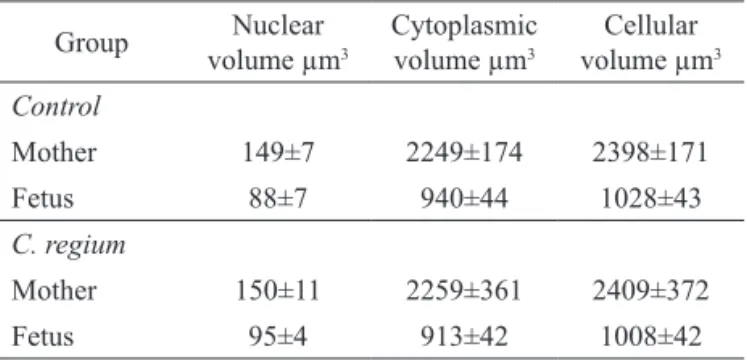
Table 4 summarizes the effects of C. regium extract in the hepatocytes parameters. The histophatological examination of maternal and fetuses livers showed similar (p>0.05) hepatocyte volumes between the control and treated group.
Table 4. Effect of Cochlospermum regium extract on maternal and fetus hepatocytes parameters.
Group Nuclear volume µm3
Cytoplasmic volume µm3
Cellular volume µm3
Control
Mother 149±7 2249±174 2398±171
Fetus 88±7 940±44 1028±43
C. regium
Mother 150±11 2259±361 2409±372
Fetus 95±4 913±42 1008±42
Results expressed in mean±standard error. p>0.05.
Discussion
C. regium extract is used as a folk medicine in
the southwestern of the Brazil to treat inlammation and
genitourinary infections. Many Brazilian women in this region have been using this plant. Some chemical and pharmacological evaluations of C. regium are available in
the literature, but this is the irst investigation to evaluate
the impact of the C. regium hydroethanolic extract on pregnant rats within the organogenic period. At the dose given, maternal nontoxicity was evidenced by the body weight gain and by placenta’s and fetuses’ weight (Freitas et al., 2005). When testing possible fetal toxic
effects of a speciic substance, it is necessary to establish
if these effects are due to direct action on the fetus or an indirect action trough the maternal organism that could secondarily interfere with the fetus (Chang et al., 2002). In this study, no clinical signs of maternal toxicity were observed. Additionally, maternal liver and spleen weights, in the treated rats, were similar to control and, reduction or increases in the weight of these organs suggest toxicity (Queiroz et al., 2012).
Although the body weight of the C. regium
treated group sacriiced on the 20th day was decreased,
this data might be explained by the reduction of the live fetuses in the treated animals. The birth rate was also lower in the C. regium treated group. Based on that, we can assume that the extract would interfere in the rate of postimplantation loss, which establishes the correlation between the number of implanted embryos and those which manage to develop normally (Almeida & Lemonica, 2000). There is a direct relation between the number of conceptuses and the corpora lutea in rats (Kato et al., 1979). In the present investigation, the number of corpora lutea in treated rats was similar to that in control and the term fetuses presented similar morphology. Taking all data together, it is possible to suppose that C. regium extract interferes in the progress of the embryo
development, which justiies the decreased number of
live fetus in the treated group. However, the dose tested in the present study, did not present a direct teratogenic effect because the live fetuses were completed normal and they did not show malformations. Moreover, there was a strong trend toward the increase in the number of dead fetus as well as reduced birth rate was an indication of the abortifacient activity (Yakubu & Bukoye, 2009) of the C. regium extract.
According to the literature the ovary weight is dependent of the number and volume of the corpora lutea (Guerra et al., 2000). The C. regium treated animals
presented a signiicantly reduction at the ovary weight.
studies are necessary to evaluate the signiicance of this
alteration.
This study conirms earlier indings that C. regium
hydroethanolic extract does not induce histopathological alteration in the liver (Toledo et al., 2000). This organ was analyzed, in the present investigation, because its vulnerability to damage induced by different compounds (Tennant, 1997). Nevertheless, it should be emphasized that the liver vulnerability is increased in pregnancy due a decrease in hepatic metabolism (Hytten et al., 1984). Our results provide important morphological and stereological data related to maternal and fetus hepatocyte function. The absence of changes in the hepatocyte nuclear, cytoplasmatic and cellular volume, suggest normal liver function (Moreti et al., 2005).
In conclusion, although detailed understanding of the molecular and biochemical action of the C. regium hydroethanolic extract on pregnant rats during the organogenic period requires further characterization, the present study suggests that the indiscriminate use of this plant, by pregnant woman, would be likely to interfere in the progress of the embryofetal development, though maternal nontoxicity was observed.
Acknowledgments
We are grateful to Simone Bertozi de Souza Vasconcelos and Cláudio Gonçalves Oliveira for
histological assistance. This work was inancial supported
by the Brazilian Foundation: FUNDECT-MS and CNPq. Authors JMS and MCV acknowledge CNPq for a research grant.
Authors’ contributions
ALCL designed the study and contributed in running the laboratory work and analysis of the data. ALCB (graduate student) contributed to biological studies. JMS and MCV contributed in the obtaining of hydroethanolic extract and plant herbarium confection, respectively. RJO contributed to critical reading of the manuscript. SAA designed the stereological study and writing the
manuscript. All the authors have read the inal manuscript
and approved the submission.
References
Almeida FCG, Lemonica IP 2000. The toxic effects of Coleus barbatus B. on the different periods of pregnancy in rats. J Ethnopharmacol 73: 53-60. Andrade LS, Santos DB, Castro DB, Guillo LA,
Chen-Chen L 2008. Absence of antimutagenicity of Cochlospermum regium (Mart. and Schr.) Pilger 1924 by micronucleus test in mice. Braz J Biol 68: 155-159.
Ceschini L, Campos EG 2006. Cytotoxic effects of Cochlospermum regium (Mart & Schrank) Pilger aqueous root extract on mammalian cells. J Ethnopharmacol 103: 302-305.
Chang CV, Felício AC, Reis JEP, Guerra MO, Petrs MV 2002. Fetal toxicity of Solanum lycocarpum (Solanacea) in rats. J Ethnopharmacol 81: 265-269.
Correa MP 1975. Dicionário das plantas úteis do Brasil e das exóticas cultivadas. Rio de Janeiro: Imprensa Nacional.
Freitas TG, Augusto PM, Montanari T 2005. Effect of Ruta graveolens L. on pregnant mice. Contraception 71: 74-77.
Golos TG, Sherwood OD 1982. Control of corpus luteum function during the second half of pregnancy in the rat: a direct relationship between conceptus number and both serum and ovarian relaxin levels. Endocrinol 111: 872-878.
Guerra MO, Oliveira LEG, Peters VM 2000. Desenvolvimento pré-embrionário em ratas tratadas com oxcarbazepina nos quatro primeiros dias após a inseminação. Rev Assoc Med Bras 46: 346-353. Hytten FE 1984. Physiological changes in the mother
related to drug handling. In: Krauer B (org) Drugs and Pregnancy. New York: Academic Press, p. 7. Kato H, Morishige WK, Rothchild I 1979. A quantitative
relation between the experimentally determined number of conceptuses and corpos luteum activity in the pregnant rat. Endocrinol 105: 846-850. Mason JM, Kang YJ 1994. Test methods for assessing
female reproductive and developmental toxicology. In: Hayes AW (org.) Principles and Methods of Toxicology. New York: Raven Press, p. 989-1034. Moreti DLC, Lopes RA, Vinah D, Sala MA, Semprini
M, Friedrichi C 2005. Efectos del Albendazol em el hígado de feto de rata: estúdios morfológico y morfométrico. Int J Morphol 23: 111-120.
Nunes GPL, Silva MF, Resende UML, Siqueira JM 2003. Plantas medicinais comercializadas por raizeiros no Centro de Campo Grande, Mato Grosso do Sul. Rev Bras Farmacog 13: 83-92.
Oliveira CC, Siqueira JM, Souza KCB, Resende UM 1996. Antibacterial activity of rhizomes from Cochlospermum regium: preliminar results. Fitoterapia 67: 176-177.
Oliveira RJ, Salles MJS, Silva AF, Kanno TYN, Lourenço ACS, Freiria GA, Matiazi HJ, Ribeiro LR, Mantovani MS 2009. Effects of the polysaccharide b-glucan on clastogenicity and teratogenicity caused by acute exposure to cyclophosphamide in mice. R Toxicol Pharmacol 53: 164-173.
rats. Food Chem Toxicol 50: 816-822.
Solon S, Carollo CA, Brandão LFG, Macedo CS, Klein A, Dias-Júnior CA, Siqueira JM 2012. Phenolic derivatives and other chemical compounds from Cochlospermum regium. Quim Nova 35: 1169-1172.
Spritzer DT, Sanseverino MTV, Schuler F 2001. Manual de Teratogênese. Porto Alegre: Universidade/ UFRGS.
Tennant BC 1997. Hepatic function. In: Kaneko JJ, Harvy JW, Bruss ML (org.) Clinical Biochemistry of Domestic Animals. San Diego: Academic Press, p. 327-352.
Toledo MI, Siqueira JM, Araújo LCL, Oga S 2000. Acute and subacute toxicity of Cochlospermum regium (Mart. & Schr.) Pilger. Phytother Res 14: 359-361.
Uchida K, Kadowaki M, Nomura Y, Miyata K, Miyake T 1970. Relationship between ovarian progestin secretion and corpora lutea function in pregnant rat. Endocrinol Japonica 17: 499-507.
Waynforth HB 1971. Changes in the volume of rat corpus luteum during pregnancy and after surgical interference with the uterus and placenta. Acta Endocrinol 66: 296-302.
Wilson JG 1977. Current status of teratology. In: Wilson JG, Fraser FC (org.). Handbook of Teratology. New York: Plenum Press, p.1-47.
Yakubu MT, Bukoye BB 2009. Abortifacient potentials of the aqueous extract of Bambusa vulgaris leaves in pregnant Dutch rabbits. Contraception 80: 308-313.
*Correspondence
Sarah Alves Auharek
Centro de Ciências Biológicas e da Saúde, Universidade Federal do Mato Grosso do Sul