DOI: http://dx.doi.org/10.5007/1980-0037.2015v17n2p238
original article
Licence Creative Commom CC
RBCDH
1 Sergipe Federal University. Physical Education Post Graduate Program. São Cristóvão, Sergipe. Brazil.
2 Sergipe Federal University. Department of Physical Education. São Cristóvão, Sergipe. Brazil.
Received: 12 June 2014 Accepted: 14 October 2014
Aspects of lexibility of women with
ibromyalgia syndrome
Aspectos da lexibilidade de mulheres com síndrome de
ibromialgia
Marcos Bezerra de Almeida1,2
Mônica Oliveira Santos2
Abstract– Regular physical exercise tends to beneit people with ibromyalgia syndrome (FMS). he efects have been observed regarding aerobic power and strength; however, results concerning lexibility have been controversial. In general, studies have evaluated speciic joints or tests involving only a single body movement. he aim of this study was to compare the lexibility proile of FMS and asymptomatic women using a more com-prehensive test protocol regarding the number of movements and joints involved. he sample consisted of 30 women divided into two groups: asymptomatic (n = 15; mean age: 50.2 ± 8.2 years; mean weight: 63.0 ± 9.6 kg; mean height: 157 ± 6 cm) and ibromyalgia (n = 15; mean age: 47.3 ± 9.4 years; mean weight: 61.9 ± 12.2 kg; mean height: 159 ± 7 cm). Flexibility was measured using the Flexitest, which was evaluated by the global index of lexibility (Flexindex), and the ive indices of variability of joint mobility: intermove-ment (IVIM), interjoint (IVIA), lexion-extension (IVFE), between segintermove-ment (IVES) and distal-proximal (IVDP). All of the indices were calculated based on the results of the 20 movements of the Flexitest. here was no diference between groups (44.4 ± 3.7 vs. 45.7 ± 4.1 points, for asymptomatic and ibromyalgia, respectively; p = 0.379; 95% conidence interval (CI): -4.2 to 1.6). Most of the sample (83%) showed an average level of lexibility based on reference values for gender and age. Only IVIM showed a signiicant diference between the groups. Asymptomatic and ibromyalgic women have similar overall levels of lexibility but with diferent proiles.
Key words: Chronic pain; Joints; Range of motion.
Fibromyalgia syndrome (FMS) can be deined as a chronic, non-inlamma-tory musculoskeletal pain syndrome of unknown etiopathogenesis, charac-terized by difuse pain across the body and a heightened sensitivity to the
palpation of speciic tender points, associated with chronic fatigue and sleep
and mood disorders, among other problems1. Some studies have shown that
FMS afects 0.5~6% of the overall population in diferent countries, and its prevalence in Brazil is estimated to be 2.5%. he symptoms of FMS could
appear at any age and is most common among women aged 35 to 60 years1.
Kelley and Kelley3 performed a judicious meta-analysis to establish
the efect size of exercise on the wellbeing of individuals with FMS and found that regular exercises tends to improve the overall wellbeing of those individuals. hose indings are similar to the ones reported by Kaleth et
al.4, who assessed the efects of a moderate to vigorous training program
and found that sustained physical activity was not associated with worsen-ing of discomfort (pain). Nevertheless, most individuals with FMS report diiculties in the performance of everyday tasks, such as climbing stairs,
running and carrying objects5,6.
Mannerkorpi et al.7 detected reduced aerobic power and a lower rate of
muscle strength production in women with FMS compared with asymp-tomatic women; however, the results regarding the active shoulder range of motion were conlicting between the two test protocols used.
Addition-ally, Góes et al.8 found a reduction of functional capacity, particularly in
strength production, but not in lexibility. By contrast, Pedro-Angel et al.9
found a signiicant reduction in lexibility among women with mild or
severe FMS compared with asymptomatic women. While Jones et al.10 did
not detect limitations in shoulder external and internal rotation range of
motion, the study by Hughes11 found that the degree of lexibility in the
sit-and-reach test ranged between the 8th and 30th percentile for age and
gender in women with FMS.
he lexibility tests used in all of the aforementioned studies consisted of one single movement or a limited number of joints, a condition that does not allow for a thorough analysis of the joint mobility in individuals with FMS. hat there is not one single lexibility pattern for all of the joints in
the human body makes that problem even more critical12. In addition,
lex-ibility has been undervalued in the studies on and interventions in FMS13.
Another relevant issue is that pain has been described as the main
lim-iting factor in physical performance tests8,14 as well as in motor tasks as a
whole, particularly when performing new exercises or unusual movements11.
hus, the application of active joint mobility tests might be a relevant factor in the physical and functional assessment of individuals with FMS. his assumption is based on the age range with the highest prevalence of FMS corresponding to the stage in life when musculoarticular stifness is most
patent15. Given the relevance of lexibility in the quality of life of those
Flexibility and ibromyalgia Almeida & Santos
proile between women with or without FMS based on a more comprehensive test protocol that includes the number of movements and joints assessed.
METHODOLOGICAL PROCEDURES
Sample
To recruit participants, women performing supervised physical activ-ity at a private physical therapy clinic were directly invited to participate; asymptomatic peers were used as the control group. All of the women were regular participants in a training program including muscle strengthening and aerobic exercise for at least 1 year, with similar regimens regarding the weekly frequency and intensity because the clinic has a standard exercise prescription routine. he exercise routine did not include stretching or lex-ibility exercises. he sample was composed of 30 women, 15 with a previous diagnosis of FMS based on the criteria formulated by the American College
of Rheumatology16 and 15 without FMS (table 1). All of the participants read
and signed an informed consent form that described all of the procedures included in the study and stressed the voluntary nature of the participation. he study was approved by the ethics committee of Federal University of Ser-gipe, Certiicado de Apresentação para Apreciação Ética/Certiicate of Pres-entation for Ethical Appraisal (CAAE) protocol no. 13503213.3.0000.5546.
Table 1. Demographic characteristics of the subjects. Data are expressed as the mean ± standard deviation (minimum - maximum)
All (n = 30)
Asymptomatic (n = 15)
Fibromyalgia (n = 15) p*
Age (years) 48.8 ± 8.8 (30 - 63)
50.2 ± 8.2 (32 - 61)
47.3 ± 9.4
(30 - 63) 0.380
Body Weight (kg) 62.4 ± 10.8 (36 - 93)
63 ± 9.6 (46 - 77.4)
61.9 ± 12.2
(36 - 93) 0.790
Height (cm) 158 ± 6 (147 - 174)
157 ± 6 (147 - 165)
159 ± 7
(149 - 174) 0.390
*Student’s t-test for independent samples between the asymptomatic and ibromyalgia groups.
Procedures
All of the assessments were performed at the aforementioned clinic on dates and times deined together with the participants and were systematically conducted in the aternoon. he participants were instructed not to practice physical activity before the assessments, and warming up was not permitted because this activity could interfere with the assessment of the overall
lex-ibility proile17. Additionally, to not afect the lexibility assessment, the
par-ticipants were instructed to wear clothes that would not restrict movement.
Measurement of lexibility
he Flexitest was used to establish the overall lexibility proile.18 he
4 to the corresponding range of motion.
In addition to the assessment of single movements, the Flexitest allows for the acquisition of an overall lexibility index, the Flexindex, which is the sum of the scores of the 20 single movements, as well as the pattern of homogeneity of lexibility. he study of the latter allows for the comparison of individuals with equal Flexindex absolute values but resulting from dif-ferent scores in the individual components. Homogeneity is measured based
on ive dimensionless indices formulated by Araújo19, and the deinitions
of the indices are summarized in Box 1.
Box 1. Operational deinition of the ive indices of variability of joint mobility calculated from the results of the Flexitest
Variability Indices
of Joint Mobility Operational Deinition
Intermovement (IVIM) Standard deviation of 20 movements
Interjoint (IVIA) Variability among seven joints evaluated by the Flexitest Flexion-Extension (IVFE) Comparison between lexion and extension movements
Between Segment (IVES) Comparison between upper and lower body segments
Distal-Proximal (IVDP) Comparison between proximal and distal joints
he measurements were performed in the order established in the original protocol to perform data collection in the shortest time possible as follows: movements on the dorsal decubitus, movements on the ventral decubitus, lateral, sitting and standing up. One single examiner trained and experienced in the application of the procedure performed all of the measurements.
Data analysis
he score of each movement was assigned based on an ordinal scale. Additionally, no quantitative relationship was established between the results corresponding to the individual joint range of motion. he score sum that composes the Flexindex was subjected to parametric statistical analysis because all of the assessed variables exhibited a normal distribution
(Kolmogorov-Smirnov test; p > 0.05) and equal variances (Leven’s test; p
> 0.05). hus, Student’s t-test for independent samples was used to assess diferences between the groups.
he participants were classiied based on the Flexindex results and index of variability of joint mobility according to the reference values
suggested by Araújo18 (percentiles for age and gender). Next, comparisons
between the groups were performed using the non-parametric Mann-Whitney U-test. All of the analyses were performed using SPSS 20.0 sta-tistical sotware at 5% signiicance and a 95% conidence interval (95% CI).
RESULTS
Flexibility and ibromyalgia Almeida & Santos
(mean scores: 44.4 ± 3.7 vs. 45.7 ± 4.1, asymptomatic vs. FMS, respectively;
p = 0.379; 95% CI = -4.2 to 1.6; power = 0.139). he lexibility level of most
of the sample (83%) corresponded to the average for the female gender and corresponding age range (table 2). here was no signiicant diference in
the classiication of the groups (p = 1.00). he percentile distribution in the
asymptomatic group fell between the 25th and 75th percentiles; however, in
most of FMS group, the distribution fell between the 35th and 75th percentiles,
with one participant in the 3rd percentile and another in the 10th percentile.
he FMS group exhibited, on average, a 10% greater range of motion in three speciic movements compared with the asymptomatic group; that dif-ference was statistically signiicant regarding two of the movements: wrist
lexion (scores: 2.6 ± 0.6 vs. 2.3 ± 0.5, respectively; p = 0.207); elbow lexion
(scores: 3.0 ± 0.0 vs. 2.7 ± 0.5, respectively; p=0.032); and shoulder extension
(scores: 3.1 ± 0.3 vs. 2.7 ± 0.5, respectively; p=0.020). he range of motion of
the remainder of the assessed movements was similar between the groups.
Table 2. Classiication of the lexibility level by gender and age, according to the Flexindex. Data are presented as n (%)
Classiication All Asymptomatic Fibromyalgia
Very Low 2 (7) 0 2 (13)
Low 3 (10) 3 (20) 0
Medium 25 (83) 12 (80) 13 (87)
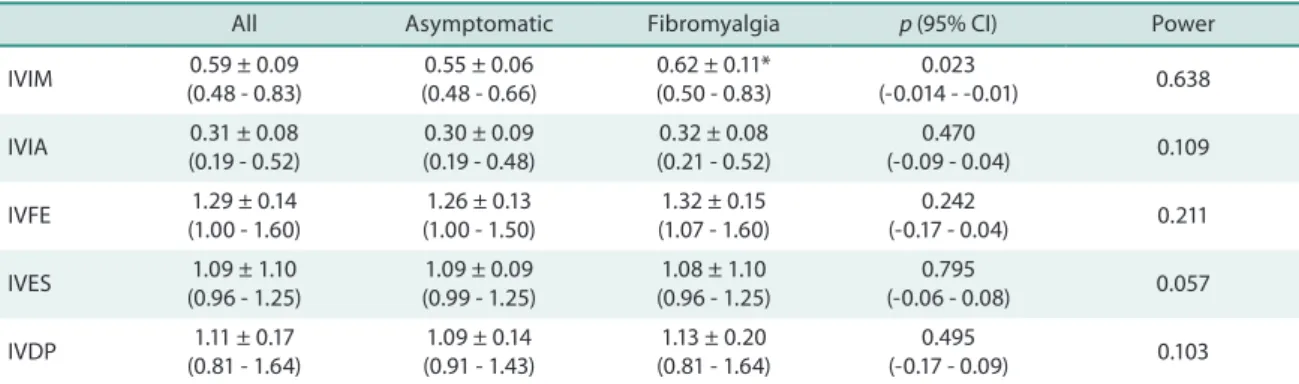
Comparison of the joint mobility variability indices showed that only IVIM exhibited a signiicant diference between the FMS and asymptomatic groups (table 3). In the distribution of the classiication of the joint vari-ability mobility indices, only IVIM exhibited a diferentiated pattern as a function of the investigated clinical condition. Approximately 60% of the women in the asymptomatic group exhibited a more homogeneous proile among the 20 assessed movements, with a predominance of an atypical pattern below the normal range. In turn, most of the women in the FMS group (60%) were classiied as being within the normal range, and the proile was quite homogeneous in 13%. he remainder of the variability indices was similar between the groups (igure 1).
Table 3. Comparison of the variability indices of joint mobility determined by the Flexitest among asymptomatic and ibromyalgia women. The results are expressed as the mean ± standard deviation (minimum - maximum).
All Asymptomatic Fibromyalgia p (95% CI) Power
IVIM 0.59 ± 0.09 (0.48 - 0.83)
0.55 ± 0.06 (0.48 - 0.66)
0.62 ± 0.11* (0.50 - 0.83)
0.023
(-0.014 - -0.01) 0.638
IVIA 0.31 ± 0.08 (0.19 - 0.52)
0.30 ± 0.09 (0.19 - 0.48)
0.32 ± 0.08 (0.21 - 0.52)
0.470
(-0.09 - 0.04) 0.109
IVFE 1.29 ± 0.14 (1.00 - 1.60)
1.26 ± 0.13 (1.00 - 1.50)
1.32 ± 0.15 (1.07 - 1.60)
0.242
(-0.17 - 0.04) 0.211
IVES 1.09 ± 1.10 (0.96 - 1.25)
1.09 ± 0.09 (0.99 - 1.25)
1.08 ± 1.10 (0.96 - 1.25)
0.795
(-0.06 - 0.08) 0.057
IVDP 1.11 ± 0.17 (0.81 - 1.64)
1.09 ± 0.14 (0.91 - 1.43)
1.13 ± 0.20 (0.81 - 1.64)
0.495
(-0.17 - 0.09) 0.103
distal movement variability index; *indicates p < 0.05.
DISCUSSION
In FMS, chronic pain tends to limit the performance of everyday
move-ments, a inding that was emphasized by Aparício et al.20 upon reporting
that women with the most severe pain exhibited greater limitation of movements compared with those with less pain. Nevertheless, it was not known whether such an efect was caused by a particular pattern of joint mobility. hus, the aim of the present study was to compare not only the overall lexibility level but also the lexibility proile between women with FMS and asymptomatic women. he main result of the present study was that although lexibility was similar between both groups, there were rel-evant variations between the investigated joint movements.
hat inding was made possible by the application of the Flexitest to the measurement of the joint range of motion because this assessment includes a larger number of movements compared with other procedures. One might imagine that some Flexitest measurement positions were impaired by the matching of the point of contact of the examiner’s hand, when moving
the body segments, with the participants’ tender points. However, only
two such points (trapezius and supraspinatus) are close to the sites used as support for the examiner’s hands when assessing movements X and XI (trunk extension and trunk lateral lexion). Nevertheless, no diferences were detected for those movements between the groups. hus, the use of the Flexitest was valuable in the present study because the previous
stud-ies merely recorded a rather narrow range of joint movements7,8,15,20 that
does not systematically relect the actual level of lexibility of individuals or allow the determination of a more complete proile of body movements.
Mannerkorpi et al.7 assessed only two active shoulder adduction
move-ments and found that in the FMS group, the range of motion was smaller
on the hand-to-neck test but not on the hand-to-scapula test. Using a
Flexibility and ibromyalgia Almeida & Santos
diference in the active shoulder adduction range of motion (back scratch
test). Dierick et al.15 assessed passive musculoarticular stifness in ankle
lexion and extension using an electromechanical device and found that this stifness was greater in the FMS group.
Trunk lexion is quite widely used to characterize the overall lexibility of individuals. Although that movement depends on a complex set of joints
and vertebrae, Araújo18 suggests considering this movement as involving
one single joint for simplicity reasons. In this regard, a signiicant diference was not found in the lexibility of women with or without FMS by studies that applied the conventional sit-and-reach test or trunk lexion in the
standing position21. By contrast, in other studies, the FMS group exhibited
poorer performance on the conventional sit-and-reach test regardless of
the severity of pain9 and on the modiied sit-and-reach test (unilateral and
sitting on a chair) compared with the control group20.
he conlicting results of the aforementioned studies suggest that lex-ibility should be assessed not only more comprehensively but also passively to attain the maximum range of motion, considering that most protocols used in studies measure lexibility actively. Furthermore, the
neuromus-cular performance of women with FMS being poorer22 explains why active
lexibility tests might underestimate the actual range of motion and impair the determination of their lexibility level.
In the present study, the overall lexibility level of the women with FMS was similar to that of the control group, as assessed by the Flexindex and percentile
reference values for age23. Most of the women in the sample were classiied
within the population average, independent of FMS, a result that disagrees
with evidence indicating that FMS is associated with joint hypermobility24-26.
As described when presenting the protocol, in the Flexitest, each as-sessed movement is scored from 0 (lowest range of motion) to 4 (largest range of motion). Upon assessing some movements more thoroughly, the shoulder extension range of motion was larger in the FMS group. How-ever, interestingly, all 15 participants scored 3 for the latter measurement corresponding to a range of motion above the average, without character-izing joint hypermobility. Flexitest movements XVI (shoulder posterior adduction at 180º of abduction) and IX (trunk lexion) are similar to the
procedures applied in other studies (shoulder7,20 and trunk8,9,20,21), allowing
for a more robust methodological comparison between those studies and ours. Our results did not indicate a signiicant diference in those move-ments between the groups. Finally, the diference found in the elbow lexion favorable to the FMS group might be related to diferences in the biceps muscle volume, which was not measured in the present study.
Acasuso-Diaz and Collantes-Estevez26 used a modiied version of the
Beighton et al.27 protocol and found a higher prevalence of
hypermobil-ity among women with FMS compared with other rheumatic conditions.
Sendur et al.25 and Oluoglu et al.24 found hypermobility rates of 47% vs.
29% and 64% vs. 22%, respectively, in women with FMS compared with
control groups (8% vs. 6%). Representative cases of joint hypermobility were not found in our sample. Although we applied methods diferent from the ones used in the aforementioned studies, the Flexitest was previously used
to determine joint hypermobility29; therefore, its use does not represent a
methodological limitation of the present study.
Another relevant issue of our study was the identiication of the pat-tern of distribution of joint mobility across the 20 movements that were assessed. hat aspect is relevant because two individuals might seem equally lexible based on the Flexindex score (total sum of the score of each individual movement), while the range of the various movements might exhibit considerable variation. For example, a Flexindex score of 40 might result from a score of 2 on all 20 movements or from a score of 0 on ive, a score of 1 on ive, a score of 3 on ive and a score of 4 on ive. hus, the variability indices allow the assessment of the homogeneity among the measurements of lexibility of one individual.
Similar to the Flexindex, most of the variability indices did not dif-fer between the groups, except IVIM, which is the most typical marker of variability because it is calculated based on the standard deviation of all 20 movements. he FMS group exhibited greater heterogeneity in the ranges of motion compared with that in the control group; more than 50% of the asymptomatic women exhibited greater homogeneity among the 20 movements than expected (igure 1). It is worth noting that the other four variability indices represent the existence of a characteristic lexibility pattern, by identifying the potential diferences between joints (IVIA), the predominance of lexion over extension (IVFE), the predominance of the distal over the proximal joints (IVDP) and the predominance of the upper over the lower part of the body (IVES). hose data indicate that although the overall lexibility was similar between the groups, it was patently com-posed of diferent elements, and no typical pattern was found, allowing the discrimination between the women with FMS and asymptomatic women. To the best of our knowledge, the present study is the irst to compare the lexibility proile of women with or without FMS in a more compre-hensive and detailed manner, allowing the assessment of joint mobility features of interest for the prescription of stretching and lexibility exercises for individuals with FMS. Given that lexibility is movement- and joint speciic, as shown above, knowledge of those results allows for a more conscious indication of training programs based on the understanding that this component of physical training ought to be individualized similar to that for aerobic and muscle strengthening exercises. hus, it is evident that although the overall lexibility was similar, the speciic needs for joint mobilization difered between the investigated groups.
Flexibility and ibromyalgia Almeida & Santos
Although the study universe was, thus, rather restricted, it allowed for closer comparison with the control group given the similar characteristics among the individuals. Another relevant aspect was that the level of chronic pain was not measured. Although we expected that pain would behave as a limiting factor for lexibility, the results did not support that hypothesis; thus, we believe that such an aspect did not interfere with our results.
CONCLUSION
No signiicant diference was found in the overall lexibility levels between the asymptomatic women and women with ibromyalgia. he women with ibromyalgia exhibited greater heterogeneity in the ranges of motion.
REFERENCES
1. Cavalcante AB, Sauer JF, Chalot SD, Assumpção A, Lage LV, Matsutani LA, et al. A prevalência de ibromialgia: uma revisão de literatura. Rev Bras Reumatol 2006;46(1):40-8.
2. Üçeyler N, Häuser W, Sommer C. Systematic review with meta-analysis: cytokines in ibromyalgia syndrome. BMC Musculoskelet Disord 2011;12:245.
3. Kelley GA, Kelley KS. Exercise improves global well-being in adults with ibromyal-gia: conirmation of previous meta-analytic results using a recently developed and novel varying coeicient model. Clin Exp Rheumatol 2011;29(6):S60-2.
4. Kaleth AS, Saha CK, Jensen MP, Slaven JE, Ang DC. Efect of moderate to vigorous physical activity on long-term clinical outcomes and pain severity in ibromyalgia. Arthritis Care Res (Hoboken) 2013;65(8):1211-8.
5. Henriksson C, Gundmark I, Bengtsson A, Ek AC. Living with ibromyalgia: con-sequences for everyday life. Clin J Pain 1992;8(2):138-44.
6. Jones J, Rutledge DN, Jones KD, Matallana L, Rooks DS. Self-assessed physical function levels of women with ibromyalgia: a national survey. Womens Health Issues 2008;18(5):406-12.
7. Mannerkorpi K, Svantesson U, Carlsson J, Ekdahl C. Tests of functional limitations in ibromyalgia syndrome: a reliability study. Arthritis Care Res 1999;12(3):193-9.
8. Góes SM, Leite N, Shay BL, Homann D, Stefanello JMF, Rodacki ALF. Functional capacity, muscle strength and falls in women with ibromyalgia. Clin Biomech (Bristol, Avon) 2012;27(6):578-83.
9. Pedro-Angel LR, Campos MAS, Meza JAM, Fernández MD, Heredia JM. Análise das capacidades físicas de mulheres com ibromialgia segundo o nível de gravidade da enfermidade. Rev Bras Med Esporte 2012;18(5):308-12.
10. Jones KD, Burckhardt CS, Clark SR, Bennett RM, Potempa KM. A randomized controlled trial of muscle strengthening versus lexibility training in ibromyalgia. J Rheumatol 2002;29(5):1041-8.
11. Hughes L. Physical and psychological variables that inluence pain in patients with ibromyalgia. Orthop Nurs 2006;25(2):112-9.
12. Dickinson RV. he speciicity of lexibility. Res Quart 1968;39(3):792-4.
13. Busch AJ, Schachter CL, Overend TJ, Peloso PM, Barber KA. Exercise for ibromy-algia: a systematic review. J Rheumatol 2008;35(6):1130-44.
14. Assumpção A, Sauer JF, Mango PC, Marques AP. Physical function interfering with pain and symptoms in ibromyalgia patients. Clin Exp Rheumatol 2010;28(6):S57-63.
Corresponding author
Marcos Bezerra de Almeida Universidade Federal de Sergipe Cidade Universitária “Prof José Aloísio de Campos”
Núcleo de Pós-graduação em Educação Física
Av. Marechal Rondon, s/n - Jardim Rosa Elze
CEP 49100-000 – São Cristóvão – Sergipe, SE. Brasil
E-mail: [email protected]
of Fibromyalgia: Report of the Multicenter Criteria Committee. Arthritis Rheum 1990;33(2):160-72.
17. Matos VS, Matos-Santos L, Almeida MB. Efeitos do aquecimento sobre os índices de variabilidade da mobilidade articular. In: Cabral de Oliveira AC, Haiachi MC, Almeida MB, organizadores. Tópicos especiais em ciência da atividade física e do esporte. Aracaju: J. Andrade, 2010.
18. Araújo CGS. Flexiteste: um método completo para avaliar a lexibilidade. São Paulo: Manole, 2004.
19. Araújo CGS. Flexiteste: proposição de cinco índices de variabilidade da mobilidade articular. Rev Bras Med Esporte 2002;18(1):13-9.
20. Aparicio VA, Carbonell-Baeza A, Ruiz JR, Aranda P, Tercedor P, Delgado-Fernández M, et al. Fitness testing as a discriminative tool for the diagnosis and monitoring of ibromyalgia. Scand J Med Sci Sports 2013;23(4):415-23.
21. Sener U, Ucok K, Ulasli AM, Genc A, Karabacak H, Coban NF, et al. Evaluation of health-related physical itness parameters and association analysis with depression, anxiety, and quality of life in patients with ibromyalgia. Int J Rheum Dis [Epub ahead of print].
22. Bachasson D, Guinot M, Wuyam B, Favre-Juvin A, Millet GY, Levy P, et al. Neuro-muscular fatigue and exercise capacity in ibromyalgia syndrome. Arthritis Care Res (Hoboken) 2013;65(3):432-40.
23. Araújo CGS. Avaliação da lexibilidade: valores normativos do lexiteste dos 5 aos 91 anos de idade. Arq Bras Cardiol 2008;90(4):280-7.
24. Oluoglu D, Gunduz OH, Kul-Panza E, Guven Z. Hypermobility in women with ibromyalgia syndrome. Clin Rheumatol 2006;25(3):291-3.
25. Sendur OF, Gurer G, Bozbas GT. he frequency of hypermobility and its relationship with clinical indings of ibromyalgia patients. Clin Rheumatol 2007;26(4):485-7.
26. Acasuso-Díaz M, Collantes-Estévez E. Joint hypermobility in patients with ibro-myalgia syndrome. Arthritis Care Res 1998;11(1):39-42.
27. Beighton P, Solomon L, Soskolne CL. Articular mobility in an African population. Ann Rheum Dis 1973;32(5):413-8.
28. Karaaslan Y, Haznedaroglu S, Oztürk M. Joint hypermobility and primary ibro-myalgia: a clinical enigma. J Rheumatol 2000;27(7):1774-6.