ABSTRACT
http://dx.doi.org/10.1590/1679-775720130016
High-efficiency tooth bleaching using
non-thermal atmospheric pressure plasma with low
concentration of hydrogen peroxide
Seoul Hee NAM1, Hyun Woo LEE2, Soo Hyun CHO3, Jae Koo LEE2, Young Chan JEON4, Gyoo Cheon KIM5
1- MSc, PhD student, Department of Oral Anatomy, School of Dentistry, Pusan National University, Yangsan, Republic of Korea. 2- PhD, Department of Electronic and Electrical Engineering, Pohang University of Science and Technology, Pohang, Republic of Korea. 3- DDS, MSc, Department of Oral Anatomy, School of Dentistry, Pusan National University, Yangsan, Republic of Korea.
4- DDS, PhD, Department of Prosthetic Dentistry, School of Dentistry, Pusan National University, Yangsan, Republic of Korea. 5- PhD, Department of Oral Anatomy, School of Dentistry, Pusan National University, Yangsan, Republic of Korea.
Corresponding address: Gyoo Cheon Kim - Department of Oral Anatomy, School of Dentistry, Pusan National University - Beomeo-ri - Mulgeum-eup - Yangsan-si - Gyeongsangnam - 626-870 - Republic of Korea - Phone: 82-10-5251-8214 - 82-51-510-8243 - Fax: 82-51-510-8241 - e-mail: [email protected]
L
ight-activated tooth bleaching with a high hydrogen peroxide (HP; H2O2) concentration has risks and the actual role of the light source is doubtful. The use of conventional light might result in an increase in the temperature and cause thermal damage to the health of non-thermal atmospheric pressure plasma (NAPP) with 15% carbamide peroxide (CP; CH6N2O3) including 5.4% HP, as compared with conventional light sources. Material and Methods: Forty human teeth were randomly divided into four groups: Group I (CP+NAPP), Group II (CP+plasma arc lamp; PAC), Group III (CP+diode laser), and Group IV (CPE) of the tooth and tooth surface temperatures were measured.
Data were evaluated by one-way analysis of variance (ANOVA) and post-hoc Tukey’s
! "#$&$E value of 1.92-,
2.61 and 2.97-fold greater than those of Groups II, III and IV, respectively (P<0.05). The tooth surface temperature was maintained around 37°C in Group I, but it reached 43°C in Groups II and III. Conclusions: The NAPP has a greater capability for effective tooth bleaching than conventional light sources with a low concentration of HP without causing '' */88''= > bleaching in the near future.
Key words: Tooth bleaching. Plasma gases. Hydrogen peroxide. Temperature.
INTRODUCTION
Modern tooth bleaching agents are based primarily on hydrogen peroxide (HP; H2O2) and carbamide peroxide (CP; CH6N2O3)18. Both bleaching agents effectively remove chromogens deposited on the enamel and dentin of teeth, thereby whitening the tooth1. High-concentration peroxides are used >&$ >' #> is generally performed using high concentrations (35-50%) of HP-containing gel in combination with light sources28. However, high concentrations of HP can cause problems, such as external cervical
root resorption, tooth sensitivity, alteration of the enamel surfaces, and pulp damage4,22. On the other hand, at-home bleaching is performed using low concentrations of CP (usually containing 2-10% HP), which are applied for several hours per day for several weeks8@E>&>' bleaching does not guarantee immediate results. &>= E'
metal halide lamp, light emitting diode, and laser are widely-used light sources that accelerate the >" 3. However, the actual role of the light source in tooth bleaching remains a source of controversy.
Some reports claim that the use of light sources
'21,27;
conversely, other articles have reported that light
bleaching9,24. Furthermore, the light energy may increase the tooth temperature, potentially leading to irreversible thermal damage of the pulp tissue15. Therefore, an effective, non-thermal light source is desired for successful and safe tooth bleaching.
'& dental medicine, have employed plasma, the fourth state of matter. Since 2000, non-thermal atmospheric pressure plasma (NAPP) has attracted great interest and has been widely used in biomedical applications, such as sterilization, treatment of eukaryotic cells, wound healing, blood coagulation, and dental applications7,10,13,16,20. NAPP has been shown to have a strong tooth bleaching effect16,17,25. We supposed that if the NAPP is able to > low CP concentrations of at-home bleaching, the NAPP could become an important energy source for tooth bleaching. This in vitro study examined the */88&8/& with a low concentration of 15% CP containing 5.4% HP by analyzing the color change and temperature increase of the tooth surface after treatment.
MATERIAL AND METHODS
Plasma device
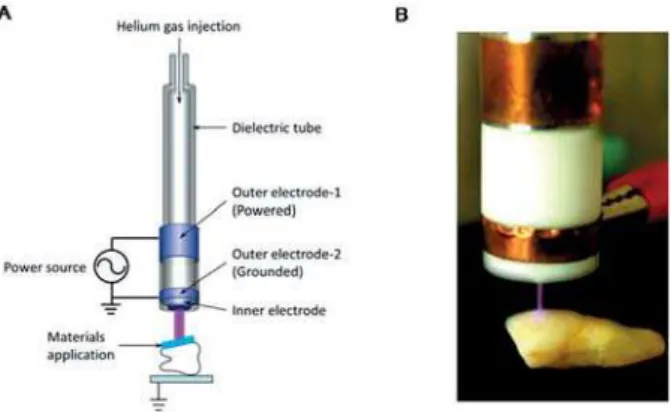
Figure 1 illustrates the process for external bleaching using the NAPP jet. The hand held NAPP jet is driven by a low frequency (20 kHz) high "E>>"E'" JK
EQR '$U$XYZ'-1
for a safe and stable operation of the NAPP jet. A detailed description and analysis of the electrical and physical features of the NAPP jet are beyond the scope of this paper, but we have reported this previously16,17.
Tooth preparation and selection
We used forty extracted human molar teeth with intact crowns in this experiment after receiving approval from the research ethics committee of the Pusan National University Yangsan Hospital, Yangsan, Korea (approval #04-2012-012). All teeth were stored in a 0.4% sodium azide solution to prevent bacterial growth. Before the bleaching procedure, we cleaned the teeth using scalers to remove the calculus and soft tissue remnants. We then polished them with water/pumice slurry
in dental prophylactic cups and examined them '" `{| '& SZ-CTV, Olympus, Tokyo, Japan) and selected teeth with no signs of fracture, caries, lesions, or surface defects. We removed the root portions of the teeth horizontally using a water-cooled low-speed diamond saw (Struers Minitom, Struers A/S, Copenhagen, Denmark). Each crown was vertically bisected, and the cut surfaces of the teeth were waterproofed with two layers of nail varnish. All the $ & Hanlim, Seoul, Korea) before tooth bleaching.
Tooth bleaching procedure
The crowns of the human teeth were subjected `XK8$K&8> International, Walnut, CA, USA), activated by three different sources: the NAPP, PAC, and diode laser. We followed the protocols for applying the light sources as per the manufacturers’ instructions (Figure 2). The four groups differed in light sources, treatment durations, and application devices. The forty teeth were randomly divided into four groups J{ $ $ */88& 8/& laser, or CP alone (control). Before tooth bleaching, the surface of each tooth was photographed using a digital imaging system under a stereomicroscope {|'
In all groups, we covered the buccal surfaces with a uniform layer (approximately 1 mm thick) of 15% CP gel containing 5.4% HPevery 10 min, according to the manufacturer’s guidelines. In Group I, we applied 15% CP gel and NAPP (500-750 nm, helium lines) for 20 min. The tip of the NAPP device was kept at a distance of 1 cm from the tooth surface. After 10 min, the teeth were carefully washed with distilled water to remove the CP gel and were dried with absorption paper. All teeth were photographed under a stereomicroscope. We repeated the procedure one more time, so that the total treatment was 20 min. Group II was treated
in the same manner as Group I, but the activation was performed with a PAC (380–520±10 nm, 30 mW/cm2±20%, Curing & Whitening BC 330, B&B Systems, Seoul, Korea)for 20 min. Group III was treated with 15% CP gel using a diode laser (Vision MDL-10, Vision Lasertechnik GmbH, Rodenberg, Germany) with an emission wavelength of 980±10 ' $'& " 'K{'' " of 0.5 W for 20 min. The other procedures were the same as those for Group I. Group IV (control) was treated with 15% CP gel without a light source for 20 min.
$QDO\VLVRIWKHEOHDFKLQJHI¿FDF\
We photographed all teeth in the four groups before, during (10 min), and after the treatment (20 min). To make determinations as accurately as possible, all measurements were obtained under standard conditions: 10× magnification, black background, blackout curtains, and exposure time (90.0 ms) in the same room. The images were loaded onto a computer through the Image-Pro Plus 5.1 software (Media Cybernetics Inc, Bethesda, MD, USA). Color changes were evaluated with Adobe Photoshop CS2 (Adobe Systems Inc, San Jose, CA, USA). For each tooth, values were expressed according to the Commission Internationale de L’Eclairage Lab (CIELAB) Color System29. The
CIELAB system uses three parameters, L*, a*, and b*, where L* indicates the brightness, and a* and b* describe the amount of green-red and blue-yellow, respectively, in the color space of the tooth. We calculated the value of the color changes E) of the tooth according to the following formula:
Measurement of tooth temperature
We measured the temperature increase in each tooth independently from the tooth bleaching experiments for each of the three light sources using a fiber optic temperature measurement system (FTI-10 fiber optic signal conditioner, >Y> " '" # #& &" temperature sensor was placed in contact with the &$"" During the measurement, we had positioned the light source perpendicular to the buccal surface at a distance of 1 cm for 30 min and had performed three applications of each light source on each tooth at room temperature (25°C), and at 55% humidity levels.
Statistical analysis
Statistical analysis was performed using a computerized program in SPSS 15.0® (SPSS Inc, Chicago, IL, USA). All light-activated bleaching effects and color changes for each group were analyzed by one-way analysis of variance (ANOVA) and a post-hoc Tukey’s test. P<0.05 represented
RESULTS
Effects of tooth bleaching
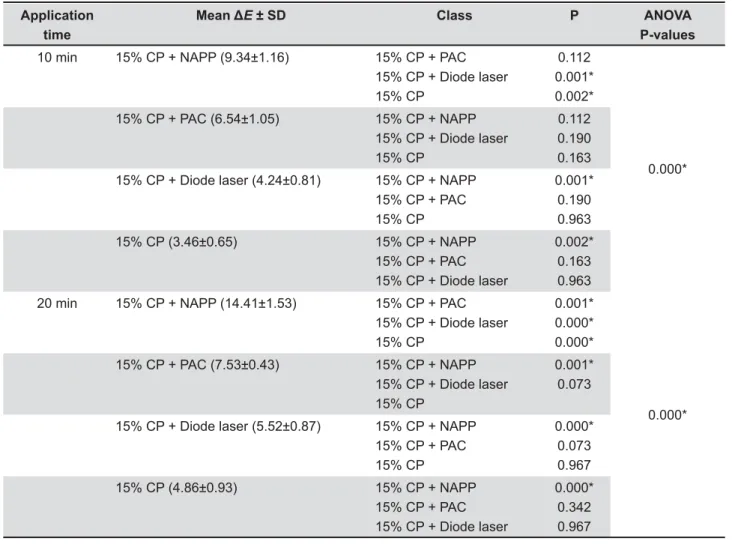
Figure 3 shows the tooth bleaching effects in the four groups. After the teeth were coated with 15% CP, they were treated with each light source for the indicated times. While the bleaching effects from all of the light sources were time dependent, the NAPP was the most effective for bleaching. The average E±standard deviations (SD) were 9.34±1.16 and 14.41±1.53, 6.54±1.05 and 7.53±0.43, 4.24±0.81 and 5.52±0.87, and 3.46±0.65 and 4.86±0.93 after 10 min and 20 min treatment with NAPP, PAC, diode laser, and without a light source, respectively. Light unit
(Brand)
Manufacturer Light activation
source
Application time (min)
Curing & Whitening BC 330 B&B Systems, South Korea Plasma Xenon Arc Lamp
(380-520 nm ± 10 nm)
20
Vision MDL-10 Vision Lasertechnik GmbH,
Rodenberg, Germany
Diode laser (980 ± 10 nm) 20
Figure 2- Light sources employed in this study
Figure 3- The tooth bleaching effects of three different
E value of Group I, which was treated with NAPP, was statistically higher than that of any of the other groups (P<0.05). The NAPP improved the `X&XX{ and 2.61, and 2.70 and 2.97 compared to the PAC, diode laser, and CP alone, respectively, after 10 min and 20 min. However, Table 1 demonstrates that there were no statistical differences between the other groups (II, III, and IV) (P>0.05).
Temperature measurement
The temperature increase induced by the three light sources is shown in Figure 4. The PAC and diode laser increased the temperature of the buccal surface of the tooth to a greater extent than the NAPP. The temperature of a tooth treated with the NAPP stabilized near 37°C after 10 min of operation, and this state was continuously maintained throughout the treatment duration. In contrast, the PAC and diode laser increased the tooth temperature to 43°C and 42.5°C, respectively, after 20 min.
Table1-+E±SD (standard deviation) after tooth bleaching using different light sources
Application time
<E ± SD Class P ANOVA
P-values
10 min 15% CP + NAPP (9.34±1.16) 15% CP + PAC
15% CP + Diode laser 15% CP
0.112 0.001* 0.002*
0.000*
15% CP + PAC (6.54±1.05) 15% CP + NAPP
15% CP + Diode laser 15% CP
0.112 0.190 0.163
15% CP + Diode laser (4.24±0.81) 15% CP + NAPP
15% CP + PAC 15% CP
0.001* 0.190 0.963
15% CP (3.46±0.65) 15% CP + NAPP
15% CP + PAC 15% CP + Diode laser
0.002* 0.163 0.963
20 min 15% CP + NAPP (14.41±1.53) 15% CP + PAC
15% CP + Diode laser 15% CP
0.001* 0.000* 0.000*
0.000*
15% CP + PAC (7.53±0.43) 15% CP + NAPP
15% CP + Diode laser 15% CP
0.001* 0.073
15% CP + Diode laser (5.52±0.87) 15% CP + NAPP
15% CP + PAC 15% CP
0.000* 0.073 0.967
15% CP (4.86±0.93) 15% CP + NAPP
15% CP + PAC 15% CP + Diode laser
0.000* 0.342 0.967
=$ ! ! >?IJQ?+Z[%'*" (CP=carbamide peroxide; NAPP=nonthermal atmospheric pressure plasma; PAC=plasma arc lamp)
DISCUSSION
Current tooth bleaching procedures have several drawbacks: (1) at-home bleaching using low concentrations of HP is relatively safe for tissues but requires a long time for satisfactory results $EX> a stronger effect but has risks due to the high HP & used in tooth bleaching is doubtful. Therefore, it would be ideal to utilize a light source that can $$8 concentrations. If such a light source could produce '>& three major problems could be simultaneously solved.
Various light sources are being used to increase the bleaching effect and shorten the duration of tooth bleaching12. Among them, the PAC and diode laser have been widely used in dental clinics3. Because the PAC has a high broadband emission (400-580 nm) and high-energy intensity, it has been used for tooth bleaching as well as resin curing26. Nakamura, et al.23 (2001) and Kashima-Tanaka, et al.14 (2003) " 8/ tooth color, whereas Hein, et al.9 (2003) and Lima, et al.19 (2009) demonstrated that the PAC did not effectively activate the bleaching gels. Because laser tooth bleaching began about 15 years ago, many kinds of laser devices have been used for tooth bleaching2,11. Laser irradiation is known to reduce the total treatment time and has the virtue of mitigating tooth sensitivity accompanied by $& caused by laser irradiation remain in question.
This study demonstrated that the bleaching effect of the NAPP was superior to those of the other $ E value achieved with the */88$ with the PAC and diode laser. The NAPP group had ' groups. When the PAC and diode laser were used X{' &E values increased more than that of the control group, but $ When we irradiated with the diode laser for 20 min, E value was only slightly different from that of the control group. These results demonstrate that neither light source is appropriate for accelerating the effects of 15% CP.
The 15% CP used in this study includes only 5.4% HP. Considering that 30-50% HP is generally >&8/ and diode laser did not show bleaching effects in this study could be due to the low concentration of HP. $& */88 E value after 10 min, and after 20 min, the E value was much higher than those of the other
two light sources. This demonstrates that, with a low concentration of CP, the NAPP has a stronger bleaching effect than the other two light sources. E value of Group I was approximately 1.5416 and 2.03 times higher than those after treatment with 30% HP alone for 10 min and 20 min, respectively (data not shown). Because the NAPP produces large amounts of energetic ions, charged particles, and free radicals, these might interact with the HP, thereby synergistically enhancing the bleaching effect.
Since human tissues are sensitive to heat, many studies have investigated thermal damage to the pulp of teeth induced by light sources. Temperatures in excess of 42.5°C may induce degradation of the pulp tissues6. Similar to previous reports2,5, this study found that the PAC and diode laser increased the temperature of the tooth surface to approximately 43°C and 42.5°C, respectively, after 20 min. The NAPP, however, took about 10 min to reach a steady-state temperature, and thereafter the tooth surface temperature was maintained around 37°C. The fact that the temperature of the NAPP treatment is similar to the human body temperature means that a patient could not feel a sense of pain from cold or heat. Furthermore, it does not induce thermal damage in the tooth pulp or the tooth around the tissue.
CONCLUSIONS
Tooth bleaching using the NAPP resulted in a better bleaching effect than the use of the PAC and diode laser with a 15% CP. In addition, the NAPP treatment did not increase the temperature of the tooth surface above 37°C, indicating that the NAPP does not cause any thermal damage to the tooth. Therefore, the NAPP can be a useful tooth bleaching device that provides a high bleaching effect with a low concentration of HP. As such, it could replace conventional light sources that have limitations, = temperatures.
ACKNOWLEDGEMENTS
REFERENCES
1- Berger SB, Coelho AS, Oliveira VA, Cavalli V, Giannini M. Enamel susceptibility to red wine staining after 35% hydrogen peroxide bleaching. J Appl Oral Sci. 2008;16:201-4.
2- Baik JW, Rueggeberg FA, Liewehr FR. Effect of light-enhanced bleaching on in vitro surface and intrapulpal temperature rise. J Esthet Restor Dent. 2001;13:370-8.
3- Buchalla W, Attin T. External bleaching therapy with activation by heat, light or laser - a systematic review. Dent Mater. 2007;23:586-96.
4- Dahl JE, Pallesen U. Tooth bleaching - a critical review of the biological aspects. Crit Rev Oral Biol Med. 2003;14:292-304. 5- Eldeniz AU, Usumez A, Usumez S, Ozturk N. Pulpal temperature rise during light-activated bleaching. J Biomed Mater Res B Appl Biomater. 2005;72:254-9.
6- Erikkson A, Albrektsson T, Grane B, McQueen D. Thermal injury to bone: a vital microscopic description of heat effects. Int J Oral Surg. 1982;11:115-21.
7- Fridman G, Friedman G, Gutsol A, Shekhter AB, Vasilets VN, Fridman A. Applied plasma medicine. Plasma Processes Polym. 2008;5:503-33.
>$Q/'">'> Dent Today. 2000;19:44-53.
9- Hein DK, Ploeger BJ, Hartup JK, Wagstaff RS, Palmer TM, Hansen Y#>>$'" Contin Educ Dent. 2003;24:340-52.
10- Iza F, Kim GJ, Lee SM, Lee JK, Walsh JL, Zhang YT, et al. Microplasmas: sources, particle kinetics, and biomedical applications. Plasma Processes Polym. 2008;5:322-44.
11- Joiner A. The bleaching of teeth: a review of the literature. J Dent. 2006;34:412-9.
12- Jones AH, Diaz-Arnold AM, Vargas MA, Cobb DS. Colorimetric assessment of laser and home bleaching techniques. J Esthet Dent. 1999;11:87-94.
13- Kang SK, Choi MY, Koo IG, Kim PY, Kim Y, Kim GJ, et al. Reactive hydroxyl radical-driven oral bacterial inactivation by radio frequency atmospheric plasma. Appl Phys Lett. 2011;98:143702. 14- Kashima-Tanaka M, Tsujimoto Y, Kawamoto K, Senda N, Ito K, Yamazaki M. Generation of free radicals and/or active oxygen by light or laser irradiation of hydrogen peroxide or sodium hypochlorite. J Endod. 2003;29:141-3.
K> !#>$ J Can Dent Assoc. 2005;71:420-1.
16- Lee HW, Kim GJ, Kim JM, Park JK, Lee JK, Kim GC. Tooth bleaching with non-thermal atmospheric pressure plasma. J Endod. 2009;35:587-91.
17- Lee HW, Nam SH, Mohamed AAH, Kim GC, Lee JK. Atmospheric pressure plasma jet composed of three electrodes: application to tooth bleaching. Plasma Processes Polym. 2010;7:274-80. 18- Lim MY, Lum SO, Poh RS, Lee GP, Lim KC. An in vitro '"K'" with established intracoronal bleaching agents. Int Endod J. 2004;37:483-8.
19- Lima DA, Aguiar FH, Liporoni PC, Munin E, Ambrosano GM, Lovadino JR. In vitro evaluation of the effectiveness of bleaching agents activated by different light sources. J Prosthodont. 2009;18:249-54.
20- Lloyd G, Friedman G, Jafri S, Schultz G, Fridman A, Harding K. Gas plasma: medical uses and developments in wound care. Plasma Processes Polym. 2010;7:194-211.
21- Luk K, Tam L, Hubert M. Effect of light energy on peroxide tooth bleaching. J Am Dent Assoc. 2004;135:194-201.
22- Marson FC, Sensi LG, Vieira LC, Araújo E. Clinical evaluation >'$$ of light-activation sources. Oper Dent. 2008;33:15-22.
23- Nakamura T, Saito O, Ko T, Maruyama T. The effects of polishing and bleaching on the colour of discoloured teeth in vivo. J Oral Rehab. 2001;28:1080-4.
24- Papathanasiou A, Kastali S, Perry RD, Kugel G. Clinical K">$' Compend Contin Educ Dent. 2002;23:335-8.
25- Park JK, Nam SH, Kwon HC, Mohamed AAH, Lee JK, Kim GC. Feasibility of non-thermal atmospheric pressure plasma for intracoronal bleaching. Int Endod J. 2011;44:170-5.
X> 8 /& /& /' composites polymerized with plasma arc curing units. Dent Mater. 2000;16:330-6.
27- Smigel I. Laser tooth whitening. Dent Today. 1996;15:32-6. 28- Sulieman M. An overview of tooth discoloration: extrinsic, intrinsic and internalized stains. Dent Update. 2005;32:463-4. 29- Villalta P, Lu H, Okte Z, Garcia-Godoy F, Powers JM. Effects of staining and bleaching on color change of dental composite resins. J Prosthet Dent. 2006;95:137-42.