L
Journal of Alloys and Compounds 344 (2002) 105–109
www.elsevier.com / locate / jallcom
S
tudy of the thermal decomposition of the Nd(III), Eu(III)
and Tb(III) scorpionates
a,b ,
*
a,c c b´
´
Pedro Miranda Jr.
, Eliana M. Arico , Marcelo F. Maduar , Jivaldo R. Matos ,
d
Carlos Alberto A. de Carvalho
a
˜
Faculdades Oswaldo Cruz–FOC,Sao Paulo(SP),Brazil
b
˜ ´
Instituto de Quımica,USP,Sao Paulo(SP),Brazil
c
˜ ´
Instituto de Pesquisas Energeticas e Nucleares,Sao Paulo(SP),Brazil
d
´
Departamento de Quımica,UFOP,Ouro Preto(MG),Brazil
Abstract
3
The thermal behavior of the compounds [kHB(N C H ) ] Ln (Ln2 3 3 3 3 5Nd, Eu and Tb) was investigated through TG / DTG and DSC
21 analyses. TG / DTG experiments were performed in a TGA-50 Shimadzu instrument under dynamic air atmosphere (50 ml min ). DSC
21 21
measurements were performed in a dynamic nitrogen atmosphere (50 ml min ) at 108C min heating rate using a DSC-50 Shimadzu differential calorimeter. For the TG / DTG and DSC analyses, an amount of 1.5–2.0 mg was used. From the TG curves, it was possible to show that all compounds are anhydrous, a one-step mass loss occurring between 200 and 4508C, yielding a residual stable up to 9008C. From the DTG curves it was found that decomposition temperatures decrease as the Ln(III) ionic radius decreases. DSC curves indicate that the compounds do not melt before the decomposition. For all three compounds, the decomposition process is exothermic.
2002 Elsevier Science B.V. All rights reserved.
Keywords: Lanthanides; Scorpionates; Thermal decomposition
1. Introduction scopic compounds, the investigation of their thermal
behavior was undertaken in order to understand and The poly(pyrazolyl)-borates (Tp*), also known as scor- correlate it with the structure of the compounds along the pionates, formula HB(N C H ) , are chelating monovalent2 3 3 3 lanthanide series.
anions, containing nitrogen as donor atoms. Such com-pounds have lately found numerous applications in inor-ganic, organometallic and bioinorganic chemistry [1,2]. The Tp* ligand behaves as a six-electron donor and, with regard to rare earth ions, they fulfil the electronic and steric requirements of the central ion, saturating its coordination sphere and therefore providing anhydrous stable
com-3
pounds, [k HB(N C H ) ] Ln, even when prepared from
2 3 3 3 3
aqueous solution, with unusual chemical environments and molecular structures [3]. A formula drawing of a Ln(Tp*)3 compound is shown in Fig. 1.
As the Ln(Tp*) are very unusual water-free non-hygro-3
*Corresponding author. Tel. / fax:155-11-3091-3876.
E-mail address: [email protected](P. Miranda Jr.). Fig. 1. Formula drawing of Ln(Tp*) .3
The Ln(Tp*) (Tp*5HB(N C H ) , Ln5Nd, Eu and [k HB(N C H ) ] Ln, by Apostolidis et al. [3]. The IR
3 2 3 3 3 2 3 3 3 3
Tb) compounds were synthesized through the reaction of spectra of the Ln(Tp*)3 compounds were very similar, hydrated lanthanide chlorides with excess of KTp* in evidencing the isomorphism among them. A previous work aqueous solution [3]. The resulting solid compounds were reported that Ln(Tp*) (Ln5La to Dy) compounds are
3
separated and washed with distilled water and dried under isostructural, having the same structure as Pr(Tp*) ,3 vacuum over anhydrous calcium chloride. determined by single-crystal X-ray analysis, where the The thermal decomposition of the compounds was lanthanide ion is nine-coordinated to three nitrogen atoms performed by TG / DTG and DSC analyses, using a small from each ligand and displays tricapped trigonal prismatic amount of material (1.5–2.0 mg). TG / DTG experiments geometry [3].
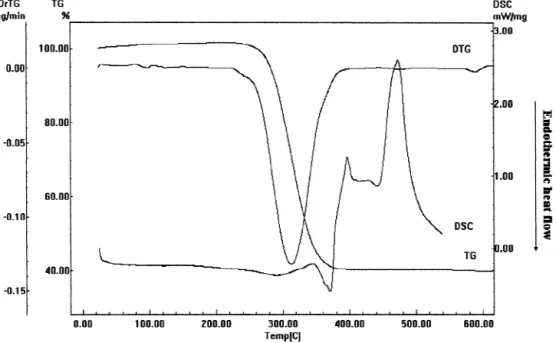
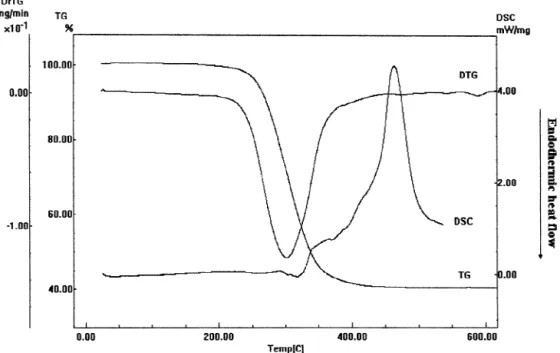
were performed in a TGA-50 Shimadzu instrument under TG, DTG and DSC curves are shown in Figs. 2–4. In
21 21
dynamic air atmosphere (50 ml min ) at a 108C min the TG curves the anhydrous character of the compounds
heating rate. DSC measurements were performed in a was evidenced. The mass loss occurs in a single stage,
21
dynamic nitrogen atmosphere (50 ml min ) at 108C corresponding to 61.7% for the Nd compound, 60.0% for
21
min heating rate, using a differential calorimeter DSC- Eu, and 50.2% for Tb, in the interval from 200 to 4508C,
50 Shimadzu. generating a stable residual until 9008C.
The resulting residual, obtained at 6008C heating, was In the DTG curves, it was observed that the values of
characterized by elemental analysis of Ln, C, H and N and decomposition peak temperatures decrease with the de-IR spectroscopy. Lanthanide ions were determined by crease of the ionic radius of lanthanide ions: 313, 303 and titration with EDTA using a buffer (pH 5.8) and xylenol- 2878C for Nd, Eu and Tb compounds, respectively.
orange as indicator. CHN microanalytical procedures were The DSC curves showed peaks related to the decompo-performed in a Perkin-Elmer 240 instrument. IR spectra sition that occurs in endothermic and exothermic events. were recorded on a Bomem MB-100 spectrometer using The first peak appears at 372, 318 and 3218C for the Nd,
KBr pellets. Eu and Tb compounds, respectively. These peaks
corre-spond to endothermic events and are not related to the melting, since the TG curves show a mass loss in the same
3. Results and discussion temperature range. This observation indicates that the
melting and decomposition processes occur simultaneously The solid Ln(Tp*)3 compounds obtained by precipi- in endothermic and exothermic events.
tation from aqueous solutions were stable in air. Their Above 4008C, in the DSC curves, it was verified that
colors are those of lanthanide chlorides. Nd(Tp*) is pale3 the thermal decomposition occurs in exothermic events, mauve, while Eu(Tp*) and Tb(Tp*) are white. The Ln, with maximum peaks at 474, 464 and 4898C for Nd, Eu
3 3
Fig. 3. TG / DTG and DSC curves for Eu(Tp*) .3
and Tb compounds, respectively. Some similarity was the DTG curve; with further heating, the compound curve observed between the peaks of Nd and Eu compounds. The initially shows a plateau; after 2008C until 6508C the
Tb compound presented different behavior, showing sever- mass loss reaches 63.5%, related to several events in the
al peaks. DTG curve, whose most intense peak occurs at 3808C.
Fig. 5 shows the TG / DTG and DSC curves for KTp*, The DSC curve for KTp* showed one endothermic which is the starting salt for the synthesis of Ln(Tp*)3 event related to dehydration, corresponding to one peak at compounds. The decomposition behavior for KTp* differs 798C. It was also possible to verify that the melting of this
significantly from that of the Ln(Tp*) . compound corresponds to one peak at 1908C. The
de-3
It was found that KTp* contains hydration water, which composition occurred above 2708C in several exothermic
corresponds to the 6.5% mass loss and to the 738C peak in events, whose most intense peak occurs at 4528C.
Fig. 5. TG / DTG and DSC curves for KTp*.
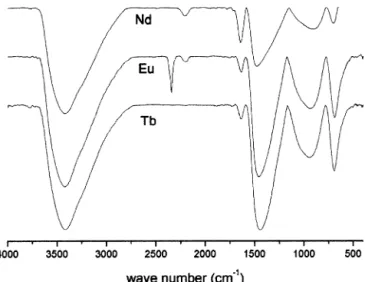
CHN analyses results of the residual at 6008C of three distant IR, it was found that Nd and Eu compounds are
isostructural [3]. Structural information for the Tb(Tp*) is
lanthanide compounds did not indicate the presence of C, 3
not known, but according to the differences of its thermal H and N elements. The IR spectra (Fig. 6) for those
behavior in comparison with those of Nd and Eu, one may samples showed absorption bands characteristic of borate
suppose that the Tb compound should not be isostructural ion. The four bands corresponding to the vibrational mode
21
with Nd(Tp*) and Eu(Tp*) , but instead with the of the planar borate ion [4], n (around 900 cm ), n
3 3
1 2
21 21
Yb(Tp*) , which have a Tp* as bidentate and two Tp* as (around 700 cm ),n (around 1400 cm ) andn (around
3
3 4
21
tridentate, resulting in octa-coordinated compounds [6]. 600 cm ), could be observed. These results are in
agreement with the data of the infrared spectrum of the lanthanum borate [5].
4. Summary
The monocrystal structure of Nd(Tp*) was elucidated3 [3]. By using indirect structural determination in the
This paper reports the study of the thermal behavior of the Ln(Tp*) (Ln5Nd, Eu and Tb). In the TG curves the
3
anhydrous character of the compounds was evidenced. The mass loss occurs in a single stage in the interval from 200 to 4508C, generating a stable residual up to 9008C. In the
DTG curves, it was observed that the values of decomposi-tion peak temperatures decrease with the decrease of the ionic radius of lanthanide ions. The DSC curves showed peaks related to the decomposition that occurs in endo-thermic and exoendo-thermic events, the melting and decompo-sition processes occurring simultaneously. The IR spectra of the residual at 6008C showed absorption bands
Polypyrazolylborates Ligands, Imperial College Press, London,
Acknowledgements
1999.
[3] C. Apostilidis, J. Rebizant, B. Kanellakopulos, R. von Ammon, E. Financial support was obtained from Conselho Nacional Dornberger, J. Muller, B. Powierzka, B. Nuber, Polyhedron 16¨
´ ´
de Desenvolvimento Cientıfico e Tecnologico (CNPq) and (1997) 1057.
˜ `
FAPESP (Fundac¸ao de Amparo a Pesquisa do Estado de [4] K. Nakamoto, in: Infrared and Raman Spectra of Inorganic and Coordination Compounds, Wiley, New York, 1978.
˜
Sao Paulo).
[5] W.C. Steele, J.C. Decuis, J. Chem. Phys. 25 (1956) 1184. [6] M. Stainer, J. Takats, Inorg. Chem. 21 (1982) 4050.
References
[1] S. Trofimenko, Chem. Rev. 93 (1993) 943.