FREE THEMES
1 Faculdade de Farmácia, Universidade Federal de Minas Gerais. Av. Antônio Carlos 6627, Pampulha. 31270-901 Belo Horizonte MG Brasil.
Pharmacovigilance risk mitigation plans:
action in public health to promote the safe use of medication
Abstract Risk mitigation plans (RMP) are an innovative and important strategy for monitoring the sanitary risks of medication. The scope of the study was to identify RMPs for drugs registered with the Food and Drug Administration (FDA) and the actions to minimize risks established by the Brazilian Health Surveillance Agency (Anvi-sa) and the manufacturers of these drugs. This is a quantitative and descriptive study including a survey together with the pharmaceutical in-dustries and research on sites and databases of Anvisa, the FDA and pharmaceutical industries. Forty drugs with RMPs filed with the FDA were also registered with Anvisa. Only 4 laboratories (10%) reported RMPs developed in Brazil. Safety information for 15 drugs (37.5%) were located on the Anvisa site. In 91.4% of Brazilian user pack-age leaflets there is safety information equivalent to actions to promote safe use described in RMPs available on the FDA website. The actions of com-munication on drug safety and sanitary risk of drugs needs to be expanded by Anvisa. The RMP is an important strategy in public health for man-aging new risks, monitoring known risks and, es-pecially, for promoting the safe use of medication.
Key words Pharmacovigilance, Adverse effects,
Medication, Sanitary vigilance
Stephanie Ferreira Botelho 1
B
ot
e
lho SF
, R
Introduction
Current methods of development of drugs – chemical synthesis, pharmacogenetics and bio-technology – have helped incorporate new ther-apeutic classes into clinical practice: leading ex-amples are the monoclonal antibodies, and drugs used in molecular targeting therapies1,2.
In spite of the modern regulatory measures, which take effect prior to the launch of drugs, concern with their safety has increased. The lim-itations of clinical trials underline this concern and re-emphasize the need to continue assessing and identifying: the more serious adverse effects of a drug; the emergence of new adverse reac-tions and/or confirmation of the frequency with which those already described occur; the thera-peutic value; and new indications over the whole of the period of marketing and sale1-3.
This is where the responsibility of pharma-covigilance begins, with its mission of monitor-ing the risk/benefit relationship of drugs that are sold1-5. Voluntary notification of adverse
re-actions , addressed to the drug manufacturers and pharmacovigilance centers, is a non-inter-ventionist method which generates signals for low cost, has been adopted in several countries, and is a useful tool in elucidating drug safety in the post-marketing phase. But nowadays more up-to-date safety strategies for monitoring the safety of new drugs are employed, especially in developed countries. They include: networks of population databases for surveillance, use of data mining (computer processes for finding patterns in large databases), integration of various sources of information to improve prediction and iden-tification of adverse events, and preparation of
Risk Minimization Action Plans (RiskMAPs)5,6.
The RiskMAP, a new strategy in pharma-covigilance, comprises: evaluation of the risk/ benefit of a drug; identification, characterization, prevention or minimization of risks, including the evaluation of effectiveness of these interven-tions, with the goal of helping to monitor the
safety of drugs4-8. The US Food and Drug
Ad-ministration (FDA), a benchmark in questions of drug safety, was the pioneer in implementation of the RiskMAP, followed by the European drugs agency and those of other countries5,6. The
regu-latory framework for pharmacovigilance in Bra-zil specifies development of a RiskMAP by drug manufacturers established in Brazil9.
The process of a RiskMAP is interactive, and consists of evaluation of the risk/benefit relation-ship for patients that will begin a new treatment,
and also monitoring of the safety of the patients during the treatment, to guarantee safe and ap-propriate use of the drug4,7,8.
To be efficacious, risk minimization activities require communication with both patients and health professionals, and intercommunication between these two groups. Communication of information in pharmacovigilance is very com-plex, but is an essential element for improving information on drug safety9.
In view of the growing concern with the safe-ty of new drugs, and in view of the incorporation of RiskMAPs as a risk management strategy by the principal regulatory agencies, the objective of this study was to identify the drugs sold in Brazil that have RiskMAPs registered in the FDA, and the risk minimization actions put in place in Bra-zil by Anvisa and by the drug manufacturers.
Methods
This is a descriptive, documentary, quantitative study, consisting of research on sites and databas-es of the drug regulatory agencidatabas-es and qudatabas-estion- question-ing of pharmaceutical companies by correspon-dence sent to the web addresses of their customer service departments - CSDs.
The FDA site was accessed and in the section on drug safety the relationship between those with a RiskMAP approved up to the access date (July 5, 2012)10 was identified. These drugs were
researched for availability in the Brazilian phar-maceutical market.
To identify registry in Brazil, the drug data-base of the Brazilian National Health Supervision Agency (Anvisa) was consulted, and the follow-ing information collected: The date of first reg-istry in Brazil; the manufacturer; and the name of the pharmaceutical specialty classified as the reference drug11. To identify the reference drug,
the specific list available on the Anvisa site in the drugs section was used as source of research12.
The RiskMAPs of the drugs registered in the United States and in Brazil were analyzed to iden-tify the measures employed and the key aspects involved in minimization of risk. Existence in Brazil was verified by email sent to the customer CSD of the manufacturer that produces the ref-erence drug in Brazil. The email requested that, if the information was not available in the CSD, the message should be sent to the manufacturer’s pharmacovigilance service.
In the pharmacovigilance section of the
aúd
e C
ole
tiv
a,
20(12):3897-3905,
2015
notices and letters to health professionals related to drugs that were registered in Brazil and have a RiskMAP with the FDA.
Research was also undertaken in the page of the Anvisa14 site about package leaflet
infor-mation to verify the safety inforinfor-mation and the monitoring measures on the package leaflets of the Brazilian drugs. For those which did not have package leaflet content available on the site, re-search was done in the pharmaceutical specialties
dictionary (2011/201215edition), or on the
man-ufacturer’s own site, or by contact (via telephone or email) with the CSD of the manufacturer that sells the drug in Brazil.
The active principles of the drugs were classi-fied according to Level 3 – therapeutic/pharma-cological subgroup – of the Anatomical Thera-peutic Chemical (ATC) Classification System of the World Health Organization16.
For organization of the data, an instrument of collection was prepared grounded on a liter-ature review about strategies for minimization of risks. A database was developed in Epidata 3.1 and double-typing entry employed. The descrip-tive statistical analysis, made in SPSS 18.0, com-prised determination of absolute and relative fre-quency for various categories.
Results
40 drugs were identified that had a RiskMAP registered in the FDA and were registered with Anvisa.
As to the nature of the drug, 29 (72.5%) were obtained by chemical synthesis, and 11 (27.5%) by biotechnological processes.
The drugs with a RiskMAP that were reg-istered in the FDA belonged to 20 therapeutic classes in ATC classification level 3. Among these, those with the greatest absolute frequently (Table 1) were inhalable adrenal stimulants (7), immu-nosuppressants (6) and drugs that reduce glycae-mia, excluding insulins (4).
Table 1 shows that on the Anvisa site, infor-mation about the safety of use was available for only 15 drugs (37.5%). On the package leaflets of the Brazilian drugs, information with use safe-ty warnings was found in 32 (91.4%) of the 35 drugs which had a RiskMAP in the FDA and were also registered with Anvisa.
Risk minimization actions were directed to health professionals and patients. It was found that 35 of the 40 RiskMAPs had actions in which the target was health professionals, while for 23
the patient or drug user was the target. There were cases of both being referred to in a single RiskMAP. Among the actions directed to health professionals, specific actions for doctors, nurses and pharmacists were identified.
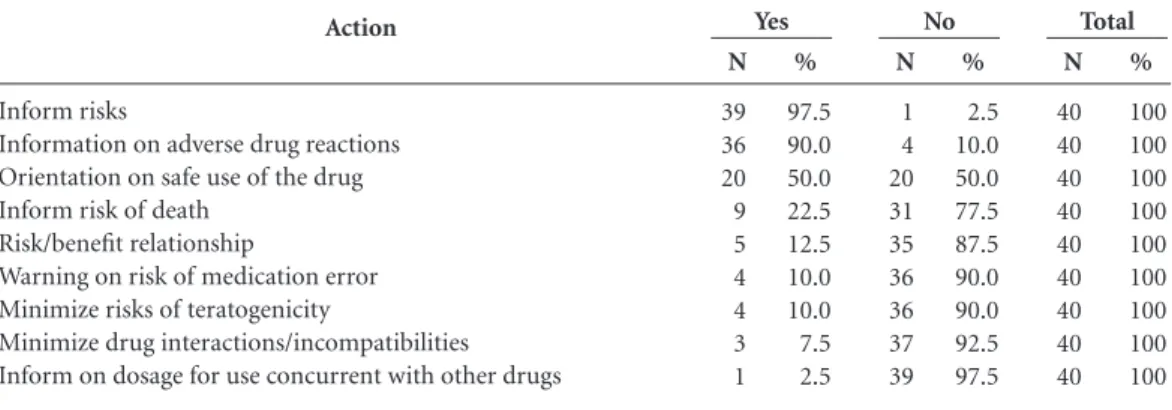
The actions for promotion of safety of drugs contained in the RiskMAPs registered with the FDA are presented in Table 2. Information on risks associated with use and in relation to pos-sible adverse drug reactions was the most preva-lent. It was found that the strategies most referred to for disseminating information about safety of the drugs with a RiskMAP were: A letter to the health professional, educative material, creation of a specific site, and a letter to the health profes-sionals’ association.
After consultation of the drug manufacturers, it was found that the manufacturers stated that they were developing a RiskMAP in Brazil for only four drugs (Table 1), these being the same as those of the USA, and they referenced the site of the FDA, in the English language, as a mecha-nism for access to the RiskMAP. Information on these four drugs registered in Brazil with Risk-MAPs is presented in Chart 1. Of the 36 (90.0%) remaining drugs, it was found that two (5.0%) did not present a RiskMAP – Metoclopramide (Plasil®) and Vigabatrin (Sabril®); for nine (22.5%), the manufacturers contacted said it was not possible to make such information available; and for 18 (45.0%) the manufacturers did not respond to the email sent. We report that seven (17.5%) drugs did not present a RiskMAP, since five of these no longer have a registry in Brazil (formoterol fumarate in solution for inhalation, rosiglitazone, rosiglitazone + metformin, testos-terone gel and vigabatrin oral solution); and two - dronedarone tablets (Multaq®) and buprenor-phine patches (Restiva®) – are registered with Anvisa, but the manufacturers stated that they were not being sold in Brazil during the period in which the research was carried out.
Of the 40 drugs identified with a RiskMAP in the USA, 35 (87.5%) were registered in Brazil in the period during which the research was carried out. Among the drugs identified with registry in Brazil, 32 (91.4%) had the same manufacturer in the two countries.
The mean time of registry with Anvisa was 5.1 years (Standard Deviation = 4.8).
B ot e lho SF , R Discussion
Development of RiskMAPs by drug manufac-turers established in Brazil is still at an incipient
stage, since only four manufacturers say that they have them. This shows a different reality from that of the USA, which has a larger num-ber of RiskMAPs. It is important to highlight that Drug
Level 3 ACT classification
R03A – adrenergics, inhalants L04A – immunosuppressants
A10B – blood glucose lowering drugs, excl. insulins L01X – other antineoplastic agents
B01A – antithrombotic agents C02K – other antihypertensives
M03A – muscle relaxants, peripherally acting agents N03A – antiepileptics
A03F – propulsives
B02B – vitamin k and other hemostatics B03X – other antianemic preparations B05D – peritoneal dialytics
C01B – antiarrhythmics, Class I and III
G03X – other sex hormones and modulators of the genital system
H05A – parathyroid hormones and analogs M05B – drugs affecting bone structure and mineralization
N02A – opioids N05A – antipsychotics N06A – antidepressants
N07B – drugs used in addictive disorders Total
Table 1. Absolute frequency of drugs with RiskMAP and safety warnings on package leaflet and website, by
regulatory agency.
* A drug of this therapeutic class was registered in Brazil, but the package leaflet is not available because it was not sold in the period under the research.
FDA N 7 6 4 3 2 2 2 2 1 1 1 1 1 1 1 1 1 1 1 1 40 ANVISA N 0 2 0 1 0 0 1 0 0 0 0 0 0 0 0 0 0 0 0 0 4 RiskMAP FDA N 7 6 4 3 2 2 2 2 1 1 1 1 1 1 1 1 1 1 1 1 40 ANVISA N 6* 6 2* 3 1 2 2 1* 1 1 1 1 0* 0 1 1 0 1 1 1 35 Warning on package leaflet FDA N 7 6 4 3 2 2 2 2 1 1 1 1 1 1 1 1 1 1 1 1 40 ANVISA N 7 1 3 0 0 0 2 0 0 0 0 0 1 0 0 0 0 1 0 0 15 Warning on website Action Inform risks
Information on adverse drug reactions Orientation on safe use of the drug Inform risk of death
Risk/benefit relationship
Warning on risk of medication error Minimize risks of teratogenicity
Minimize drug interactions/incompatibilities Inform on dosage for use concurrent with other drugs
Table 2. Actions for promotion of safe use of drugs contained in the RiskMAPs registered with the FDA.
aúd
e C
ole
tiv
a,
20(12):3897-3905,
2015
22.5% of the Brazilian manufacturers said that it was not possible to make information about RiskMAPs available. This underlines the need for improvement in the means of communication, with the creation of a space on the site of Anvi-sa, as is the case with the FDA, for publication of RiskMAPs. Another problem that is an obstacle to communication about the health risk of the drug is publication of the RiskMAP in a language other than Portuguese, since language is also an important instrument for understanding of in-formation published.
It is worth highlight this language aspect, since the manufacturers with RiskMAPs in Brazil gave information on the RiskMAP implemented
in the USA, referencing the site of the FDA in the English language.
To achieve the objectives of putting Risk-MAPs in place the manufacturers should make them available and Anvisa should make access to them possible for health professionals.
Considering that 80.0% of the manufacturers that have RiskMAPs in the USA have drugs reg-istered in Brazil, one can see that it is feasible to improve the strategies for dissemination of risk information and the measures contained in the RiskMAPs, since there is already familiarity with this strategy of promotion of safety in the post marketing phase. Setting aside of an area on An-visa’s site for publication of RiskMAPs would be
Chart 1. Information on the four drugs registered in Brazil that have RiskMAPs.
Drug
Balatacepte (Nulojix®)
Ipilimunabe (Yervoy®)
Natalizumabe (Tysabri®)
Botulinum toxin (Botox®)
Same manufacturer in Brazil as in the
USA
Yes
Yes
Yes
Yes
Main factor in the RiskMAP
Increased risk of progressive multifocal leukoencephalopathy (PML)
Risks of serious adverse reactions: fatal immune mediated enterocolitis, fatal immune mediated hepatitis, fatal immune mediated medication-induced skin disorders, fatal neurotoxicity, and endocrinopathies. Presents instructions for dealing with the reactions.
Risk of PML, including increase of risk of PLM with longer duration of treatment and prior use of immunosuppressants.
Risk of medication errors related to the lack of permutability with botulinum toxins of other manufacturers.
RiskMAP strategy
Educational material. Communication plan: letter to the health professional, and creation of a site for the drug.
Communications plan: letter to associations of health professionals.
Educational material. Accreditation of prescribers and pharmacies/hospitals. Registry of the user.
Educational material. Communications plan: letter to health professionals.
Safety warning on the package
leaflet
Yes
Yes
Yes
Yes
Safety warning on Anvisa
website
No
No
No
B
ot
e
lho SF
, R
an appropriate measure, since it would contrib-ute to the safe use of drugs, and would increase the effectiveness of actions of pharmacovigilance.
To optimize results in pharmacovigilance the contribution of health professionals and of the patients themselves – who are considered to be the priority targets of RiskMAPs – is essential. The choice of the appropriate means of commu-nication is essential to reach the target public and
achieve the expected objectives8. The
involve-ment of the whole of the health team is import-ant in achieving the positive results arising from RiskMAPs, and for this reason doctors, nurses, and pharmacists including those responsible for community/hospital pharmacies are the health professionals that are also part of some Risk-MAPs registered in the FDA.
In terms of communication, no strategy should be generic, since no strategy in particu-lar can provide the same results when applied to different publics. It is ideal for there to be more than one type of communication for each target group, and also repetition of messages to achieve a result in the long term9. This can be shown by
looking at the frequency of the strategies for pro-motion of safe use of drugs in this study. From the results, it is seen that there is more than one means of communication available for reaching the desired publics, and some can be used to no-tify health professionals and the patients simul-taneously.
Supply of educational material is a predomi-nant strategy in RiskMAPs, since providing it can minimize risks relatively easily, that is to say, it is simple to produce and implement as well as be-ing able to cover various target publics8.
In Brazil actions for communication of health risk of drugs is still at an incipient phase. There are only a few drug safety warnings available on the site of Anvisa, and indeed for only some 40% of those that have a RiskMAP with the FDA. On the package leaflet there is a larger number of warnings: for 91.4% of the 35 drugs sold in Bra-zil. However, there are some limitations to com-munication of a warning through the package leaflet of a drug, making other means of com-munication necessary. One drug that attracted attention in relation to the risk communication strategy was Thalidomide. Anvisa created a blog making a range of information about this drug available to the public17. It is clear that Anvisa has carried out intensive work to guarantee safe use of this drug and to establish an appropriate communication with health professionals and patients, but it is essential that the
manufactur-er should also participate in these actions, since the blog does not explicitly refer to actions in re-lation to the manufacturer. Some children were born after 1965 with birth defects compatible with the phenotype of embryopathy caused by thalidomide – showing that control of use and dispensation of the drug failed in the country18.
Actions by Anvisa to amplify the publication of information about the safety of Thalidomide contribute to optimization of control of its use and dispensation.
New drugs need more active pharmacovigi-lance, especially the biological drugs, since lim-ited information about the therapeutic action and adverse reactions of these products narrows their safety profile in comparison to those of a chemical nature. Some of the aspects that deter-mine the safety of drugs that contain biological agents are related to the complexity of the pro-duction processes and of purification, and to the high potential for formation of antibodies19.
The new technologies constitute a challenge for health surveillance because it is their competency to monitor the adverse effects (and risks) of the technological resources, products and services
used by the health system20. The large number
of pharmaceutical specialties in the Brazilian market; the problems relating to their safety and quality; and the registry of new biological drugs and nanotechnologies show the dimension of the challenge and the importance of the health regu-latory action of Anvisa20,21.
Of the drugs with RiskMAPs registered with the FDA, 62.5% are for hospital and ambulatory use. The health professionals that work at these levels of care should know what the risks asso-ciated with these drugs are, with a view to min-imizing them within the institutions, through systems of surveillance and risk management. Surveillance actions should be developed to cov-er both hospital and ambulatory care. Notifica-tions of adverse drug reacNotifica-tions and other adverse drug events included in the RiskMAP should be a priority target for risk management actions19.
The majority of the drugs with RiskMAPs registered with the FDA were the dosage form for parenteral administration. Since this route of ad-ministration has a higher risk of complications, with faster appearance of adverse events, and calls for greater care, actions for safety become important for a safe treatment, principally in the hospital setting where this route is widely used.
aúd
e C
ole
tiv
a,
20(12):3897-3905,
2015
their safe use. With this information, patients using these drugs can be included in individual actions of monitoring the pharmacotherapy in such a way as to reduce the risk of adverse events. The constitution of a multidisciplinary safety committee is fundamental for creating and coor-dinating programs and activities aiming for suc-cess in management of risks. The aim and pur-pose of a patient safety committee is the safety of the patient, through planning, development, control and evaluation of processes of care, so as to guarantee the quality of the services in the hospital2.
Cooperation between pharmacovigilance and patient safety committees is also feasible in the preparation of measures to minimize risks to the patient. Also, coordinated actions between institutions and the country’s regulatory agency result in more information for health profession-als, minimizing the problem of drug safety, and may encourage them to make voluntary notifi-cations1,2,22. On this aspect, the inclusion of
mon-itoring of patients that are using drugs which have RiskMAPs within the targets of the safety committee could be an action that might catalyze promotion of their safe use and might contribute to expanding knowledge of the risk/benefit rela-tionship.
The information for promotion of safe use most frequently quoted in the RiskMAPs regis-tered with the FDA was related to risk, adverse effects and specific orientation on safety of use. This shows the importance of pharmacovigilance for expanding knowledge of the safety profile of the drugs, principally because of the large num-ber of RiskMAPs that have the objective of noti-fying adverse effects.
According to the RiskMAPs registered with the FDA, the level 3 ATC classification that was most frequent was that of inhalable adrenergics (17.5%), and a single drug could be presented in more than one dosage form, justifying the large number of drugs with that nomenclature. Immunosuppressant drugs (15.0%) with Risk-MAPs registered with the FDA, in contrast to the inhalable adrenergics, were different with-in the class, showwith-ing that they present a greater potential for causing adverse drug reaction. This potential can be explained by the nature of the drug and because many of them are new drugs. In this present study, four of the six immunosup-pressant drugs are of a biological nature and have been registered in Brazil for less than two years. Antineoplasic drugs are another class that has been registered with Anvisa for only a short time;
they are frequent among those with RiskMAPs registered with the FDA – and two of the three drugs in this study have been registered for less than one year. Most antineoplasic drugs, as well as being new, have a narrow therapeutic index, requiring greater monitoring, because there is a higher probability of adverse events.
Many of the drugs that have RiskMAPs are new drugs launched in the last five years, with safety warnings, and which need a greater degree of surveillance to ensure safety of use though this is not a rule. The need to inform risk is not related to the time of registry of a drug, but to ensuring safe use for the patient over all the time during which it is sold.
The panorama of the risk minimization ac-tions in Brazil described in this investigation is limited by the fact that the majority of the drug manufacturers did not provide information about RiskMAPs, or did not respond to the email sent (45.0%), or because they did not make this information available (22.5%). However, it pro-vided an opportunity to put the approaches to RiskMAPs in context from the point of view of the Brazilian drug industry and that of Anvisa. A positive contribution of the study was to show that information about risk, adverse events and safe use presented in the RiskMAPs in the USA is present on the package leaflets of drugs sold in Brazil. This is an important measure, but an insufficient one, because more effective results call for proactive measures, with development of RiskMAPs and adequate actions of communica-tion to patients and health professionals.
Final considerations
The number of drugs sold in Brazil with Risk-MAPs, as informed by the drug manufacturers that were researched, is small; they are drugs with a short time of registry in the country, produced by transnational drug manufacturers.
It is recommended that Anvisa should re-view the strategy of development of RiskMAPs specified in the current legislation, with a view to optimizing action and ensuring a more proactive character, with more effective measures of com-munication.
B
ot
e
lho SF
, R
post-marketing period, in the monitoring of those that are known and, principally, for pro-motion of safe use of drugs.
Collaborations
aúd
e C
ole
tiv
a,
20(12):3897-3905,
2015
Agência Nacional de Vigilância Sanitária (Anvisa). Far-macovigilância, 2012 [Internet]. 2012 [acessado 2012 Out 12]. Disponível em: http://portal.anvisa.gov.br/ wps/content/Anvisa+Portal/Anvisa/Pos+-Comerciali-zacao+-+Pos+-+Uso/Farmacovigilancia.
Agência Nacional de Vigilância Sanitária (Anvisa). Bu-lário Eletrônico. 2012. [internet].2012 [acessado 2012 Jul 15]. Disponível em: http://www.anvisa.gov.br/data-visa/fila_bula/index.asp.
Dicionário de Especialidades Farmacêuticas: DEF 2012/13. 41ª ed. Rio de Janeiro: Publicações Científicas; 2012.
Organização Mundial de Saúde (OMS). ATC/DDD In-dex 2012. [Internet]. 2012 [acessado 2012 jul 5]. Dispo-nível em: http://www.whocc.no/atc_ddd_index/. Agência Nacional de Vigilância Sanitária (Anvisa). Blog Talidomida, 2011. [Internet]. 2012 [acessado 2012 nov 25]. Disponível em: http://talidomida-anvisa.blogspot. com.br/
Paumgartten Júnior F, Souza, NR. Clinical use and con-trol of the dispensing of thalidomide in Brasilia-Feder-al District, Brazil, from 2001 to 2012. Cien Saude Colet 2013; 18(11):3401-3408.
Giezen TF, Mantel-teeuwisse AK, Straus SMJM, Eg-berts TCG, Blackburn S, Persson I, Leufkend HGM. Evaluation of post-authorization safety studies in the first cohort of EU risk management plans at time of regulatory approval. Drug Saf 2009; 32(12):1175-1187. Batista AS, Pepe VLE. Os desafios da nanotecnologia para a vigilância sanitária de medicamentos. Cien Sau-de Colet 2014; 19(7):2105-2114.
Reis AMM, Perini E. Desabastecimento de medicamen-tos: determinantes, consequências e gerenciamento. Cien Saude Colet 2008; 13(Supl.):603-610.
Capucho HC, Arnas ER, Cassiani SHB. Patient Safety: a comparison between handwritten and computer-ized voluntary incident reporting. Rev. Gaúcha Enferm 2013; 34(1):164-172.
Article submitted 08/04/2014 Approved 26/01/2015
Final version submitted 28/01/2015 13.
14.
15.
16.
17.
18.
19.
20.
21.
22. References
Wise L, Parkinson J, Raine J, Breckenridge A. New ap-proaches to drug safety: a pharmacovigilance tool kit. Nat Rev Drug Discov 2009; 8(10):779-782
Dainsei SM. Pharmacovigilance: more than ever, an overall responsibility. Clinics 2005; 60(4):267-270 Freitas MST, Romano-Lieber NS. Condições de im-plantação e operação da farmacovigilância na indústria farmacêutica no Estado de São Paulo, Brasil. Cad Saude Publica 2007; 23(1):167-175
Hennessy S, Strom BL. Improving Postapproval Drug Safety Surveillance: Getting Better Information Sooner. Annu Rev Pharmacol Toxicol 2014; 55:75-87.
Cook DM, Gurugubelli RK, Bero LA. Risk management policy and black-box warnings. A qualitative analysis of US FDA proceedings. Drug Saf 2009; 32(11):1057-1066.
Nelson LS, Loh M, Perrone J. Assuring safety of inher-ently unsafe medications: the FDA risk evaluation and mitigation strategies.J Med Toxicol 2014; 10(2):165-172.
Nicholson SC, Peterson J, Yektashenas B. Risk evalua-tion and mitigaevalua-tion strategies (REMS). Drug Saf 2012; 35(2):91-104.
Zomerdijk IM, Sayed-tabatabaei FA, Trifiro G, Bla-ckburn SCF, Sturkenboom MCJM, Straus SMJM. Risk minimization activities of centrally authorized prod-ucts in the EU. Drug Saf 2012; 35(4):299-314. Bahri P. Public pharmacovigilance communication a process calling for evidence-based, objective-driven strategies.Drug Saf 2010; 33(12):1065-1079.
Food and Drug Administration (FDA). Approved Risk Evaluation and Mitigation Strategies (REMS). [Inter-net]. 2012 [acessado 2012 jul 5]. Disponível em: http:// www.fda.gov/Drugs/DrugSafety/ PostmarketDrugSa-fetyInformationforPatient sandProviders/ucm111350. htm.
Agência Nacional de Vigilância Sanitária (Anvisa). Consulta de medicamentos, 2012. [Internet]. 2012 [acessado 2012 jul 5]. Disponível em: http://www7.an-visa.gov.br/datavisa/consulta_produto/Medicamentos/ frmConsultaMedicamentos.asp
Agência Nacional de Vigilância Sanitária (Anvisa). Lis-ta de medicamentos de referência. 2009[Internet]. 2009 [acessado 2012 jul 5]. Disponível em: http://www.anvi-sa.gov.br/medicamentos/referencia/lista.pdf
1.
2. 3.
4.
5.
6.
7.
8.
9.
10.
11.