www.biogeosciences.net/11/3781/2014/ doi:10.5194/bg-11-3781-2014
© Author(s) 2014. CC Attribution 3.0 License.
Application of remote sensing and GIS for detection of long-term
mangrove shoreline changes in Mui Ca Mau, Vietnam
V. Tran Thi1,2,3, A. Tien Thi Xuan3, H. Phan Nguyen4, F. Dahdouh-Guebas1,2,*, and N. Koedam1,*
1Laboratory of Plant Biology and Nature Management, Vrije Universiteit Brussel – VUB, Brussels, Belgium
2Laboratory of Systems Ecology and Resource Management, Université Libre de Bruxelles – ULB, Brussels, Belgium 3Center for HydroMet and Environment Consultancy, Institute of Meteorology, Hydrology and Environment – IMHEN, Hanoi, Vietnam
4Mangrove Ecosystem Research Centre, Hanoi National University of Education – HNUE, Hanoi, Vietnam *These authors contributed equally to this work.
Correspondence to:V. Tran Thi ([email protected])
Received: 11 October 2013 – Published in Biogeosciences Discuss.: 20 December 2013 Revised: 22 May 2014 – Accepted: 22 May 2014 – Published: 21 July 2014
Abstract. Mui Ca Mau at the southern tip of Vietnam sup-ports a large area of mangroves and has a high value for biodiversity and scenic beauty. This area is affected by ero-sion along the East Sea and accretion along the Gulf of Thai-land, leading to the loss of huge stretches of mangroves along the East Sea and, in some cases, loss of environmental and ecosystem services provided by mangroves. In this study, we used remotely sensed aerial (1953), Landsat (1979, 1988 and 2000) and SPOT (1992, 1995, 2004, 2008, 2009 and 2011) images and the Digital Shoreline Analysis System (DSAS) to quantify the rate of mangrove shoreline change for a 58 yr period. There were 1129 transects sampled at 100 m inter-vals along the mangrove shoreline and two statistical meth-ods, namely end point rate (EPR) and linear regression rate (LRR), were used to calculate the rate of change of mangrove shorelines and distance from 1953 to 2011. The study con-firms that erosion and accretion, respectively, are significant at the East Sea and Gulf of Thailand sides of Mui Ca Mau. The East Sea side had a mean erosion LRR of 33.24 m yr−1. The accretion trend at the Gulf of Thailand side had an av-erage rate of 40.65 m yr−1. The results are important in pre-dicting changes of coastal ecosystem boundaries and enable advanced planning for specific sections of coastline, to min-imize or neutralize losses, to inform provincial rehabilitation efforts and reduce threats to coastal development and human safety.
1 Introduction
Mangrove ecosystems occur in the transitional zone be-tween marine and terrestrial environments. Mangrove mor-phology and sedimentation are good indicators of interac-tions between relative sea level changes, coastal processes and sediment supply (Souza Filho et al., 2006; Gilman et al., 2007; McIvor et al., 2013). As emphasized by Souza Filho et al. (2006), a mangrove shoreline is one of the best geo-indicators in global coastal change research.
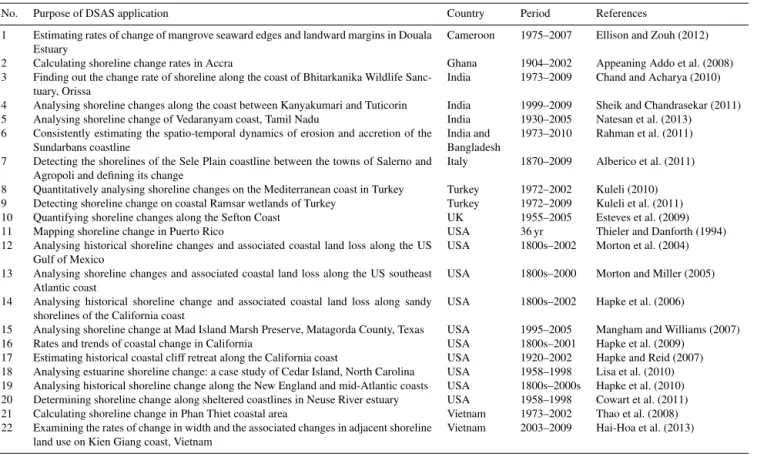
Table 1.History of universal DSAS application.
No. Purpose of DSAS application Country Period References
1 Estimating rates of change of mangrove seaward edges and landward margins in Douala Estuary
Cameroon 1975–2007 Ellison and Zouh (2012) 2 Calculating shoreline change rates in Accra Ghana 1904–2002 Appeaning Addo et al. (2008) 3 Finding out the change rate of shoreline along the coast of Bhitarkanika Wildlife
Sanc-tuary, Orissa
India 1973–2009 Chand and Acharya (2010) 4 Analysing shoreline changes along the coast between Kanyakumari and Tuticorin India 1999–2009 Sheik and Chandrasekar (2011) 5 Analysing shoreline change of Vedaranyam coast, Tamil Nadu India 1930–2005 Natesan et al. (2013) 6 Consistently estimating the spatio-temporal dynamics of erosion and accretion of the
Sundarbans coastline
India and Bangladesh
1973–2010 Rahman et al. (2011) 7 Detecting the shorelines of the Sele Plain coastline between the towns of Salerno and
Agropoli and defining its change
Italy 1870–2009 Alberico et al. (2011) 8 Quantitatively analysing shoreline changes on the Mediterranean coast in Turkey Turkey 1972–2002 Kuleli (2010) 9 Detecting shoreline change on coastal Ramsar wetlands of Turkey Turkey 1972–2009 Kuleli et al. (2011) 10 Quantifying shoreline changes along the Sefton Coast UK 1955–2005 Esteves et al. (2009) 11 Mapping shoreline change in Puerto Rico USA 36 yr Thieler and Danforth (1994) 12 Analysing historical shoreline changes and associated coastal land loss along the US
Gulf of Mexico
USA 1800s–2002 Morton et al. (2004) 13 Analysing shoreline changes and associated coastal land loss along the US southeast
Atlantic coast
USA 1800s–2000 Morton and Miller (2005) 14 Analysing historical shoreline change and associated coastal land loss along sandy
shorelines of the California coast
USA 1800s–2002 Hapke et al. (2006)
15 Analysing shoreline change at Mad Island Marsh Preserve, Matagorda County, Texas USA 1995–2005 Mangham and Williams (2007) 16 Rates and trends of coastal change in California USA 1800s–2001 Hapke et al. (2009)
17 Estimating historical coastal cliff retreat along the California coast USA 1920–2002 Hapke and Reid (2007) 18 Analysing estuarine shoreline change: a case study of Cedar Island, North Carolina USA 1958–1998 Lisa et al. (2010) 19 Analysing historical shoreline change along the New England and mid-Atlantic coasts USA 1800s–2000s Hapke et al. (2010) 20 Determining shoreline change along sheltered coastlines in Neuse River estuary USA 1958–1998 Cowart et al. (2011) 21 Calculating shoreline change in Phan Thiet coastal area Vietnam 1973–2002 Thao et al. (2008) 22 Examining the rates of change in width and the associated changes in adjacent shoreline
land use on Kien Giang coast, Vietnam
Vietnam 2003–2009 Hai-Hoa et al. (2013)
changes and to provide other statistical information (Thieler et al., 2009). It utilizes the Avenue code to develop tran-sects and rates, and the Avenue programming environment to automate and customize the user interface (Morton et al., 2004). The DSAS has been used widely to calculate the rate of shoreline changes (Table 1).
By 2012, Ca Mau Province had about 69 000 ha of man-groves accounting for about 49.6 % of the whole country (139 046 ha) (MARD, 2013; Ca Mau Portal, 2014). Natural and anthropogenic factors in the mangroves around Mui Ca Mau have caused erosion along the East Sea coast and accre-tion along the Gulf of Thailand shoreline. As stated by the MAB Vietnam (2008), these changes have led to the loss of huge stretches of mangroves along East Sea resulting in the decrease and, in some cases, loss of mangrove environmental and ecosystem services. The effects include loss of spawning grounds for aquatic species and the loss of the wave buffering and sheltering effect of mangroves, threatening residential ar-eas and infrastructure behind the mangrove (MAB Vietnam, 2008). In addition, by the end of the 21st century, average sea level in the study area is projected to rise 59–75 cm and 62– 82 cm along the East Sea and the Gulf of Thailand, respec-tively (MONRE, 2012). However the change in the mangrove shoreline due to accretion and erosion at Mui Ca Mau has not been quantified but merely observed. Key weaknesses in previous attempts at government mangrove rehabilitation
have been uniform application of homogeneous monoculture plantations with little consideration for maintenance needs or coastal dynamics, which dictate suitability of mangrove rehabilitation at any given site (IUCN, 2012). It is, there-fore, very important to detect quantitatively the changes of mangrove shoreline. This will be used effectively to predict the changes of coastal ecosystem boundaries and enable ad-vanced planning for specific sections of coastline, to mini-mize or neutralize losses, to inform provincial rehabilitation efforts and reduce threats to coastal development and human safety (Dahdouh-Guebas, 2002; Gilman et al., 2007; IUCN, 2012).
In this research, we quantify the rate of mangrove shore-line change around Mui Ca Mau with remotely sensed im-ages of aerial photographs, Landsat and SPOT data for a 58 yr period and applying DSAS.
2 Materials and methods
2.1 Study area
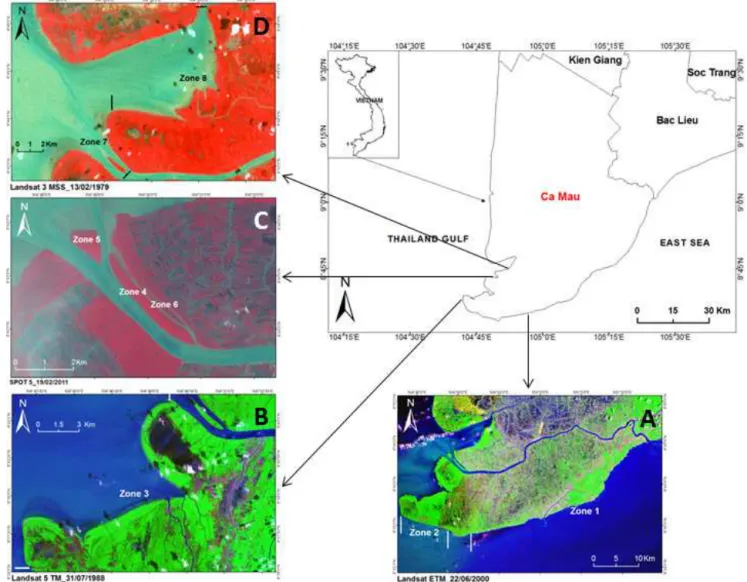
Figure 1.Map of the study area. It is divided into eight zones that depend on coastal characteristics and availability of remotely sensed data. (A)zones 1 and 2;(B)zone 3;(C)zones 4, 5 and 6; and(D)zones 7 and 8.
above mean sea level) and strongly divided by a system of natural rivers and a dense network of canals (Hong and San, 1993). The water flow regime in the area is under the in-fluence of both the East Sea and the Gulf of Thailand with the eastern flow the stronger. The whole area is character-ized by a soft muddy soil and influenced by semidiurnal tides originating from the East Sea (tidal amplitude 2–3 m) and by the diurnal tides from the Gulf of Thailand (tidal amplitude 0.5–0.8 m) (Hong and San, 1993). More importantly, Ca Mau supports the most substantial area of mangroves (Hong and San, 1993), and it is a natural mangrove ecosystem with a high conservation value for its biodiversity and scenic beauty (MAB Vietnam, 2008). There are 27 true mangrove species in Ca Mau, with Avicennia albaBlume,Avicennia marina (Forssk.) Vierh., Avicennia officinalis L.,Rhizophora apic-ulata Bl., Bruguiera parviflora Wight & Arnold ex Grif-fith,Ceriops zippelianaBlume andNypa fruticans(Thunb.) Wurmb. amongst the major species (Hung and Tan, 1999;
Massó i Alemán et al., 2010). But natural and anthropogenic factors in the mangroves around Mui Ca Mau have caused erosion along the East Sea and accretion along the Gulf of Thailand.
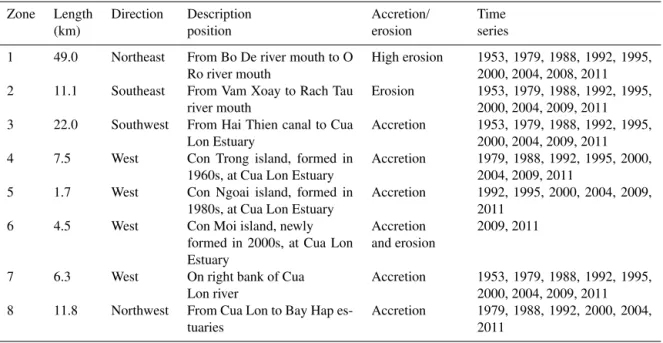
Our study area extended from Bo De river mouth on the east coast to Bay Hap Estuary on the west coast of Mui Ca Mau. Based on coastal characteristics (erosion and accretion) and availability of remotely sensed data, this area was di-vided into eight zones for the purpose of the study (Fig. 1 and Table 2).
2.2 Data sources and geo-referencing
Table 2.Eight zones in the study area divided basing on coastal characteristics and availability of remotely sensed data.
Zone Length Direction Description Accretion/ Time
(km) position erosion series
1 49.0 Northeast From Bo De river mouth to O Ro river mouth
High erosion 1953, 1979, 1988, 1992, 1995, 2000, 2004, 2008, 2011 2 11.1 Southeast From Vam Xoay to Rach Tau
river mouth
Erosion 1953, 1979, 1988, 1992, 1995, 2000, 2004, 2009, 2011 3 22.0 Southwest From Hai Thien canal to Cua
Lon Estuary
Accretion 1953, 1979, 1988, 1992, 1995, 2000, 2004, 2009, 2011 4 7.5 West Con Trong island, formed in
1960s, at Cua Lon Estuary
Accretion 1979, 1988, 1992, 1995, 2000, 2004, 2009, 2011
5 1.7 West Con Ngoai island, formed in 1980s, at Cua Lon Estuary
Accretion 1992, 1995, 2000, 2004, 2009, 2011
6 4.5 West Con Moi island, newly formed in 2000s, at Cua Lon Estuary
Accretion and erosion
2009, 2011
7 6.3 West On right bank of Cua
Lon river
Accretion 1953, 1979, 1988, 1992, 1995, 2000, 2004, 2009, 2011 8 11.8 Northwest From Cua Lon to Bay Hap
es-tuaries
Accretion 1979, 1988, 1992, 2000, 2004, 2011
Table 3.Specifications of image data.
No. Name Path/row Acquisition date Resolution (m) Study area
1 Aerial photos 1 Jan 1953 20 1,2,3,7
2 Landsat 3 MSS 135/054 13 Feb 1979 79 1,2,3,4,7,8
3 Landsat 5 TM 125 and 126/054 31 Jul 1988 30 1,2,3,4,7,8
4 Landsat ETM 125 and 126/054 22 Jun 2000 30 1,2,3,4,5,7,8
5 SPOT 2 273/332 3 Jan 1992 20 1,2,3,4,5,7,8
SPOT 2 273/333 3 Jan 1992 20
SPOT 2 274/333 3 Jan 1992 20
6 SPOT 2 273/333 12 Dec 1995 20 1,2,3,4,5,7
SPOT 2 274/333 12 Dec 1995 20
7 SPOT 5 273/332 7 Jan 2004 10 1,2,3,4,5,7,8
SPOT 5 273/333 7 Jan 2004 10
SPOT 5 274/333 7 Jan 2004 10
8 SPOT 4 274/333 8 Sep 2008 10 1
9 SPOT 2 273/333 19 Jan 2009 20 2,3,4,5,6,7
10 SPOT 5 273/332 19 Feb 2011 10 1,2,3,4,5,6,7,8
SPOT 5 273/333 19 Feb 2011 10
SPOT 5 274/333 19 Feb 2011 10
given in Table 3). The Landsat images were freely down-loaded from the US Geological Survey (USGS) at level 1T which has been processed to standard terrain correction. Other images were purchased by the Laboratory of Plant Biology and Nature Management, Vrije Universiteit Brus-sel and the Institute of Meteorology, Hydrology and Envi-ronment. The SPOT images were processed at the level of orthorectified using ground control points and a digital ele-vation model. All these data were geo-referenced to the UTM
WGS-1984 Zone 48N projection and coordinate system with further geometric correction using ENVI.
2.3 Mangrove shoreline digitization and detection
beyond them. For the accreting west side, the first occurrence of a closed mangrove canopy was used as a border. Long intertidal mudflats extend beyond the mangrove vegetation in these areas, but they are not yet suitable for mangrove propagules to establish as the water depth over time is still too high. Using the closed canopy mangrove forests as bor-der of the land area is an acceptable solution to distinguish the mudflats from the land area, although single mangrove individuals and young plants colonizing the newest areas are excluded from the analysis. ArcGIS was used to manually digitize the mangrove shoreline position in 1953.
Normalized Difference Vegetation Index (NDVI) is one of the most successful and widely used ways to simply and quickly identify vegetated areas by detecting living green plant canopies in multispectral remote sensing data (Seto and Fragkias, 2007; Vo et al., 2013). In this study, NDVI was used to distinguish vegetated areas from other surface types, espe-cially for the purpose of this study between water or land and mangrove. In order to improve the accuracy of man-grove shoreline detection, the clustering threshold technique of Otsu (1979) was used. This detects an optimum thresh-old by minimizing weighted sum of within-class variances of the foreground and background pixels and gives satisfactory results when the numbers of pixels in each class are close to each other. The Otsu method remains one of the most cited threshold methods (Sezgin and Sankur, 2004; Kuleli, 2010; Kuleli et al., 2011). The border pixels between seg-mented vegetation/water or land regions can be delineated as mangrove shorelines. These are delineated using binary images produced from a threshold-based segmentation al-gorithm. As a result, images were divided into two major segments: mangrove and water or land. After this process, the boundaries of the classified regions were vectorized by using the raster to vector conversion application of ENVI. Next, the conversion accuracy was evaluated by overlaying the extracted mangrove shorelines with the original Landsat and SPOT images.
2.4 Mangrove shoreline rate calculation
Calculating mangrove shoreline movement and changes were formalized into DSAS version 4.2, an extension to ArcMap developed by the USGS. DSAS computes rate-of-change statistics from multiple historic shoreline positions residing in a GIS (Thieler et al., 2009). DSAS generates tran-sects that are cast perpendicular to the baseline at a user-specified spacing alongshore. The intersections of transects and the mangrove shorelines along this baseline are then used to calculate the rate-of-change statistics. In this study, a total of 1129 transects were regularly placed at a spacing of 100 m by applying DSAS software. To assess the spatial and tempo-ral movement trend of mangrove shoreline positions, a hypo-thetical baseline was constructed offshore and parallel to the general orientation of the mangrove shoreline. The generated
transects together with the extracted mangrove shorelines are graphically shown in Figs. 2–5.
In order to calculate erosion/accretion rates, many sta-tistical methods have been applied, such as end point rate (EPR), average of rates (AOR), minimum description length (MDL), jackknifing (JK), linear regression rate (LRR), reweighted least squares (RLS), weighted least squares (WLS), reweighted weighted least squares (RWLS), least ab-solute deviation (LAD), and weighted least abab-solute devia-tion (WLAD) (Dolan et al., 1991; Thieler et al., 1995; Crow-ell et al., 1997; Coyne et al., 1999; Honeycutt et al., 2001; Genz et al., 2007; Kuleli, 2010; Kuleli et al., 2011; Sheik and Chandrasekar, 2011). The two most frequently cited methods are EPR and LRR. In this study, two comparative statistical methods of EPR and LRR were used to calculate the change in rates of mangrove shorelines in Mui Ca Mau. The EPR is simply the rate determined by the changes in position be-tween the oldest and most recent shorelines in a given data set. As it only considers the earliest and the latest shoreline positions, it was suitable for the short-term mangrove shore-line change analysis of zone 6 (Con Moi) with only two man-grove shorelines of 2009 and 2011 available. The LRR is the result of estimating the average rate of change using a num-ber of shoreline positions over time, with the change statistic of fitting a least-squared regression line to all shoreline points for each transect. The linear regression rate is the slope of the line. Therefore, LRR was used to analyse the long-term mangrove shoreline change (from 1953 to 2011) of the other study zones. In this study, data uncertainty was±5 m, and confidence interval was 90 % determined as a weighted lin-ear rate parameter.
2.5 Ground truth and social survey
Field ground truth was carried out in 2006, 2007, 2010 and 2011. A total of 150 GPS points collected in the field with at-tribute information on location of the seaward edge of the mangroves and households in and around the mangroves area. These points were imported to ArcGIS for analysis.
Social surveys in households close to the mangrove area were conducted using interviews. The target group was the population with experience of the region. In 1980s, there was unauthorized influx of people from other provinces migrated to Ngoc Hien District (Hong and San, 1993). Therefore, the people with ages ranging from 45 to 65 yr old were chosen for the interviews. The major objectives regarded changes they had observed in the mangrove area over time. Collected information is used in the discussion.
3 Results
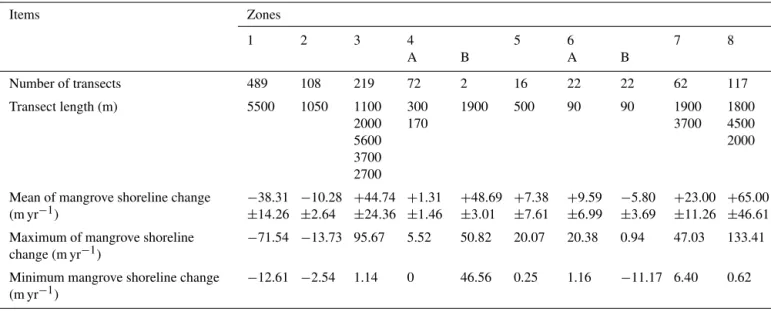
Table 4.Change rate of mangrove shoreline in eight zones of the study area. For zone 6, there are only two mangrove shorelines of 2009 and 2011, no linear regression statistic was run, and hence end point rate is used. For the rest, mangrove shoreline change was derived from linear regression rates.
Items Zones
1 2 3 4 5 6 7 8
A B A B
Number of transects 489 108 219 72 2 16 22 22 62 117
Transect length (m) 5500 1050 1100
2000 5600 3700 2700
300 170
1900 500 90 90 1900
3700
1800 4500 2000
Mean of mangrove shoreline change (m yr−1)
−38.31 ±14.26
−10.28 ±2.64
+44.74 ±24.36
+1.31 ±1.46
+48.69 ±3.01
+7.38 ±7.61
+9.59 ±6.99
−5.80 ±3.69
+23.00 ±11.26
+65.00 ±46.61
Maximum of mangrove shoreline change (m yr−1)
−71.54 −13.73 95.67 5.52 50.82 20.07 20.38 0.94 47.03 133.41
Minimum mangrove shoreline change (m yr−1)
−12.61 −2.54 1.14 0 46.56 0.25 1.16 −11.17 6.40 0.62
values. Positive EPR and LRR values represent mangrove shoreline movement towards the sea (accretion rate), and negative values indicate movement inland (erosion rate). Mangrove shoreline changes emphasize erosion along the East Sea and accretion along the Gulf of Thailand, as ob-served previously. It is also clear that the islands in the Cua Lon Estuary were recently formed.
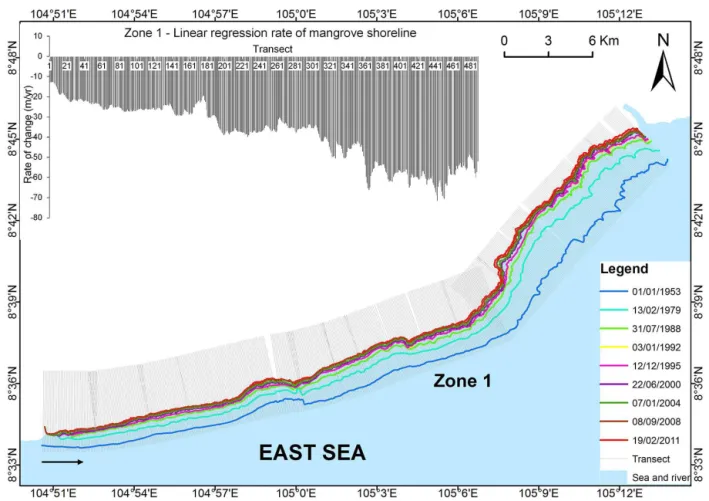
Along the East Sea, mangrove shoreline of zone 1 is lo-cated between Bo De and O Ro river mouths. Over 49 km, there were 489 transects used to intersect the base line and nine mangrove shorelines of 1953, 1979, 1988, 1992, 1995, 2000, 2004, 2008 and 2011 (Table 2 and Fig. 2). The rate of change varied from−12.61 m yr−1to−71.54 m yr−1 with a mean rate of −38.31±14.26 m yr−1 (Table 4). The maximum erosion rate was near to Bo De river mouth, −71.54 m yr−1(Fig. 2).
The mangrove shoreline of zone 2, from Vam Xoay to Rach Tau river mouth, recorded dominant erosion. Similar to zone 1, nine mangrove shorelines were observed in zone 2, but mangrove shoreline 2008 was replaced by the one in 2009 (Fig. 3). Along the 11.2 km, 111 transects were gen-erated (Table 4 and Fig. 3). Over the period 1953–2011, the change rate of the shorelines ranged from−2.54 m yr−1 to−13.73 m yr−1, with an average of−10.28±2.64 m yr−1 (Table 4).
On the other hand, mangrove accretion is significant along the Gulf of Thailand. A time series of nine mangrove shore-lines was extracted. Along the 22 km of mangrove shoreline of zone 3 from Ca Mau tip (Hai Thien canal) to Cua Lon Estuary, the rate of accretion averaged over 219 transects was 44.74±24.36 m yr−1. Maximum accretion rate in this
zone was 95.67 m yr−1 at transect between Nam Khoi and Ba Mang canals (Table 4 and Fig. 3).
Further, in the Cua Lon Estuary, three newly formed is-lands of Con Trong (zone 4), Con Ngoai (zone 5) and Con Moi (zone 6) continue to be accreted (Fig. 4). Con Trong Is-land (zone 4) was formed during the 1960s and is located in the middle of the estuary. Hence, there was no mangrove shoreline in 1953 to be observed (Fig. 4). A total of 74 tran-sects were extracted in zone 4 (Table 4 and Fig. 4). Maxi-mum accretion rate was observed at the northeastern tip of the island. Hence, zone 4 was divided into two subzones 4A and 4B. During 1979–2011, 72 transects of subzone 4A were evidenced average accretion rate of 1.31±1.46 m yr−1 that was much lower than the two transects of subzone 4B (48.69±3.01 m yr−1)(Table 4).
Located further offshore, Con Ngoai (zone 5) was formed during the 1980s. Hence, mangrove shorelines of 1953, 1979 and 1988 are not available. It is clearly seen that this island is expanding at the northeastern tip. For 16 transects there, the average accretion rate was 7.38±7.61 m yr−1 over the period 1992–2011 (Table 4 and Fig. 4). For the other parts of the island, the mangrove shoreline was stable, and no change was observed (Fig. 4).
Figure 2.Mangrove shoreline changes in zone 1 which is located between Bo De and O Ro river mouths, along the East Sea. DSAS software generated 489 transects. The arrow shows the direction of transects from 1 to 489 which have a linear regression rate illustrated in the graph at the top left corner.
Located on the western bank of the Cua Lon River, zone 7 is also a sediment receiver. Over the period 1953–2011, nine mangrove shorelines were reported. There were 62 transects generated in zone 7 (Fig. 5). Change rate of mangrove shore-lines ranged from 6.40 m yr−1to 47.03 m yr−1with mean ac-cretion rate of 23.00±11.26 m yr−1(Table 4).
Next to zone 7, six mangrove shorelines of 1979, 1988, 1992, 2000, 2004, and 2011 were remained in zone 8. Over 11.8 km of zone 8, 117 transects were recorded (Fig. 5). The mean accretion rate was 65.00±46.61 m yr−1(Table 4).
4 Discussion
4.1 Erosion along the East Sea
Analysis from a time series of mangrove shoreline along the East Sea shows average erosion rate varying from 10.28 m yr−1(zone 2) to 38.31 m yr−1(zone 1) (Table 4). In comparison to studies at other sites, these are much higher. In the Douala Estuary, Cameroon, results showed the sea-ward edge of mangroves had over two thirds of the shore-line experiencing dieback, at a rate of up to 3 m yr−1 over
the period 1975–2007 (Ellison and Zouh, 2012). Gilman et al. (2007) observed mean landward migration of American Samoa mangroves over 4 decades was from 6.39 cm yr−1to 3.27 m yr−1. Recently, Hai-Hoa et al. (2013) found the width of fringe mangroves had been significantly reduced on Kien Giang coast, Vietnam, with average rates of width reduction from 3 m yr−1 to 7 m yr−1over the period 2003–2009. The causes of the changes have been proposed to be reduction in sediment supply and mangrove overexploitation (Ellison and Zouh, 2012), shrimp farm expansion (Hai-Hoa et al., 2013) and climate change, especially sea level rise (Gilman et al., 2007).
Figure 3.Mangrove shoreline change in zones 2 and 3. Zone 2 is located on the East Sea coast and zone 3 on the Gulf of Thailand. DSAS software generated 108 and 219 transects for zones 2 and 3, respectively. The arrow shows the direction of transects from 1 to 108 for zone 2 and from 1 to 219 for zone 3.
Mekong mouths by the rapidly increasing number of dams on the Mekong system.
During the Vietnam War (1961–1971), herbicides were sprayed by the United States forces for military purposes at a rate more than an order of magnitude greater than for similar domestic weed control (Stellman et al., 2003). Mui Ca Mau was one of the two heavily sprayed regions in the south of Vietnam (Hong and San, 1993). Ross (1975) reported from 1966 to 1970 the tip of Ca Mau received 1027 kg of Agent Orange from 55 missions and 285 kg of Agent White. As a result, 52 % of dense mangroves at the tip of Ca Mau were destroyed (Hong and San, 1993). In the study area, bare waste land area increased about 10 times from 2003 ha in 1953 to 21 964 ha in 1975 (Van et al., 2014), with a similar-ity to the flight paths of spray missions delivering Agent Or-ange and Agent White during the war (Stellman et al., 2003). After this time, forests in the affected areas have consisted mainly of secondary growth, much of it scrubby, and planta-tions (FAO, 2007).
In Mui Ca Mau, Rhizophora sp. has value for timber and poles, firewood and charcoal (Hong and San, 1993). After the war, there was rapid population growth in the
study area, which resulted in increased demands on the ma-ture forests remaining in Ca Mau. Exploitation was indis-criminate despite regulation of the utilization of mangrove forests. From 1975 to 1983, there were 207 798.4 m3of tim-ber, 686 961.6 m3of firewood, and 23 030.19 tons of charcoal exploited from the mangrove forests of the former Minh Hai Province (Ca Mau and Bac Lieu provinces) (Hong and San, 1993). In addition, conversion to brackish water aquaculture is a major agent of mangrove change in Vietnam (Giesen et al., 2006). Extensive expansion of aquaculture in the 1980s and 1990s resulted in the loss of about two thirds of Viet-nam’s mangroves by 2000 (Hashimoto, 2001). At the ini-tial stage, extensive tidal areas in Ca Mau were converted for agriculture. Although initially yields were high, crops eventually failed. The reclaimed land was rapidly converted to aquaculture (Hong and San, 1993; Binh et al., 2005). In 1980s, most of forestry aquaculture enterprises in Ca Mau cleared mangrove forest for the expansion of shrimp farming area, and this lead to the further deterioration of mangrove forests (Hong and San, 1993).
Figure 4.Mangrove shoreline change in zone 4 (Con Trong), zone 5 (Con Ngoai) and zone 6 (Con Moi) in the Cua Lon Estuary. These are new islands were formed in the 1960s, 1980s, and 2000s, respectively. Therefore, 8, 5 and only 2 mangrove shorelines were generated for zone 4, zone 5 and zone 6, respectively. DSAS software generated 74, 16 and 44 transects for zone 4, zone 5 and zone 6, respectively. Zone 4 and zone 6 each is divided into two dynamic regions, A and B. The arrows show the direction of transects from 1 to 74 for zone 4, from 1 to 16 for zone 5 and from 1 to 44 for zone 6.
complexity by modifying local coastal dynamics, which can impact mangrove ecosystem permanence by altering rates of erosion or accretion (Hashimoto, 2001). Dam construc-tion on rivers has been reported to reduce (Ellison and Zouh, 2012) or to increase (Dahdouh-Guebas et al., 2005; Koedam and Dahdouh-Guebas, 2008) the volume of water and river-ine sediment supply to the sea and coastal mangroves in the affected and adjacent river basins resulting in altered man-grove extent and/or quality. The Mekong River is likely to al-ready have lower sediment loads due to damming of the main stream and tributaries, and this will be exacerbated in the fu-ture with more dam construction. Longshore drift from the Mekong River mouths is southwards towards Mui Ca Mau. As compared with the pre-dam period, monthly suspended sediment concentration decreased about 20–30 % at the Viet-namese stations of Tan Chau, My Thuan and Can Tho (Lu and Siew, 2006), but the impact particularly on the erosion of the eastern coast is unpredictable.
4.2 Accretion along the Gulf of Thailand
The strong longshore drift associated with the wave action eroding the East Sea shoreline transfers sediment to the Gulf of Thailand (MAB Vietnam, 2014). A huge amount of sed-iment in the East Sea is transported to the Gulf of Thailand by the Cua Lon River, then accumulates at the Cua Lon Es-tuary at an average rate of 70–80 mg L−1(November–April) and 30 mg L (May–October). It is estimated Cua Lon River transfers about 1 030 000 tons yr−1of sediment from the East Sea to the Gulf of Thailand (MAB Vietnam, 2014). As a con-sequence, this study shows accretion is dominant along the Gulf of Thailand (Table 4, Figs. 3–5). Especially, the three islands of Con Trong (zone 4), Con Ngoai (zone 5) and Con Moi (zone 6) were newly formed in the 1960s, 1980s, and 2000s, respectively.
Figure 5.Mangrove shoreline change in zones 7 and 8. Mangrove shoreline 1953 is not observed in zone 8. DSAS software generated 62 and 117 transects for zone 7 and zone 8, respectively. The arrows show the direction of transects from 1 to 62 for zone 7 and from 1 to 117 for zone 8.
the East Sea (transported by rivers, canals and shore drift) is interpreted as the main sediment source (MAB Vietnam, 2014). Mangroves on these three newly formed islands have been growing naturally.
4.3 Implication for mangrove management and conservation
found to disperse over a short distance up to tens of metres (McGuinness, 1997; Breitfuss et al., 2003; Sousa et al., 2007; De Ryck et al., 2012). However, some propagules dispersed over extensive ranges, even more than 50 km (Clarke, 1993). In all cases, microtopography and sediment dynamics of the site colonized will determine to a great extent whether or not propagules will establish and survive their earliest stages as a growing tree. Excessive erosion will prevent the propag-ules from establishing or stabilizing in the soil, whereas ex-cessive accretion might cover and suffocate the seedlings. In addition, propagule buoyancy, period of obligate dispersal, anchoring time, tides, currents, wind and even dyke removal are primary factors determining dispersal and establishment of mangroves (Clarke, 1993; McGuinness, 1997; Di Nitto et al., 2013; Van der Stocken et al., 2013). After stranding and establishment, other factors become important in deter-mining survival including predation, interspecific competi-tion, flooding regime, and soil physico-chemical characteris-tics (Clarke et al., 2001; Delgado et al., 2001; Cannicci et al., 2008; Krauss et al., 2008). As stated by Duke et al. (1998), if (an adult specimen of) a species is present, the environment must be suitable for it, but the opposite does not apply. The shoreline of Mui Ca Mau is characterized by river alluvium and is a “soft shoreline” where the mangrove forest plays a vital important role in the erosion and accretion process of the coast (MAB Vietnam, 2008). The results show the man-grove shoreline is changing dynamically with erosion and ac-cretion dominating along the East Sea and Gulf of Thailand, respectively.
Along the East Sea coastline, it was observed that some sections of the Ho Chi Minh road (Prime Minister, 2007, 2012) are being built about 1 km inland from the mangrove shoreline. If erosion persists along the East Sea, mangroves at some parts will be lost resulting in loss of their wave buffer-ing and shelterbuffer-ing effect. This will threaten residential ar-eas and infrastructure behind the mangrove, such as the Ho Chi Minh road. Similar situations are reported from Suri-name, where dynamic mud banks shifting along the shore lead to mangrove destruction and eventually to road destruc-tion (S. Naipal, personal communicadestruc-tion, 2010). Therefore, adaptation measures combining “soft” and “hard” solutions focusing on wave reduction, facilitating accretion, and man-grove reforestation are needed. This is not only for the pur-pose of existing coastal protection but also long-term coastal engineering to take advantage of alluvium from the rivers in the Mekong Delta to advance the shoreline to the sea. In order to achieve success in these combined measures, the following recommendations should be considered by man-grove managers in the study area. Firstly, measures for ac-cretion combining mangrove reforestation should be imple-mented seaward progressively. Secondly, infrastructure for wave reduction should be considered in short-term, simple and locally used material terms. For mangrove growth, these measures should aim to ensure the accretion rate is not too fast with too small-grained alluvium only. Thirdly, advanced
techniques for mangrove reforestation and protection should be considered.
Along the Gulf of Thailand, the mangrove shoreline of zone 3, from Rach Tau to the Cua Lon Estuary, is con-sidered an important spawning ground for valuable aquatic species. There are about 8 billion breeding shrimps gener-ated per year in Mui Ca Mau (MAB Vietnam, 2008). From interviews, it is noted that local people usually use rakes to illegally collect breeding aquatic organisms (fish, shrimp, clam, etc.) for livelihood. In the field, we observed finger-prints of peanut worms digging in the mangrove floor. These techniques threaten the aerial root system and propagules of pioneer mangrove species, especiallyAvicenniaspp. In addi-tion, Ha and van Dijk (2013) stated that overexploitation is unavoidable in nearshore waters because of the limitation of alternative sources of income. Therefore, the issue of over-capacity in aquaculture and capture fisheries needs to be ad-dressed, and national policy is required to move a signifi-cant proportion of coastal livelihoods to non-marine liveli-hood alternatives (IUCN, 2012). In addition, public aware-ness should be raised. Mangroves on the three newly formed islands of Con Trong (zone 4), Con Ngoai (zone 5) and Con Moi (zone 6) have been growing naturally. These can poten-tially be open laboratories for scientific activities on man-grove ecosystems and should be strictly protected.
However, the capacity to implement any measure is not yet present. The staff of the Mui Ca Mau National Park lacks the numbers for functional operation. In order to be able to enlarge the mangrove protection zone and to maintain the present status of the forest, more staff is needed. It could be that volunteering co-workers will step forward after aware-ness has risen, but still encouragement by higher authorities is necessary (Van Dam, 2010).
in Ca Mau has become more decentralized on paper; how-ever decentralization of management cannot be implemented because of both vertical (from central to local) and horizon-tal (among local) linkages. At the local level, the following measures should be considered by the public servants and of-ficials: (i) allocation of mangroves and forestland to house-holds for long-term use; (ii) management rights between con-tractors and sub-concon-tractors; (iii) better dissemination of ben-efit sharing; (iv) allocating forests to different organizations; and (v) enhancement of monitoring and control mechanisms against lobbying or corruption (Ha et al., 2014).
5 Conclusions
The study on mangrove shoreline changes in Mui Ca Mau be-tween 1953 and 2011 confirms that erosion and accretion, re-spectively, are significant along the East Sea and the Gulf of Thailand. Along 60 km of mangrove shoreline at the East Sea side, the mean LRR of erosion was found to be 33.24 m yr−1. The accretion trend at the Gulf of Thailand side had an aver-age rate of 40.65 m yr−1.
The combination of remote sensing and GIS techniques is a helpful tool to detect mangrove shoreline movement changes over time in response to both natural and anthro-pogenic forces. The method should be good for application in other Mekong Delta areas where there has been erosion or where the situation is complex. Understanding the nature of changes, either natural or human, is a basic knowledge to facilitate suitable planning, management, and regulation of coastal wetland.
The results obtained from the study will aid scientists in predicting areas most at risk of erosion and/or progress of accretion in the future. Furthermore, it will facilitate the man-agers and decision makers to propose adaptation measures as well as to incorporate wetland management plans into plans and strategies at both provincial and national levels. Espe-cially, it will contribute to a provincial, effective coastal zone management plan to respond to climate change and sea level rise in Ca Mau.
Acknowledgements. This study was supported by the Vlaamse Interuniversitaire Raad (VLIR) and the Mangrove Ecosystem Research Centre, Hanoi National University of Education in cooperation with Belgian Science Policy Office (BelSPO) and the Vietnamese Ministry of Science and Technology (MOST) project. We are thankful to colleagues of the Laboratory of Plant Biology and Nature Management, Vrije Universiteit Brussel, Belgium and the Center for HydroMet and Environment Consultancy, Institute of Meteorology, Hydrology and Environment, Vietnam for giving us facilities to carry out this study. The authors would like to thank Le Minh Loc (Ca Mau Forestry Department, Vietnam) and Nick Wilson (Forest Science Institute of South Vietnam) for their scientific comments. Further thank is given to Mui Ca Mau National Park for all logistics support in the field.
Edited by: B. Satyanarayana
References
Alberico, I., Amato, V., Aucelli, P. P. C., D’Argenio, B., Paola, G. Di, and Pappone, G.: Historical shoreline change of the Sele Plain (Southern Italy): The 1870–2009 time window, J. Coastal Res., 28, 1638–1647, 2012.
Ali, T. A.: New methods for positional quality assessment and change analysis of shoreline features, PhD thesis, Graduate pro-gram in Geodetic Science and Surveying, Ohio State University, US, 142 pp., 2003.
Appeaning Addo, K., Walkden, M., and Mills, J. P.: Detection, mea-surement and prediction of shoreline recession in Accra, Ghana, ISPRS J. Photogramm. Remote Sens., 63, 543–558, 2008. Binh, T. N. K. D., Vromant, N., Hung, N. T., Hens, L., and Boon,
E. K.: Land cover changes between 1968 and 2003 in Cai Nuoc, Ca Mau peninsula, Vietnam, Environment, Develop. Sustainab., 7, 519–536, 2005.
Breitfuss, M. J., Connolly, R. M., and Dale, P. E. R.: Mangrove distribution and mosquito control: transport ofAvicennia marina propagules by mosquito-control runnels in southeast Queensland saltmarshes, Est. Coast. Shelf Sci., 56, 573–579, 2003.
Ca Mau Portal: Forest resource, http://www.camau.gov.vn/wps/ portal/camauportal (last access: 8 April 2014), 2014.
Cannicci, S., Burrows, D., Fratini, S., Smith III, T. J., Offenberg, J., and Dahdouh-Guebas, F.: Faunistic impact on vegetation struc-ture and ecosystem function in mangrove forests: A review, Aquatic Bot., 89, 186–200, 2008.
Chand, P. and Acharya, P.: Shoreline change and sea level rise along coast of Bhitarkanika wildlife sanctuary, Orissa: An analytical approach of remote sensing and statistical techniques, Int. J. Ge-omat. Geosci., 1, 436–455, 2010.
Chen, L. C. and Rau, J. Y.: Detection of shoreline changes for tide-land areas using multi-temporal satellite images, Int. J. Remote Sens., 19, 3383–3397, 1998.
Clarke, P. J.: Dispersal of grey mangrove (Avicennia marina) propagules in southeastern Australia, Aquatic Botany, 45, 195– 204, 1993.
Clarke, P. J., Kerrigan, R. A., and Westphal, C. J.: Dispersal poten-tial and early growth in 14 tropical mangroves: do early life his-tory traits correlate with patterns of adult distribution?, J. Ecol., 89, 648–659, 2001.
Cohen, M. C. L. and Lara, R. J.: Temporal changes of mangrove vegetation boundaries in Amazonia: Application of GIS and remote sensing techniques, Wetl. Ecol. Manag., 11, 223–231, 2003.
Cowart, L., Corbett, D. R., and Walsh, J. P.: Shoreline change along sheltered coastlines: Insights from the Neuse River Estuary, NC, USA, Remote Sens., 3, 1516–1534, 2011.
Coyne, M. A., Fletcher, C. H., and Richmond, B. M.: Mapping coastal erosion hazard areas in Hawaii: observation and errors, J. Coastal Res., 28, 171–184, 1999.
Crowell, M., Douglas, B. C., and Leatherman, S. P.: On forecasting future U.S. shoreline positions: a test of algorithms, J. Coastal Res., 13, 1245–1255, 1997.
Dahdouh-Guebas, F.: The use of remote sensing and GIS in the sustainable management of tropical coastal ecosystems, Environ-ment, Develop. Sustainab., 4, 93–112, 2002.
sens-ing, social surveys, and tree distribution, Mar. Ecol.-Prog. Ser., 272, 77–92, 2004.
Dahdouh-Guebas, F., Hettiarachchi, S., Sooriyarachchi, S., Lo Seen, D., Batelaan, O., Jayatissa. L. P, and Koedam, N.: Tran-sitions in ancient inland freshwater resource management in Sri Lanka affect biota and human populations in and around coastal lagoons, Curr. Biol., 15, 579–586, 2005.
Delgado, P., Hensel, P. F., Jiménez, J. A., and Day J. W.: The im-portance of propagule establishment and physical factors in man-grove distributional patterns in a Costa Rican estuary, Aquatic Bot., 71, 157–178, 2001.
De Ryck, D. J. R., Robert, E. M. R., Schmitz, N., Van der Stocken, T., Di Nitto, D., Dahdouh-Guebas, F., and Koedam, N.: Size does matter, but not only size: Two alternative dispersal strategies for viviparous mangrove propagules, Aquatic Bot., 103, 66–73, 2012.
Di Nitto, D., Erftemeijer, P. L. A., van Beek, J. K. L., Dahdouh-Guebas, F., Higazi, L., Quisthoudt, K., Jayatissa, L. P., and Koedam, N.: Modelling drivers of mangrove propagule disper-sal and restoration of abandoned shrimp farms, Biogeosciences, 10, 5095–5113, doi:10.5194/bg-10-5095-2013, 2013.
Dolan, R., Fenster, M. S., and Holme, S. J.: Temporal analysis of shoreline recession and accretion, J. Coastal Res., 7, 723–744, 1991.
Duke, N. C., Ball, M. C., and Ellison, J. C.: Factors influencing bio-diversity and distributional gradients in mangroves, Glob. Ecol. Biogeogr. Lett., 7, 27–47, 1998.
Ellison, J. C. and Zouh, I.: Vulnerability to climate change of man-groves: Assessment from Cameroon, Central Africa, Biology, 1, 617–638, 2012.
El-Raey, M., Frihy, O., Nasr, S., and Dewidar, K.: Vulnerability as-sessment of sea level rise over Port Said Governorate, Egypt, En-viron. Monit. Assess., 56, 113–128, 1999.
Esteves, L. S., Williams, J. J., Nock, A., and Lymbery, G.: Quanti-fying shoreline changes along the Sefton coast (UK) and the im-plications for research-informed coastal management, J. Coastal Res., 56, 602–606, 2009.
FAO (Food and Agriculture Organization of the United Nations): Mangroves of Asia 1980–2005: Country reports, Rome, Working Paper, 137, 148 pp., 2007.
Fromard, F., Vega, C., and Proisy, C.: Half a century of dynamic coastal change affecting mangrove shorelines of French Guiana, A case study based on remote sensing data analyses and field surveys, Mar. Geol., 208, 265–280, 2004.
Genz, A. S., Fletcher, C. H., Dunn, R. A., Frazer, L. N., and Rooney, J. J.: The predictive accuracy of shoreline change rate methods and alongshore beach variation on Maui, Hawaii, J. Coastal Res., 231, 87–105, 2007.
Ghosh, T., Bhandari, G., and Hazra, S.: Assessment of landuse/ landcover dynamics and shoreline changes of Sagar island through remote sensing, The 22nd Asian Conference on Remote Sensing, Singapore, 5–9 November 2001, Vol. 2, 848–852, 2001. Giesen, W., Wulffraat, S., Zieren, M., and Scholten, L.: Mangrove guidebook for Southeast Asia, FAO and Wetlands International, ISBN: 974-7946-85-8, 769 pp., 2006.
Gilman, E., Ellison, J. C., and Coleman, R.: Assessment of man-grove response to projected relative sea-level rise and recent his-torical reconstruction of shoreline position, Environ. Monit. As-sess., 124, 105–130, 2007.
Giri, C., Long, J., and Tieszen, L.: Mapping and monitoring Louisiana’s mangroves in the aftermath of the 2010 Gulf of Mex-ico oil spill, J. Coastal Res., 27, 1059–1064, 2011.
Ha, T. T. P. and van Dijk, H.: Fishery livelihoods and (non-)compliance with fishery regulations: A case study in Ca Mau Province, Mekong Delta, Viet Nam, Mar. Policy, 38, 417–427, 2013.
Ha, T. T. P., van Dijk, H., and Visser, L.: Impacts of changes in man-grove forest management practices on forest accessibility and livelihood: A case study in mangrove-shrimp farming system in Ca Mau Province, Mekong Delta, Vietnam, Land Use Policy, 36, 89–101, 2014.
Hai-Hoa, N., McAlpine, C., Pullar, D., Johansen, K., and Duke, N. C.: The relationship of spatial–temporal changes in fringe man-grove extent and adjacent land-use: Case study of Kien Giang coast, Vietnam, Ocean Coast. Manage., 76, 12–22, 2013. Hapke, C. J. and Reid, D.: National assessment of shoreline change,
Part 4: Historical coastal cliff retreat along the California coast: US Geological Survey Open-file Report 2007-1133, US Geolog-ical Survey, USA, 51 pp., 2007.
Hapke, C. J., Reid, D., Richmond, B. M., Ruggiero, P., and List, J.: National assessment of shoreline change, Part 3: Historical shoreline change and associated coastal land loss along sandy shorelines of the California coast, US Geological Survey Open File Report 2006–1219, US Geological Survey, USA, 69 pp., 2006.
Hapke, C. J., Reid, D., and Richmond, B.: Rates and trends of coastal change in California and the regional behavior of the beach and cliff system, J. Coastal Res., 25, 603–615, 2009. Hapke, C. J., Himmelstoss, Emily A., Kratzmann, M. G., List, J.
H., and Thieler, E. R.: National assessment of shoreline change: historical shoreline change along the New England and Mid-Atlantic coasts: Mid-Atlantic, US Geological Survey Open File Re-port 2010–1118, US Geological Survey, USA, 57 pp., 2010. Hashimoto, T. R.: Environmental issues and recent infrastructure
development in the Mekong Delta: review, analysis and recom-mendations with particular reference to largescale water control projects and the development of coastal areas, Working Paper No. 4, Australian Mekong Resource Centre, University of Syd-ney, 70 pp., 2001.
Heumann, B. W.: Satellite remote sensing of mangrove forests: Re-cent advances and future opportunities, Prog. Phys. Geogr., 35, 87–108, 2011.
Honeycutt, M. G., Crowell, M., and Douglas, B. C.: Shoreline po-sition forecasting: impact of storms, rate calculation methodolo-gies, and temporal scales, J. Coastal Res., 17, 721–730, 2001. Hong, P. N. and San, H. T.: Mangroves of Vietnam, IUCN,
Bangkok, Thailand, 1993.
Hung, H. Q. and Tan, D. T.: Plants in Ca Mau Wetland, edited by: Quynh, N. B., and Oanh, T. T., Department of Science, Technol-ogy and Environment, Ca Mau, Vietnam, 170 pp., 1999. IUCN (International Union for Conservation of Nature): Viet Nam
national strategy and action plan (2011–2013), Mangroves for the Future, Gland, Switzerland, 32 pp., 2012.
Koedam, N. and Dahdouh-Guebas, F.: Ecological quality changes precede changes in quantity in mangrove forests, Science, E-Letter 2 October 2008, 2008.
produc-tion sustainability and shrimp safety in Vietnam, Vrije Univer-siteit Brussel, Brussels, Belgium, BelSPO Project Report, 88 pp., 2007.
Krauss, K. W., Lovelock, C. E., McKee, K. L., López-Hoffman, L., Ewe, S. M. L., and Sousa, W. P.: Environmental drivers in man-grove establishment and early development: A review, Aquatic Bot., 89, 105–127, 2008.
Kuleli, T.: Quantitative analysis of shoreline changes at the Mediter-ranean Coast in Turkey, Environ. Monit. Assess., 167, 387–397, 2010.
Kuleli, T., Guneroglu, A., Karsli, F., and Dihkan, M.: Automatic detection of shoreline change on coastal Ramsar wetlands of Turkey, Ocean Eng., 38, 1141–1149, 2011.
Lin, T. H., Liu, G. R., Chen, A. J., and Kuo, T. H.: Applying satel-lite data for shoreline determination in tideland areas, The 22nd Asian Conference on Remote Sensing, Singapore, 5–9 Novem-ber 2001, 2001.
Lisa, C., Walsh J. P., and Reide, C. D.: Analyzing estuarine shore-line change: A case study of Cedar Island, North Carolina, J. Coastal Res., 26, 817–830, 2010.
Lu, X. X. and Siew, R. Y.: Water discharge and sediment flux changes over the past decades in the Lower Mekong River: pos-sible impacts of the Chinese dams, Hydrol. Earth Syst. Sci., 10, 181–195, doi:10.5194/hess-10-181-2006, 2006.
MAB Vietnam (Man and the Biosphere Programme): Mui Ca Mau Biosphere Reserve, Ca Mau Province, Biosphere Reserve Nom-ination Form to be submitted to UNESCO, 112 pp., 2008. MAB Vietnam (Man and the Biosphere Programme): Ca
Mau Biosphere Reserve, http://www.mabvietnam.net/Vn/ MuiCaMaubios_vn.htm{#}c (last access: 8 April 2014), 2014. Maiti, S. and Bhattacharya, A. M.: Shoreline change analysis and its
application to prediction: A remote sensing and statistics based approach, Mar. Geol., 257, 11–23, 2009.
Mangham, W. and Williams, H.: GPS-based analysis of shore-line change, 1995–2005, Mad Island Marsh Preserve, Matagorda County, Texas, Texas J. Sci., 59, 61–72, 2007.
MARD (Ministry of Agriculture and Rural Development): An an-nouncement on National Forest Status in 2012, 1736/QD-BNN-TCLN, 8 pp., 2013.
Massó i Alemán, S., Bourgeois, C., Appeltans, W., Vanhoorne, B., De Hauwere, N., Stoffelen, P., Heaghebaert, A., and Dahdouh-Guebas, F.: The “Mangrove Reference Database and Herbar-ium”, Plant Ecol. Evol., 143, 225–232, 2010.
McGuinness, K. A.: Dispersal, establishment and survival of Ceri-ops tagalpropagules in a north Australian mangrove forest, Oe-cologia, 109, 80–87, 1997.
McIvor, A. L., Spencer, T., Möller, I., and Spalding, M.: The re-sponse of mangrove soil surface elevation to sea level rise, Nat-ural Coastal Protection Series: Report 3, Cambridge Coastal Re-search Unit Working Paper 42, Published by The Nature Conser-vancy and Wetlands International, 59 pp., 2013.
MONRE (Ministry of Natural Resources and Environment): Cli-mate change, sea level rise scenarios for Vietnam, Vietnam Pub-lishing House of Natural Resources, Environment and Maps, 96 pp., 2012.
Morton, R. A. and Miller, T. L.: National assessment of shore-line change, Part 2: Historical shoreshore-line changes and associated coastal land loss along the US Southeast Atlantic Coast, US
Geo-logical Survey Open File Report 2005-1401, US GeoGeo-logical Sur-vey, USA, 35 pp., 2005.
Morton, R. A., Miller, T. L., and Moore, L. J.: National assessment of shoreline change, Part 1: Historical shoreline changes and as-sociated coastal land loss along the U.S. Gulf of Mexico, US Geological Survey Open File Report 2004-1043, US Geological Survey, USA, 44 pp., 2004.
Natesan, U., Thulasiraman, N., Deepthi, K., and Kathiravan, K.: Shoreline change analysis of Vedaranyam coast, Tamil Nadu, In-dia, Environ. Monit. Assess., 185, 5099–5109, 2013.
Nfotabong-Atheull, A., Din, N., and Dahdouh-Guebas, F.: Qual-itative and quantQual-itative characterization of mangrove vegeta-tion structure and dynamics in a peri-urban setting of Douala (Cameroon): An approach using air-borne imagery, Estuar. Coast., 36, 1181–1192, 2013.
Otsu, N.: A threshold selection method from gray-level Histograms, IEEE Transactions on Systems, Man, and Cybernetics, 9, 62–66, 1979.
Prime Minister: Decision on the master plan of Ho Chi Minh road, 242/QD-TTg, 12 pp., 2007.
Prime Minister: Decision on the detail plan of Ho Chi Minh road, 194/QD-TTg, 17 pp., 2012.
Rahman, A. F., Dragoni, D., and El-Masri, B.: Response of the Sun-darbans coastline to sea level rise and decreased sediment flow: A remote sensing assessment, Remote Sens. Environ., 115, 3121– 3128, 2011.
Rebelo, L. M., Finlayson, C. M., and Nagabhatla, N.: Remote sens-ing and GIS for wetland inventory, mappsens-ing and change analysis, J. Environ. Manage., 90, 2144–2153, 2009.
Ross, P.: The mangrove of southern Vietnam: the impact of military use of herbicides, in: Proceedings of International Symposium on Biological and Management of Mangroves, Hololulu, 2, 695– 707, 1975.
Saintilan, N. and Wilton, K.: Changes in the distribution of man-groves and saltmarshes in Jervis Bay, Australia, Wetl. Ecol. Manag., 9, 409–420, 2001.
Satyanarayana, B., Koedam, N., De Smet, K., Di Nitto1, D., Bauwens, M., Jayatissa, L. P., Cannicci, S., and Dahdouh-Guebas, F.: Long-term mangrove forest development in Sri Lanka: early predictions evaluated against outcomes using VHR remote sensing and VHR ground-truth data, Mar. Ecol.-Prog. Ser., 443, 51–63, 2011.
Seto, K. C. and Fragkias, M.: Mangrove conversion and aquaculture development in Vietnam: A remote sensing-based approach for evaluating the Ramsar Convention on Wetlands, Global Environ. Chang., 17, 486–500, 2007.
Sesli, F. A., Karsli, F., Colkesen, I., and Akyol, N.: Monitoring the changing position of coastlines using aerial and satellite image data: an example from the eastern coast of Trabzon, Turkey, En-viron. Monit. Assess., 153, 391–403, 2009.
Sezgin, M. and Sankur, B.: Survey over image thresholding tech-niques and quantitative performance evaluation, J. Electron. Imaging, 13, 146–165, 2004.
Sheik, M. and Chandrasekar: A shoreline change analysis along the coast between Kanyakumari and Tuticorin, India, using digital shoreline analysis system, Geo-Spat. Informat. Sci., 14, 282– 293, 2011.
South Pacific, in: Proceedings of the Canadian Coastal Confer-ence, Ottawa, Canada, 21–24 May 1997, 1997.
Sousa, W. P., Kennedy, P. G., Mitchell, B. J., and Ordínez L., B. M.: Supply-side ecology in mangroves: do propagule dispersal and seedling establishment explain forest structure?, Ecol. Monogr., 77, 53–76, 2007.
Souza Filho, P. W. M., Martins, E. do S. F., and Costa, F. R.: Using mangroves as a geological indicator of coastal changes in the Bragança macrotidal flat, Brazilian Amazon: A remote sensing data approach, Ocean Coast. Manage., 49, 462–475, 2006. Stellman, J. M., Stellman, S. D., Christian, R., Weber, T., and
Tomasallo, C.: The extent and patterns of usage of Agent Orange and other herbicides in Vietnam, Nature, 422, 681–687, 2003. Thao, P. T. P., Duan, H. D., and To, D. V.: Integrated remote sensing
and GIS for calculating shoreline change in Phan Thiet coastal area, International Symposium on Geoinformatics for Spatial In-frastructure Development in Earth and Allied Sciences, Hanoi, Vietnam, 2008.
Thieler, E. R. and Danforth, W. W.: Historical shoreline mapping (II): Application of the digital shoreline mapping and analysis systems (DSMS/DSAS) to shoreline change mapping in Puerto-Rico, J. Coastal Res., 10, 600–620, 1994.
Thieler, E. R., Rodriguez, R. W., and Carlo, M.: Beach erosion and coastal development at Rincon, Puerto Rico, Shore Beach, 63, 18–28, 1995.
Thieler, E. R., Himmelstoss, E. A., Zichichi, J. L., and Ergul, A.: Digital Shoreline Analysis System (DSAS) version 4.0-An Ar-cGIS extension for calculating shoreline change, US Geologi-cal Survey Open File Report 2008-1278, US GeologiGeologi-cal Survey, USA, 2009.
Van, T. T, Wilson, N., Thanh-Tung, H., Quisthoudt, K., Quang-Minh, V., Xuan-Tuan, L., Dahdouh-Guebas, F., and Koedam, N.: Changes in mangrove vegetation area and character in a war and land use change affected region of Vietnam (Mui Ca Mau) over six decades, Acta Oecol., in review, 2014.
Van Dam, T.: Potential impacts of climate change induced sea level rise on mangroves in Ca Mau, South Vietnam: Application of re-mote sensing techniques for assessment, M. S. thesis, Vrije Uni-versiteit Brussel, Belgium, 95 pp., 2010.
Van der Stocken, T., De Ryck, D. J. R., Balke, T., Bouma, T. J., Dahdouh-Guebas, F., and Koedam, N.: The role of wind in hy-drochorous mangrove propagule dispersal, Biogeosciences, 10, 3635–3647, doi:10.5194/bg-10-3635-2013, 2013.
Van der Wal, D., Pye, K., and Neal, A.: Long-term morphological change in the Ribble Estuary, northwest England, Science, 189, 249–266, 2002.
Vanderstraete, T., Goossens, R., and Ghabour, T. K.: The use of multi-temporal Landsat images for the change detection of the coastal zone near Hurghada, Egypt, Int. J. Remote Sens., 27, 3645–3655, 2006.
Vo, Q. T., Oppelt, N., Leinenkugel, P., and Kuenzer, C.: Remote sensing in mapping mangrove ecosystems – An Object-Based Approach, Remote Sens., 5, 183–201, 2013.
Wilton, K. and Saintilan, N.: Protocols for mangrove and saltmarsh habitat mapping, Unit Technical Report 2000/01, Coastal Wet-lands Unit, Australian Catholic University, Australia, 2000. Woodroffe, C. D.: Response of tide-dominated mangrove shorelines