ISSN 0080-2107
Percepção de injustiça em aumentos de preço: um estudo experimental
Neste artigo, apresenta-se experimento realizado com o objetivo de investigar os antecedentes e as consequências da percepção de injustiça em uma situação de aumento de preço. No modelo
teórico proposto airma-se que a dependência do consumidor em
relação ao fornecedor do serviço e a relevância que o consumidor atribui ao serviço afetarão os graus de percepção quanto à injustiça de preços, de raiva e de intenções de reclamar e retaliar. Os
resul-tados dão suporte a todas as hipóteses especiicadas no modelo.
Os resultados indicam que certas situações de percepção de injustiça não apenas levam a emoções mais fortes e reações mais dramáticas por parte de consumidores, mas também permitem que se anteci-pem quais as situações de injustiça percebida que oferecem maiores
riscos e maior potencial de conlito.
Palavras-chave: injustiça de preços, aumento de preço, raiva, relevância do serviço, dependência do fornecedor do serviço.
1. INTRODUCTION
Consumers expect fair pricing practices and are particularly sensitive to price increases considered unacceptable or unfair. Evidence suggests that perceptions of
unfair pricing practices can harm a company´s image and limit its proits (Campbell,
2007). Most research on this topic, however, has focused on the cognitive factors related to these perceptions. This study investigates the relationships between the unfairness perception, negative emotions and behavi oral intents. Furthermore, concerning the antecedents of the unfairness price perception, we evaluate the impact of two other variables: the degree of consumer dependence on the service provider and the relevance of the service itself.
We examine the antecedents and consequences of the price unfairness per-ceptions in a scenario in which the perception that a price increase is unfair already exists. In such scenario, with regard to the antecedents of the unfairness
Perceptions of unfairness in price
increases: an experimental study
Verônica Feder Mayer
Universidade Federal Fluminense – Niterói/RJ, Brasil
Marcos Avila
Universidade Federal do Rio de Janeiro – Rio de Janeiro/RJ, Brasil
Recebido em 25/junho/2013 Aprovado em 10/dezembro/2013
Sistema de Avaliação: Double Blind Review
Editor Cientíico: Nicolau Reinhard
DOI: 10.5700/rausp1168
RESUMO
Verônica Feder Mayer, Doutora em Administração pelo Instituto COPPEAD de Administração da Universidade Federal do Rio de Janeiro, é Professora Adjunta na Universidade Federal Fluminense (CEP 24210-510 – Niterói/RJ, Brasil). E-mail: [email protected]
Endereço:
Universidade Federal Fluminense Campus do Gragoatá
São Domingos, Bloco H 24210-510 – Niterói – RJ
perception, we will investigate, first, if such a perception becomes stronger as the degree of consumer dependence on the provider increases. The degree of dependence on the pro-vider can be due to either lack of competition, or high costs of
changing (Joshi & Arnold, 1997).
Secondly, we will examine if the unfairness perception becomes stronger as the degree of the service relevance to the consumer increases. We suggest that the higher the rele-vance to the consumer, the stronger the perception that a price increase is unfair. Thirdly, we will examine the interaction effects of relevance and dependence on the price unfairness perception. We expect that when both relevance and depen-dence are high, the judgment of fairness will reach the high-est levels of intensity. With regard to the consequences of the unfairness perception, we propose that the higher the unfair-ness perception, the stronger the feelings of anger associated with the perception. We also investigate how anger relates to different consumer behavioral intentions.
2. THEORETICAL BASIS
Kahneman, Knetsch and Thaler (1986) introduce the notion
that, in addition to legal and budget restrictions, community principles of justice tend to restrict businesses’ efforts to
max-imize proits. They propose that a principle of dual entitle-ment (italics in the original) governs community standards of fairness. In other words, consumers and companies alike have established rights in terms of the so-called reference transaction.
A reference transaction is characterized by a reference price for the consumer (market prices, posted prices and the history of previous transactions) and by a positive reference proit for
the company. The company must not violate the principle of
dual entitlement to arbitrarily increase its proits. However, when the reference proit is threatened (by increasing costs,
for example) consumers tend to perceive price increases as fair or acceptable.
Although the Kahneman et al. (1986) research did break ground with respect to consumer perceptions of price fairness, they did not investigate its direct impacts on consumer behavior. Their main conclusions showed that price fairness: is regulated by social norms; can affect market behavior; is a variable that cannot be ignored by the consumer behavior microeconomi cs
ield and; can be summarized by a number of informal cus
-tomers’ entitlements. Until the mid 1990s, the majority of pub -lished studies on price fairness perceptions were concerned
with conirming or refuting the conclusions of the Kahneman et al. (1986) study (see details in Urbany, Madden & Dickson, 1989; Kalapurakal, Dickson & Urbany, 1991; Maxwell, 1995).
In the late nineties, the research on price fairness began to take into account additional psychological aspects of fairness judgments, underscoring the importance of motives, control
and causes of the price increase (Campbell, 1999; Vaidynathan & Aggarwal, 2003). Campbell (1999) shows that when the
consumer judges the fairness of a price increase, he/she,
besides making inferences about supplier cost/proits (as pro -posed by Kahneman et al., 1986), also makes inferences about the company’s intentions/motives in setting the price. Motives perceived as being negative, such as exploiting a situation to
increase proits, lead to perceptions of unfairness and to lower
intention to buy.
Xia, Monroe and Cox (2004) propose a conceptual model
of antecedents and consequences of the perception of fairness in prices. They stress that research, until then, had essentially focused on the cognitive aspects of this judgment and neglected the emotional aspects. The authors pointed to the need to study consumer emotions, in line with the present trend of consumer
research (Bagozzi, Gopinath & Nyer, 1999), and suggest that the ield of fairness perception in prices holds some important research opportunities. The ield lacks empirical studies that
examine the unfairness perceptions and the consumers’ emotions in situations of price increases, as well as the consequences of such increases in terms of behavioral intent.
Despite the fact that the literature on unfairness indicates
that people perceive some injustices as being more serious than others, and that this perception leads to stronger negative
emotions, especially anger (Finkel, 2001), the issue has been examined in the speciic literature only in more recent studies (Campbell, 2007; Schweitzer & Gibson, 2008; Namkung & Jang Soo, 2010). The literature on price fairness does not yet
allow us to predict, for instance, which price increase situa-tions will lead to the most negative reacsitua-tions and which con-sumer segments are more likely to react. Two factors that are important to the consumer when judging the unfairness of a price increase have not been yet examined: the degree of con-sumer dependence on the provider and the relevance of the service to the consumer. The importance of these variables has already been established in other areas of marketing research
(Lauren & Kapferer, 1985; Gotlieb, Schlacter & St Louis, 1992; Joshi & Arnold, 1997; Nyer, 1997).
Among the studies conducted, only a few investigated the
context of continuous services, where the relationship between
the consumer and the provider is of long term (Joshi & Arnold, 1997; Nyer, 1997). These studies indicate that the costs of
changing may lead consumers who judge a price as unfair not
to switch providers in the short term. However, even if con -sumers do not take this step, they have a high potential to cause damage to the provider of services through their short-term behavior. Moreover, in a longer term perspective, the provider may experience the effects of the perceived unfairness through the loss of client loyalty and high turnover rates.
3. HYPOTHESES
serious and severe than other situations (Finkel, 2001), and the
perceived severity of the situation is related to the level of depen-dence on the provider and the level of relevance of the service; the intensity of the perceived unfairness is positively correlated to the intensity of anger; and anger affects behavior intent.
3.1. Consumer dependence
Consumer dependence is a measure of consumer percep-tion regarding the availability of similar alternatives and the switching costs involved in adopting a new product or service
provider (Joshi & Arnold, 1997). This includes monetary costs, time, effort and psychological costs (Hoffman & Kelley, 2000). A sense of entrapment and exploitation may occur every time a consumer perceives that a company is beneiting from a situation of dependence and using its power against him/her (Chauvel,
2000). Therefore, we propose that in a situation where a price increase is perceived to be unfair, higher levels of dependence will exacerbate the sense of unfairness and lead to stronger emo-tions. The higher dependence will trigger the feeling of social injustice that individuals tend to consider more serious, the “punished innocent” category, when people in a weaker
posi-tion and unable to react are inancially exploited (Finkel, 2001).
H
1: In a context in which the perception that a price increase is unfair already exists, the higher the dependence degree on
the service provider, (a) the higher the degree of perceived price unfairness, (b) the stronger the feelings of anger, (c) the stronger the intention to complain, and (d) the stronger
the intention to retaliate.
3.2. Relevance of the service
The relevance of a service is a measure of the importance of the service to the consumer and will affect consumer cognition
and emotions with respect to the service (Lauren & Kapferer, 1985; Gotlieb et al., 1992). Speciically, the more relevant a service is, the more the consumer worries about it, and the more
intense are emotions related to such a service (Nyer, 1997). Higher levels of involvement and relevance are usually associ -ated with more deliberate decision processes and deeper
infor-mation processing (Lauren & Kapferer, 1985). For instance, in
situations of high involvement, the consumer will tend to pay
more attention to price and information (Gotlieb et al., 1992). There is also evidence that consumers with high involvement with a service express greater desire to receive fair treatment
(Varki & Wong, 2003). The higher relevance of the service
should also make the injustice situation more personal, so the perceived unfairness of the price increase will have a stronger effect on the consumer. Therefore, we propose that in a situ-ation of a price increase that is perceived to be unfair, higher levels of relevance will lead to stronger feelings of unfairness and also to stronger emotions
H
2: In a context in which the perception that a price increase is unfair already exists, the higher the degree of relevance
of the service to the consumer, (a) the higher the degree of perceived price unfairness, (b) the stronger the feelings of anger, (c) the stronger the intention to complain, and (d)
the stronger the intention to retaliate.
3.3. Interaction effects
When both, dependence and relevance are high, we have a situation in which the consumer faces high costs of change and a
sense of entrapment (Joshi & Arnold, 1997; Hoffman & Kelley,
2000). In this scenario, we envision that the consumer feels very
weak, with little capacity to react and succeed. Hence, the combi -nation of dependence and relevance tends to raise the central
arche-type of injustice: the struggle of the strong and the weak (Finkel, 2001). Therefore, we propose that relevance and dependence
interact such that when both are high, the perception of injustice and the emotions will be more intense than in any other situation.
H
3: In a context in which a perception that a price increase is unfair already exists, dependence and relevance interact
such that when both are high, (a) the degree of perceived unfairness, (b) the feelings of anger, (c) the intention to complain, and (d) the intention to retaliate will be higher
than in any other combination of relevance and dependence.
3.4. Unfairness and anger
According to Roseman (1991), unfairness perception (also
called illegitimacy or moral value by the author) may gener-ate negative emotions such as fear, frustration, anger and guilt.
Finkel (2001) provides evidence that people judge some
situ-ations to be more unfair than others, and that more serious unfairness episodes evoke stronger emotions. Namkung and
Jang Soo (2010) found that setting reasonable prices and pro
-viding eficient services in a timely manner were key factors in avoiding negative emotion and their indings have been con
-irmed by other empirical studies. For instance, Frijda (1993) and Berkowitz and Harmon-Jones (2004) also investigated
the relationship between anger and unfairness, supporting the
association. Kuppens, Van Mechelen, Smith and De Boeck (2003), in their study regarding to the subject, where cogni -tive judgments correlate with anger, concluded that the unfair-ness perception is the most important basis for anger. Xia et al.
(2004) proposed that perceptions of price unfairness, when the
consumer is at a disadvantage position, should lead to nega-tive emotions such as disappointment and anger. Schoefer and
Ennew (2005) showed that different degrees of justice during
H
4: In a context in which a perception that a price increase is unfair already exists, the higher the perceived price unfair-ness, the stronger the feeling of anger.
3.5. Behavioral intentions
Bagozzi et al. (1999) suggest that emotions can result in spe
-ciic actions to afirm or cope with the situation, depending on its
nature and meaning for the person experiencing it. We assume that
negative emotions will inluence behavioral intentions towards
service providers. When negative emotions generated by a situ-ation of unfairness, especially anger, appear, individuals not only complain and protest in order to restore justice, but also to punish and retaliate against those apparently responsible for the violation
(Kim & Mauborgne, 1997). In fact, Xia and Monroe (2005) also
found evidence that negative emotions generated by the price unfairness perception lead to intentions to buy less in the future, complaints, and a desire to punish the salesperson. Thus, based on previous research, we predict that anger will mediate the rela-tionship between perceived unfairness and behavioral intentions.
H
5: In a context in which a perception that a price increase is unfair already exists, anger mediates the effects of per ceived unfairness of a price increase on intentions to complain, and intentions to retaliate.
A scheme of the proposed effects appears in Figure 1.
4. RESEARCH METHOD
This study used a 2 X 2 between-subject factorial design,
cross-ing relevance (high and low) and dependence (high and low).
Participants were undergraduate (30% of the sample) and graduate (70%) students enrolled in business programs in one of the following majors: General Management, Finance
and Marketing. They were all students at the same private
university, located in the city of Rio de Janeiro. There were 260 participants (65 subjects in each cell) and 248 valid ques -tionnaires, evenly distributed across the four experiments.
The majority (82%) of the respondents were between 20 and 40 years old.
The subjects illed out a self-report questionnaire with
the manipulation checks and measures of the dependent
variables. All the scenarios and scales developed were evaluated and validated in a previous test involving 126
participants. The pre-test was performed in two stages.
In the irst stage, participants responded to questionnaires related to the High relevance/High dependence and Low relevance/Low dependence cells. Then, right after inishing
the questionnaires, they participated in a focus group session in which they expressed their perceptions and doubts about the scenarios, the scales and the type of service studied. Table
1 reports the items, factor loading and Cronbach alphas.
4.1. Basic scenario
The stimuli consist of scenarios describing a company’s decision to increase a price in a context of private education services. The basic scenario described an unfair price increase
situation in the context of private education services. After
acquiring its competitor, an educational institution intends to increase its profits through an increase in tuition. The decision regarding the kind of service to be selected for the
Dependence (mains effect)
Perception of unfairness
Anger
Retaliation
Complaint Relevance (mains effect)
Dependence x Relevance (mains effect)
basic scenario was made during the pre-test phase taking into account participants’ attitudes towards three service sectors: private education, private health and telecommunications.
To avoid biased results, it was deemed necessary to choose a service that produced neither extreme negative nor extreme positive emotions in the participants of the experiment. For example, due to consumer lawsuits, services
with high media visibility tend to be pre-judged before the scenario is read. Consequently, the private education
service was selected for the study. Before the experiment,
the participants answered a scale on attitude for the chosen
service. The scale ranged from 1 to 9 and followed the
standards of attitude measuring scales used in consumer
behaviour literature (Bruner II, Karen & Hensel, 2001): Table 1
Measurement Items, Factor Loading, Cronbach Alphas and Correlation Coeficient
Construct Items Loading Cronbach
Alpha
Correlation Coeficient
Dependence 0.88
If your friend decides to stop using the service provided by this company 0.888 Your friend does not have many options of equivalent quality 0.901 Considering the information from the text, your friend´s son would lose a lot if
he switched service providers 0.901
In general terms, the cost of time, effort and anxiety involved in the change of
service provider would be high 0.747
Relevance 0.89
This service is very important to your friend 0.898 To your friend, this service does not matter 0.906 The service is an important part of your friend´s life 0.905
Unfair motive 0.71
The service provider intended to increase proits with the price increase 0.811 The service provider intended to take advantage of the consumers with the
price increase 0.735
The service provider did not have good intentions increasing the prices
0.754
Anger 0.94
Mad 0.841
Enraged 0.856
Irritated 0.890
Furious 0.885
Angry 0.884
Indignant 0.768
Upset 0.691
Retaliation 0.76
Write a letter to a newspaper 0.650 Use the internet to spread the word about the shoddy treatment served up by
the company 0.753
Try to retaliate against the company 0.768
Sue the company 0.757
Complaint 0.406; p<0.001
“Bad / Good”; “Unfavourable / Favourable”; “Dislike / Like”; “Negative / Positive” (Cronbach alpha 0,92).
Subjects in all cells were expected to infer that the price
increase was unfair. The principle of dual entitlement (Kahneman et al., 1986) suggests that a price increase to arbitrarily increase the company’s proits violates basic community standards and will be perceived as unfair. Campbell (1999) shows that con -sumers make inferences about motives in setting the prices and motives perceived as negative lead to perception of unfairness. The basic scenario included information on the service price
increase percentage. This percentage was deined in the pre-test
phase by asking each participant what percentage they would
consider acceptable in a scale of 0 to 20%. The value with the most number of responses was 20% and therefore it was the value
chosen. Participants evaluated the service provider’s motives
(unfair motive construct) to increase the price on a three-item
scale from 1 (“strongly disagree”) to 9 (“strongly agree”).
4.2. Independent variables
The experimental factors of relevance and dependence were manipulated by including different pieces of information in the basic scenario. Previous research has found that consumer’s dependence on the provider can be due to either lack of
competition or high costs of changing (monetary, time, or psychological) (Joshi & Arnold, 1997). Consumer’ relevance
relates to the necessity and importance of the service in the
consumer’s life (Lauren & Kapferer, 1985; Nyer, 1997). Thus, (a) the high (low) dependence scenario simulates a
situation for the partici pants in which the consumer perceives
higher (lower) costs of change and higher (lower) restrictions in terms of similar offers and (b) the relevance scenario simulates
situations with a higher (lower) importance of the service, given
the consumer needs. The scenarios are presented in Figure 2.
4.3. Dependent variables
The dependent variables are perception of unfairness, anger and behavioral intentions (intentions to complain, intentions to retaliate). After reading through the scenario, each partici -pant provided unfairness evaluations of the price increase on
a scale from 1 (“not unfair at all”) to 9 (“extremely unfair”), based on Finkel (2001). Anger was evaluated on a nine-point
scale from 1(“not at all”) to 9 (“extremely”). This scale was
developed in the pre-test and was tested and validated with the
inal sample of the experiment, according to the recommen
-dations in the literature (Richins, 1997; Bagozzi et al., 1999; Netemeyer, Bearden & Sharma, 2003). Behavioral intentions were also evaluated on a nine-point scale from 1 (“no possi
-bili ty”) to 9 (“extremely possible”). The scale was adapted from Zeithaml, Berry and Parasuraman (1996) and Xia and Monroe (2005), and comprised two dimensions: Intention to complain and intention to retaliate.
4.4. Manipulation checks
Participants evaluated dependence on a nine-point scale
from1 (“strongly disagree”) to 9 (“strongly agree”), with the items following Bruner II et al. (2001). Next, participants evaluated relevance of the service on a nine-point scale from
1 (“strongly disagree”) to 9 (“strongly agree”) with the items following Lauren and Kapferer (1985). Participants, ages, gen -der and attitude towards the service were collected as possible
covariates. Analyses revealed that none of these factors had
Scenarios
High relevance: “A friend of yours has a ten-year-old son who attends a private elementary school. Your friend wants to give his son a high quality education. According to your friend, the monthly tuition fees represent a large share of his monthly budget.”
Low relevance: “A friend of yours has a ten-year-old son who attends theater classes at a private theater course. Your friend wants to give his son a high quality education that includes recreational activities. According to your friend the monthly tuition he pays for the theater course represents a small share of his monthly budget”.
The basic scenario: In the beginning of the school year, your friend was informed that the school was being acquired by a competitor and that there would be a 20% increase in tuition. This increase is higher than the inlation rate for the same period and much higher than increases made in previous years. Shortly after the increase was announced, your friend found out from someone, who knows the school principal, that the new management was aiming at a signiicant increase in proits by raising tuition.
High dependence: “Your friend is very worried. With the acquisition of the school by a competitor, he was left with no options of private elementary schools in the city of equivalent quality that offered lower monthly tuition fees. Moreover, his son does not want to be transferred to other school since his network of friends consists of his classmates, and he would, therefore, face dificulties adapting to a new environment.
Low dependence: “Your friend is not too concerned: Even though a competitor acquired the theater course, there are other options of courses in the city which charge lower monthly tuition with an equivalent quality. Besides, his son would not mind being transferred from one course to another, because he has few friends who attend other courses and, therefore, he would not face dificulties adapting to a new environment”.
any effects as covariates, and were therefore excluded from the subsequent analysis.
5. RESULTS
All scales were submitted to a factor analysis. The princi -pal component analysis derived nine factors with eigenvalues greater than one 1, explaining 70.32% of the variance. Next, we
employed an oblique factor rotation and examined the factor matrix
of loadings to obtain the inal factor structure. The manipulation
checks showed that the scenarios were perceived as intended. The dependence scale presented greater scores in the high vs. low
condition (F(1,243)=279.48; p<0.000; Mhigh=4.89 vs. Mlow=4.44). The relevance scale presented greater scores in the high
condi-tion (F(1,243)=102.75; p<0.000; Mhigh=7.35 vs. Mlow =5.05).
The two conditions did not associate to each other (χ²=.01). The summated scales method was adopted. The separate vari-ables of each construct were summed and their average score
was used in the analysis. Analysis of the participants’ ratings allowed for veriication that the price increase was considered unfair (overall mean score of the unfair motive construct =7.19; standard deviation =1.56). In all cells, the mean unfairness score
was higher than the mid-point of the scale.
5.1. Main effects
A MANOVA model was used to analyze all variables. Figure 3 reports the dependent measures. In support of H1, we found
a signiicant main effect for dependence on price unfairness
(F(1,243)=12.95; p<0.000; Mhigh=7.50 vs. Mlow =6.68), anger
(F(1,243)=16.91; p<0.000; Mhigh =6.51 vs. Mlow =5.46), retalia
-tion (F(1,243)=3.77; p<0.000; Mhigh =3.40 vs. Mlow =2.97) and
complaint (F(1,243)=5.63; p<0.000; Mhigh =7.52 vs. Mlow =6.96).
In support of H2,we found a signiicant main effect for depen
-dence on price unfairness (F(1,243)=6.26; p<0.01; Mhigh=7.39 vs. Mlow=6.81), anger (F(1,243)=20.45; p<0.000; Mhigh=6.56 vs. Mlow =5.41), and retaliation (F(1,243)=4.33; p<0.000; Mhigh =3.42 vs. Mlow =2.96), but not on complaint (F(1,243)=.12; p=NS).
5.2. Interaction effects
The results reveal a signiicant relevance x dependence interaction on price unfairness (F(2,243)=8.00; p<0.000), anger
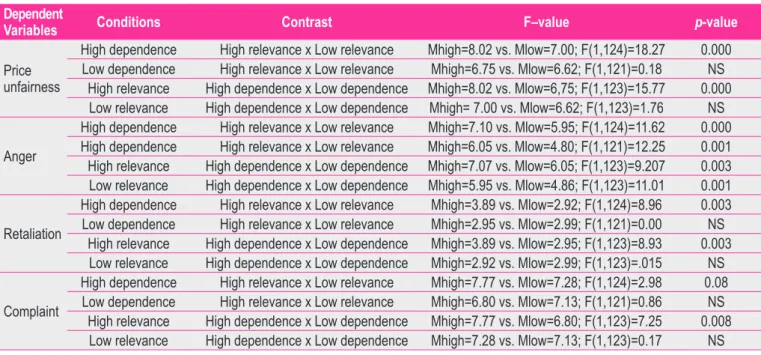
(F(2,243)=13.44; p<0.000), retaliate (F(2,243)=4.49; p<0.004), and complaint (F(2,243)=2.92; p<0.03). Given the overall interac -tion, an analysis was conducted to interpret the pattern of results. The results are presented in Table 2 and are summarized below.
The results support H3. The subjects in the high relevance /
high dependence group experienced signiicantly higher levels
of perceived unfairness, anger, and intentions to retaliate and complain condition than the subjects in the other three groups
(a univariate analysis of variance with the Scheffe post hoc
procedure examined the group differences across all pairs of each dependent variable, with similar results).
Next, the pattern of contrasts was examined in the context of high relevance conditions. In this case, subjects in the high dependence group experienced higher levels of perceived unfair-ness, anger, and intentions to complain and retaliate than the
High Dependence
High
Low Dependence
Low
Price Unfairness Anger Retaliate Complaint
Relevance Condition
High Low High Low High Low
Scores on Dependent V
ariables
8.02
6.75
6.05 5.95
4.86
3.89
2.95 2.93 2.99
6.62 6.80
7.00 7.07
7.77
7.28 7.13
subjects in the low dependence group. Under conditions of low relevance, subjects in the high dependence group and subjects
in the low dependence group did not experience signiicantly
different levels of perceived unfairness and intentions to com-plain and to retaliate, but experienced different levels of anger. Under conditions of high dependence, subjects in the high relevance group also experienced higher levels of perceived unfairness, anger, and intentions to complain and retaliate than the subjects in the low dependence group. Under conditions of low dependence, subjects in the high relevance group and subjects
in the low dependence group did not experience signiicantly dif -ferent levels of perceived unfairness and intentions to complain and to retaliate. The exception was, again, when it came to anger.
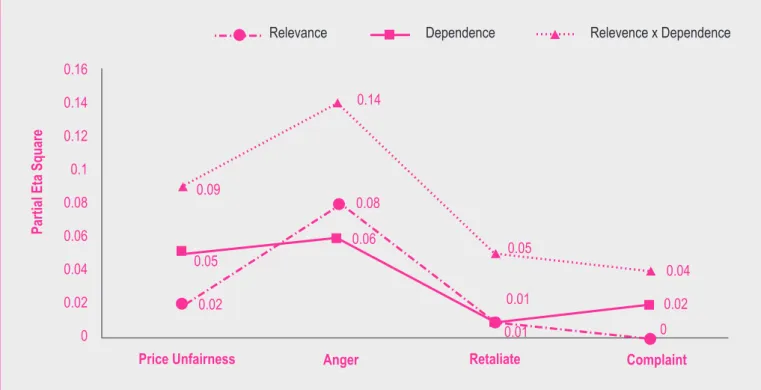
Figure 4 presents the partial eta squared (η²) and reveals that the variance explained increased from the main effect to the interaction effect, as expected. The effects of the relevance
x dependence interaction ampliied the variance on the depen -dent variables.
5.3. Unfairness and anger
Hypothesis four is that there is a positive and signiicant
correlation between unfairness and anger. The results support
this hypothesis (r=0.56; p<0.000). This result is consistent with the proposition that anger is an emotion that correlates with
per-ceived unfairness (Frijda, 1993; Weiss, Suckow & Cropanzano, 1999; Kuppens, Van Mechelen, Smits & De Boeck, 2003; Berkowitz & Harmon-Jones, 2004; Xia et al., 2004). In a situ -ation in which there is a pre-existing perception of unfairness in price increase, the greater the perceived unfairness, the more
intense the feeling of anger against the company. Furthermore,
(a) there is a signiicant correlation between anger and retalia
-tion (r=0.44; p<0.000) and (b) there is a positive and signiicant correlation between anger and intention to complain (r=0.30; p<0.000). The correlation coeficient between retaliation and complaint (r=0.36; p<0.000), retaliation and price unfairness
(r=0.32; p<0.000) complaint and price unfairness (r=0.32; p<0.000) also show expressive results.
5.4. Mediation effects
With regards to mediation effects, in contrast to moderating
(Vieira, 2010), a variable may be considered a mediator to the extent to which it carries the inluence of a given independent
variable to a given dependent variable. In order to examine
this, we use Baron and Kenny’s (1986) four steps sugges -tion, positioning anger as key mediator variable. In addition
to Baron and Kenny’s (1986) procedure, Sobel’s (1982) test was performed to conirm the mediation hypothesis, taking
the following equation: Z-value = a×b/√(b2×s
a2 + a2×sb2). In that equation, the beta unstandardized regression
coef-icients (a and b) and standard error values (sa and sb) were used. If the Z-value was above ±1.96, p<0.05, it means that the indirect effect is different from zero, indicating the
medi-ator inluence. The mediation effect was tested on two rela
-tionships where anger (negative emotion) mediates, assuming full mediation and partial. According to Iacobucci, Saldanha and Deng (2007), full mediation occurs when the Sobel’s z-value is signiicant, and the beta weight for the basic rela
-tionship (independent to dependent) becomes non-signiicant Table 2
Multiple Comparisons
Dependent
Variables Conditions Contrast F–value p-value
Price unfairness
High dependence High relevance x Low relevance Mhigh=8.02 vs. Mlow=7.00; F(1,124)=18.27 0.000 Low dependence High relevance x Low relevance Mhigh=6.75 vs. Mlow=6.62; F(1,121)=0.18 NS
High relevance High dependence x Low dependence Mhigh=8.02 vs. Mlow=6,75; F(1,123)=15.77 0.000 Low relevance High dependence x Low dependence Mhigh= 7.00 vs. Mlow=6.62; F(1,123)=1.76 NS
Anger
High dependence High relevance x Low relevance Mhigh=7.10 vs. Mlow=5.95; F(1,124)=11.62 0.000 High dependence High relevance x Low relevance Mhigh=6.05 vs. Mlow=4.80; F(1,121)=12.25 0.001 High relevance High dependence x Low dependence Mhigh=7.07 vs. Mlow=6.05; F(1,123)=9.207 0.003 Low relevance High dependence x Low dependence Mhigh=5.95 vs. Mlow=4.86; F(1,123)=11.01 0.001
Retaliation
High dependence High relevance x Low relevance Mhigh=3.89 vs. Mlow=2.92; F(1,124)=8.96 0.003 Low dependence High relevance x Low relevance Mhigh=2.95 vs. Mlow=2.99; F(1,121)=0.00 NS
High relevance High dependence x Low dependence Mhigh=3.89 vs. Mlow=2.95; F(1,123)=8.93 0.003 Low relevance High dependence x Low dependence Mhigh=2.92 vs. Mlow=2.99; F(1,123)=.015 NS
Complaint
High dependence High relevance x Low relevance Mhigh=7.77 vs. Mlow=7.28; F(1,124)=2.98 0.08 Low dependence High relevance x Low relevance Mhigh=6.80 vs. Mlow=7.13; F(1,121)=0.86 NS
in the second regression. Partial mediation occurs when beta values decrease their values.
First, we analyzed the impact of price unfairness on anger.
The result was signiicant, as expected (β=0.56; t-value=10.70; p<0.000; R2 adj=0.31). Secondly, we analyzed the impact of price
unfairness on retaliation and complaint. The results were signii-cant, as expected (β=0.31; t-value=5.20; p<0.000; R2 adj=0.09 and β=0.31; t-value=5.22; p<0.000; R2 adj=0.10, respectively). Thirdly, we analyzed the impact of anger on retaliation and
complaint. The outcomes were expressive, as expected (β=0.44;
t-value=7.77; p<0.000; R2 adj=0.19 and β=0.30; t-value=4.93; p<0.000; R2 adj=0.09, respectively). Fourthly, we analyzed the impact of both anger and price unfairness on retaliation and complaint. Thus, using the mediator variable, we expect the impact of price unfairness to decreases. The outcomes were
expressive over retaliation, as expected (βprice unfairness=0.10;
t-value=1.43; p=NS; and βanger=0.38; t-value=5.56; p<0.000; R2 adj=0.19, respectively) and over complaint (β
price unfairness=0.20;
t-value=2.83; p<0.005; and βanger=0.19; t-value =2.74; p<0.007;
R2 adj=0.12, respectively). Thus, anger mediated the effects
of perceived unfairness on complaint (sobel=4.80; p<0.000) and on retaliation (sobel=4.80; p<0.000) and H5 is supported.
6. DISCUSSION
The experimental data provided support for all research
hypotheses in the present study. Both the service relevance and
dependence on the service provider had an impact on perception
of the unfairness degree of the price increase. Furthermore, when both dependence and relevance were high, the respon-dents considered the intensity of the unfairness perpetrated by the company as being higher than in any other condition.
These results suggest, irst, that, in situations in which there
is a perception of unfairness, people, depending on the degree of relevance and dependence, appear to experience different levels of intensity in their perception. Secondly, the combination of
rele-vance and dependence, which may turn out to relect the degree of
power that the company exerts on the market, affects the level of unfairness that a perception of a price increase will lead to.
In certain sectors, such as power distribution, public transpor-tation and toll roads, the combination of service relevance and consumer dependence is a fact of life. In other sectors, service providers create strategies to increase consumer dependence in
order to raise customer retention and inluence demand elasticity.
For instance, it is common for telecommunications and healthcare companies to develop mechanisms that increase consumer switch-ing costs, such as contractual penalties. The results of this study suggest that in these sectors management should be especially careful with pricing decisions since there is a greater chance that perceptions of injustice are triggered due to issues related to
rel-evance and dependence. Reactions to unfair prices can be strong
and accompanied by high levels of anger followed by negative behaviors. Consumers are likely to engage in negative word of mouth and a variety of actions that may harm the company, sully its brand and reduce its market value. This was demonstrated by the fury of consumers who were charged outrageous prices for Figure 4: Eta Squares
Relevance Dependence Relevence x Dependence
Price Unfairness Anger Retaliate Complaint
Partial Eta Square
0.16
0.14 0.14
0.12
0.1
0.08 0.09 0.08
0.06 0.06
0.04 0.04
0.02 0.02
0.05 0.05
0.01
0.01
0.02
gasoline after hurricane Katrina, in 2005, in the United States. Also, in Brazil, during severe landslides that occurred in 2011 in Rio de Janeiro State, there were many angry consumers protest -ing through social media about price increases of essential items
such as water and milk. Recently, in 2013, the increase in public transportation fare prices in major Brazilian cities generated a
wave of protests all over the country, forcing mayors to cancel the increases. Times of crisis generate additional scrutiny of pricing
practices, as discussed by Ferguson, Ellen and Piscopo (2011).
The research presented here also furthers the understand-ing of feelunderstand-ings of anger and consumers´ behavioral reactions
motivated by unfairness perceptions. More than 20% of the
respondents indicated that the chances they would act against the company were high, either by writing a letter to a newspaper,
complaining to the oficial consumer protection agency, using
the internet to spread the word about the injustice perpetrated by the company, suing the company, or seeking another way of taking revenge on the company. Furthermore, perceptions of unfairness, anger and intentions to complain and retaliate were consistently strong in the high dependence group. The fact that a company manages to retain a customer should not be inter-preted as evidence of customer loyalty.
Managers need to keep in mind that pricing decisions may provide a sign of the company´s moral and ethical standing and thus, how much society and stakeholders can trust it. Managers should also consider that price unfairness perceptions appear more often when people believe that a company has exorbitant
proit margins (Kahneman et al., 1986). Therefore, when there is a low perceived quality due to poorly trained staff, poor physical facilities, or malfunctioning systems, the service provider may be accused of charging unfair prices. To avoid this it is necessary to invest in managing the perceived quality of the service, to main-tain detailed and transparent communication about price increases, and relate price increases to improvements in service performance. Some limitations of this research suggest directions for
future work. A irst issue to consider relates to the artiiciality of
the scenarios presented to the participants. The information on relevance and dependence were provided in short paragraphs. In a more natural social setting, we would expect the consumer to have more information and perform more complex evalua-tions. In addition, several other unexplored variables may affect consumer perceptions and emotions related to a price increase.
Nyer (1997) and Xia et al. (2004) indicate, for instance, that the relationship between emotions and behaviors is probably mediated by the cost of confrontation, that is, the individual will probably evaluate the consequences of engaging in con-frontation activities. Finally, we relied on convenience
sam-ples of undergraduate students. Although the use of students is
well accepted in this stream of research, this practice creates
an issue of external validity (Sears, 1986; Druckman & Kam, 2011). It is conceivable that students reactions are different from those of the general population. Research using randomly
selected subjects from the general population would increase the generalizability of the results.
REFERENCES
Bagozzi, R., Gopinath, M., & Nyer, P. (1999, Spring). The role of emotions in marketing. Journal of The Academy of
Marketing Science, 27(2), 184-206.
DOI: 10.1177/0092070399272005
Baron R., & Kenny, D. (1986). The moderator-mediator variable distinction in social psychological research: Conceptual, strategic, and statistical considerations. Journal
of Personality and Social Psychology, 51(6), 1173-1182.
DOI: 10.1037/0022-3514.51.6.1173
Berkowitz, L., & Harmon-Jones, E. (2004, June). Toward an understanding of the determinants of anger. Emotion, 4(2), 107-130.
DOI: 10.1037/1528-3542.4.2.107
Bruner II, G., Karen, E., & Hensel, P. (2001). Marketing
scales handbook: a compilation of multi-item measures,
Vol. III, p.1651. Chicago, Illinois: American Marketing Association.
Campbell, M. (1999, May). Perceptions of price unfairness: antecedents and consequences. Journal of Marketing
Research, 36(2), 187-199.
DOI: 10.2307/3152092
Campbell, M. (2007). “Says who?!” How the source of price information and affect inluence perceived price (un)fairness.
Journal of Marketing Research, 44(2), 261-271
DOI: 10.1509/jmkr.44.2.261
Chauvel, M. (2000). Dissatisied consumer an opportunity for companies. Mauad Editor, RJ, Brazil, p. 215.
Druckman, J., & Kam, C. (2011). “Students as experimental participants: A defense of the “narrow data base”. In J. Drukman, D. Green, J. Kuklinski, & A. Lupia, (Eds.). Handbook of experimental
political science, New York: Cambridge University Press.
DOI: 10.1017/CBO9780511921452.004 10.1017/CBO9780511921452 Ferguson J., Ellen, P., & Piscopo, G. (2011). Suspicion and perceptions of price fairness in times of crisis, Journal of
Business Ethics, 98(2), 331-349.
DOI: 10.1007/s10551-010-0552-8
Finkel N. (2001). Not fair! The typology of commonsense
unfairness. Washington DC: American Psychological
Associations.
DOI: 10.1037/10431-000
Frijda, N. (1993). Moods, emotion episodes, and emotions. In M. Lewis & J.M. Haviland-Jones (Eds.). Handbook of
emotions. New York: Guilford, pp. 381-403.
Gotlieb, J., Schlacter, J., & St Louis, R. (1992, May/ June). Consumer decision making: A model of the effects of involvement, source credibility and location on price difference required to induce consumers to change suppliers. Psychology & Marketing,9(3), p.191.
REFERENCES
Hoffman, D., & Kelley, D. (2000). Perceived justice needs and recovery evaluation: a contingency approach. European
Journal of Marketing, 34(Issue 3), p.418.
DOI: 10.1108/03090560010311939
Iacobucci, D., Saldanha, N., & Deng, X. (2007). A meditation on mediation: evidence that structural equations models perform better than regressions. Journal of Consumer
Psychology, 17(2), 140-154.
DOI: 10.1016/S1057-7408(07)70020-7
Joshi, A., & Arnold, S. (1997, December). The Impact of buyer dependence on buyer opportunism in buyer supplier relationships: the moderating role of relational norms.
Psychology & Marketing, 14(18), p. 823.
DOI: 10.1002/(SICI)1520-6793(199712)14:8<823:: AID-MAR5>3.0.CO;2-G 10.1002/(SICI)1520-6793(199712)14:8<823::AID-MAR5>3.3.CO;2-#
Kahneman, D., Knetsch, J., & Thaler, R. (1986). Fairness as a constraint on proit seeking: entitlements in the market.
The American Economic Review, 76(4), 728-741.
Kalapukaral, R., Dickson, P., & Urbany, J. (1991). Perceived price fairness and dual entitlement. In R. Holman & M. Solomon, (Eds.). Advances in Consumer Research, 18, pp. 788-993. Provo, UT: Association for Consumer Research. Kim, C., & Mauborgne, R. (1997, July/Aug.). Fair process: managing in the knowledge economy. Harvard Business
Review, pp. 65-75.
Kuppens, P., Van Mechelen, I., Smits, D., & De Boeck, P. (2003). The appraisal basis of anger: speciicity, necessity, and suficiency of components. Emotion, 3(3), 254-269.
DOI: 10.1037/1528-3542.3.3.254
Lauren, G., & Kapferer, J. (1985, February). Measuring consumer involvement proiles. Journal of Marketing
Research, p. 41.
DOI: 10.2307/3151549
Maxwell, S. (1995). What makes a price seem fair? Pricing
Strategy & Practice, 3(4), 21-27.
Namkung, Y., & Jang Soo, C. (2010). Effects of perceived service fairness on emotions, and behavioral intentions in restaurants.
European Journal of Marketing, 44(9/10), 1233-1259.
DOI: 0.1108/03090561011062826
Netemeyer, R., Bearden, W., & Sharma, S. (2003). Scaling
procedures – issues and applications. London: Sage
Publications.
Nyer, P. (1997). A study of the relationships between cognitive appraisals and consumption emotions. Journal of
the Academy of Marketing Science, 25(4), 296-304.
DOI: 10.1177/0092070397254002
Richins, M. (1997, September). Measuring emotions in the consumption experience. Journal of Consumer Research,
24(2), p.127.
DOI: 10.1086/209499
Roseman, I. (1991). Appraisal determinants of discrete emotions. Cognition and Emotion, 5, pp. 161-200. DOI: 10.1080/02699939108411034
Schoefer, K., & Ennew C. (2005). The impact of perceived justice on consumers’ emotional responses to service complaint experiences. Journal of Services Marketing, 19(5), 261-270.
DOI: 10.1108/08876040510609880
Schweitzer, M., & Gibson, D. (2008). Fairness, feelings, and ethical decision making: consequences of violating community standards of fairness. Journal of Business Ethics. 77, pp. 287-301.
DOI: 10.1007/s10551-007-9350-3
Sears, D. (1986). “College sophomores in the laboratory: Inluence of a narrow data base on social psychology’s view of human nature”. Journal of Personality and Social
Psychology, 51, pp. 515-530.
DOI: 10.1037/0022-3514.51.3.515
Sobel, M. (1982). “Asymptotic intervals for indirect effects in structural equations models”. In S. Leinhart (Ed.). Sociological
Methodology, pp. 290-312. San Francisco: Jossey-Bass.
Urbany, J., Madden, T., & Dickson, P. (1989). All’s not fair in pricing: an initial look at the dual entitlement principle.
Marketing Letters, 1(1), pp. 17-25.
DOI: 10.1007/BF00436145
Vaidyanathan, R., & Aggarwal, P. (2003). What is the fairest of them all? An attributional approach to price fairness.
Journal of Business Research, 56, pp. 453-463.
DOI: 10.1016/S0148-2963(01)00231-4
Varki, S., & Wong, S. (2003). Consumer involvement in relationship marketing of services. Journal of Service
Research, 6(1), 83-91.
DOI: 10.1177/1094670503254287
Vieira, V. (2010). Visual aesthetics in store environment and its moderating role on consumer intention. Journal of
Consumer Behaviour, 9(2), 364-380.
DOI: 10.1002/cb.324
Weiss, H., Suckow, K., & Cropanzano, R. (1999). Effects of justice conditions on discrete emotions. Journal of Applied
Psychology, 84(5), 786-794.
DOI: 10.1037/0021-9010.84.5.786
Xia, L., & Monroe, K. (2005). Comparison references and the effects of price unfairness perceptions. Working Paper at The Department of Business Administration, University of Illinois, Champaign, IL, USA.
Xia, L., Monroe, K., & Cox, J. (2004, October). The price is unfair! A conceptual framework of price fairness perceptions.
Journal of Marketing, 68, pp. 1-5.
DOI: 10.1509/jmkg.68.4.1.42733
Zeithaml, V., Berry, L., & Parasuraman, A. (1996). The behavioral consequences of service quality. Journal of
Marketing, 60(Issue 2).
ABSTRACT
RESUMEN
Perceptions of unfairness in price increases: an experimental study
This experimental study investigates antecedents and consequences of perceptions of price unfairness in a price increase situation. The proposed theoretical model states that consumer dependence on the
ser-vice provider as well as the relevance the consumer attributes to the serser-vice (for the consumer’s life) will affect his/her degree of (a) unfairness price perception, (b) anger, and (c) intention to complain and retali -ate. The results support all the hypotheses specified in the model. The findings not only indicate that some situations of unfairness price perception lead to stronger emotions and more dramatic reactions from con-sumers, but also allow us to predict which situations of perceived unfairness offer greater risks and have greater potential for conflict.
Keywords:price unfairness, price increases, anger, service relevance, service provider dependence.
Percepción de injusticia en aumento de precio: un estudio experimental
En este artículo se presenta un estudio en que se analizan los antecedentes y las consecuencias de la percep-ción de injusticia en una situapercep-ción de aumento de precio. En el modelo teórico propuesto se afirma que la dependencia del consumidor con relación al proveedor del servicio y la relevancia que el consumidor atri-buye al servicio afectarán el grado de percepción cuanto a injusticia de precios, rabia e intenciones de queja y
represalia. Los resultados sostienen todas las hipótesis especificadas en el modelo e indican que determinadas
situaciones de percepción de injusticia no sólo conducen a emociones más fuertes y reacciones más dramá-ticas por parte del consumidor, sino que también permiten que se anticipen aquellas situaciones de injusticia percibida que presenten mayores riesgos y alto potencial de conflicto.
Figure 4: Eta Squares
Relevance Dependence Relevence x Dependence
Price Unfairness Anger Retaliate Complaint
Partial Eta Square
0.16
0.14 0.14
0.12
0.1
0.08 0.09 0.08
0.06 0.06
0.04 0.04
0.02 0.02
0.05 0.05
0.01
0.01
0.02
0 0
ERRATUM
The Figure 4 of the article “Perceptions of unfairness in price increases: an experimental study”, published on Revista de Administração da Universidade de São Paulo, v. 49, n. 3, p. 574, 2014, is not correct. The corrected Figure can be found below.
Figure 4: Eta Squares
Relevance Dependence Relevence x Dependence
Price Unfairness Anger Retaliate Complaint
Partial Eta Square
0.16
0.14 0.14
0.12
0.1
0.08 0.09 0.08
0.06 0.06
0.04 0.04
0.02 0.02
0.05 0.05
0.01
0.01
0.02
0 0
ERRATA
A Figura 4 do artigo “Perceptions of unfairness in price increases: an experimental study”, publicado na Revista de Administração da Universidade de São Paulo, v. 49, n. 3, p. 574, 2014, não estava certa. A igura correta segue abaixo.