Naphthoquinone-based chalcone hybrids and
derivatives: synthesis and potent activity against
cancer cell lines
†
Guilherme A. M. Jardim,aTiago T. Guimar ˜
aes,bMaria do Carmo F. R. Pinto,c Bruno C. Cavalcanti,dKaio M. de Farias,dClaudia Pessoa,deClaudia C. Gatto,f Divya K. Nair,gIrishi N. N. Namboothiri*gand Eufr
ˆ
anio N. da Silva J´unior*a
Novel naphthoquinone-based chalcones were prepared from the reaction between 3-bromo-nor-b -lapachone and amino-chalcones. Lapachone derivatives are also described here. All the substances were evaluated against cancer and normal cell lines and several compounds demonstrated potent antitumor activity.
1.
Introduction
The population growth and aging associated with some risk factors have increased the incidence of new cases of cancer and related deaths in developed countries and in developing coun-tries.1 In a four-year period, the estimated number increased
from 12.7 million new cancer cases with 7.6 million cancer-related deaths in 2008, to 14.1 million new cancer cases and 8.2 million cancer-related deaths in 2012. The projection for the year 2030, estimates 27 million new cancer cases with 17 million cancer-related deaths.2,3
Naphthoquinone containing natural products belong to an important class of naturally occurring secondary metabolites found in the bignoniaceae family.4 Among these,
naph-thoquinoidal compounds obtained from natural products, such as lapachol and lawsone (2-hydroxy-1,4-naphthoquinone), have received considerable attention because of their antitumor potential.5–8 1,4- and 1,2-naphthoquinones, and for instance,
dehydro-a-lapachone, an important anti-vascular agent,9and
b-lapachone, a potent antitumoral compound, have also been used as prototypes for the development of new drugs.10
Generally, quinones are able to provoke apoptosis and act as topoisomerase inhibitorsviaDNA intercalation. Their toxicity can also be explained by inducing oxidative stress through reactive oxygen species (ROS) generation.11Recently, described
by Bolognesi and coworkers, quinones have attracted attention due to their activity being intrinsically related by a multitarget mechanism.12
In recent years, lapachones were employed as key substrates for the synthesis of complex diazaazulenones,13spirolactones,14
oxazoles15 and other potentially bioactive heterocyclic
compounds.15Our research group has explored the potential of
quinones against cancer, mainly,viastructural modication of the nor-b-lapachone, particularly, the C-ring and redox centre modication16since these moieties are deeply related with the
generation of ROS (Scheme 1).
Earlier, we reported the synthesis of nor-b-lapachone-based 1,2,3-triazole and 3-arylamino derivatives with potent antitumor activityviaC-ring modication of nor-b-lapachone and molec-ular hybridization19with the junction of 1,2,3-triazole groups
(Scheme 1).17,18 Recently, we described a derivative of
nor-b-lapachone coupled benzothiadiazole (Scheme 1) with potent activity against twenty cancer cell lines and low cytotoxicity against three normal cells.20These results were very promising
and the mechanism of action of this substance in tumor cells is being currently investigated in our laboratories and it will be reported in due course.
Using redox centre modication, imidazoles and an oxirane derivative were obtained from nor-b-lapachone and b-lapa-chone (Scheme 1), with antimycobacterial21and trypanocidal22
activities, indicating the importance of this approach. The C-ring modication in thea-lapachone was also accomplished and thio-derivatives with antitumor activities and 1,2,3-triazoles with leishmanicidal activity were recently reported.23,24
Finally, following our program to develop new bioactive molecules, particularly, new nor-b-lapachones with activity aInstitute of Exact Sciences, Department of Chemistry, Federal University of Minas
Gerais, CEP 31270-901, Belo Horizonte-MG, Brazil. E-mail: [email protected]; Fax: +55 31 34095700; Tel: +55 31 34095720
bInstituto Nacional de Cˆancer, Hospital do Cancerˆ
–Unidade I–Seçao de Medicina˜
Nuclear, 20230-130, Rio de Janeiro, RJ, Brazil
cN´ucleo de Pesquisas de Produtos Naturais, UFRJ, 21944-971, Rio de Janeiro, RJ, Brazil
dDepartamento de Fisiologia e Farmacologia, UFC, 60430-270, Fortaleza, CE, Brazil
eFiocruz
–Cear´a, 60180-900, Fortaleza, CE, Brazil
fInstitute of Chemistry, University of Brasilia, CEP 70904970, Brasilia-DF, Brazil
gDepartment of Chemistry, Indian Institute of Technology Bombay, Mumbai 400 076, India. E-mail: [email protected]; Fax: +91-22-2576-7152; Tel: +91-22-2576-7196
†Electronic supplementary information (ESI) available. CCDC 1018940. For ESI and crystallographic data in CIF or other electronic format see DOI: 10.1039/c4md00371c
Cite this:Med. Chem. Commun., 2015, 6, 120
Received 28th August 2014 Accepted 19th September 2014
DOI: 10.1039/c4md00371c
www.rsc.org/medchemcomm
CONCISE ARTICLE
Published on 24 September 2014. Downloaded on 26/07/2016 12:19:11.
View Article Online
against cancer cell lines and low cytotoxicity against normal cells, the synthesis of quinone-based chalcones, is described herein for the rst time. The strategies of molecular hybrid-ization and C-ring modication were used because of chal-cone's known antitumor activity.25Redox centre modi
cation in lapachones to obtain hydrazone derivatives and C-ring modi-cation ina-lapachone in addition to nor-b-lapachone coupled withpara-quinones were also accomplished. All the substances were evaluated against cancer and normal cell lines.
2.
Results and discussion
Chemistry
To obtain therst class of compounds, nor-b-lapachone-based chalcones, initially amine-chalcones were prepared in good yields (Scheme 2). The syntheses of chalcones were easily accomplished by condensing 40-aminoacetophenone with different aldehydes in the presence of sodium hydroxide in
ethanol. Compounds1–6were prepared with electron-donating (methyl, phenyl, methoxy and isopropyl groups) and an elec-tron-withdrawing group (nitro) in addition to the unsub-stituted,1. All the substances are known in the literature.26–28
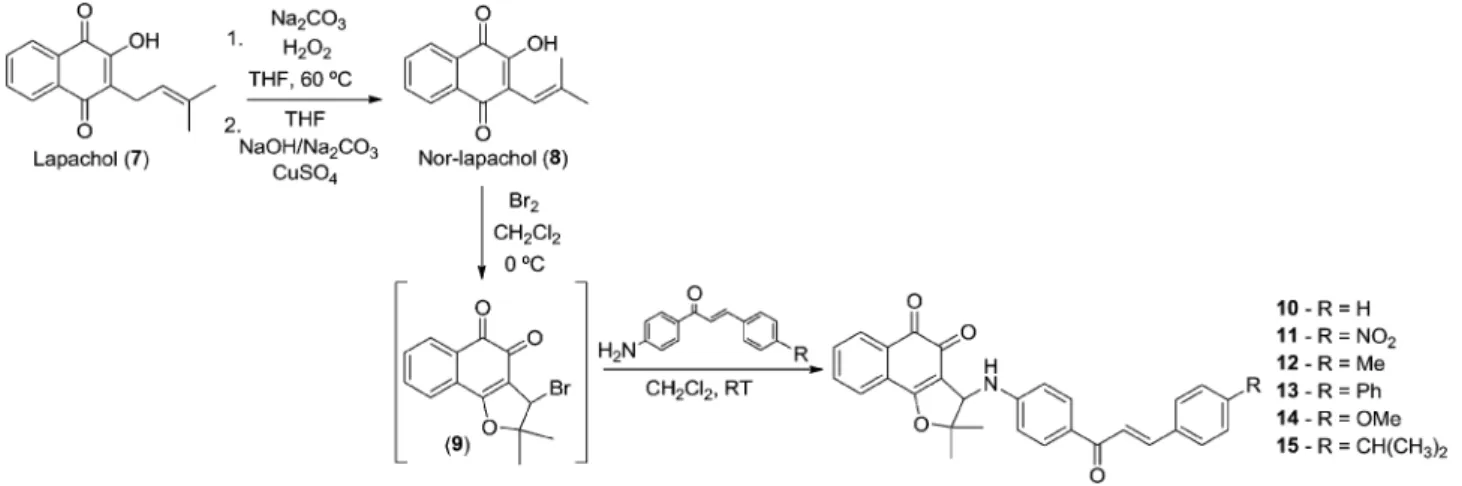
Using the Hooker oxidation methodology29nor-lapachol 8
was prepared from lapachol7 and used to obtain the classic intermediate 3-bromo-nor-b-lapachone9in quantitative yield. Compound9was reacted with the previously prepared amine-chalcones1–6to provide nor-b-lapachone-based chalcones10–
15(Scheme 3).
New compounds10–15were well characterized by1H and 13C NMR and high resolution mass spectrometry and all the
data are in accordance with the proposed structures. It was observed in the1H NMR spectrum of chalcone derivatives that the respective doublet signals with coupling constant,J¼15.6 Hz indicated the presence of thetrans-olen of the quinone coupled chalcone. Another important observation is a singlet at aroundd4.90–5.00 corresponding to the hydrogen attached to the C-3 in the chalcone derivatives. It is more shielded, compared to its counterpart in the bromo derivative9, which is observed atd5.40. In addition, the13C NMR spectra showed all the expected signals. The structure of quinone-based chalcone
14was reconrmed by X-ray crystallography (Fig. 1).
Recently, the second class of substances was reported by us (Scheme 4).30Lawsone was reacted with Morita
–Baylis–Hillman acetates of nitroalkenes in the presence of a quinine–
Scheme 1 Structural modification of the prototype lapachones.
Scheme 2 Synthesis of the chalcone intermediates1–6.
squaramide organocatalyst to provide enantioenriched disub-stituteda-lapachones. This methodology allowed us to access asymmetric lapachones that are C-ring modied in a single step. In general, the products were obtained in high yields with excellent diastereo- and enantioselectivities.30 The catalyst
shown in Scheme 4 was the most effective.
The compounds16–25assayed against cancer cell lines here were previously described.30
In view of the ease of access to lapachone derivatives by selective chemical transformation of lapachol7, we invested to study the corresponding hydrazone derivatives. In addition, the hydrazones of the b-lapachone 26, 3-iodo-b-lapachone 27, 3-Scheme 3 Nor-b-lapachone-based chalcones obtained from lapachol7.
Fig. 1 An ORTEP-3 representation (50% probability displacement ellipsoids) of the asymmetric unit of compound14.
Scheme 4 a-Lapachone derivatives16–25.
bromo-b-lapachone 28, a-lapachone 32, nor-b-lapachone 34, nor-a-lapachone 36 and 3-hydroxy-nor-b-lapachone 38, were obtained in high yields. In fact, the hydrazones of naturally occurring quinones have been considered for a long time as simple derivatives to conrm the identity of quinones. To the best of our knowledge, the use of hydrazones from quinones of the lapachol's group was not considered for major antitumor studies until now.
Initially, b-lapachone 26, its derivatives 27 and 28 and a-lapachone32, were prepared from lapachol7, by reaction with sulfuric acid, iodine, bromine and CH3COOH/HCl, respectively, as previously reported.31,32Nor-lapachol8was used to obtain
3-hydroxy-nor-b-lapachone 38, nor-b-lapachone 34 and nor-a-lapachone 36.33 The hydrazone derivatives were prepared
according to the methodology previously published with minor modications.34The reaction of the appropriate quinones with
phenylhydrazine hydrochloride in acetic acid yielded the respective derivatives29–31,33,35,37and39in excellent yields (Scheme 5).
The spectroscopic data of hydrazone derivatives are in accordance with the proposed structures. The formation of these compounds followed the regioselective pattern previously observed and it is possible to conclude that the benzylic carbonyl group formed the hydrazone in all the cases.34This is
evident from 1H NMR data that the peri-hydrogen of the naphthalene ring appeared atd 7.55 to 7.14 ppm, due to the anisotropic hydrazo group at carbon C-6. In addition, the13C NMR spectra of 30,35 and 39, for instance, showed similar chemical shis for the carbonyls, atd179.1, 178.2 and 177.0 ppm, respectively, which is consistent with carbonyl at carbon C-6 (for30) and C-5 (for35and39). A common feature observed for compounds 30, 35 and39 in the 1H NMR spectra using CDCl3as solvent is the presence of sharp singlet signals in the downeld region (d 15.5–16.5 ppm) attributed to one N–H, which could form an internal hydrogen bond with the carbonyl of theortho-hydrazone moiety, a strong H-bond acceptor.
a-Lapachone32gave the regioselective para-hydrazone33, which is conrmed by the presence in its1H NMR spectrum of an isolated downeld doublet in the aromatic region, attributed to one naphthaleneperi-hydrogen. Thus, as in the case of the aboveortho-hydrazones, the anisotropic effect of the hydrazine moiety on theperi-hydrogen of naphthalene is also observed in the case ofpara-hydrazones. On the other hand, in comparison to the original methylene hydrogens of the pyran ring in32, the 1H NMR of the corresponding ones of33, shows only negligible effects, indicating that the hydrazo group has little inuence over the pyran ring.
Scheme 5 Synthesis of the hydrazone derivatives29–31,33,35,37and39. (i) To obtain compound26: H2SO4,27: I2, Py, CH2Cl2, 0C,28: Br2, CH2Cl2.
Recently, the trypanocidal activity of nor-b-lapachone-derived 1,2,3-triazole-conjugated aminoquinones was described.35These compounds presentortho- andpara-carbonyl
moieties that are able to generate ROS and these can be considered as important structures for evaluation against cancer cell lines because the activity of quinoidal molecules is deeply related with ROS generation as previously discussed.11,12
Bearing in mind the importance of these substances, we considered the compounds41–43, obtained from lapachol 7 (Scheme 6) for antitumor studies. Nor-lapachol8was cyclized to 3-bromo-nor-b-lapachone that was used to prepare compound
40. The azido derivative40was used to synthesize41–43and all spectroscopy data were in accordance with the literature.35
3.
Biology
All the substances described (Schemes 2–5), were evaluatedin vitrousing the MTT assay against four cancer cell lines: HL-60 (human promyelocytic leukemia), OVCAR-8 (human ovarian adenocarcinoma), SF295 (human glioblastoma) and HCT-116 (human colon carcinoma). Doxorubicin was used as the positive control (Table 1).36The selectivity of the compounds toward a
normal proliferating cell line was investigated using the MTT assay with human peripheral blood mononuclear cells (PBMC) aer 72 h of drug exposure.
Our strategy was based on the modication of the prototypes b-lapachone26,a-lapachone32, nor-b-lapachone34and nor-a-lapachone 36. Recently, 1,2,3-triazole-, arylamino- and thio-substituted a-lapachones were synthesized and evaluated against eleven cancer cell lines.24,35,36 Most of them were
considered moderately active and several compounds were considered highly active (IC50< 2mM). Following this previous work, herein, the antitumor activities of asymmetric a-lapa-chone C-ring modied16–25were evaluated.
The selected compounds have different patterns of substitu-tion with an aryl ring substituted by electron withdrawing (Cl and NO2) and donating (OMe and CH3) groups in different positions, in addition to furan and thiophene rings. Unfortunately, in this study our strategy has failed and none of the compounds pre-sented antitumor activity with IC50values > 12.1mM (Table 1). At present, several modications of the asymmetric lapachones, for instance the insertion of 1,2,3-triazoles, are being currently investigated and will be reported in due course.
Recently, redox centre modication in quinones was successfully employed to obtain antitumor compounds.16Imine
derivatives obtained from b-lapachone 26 presented potent antitumor activity.37In this context, we conducted the synthesis
of hydrazone derivatives fromb-lapachone26, their iodine and bromine derivatives 27 and 28, a-lapachone 32, nor-b-lapa-chone 34, nor-a-lapachone 36 and 3-hydroxy-nor-b-lapachone
38, all the substances from the lapachol group. The derivatives
29–31,33,35,37and39were evaluated against four cancer cell lines. In the same manner as the asymmetric quinones, the hydrazones were not active against all the lineages evaluated (Table 1). In comparison of these structures with the imines, previously obtained fromb-lapachone26,37the simple insertion
of the NH-bond was enough to provoke the suppression of the activity. As suggested by Burton and coworkers,37the change in
the redox centre does not affect the overall activity and selec-tivity of the lapachone imine derivatives and it was described as an alternative in the search for new anticancer agents consid-ering the high cytotoxicity of theb-lapachone26in normal cell lines. On the basis of this principle, we considered the redox centre modication of lapachone derivatives as an important strategy to obtain novel antitumor drugs despite the lack of activity of the compounds described herein.
The third group of compounds was strategically planned by C-ring modication16 of nor-b-lapachone 34 and molecular
hybridization19with chalcone moieties (Scheme 7). Scheme 6 Lapachones41–43obtained from lapachol (7).
Chalcones are recognized by their biological activities, for instance, antitumor,38 leishmanicidal39 and antimalarial.40
Considering the potential of the chalcones, naphthoquinoidal compounds10–15were prepared and evaluated against cancer and normal cell lines (Table 1). The selectivity index was considered to establish the potential of these structures (Table 2).
For the insertion of chalcone in the naphthoquinoidal moiety, compounds1–6were prepared. The structures1–3were also evaluated and showed activity against HL-60, HCT-116 and OVCAR-8 with IC50 values in the range of 0.46 to 15.35 mM. Compound 4was not active and the structures 5 and6 pre-sented activity only for HL-60 with IC50values¼10.5 and 10.0 mM, respectively.
Table 1 Cytotoxic activities expressed by IC50mM (95% CI) for compounds1–6,10–25,29–31,33,35,37,39and41–43and for the positive control doxorubicin and the precursors lapachonea
Compounds HL-60 HCT-116 OVCAR-8 SF295 PBMC
1 6.40 (5.24–7.84) 14.1 (12.86–15.59) >22.4 >22.4 20.2 (19.54–22.00)
2 1.75 (0.89–3.46) 10.96 (9.99–12.01) >18.65 >18.65 13.83 (13.54–14.54)
3 0.46 (0.08–1.94) 15.35 (12.73–18.47) >21.08 >21.08 >21.08
4 >16.71 >16.71 >16.71 >16.71 >16.71
5 10.50 (8.53–12.99) >19.75 >19.75 >19.75 >19.75
6 10.0 (12.52–17.53) >18.85 >18.85 >18.85 >18.85
10 0.04 (0.02–0.04) 0.71 (0.62–0.82) 1.53 (1.33–1.75) 0.37 (0.26–0.53) 2.20 (1.82–2.64)
11 0.20 (0.16–0.26) 2.22 (1.94–2.57) 4.35 (3.78–4.81) 2.89 (2.50–3.39) 6.51 (5.80–6.88)
12 0.10 (0.04–0.21) 1.94 (1.77–2.15) 2.13 (1.81–2.52) 4.57 (4.14–5.05) 7.90 (7.66–8.26)
13 2.20 (1.84–2.60) >9.5 >9.5 >9.5 >9.5
14 0.10 (0.08–0.12) 1.54 (0.91–1.89) 0.64 (0.33–1.08) 1.08 (0.56–1.46) 1.33 (0.85–1.73)
15 0.14 (0.10–0.18) 1.56 (1.18–2.23) 2.54 (1.99–2.91) 1.62 (1.30–2.13) 2.28 (1.77–2.64)
16 >14.92 >14.92 >14.92 >14.92 >14.92
17 >12.98 >12.98 >12.98 >12.98 >12.98
18 >12.65 >12.65 >12.65 >12.65 >12.65
19 >13.54 >13.54 >13.54 >13.54 >13.54
20 >14.32 >14.32 >14.32 >14.32 >14.32
21 >12.10 >12.10 >12.10 >12.10 >12.10
22 >13.54 >13.54 >13.54 >13.54 >13.54
23 >13.15 >13.15 >13.15 >13.15 >13.15
24 >14.66 >14.66 >14.66 >14.66 >14.66
25 >15.38 >15.38 >15.38 >15.38 >15.38
29 >15.05 >15.05 >15.05 >15.05 >15.05
30 >10.91 >10.91 >10.91 >10.91 >10.91
31 >12.19 >12.19 >12.19 >12.19 >12.19
33 >15.05 >15.05 >15.05 >15.05 >15.05
35 >15.71 >15.71 >15.71 >15.71 >15.71
37 >15.71 >15.71 >15.71 >15.71 >15.71
39 >14.96 >14.96 >14.96 >14.96 >14.96
41 0.45 (0.39–0.54) 0.58 (0.52–0.66) 1.33 (1.12–1.58) 1.29 (1.14–1.43) 0.27 (0.14–0.37)
42 1.76 (1.43–2.17) 1.90 (1.65–2.21) 3.32 (2.82–4.06) 1.80 (1.55–2.10) 1.10 (0.83–1.18)
43 1.75 (1.37–2.25) 2.32 (2.25–2.72) 4.36 (3.83–4.78) 2.21 (1.52–2.79) 1.00 (0.87–1.07) Nor-b-lapachone 1.75, 1.59–1.83 1.41, 1.28–1.54 1.25, 1.07–1.43 1.58, 1.31–1.88 >21.90 b-Lapachone 1.65, 1.49–1.78 0.97, 0.81–1.04 1.16, 0.97–1.25 0.91, 0.74–1.11 >20.60 a-Lapachone 8.18, 7.55–8.92 19.11, 18.75–19.88 14.79, 14.42–18.15 18.77, 18.15–19.03 >20.66 Doxorubicin 0.03, 0.01–0.05 0.02, 0.01–0.03 0.09, 0.04–0.12 0.48, 0.37–0.52 0.37, 0.30–0.43
a
Results obtained by nonlinear regression for all assayed cell lines from three independent experiments (deviations in parenthesis).
Scheme 7 Strategy used to obtain new antitumor naphthoquinonoid compounds.
Aer evaluating nor-b-lapachone based chalcone10–15, the data conrmed the success of our approach. As previously described,8 the compounds were classi
ed according to their activity as highly active (IC50< 2mM), moderately active (2mM < IC50< 10mM), or inactive (IC50> 10mM). The structures10–15 were considered highly active against HL-60 and HCT-116 with IC50 values between 0.04 to 2.2 mM. Compounds3,10–12,14 and 15 were considered very promising against HL-60 aer assaying these structures against peripheral blood mono-nuclear cells (PBMC). The selectivity index (SI), which is an excellent parameter to determine the efficiency of the compounds in cancer cells with low cytotoxicity in normal cell lines is expressed by the ratio of cytotoxicities between normal cell (PBMC) and different cancer cell lines. For compounds3,
10,11,12,14and15the values of SI (considering HL-60) were 45.8, 55.0, 32.5, 79, 13.3 and 16.2 (Table 2), respectively. For doxorubicin, the drug used clinically against several types of cancer, the SI value is 12.0. In comparison with the positive control, doxorubicin, nor-b-lapachone-based chalcone 12 is more active and this structure could be considered as an important prototype for further studies. To the best of our knowledge, 12 can be considered as one of the most active substances for HL-60 cancer cell line with a high selectivity index obtained from lapachol7already reported.
Another important characteristic that points to the success of the strategy herein employed was the increase of the activity of nor-b-lapachone 34 aer the insertion of the chalcone moieties (IC50values for34in the range of 1.25–1.75mM), Table 1. The hybrid compounds were also more active than the non-hybridized chalcones1–4.
Finally, compound 13 was not active against HCT-116, OVCAR-8 and SF295, but this molecule presented selective activity for HL-60 with IC50value¼2.20mM. In terms of selec-tivity index this structure was not promising, but further modications in this prototype are under investigation in our research group to develop drugs with selectivity against a certain type of cancer. Compounds14and15were highly active
against all the cancer cell lines evaluated, but these compounds were more cytotoxic than the other derivatives of this class.
In general terms, lapachone-based chalcone hybrids pre-sented important activity against cancer cell lines with low cytotoxicity in normal cancer cell lines. This manuscript represents the rst report on this class of compounds with promising activity, and based on our experience with lapachone derivatives, the compounds herein described deserve further subsequent studies.
The last class of compounds herein evaluated has been chosen because of the intrinsic ability of these structures to generate ROS. In fact, the compounds41–43were considered highly active (IC50< 2mM) against all the cancer lineages eval-uated with some exceptions. The main problem observed for these compounds was the high cytotoxicity observed in normal cell lines (PBMC). For instance, compound41was highly active against HL-60 cell lines with IC50 ¼0.45mM, but it presented IC50 value¼ 0.27mM for normal cells. In general, 41–43 are more cytotoxic for normal cell than cancer cell lines.
Lately, microencapsulation aimed controlled release is an important strategy to increase the efficiency of antitumor drugs.41Recent studies usingb-lapachone were described to try
to diminish the cytotoxicity of this important antitumor quinone.42Considering the promising results observed for41
–
43, in four types of cancer cell lineage, studies aiming controlled delivery systems, could be an interesting possibility to solve the problem of cytotoxicity.
4.
Conclusions
We evaluated thirty-two compounds against four cancer cell lines and peripheral blood mononuclear cells (PBMC). These compounds were obtained by C-ring and redox centre modi -cations based on the prototypes nor-b-lapachone,a-lapachone, nor-a-lapachone and b-lapachone analogues. Fourteen compounds were discovered as important substances with potent antitumor activity. In general, all the compounds were highly active (IC50< 2mM) and the substances were more active than doxorubicin, a clinically used drug against several types of cancer. Compound12presented good selectivity for HL-60 cell line with high selectivity index even better than doxorubicin the positive control. This compound presents a promising prole for further experimental investigations in this study.
5.
Experimental section
Melting points were obtained on a Thomas Hoover apparatus and are uncorrected. Analytical grade solvents were used. Column chromatography was performed on silica gel (Acros Organics 0.035–0.070 mm, pore diameterca.6 nm).1H and13C NMR were recorded at room temperature using a Bruker AVANCE DRX 200 and Varian Mercury 400 and 500 MHz spec-trometers in the solvents indicated with TMS as an internal reference. Chemical shis (d) are given in ppm. Electron-impact mass spectra (70 eV) were obtained using a VG Autospec appa-ratus (Micromass, Manchester, UK). The main fragments were described as a relation between atomic mass units and the Table 2 Selectivity index for the most active compounds [ratio
between the cytoxicities, expressed as IC50(mM), against PBMC and four cancer cell lines]. Nd¼not determined
Compounds PBMCvs. HL 60 PBMCvs. HCT-116 PBMCvs. OVCAR-8 PBMCvs. SF295
1 3.1 1.4 0.9 0.9
2 7.9 1.2 0.7 0.7
3 45.8 1.3 1.0 1.0
10 55.0 3.0 1.4 5.9
11 32.5 2.9 1.4 2.2
12 79.0 4.0 3.7 1.7
13 4.3 1.0 1.0 1.0
14 13.3 0.8 2.0 1.2
15 16.2 1.4 0.8 1.4
41 0.6 0.4 0.2 0.2
42 0.6 0.5 0.3 0.6
43 0.5 0.4 0.2 0.4
Doxorubicin 12.0 18.5 4.1 0.7
charge (m/z) and the relative abundance as a percentage of the base peak intensity. Lapachol (5) (2-hydroxy-3-(30-methyl-20 -butenyl)-1,4-naphthoquinone) was extracted from the heart-wood of Tabebuia sp. (Tecoma) and puried by a series of recrystallizations in an appropriate solvent. From this quinone, nor-lapachol (2-hydroxy-3-(20 -methyl-propenyl)-1,4-naph-thoquinone) was obtained by the Hooker oxidation method.28
General procedure to prepare the quinone-based chalcones
An excess of bromine (2 mL) was added to a cooled solution of nor-lapachol (228 mg, 1 mmol) in 25 mL of dichloromethane. The brominated intermediate 9 was obtained as an orange solid. Aer the removal of excess bromine, a solution of the respective chalcone (1 mmol) in 25 mL of dichloromethane was added and stirred overnight. The reaction mixture was concentrated under reduced pressure and the residue was puried by column chromatography in silica gel by eluting with an increasing polarity gradient mixture of hexane and ethyl acetate.
(E )-3-(4-Cinnamoylphenylamino)-2,2-dimethyl-2,3-dihy-dronaphtho[1,2-b]furan-4,5-dione (10).The compound10was obtained as a red solid (157 mg, 0.35 mmol, 35% yield); mp 196–
199C.1H NMR (500 MHz, CDCl3)d7.98 (d, 1H,J¼7.4 Hz), 7.88 (d, 2H,J¼8.4 Hz), 7.69 (dt, 3H,J¼14.8, 11.6 Hz), 7.59 (t, 3H,J¼ 7.4 Hz), 7.49 (d, 1H,J¼15.6 Hz), 7.39–7.35 (m, 3H), 6.61 (d, 2H, J¼8.7 Hz), 4.91 (d, 1H,J¼7.3 Hz), 1.69 (s, 3H), 1.57 (s, 3H).13C NMR (125 MHz, CDCl3)d187.8, 180.7, 175.2, 170.0, 151.3, 142.9, 135.3, 134.6, 132.7, 131.1, 131.0, 129.9, 129.5, 128.8, 128.2, 128.0, 127.2, 125.2, 121.9, 114.5, 112.2, 96.7, 60.8, 27.4, 21.8. EI/ MS (m/z) [M + Na]+: 472.1511. Calcd for [C
29H23NO4Na]+: 472.1519.
(E )-2,2-Dimethyl-3-(4-(3-(4-nitrophenyl)acryloyl)phenyl-amino)-2,3-dihydronaphtho[1,2-b]furan-4,5-dione (11). The compound11was obtained as a brown solid (144 mg, 0.3 mmol, 30% yield); mp 224–227C.1H NMR (400 MHz, acetone)d8.39– 8.28 (m, 3H), 8.17 (d, 1H,J¼9.1 Hz), 8.15–8.01 (m, 3H), 7.92 (d, 1H,J¼15.7 Hz), 7.82–7.75 (m, 2H), 7.01 (d, 2H,J¼8.5 Hz), 6.84 (d, 2H,J¼8.8 Hz), 5.06 (s, 1H), 1.76 (s, 3H), 1.60 (s, 3H).13C NMR (125 MHz, CDCl3)d189.2, 183.9, 180.6, 171.1, 151.6, 148.2, 141.6, 139.8, 134.7, 132.7, 131.2, 131.2, 129.6, 128.7, 127.6, 127.1, 125.8, 125.1, 124.1, 114.3, 112.2, 96.4, 60.8, 27.4, 21.8. EI/ MS (m/z) [M + Na]+: 517.1378. Calcd for [C
29H22N2NaO6]+: 517.1370.
(E)-2,2-Dimethyl-3-(4-(3-p -tolylacryloyl)phenylamino)-2,3-dihydronaphtho[1,2-b]furan-4,5-dione (12).The compound 12
was obtained as a red solid (153 mg, 0.3 mmol, 33% yield); mp 217–220C.1H NMR (400 MHz, CDCl
3)d8.14 (d, 1H,J¼7.3 Hz), 7.96 (d, 2H,J¼8.6 Hz), 7.76 (d, 1H,J¼16.0 Hz), 7.74–7.62 (m, 3H), 7.53 (d, 2H,J¼8.1 Hz), 7.50 (d, 1H,J¼15.9 Hz), 7.21 (d, 2H,J¼7.8 Hz), 6.62 (d, 2H,J¼8.7 Hz), 4.95 (s, 1H), 2.39 (s, 3H), 1.71 (s, 3H), 1.58 (s, 3H).13C NMR (100 MHz, CDCl3)d187.9, 180.7, 175.3, 170.1, 151.2, 143.2, 140.4, 134.6, 132.7, 132.5, 131.1, 131.0, 129.6, 128.3, 128.1, 127.2, 125.2, 120.9, 114.4, 112.1, 96.7, 60.7, 27.4, 21.8, 21.5. EI/MS (m/z) [M + Na]+: 486.1669. Calcd for [C30H25NNaO4]+: 486.1676.
(E )-3-(4-(3-(Biphenyl-4-yl)acryloyl)phenylamino)-2,2-dimethyl-2,3-dihydronaphtho[1,2-b]furan-4,5-dione (13). The compound 13 was obtained as a orange solid (157 mg, 0.3 mmol, 30% yield); mp 248–252C.1H NMR (400 MHz, CDCl3)d 8.12 (dd, 1H,J¼7.4, 1.3 Hz), 7.98 (d, 2H,J¼8.7 Hz), 7.82 (d, 1H, J¼15.6 Hz), 7.75–7.73 (m, 1H), 7.73–7.69 (m, 3H), 7.69–7.67 (m, 1H), 7.67–7.61 (m, 5H), 7.58 (d, 1H,J¼15.6 Hz), 7.50–7.44 (m, 2H), 7.41–7.36 (m, 1H), 6.64 (d, 2H,J¼8.8 Hz), 1.72 (s, 3H), 1.59 (s, 3H).13C NMR (100 MHz, DMSO-d
6) d 186.4, 181.0, 175.3, 168.5, 152.8, 141.9, 141.7, 139.7, 135.5, 135.4, 134.7, 133.1, 132.9, 131.6, 131.4, 130.6, 129.7, 129.5, 127.6, 127.5, 127.2, 126.6, 125.0, 122.7, 115.5, 96.2, 59.7, 27.1, 21.8. EI/MS (m/z) [M + Na]+: 548.1836. Calcd for [C
35H27NNaO4]+: 548.1832.
(E )-3-((4-(3-(4-Methoxyphenyl)acryloyl)phenyl)amino)-2,2-dimethyl-2,3-dihydronaphtho[1,2-b]furan-4,5-dione (14). The compound14was obtained as a red solid (191 mg, 0.4 mmol, 40% yield); mp 230–232C.1H NMR (400 MHz, CDCl3)d8.06 (d, 1H,J¼7.4 Hz), 7.90 (d, 2H,J¼8.7 Hz), 7.74–7.59 (m, 4H), 7.54 (d, 2H,J¼8.7 Hz), 7.38 (d, 1H,J¼15.6 Hz), 6.89 (d, 2H,J¼8.7 Hz), 6.59 (d, 2H,J¼8.8 Hz), 4.91 (d, 1H,J¼7.2 Hz), 4.60 (d, 1H, J¼7.2 Hz), 3.82 (s, 3H), 1.68 (s, 3H), 1.55 (s, 3H).13C NMR (100 MHz, DMSO-d6)d187.9, 180.7, 175.2, 170.0, 151.3, 151.2, 143.1, 134.6, 132.9, 132.7, 131.1, 131.0, 129.5, 128.4, 128.1, 127.1, 126.9, 125.1, 120.9, 114.4, 113.9, 112.1, 96.7, 60.7, 27.4, 21.7. EI/ MS (m/z) [M + Na]+: 502.1624. Calcd for [C
30H25NO5Na]+: 502.1630.
(E )-3-((4-(3-(4-Isopropylphenyl)acryloyl)phenyl)amino)-2,2-dimethyl-2,3-dihydronaphtho[1,2-b]furan-4,5-dione (15). The compound 15 was obtained as a orange solid (171 mg, 0.3 mmol, 35% yield); mp 212–214C.1H NMR (400 MHz, CDCl
3)d: 8.10 (d, 1H,J¼7.5 Hz), 7.94 (d, 2H,J¼8.6 Hz), 7.77–7.71 (m, 2H), 7.69–7.64 (m, 1H), 7.56 (d, 2H,J¼8.1 Hz), 2.97–2.92 (m, 1H), 7.27 (t, 3H,J¼4.1 Hz), 6.62 (d, 2H,J¼8.7 Hz), 4.94 (d, 1H,J ¼7.2 Hz), 4.59 (d, 1H,J¼7.2 Hz), 2.97–2.92 (m, 1H), 1.71 (s, 3H), 1.58 (s, 3H), 1.28 (s, 3H), 1.26 (s, 3H).13C NMR (100 MHz, DMSO-d6) d: 187.9, 180.7, 175.2, 170.0, 151.3, 151.8, 143.1, 134.6, 132.9, 132.7, 131.1, 130.9, 129.5, 128.4, 128.1, 127.1, 127.0, 126.9, 125.1, 120.9, 114.4, 113.8, 112.1, 96.7, 60.7, 34.1, 27.4, 23.4, 21.7. EI/MS (m/z) [M + Na]+: 514.1979. Calcd for [C32H29NO4Na]+: 514.1994.
General procedure to prepare the hydrazone-derivatives
Phenylhydrazine hydrochloride (288 mg, 2 mmol) was added all at once to a solution of respective quinone (1 mmol) in acetic acid (15 mL). The mixture was stirred at reux and monitored by TLC until complete consumption of the quinone. The residue was poured into water and the precipitate was ltered and washed with plenty of water. Aer dried, the crude hydrazones were puried by column chromatography in silica gel by eluting with an increasing polarity gradient mixture of hexane and ethyl acetate.
3-Iodo-2,2-dimethyl-6-(2-phenylhydrazono)-3,4-dihydro-2H -benzo[h]chromen-5(6H)-one (30). The compound 30 was obtained as a red solid (435 mg, 0.9 mmol, 95% yield); mp 157–
158C.1H NMR (200 MHz, CDCl3)d16.11 (s, 1H), 8.25 (d, 1H,J ¼8.1 Hz), 7.80 (d, 1H,J¼7.8 Hz), 7.43–7.22 (m, 6H), 7.08–7.01
(m, 1H), 4.29 (dd, 1H,J¼8.9, 5.7 Hz), 3.44 (dd, 1H,J¼5.5, 7.3 Hz), 3.22 (dd, 1H,J¼8.6, 8.0 Hz) 1.59 (s, 3H), 1.50 (s, 3H).13C NMR (50 MHz, CDCl3)d178.0, 158.7, 142.6, 133.0, 129.4, 127.6, 125.9, 124.9, 123.7, 122.5, 121.6, 116.2, 110.6, 79.4, 30.9, 29.9, 27.3, 24.1. EI/MS (m/z) [M + Na]+: 481.0371. Calcd for [C21H19-IN2O2Na]+: 481.0389.
3-Bromo-2,2-dimethyl-6-(2-phenylhydrazono)-3,4-dihydro-2H-benzo[h]chromen-5(6H)-one (31). The compound 31 was obtained as an orange solid (369 mg, 0.9 mmol, 90% yield); mp 187–189C.1H NMR (200 MHz, CDCl3)d16.17 (s, 1H), 8.31 (d, 1H,J¼7.9 Hz), 7.87 (d, 1H,J¼7.8 Hz), 7.58–7.33 (m, 6H), 7.12 (m, 1H), 4.22 (dd, 1H,J¼8.1, 5.7 Hz), 3.29 (dd, 1H,J¼5.5, 12.2 Hz), 3.03 (dd, 1H,J¼8.4, 9.4 Hz), 1.61 (s, 3H), 1.52 (s, 3H).13C NMR (50 MHz, CDCl3)d178.3, 158.5, 142.6, 133.0, 129.4, 127.7, 125.9, 124.9, 123.6, 122.6, 121.6, 116.2, 109.8, 79.4, 51.3, 28.3, 26.6, 22.4. EI/MS (m/z) [M + Na]+: 433.0522. Calcd for [C
21H19 -BrN2O2Na]+: 433.0527.
2,2-Dimethyl-5-(2-phenylhydrazono)-2,3-dihydronaphtho-[1,2-b]furan-4(5H)-one (35).The compound35was obtained as an orange solid (334 mg, 0.9 mmol, 95% yield); mp 186–188C. 1H NMR (200 MHz, CDCl3)
d16.30 (s, 1H), 8.42 (d, 1H,J¼7.8 Hz), 7.74 (d, 1H,J¼7.8 Hz), 7.64–7.32 (m, 6H), 7.15 (t, 1H,J¼ 7.2 Hz), 3.02 (s, 2H), 1.60 (s, 6H).13C NMR (50 MHz, CDCl3)d 177.3, 165.9, 142.7, 135.0, 129.7, 129.4, 129.3, 125.9, 124.6, 123.0, 122.4, 120.4, 116.0, 113.6, 91.6, 39.5, 28.5. Mass spectra (relative intensity): 318 (M+
c, 100), 303 (10), 226 (85), 213 (27), 130 (20). Elemental analysis calcd for C20H18N2O2(318.36): C¼ 75.45, H¼7.55, N¼8.79. Found: C¼75.52, H¼7.60, N¼8.33.
2,2-Dimethyl-9-(2-phenylhydrazono)-2,3-dihydronaphtho-[2,3-b]furan-4(9H)-one (37).The compound37was obtained as an orange solid (270 mg, 0.8 mmol, 85% yield); mp 165–167C. 1H NMR (200 MHz, CDCl
3)d10.86 (s, 1H), 8.26 (d, 1H,J¼7.7 Hz), 8.16 (d, 1H,J¼7.4 Hz), 7.51–7.28 (m, 6H), 7.04–7.01 (m, 1H), 2.92 (s, 2H), 1.61 (s, 6H).13C NMR (50 MHz, CDCl3)d181.1, 157.7, 142.7, 133.8, 130.8, 130.5, 129.5, 127.2, 125.3, 123.2, 122.7, 116.2, 114.5, 93.5, 38.8, 28.7. EI/MS (m/z) [M + Na]+: 341.1258. Calcd for [C20H18N2O2Na]+: 341.1266.
3-Hydroxy-2,2-dimethyl-5-(2-phenylhydrazono)-2,3-dihy-dronaphtho[1,2-b]furan-4(5H)-one (39).The compound39was obtained as a red solid (300 mg, 0.9 mmol, 90% yield); mp 197–
198C.1H NMR (200 MHz, CDCl3)d16.11 (s, 1H), 8.34 (d, 1H,J ¼8.2 Hz), 7.74 (d, 1H,J¼7.8 Hz), 7.58–7.32 (m, 6H), 7.15 (t, 1H, J¼14.1 Hz), 5.12 (s, 1H), 1.67 (s, 3H), 1.48 (s, 3H).13C NMR (50 MHz, CDCl3)d 178.0, 167.8, 142.7, 135.9, 130.9, 129.7, 129.5, 126.3, 125.2, 123.9, 122.8, 120.3, 116.4, 116.2, 94.7, 27.0, 21.0. EI/MS (m/z) [M + Na]+: 357.1208. Calcd for [C
20H18N2O3Na]+: 357.1215.
Crystallographic data for compound 14
X-ray data collection was accomplished on a Bruker CCD SMART APEX II single crystal diffractometer with Mo Ka radi-ation (0.71073˚A) at 296 K. The data were processed with SAINT43
and were corrected for absorption using SADABS.44The
struc-tures were solved by direct methods using SHELXS-97 and subsequent Fourier-difference map analyses yielded the posi-tions of the nonhydrogen atoms, the renement was performed
using SHELXL-97.45 Molecular graphics, ORTEP-3,46 soware
was used to prepare material for publication, WinGX-Routine.47†
Crystal data for compound 14
C30H25NO5; M ¼ 479.51; monoclinic, space group C2/c;a ¼ 37.446(2)A,˚ b¼10.070(7)˚A,c¼13.198(10)A;˚ a¼g¼90,b¼ 101.015(5);V¼4885.3(6)A˚3;Z
¼8;Dc¼1.304 g cm 1;F(000)¼ 2016; red prism, size 0.390.220.11 mm; 4944 independent measured reections, renement based on F2 to giveR1[F2 > 4s(F2)]¼0.055;w2¼0.106 for 17 276 observed reections, and 393 parameters.
Cytotoxicity against cancer and normal cell lines
Compounds (0.001–5mg mL 1) were tested for cytotoxic activity against several human cancer cell lines obtained from the National Cancer Institute, NCI (Bethesda, MD). Peripheral blood mononuclear cells (PBMC) were isolated from heparin-ized blood from healthy, non-smoker donors who had not taken any medication at least 15 days prior to sampling by a standard method of density-gradient centrifugation on Histopaque-1077 (Sigma Aldrich Co.– St. Louis, MO/USA). All cancer cell lines and PBMC were maintained in RPMI 1640 medium. All culture media were supplemented with 20% (PBMC) or 10% (HL-60, HCT-116, OVCAR-8 and SF295) fetal bovine serum, 2 mM L
-glutamine, 100 IU mL 1penicillin, 100mg mL 1streptomycin at 37 C with 5% CO
2. PBMC cultures were also supplemented with 2% phytohaemagglutinin. In cytotoxicity experiments, cells were plated in 96-well plates (1 106 cells per well for leukemia HL-60 cells and 1106cells per well for solid tumors cell lines and PBMC). All the tested compounds were dissolved with DMSO. Thenal concentration of DMSO in the culture medium was kept constant (0.1%, v/v). Doxorubicin (0.001–1.10 mM) was used as the positive control, and negative control groups received the same amount of vehicle (DMSO). The cell viability was determined by reduction of the yellow dye 3-(4,5-dimethyl-2-thiazol)-2,5-diphenyl-2H-tetrazolium bromide (MTT) to a blue formazan product as described by Mosmann.48
At the end of the incubation time (72 h), the plates were centrifuged and the medium was replaced by fresh medium (200mL) containing 0.5 mg mL 1MTT. Three hours later, the MTT formazan product was dissolved in DMSO (150mL) and the absorbance was measured using a multiplate reader (Spectra Count, Packard, Ontario, Canada). Drug effect was quantied as the percentage of control absorbance of the reduced dye at 550 nm. All cell treatments were carried out with three replicates.
Acknowledgements
This work was partially supported by grants from the Conselho Nacional de Desenvolvimento Cient´ıco e Tecnol´ogico (CNPq) Edital Jovens pesquisadores 550579/2012-5, CAPES, FAPEMIG, and RENORBIO (Rede Nordeste de Biotecnologia) and Fundaç˜ao Cearense de Apoio ao Desenvolvimento Cient´ıco–
FUNCAP. A research grant to INNN by DST India and a research felowship to DKN by CSIR India are gratefully acknowledged.
Notes and references
1 B. D. Smith, G. L. Smith, A. Hurria, G. N. Hortobagyi and T. A. Buchholz,J. Clin. Oncol., 2009,27, 2758–2765. 2 P. Boyle and B. Levin,World Cancer Report, 2008, IARC Press,
Lyon, 2008, p. 510.
3 J. Ferlay, I. Soerjomataram, M. Ervik, R. Dikshit, S. Eser, C. Mathers, M. Rebelo, D. M. Parkin, D. Forman and F. Bray, GLOBOCAN 2012 v1.0, Cancer Incidence and Mortality Worldwide: IARC CancerBase No. 11 [Internet], International Agency for Research on Cancer, Lyon, France, 2013, http://globocan.iarc.fr, accessed 10 April 2014. 4 A. Reichstein, S. Vortherms, S. Bannwitz, J. Tentrop, H. Prinz
and K. M¨uller,J. Med. Chem., 2012,55, 7273–7284.
5 E. N. da Silva J´unior, M. C. B. V. Souza, A. V. Pinto, M. C. F. R. Pinto, V. F. Ferreira, R. F. S. Menna-Barreto, R. S. F. Silva, D. V. Teixeira, C. A. de Simone and S. L. de Castro,Eur. J. Med. Chem., 2008,43, 1774–1780.
6 M. L. Bolognesi, N. Calonghi, C. Mangano, L. Masotti and C. Melchiorre,J. Med. Chem., 2008,51, 5463–5467.
7 E. N. da Silva J´unior, C. F. de Deus, B. C. Cavalcanti, C. Pessoa, L. V. Costa-Lotufo, R. C. Montenegro, M. O. de Moraes, M. C. F. R. Pinto, C. A. de Simone, V. F. Ferreira, M. O. F. Goulart, C. K. Z. Andrade and A. V. Pinto,J. Med. Chem., 2010,53, 504–508.
8 E. P´erez-Sacau, R. G. D´ıaz-Pe˜nate, A. Est´evez-Braun, A. G. Ravelo, J. M. Garcia-Castellano, L. Pardo and M. Campillo,J. Med. Chem., 2007,50, 696–706.
9 I. Garkavtsev, V. P. Chauhan, H. K. Wong, A. Mukhopadhyay, M. A. Glicksman, R. T. Peterson and R. K. Jaina,Proc. Natl. Acad. Sci. U. S. A., 2011,108, 11596–11601.
10 C. J. Li, Y. Z. Li, A. V. Pinto and A. B. Pardee,Proc. Natl. Acad. Sci. U. S. A., 1999,96, 13369–13374.
11 R. P. Verma,Anti-Cancer Agents Med. Chem., 2006,6, 489–499. 12 F. Prati, E. Uliassi and M. L. Bolognesi, Med. Chem.
Commun., 2014,5, 853–861.
13 F. S. Emery, M. C. F. R. Pinto, C. A. de Simone, V. R. S. Malta, E. N. da Silva J´unior and A. V. Pinto,Synlett, 2010,13, 1931–
1934.
14 E. N. da Silva J´unior, C. A. de Simone, A. C. B. de Souza, C. N. Pinto, T. T. Guimar˜aes, M. C. F. R. Pinto and A. V. Pinto,Tetrahedron Lett., 2009,50, 1550–1553.
15 A. V. Pinto, C. Neves Pinto, M. C. F. R. Pinto, R. M. Santa Rita, C. Pezzella and S. L. de Castro,Arzneim.-Forsch., 1997,47, 74–
79.
16 S. L. de Castro, F. S. Emery and E. N. da Silva J´unior,Eur. J. Med. Chem., 2013,69, 678–700.
17 E. N. da Silva J´unior, C. F. de Deus, B. C. Cavalcanti, C. Pessoa, L. V. Costa-Lotufo, R. C. Montenegro, M. O. de Moraes, M. C. F. R. Pinto, C. A. de Simone, V. F. Ferreira, M. O. F. Goulart, C. K. Z. Andrade and A. V. Pinto,J. Med. Chem., 2010,53, 504–508.
18 E. N. da Silva J´unior, M. A. B. F. de Moura, A. V. Pinto, M. C. F. R. Pinto, M. C. B. V. de Souza, A. J. Ara´ujo, C. Pessoa, L. V. Costa-Lotufo, R. C. Montenegro, M. O. de
Moraes, V. F. Ferreira and M. O. F. Goulart,J. Braz. Chem. Soc., 2009,20, 635–643.
19 C. Viegas J´unior, A. C. Danuello, V. S. Bolzani, E. J. Barreiro and C. A. M. Fraga,Curr. Med. Chem., 2007,14, 1829–1852. 20 E. H. G. da Cruz, P. H. P. R. Carvalho, J. R. Corrˆea, D. A. C. Silva, E. B. T. Diogo, J. D. de Souza Filho, B. C. Cavalcanti, C. Pessoa, H. C. B. de Oliveira, B. C. Guido, D. A. da Silva Filho, B. A. D. Neto and E. N. da Silva J´unior,New J. Chem., 2014,38, 2569–2580.
21 K. C. G. Moura, P. F. Carneiro, M. C. F. R. Pinto, J. A. da Silva, V. R. S. Malta, C. A. de Simone, G. G. Dias, G. A. M. Jardim, J. Cantos, T. S. Coelho, P. E. A. da Silva and E. N. da Silva J´unior,Bioorg. Med. Chem., 2012,20, 6482–6488.
22 V. F. Ferreira, A. Jorqueira, A. M. T. Souza, M. N. da Silva, M. C. B. V. de Souza, R. M. Gouvˆea, C. R. Rodrigues, A. V. Pinto, H. C. Castro, D. O. Santos, H. P. Ara´ujo and S. C. Bourguignon,Bioorg. Med. Chem., 2006,14, 5459–5466. 23 E. H. G. da Cruz, C. M. B. Hussene, G. G. Dias, E. B. T. Diogo, I. M. M. de Melo, B. L. Rodrigues, M. G. da Silva, W. O. Valença, C. A. Camara, R. N. de Oliveira, Y. G. de Paiva, M. O. F. Goulart, B. C. Cavalcanti, C. Pessoa and E. N. da Silva J´unior, Bioorg. Med. Chem., 2014,22, 1608–
1619.
24 T. T. Guimar˜aes, M. C. F. R. Pinto, J. S. Lanza, M. N. Melo, R. L. do Monte-Neto, I. M. M. de Melo, E. B. T. Diogo, V. F. Ferreira, C. A. Camara, W. O. Valença, R. N. de Oliveira, F. Fr´ezard and E. N. da Silva J´unior, Eur. J. Med. Chem., 2013,63, 523–530.
25 Y. Zhang, B. Srinivasan, C. Xing and J. L¨u, Anticancer Res., 2012,32, 3689–3698.
26 R. T. Blickenstaff, W. R. Hanson, S. Reddy and R. Witt, Bioorg. Med. Chem., 1995,3, 917–922.
27 V. Tomar, G. Bhattacharjee, Kamaluddin, S. Rajakumar, K. Srivastava and S. K. Puri, Eur. J. Med. Chem., 2010,45, 745–751.
28 F. L. Ansari, S. Umbreen, L. Hussain, T. Makhmoor, S. A. Nawaz, M. A. Lodhi, S. N. Khan, F. Shaheen, M. I. Choudhary and Atta-ur-Rahman, Chem. Biodiversity, 2005,2, 487–496.
29 L. F. Fieser and M. Fieser,J. Am. Chem. Soc., 1948,70, 3215. 30 D. K. Nair, R. F. S. Menna-Barreto, E. N. da Silva J´unior, S. M. Mobin and I. N. N. Namboothiri, Chem. Commun., 2014,50, 6973–6976.
31 J. S. Sun, A. H. Geiser and B. Frydman,Tetrahedron Lett., 1998,39, 8221–8224.
32 C. Salas, R. A. Tapia, K. Ciudad, V. Armstrong, M. Orellana, U. Kemmerling, J. Ferreira, J. D. Maya and A. Morello,Bioorg. Med. Chem., 2008,16, 668–674.
33 A. V. Pinto, M. C. F. R. Pinto and C. G. T. de Oliveira,An. Acad. Bras. Cienc., 1982,54, 108–114.
34 C. E. M. Carvalho, V. F. Ferreira, A. V. Pinto, M. C. F. R. Pinto and W. Harrison,Dyes Pigm., 2002,52, 209–214.
35 E. B. T. Diogo, G. G. Dias, B. L. Rodrigues, T. T. Guimar˜aes, W. O. Valença, C. A. Camara, R. N. de Oliveira, M. G. da Silva, V. F. Ferreira, Y. G. de Paiva, M. O. F. Goulart, R. F. S. Menna-Barreto, S. L. de Castro and E. N. da Silva J´unior,Bioorg. Med. Chem., 2013,21, 6337–6348.
36 E. N. da Silva J´unior, M. C. B. V. de Souza, A. V. Pinto, M. C. F. R. Pinto, M. O. F. Goulart, F. W. A. Barros, C. Pessoa, L. V. Costa-Lotufo, R. C. Montenegro, M. O. de Moraes and V. F. Ferreira, Bioorg. Med. Chem., 2007, 15, 7035–7041.
37 P. H. Di Chenna, V. Benedetti-Doctorovich, R. F. Baggio, M. T. Garland and G. Burton, J. Med. Chem., 2001, 44, 2486–2489.
38 E. Winter, P. D. Neuenfeldt, L. D. Chiaradia-Delatorre, C. Gauthier, R. A. Yunes, R. J. Nunes, T. B. Creczynski-Pasa and A. D. Pietro,J. Med. Chem., 2014,57, 2930–2941. 39 R. Shivahare, V. Korthikunta, H. Chandasana, M. K. Suthar,
P. Agnihotri, P. Vishwakarma, T. K. Chaitanya, P. Kancharla, T. Khaliq, S. Gupta, R. S. Bhatta, J. V. Pratap, J. K. Saxena, S. Gupta and N. Tadigoppula, J. Med. Chem., 2014, 57, 3342–3357.
40 F. J. Smit and D. D. N’Da,Bioorg. Med. Chem., 2014,22, 1128–
1138.
41 E. Blanco, E. A. Bey, C. Khemtong, S. G. Yang, J. Setti-Guthi, H. Chen, C. W. Kessinger, K. A. Carnevale, W. G. Bornmann, D. A. Boothman and J. Gao,Cancer Res., 2010,70, 3896–3904. 42 S. Y. Jeong, S. J. Park, S. M. Yoon, J. Jung, H. N. Woo, S. L. Yi, S. Y. Song, H. J. Park, C. Kim, J. S. Lee, J. S. Lee and E. K. Choi,J. Controlled Release, 2009,139, 239–245. 43SMART and SAINT, Area Detector Control Integration Soware,
Bruker Analytical X-ray Instruments, Inc., Madison Wisconsin, USA, 1999.
44 G. M. Sheldrick,SADABS, Program for Empirical Absorption Correction of Area Detector Data, University of G¨ottingen, Germany, 1997.
45 G. M. Sheldrick,Acta Crystallogr., Sect. A: Found. Crystallogr., 2008,64, 112.
46 L. J. Farrugia,J. Appl. Crystallogr., 1997,30, 565. 47 L. J. Farrugia,J. Appl. Crystallogr., 2012,45, 849–854. 48 T. J. Mosmann,Immunol. Methods, 1983,65, 55–63.