Article
J. Braz. Chem. Soc., Vol. 23, No. 10, 1839-1843, 2012. Printed in Brazil - ©2012 Sociedade Brasileira de Química 0103 - 5053 $6.00+0.00
A
*e-mail: [email protected]
Synthesis of
N
-Substituted Phthalimidoalkyl 1
H
-1,2,3-Triazoles:
a Molecular Diversity Combining Click Chemistry and Ultrasound Irradiation
Moara T. da Silva, Ronaldo N. de Oliveira,* Wagner O. Valença, Fernanda C. G. Barbosa, Mauro G. da Silva and Celso A. Camara
Departamento de Ciências Moleculares, Universidade Federal Rural de Pernambuco, Rua Dom Manoel de Medeiros S/N, Dois Irmãos, 52171-900 Recife-PE, Brazil
Uma série de derivados 1,2,3-triazólicos foi sintetizada a partir de N-alquilftalimida-azidas (A1-A4) e alcinos (a-e) sob irradiação de ultrassom na presença de CuI, Et3N e DMF como
solvente. O presente protocolo forneceu 18 novos 1,2,3-triazóis (1-4) em rendimentos de bons a excelentes (67-98%).
A series of 1,2,3-triazole derivatives was synthesized from N-phthalimidoalkyl-azides (A1-A4)
and alkynes (a-e) under ultrasound irradiation in the presence of CuI, Et3N and DMF as solvent.
The present protocol afforded 18 new 1,2,3-triazoles (1-4) in good-to-excellent yields (67-98%).
Keywords: 1,2,3-triazole, phthalimide, ultrasound, copper-catalyst, click chemistry
Introduction
The discovery of new drugs has one of the largest beneficial effects on human health.1 Everyday, a variety of molecules are synthesized with this purpose, employing a myriad of protocols to attach structural part or functional groups into old or new chemical entities.
Phthalimide is a functional group of growing interests in the field of organic synthesis.2 In particular, our research group is interested in new derivatives of N-substituted phthalimides,3,4 a very important motif in synthetic organic chemistry for the preparation of suitable scaffolds for biological activity screening.2-4 The conjugation of phthalimide with 1,2,3-triazole has recently emerged in the literature.3 Herein, we consider these molecular hybrids as good candidates for pharmaceutical application.
In the last decade, 1,2,3-triazoles have become attractive as target compounds for drug discovery,5 among other applications.6 After the discovery by Meldal and co-workers7 and Sharpless and co-workers8 of the Cu-AAC (Cu-catalyzed azide alkyne cycloadditon) reaction,9 a number of molecules were synthesized through this method to afford the 1,4-disubstituted 1,2,3-triazoles. Due to recent application of the products resultant from Cu-AAC
protocols,5,6,9 this reaction has encouraged many more researchers around the world. Usually, the most common methodology uses CuSO4 as Cu(II) source and sodium ascorbate in tert-BuOH-H2O at ambient temperature.8 However, this procedure was altered during the last decade mainly to overcome difficulties related to low reactivity in the presence of specific functional groups.9 For example, our group recently reported that the catalytic system CuSO4/sodium ascorbate acted as an undesirable copper(II)-ascorbate redox system that resulted in reduction of the electron-deficient azide group to an amine group.10 Another recent protocol used acidic conditions to promote the synthesis of 1,2,3-triazoles.11
Sonochemistry has been applied to accelerate a large number of organic reactions and enhance chemical yields.12-15 The effect of ultrasound on the “click chemistry” of 1,2,3-triazole synthesis has been poorly described, and only very recently few examples using this procedure have arised.16,17
Results and Discussion
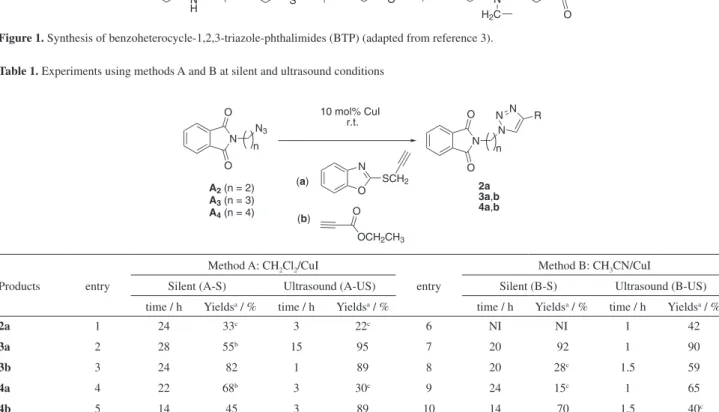
In our continuous effort to find new reaction conditions, we applied ultrasound energy in our previously related procedure to prepare 1,2,3-triazole phthalimides via 1,3-dipolar cycloaddition.3 We described the synthesis of benzoheterocycle-1,2,3-triazole-phthalimide (BTP) from phthalimidopropyl-azide or phthalimidobutyl-azide at conventional condition (CH2Cl2/CuI in absence of base or ligand); the reaction occurred within 24 h in moderate-to-good yields of 55-84% (Figure 1).
When we changed to phthalimidoethyl-azide (A2), we observed lower yields of 33% after 24 h of reaction to afford compound 2a (Table 1, entry 1). Then, the reaction was performed under ultrasound irradiation and the reaction time decreased to 3 h, but no increased yields were observed (entry 1). Furthermore, we broadened our options using phthalimidopropyl-azide (A3) or phthalimidobutyl-azide (A4) as substrates, and yet non-homogeneous results were found (Table 1, entries 2-5).
Now, in order to improve our results (yields and reaction time), we focused our endeavor on using a polar solvent, namely acetonitrile. Albeit our effort, we observed a wide yield range between 15-92% in 14-24 h at stirring conditions and room temperature (30 oC) (Table 1, entries 7-10, silent condition). On the other hand, when ultrasound irradiation was applied at short times (1-1.5 h), some results were improved (entries 8 and 9), but the reactions showed a wide yield range (40 to 90%, Table 1, entries 6-10, ultrasound condition). The literature describes that CH3CN has a high affinity for copper-(I) and therefore can inhibit the reaction, requiring the addition of an amine as ligand.9 Thus, when we carried out an experiment using CH3CN, CuI, Ultrasound and Et3N (Method C) over 2 h to prepare 3b, we observed only 36 % of 3b after column chromatography.
Our methodologies (Method A, B and C), so far, showed variable results even after ultrasound irradiation. As an attempt to reach more consistent results, we replaced MeCN by DMF, as a solvent with high dielectric constant.
Table 1. Experiments using methods A and B at silent and ultrasound conditions
N O
O N3
n
10 mol% CuI r.t.
A2(n = 2) A3(n = 3) A4(n = 4)
N O
O N
n N N
2a 3a,b 4a,b O
OCH2CH3 (b)
O N
SCH2 (a)
R
Products entry
Method A: CH2Cl2/CuI
entry
Method B: CH3CN/CuI
Silent (A-S) Ultrasound (A-US) Silent (B-S) Ultrasound (B-US) time / h Yieldsa / % time / h Yieldsa / % time / h Yieldsa / % time / h Yieldsa / %
2a 1 24 33c 3 22c 6 NI NI 1 42
3a 2 28 55b 15 95 7 20 92 1 90
3b 3 24 82 1 89 8 20 28c 1.5 59
4a 4 22 68b 3 30c 9 24 15c 1 65
4b 5 14 45 3 89 10 14 70 1.5 40c aYields after column chromatography; bdata from reference 3; NI = not investigated; cstarting material was observed.
N H N
SCH2
S N
SCH2
O N
SCH2
N N
H2C
N O
O CH2 R =
(n =3,4) N O
O N
n N
N R
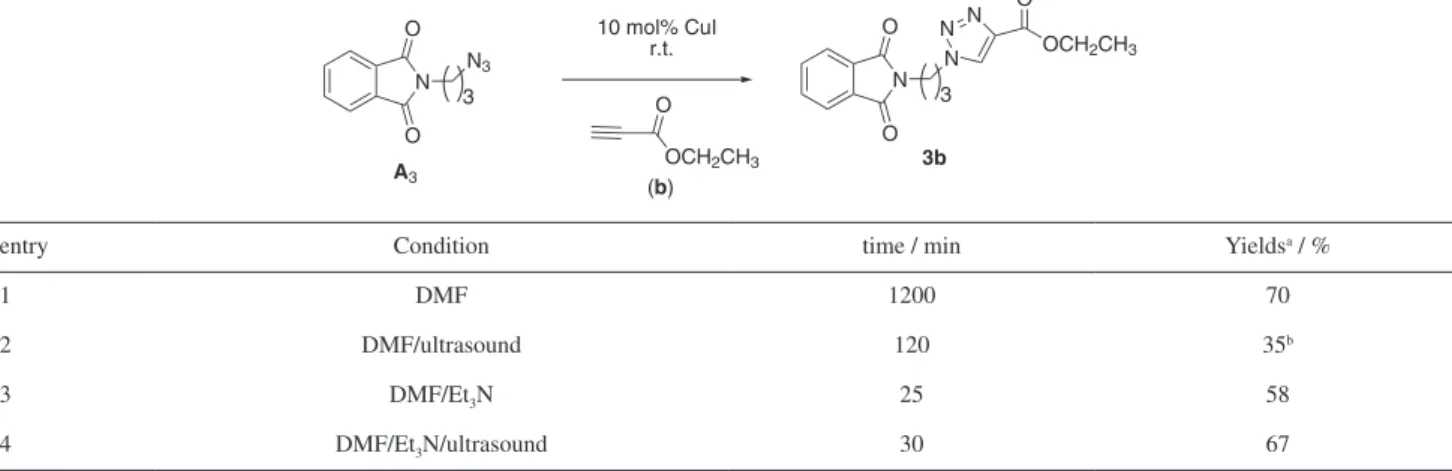
We studied the reaction between (A3) and (b) to afford compound 3b and the results are summarized in Table 2.
We found that using only DMF, compound 3b was obtained in 70% yield after 20 h of reaction, with some variation in our template reaction (Table 2, entry 1). In order to accelerate the reaction, we applied ultrasound irradiation and the reactions proceed in 2 h to yield 35% of 3b and the starting material was recovered in 28% (entry 2). When we used DMF and added 10 mol% of Et3N, the reaction occurred after 25 min in a moderate yield of 58% (entry 3).
As a step forward to improving our methodology, we evaluated the reaction under ultrasound conditions in 30 min to afford 3b in 67% yield (entry 4). With these experiments, we concluded that the independent use of DMF and ultrasound (entry 2) or DMF and Et3N (entry 3) has not sufficiently improved the results. To rationalize this fact, we believe in a synergistic effect between basic
catalyst Et3N and ultrasound energy, contributed to more optimized conditions (Table 2, entry 4).
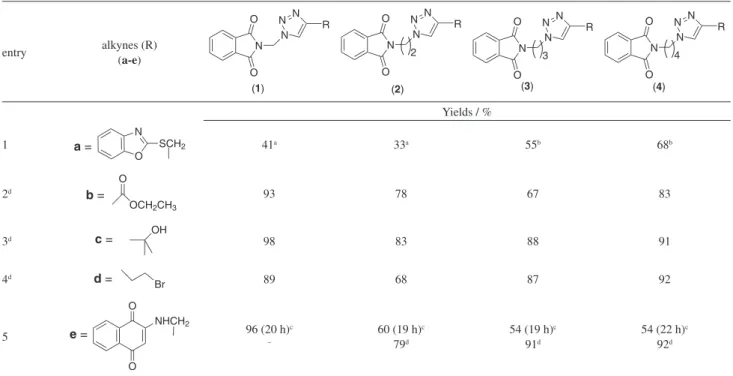
Based on these preliminary studies, we adopted the best condition, combining good yields and shorter reaction time. At first, our interests were focused on alkynes bearing the reactive functional groups ethyl propyolate (b), alcohol (c) and ethyl-bromide (d). The reaction proceeded in only 30 min showing more homogeneous results between 67 and 98% yields (Scheme 1 and Table 3, entries 2-4).
In order to investigate the synthesis of other structural scaffolds, we applied our methodology to the synthesis of 4-(2-aminomethyl-1,4-naphthoquinone)-1-(N-phthalimidoalkyl)-1,2,3-triazoles (1e-4e) from 2-(2-propyn-1-yl-amino)-1,4-naphthoquinone (e) and
N-phthalimidoalkyl-azides (A1-A4) (Table 3, entry 5). We started employing our previous conditions used for the synthesis of 2-(1H-1,2,3-triazole)-1,4-naphthoquinone derivatives.10 The use of CH
3CN and CuI at room
Table 2. Experiments to synthesis of 3b using DMF as solvent
N O
O N3
3
10 mol% CuI r.t.
A3
N O
O N
3 N N
3b O
OCH2CH3 (b)
O
OCH2CH3
entry Condition time / min Yieldsa / %
1 DMF 1200 70
2 DMF/ultrasound 120 35b
3 DMF/Et3N 25 58
4 DMF/Et3N/ultrasound 30 67
aYields after column chromatography; bstarting materials were recovered.
N O
O N3
n
R CuI/Et3N/DMF r.t.
a-e
A1 (n = 1)
A2(n = 2)
A3 (n = 3)
A4 (n = 4)
N O
O N
n N N
O N
SCH2
(a)
O
OCH2CH3
(b) R =
OH (c)
Br
(d)
1a-e 2a-e 3a-e 4a-e
O
O
NHCH2
(e) R
Table 3. Synthesis of N-substituted phthalimidoalkyl 1H-1,2,3-triazoles
entry alkynes (R) (a-e)
N O
O N
N N
(1)
R
N O
O N
2 N N
(2)
R
N O
O N
3 N N
(3)
R
N O
O N
4 N N
(4)
R
Yields / %
1 SCH2
N
O
a = 41a 33a 55b 68b
2d b =
O
OCH2CH3
93 78 67 83
3d c = OH 98 83 88 91
4d d =
Br 89 68 87 92
5 e =
O
O
NHCH2
96 (20 h)c –
60 (19 h)c
79d
54 (19 h)c
91d
54 (22 h)c
92d
aThese compounds were obtained using CH
2Cl2/CuI (method A-S); bdata from literature3 (method A-S); cCH3CN/CuI/r.t (method B-S); dmethod D: DMF/
Et3N/CuI/ultrasound/30 min.
temperature (method B/silent condition), furnished 1e
in excellent yield of 96%. However, for the synthesis of compounds 2e, 3e and 4e, moderate yields (54-60%) were obtained in approximately 20 h of reaction. With those results in hands, we used the protocol developed in this work (method D: DMF/Et3N/CuI/ultrasound/30 min), to obtain (2e-4e) in good to excellent yields of 79-92% (Table 3, entry 5).
2-Amino-1,4-naphthoquinone derivatives are a versatile class of molecules.19 In this work, we described for the first time the heterocyclic N-substituted phthalimidoalkyl-1,2,3-triazole appending 2-aminomethyl-1,4-naphthoquinone; we named this new class of compounds as ANTP (amino-naphthoquinone-triazole-phthalimide) and they will be the object of studies in the future.
The structures of compounds (1-4, a-e) were assigned on the basis of their 1H and 13C NMR, and elemental analysis. 1H NMR spectra of compounds (1-4) confirm click condensation reaction by the presence of a singlet, generally between 7.5 and 8.6 ppm, corresponding to the hydrogen of the triazole ring. The results are also consistent with the conjugation of a phthalimide-alkyl moiety with substituted terminal alkynes. The phthalimide group was well characterized in the aromatic region in d 7.6-7.9 ppm as second-order multiplets. The homologous series (CH2)n showed the side chain as one singlet (when n = 1); two triplets with respect to NCH2 (n = 2); two triplets and
one quintet when n = 3; and two triplets (NCH2) and two quintets for n = 4. The 13C NMR spectra of the compounds (1-4) confirmed the presence of conjugated products and aliphatic carbons were noticed at a region down to d 67 ppm corresponding to methylene groups. Aromatic and other aliphatic groups were also characterized.
Experimental
All commercially available reagents (Sigma-Aldrich) were used as received. All organic solvents (Vetec-Brazil) used for the synthesis were of analytical grade. Column chromatography was performed on Merck (Darmstadt, Germany) silica gel 60 (70-230 mesh). All reactions were monitored by TLC silica gel 60GF254 (Merck, Darmstadt, Germany) analysis containing GF254.
1H and 13C NMR
Conclusions
We have developed a practical and efficient click procedure for the preparation of a molecular library of 18 new N-phthalimidoalkyl 1H-1,2,3-triazoles (1-4) in good-to-excellent yields. The best results were obtained using DMF, CuI and Et3N under ultrasound irradiation during 30 min at room temperature. Ultrasound irradiation combined with click chemistry promoted the synthesis of a variety of functional groups containing a branched-chain phthalimide linked to 1,2,3-triazole, and this can be a starting point for drug designing through different scaffolds.
Supplementary Information
Supplementary information (spectral data and Figures containing 1H and 13C NMR) is available, free of charge, at http://jbcs.sbq.org.br as a PDF file.
Acknowledgments
The authors are grateful to FACEPE (PRONEM 1232.1.06/10) and CNPq (Brazil) for financial support and a research fellowship. Our thanks are also due to Analytical Centers CENAPESQ-UFRPE and DQF-UFPE. We also thank Professor Patrícia L. B. Araujo (DCM-UFRPE) for her kind suggestions.
References
1. Nogrady, T.; Weaver, D. F.; Medicinal Chemistry: A Molecular and Biochemical Approach, 3rd ed.; Oxford University Press:
New York, 2005.
2. Sharma, U.; Kumar, P.; Kumar, N.; Singh, B.; Mini-Rev. Med. Chem. 2010, 10, 678.
3. Barbosa, F. C. G.; de Oliveira, R. N.; J. Braz. Chem. Soc.2011,
22, 592.
4. Neves Filho, R. A. W.; Palm-Forster, M. A. T.; de Oliveira, R. N.;
Synth. Commun., in press, DOI: 10.1080/00397911.2011.651677.
5. Agalave, S. G.; Maujan, S. R.; Pore, V. S.; Chem. Asian J.2011,
6, 2696.
6. Dedola, S.; Nepogodiev, S. A.; Field, R. A.; Org. Biomol. Chem.
2007, 5, 1006; Liang, L.; Astruc, D.; Coord. Chem. Rev. 2011,
255, 2933.
7. Tornoe, C. W.; Christensen, C.; Meldal, M.; J. Org. Chem. 2002,
67, 3037.
8. Rostovtsev, V. V.; Green, L. G.; Fokin, V. V.; Sharpless, K. B.;
Angew. Chem., Int. Ed. 2002, 41, 2596.
9. Meldal, M.; Tornoe, C. W.; Chem Rev. 2008, 108, 2952. 10. Nascimento, W. S.; Camara, C. A.; de Oliveira, R. N.; Synthesis
2011, 20, 3220.
11. Shao, C.; Wang, X.; Xu, J.; Zhao, J.; Zhang, Q.; Hu, Y.; J. Org. Chem.2010, 75, 7002.
12. Barros, C. J. P.; de Freitas, J. J. R.; de Oliveira, R. N.; de Freitas Filho, J. R.; J. Chil. Chem. Soc. 2011, 56, 610; Cintas, P.; Palmisano, G.; Cravoto, G.; Ultrason. Sonochem.
2011, 18, 836.
13. Dadhania, A. N.; Patel, V. K.; Raval, D. K.; J. Braz. Chem. Soc.
2011, 22, 511; Franco, C. F. J.; Jordão, A. K.; Ferreira, V. F.; Pinto, A. C.; de Souza, M. C. B. V.; Resende, J. A. L. C.; Cunha, A. C.; J. Braz. Chem. Soc.2011, 22, 187.
14. Duarte, A.; Cunico, W.; Pereira, C. M. P.; Flores, A. F. C.; Freitag, R. A.; Ultrason. Sonochem.2010, 17, 281.
15. Li, J. T.; Meng, X. T.; Zhai, X. L.; Ultrason. Sonochem.2009,
16, 590.
16. Sreedhar, B.; Reddy, P. S.; Synth. Commun.2007, 37, 805. 17. Jiang, Y.; Chen, X.; Qu, L.; Wang, J.; Yuan, J.; Chen, S.; Li, X.;
Qu, C.; Ultrason. Sonochem.2011, 18, 527.
18. da Silva Jr., E. N.; de Melo, I. M. M.; Diogo, E. B. T.; Costa, V. A.; de Souza Filho, J. D.; Valença, W. O.; Camara, C. A.; de Oliveira, R. N.; Araújo, A. S.; Emery, F. S.; Santos, M. R.; Simone, C. A.; Menna-Barreto, R. F. S.; Castro, S. L.; Eur. J. Med. Chem.2012, 52, 304.
19. Mathew, N.; Karunan, T.; Srinivasan, L.; Muthuswamy, K.;
Drug Dev. Res.2010, 71, 188.
Submitted: May 25, 2012