Brazilian Journal of Physics, vol. 37, no. 4, December, 2007 1269
First-Principles Study of the Ferromagnetic and Semiconductor
Properties of [Mn(4,4
′-bipy)( N
3
)
2]
nJ.W. Li1, G.Y. Gao2, and F. Jia3
1 Department of Physics, Nanchang Institute of Technology, Nanchang 330099, China 2Department of Physics, Huazhong University of Science and Technology, Wuhan 430074, China
3Department of Physics, Jiangxi Normal University, Nanchang 330022, China
Received on 11 September, 2007
Based on density functional theory, the full potential linearized augmented plane wave (FPLAPW) method is applied to study the electronic structure and the magnetic properties of the compound [Mn(4,4′-bipy)(N
3)2]n. The density of states, the spin magnetic moment and the electronic band structure are calculated. The results indicate that the compound has ferromagnetic and semiconductor properties. It is found that there is hybridiza-tion between the d orbital of the central Mn atom and the p orbital of the N atom, and that there exists a spin delocalization from the Mn atom towards the N atoms of the EE-azide groups. Through the EE-azide bridges, the spin delocalization makes the neighboring Mn atoms having a dominant ferromagnetic interaction. The
magnetic moment 5.0µBper molecule mainly comes from Mn ion with little contribution from the EE-azide
groups.
Keywords: FPLAPW; Electronic structure; Ferromagnetic; Semiconductor
I. INTRODUCTION
In the past decades, the molecular-based magnetic materi-als with paramagnetic metal ions, where the bridging ligands act as a super-exchange pathway between the metal centers, have been considerably studied both experimentally and theo-retically, and some new materials have also been synthesized [1-5]. Recently the investigation of organic magnetic materi-als containing only light elements, typically C, H, O, N and S, has been drawn more and more attention [6-11]. Pure or-ganic magnetic materials have free radicals, which can sup-ply the magnetic moment, but generally their transition tem-peratures are too low for practical applications. The synthe-sis of the molecular-based ferromagnet with metallic ions has attracted an extensive interest. The solid-state assembly of metal-organic polymers has also the potential applications in nonlinear optics, magnetism and molecular recognition.
The compound [Mn(4,4′-bipy)(N
3)2]nconsists of a 3D net-work in which Mn(II) cations are octahedrally coordinated to six N-atoms: four of them corresponding to single EE azides, on the equatorial positions, and two of them to 4,4′-bipy lig-ands, on the axial ones [12,13]. The structure is rather com-plex as the six ligands connected to each metal ion perform as intermetallic bridges. The pseudohalide ligands provide a tetrahedral topology around Mn(II) cations resulting in an azide-linked diamondoid network, which have been recog-nized as potential structural motifs for the construction of acentric solids. The singularity of the compound lies on the absence of a center of symmetry that is a requirement for many bulk properties of solid materials. The structure of the compound [Mn(4,4′-bipy)(N
3)2]n with atom numbering scheme is shown in Fig. 1. According to the susceptibility measurement in experiment, the present complex is ferromag-netic at low temperatures [13].
In order to understand well the magnetic and electronic properties of the compound [Mn(4,4′-bipy)(N
3)2]n, in the present paper, we report our accurate first-principles
calcu-FIG. 1: ORTEP diagram of [Mn(4,4′-bipy)(N3)2]nwith atom num-bering scheme showing 50% probability ellipsoids [14].
lations. To our knowledge this is the first attempt based on molecular entity for this compound theoretically. The main points of such work are to investigate the electronic struc-ture, the magnetic coupling, and to analyze the propagation of the observed ferromagnetic interaction via the density of states (DOS) and the electronic band structure. This provides new insights into the origin of the ferromagnetic coupling in the compound which should be useful for the design of novel molecular-based ferromagnet with metallic ions. Our results show that there exists a dominant ferromagnetic interaction arises from the EE-azide groups part of the compound. In ad-dition, we find that the spin magnetic moment mainly comes from Mn ion, and there are smaller positive spin populations on the EE-azide groups. This paper is organized as follows. In Section 2 we present the computational method. Section 3 is devoted to the results and discussions. Finally, we summarize the results in Section 4.
II. COMPUTATIONAL METHODS
1270 J.W. Li, G.Y. Gao, and F. Jia
most accurate band structure methods presently available and has been applied to materials simulation successfully. In this method, no shape approximation is used for either the poten-tial or the electronic charge density. We use the wien2k [14] package that allows inclusion of local orbitals in the basis, which upon linearization improves and makes possible a con-sistent treatment of semi-core and valence in one energy win-dow. In general, the local density approximation (LDA) and the generalized gradient approximation (GGA) can be cho-sen in wien2k code. Considering the success of the GGA de-rived from their ability to correct some LDA deficiencies with a modest increase in computational workload, the GGA is mandatory for systems containing “weak” or hydrogen bonds such as molecular crystals; for these systems the intermolecu-lar bond lengths are severely underestimated in LDA, but they can be appreciably improved in GGA. In addition, the GGA has been demonstrated to be capable of calculating organic magnets [15]. So in our calculations, the exchange and corre-lation effects are treated with the GGA according to Perdew et al [16].
FIG. 2: ORTEP labeled primitive cell for [Mn(4,4′-bipy)(N
3)2]n.
(For clarity we only label the hydrogen atom in part.)
The compound [Mn(4,4′-bipy)(N
3)2]n crystallizes in the tetragonal system, space group is P43212. There are four molecules in one primitive cell, as shown in Fig. 2. For clear view, we only label the hydrogen atom in part. The structure parameters of the compound are a=8.229(2) ˚A, b=8.229(2) ˚A, c=16.915(7) ˚A,α=β=γ=90o. The atomic-sphere radiiRmt are chosen as 2.18, 1.08, 1.13 and 0.61 a.u. for Mn, N, C and H, respectively. We set the charge density Fourier ex-pansion up to l=10 and the charge density Fourier exex-pansion cutoffGmax=14 in the muffintins. One hundredk-points in the first Brillouin zone are adopted in the calculations. The plane wave cutoff energy is 146 eV. In order to achieve a satisfac-tory degree of convergence, the cutoff parameter is taken to be RmtKmax=2.0, whereKmax is the maximal value of the recip-rocal lattice vector used in the plane wave expansion, andRmt is the smallest atomic sphere radius in the unit cell. The self-consistency calculations are considered to be converged only when the energy difference between input and output energy is less than 10−4Ryd per formula unit.
III. RESULTS AND DISCUSSION
In order to study the electronic structure and the magnetic properties of [Mn(4,4′-bipy)(N
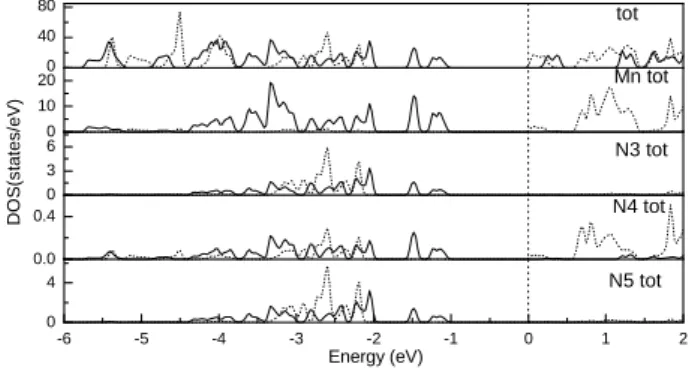
3)2]n, the total DOS of the molecule, the total DOS of Mn, N3, N4, N5 are calculated as shown in Fig. 3. Because the DOS distribution near the Fermi level determines the magnetic properties, we concentrate our attention on the DOS distribution from -6 to 2 eV. In the vicin-ity of the Fermi level, we find that the total DOS distribution of the up- and down-spin electrons is obviously split. These energy bands are decomposed into two subbands: one is the up-spin valence band; the other is the down-spin band. Thus the ordered spin arrangement of electrons is formed by the exchange correlation of electrons, which provides the static magnetic moment of this compound. According to the DOS distribution, it is worthwhile to note that the main origin of magnetism is provided by Mn atom, in addition, the N3, N4 and N5 atoms also contribute to the spin magnetic moment, and the net spin of Mn is parallel to those of N3, N4 and N5. These phenomena play an important role in the indirect interaction between Mn(II) ions, which implies that the four EE-azide ligands act as super-exchange pathway. It is more interesting that near the Fermi level, the top of the occupied spin-up band is 1.0 eV below the Fermi level. There is an en-ergy gap of 1.17 eV between the spin-up occupied subband and the up unoccupied subband. While the total spin-down DOS is above the Fermi level. So the compound has semiconductor properties.
-6 -5 -4 -3 -2 -1 0 1 2
0 4
Energy (eV)
N5 tot
0.0
0.4 N4 tot
0 3 6
DO
S
(s
tat
es/
e
V
)
N3 tot
0 10
200 Mn tot
40
80 tot
FIG. 3: DOS of the molecule and Mn, N3, N4, N5 atoms (solid: spin-up states; dotted: spin-down states. The Fermi level is located at 0 eV).
Brazilian Journal of Physics, vol. 37, no. 4, December, 2007 1271
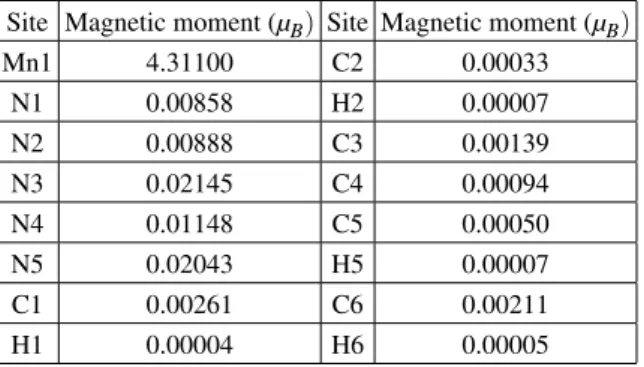
TABLE I: Atomic spin magnetic moments of [Mn(4,4′-bipy)(N
3)2]n
Site Magnetic moment (µB) Site Magnetic moment (µB)
Mn1 4.31100 C2 0.00033
N1 0.00858 H2 0.00007
N2 0.00888 C3 0.00139
N3 0.02145 C4 0.00094
N4 0.01148 C5 0.00050
N5 0.02043 H5 0.00007
C1 0.00261 C6 0.00211
H1 0.00004 H6 0.00005
spin delocalization from the Mn atom towards the two 4,4′ -bipy ligands is weak. That is to say, the ferromagnetic in-teraction mainly arises from the four EE-azide bridges. In the present calculations, the spin magnetic moment of the unit cell is 20.004µB. Because there are four molecules in one primi-tive cell, the spontaneous magnetic moment of the molecule is about 5.001µBper molecule. The Mn2+ion with 3d5has five unpaired electron, therefore our calculations is reasonable. In the FPLAPW method, the unit cell is divided into two parts: (1) non-overlapping atomic spheres (centered at the atomic sites) and (2) an interstitial region. The magnetic moments of atoms add up to a saturation moment of 4.390µBper molecule, and the interstitial moment yields the remaining 0.699µBper molecule.
-6 -5 -4 -3 -2 -1 0 1 2
0.0 0.3 0.6
Energy (eV)
p.N5 0.00
0.04
DO
S
(
s
ta
te
s
/eV
)
p.N4 0.0
0.3
0.6 p.N3
0 2 4 6
d.Mn
FIG. 4: The calculated partial density of states (PDOS) for Mn, N3, N4, N5 atoms (solid: spin-up states; dotted: spin-down states. The Fermi level is located at 0 eV).
To exploit the mechanism of the magnetic interactions in Mn(4,4′-bipy)(N
3)2]n, the partial density of states of Mn d, N3 p, N4 P and N5 p is shown in Fig. 4. It is quite obvious that the total atomic DOS comes nearly only from d orbitals of Mn and p orbitals of N3, N4, N5 in the energy range. In addition, the partial DOS of Mn d, N3 p, N4 P and N5 p below the Fermi level have similar peaks and character, which indicates that there exist hybridizations between Mn d and N3 p, N4 P and N5 p. It is worthwhile to say that the hybridizations reveals two points: (i) the four orbitals are strongly mixed over the energy region which means the N3 P orbital, N4 P orbital and the N5 P orbital are responsible for the magnetic coupling in
FIG. 5: Electronic bands of [Mn(4,4′-bipy)(N
3)2]n along selected symmetry lines within the first Brillouin zone. The horizontal solid line denotes the Fermi level. The solid lines denote the spin-up tronic band structure. The dotted lines denote the spin-down elec-tronic band structure.
the molecule, and the strong overlap of the magnetic orbitals below the Fermi level between Mn and the four EE-azide lig-ands that link the manganese centers indicates the contribu-tion of the super-exchange interaccontribu-tion to the magnetism and (ii) the net spin of Mn d is parallel to those of N3 p, N4 P and N5 p, so the ordered spin arrangement is formed by the super-exchange interaction.
For further consideration, we also give the electronic band structure in Fig. 5 (solid line is the spin-up electronic band; dashed line is the spin-down electronic band). As shown in Fig. 5, the spin-up electronic bands are below the Fermi level, but the spin-down electronic bands are above the Fermi level. This means that there exists a ferromagnetic interaction be-tween the molecules. Furthermore, we can see that the top of the spin-up occupied bands is 1.0 eV below the Fermi level and there is an energy gap of 1.17 eV between the spin-up occupied bands and the spin-up unoccupied bands, which im-plies that the complex has the properties of a semiconductor.
IV. CONCLUSIONS
1272 J.W. Li, G.Y. Gao, and F. Jia
Acknowledgments
We are grateful to Drs. L.Y. Hu, and J. Zhang for their
valuable discussions.
[1] J. Ribas, M. Monfort, C. Diaz, C. Bastos, and X. Solans, Inorg. Chem.33, 484 (1994).
[2] L. Deakin, M.A. Arif, and J.S. Miller, Inorg. Chem.38, 5072 (1999).
[3] A. Escuer, R. Vicente, M.A.S. Goher, and F.A. Mautner, Inorg. Chem.35, 6386 (1996).
[4] E. Bakalhassis, P. Bergerat, O. Kahn, S. Jeannin, Y. Jeanin, Y. Dromzee, and M. Guillot, Inorg. Chem.31, 625 (1992). [5] A. Escuer, R. Vicente, J. Ribas, and X. Solans, Inorg. Chem.
34, 1793 (1995).
[6] Z. Fang, Z.L. Liu, K.L. Yao, and Z.G. Li, Phys. Rev. B51, 1304 (1995).
[7] Y.F. Duan and K.L. Yao, Phys. Rev. B134, 6313 (2001). [8] W.Z. Wang, J. Chem. Phys.108, 2867 (1998).
[9] T. Sugano, S.J. Blundell, W. Hayes, and P. Day, Synth. Metals
121, 1812 (2001).
[10] S.J. Luo and K.L. Yao, J. Magnet. Magnet. Mater 257, 11
(2003).
[11] W.Z. Wang, Z.L. Liu, and K.L. Yao, Phys. Rev. B55, 12989
(1997).
[12] S. Han, J.L. Manson, J. Kim, and J.S. Miller, Inorg. Chem.39, 4182 (2000).
[13] S. Mart´ın, M.G. Barandika, L. Lezama, J.L. Pizarro, Z.E. Serna, J.I.R.D. Larramendi, M.I. Arriortua, T. Rojo, and R. Cort´es, Inorg. Chem.40, 4109(2001).
[14] P. Blaha, K. Schwarz, G.K.H. Madsen, D. Kvasnicka, J. Luitz, Wien2k, Vienna University of Technology, 2002, improved and updated Unix version of the original copyrighted Wien-code, which was published by P. Blaha, K. Schwarz, P. Sorantin, and S.B. Trickey, Comput. Phys. Commun.59, 399 (1990). [15] L. Ducase and A. Fritsh, Chem. Phys. Lett.286, 183 (1998). [16] J.P. Perdew, S. Burke, and M. Ernzerhof, Phys. Rev. Lett. 77,
![FIG. 1: ORTEP diagram of [Mn(4,4 ′ -bipy)(N 3 ) 2 ] n with atom num- num-bering scheme showing 50% probability ellipsoids [14].](https://thumb-eu.123doks.com/thumbv2/123dok_br/18982338.457505/1.892.487.823.440.579/fig-ortep-diagram-bering-scheme-showing-probability-ellipsoids.webp)