Introduction
2,4- and 3,4- Dimethoxybenzoates of Cu(II), Co(II) and Nd(III) were synthesized, their properties investigated and presented in our pre-viously published papers [1,2]. We undertook the above topic of our paper for studying the influ-ences of the -OCH3 group positions in benzene ring on the complex properties. That presention has been still a continuation of our experiments on the carboxylates with various d-and 4f– metal ions. These type of compounds have the signifi-cant positions in inorganic and bioinorganic chemistry and the again many metal cations in a great number of various biological processes especially six-membered ring system are
com-pounds of several vitamins and drugs [3,4]. Moreover, carboxylates of dand 4fion elements depending on their magnetic properties, as mag-nets, may be used in the modern branches of tech-niques and technology as electronic materials, and they have applications as precursors in superconducting ceramic and magnetic material productions. Multifunctional rigid type of car-boxylate ligands as tethers for constructions of solid phases were also exploited with diverse and unusual topologies [5].
2,4- and 3,4- Dimethoxybenzoic acids are used in various branches of techniques and tech-nology as electric materials, and for magnetic material productions [6-11]. In medicine and in pharmacy they are applied for the preparation of
www.scielo.br/eq www.ecletica.iq.unesp.br
Volume 33, número 2, 2008
Comparison of some properties of 2,3 – and
3,4 – dimethoxybenzoates of Cu(II), Co(II) and Nd(III)
aW. Ferenc*, a K. Czapla, bJ. Sarzynski , and aA. Zwolinska aFaculty of Chemistry, Maria Curie-Sklodowska University, Pl 20-031 Lublin, Poland
bInstitute of Physics, Maria Curie-Sklodowska University, Pl 20-031 Lublin, Poland * [email protected]
Abstract: The physicochemical properties of 2,4-, and 3,4- dimethoxybenzoates of Cu(II), Co(II) and Nd(III) were studied and compared to observe the -OCH3substituent positions in benzene ring on the character of complexes. The analysed compounds are crystalline hydrated or anhydrous salts with colours depending on the kind of central ions: blue for Cu(II), pink for Co(II) and violet for Nd(III) complexes. The carboxylate groups bind as monodentate, bidentate bridging or chelating and even tri-dentate ligands. Their thermal stabilities were studied in air at 293-1173K. When heated the hydrated complexes release the water molecules and form anhydrous compounds which are then decomposed to the oxides of respective metals. Their magnetic moment values were determined in the range of 76-303K. The results reveal the compounds of Nd(III) and Co(II) to be the high-spin and that of Cu(II) forms dimer. The various positions of -OCH3groups in benzene ring influence some of physicochem-ical properties of analysed compounds.
Keywords: 2,4- and 3,4- dimethoxybenzoates; thermal stability; magnetic properties.
antibiotics and various dyes. From the survey of literature it follows that there are papers on the complexes of some of rare earth elements with 2,4- and 3,4-dimethoxybenzoic acid anions and on their properties [12-17].
There is no information about the compar-ison of properties of solid of 2,4- and 3,4-dimethoxybenzoates of Cu(II), Co(II) and Nd(III). Therefore, we decided to investigate the influence of the positions of methoxy- groups in the benzene ring on such their properties having been presented in our previous papers [1,2] as: thermal stability in air, spectral characterization, X-ray powder investigations and magnetic behaviour in the range of 76 – 303K.
Experimental
The preparation of complexes were given in our previously published papers [1,2].
The carbon and hydrogen analysis was performed using a CHN 2400 Perkin-Elmer ana-lyzer. The contents of M(II) and M(III) metals were calculated from TG curves and for compar-ison also established gravimetrically [1,2].
The IR spectra of complexes were record-ed over the range of 400-4000 cm-1using M-80 spectrophotometer (Carl - Zeiss, Jena). Samples for IR spectra measurements were performed as KBr discs.
The X-ray powder diffraction were taken on a HZG-4 (Carl - Zeiss, Jena) diffractometer using Ni - filtered CuKα radiation. The measurements were made within the range 2θ= 4 - 80º by means of the Debye – Scherrer – Hull method [1,2].
The thermal stability and decomposition of Co(II), Cu(II) and Nd(III) complexes were studied in air using a Q-1500D derivatograph with Derill converter recording TG, DTG and DTA curves. The details of measurements are presented in our papers previously published [1,2].
Magnetic susceptibilities of polycrystalline samples of 2,4- and 3,4- dimethoxybenzoates of Co(II), Cu(II) and Nd(III) were measured by the Gouy method using a sensitive Cahn RM-2 elec-trobalance [1,2]. The calibrant employed was Hg[Co(SCN)4] for which the magnetic susceptibil-ity was assumed to be 8.08 ×10⁻³cm3mol-1. The
correction for diamagnetism of the constituent atoms was calculated by the use of Pascal’s con-stants [18]. Magnetic moments were calculated from the the equations (1) and (1*):
µeff= 2.83 (χM (T-θ))1/2; where θ– Weiss constant (1) µeff= 2.83 (χM (T-θ))1/2· 1.257 ×10-6 m · kg · s-2A-2 (1*)
Results and discussion
The complexes of 2,4- and 3,4-dimethoxybenzoates of Cu(II), Co(II) and Nd(III) were obtained as polycrystalline products with a metal to ligand ratio of 1:2 for divalent ions, and 1:3 for Nd(III). The general formula for 2,4-dimethoxybenzoates of Cu(II) and Co(II) is M(C9H9O4)2· nH2O, where M(II) = Cu, Co, and n=1 for Cu(II), and n=0 for Co(II). For 3,4-dimethoxybenzoates of Co(II) and Cu(II) the general formula is M(C9H9O4)2 · nH2O, where M(II)=Cu, Co, and n=2 for Cu(II), and n=0 for Co(II). 2,4- and 3,4- Dimethoxybenzoates of Nd(III) form anhydrous salts Nd(C9H9O4)3. The colours of complexes are following: for Co – pink, Cu – blue, Nd – violet [1,2,19,20].
The compounds exhibit in solid state similar IR spectra. Some of the results taken from our papers [1,2] are presented in Table 1. The bands due to the COOH group at 1670 cm-1for the 2,4- dimethoxybenzoic acid and 1700 cm-1 for the 3,4- dimethoxybenzoic acid are replaced in the spectra of the complexes by two bands: asymmetric (1628 – 1608 cm-1 for 2,4-dimethoxybenzoates and 1600 – 1590 cm-1 for 3,4- dimethoxybenzoates) and symmetric vibra-tions of COO-group (1408 – 1372 cm-1for 2,4-dimethoxybenzoates and 1420 – 1380 cm-1 for 3,4- dimethoxybenzoates), respectively [1,2,21]. The magnitudes of separation, ∆νCOO-(∆νCOO-=
∆asCOO-- ∆sCOO-) which characterize the metal – oxygen bond change in the range from 220 – 208 cm-1 for 2,4- dimethoxybenzoates to 240 – 180 cm-1for the 3,4- dimethoxybenzoates.
Co(II) > Cu(II) > Nd(III),
which indicates that in Nd(III) complexes the M-O bonds are more covalent than those in Cu(II) and Co(II) compounds. These values are greater for 3,4-dimethoxybenzoates than those for 2,4- dimethoxybenzoates which may show the stronger covalent bonds in 2,4- dimethoxyben-zoates than in 3,4- dimethoxybendimethoxyben-zoates of those elements. The values of frequencies of M-O vibra-tion bands for Co(II) and Nd(III) 2,4- and 3,4-dimethoxybenzoates are changed in sequence: 2,4-< 3,4- , while for Cu(II) complexes they incrase in the order: 3,4- < 2,4-. These relations may indicate that the stronger M-O bonds are in the case of Co(II) and Nd(III) complexes whereas reciprocal relation is observed for Cu(II) compounds.
The IR spectra recorded for complexes show that for 2,4- and 3,4- dimethoxybenzoates of Cu(II), Co(II) and Nd(III) there is only one band of asymmetrical COO-group vibrations but in the case of symmetrical COO- group vibration bands only
one is observed for 2,4- and 3,4-dimethoxyben-zoates of Cu(II) and 2,4-dimethoxyben3,4-dimethoxyben-zoates of Co(II) and Nd(III). In the IR spectra of 3,4-dimethoxybenzoates of Co(II) and Nd(III) there are two bands of symmetrical COO-group vibrations, which indicates the various dentates of carboxylate groups in the analysed complexes.
According to the spectroscopic criteria [1,2,21,22] the carboxylate ions appear to be monodentate, bidentate bridging or chelating and tridentate groups. All details connected with the estimations of their dentates are presented in our previously published papers [1,2].
The analysis of the diffractograms of the complexes suggests them to be polycrystalline compounds with different structures [1,2,23].
The thermal stability of analysed dimethoxy-benzoates of Co(II), Cu(II) and Nd(III) was studied in air in the range of 293 – 1173K (Table 2). When heated to 1173K the Cu(II) compounds are dehy-drated in one step and form anhydrous complexes that next are decomposed to CuO [1,2].
Table 1. Frequencies of the absorption of COO- and M-O group vibrations for 2,4- and 3,4–dimethoxybenzoates of Co(II), Cu(II), Nd(III), Na(I), and of the COOH band in 2,4- and 3,4–dimethoxybenzoic acid [1,2].
The dehydration process is connected with endo–effect while the combustion of the organic ligands with exothermic one. From the values of temperature at which the dehydration process occurs and from the way in which it pro-ceeds, it is possible to assume that the water mol-ecules are in the outer coordination sphere of these complexes [1,2,24-26].
From the comparison of thermal stability values of 2,4- and 3,4-dimethoxybenzoates of Cu(II) it appears that 2,4- dimethoxybenzoate is more thermally stable complex than that of 3,4-dimethoxybenzoate. It is connected with the vari-ous influence of mesomeric, inductive or steric effects on the electron density in the analysed com-pound molecule. During heating in air to 1173K the anhydrous cobalt(II) 2,4- dimethoxybenzoates decompose directly to Co3O4(Fig.1). The obtained results reveal them to have the similar stability (Table 2). The complexes of Nd(III) with 2,4- and 3,4- dimethoxybenzoic acid anions decompose in two steps. In the range of 495-685K they form the oxycarbonates that next are ultimately decomposed (983-1010K) to Nd2O3[1,2]. The final products of the complex decompositions were identified by
X-ray powder diffraction measurements. From the Figura 1. dimethoxybenzoates of Co(II).TG, DTG and DTA curves of 2,4- and 3,4-Table 2. Temperature ranges of thermal stbility of Nd(III), Co(II), and Cu(II) 2,4- and 3,4-dimethoxyben-zoates in air [1,2].
∆T1= temperature range of dehydration process; n= number of crystallization water molecules lost in one endothermic step; ∆T2= temperature range of decomposition of anhydrous complex; ∆T3= temperature range of decomposition of Nd(III) oxycarbonate; IDP= Intermediate decomposition product
follows that 2,4- dimethoxybenzoate of Cu(II) is less thermally stable compared to that of 3,4-dimethoxybenzoate.
In the series of 2,4- and 3,4- dimethoxy-benzoates of Cu(II) and Co(II) it appears that the complexes with Co(II) are more thermally stable than those with Cu(II).
The differences in the presented values show that there is the various influences of induc-tive, mesomeric and steric effects on the analysed properties of complexes.
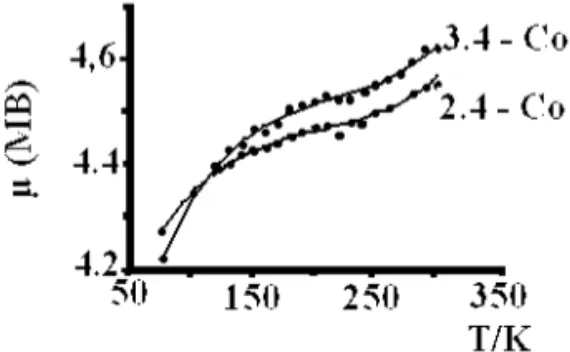
The magnetic susceptibility of analysed dimethoxybenzoates was measured over the range of 76–303K [1,2]. The complexes of Co(II) and Nd(III) with both ligands obey the Curie–Weiss law, suggesting a weak ferromagnetic interaction. The magnetic moment values experimentally determined for Co(II) and Nd(III) 2,4- and 3,4-dimethoxybenzoates change from 4,27µB to 4,55µBfor 2,4- dimthoxybenzoate of Co(II), from 4,22µB to 4,61µB for 3,4- dimethoxybenzoate of Co(II) (Fig. 2), from 2,89µB to 3,21µB for 2,4-dimthoxybenzoate of Nd(III) and from 2,69µBto 3,15µBfor 3,4- dimethoxybenzoate of Nd(III) (Fig. 3). These values are very close to the spin only ones for the 2,4- and 3,4- dimethoxybenzoates of Co(II) calculated from the equation µeff= [4s ( s + 1)]1/2 in the absence of the magnetic interactions for the present spin system. The theoretical mag-netic moment value at 293K for Co(II) ion is equal to 3.88 µB. The experimental data suggest that the compound of Co(II) seems to be high – spin com-plexes with probably weak ligand field [1,2 ]. The values of µeffdetermined for Nd3+in the range of 76 – 303K are close to those calculated for Nd(III) ion by Hund (3.62µB), and van Vleck (3.68 µB) [27]. This may probably also result from the pres-ence of superexchange magnetic interactions between paramagnetic centers of different mole-cules of the complexes in the crystal lattice. The 4f electrons causing its paramagnetism are well pro-tected from outside influences and do not partici-pate in the formation of the Nd – O bond.
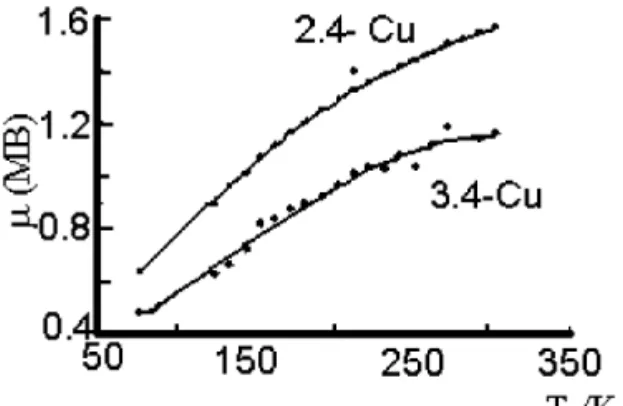
The magnetic susceptibility values of 2,4-and 3,4- dimethoxybenzoates of Cu(II) incrase with rising temperature suggesting a weak anti-ferromagnetic interaction. The magnetic moment experimentally determined change from 0,49µB (at 76K) to 1,17µB(at 303K) for 3,4-
dimethoxy-Figura 2. Relationship between µνs T for 2,4- and 3,4-dimethoxybenzoates of Co(II).
benzoates of Cu(II) and 0,64µB (at 76K) to 1,57µB(at 303K) for 2,4- dimethoxybenzoates of Cu(II) (Fig. 4). These values are lower than the d9 spin-only magnetic moment ∆eff=1,73µB. Such dependence is a typical behaviour for copper dimer [1,2,27,28]. Magnetic susceptibility meas-urements revealed the χ=f(T) relation course to be typical for copper(II) carboxylates, where the paramagnetic centers are antiferromagnetically coupled. Magnetic susceptibility is the highest at room temperature and decreases with the temper-ature lowering. This is related to the occupation of the triplet and singlet states. Occupation of the energetically lower singlet state increases with the temperature lowering [1,2,27,28-30].
[2] W.Ferenc, K.Czapla, J.Sarzynski, and A.Zwolinska Ecl. Quim., São Paolo, 32(4) (2007) 27.
[3] S.C. Mojumdar, D.Hudecová, and M.Melnik, Pol. J. Chem., 73 (1999) 759.
[4] M.Mc Cann, J.F.Cronin, and M.Devereux, Polyhedron, 17 (1995) 2327.
[5] S. Cevik, M.Poyraz, M.Sara, O. Buyukbjungor, J. Chem. Crystallgr. 37(2007)497.
[6] Al-Afaleq, J. Eljazi, and A.Samar, Synth. Commun., 29 (1999) 1965.
[7] R.P.Dunlap, N.W. Boaz, and A.J. Mura, U.S. US 5., 512, 589, 30Apr(1996).
[8] O.Cabaliero, and R. Cela, J. Microcolumn. Sep.,VI, 8 (1996) 231.
[9] P.Barraclough, J.W. Black, and D. Cambridge, Eur. J. Med. Chem., 27 (1997) 207.
[10] A.G.Pinkus, J.A.Kautz, and Pallavi Ahobila-Vajjula, Chem.Cryst., 32, 5(2002).
[11] V.Lattanzio, D.Di Venere, V.Linsalota, G.Lima, A.Lippalito, and M. Saleno, Postharvest Biology and Technology, 9, 325(1999).
[12] W.Ferenc, and A.Walków-Dziewulska, Collect. Czech. Chem. Commun. 65, 179(2000).
[13] W.Ferenc, and A.Walków-Dziewulska, J. Therm. Anal. Cal., 61, 923 (2000).
[14] W.Ferenc, and A.Walków-Dziewulska, J. Serb. Chem. Soc., 65 (2000) 27.
[15] W.Ferenc, and A.Walków-Dziewulska, J. Therm. Anal. Cal., 63 (2001) 865.
[16] W.Ferenc, and A.Walków-Dziewulska, J. Serb. Chem. Soc., 65 (2000) 789.
[17] W. Ferenc, and A.Walków-Dziewulska, J. Therm. Anal. Cal., 70 (2002) 949.
[18] E.König, Magnetic Praperties of Coordination and Organometallic Transition Metal Compounds, Berlin, 1966. [19] W.Ferenc, B.Bocian, and J.Sarzynski, J. Therm. Anal. Cal., 84, 377(2006).
[20] W.Ferenc, B. Cristovão, B. Mazurek, and J. Sarzynski, Chem. Pap., 59, 207(2006).
[21] K.Nakamoto, Infrared and Ramana Spectra of Inorganic and Coordination Compounds, John-Wiley and Sons, New Jork, 1997.
[22] B.S.Manhas, and A.K.Trikha, J. Indian. Chem Soc., 59, 315(1982).
[23] Z.Bojarski, and E. Lagiewka, Structural X-Ray Analysis, Polish Scientific Publisher, Warsaw, 1988.
[24] A.V.Nikolaev, V.A.Logvinienko, and L.S.Myachina, Thermal Analysis, Vol.2, Academic Press, New York, 1969. [25] B.Singh, V.Agarwala, P.L.Mourya, and A.K.Dey, J. Indian. Chem. Soc., 59(1992)1130.
[26] K.Burger, Coordinatrion Chemistry: Experimental Methods, Akademià Kiadó, Budapest, 1973.
[27] J. Mrozinski, M.Janik, and T. Nowakowski, Zeszyty Naukowe Politechniki Slaskiej,119 (1988) 125(in Polish). [28] A.Earnshaw, Introduction to Magnetochemistry, Academic Press, London, 1956.
[29] O’Connor, Progress in Inorganic Chemistry, Wiley, New York, 1982.
[30] A. Keetle, Inorganic Physical Chemistry, Polish Scientific Publisher, Warsaw, 1999.
∆effcalculated for the complexes in the range of 76-303K reveal the 2,4- dimethoxybenzoates of Cu(II) and Nd(III) to have the stronger paramagnetic properties than those for 3,4- dimethoxybenzoates. 3,4- Dimethoxybenzoate of Co(II) shows the greater values of magnetic moments compared to that of 2,4-dimethoxybenzoates.
Conclusions
The various positions of methoxy- groups in the benzene ring do not influence the metal : lig-and ratio, magnetic properties lig-and colours of com-plexes, but effect the magnetic moment values and the modes of the carboxylate group coordinations. These differences result from the various influence of an inductive, mesomeric and steric effects of the -OCH3substituent positions on the electron densi-ty in the benzene ring. When –OCH3group is in the ortho-position in benzene ring the steric effect is stronger than in its meta-position in which it clearly reveals the mesomeric one.
Received 25 February 2008 Accepted 10 April 2008
References
[1] W.Ferenc, K.Czapla, J.Sarzynski, Ecl. Quim., São Paolo, 32(3) (2007)7.
Figura 4. Relationship between m vs T for complex-es of Cu(II).
![Table 1. Frequencies of the absorption of COO- and M-O group vibrations for 2,4- and 3,4–dimethoxybenzoates of Co(II), Cu(II), Nd(III), Na(I), and of the COOH band in 2,4- and 3,4–dimethoxybenzoic acid [1,2].](https://thumb-eu.123doks.com/thumbv2/123dok_br/18977289.455746/3.892.200.720.137.531/table-frequencies-absorption-group-vibrations-dimethoxybenzoates-cooh-dimethoxybenzoic.webp)
![Table 2. Temperature ranges of thermal stbility of Nd(III), Co(II), and Cu(II) 2,4- and 3,4-dimethoxyben- 3,4-dimethoxyben-zoates in air [1,2].](https://thumb-eu.123doks.com/thumbv2/123dok_br/18977289.455746/4.892.91.774.123.437/table-temperature-ranges-thermal-stbility-dimethoxyben-dimethoxyben-zoates.webp)