CR Dhan 407, a high-yielding rice cultivar released for the rainfed
shallow lowland ecosystem of eastern India
P S Roy1, S S C Patnaik1*, A Patnaik1, G J N Rao1 and O N Singh1
Received 19 June 2014 Accepted 6 January 2015
Abstract – Development of high-yielding rice varieties for the rainfed shallow lowland ecosystem of eastern India is a major challenge for plant breeders. Development and release of CR Dhan 407, a high-yielding cultivar, with a potential yield of more than 5 tons per hectare and non-lodging plant type, can address the problem of yield stagnation in this major rice ecosystem of India. With its high yield and excellent grain quality, this variety can signiicantly enhance the income of rice farmers of eastern India.
Key words: Rice, breeding, variety, multi-location, ingerprinting.
Crop Breeding and Applied Biotechnology 15: 120-124, 2015 Brazilian Society of Plant Breeding. Printed in Brazil
CULTIVAR RELEASE
http://dx.doi.org/10.1590/1984-70332015v15n2c22
1 Crop Improvement Division, Central Rice Research Institute, Cuttack (753006), Odisha, India. *E-mail: [email protected]
INTRODUCTION
Rice (Oryza sativa L.), the staple food crop of millions, contributes 27 per cent of dietary energy supply, 20 per cent of dietary protein and 3 per cent of dietary fat in the Asian Diet (FAO 2002). For most rice-producing countries to attain
self-suficiency, development of high-yielding rice varieties
with consumer-preferred grain quality features and inbuilt resistance against diseases and insect pests to safeguard the environment is a prerequisite.
In India, 92% of an area of about 12 million hectares of a rainfed lowland ecosystem (Reddy et al. 2013) is dis-tributed in the eastern and northeastern states (Singh and Hossain 2000). Though eastern India comprises the largest rice-growing region of the country (58%), both production and productivity are the lowest, with an average productiv-ity of only 1.0 - 1.2 t ha-1 (Adhya et al. 2008). Since these
lowlands are rainfed, rice production suffers due to the vagaries of the monsoon rainfall and water stagnation up to
50 cm in the rice ields is a common feature (Singh 2006).
Until recently, rice cultivation in the rainfed ecosystems of eastern India was restricted to growing traditional varieties. They are characterized by tall plant types prone to lodging, unresponsive to fertilizer inputs, and generally low yielding. Hence, farmers are unable to get high economic returns. Development of improved cultivars for the rainfed shallow lowland ecosystem may lead to a quantum leap in national production and economic returns to farmers since this is
one of the major rice ecosystems in India. In developing high-yielding varieties for a target ecosystem, traits related to yield stability and sustainability are the major focus of plant breeding efforts (Fehr 1987, Falconer and Mackay 1996, Cutforth et al. 2007, Naylor 2007, Araus et al. 2008, Collard and Mackill 2008, Soares et al. 2013, Neto et al. 2013). To address problems like the low and highly unstable yields of this ecosystem, a systematic breeding approach was undertaken at the ICAR-Central Rice Research Institute, India. The present study reports the development of a high-yielding variety suitable for the rainfed shallow lowlands of eastern India using the pedigree breeding approach. MATERIAL AND METHODS
Development of breeding populations and ield evalu -ation of promising lines
The parents employed in the study were two mega-vari-eties: Swarna, a variety released (1982) for rainfed shallow lowlands of India, and IR64 [developed at the International Rice Research Institute, Manila and released in several countries, including India (1992)]. The breeding popula-tions were generated using the pedigree method (Figure 1). A total of 1080 single plants of semi-dwarf plant stature were selected from the 3,000 plants grown in the F2
genera-tion from the ifteen F1 hybrid (Swarna/IR64) plants. From
panicle type, and grain traits, and only plants/lines having a semi-dwarf plant stature and Swarna type grain were advanced. Selection was continued up to the F6 generation
until nine ixed lines with desirable features were identiied.
For the observational yield trial (OYT), thirty-day-old seedlings of the nine selected lines and the parents were
transplanted in a well-prepared ield at a 15 x 20 cm spacing
in a randomized complete block design with two replica-tions at the experimental farm of the Central Rice Research Institute (CRRI), Cuttack. The crop was moderately fertilized (N:P:K; 60:40:40 kg ha-1) and plant protection measures
were undertaken according to need. Observations were
recorded for ive plants for agronomic traits, and grain
collected from a 1 m2 area from each replication was taken
to estimate the yield.
Multi-location evaluation
The most promising recombinant line (CR 2459-12-8)
identiied from the observational yield trial was nominated
for the multi-location evaluation trials, conducted by the All India Co-ordinated Rice Improvement Programme (AICRIP), the nodal (Government) agency designated in India for the purpose of evaluating breeding lines prior to their release. The line was evaluated for three consecutive years (2010-2012) in the trials conducted in the rainfed shallow lowland ecosystem (RSL) with the designation IET 21974.
DNA ingerprinting
Genomic DNA was extracted from young rice leaves as
per Dellaporta et al. (1983). For DNA ingerprinting analysis,
rice microsatellite markers (McCouch et al. 2002, Singh et al. 2010) representing all twelve chromosomes were used. All the PCR assays were performed as described earlier for each marker, and the separated PCR products were visual-ized under UV light and photographed using a Typhoon FLA 7000 fluorescent image analyzer (GE Healthcare Bio-Sciences AB, Uppsala, Sweden).
RESULTS AND DISCUSSION
Performance
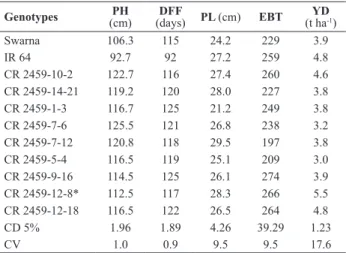
The observational yield trial (OYT), conducted with nine selected breeding lines for their agronomic
perfor-mance, resulted in identiication of two promising lines,
CR 2459-12-8 and CR 2459-12-18, and both lines out-yielded the parents (Table 1). Of the two promising lines,
CR 2459-12-8 was identiied for further evaluation as it
has the desirable grain quality traits of Swarna, the most popular rice variety in India.
Figure 1. Breeding scheme illustrating the development of IET21974 (CR 2459-12-8). MLE-Multi-location evaluation; RSL – Rainfed Shallow Lowland; IVT-Initial Evaluation Trial. AICRIP- All India Coordinated Rice Improvement Programme
Table 1. Agro-morphological features of the promising breeding lines
Genotypes PH
(cm)
DFF
(days) PL (cm) EBT
YD
(t ha-1)
Swarna 106.3 115 24.2 229 3.9
IR 64 92.7 92 27.2 259 4.8
CR 2459-10-2 122.7 116 27.4 260 4.6
CR 2459-14-21 119.2 120 28.0 227 3.8
CR 2459-1-3 116.7 125 21.2 249 3.8
CR 2459-7-6 125.5 121 26.8 238 3.2
CR 2459-7-12 120.8 118 29.5 197 3.8
CR 2459-5-4 116.5 119 25.1 209 3.0
CR 2459-9-16 114.5 125 26.1 274 3.9
CR 2459-12-8* 112.5 117 28.3 266 5.5
CR 2459-12-18 116.5 122 26.5 264 4.8
CD 5% 1.96 1.89 4.26 39.29 1.23
CV 1.0 0.9 9.5 9.5 17.6
PH- Plant height; PL- Panicle length; DFF- Days to ifty per cent lowering; EBT- Ear
Multi-location evaluation
In the irst year of testing (2010) in the multi-location
trials, IET 21974 (CR 2459-12-8) was ranked 1st among
the 42 entries, recording a mean yield of 5093 kg ha-1, and
on an overall mean yield basis, it showed 16.5%, 29.0%, and 42.3% yield superiority over the national, regional, and local control varieties, respectively (Table 2). In the state
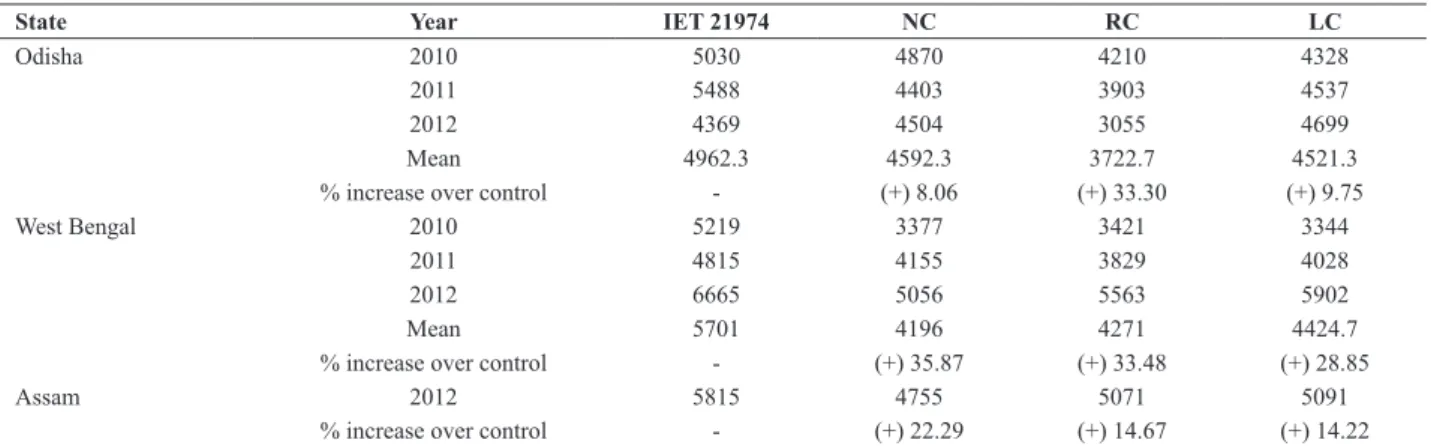
of Odisha and West Bengal, it was ranked irst, with mean
yield of 5030 kg ha-1 and 5219 kg ha-1, respectively (Table
3). In the year 2011 (2nd year), it was ranked 2nd (5024 kg
ha-1) on an overall mean basis and out-yielded the national
(24.3%), regional (32.5%), and local (13.2%) controls on an overall mean basis (Table 2). The entry IET 21974 also showed superior performance in different states like Odisha (2nd rank, 5488 kg ha-1) and West Bengal (2nd rank, 5437 kg
ha-1) and showed 20.96% and 15.87% yield superiority,
respectively, over the best control in those states (Table 3). In 2012 (third year), IET 21974 was ranked 1st (5517 kg
ha-1) on an overall basis and again surpassed the controls (Table 2). It was ranked irst in the states of West Bengal
(6665 kg ha-1) and Assam (5815 kg ha-1) (Table 3). From
the three year pooled data, IET 21974 had a mean yield of 5211 kg ha-1 and recorded 18.5% yield superiority over
the national control (Dhanrasi), 29.8% over the regional control (Swarna Sub1), and 17.4% over the local control (Directorate of Rice Research 2011, 2012, 2013).
The line IET 21974, with a plant height of 102 cm, duration of 150 days, and well-exerted compact panicles, consistently recorded superior performance and yield superiority over the controls, with a yield potential >5 t ha-1 in all three years of evaluation. It showed moderate
resistance to bacterial blight, leaf blast, white backed plant hopper and whorl maggot. This line was also found to be highly responsive to fertilizer application and responds well up to 130 kg ha-1 of N. The line CR2459-12-8 possesses
desirable grain quality features like long grain, high head rice recovery - HRR (63.6%), intermediate amylose content (23.475%), and intermediate gel consistency - GC (Table 4). Based on its overall performance in the multi-location
trials of AICRIP from 2010-2012, IET 21974 was identiied
as promising and released as CR Dhan 407 for the rainfed shallow lowland ecosystem of the states of Odisha and West Bengal in India in 2013.
DNA ingerprinting
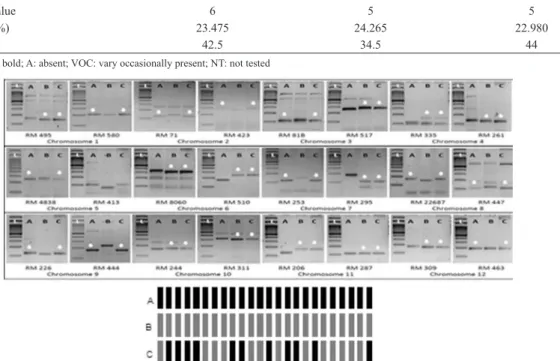
The DNA ingerprint pattern generated using twenty-four
rice polymorphic microsatellite markers suggests that allele sharing between CR 2459-12-8 and Swarna was 54.2%, while the sharing was 45.8% between CR 2459-12-8 and IR 64, thus establishing the lineage of CR 2459-12-8 with
its parents (Figure 2). The unique ingerprints of CR 2459-12-8 can be used for its easy identiication and protection
of intellectual property rights.
As only a limited number of rice varieties with good grain quality and superior grain yield potential are available for the farmers in this ecosystem of eastern India, yield gains have not yet been very extensive. In this context, the variety CR Dhan 407 can be a boon, with desirable features like semi-dwarf stature, non-lodging plant type, late maturity period, and dark green leaves that are ideal for shallow low-lands. Release of this variety is an important step towards Table 2. Performance of IET 21974 (CR 2459-12-8) in the multi-location
trials (2010-12)
Year IET 21974 NC RC LC
2010 5093 4372 (16.5) 3947 (29.0) 3578 (42.3)
2011 5024 4042 (24.3) 3792 (32.5) 4437 (13.2)
2012 5517 4780 (15.4) 4309 (28.0) 5301 (4.1)
Mean 5211.3 4398 (18.5) 4016 (29.8) 4438.7 (17.4)
NC- National control (Dhanrasi); RC- Regional control (Swarna sub 1); LC- Local control. Figures in parentheses indicate % increase of IET 21974 over the control.
Table 3. Performance of IET21974 (CR 2459-12-8) in multi-location trials: state wise (2010-2012)
State Year IET 21974 NC RC LC
Odisha 2010 5030 4870 4210 4328
2011 5488 4403 3903 4537
2012 4369 4504 3055 4699
Mean 4962.3 4592.3 3722.7 4521.3
% increase over control - (+) 8.06 (+) 33.30 (+) 9.75
West Bengal 2010 5219 3377 3421 3344
2011 4815 4155 3829 4028
2012 6665 5056 5563 5902
Mean 5701 4196 4271 4424.7
% increase over control - (+) 35.87 (+) 33.48 (+) 28.85
Assam 2012 5815 4755 5071 5091
% increase over control - (+) 22.29 (+) 14.67 (+) 14.22
achieving higher production in the rainfed shallow lowlands of India and can also help in enhancing farmers’ incomes. Due to its close similarity with the popular cultivar Swarna in terms of husk colour and grain quality traits, this new variety will be extensively adopted by farmers, millers, and consumers of the target area. This newly developed variety has the requisite potential to be an alternative to the popular varieties Swarna, Swarna Sub1, Dhanrasi, and Savitri in the shallow lowland areas of eastern India.
SEED PRODUCTION AND MAINTENANCE
The breeder seed production, and maintenance of the released rice variety CR Dhan 407 was taken up by the seed production unit of the Central Rice Research Institute, Cuttack under the supervision of the breeder involved in its development.
CONCLUSION
The yield stagnation in the shallow lowlands of eastern India can be successfully addressed with the release of CR Dhan 407, a long duration variety with semi-dwarf plant stature, high yield potential, and excellent grain and cooking quality traits. This new variety, with its high yield stability, can bring high economic returns to the farmers of
the shallow lowland ecosystem in India through signiicant
increases in rice production in the years to come.
ACKNOWLEDGEMENTS
The authors are highly grateful to the Director of the Central Rice Research Institute, Cuttack, India for providing the necessary facilities.
Table 4. Quality characteristics of IET 21974 (CR 2459-12-8)
Quality characteristics (CR 2459-12-8)IET 21974 National control(Dhanrasi) Regional control(Swarna sub 1)
Hulling % 79.65 79.45 80.2
Milling (%) 70.6 68.1 71.2
Head Rice Recovery (%) 63.6 60.25 67.7
Kernel Length (mm) 6.585 5.195 4.65
Kernel Breadth (mm) 2.215 2.445 2.47
Length/Breadth Ratio 2.965 2.315 2.47
Grain type LB SB SB
Grain Chalkiness A VOC NT
Alkali Spreading Value 6 5 5
Amylose Content (%) 23.475 24.265 22.980
Gel Consistency 42.5 34.5 44
LB-long bold; SB-short bold; A: absent; VOC: vary occasionally present; NT: not tested
Figure 2. DNA ingerprints of IET21974 (CR 2459-12-8). i. DNA ingerprints generated with different markers. L: 100bp ladder; A: Swarna; B:
IR64; C: CR 2459-12-8 (Swarna/IR64); Arrow represents allelic similarity of (CR 2459-12-8) with respective parent. ii. DNA ingerprint bar graph.
REFERENCES
Adhya TK, Singh ON, Swain P and Ghosh A (2008) Rice in eastern India: causes for low productivity and available options. Journal of Rice Research 2: 1-5.
Araus JL, Slafer GA, Royo C and Serret MD (2008) Breeding for yield potential and stress adaptation in cereals. Critical Reviews in Plant Science 27: 377-412.
Collard BCY and Mackill DJ (2008) Marker-assisted selection: an
approach for precision plant breeding in the twenty-irst century.
Philosophical Transactions of the Royal Society 363: 557-572.
Cutforth HW, Mcginn SM, Mcphee KE and Miller PR (2007) Adaptation of pulse crops to the changing climate of the Northern Great Plains.
Agronomy Journal 99: 1684-1699.
Dellaporta SL, Wood J and Hicks JB (1983) A plant DNA mini preparation: version II. Plant Molecular Biology Reporter 1: 19-21.
Directorate of Rice Research (2010) Progress report, Varietal improvement. All India Coordinated Rice Improvement Programme (ICAR), DRR, Hyderabad, AP, India 1: 1.31-1.49.
Directorate of Rice Research (2011) Progress report, Varietal improvement. All India Coordinated Rice Improvement Programme (ICAR), DRR, Hyderabad, AP, India 1: 1.61-1.65.
Directorate of Rice Research (2012) Progress report, Varietal improvement. All India Coordinated Rice Improvement Programme (ICAR), DRR, Hyderabad, AP, India 1: 1.32-1.51.
Falconer DS and Mackay TFC (1996) Introduction to quantitative genetics. Longman, Essex, 480p.
FAO (2002) Sustainable rice production for food security. In Proceedings of the 20th session of the international rice commission. FAO, Bangkok, p. 23-26.
Fehr WR (1987) Principles of cultivar development. vol. 1, Theory and
technique, Macmillian Publishing Company, New York, p. 95-105.
McCouch SR, Teytelman L, Xu Y, Lobos KB, Clare K, Walton M, Fu B, Maghirang R, Li Z, Xing Y, Zhang Q, Kono I, Yano M, Fjellstrom R, Declerck G, Schneider D, Cartinhour S, Ware D and Stein L (2002) Development and mapping of 2240 new SSR markers for rice (Oryza sativa L.). DNA Research 9: 199-207.
Naylor R (2007) The conservation of global crop genetic resources in the face of climate change. In Summary statement from a bellagio meeting. Rockefeller Foundation Conference, Bellagio, p. 3-7.
Neto AR, Gallo PB, Junior EUR, Kiihl TAM and Azzini LE (2013) IAC 203 and IAC 204: new upland rice varieties for the State of São Paulo.
Crop Breeding and Applied Biotechnology 13: 367-370. Reddy JN, Patnaik SSC, Sarkar RK, Das SR, Singh VN, Dana I, Singh
NK, Sharma RN, Ahmed T, Sharma KK, Verulkar S, Collard BCY, Pamplona AM, Singh US, Sarkarung S, Mackill DJ and Ismail AM (2013) Overview of the eastern India rainfed lowland shuttle breeding network (EIRLSBN) SABRAO. Journal of Breeding and Genetics 45: 57-66.
Singh BN (2006) Rainfed lowland rice improvement: current status in India and future strategies. Journal of Rice Research 1: 104-112.
Singh H, Deshmukh RK, Singh A, Singh AK, Gaikwad K, Sharma TR, Mohapatra T and Singh NK (2010) Highly variable SSR markers suitable for rice genotyping using agarose gels. Molecular Breeding 25: 359-364.
Singh VP and Hossain M (2000) Rice area in different ecosystems in eastern India. In Singh VP and Singh RK (Eds) Best practices and
strategies in eastern India. IRRI, Manila, p. 7-8.
Soares AA, Reis MS, Cornélio VMO, Leite NA, Soares PC, Santos VB, Condé ABT and Reis WP (2013) BRSMG Caçula: very early upland rice cultivar for Minas Gerais. Crop Breeding and Applied