Nonlinear Processes
in Geophysics
c
European Geosciences Union 2003
Electrostatic shock properties inferred from AKR fine structure
R. Pottelette1, R. A. Treumann2, M. Berthomier3, and J. Jasperse4
1CETP-CNRS, 4 Rue de Neptune, F-94107 Saint-Maur des Foss´es, France
2Centre for Interdisciplinary Plasma Science, Max-Planck-Institute for extraterrestrial Physics, P.O.Box 1312,
D-85748 Garching, Germany. Also at International Space Science Institute, Hallerstr. 6, CH-3012 Bern, Switzerland
3Space Sciences Laboratory, University of California, Berkeley, CA 94720-7450, USA. On leave from CETP 4Air Force Research Laboratory, Hanscom Air Force Base, MA 01731-3010, USA
Received: 31 January 2002 – Revised: 5 April 2002 – Accepted: 12 April 2002
Abstract. The auroral kilometric radiation (AKR) consists of a large number of fast drifting elementary radiation events that have been interpreted as travelling electron holes result-ing from the nonlinear evolution of electron-acoustic waves. The elementary radiation structures sometimes become re-flected or trapped in slowly drifting larger structures where the parallel electric fields are located. These latter features have spectral frequency drifts which can be interpreted in terms of the propagation of shock-like disturbances along the auroral field line at velocities near the ion-acoustic speed. The amplitude, speed, and shock width of such localized ion-acoustic shocks are determined here in the fluid approxima-tion from the Sagdeev potential, assuming realistic plasma parameters. It is emphasized that the electrostatic potentials of such nonlinear structures contribute to auroral accelera-tion.
1 Introduction
The FAST spacecraft, with its high time-resolution instru-mentation and high telemetry rate, has provided new details concerning the complex plasma processes involved in the wave-particle interaction processes in the center of the au-roral acceleration region. This region is marked by the tran-sition layer from the hot, tenuous magnetospheric plasma to the cold and dense ionospheric plasma. In this paper, we con-centrate on the study of the physical processes in the upward-current region, the region that is associated with the visible aurora. It contains the convergent electrostatic fields (some-times referred to as electrostatic shocks) and parallel poten-tial drops. The FAST observations have demonstrated un-ambiguously that these parallel potential drops constitute the source of auroral potential acceleration (Carlson et al., 1998). They accelerate the precipitating magnetospheric electrons downward towards the ionosphere, where they cause the
au-Correspondence to:R. Pottelette ([email protected])
rora and, vice versa, they accelerate the cold ionospheric ion population into an energetic, though cool upward ion beam.
Use of a single satellite, however, inhibits inferring about the dynamics and spatial scales of the parallel electric poten-tial layers. In order to have access to such a piece of infor-mation, an alternative way consists of monitoring the time variation of the frequency drift of the fine structure detected in the spectrum of the auroral kilometric radiation (AKR). As previously shown, the analysis of these fine structures allows one to obtain information on the auroral acceleration pro-cesses, and to qualitatively infer about the spatial extension and the dynamics of the mesoscale field-aligned potential drops (Gurnett and Anderson, 1981; Pottelette et al., 2001).
v ≈ 0
Magnetic Field B E=
E= 1
2
E - Layer=
E - Layer= v ≈ cia
≈ 60 km
Φ = const
0 2 4 6
Time (sec) 425
430 435 440 445
-4.0
-5.0
-6.0
-7.0
-9.0 -8.0
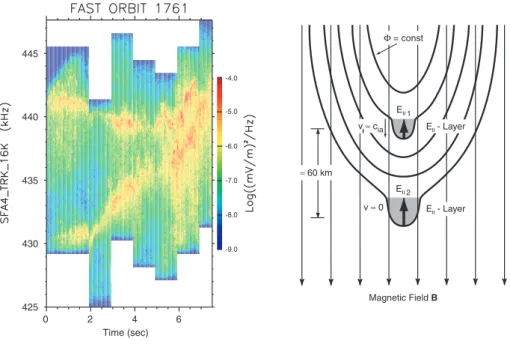
Fig. 1.Left: High time and frequency resolution recordings of AKR as obtained on 31 January 1997 by the FAST satellite above the auroral zone. Two narrow-band AKR emissions are visible at 430 kHz and 440 kHz, approaching each other within∼5 s. As these emissions are generated at the local electron gyrofrequency, the upper band corresponds to a source spatially located below the one of the lower band. The upper band is nearly stable until after 6 s, when the lower band approaches it and pushes it to higher frequencies. The two bands do not merge into one single band, suggesting that their polarities are repulsive. Right: A simple visualization of the presumable electric field structure where two field-aligned potential layers are sitting on one field line.
source region, has escaping frequency below the local non-relativistic cyclotron frequency. The most far reaching im-plication (Ergun et al., 2000) is that the electron-cyclotron maser mechanism is directly associated with charged particle acceleration in magnetic field-aligned potential drops. The AKR is generated in those regions where the parallel electric fields are located. Being a direct consequence of the paral-lel acceleration processes, the radiation contains fundamen-tal information on their characteristic spatial and temporal scales. In the remainder of this paper, we investigate these scales using the AKR fine structure observations of FAST as a tool for remote sensing of the acceleration region.
2 Observations
The AKR does not represent a continuous broad band emis-sion (Gurnett and Anderson, 1981). Instead, early high time-resolution wide band measurements by the ISEE 1 and 2 spacecraft, performed at large distance from the AKR source region, showed that the radiation consists of many discrete narrow band emissions. The center frequency of the individ-ual emissions often varies in a systematic manner, sweeping either upward or downward across the spectrum. The FAST observations allowed for a detailed study of the complex spectral structure of AKR. Pottelette et al. (2001) showed that the AKR emissions consist of a large number of fast drifting (what they called) “Elementary Radiation Events”. They interpreted these EREs as travelling electron holes. The
ERE structures are sometimes reflected or trapped in slower drifting larger scale structures. These latter structures have been interpreted as parallel electric field layers. Figure 1 shows an example of such narrow-band slowly-drifting fea-tures detected by the on-board wave-tracker instrumentation on FAST. The bandwidth of each tracker snapshot is 16 kHz, with 100 Hz resolution, and the time resolution-per-sweep amounts to 16 ms.
The tracker data on the left of Fig. 1 show two simulta-neous narrow-band slowly-drifting emission features at dif-ferent central frequencies. According to the theory of AKR generation (see e.g. Pritchett, 1984; Strangeway, 1985; Er-gun et al., 2000), these two emissions are excited at, or just beneath, the local electron gyrofrequencyωcein regions
425
420
415
6 8 10 12 14
-5.5
-6.8
-8.1
-9.4
-10.7
-12.1
Fig. 2.Spectral dynamics of a narrow emission band in auroral kilometric radiation. Though the emission band remains stable over the entire period of 9 s, its drift across the spectrum experiences severe changes in time. In the average the band is moving towards lower altitudes (increasing frequency) suggesting that the source is riding on the auroral electron beam in the upward current AKR source region. The average drift speed re-calculated into real space corresponds to the ion-acoustic velocity.
moved slowly upward in real space, as indicated by the de-crease in its central emission frequency. The rate of dede-crease is of the order of ∼1 kHz s−1, corresponding to a velocity of∼10 km s−1along the field. At the same time, the low-frequency feature that is located at the higher altitude moved downward in real space, as indicated by the increasing cen-tral speccen-tral emission frequency. Its speccen-tral frequency drift is about constant during this period and corresponds to the somewhat larger velocity of about∼40 km s−1. At the end
of the event, when the two features approach each other, they start moving together, though remaining mutually separated at a constant separation distance of∼3 kHz, corresponding to roughly a 15 km vertical distance. It is important to note that the two radiation sources do not merge. Instead, the low-frequency emission region that is approaching the higher fre-quency source from above obviously pushes the latter down the field line. These observations can be interpreted as the interaction of two parallel electric field layers of the same polarity, with the upper source region having a larger mo-mentum than the lower region.
Figure 2 shows another example related to the dynamics of such localized electric field structures. For the 9 s duration where the wave tracker could follow this event, the struc-ture is moving predominantly downward at a velocity rang-ing from∼10–80 km s−1 with the higher speed attained at larger altitudes. The displacement speed is highly variable in the present case, which indicates a considerable dynamics in the source region. The range of the velocities observed inhibits an easy identification of the emission-source
struc-ture with a particular wave mode excited in a Maxwellian plasma as a causative agent. However, it roughly matches the range of ion-acoustic waves for the parameters of the lower magnetospheric source region of AKR. Therefore, ten-tatively suggest that the slowly-drifting emission bands in the AKR may consist of nonlinear ion-acoustic features evolving under the local conditions that are met in the auroral plasma. The most probable of those features are ion-acoustic soli-tons (e.g. Buti, 1980; Reddy and Lakhina, 1991; Reddy et al., 1992) which may evolve into ion holes (e.g. Gray et al., 1991). The latter form during the nonlinear evolution of ion-acoustic waves in the presence of field-aligned currents and are a typical consequence of the nonlinear interaction of ion-acoustic waves with a diluted hot plasma.
Field-aligned currents have been proposed long ago by Kindel and Kennel (1971) as the free energy source of the ion-acoustic instability. Subsequent two-dimensional numer-ical simulations (e.g. Gray et al., 1991) indeed showed that current-generated ion-acoustic waves of high current drift speedvFAC> cia, well above the ion-acoustic
and have little tendency to form nonlinear structures, such as solitons. Since their electric fields are about perpendic-ular to the magnetic field, their effect on the electron com-ponent and, thus, on electron acceleration, should be small. It is probably reasonable to assume that they are not respon-sible for the presence of localized electric potential drops. On the other hand, ion-hole formation makes the threshold of ion-acoustic waves practically vanish, allowing for short parallel-wavelength ion-acoustic waves to be excited locally already at a very weak field-aligned current intensity. These appear as spatially localized electric fields, i.e. as ion holes that form on the cool plasma ion background: in our case, on the cool upward ion beam plasma. The holes survive for an extended time while moving into the warm electron background: in our case, the auroral horseshoe distribution. Lacking positively charged ions, the holes form a localized negative potential bump and are thus retarded by the current electrons. Interacting holes experience strong variations in their drift velocities. They even may reverse direction while maintaining their physical integrity. This is possible when the velocity change happens on a time scale faster than the decay time of the hole.
It must, however, be noted that Berman et al. (1985) were using an unrealistically low mass ratio of 4 (pointed out to us by the referee). Simulations with larger mass-ratios did indeed confirm the lowering of the threshold (Hudson et al., 1983) by the presence of holes. However, the initial evolution of the ion-acoustic waves still requires large ini-tial current drifts, in which case, according to linear theory, the EICW should dominate. In the case under considera-tion here, the downward current drift velocity is of the or-der of 10 000 km s−1, large enough, though still below the
thermal electron speed, to provide a susceptible growth to ion-acoustic waves, and probably fast enough to overcome the growth of EICW. These waves should, after a few ion plasma periods, readily enter the nonlinear regime, when they will non-resonantly evolve into solitons and ion holes, thereby further lowering the instability threshold. This evo-lution can be handled in terms of a two-component fluid the-ory (Berthomier et al., 1998). In the following section, we use this theory in order to investigate the properties of a well developed auroral electrostatic shock.
3 Inferred electrostatic shock properties
Large-amplitude density depletions of the ion-acoustic type can be excited in plasmas exhibiting two Maxwellian-electron populations, provided that the temperature ratio of the two electron populations is sufficiently high (Buti, 1980). The auroral plasma consists of a mixture of a minor cold (∼eV) electron component and of a predominant hot (∼keV) electron component. It can thus be expected that such type of nonlinear structures are likely to develop in the auroral plasma. Berthomier et al. (1998) have shown that for large velocity, the nonlinear ion-acoustic hole structures evolve into electric potential ramps, which are typical for so-called
Φ Ψ
M = 3.4
3.2 2.3
3.3 0.10
0.00
-0.10
-0.20
-0.30
-0.40
-20
-25 -15 -10 -5 0
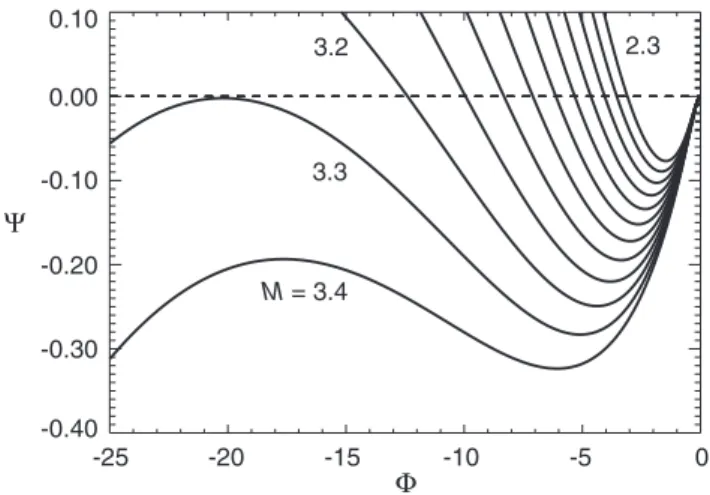
Fig. 3. The pseudo-potential9(8)as function of the normalized electrostatic potential8(φ). The calculation has been performed forn=nh/nc= 5,t≡th/tc=200, andti= 0.1. Solutions are only
for negative values9 <0 of9. Finite “discrete” (or “harmonic”) solutions are obtained in the range of Mach numbers correspond-ing to the localized minima in9. Those solutions are supersonic and correspond to solitary structures. Electrostatic shock solutions are possible close to the upper limit of the allowed Mach number, which, in this case, isMs≈3.3. Close toMsthe potential becomes
asymmetric, and a real field-aligned potential drop builds up across the structure.
electrostatic shocks with finite net potential drop across the structure. Such drops are needed for the acceleration of elec-trons and ions, and may just constitute the observed field-aligned drifting potential features. In the following, based on the above theoretical approach and observations, we estimate the order of magnitude of the amplitude of such electrostatic shocks for the particular case of our observations.
Let us consider a collisionless plasma consisting of a sin-gle cool ion component and two thermal electron popula-tions. The cold electron population, which has a temperature of a few eV, typical for the ionospheric electron population, is assumed to be highly dilute, while the predominant hot ∼keV-temperature electron component represents the precip-itating plasma-sheet horseshoe electrons. Each electron pop-ulation is assumed to be in equilibrium in the electrostatic potentialφ. The electron densities of the cold and hot com-ponents, nc andnh, obey the Boltzmann relation, with the
respective temperaturesTcandTh.
We define the normalized potential8 =eφ/ kBTeff, the
normalized electron temperatures tch = Tch/Teff, where
Teff=TcTh/[(nc/n0)Th+(nh/n0)Tc]is the efficient
temper-ature corresponding to the ion-acoustic speedceff, excited in
such a plasma, andn0=nc+nhis the total electron density.
The normalized fluid equations can be reduced to
∂ni
∂t + ∂(nivi)
∂x =0 (1)
∂vi
∂t +vi ∂vi
∂x = − ∂8
∂x −3tini ∂ni
∂28
∂x2 =nc+nh−ni, (3)
where we normalized the densities ton0, lengths to the
ef-fective Debye lengthλD,eff, velocities to the effective
ion-acoustic speedceff =√kBTeff/mi, and temperatures toTeff.
The time is taken in units of the inverse ion plasma frequency
ωpi. Furthermore, we assume that the ion population
re-sponds adiabatically. We are looking for waves travelling along the magnetic field directionx, and transforming to the moving systemx→x−Mt, whereM=V0/ceffis the Mach
number of the stationary wave structure, andV0its velocity.
In the stationary case, the one-dimensional set of the above equations is reduced to
1 2
d8
dx
2
+9(8)=0. (4) This equation is similar to that of an imaginary particle with position8and velocity d8/dx moving in the so-called Sagdeev pseudo-potential9and has been solved analytically (Berthomier et al., 1998). The pseudo-potential9is given by
9(8)=tc
nc0
n0
1−exp8
tc
+th
nh0
n0
1−88 th
−3tiM6 14√
θ−pθ0−
1 3
p
θ3−qθ3 0
(5) andθis defined by
lnθ =cosh−1 "
M2+3ti−28
√ 12tiM
#
(6)
withθ0=θ (8=0).
The result of the numerical solution of the above equation is illustrated in Fig. 3 for the parameter setn=nh/nc= 5,
t≡th/tc= 200, andti= 0.1, where only negative values of9
have to be considered. Figure 3 shows that the amplitude8
of ion-acoustic solitary structures is an increasing function of the Mach numberM. Sufficiently far below the critical “shock” Mach numberMs≈3.3, electrically neutral solitary
structures are excited, lacking a net potential drop across the soliton,1φ =0, even though the solitons are very different in structure from the ordinary Korteweg-deVries or nonlinear Schr¨odinger-like solitons. The symmetry of the solitons be-lowM = Ms proves that there exist no electrostatic shock
solutions.
Electrostatic shock structures with1φ6=0 occur for Mach numbers close toMs=3.3 and8∼ −20, when the
pseudo-potential9-curve becomes tangent to the abscissa axis. The selected threshold value for shocks corresponds tokBTc=
5 eV,kBTh=1 keV, and an effective temperature ofkBTeff=
30 eV, which gives an ion-acoustic speedceff=50 km s−1and
a density ration=nh/n0=85%. These are values that are
typically met at the base level of the acceleration regions in the auroral magnetosphere (Pottelette et al., 1999).
Shock structures generated for 8= -20, granted that
kBTeff =30 eV, correspond to a moderate electric-potential
drop ofφ≈ 600 V. This estimate of half a kV potential drop
across the electrostatic shock gives a relatively large value for the elementary potential drop supported by one such lo-calized shock structure. This potential drop is, however, still too small for generating the observed parallel acceleration of auroral electrons, which, in many cases, may reach values of 10 keV. The observations do, however, show that, in most cases, not one single electric field layer evolves in the auroral magnetosphere. Instead, several such layers can be expected to be the rule. Evidence for their existence can be drawn from the observation of several simultaneous emission bands in the AKR at different central frequencies, as is found, for instance, from the observations in Fig. 1. The potentials of these layers along a magnetic field will add up to produce the energetic electrons in the energy range observed in the auroral magnetosphere.
One may then conclude that energetic electrons are pro-duced by electric potential drops resulting from the spatial arrangement along one auroral flux tube of several micro-scopic electrostatic shock structures of the kind mentioned in this paper, when their potential drops add up along the field line over meso-scale distances. In order to estimate the number of such electrostatic shocks required to explain the observed acceleration of1E∼few keV, we need to estimate the spatial widthws of one of the electrostatic shocks. This
can be done with the help of Eq. (4), which for an estimate can be rewritten forwsas
ws ≈ |18|/(2h|9(8)|i)
1
2, (7)
holding for the curve corresponding to the shock Mach num-ber Ms. The angular brackets indicate averaging over 8.
From Fig. 3, we have18 ≈-20,h9i ≈-0.15. These val-ues yield roughlyws ≈50λD,eff for the width of the shock
transition. For the conditions of Fig. 2, the input values are
fpe= 10 kHz for the plasma frequency,kBTeff= 30 eV for the
temperature, and thusλD,eff≈35 m, yielding a shock width
of ws ≈2 km, and an electric field of ∼300 mV m−1, in
excellent agreement with the observational conclusion from Fig. 2 that the shock thickness should be at most a few km wide. In our previous paper (Pottelette et al., 2001), we esti-mated the distance between any two such electrostatic shocks along the magnetic field to amount to some∼10–100 km.
will contribute to the potential ladder along the flux tube. If each of them contributes half a kV potential drop, this will readily explain that typical acceleration energies fall into the interval between several 100 eV and several keV. Therefore, it is not difficult to generate a total field-aligned potential drop of several keV as required by the observations of the particle acceleration, by hosting a small number of meso-scale elec-trostatic shocks along an auroral magnetic flux tube over a distance of a few 1000 km.
4 Conclusions
Within the fluid approach of our model calculation, we have estimated the meso-scale electrostatic-shock amplitude that can be reached in the nonlinear evolution of an ion-acoustic wave that is excited in the two-electron component auroral plasma with the minor (ionospheric) cold (few eV) compo-nent and the dominant hot (few keV) compocompo-nent. The veloc-ity of these structures is several timesceff and depends
sen-sitively on the respective density and temperature of the two electron populations. This dependence may explain the high variability of the speed of such structures, as derived from the measurement of the spectral frequency drifts observed in the AKR fine structure. Such a type of nonlinear structure is likely to develop on a field-aligned scale of several tens of effective Debye lengths.
The estimated amplitude of the meso-scale electrostatic shock associated with one localized nonlinear structure may be moderately large (corresponding to a few 100 eV). In or-der to accelerate auroral electrons up to the observed energies of∼10 keV a limited number of such electrostatic potential-drop or electric-field layers located along one single auroral flux tube would be required.
Acknowledgement. We thank the referees for their constructive comments and improving suggestions. The FAST mission is a project of the Space Sciences Laboratory of the University of Cali-fornia at Berkeley run under the auspices of NASA. The authors are indebted to C. W. Carlson and R. E. Ergun for providing the particle and wave data as well as for some useful discussions. This research has been initiated within the France-Berkeley Program. Work of R.T. has been performed at ISSI, Bern. He thanks the directors of ISSI, J. Geiss, G. Paschmann, and R. von Steiger for their hospi-tality, and the ISSI staff for providing an excellent research atmo-sphere. Part of the work was supported by the PROCOPE coopera-tion under contract numbers D/9822921 and F/99057.
References
Berthomier, M., Pottelette, R., and Malingre, M.: Solitary waves and weak double layers in the two-electron-temperature auroral plasma, J. Geophys. Res., 103, 4261, 1998.
Berman, R. H., Tetreault, D. J., and Dupree, T. H.: Simulation of phase space density hole growth and the development of inter-mittent plasma turbulence, Phys. Fluids, 28, 155, 1985.
Buti, B.: Ion acoustic holes in a two temperature plasma, Phys. Lett. A, 76, 251, 1980.
Carlson, C. W., Pfaff, R. F., and Watzin, J. G.: The FAST Auroral SnapshoT (FAST) mission, Geophys. Res. Lett., 25, 2013, 1998. Ergun, R. E., Carlson, C. W., McFadden, J. P., Mozer, F. S., De-lory, G. T., Peria, W., Chaston, C. C., Temerin, M., Elphic, R., Strangeway, R., Pfaff, R., Cattell, C. A., Klumpar, D., Shel-ley, E., Peterson, W., Moebius, E., and Kistler, L.: FAST satel-lite observations of large amplitude solitary structures, Geo-phys. Res. Lett., 25, 2061, 1998.
Ergun, R. E., Carlson, C. W., McFadden, J. P., Delory, G. T., Strangeway, R. J., and Pritchett, P. L.: Electron-cyclotron maser driven by charged-particle acceleration from quasi-static magnetic-field-aligned potentials, Astrophys. J., 538, 456, 2000. Gray, P. C., Hudson, M. K., Bergmann, R., and Roth, I.: De-cay of ion beam driven acoustic waves into ion holes, Geo-phys. Res. Lett., 18, 1675, 1991.
Gurnett, D. A. and Anderson, R. R.: The kilometric radio emis-sion spectrum: relationship to auroral acceleration processes, in Physics of auroral arc formation, Eds. Akasofu, S.-I. and Kan, J. R., AGU, Washington, D.C., Geophys. Monogr. 25, 341, 1981. Hudson, M. K., Lotko, W., Roth, I., and Witt, E.: Solitary waves and double layers on auroral field lines, J. Geophys. Res., 88, 916, 1983.
Kindel, J. M. and Kennel, C. F.: Topside current instabilities, J. Geophys. Res., 76, 3055, 1971.
Pottelette, R., Ergun, R. E., Treumann, R. A., Berthomier, M., Carl-son, C., McFadden, J. P., and Roth, I.: Modulated electron acous-tic waves in auroral density cavities: FAST Observations, Geo-phys. Res. Lett., 26, 2629, 1999.
Pottelette, R., Treumann, R. A., and Berthomier, M.: Auro-ral Plasma Turbulence and the cause of AKR fine structure, J. Geophys. Res., 106, 8465, 2001.
Pritchett, P. L.: Relativistic dispersion, the cyclotron maser instabil-ity, and auroral kilometric radiation, J. Geophys. Res., 89, 8957, 1984.
Pritchett, P. L., Strangeway, R. J., Carlson, C. W., Ergun, R. E., McFadden, J. P., and Delory, G. T.: Free energy source and frequency bandwidth for the auroral kilometric radiation, J. Geophys. Res., 104, 10 326, 1999.
Reddy, R. V. and Lakhina, G. S.: Ion acoustic double layers and solitons in auroral plasma, Planet. Space Sci., 39, 1343, 1991. Reddy, R. V., Lakhina, G. S., and Verheest, F.: Ion-acoustic
dou-ble layers and solitons in multispecies auroral beam-plasmas, Planet. Space Sci., 40, 1055, 1992.
Strangeway, R. J.: Wave dispersion and ray propagation in a weakly relativistic, nonequilibrium plasma: Implications for the genera-tion of auroral kilometric radiagenera-tion, J. Geophys. Res., 90, 9675, 1985.